Persona
Plotino
Traducción automática. Lea el original en inglés.
Filósofo del siglo III n. e., central para el neoplatonismo, cuyos tratados se reunieron como las Enéadas.
Última revisión:
Texto
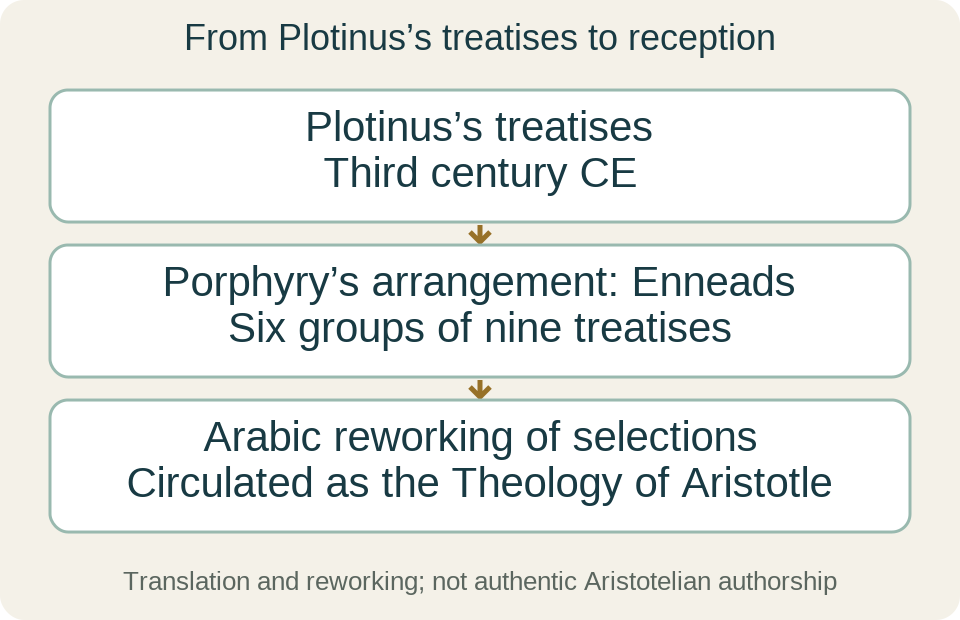
Plotino (hacia 204–270 n. e.) fue un filósofo neoplatónicoNeoplatonismoModern name for Platonic currents flourishing from the third century CE, including Plotinus, Porphyry, Iamblichus and Proclus. They examined the first principle, Intellect, Soul and the world, while disagreeing over interpretation and practice.Glosario · Pulse para leer la explicación central. Su discípulo Porfirio ordenó sus tratados en seis grupos de nueve, las Enéadas. Partes de su obra llegaron más tarde al árabe, en una reelaboración atribuida a Aristóteles, una transmisión varios siglos posterior a Filón.[1][2]
Referencias y notas
- Plotinus, Stanford Encyclopedia of Philosophy. Introduction, life and writings; Arabic transmission documented in the study’s Greek Sources reference. Volver al texto ↑
- Cristina D’Ancona, Greek Sources in Arabic and Islamic Philosophy, Stanford Encyclopedia of Philosophy, revised 23 March 2026 Introduction and selected sections 1–3; Syriac background, translations and Theology of Aristotle. Volver al texto ↑
Proponer una corrección · Proponga una fuente para este registro
Citar este registro
IL Archive, «Plotino», https://ilarchive.com/es/people/plotinus-philosopher
Seguir leyendo