Persona
Takayoshi Oshima
Takayoshi Oshima is an Assyriologist studying Babylonian literature and religion and their connections with the Hebrew Bible.
Variantes del nombre: Takayoshi Oshima
Contexto y fuentes →Una herramienta de lectura
Definiciones breves de nombres, conceptos y lugares. Abra un registro para leer su contexto, sus fuentes y los materiales relacionados.
1047 definiciones
Persona
Takayoshi Oshima is an Assyriologist studying Babylonian literature and religion and their connections with the Hebrew Bible.
Variantes del nombre: Takayoshi Oshima
Contexto y fuentes →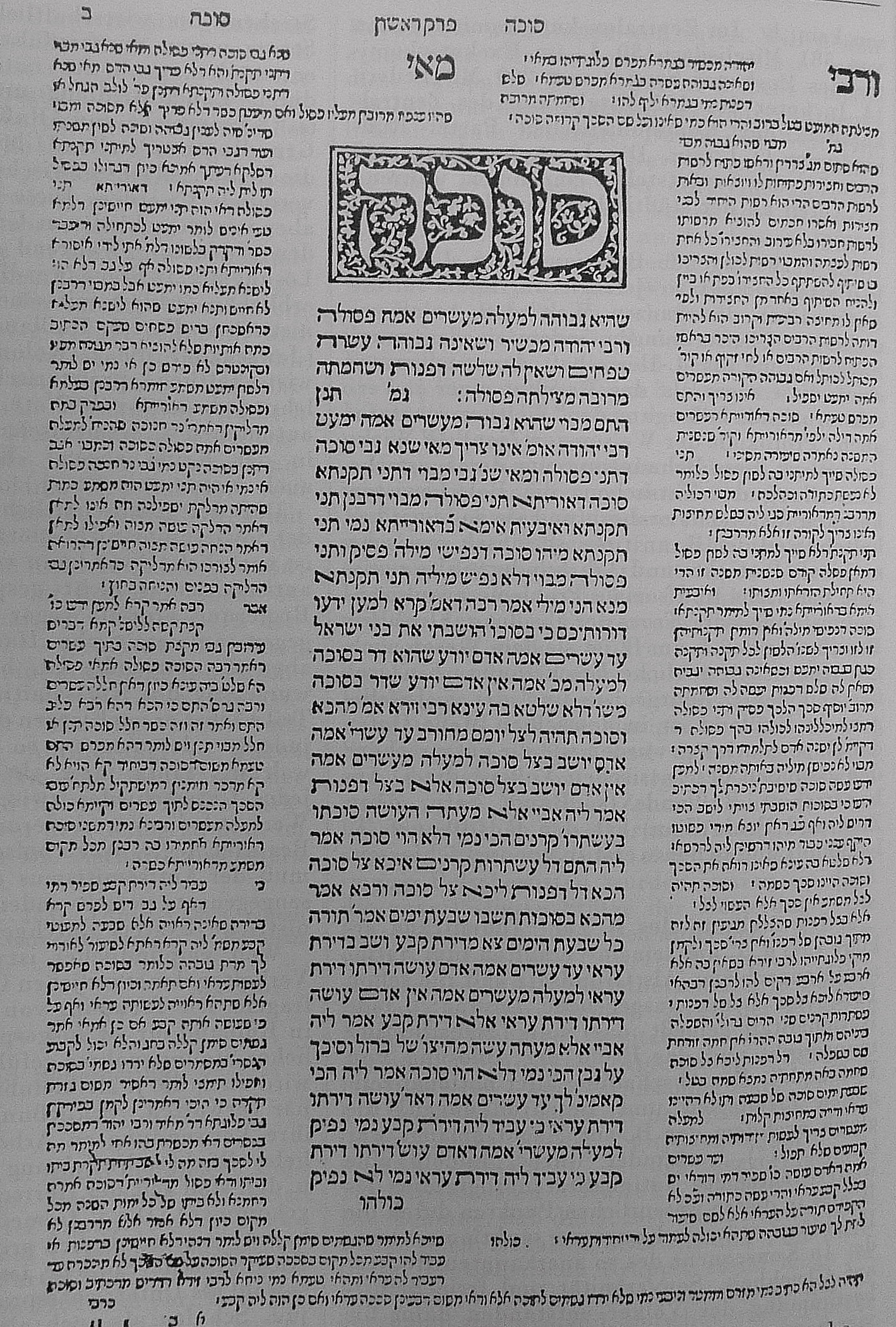
A page from Daniel Bomberg's Babylonian Talmud, printed in Venice between 1525 and 1539, photographed by Warburg. This page is from Sukkah, not Gittin 68, and the edition postdates the Talmud's composition. Public domain
Texto antiguo
A large rabbinic compilation in Hebrew and Aramaic, formed in Mesopotamia through stages; its final redaction remains debated.
Variantes del nombre: Babylonian Talmud, Bavli
Contexto y fuentes →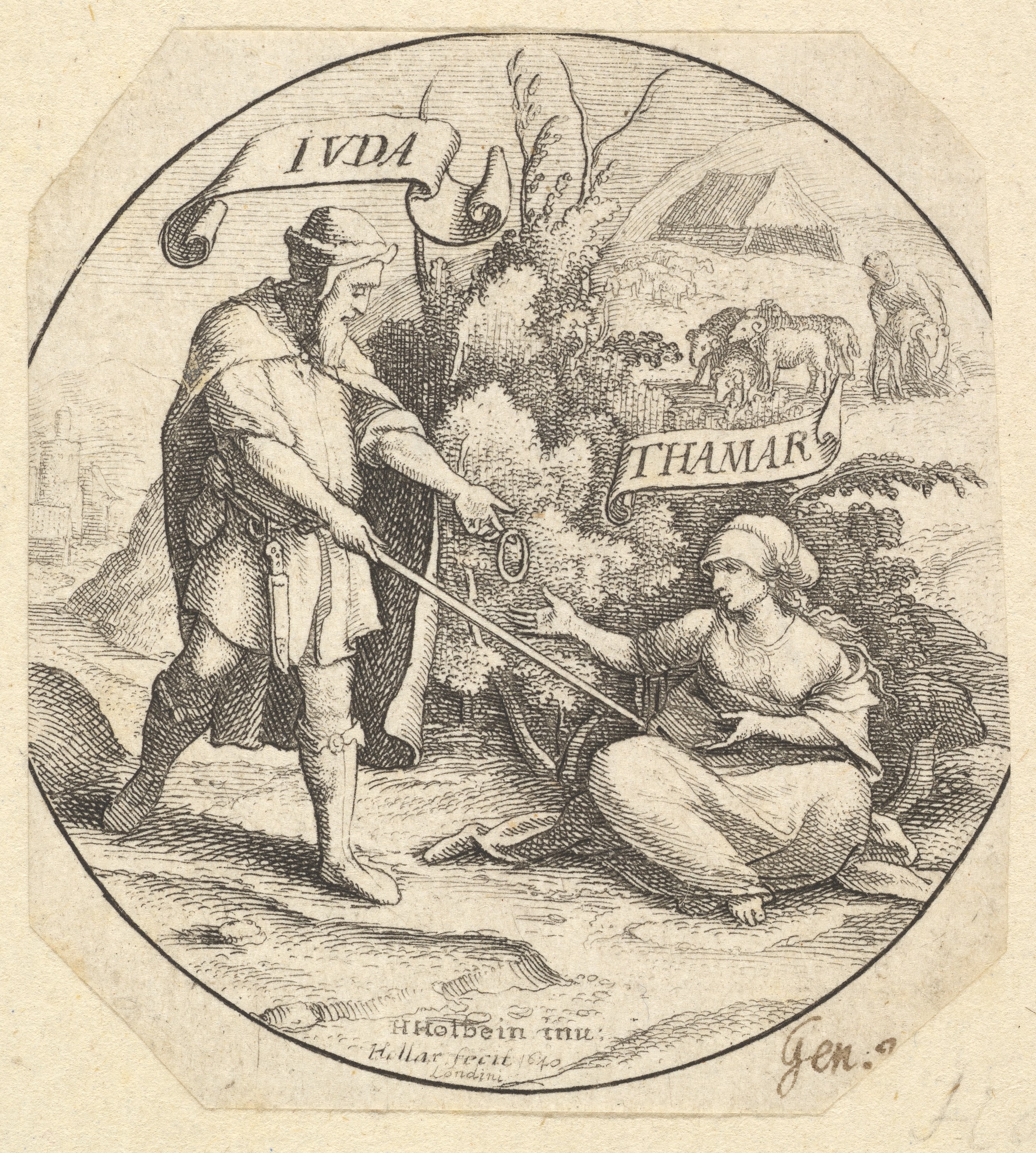
Judah and Tamar, etching by Wenceslaus Hollar, 1640, after Hans Holbein the Younger; Met 51.501.2142. Later reception of Genesis 38, not historical portraits or a marriage document
Persona
Genesis 38 widow who exposes Judah’s unfulfilled promise concerning Shelah.
Variantes del nombre: Tamar in Genesis 38
Contexto y fuentes →
Contemporary AI-generated expressive cover: a bird bearing a letter before an imaginary court, evoking Targum Sheni’s Solomon–Sheba digression; not an ancient artefact or documented event
Entidad
An Aramaic translation and expansion of Esther containing an excursus on Solomon and the Queen of Sheba.
Variantes del nombre: Targum Sheni of Esther
Contexto y fuentes →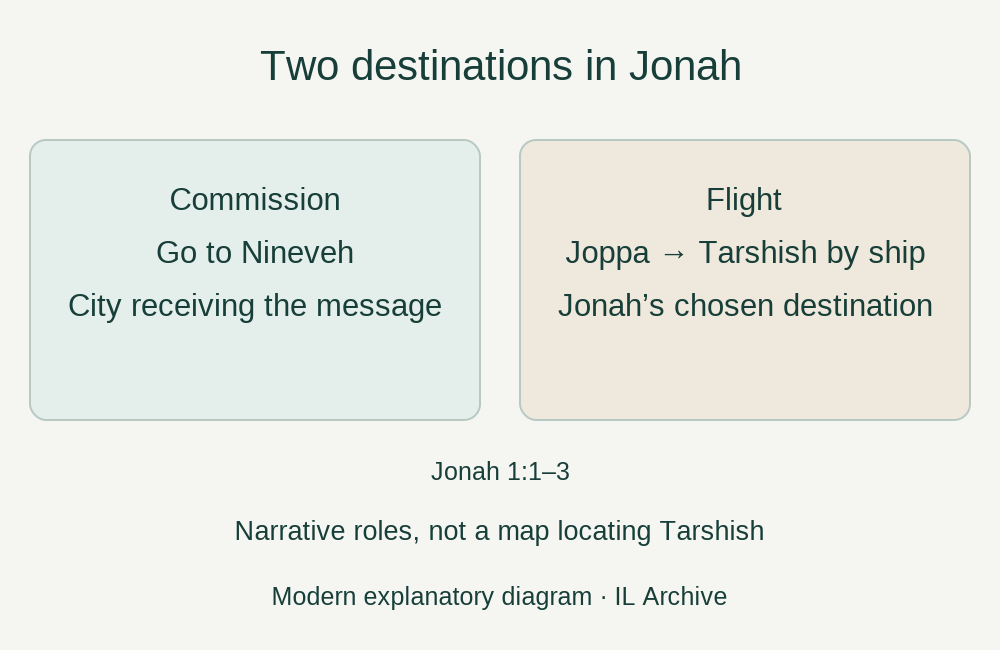
The commission toward Nineveh and flight through Joppa toward Tarshish in Jonah1:1–3. Modern narrative diagram, not a geographical identification of Tarshish or established sailing route
Yacimiento
A maritime destination in Jonah 1:3; locating it geographically differs from identifying its clear role as the destination of flight.
Variantes del nombre: Tarshish in Jonah’s voyage
Contexto y fuentes →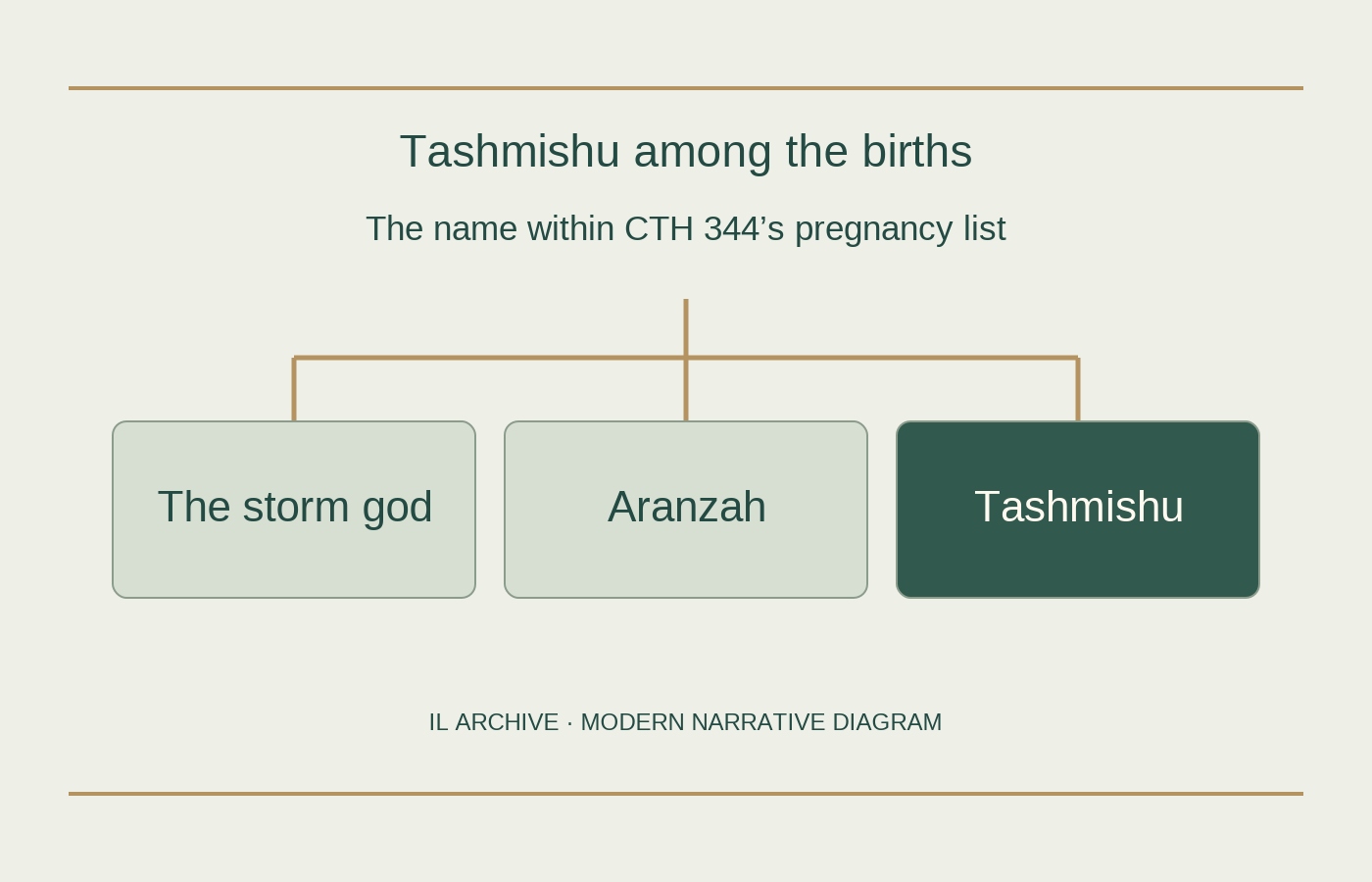
Modern diagram highlighting Tashmishu among the figures in Kumarbi’s pregnancy account. It preserves the multiple names without supplying a complete biography or imagined portrait
Entidad
Divine figure named in Kumarbi’s pregnancy with the storm god and the river Aranzah.
Variantes del nombre: Tashmishu, Tašmišu
Contexto y fuentes →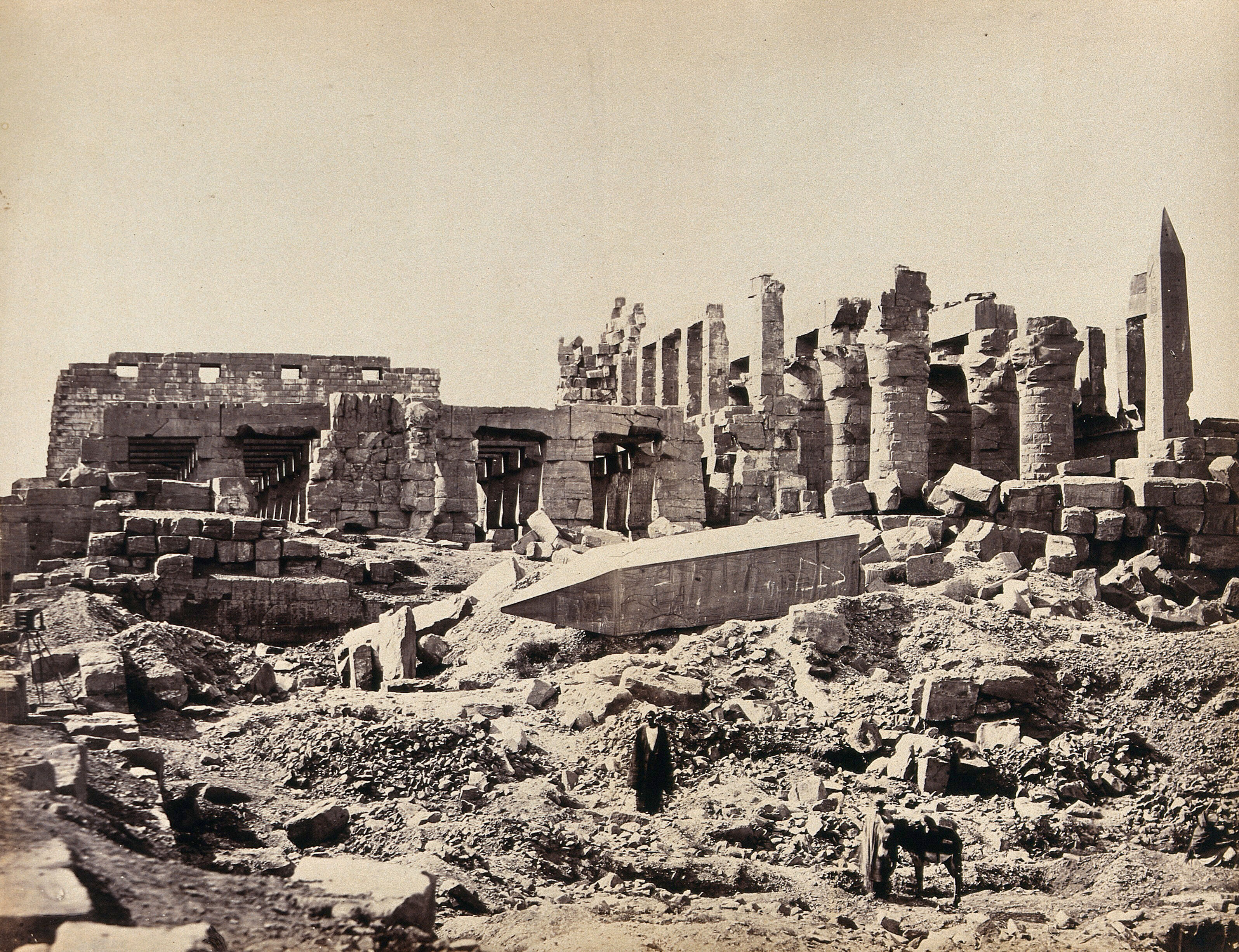
Karnak temple in the Thebes/Luxor area from the southeast, photograph by Francis Frith, about 1858, Wellcome Collection 568207i. Actual nineteenth-century view, not a reconstruction of Amenemope’s Thebes or the findspot of 26.3.165
Yacimiento
Thebes, Egyptian Waset, was an ancient Egyptian city in the area of modern Luxor, with monuments on both banks of the Nile.
Variantes del nombre: Thebes, Egypt
Contexto y fuentes →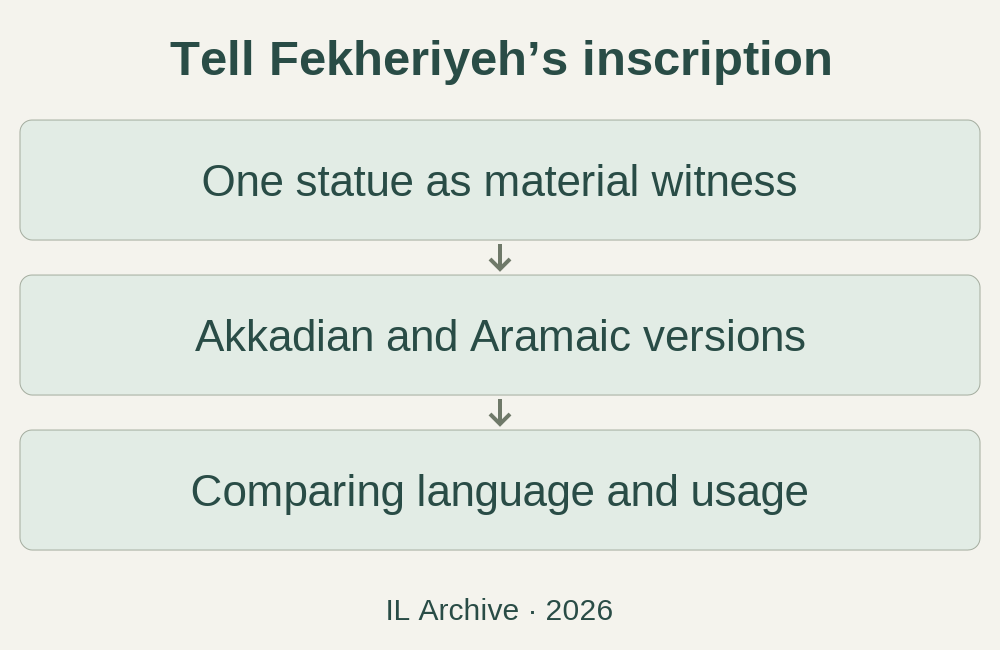
Modern witness-specific explanatory diagram of a sequence or linguistic relationship, not a portrait or fabricated artifact
Yacimiento
Syrian site where a statue with Akkadian and Aramaic inscriptions, usually dated to the ninth century BCE, was found in 1979.
Variantes del nombre: Tell Fekheriyeh, bilingual inscription site
Contexto y fuentes →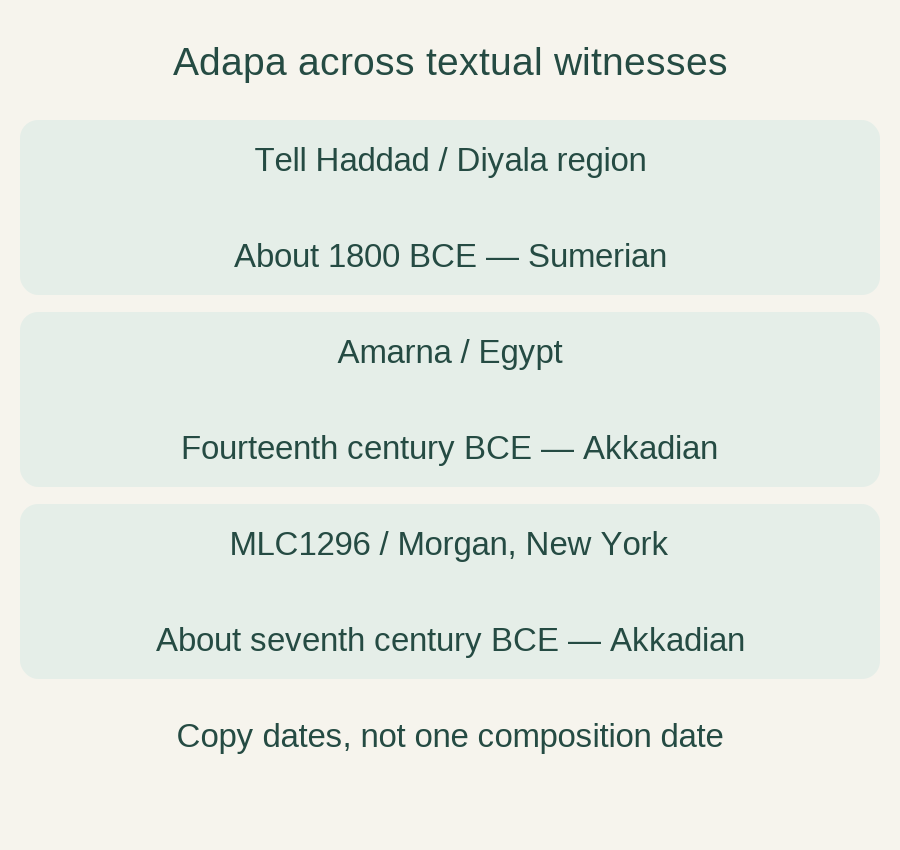
Modern comparison of witness dates and languages; not a view of Tell Haddad or a proven route of transmission
Yacimiento
Tell Haddad is an archaeological site in Iraq’s Diyala region, associated with Tell al-Sib as ancient Me-Turan; it yielded a Sumerian Adapa witness.
Variantes del nombre: Tell Haddad, Me-Turan
Contexto y fuentes →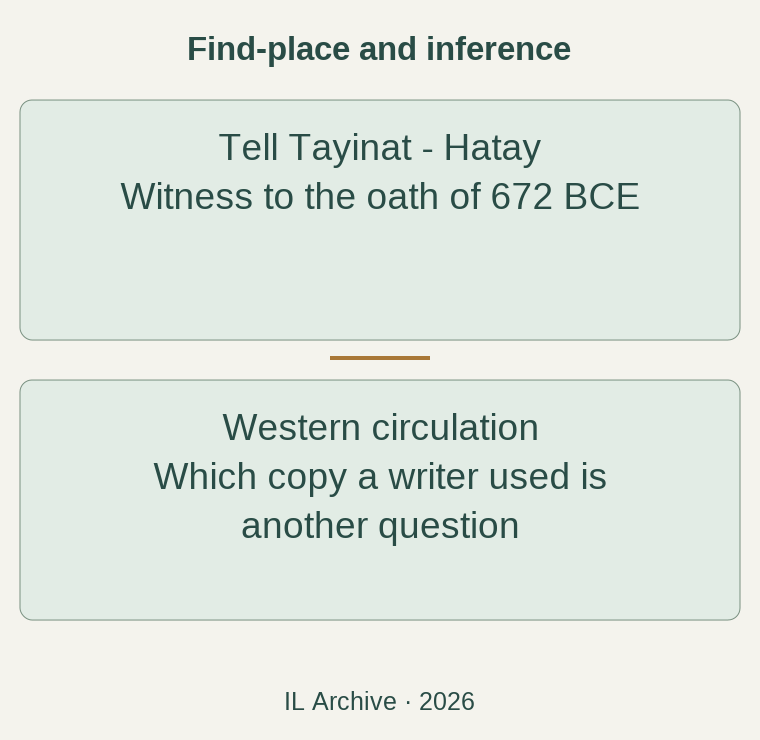
Modern diagram explaining the specified relationship in the witness; not an ancient tablet or portrait, or a boundary map
Yacimiento
Site in Hatay, present-day Turkey, yielding a copy of Esarhaddon’s succession oath of 672 BCE.
Variantes del nombre: Tell Tayinat
Contexto y fuentes →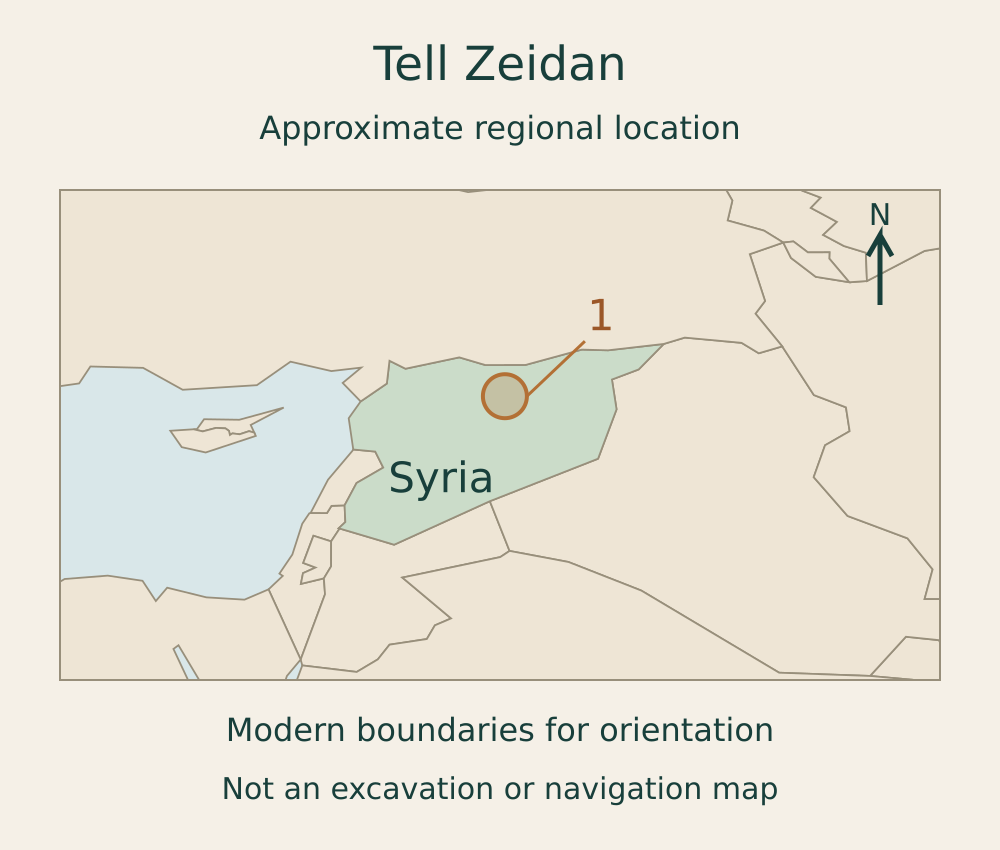
Modern regional locator: ring 1 indicates the approximate area of Tell Zeidan, not surveyed excavation coordinates. Modern boundaries do not represent an ancient community’s territory
Yacimiento
Archaeological site near Raqqa in northern Syria, with Ubaid occupation and burials from several periods.
Variantes del nombre: Tell Zeidan
Contexto y fuentes →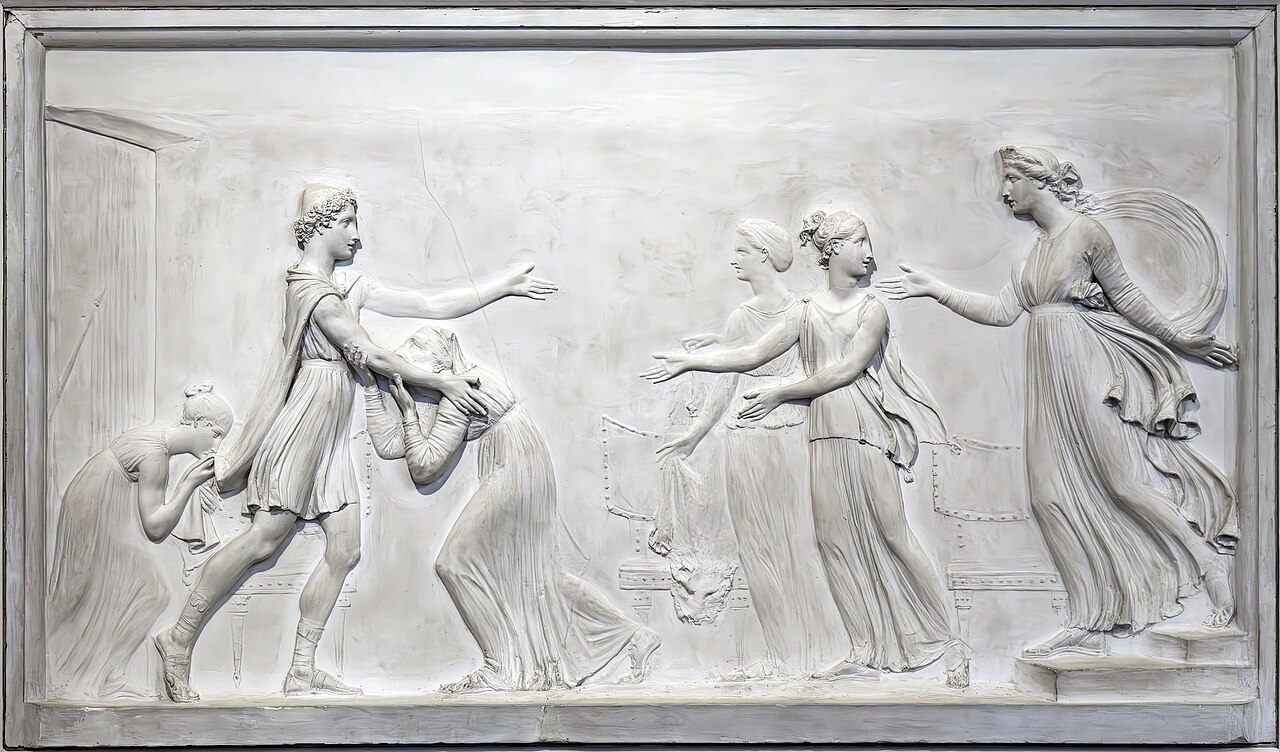
Telemachus returning to Ithaca in a plaster relief by Antonio Canova, late eighteenth century; Museo Correr, Venice. A modern work revisiting the ancient story, rather than an artifact from Homer’s era
Persona
Odysseus’s son in the Odyssey, whose position at home is affected by his father’s absence and family crisis.
Variantes del nombre: Telemachus
Contexto y fuentes →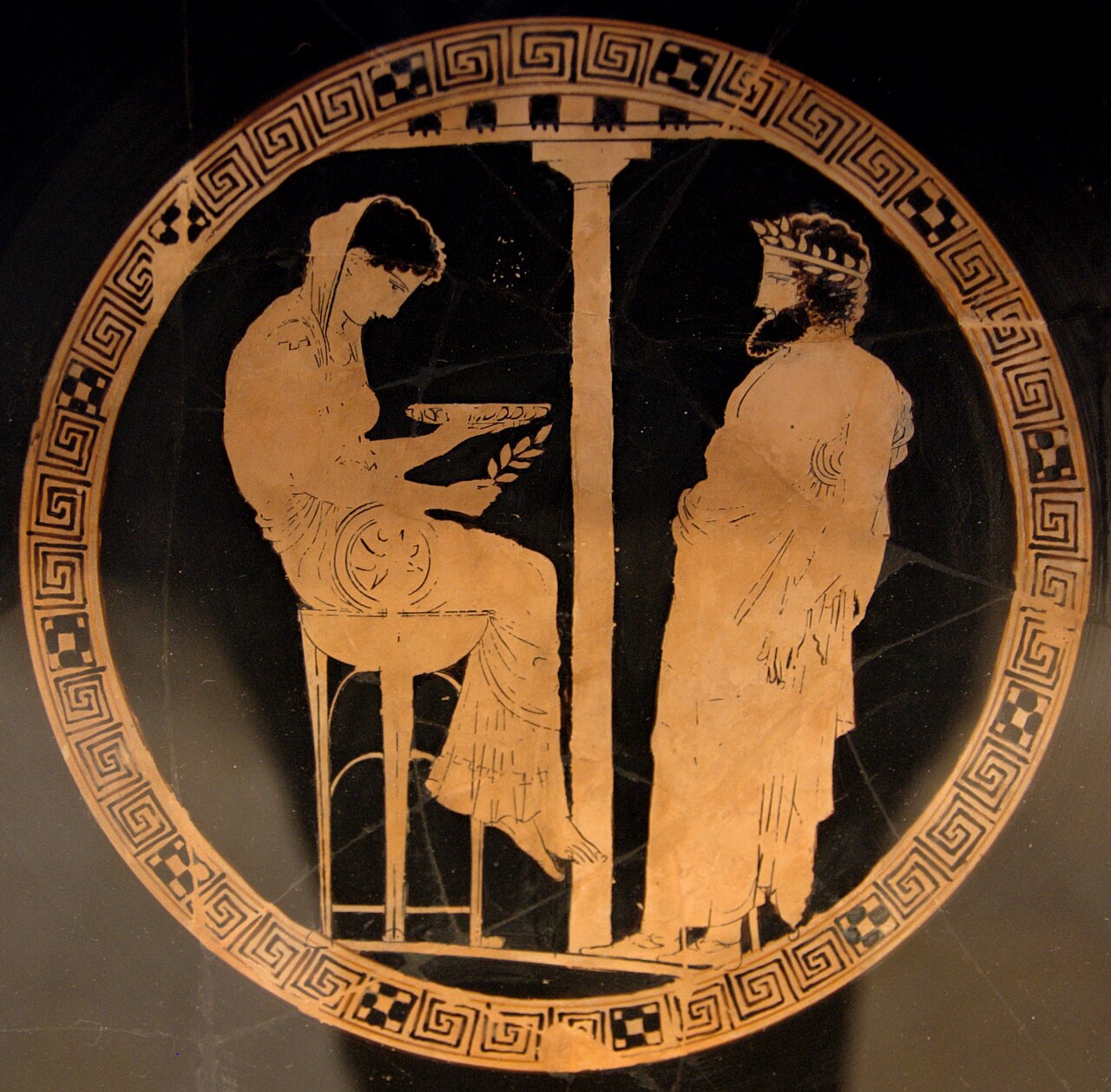
Themis and Aegeus inside an Attic cup, about 440–430 BCE; Berlin Antikensammlung F 2538. A photograph of the ancient vessel, rather than a modern redrawing
Entidad
Greek goddess instructed in the Iliad to gather the gods for a meeting with Zeus.
Variantes del nombre: Themis
Contexto y fuentes →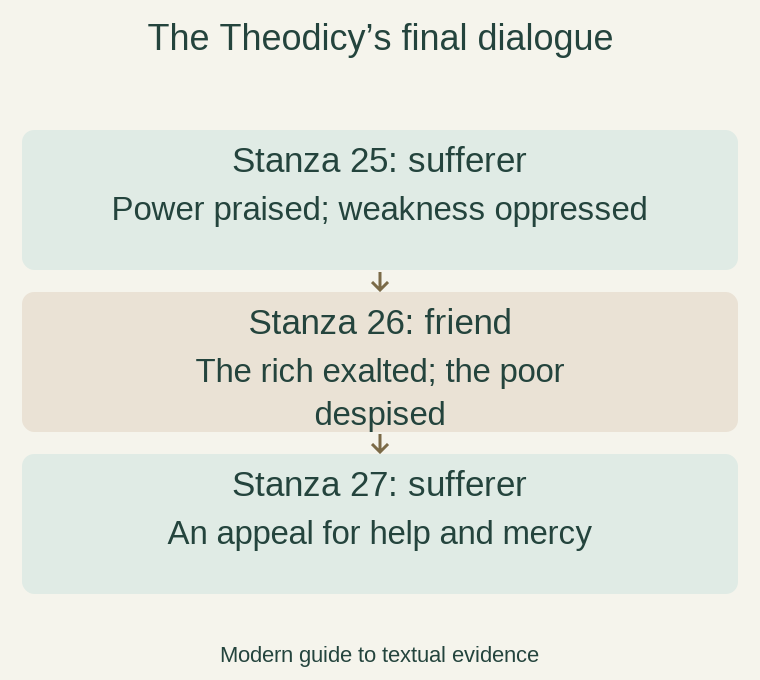
Modern diagram of stanzas 25–27: complaint about injustice, the friend’s account of rich and poor, then an appeal for mercy. It traces the voices without deciding which speaker wins
Texto antiguo
The Babylonian Theodicy is an Akkadian poetic dialogue between a sufferer and a friend about worship, injustice and divine justice.
Variantes del nombre: Babylonian Theodicy
Contexto y fuentes →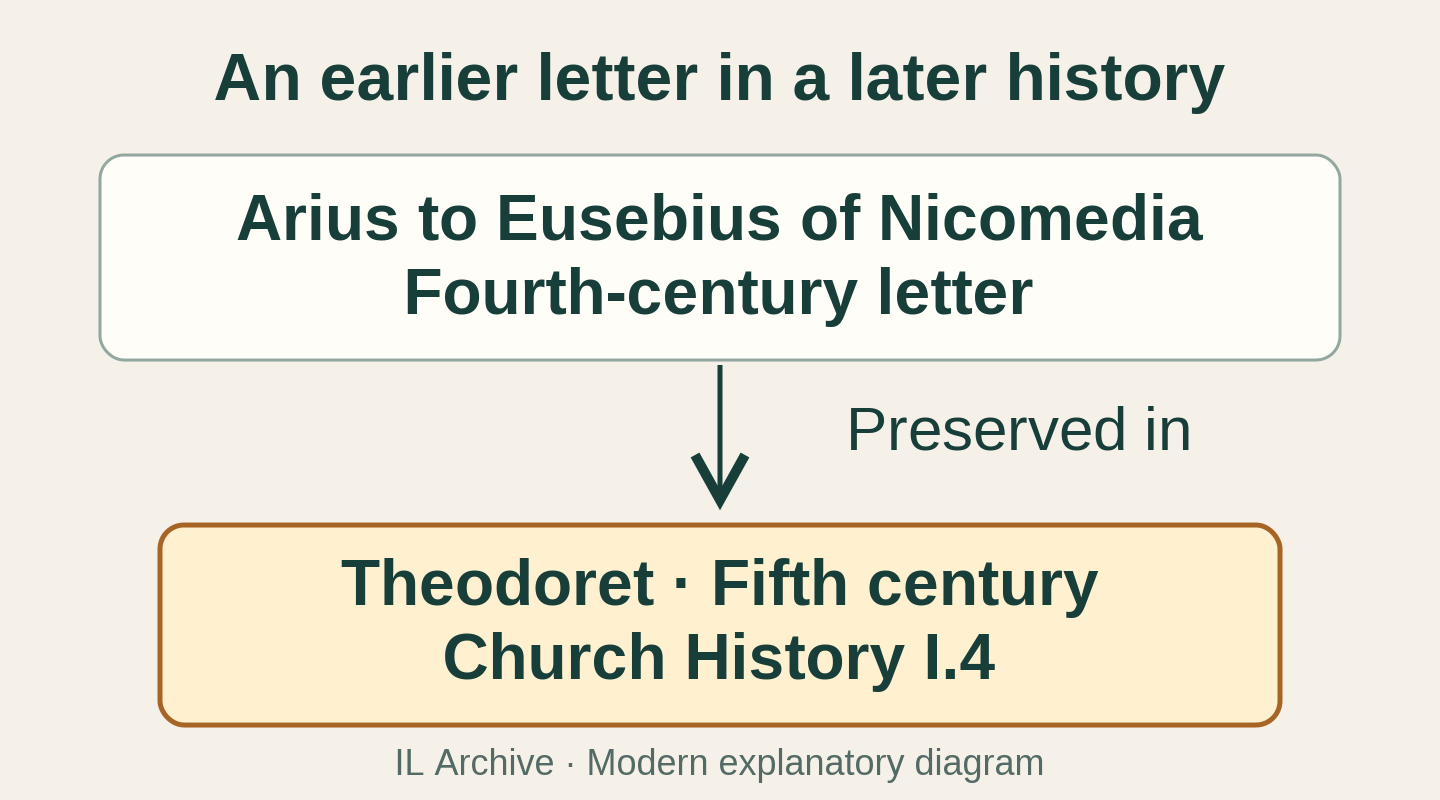
Modern diagram highlighting Theodoret’s fifth-century role in preserving an earlier fourth-century letter. The arrow separates the letter’s date from the history preserving it; it does not make the historian an eyewitness to its composition
Persona
Fifth-century bishop and church historian preserving letters from fourth-century disputes.
Variantes del nombre: Theodoret of Cyrrhus, Theodoret
Contexto y fuentes →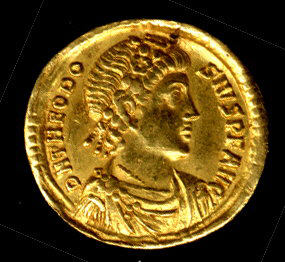
Gold solidus of Theodosius I, 379–395 CE, made in Constantinople, The Met 99.35.103. Photograph of the coin’s obverse at limited native resolution; the dates concern the object, not capture
Persona
Roman emperor in 379–395 CE, during whose reign Constantinople met in 381.
Variantes del nombre: Theodosius I
Contexto y fuentes →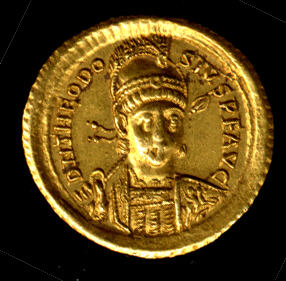
Gold solidus of Theodosius II, dated to his reign (408–450 CE), Met 04.2.819. Evidence for the emperor named in the story, not for the cave's events. Public Domain
Persona
Eastern Roman emperor of 408–450 CE; the Sleepers narratives place their awakening in his reign.
Variantes del nombre: Theodosius II
Contexto y fuentes →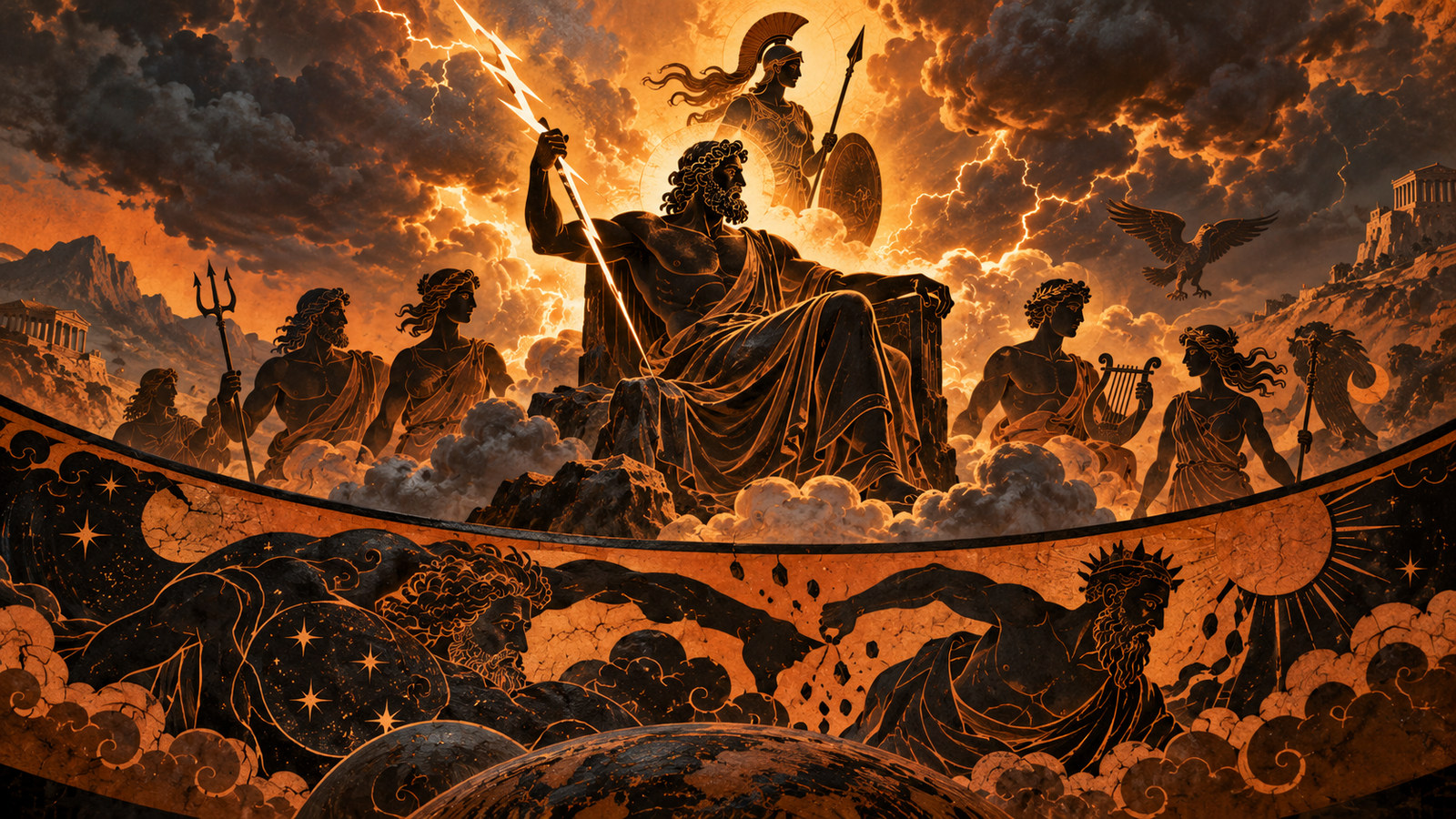
Contemporary imaginative illustration of divine generations in the Theogony, with Zeus at the center of a symbolic scene. It is not a photograph of ancient pottery or a documented reconstruction of the gods
Texto antiguo
Greek poem on divine generations and Zeus’s kingship; its surviving form does not identify all of Hesiod’s sources.
Variantes del nombre: Theogony, Hesiod’s Theogony
Contexto y fuentes →
Modern digitally generated symbolic cover: light beyond an imaginary architectural opening evokes the limits of description. Not an artifact, historical site or depiction of God
Entidad
An approach to divine language that denies limitations or defects and may emphasize the failure of human categories to capture divine essence; its forms vary across traditions.
Variantes del nombre: Negative theology, apophatic theology, apophasis
Contexto y fuentes →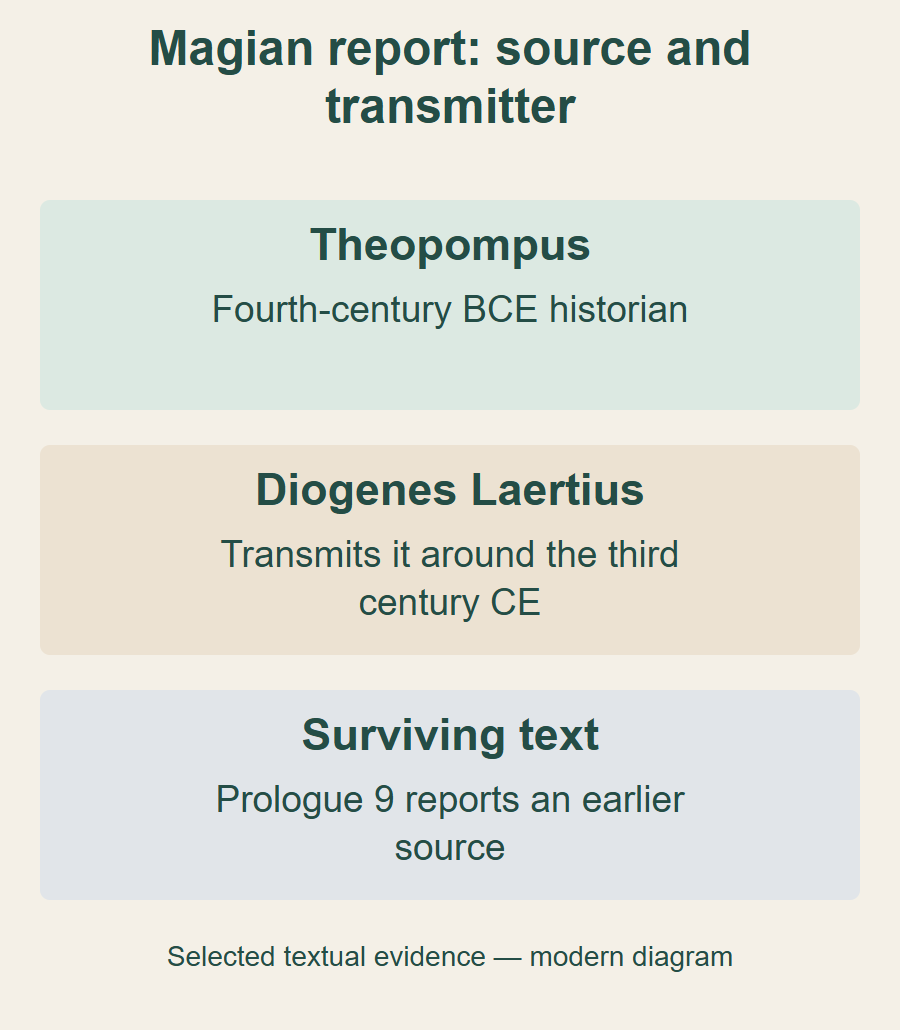
Modern chart of the report: fourth-century BCE Theopompus, then Diogenes Laertius around the third century CE, then the transmitted text. Source and transmitter dates distinguished; not an ancient manuscript
Persona
Theopompus of Chios was a fourth-century BCE Greek historian.
Variantes del nombre: Theopompus of Chios
Contexto y fuentes →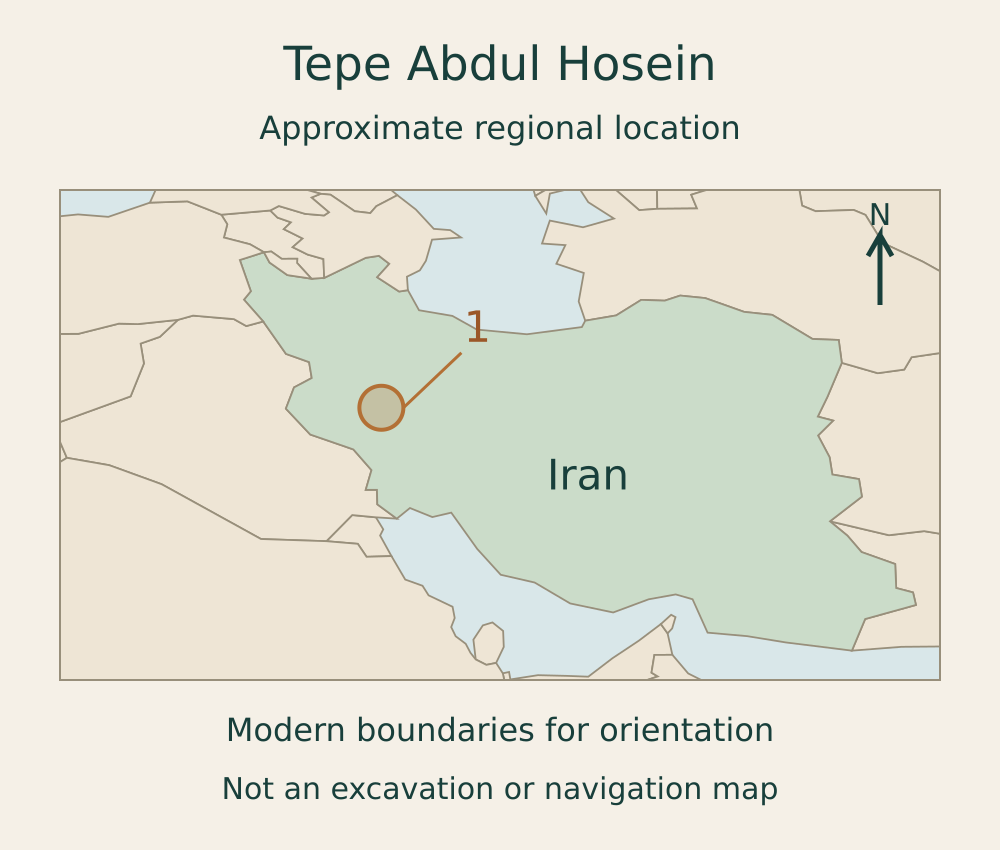
Modern regional locator: ring 1 indicates the approximate area of Tepe Abdul Hosein, not surveyed excavation coordinates. Modern boundaries do not represent an ancient community’s territory
Yacimiento
Neolithic site in western Iran’s Zagros whose human remains have been studied for early cranial modification.
Variantes del nombre: Tepe Abdul Hosein
Contexto y fuentes →
Modern digitally drawn editorial cover made for this entry: Tertullian’s name and Latin terms from his arguments with abstract writing motifs. Neither a portrait nor a historical manuscript or artifact
Persona
Latin Christian writer in Carthage around 200 CE. His writings span apology, doctrinal controversy, and religious practice. This entry examines his language of soul, Christ’s flesh, Word, and spirit alongside the limits of biography, textual chronology, and disputed affiliations.
Variantes del nombre: Tertullian, Tertullianus
Contexto y fuentes →
Modern AI-generated symbolic illustration for IL Archive: an elderly traveler and scales in an imagined setting evoke death, judgment and mercy in the Testament of Abraham. Not an artifact or manuscript image, nor a documented reconstruction of a textual scene
Entidad
An anonymous ancient narrative of Abraham’s death and visit to the court of souls, preserved in two distinct Greek recensions; it explores judgment, mercy and intercession.
Variantes del nombre: Testament of Abraham
Contexto y fuentes →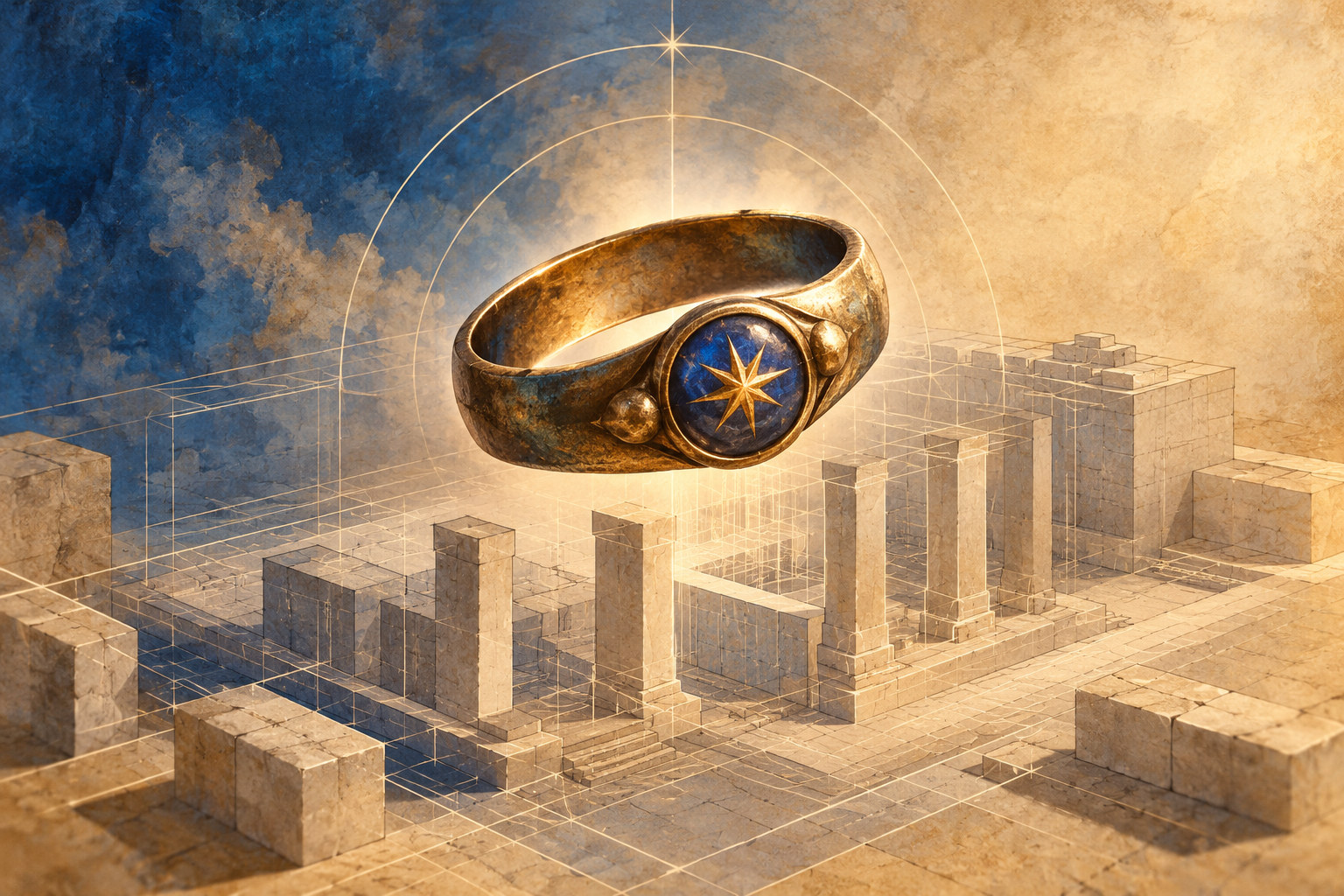
Newly generated symbolic illustration (2026): a ring and schematic architecture evoke the Testament of Solomon. Not an ancient ring, a manuscript image, or a historically verified reconstruction
Entidad
A Greek pseudepigraphal text about Solomon commanding spirits and building the Temple, preserved in different forms.
Variantes del nombre: Testament of Solomon
Contexto y fuentes →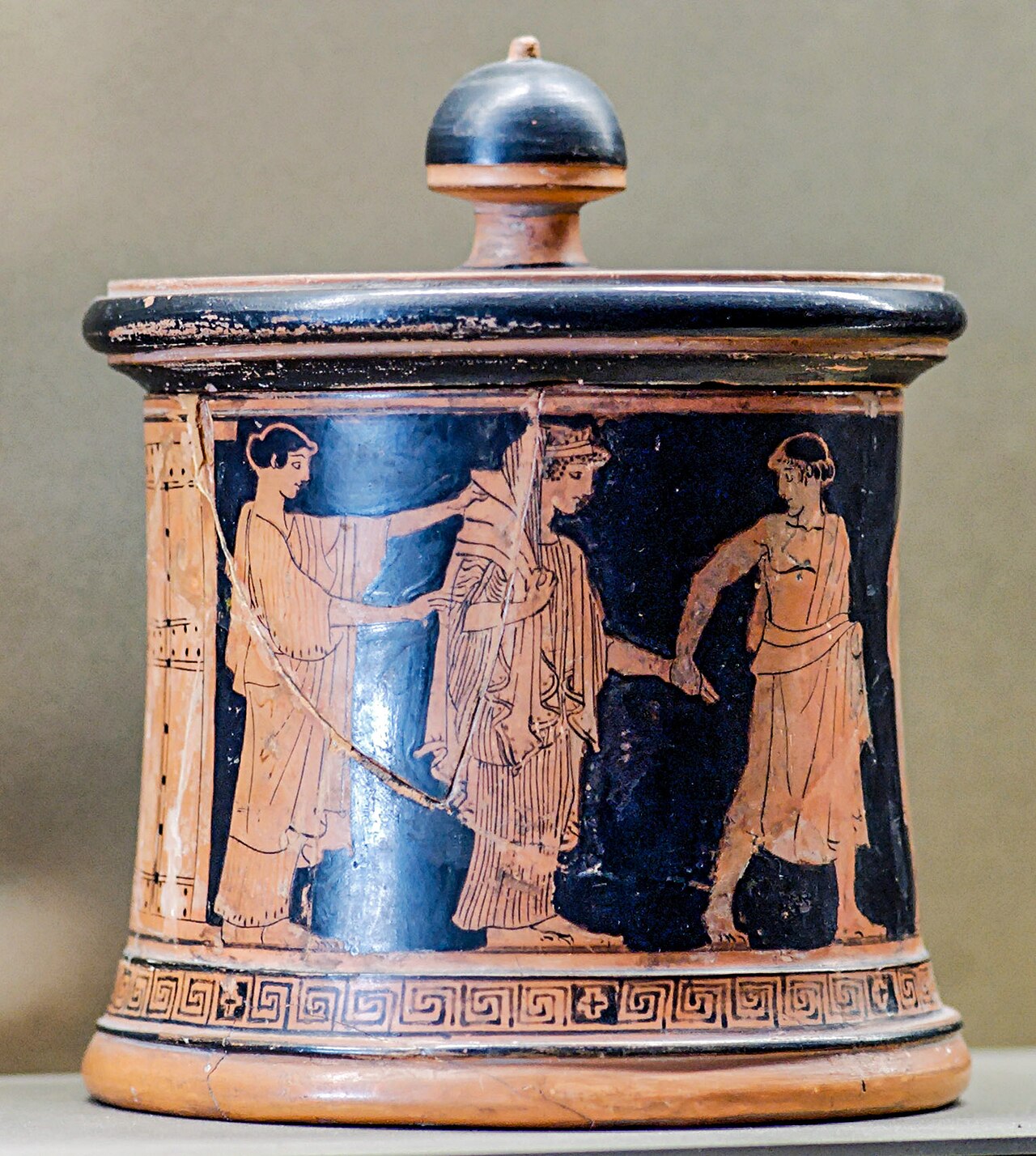
Peleus and Thetis on an Attic vase, about 470–460 BCE; Louvre LL 32 / N 3348 / L 55.1. Greek artistic evidence for the figures, rather than an image of Thetis’s appeal to Zeus in the Iliad
Entidad
Sea goddess in Greek poetry and mother of Achilles, one of the Iliad’s heroes.
Variantes del nombre: Thetis
Contexto y fuentes →
Modern expressive typographic cover of the four Hebrew letters יהוה; neither a photographed artefact nor a documented inscription reconstructed
Entidad
Term for the four Hebrew letters יהוה (YHWH), the name of Israel’s deity in the Hebrew Bible; it does not establish an exact ancient pronunciation or agreed etymology.
Variantes del nombre: Tetragrammaton, Four-letter divine name
Contexto y fuentes →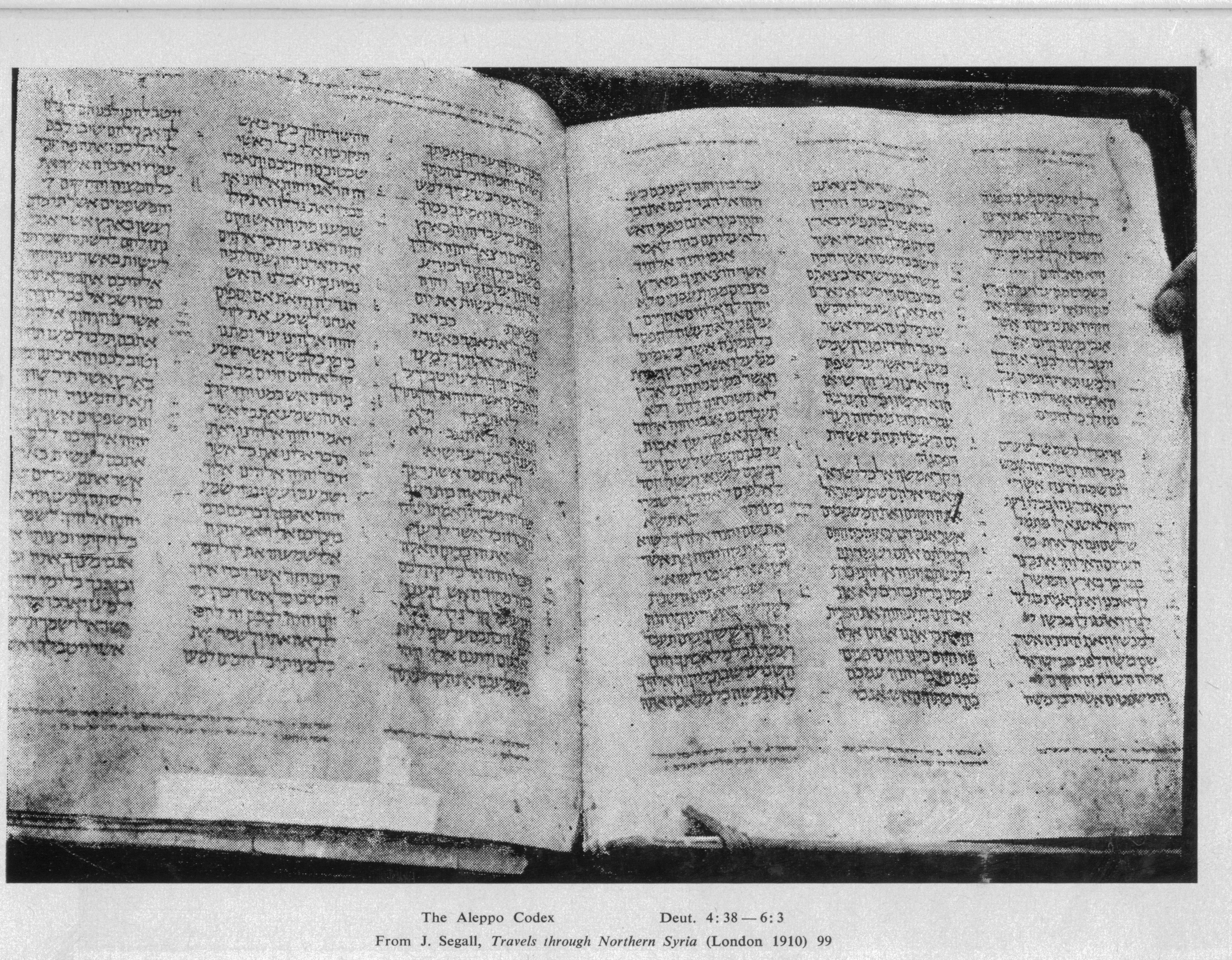
Historical photograph of two pages of the Aleppo Codex, copied around 930 CE. Published in Joseph Segall’s 1910 book, it records Deuteronomy 4:38–6:3 on subsequently lost leaves. It illustrates text and Masorah layout, not Deuteronomy 32:8
Entidad
The Hebrew Bible’s transmission tradition combining its consonantal text, transmitted vocalization and accentuation, and Masorah notes. The consonantal text has ancient roots; surviving codices that bring these layers together in their Masoretic form are medieval.
Variantes del nombre: Masoretic Text
Contexto y fuentes →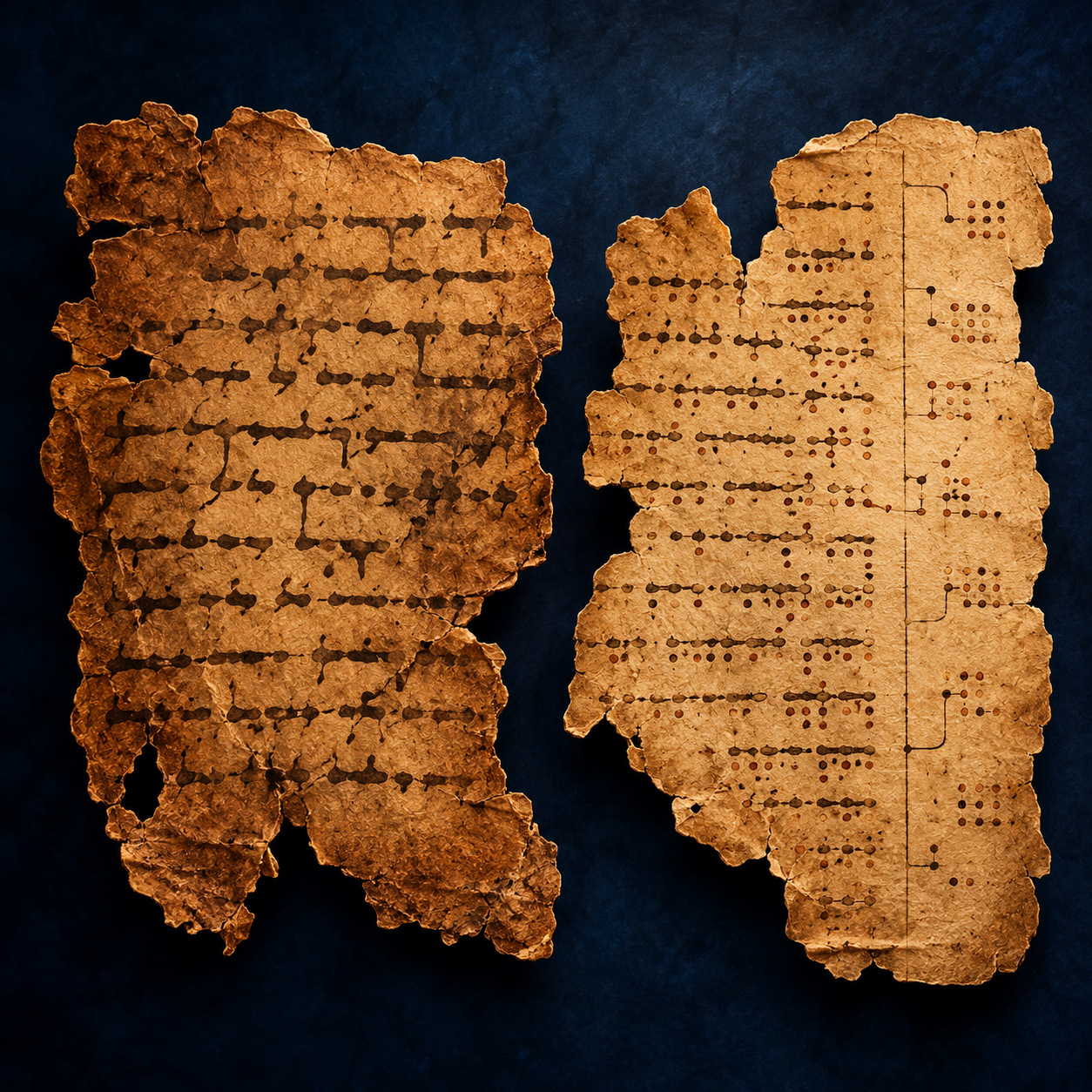
Generated modern conceptual cover: two imaginary parchment fragments contrast consonantal writing with later reading marks. Neither depicts a discovered manuscript or transcribes a real Hebrew reading
Entidad
A comparative designation for ancient Hebrew witnesses whose consonants closely resemble the later Masoretic tradition; not one original manuscript, exact identity or medieval vowel and accent notation.
Variantes del nombre: proto-Masoretic, pre-Masoretic
Contexto y fuentes →Persona
Theocritus was a Greek poet of the third century BCE. His fifteenth Idyll describes an Adonis festival in Alexandria.
Variantes del nombre: Theocritus
Contexto y fuentes →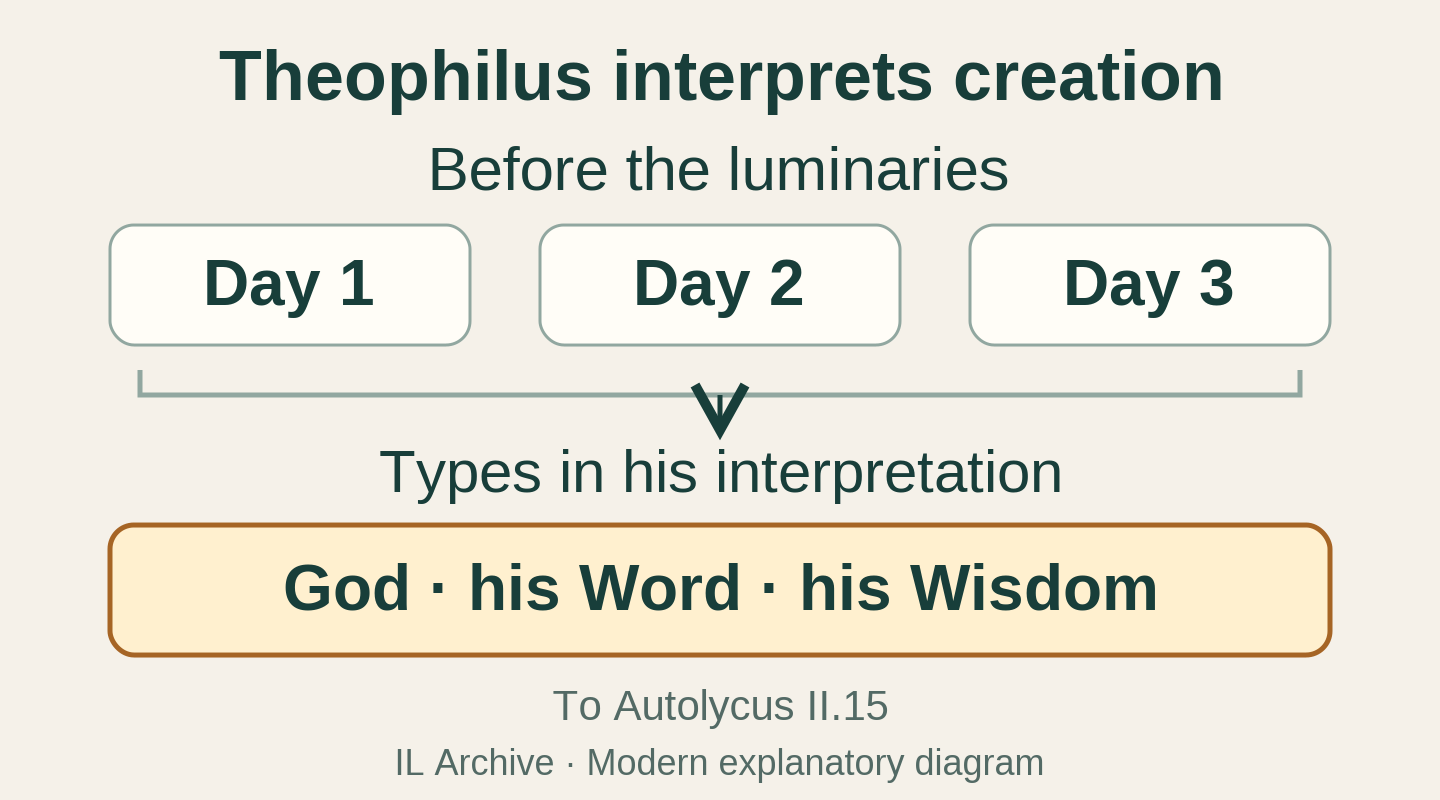
Modern explanatory diagram of Theophilus’s reading of the three pre-luminary days as types of God, his Word and Wisdom in To Autolycus II.15. The bracket groups the days without assigning one referent to each
Persona
Bishop of Antioch and Greek Christian author of the late second century CE.
Variantes del nombre: Theophilus of Antioch
Contexto y fuentes →Persona
Independent scholar of early Christianity, the Trinity’s history and Platonism.
Variantes del nombre: Thomas Edmund Gaston, Thomas E. Gaston, Thomas Gaston
Contexto y fuentes →Persona
Statistics academic at Cape Peninsula University of Technology who also publishes on the New Testament and ancient conceptions of evil.
Variantes del nombre: Thomas J. Farrar
Contexto y fuentes →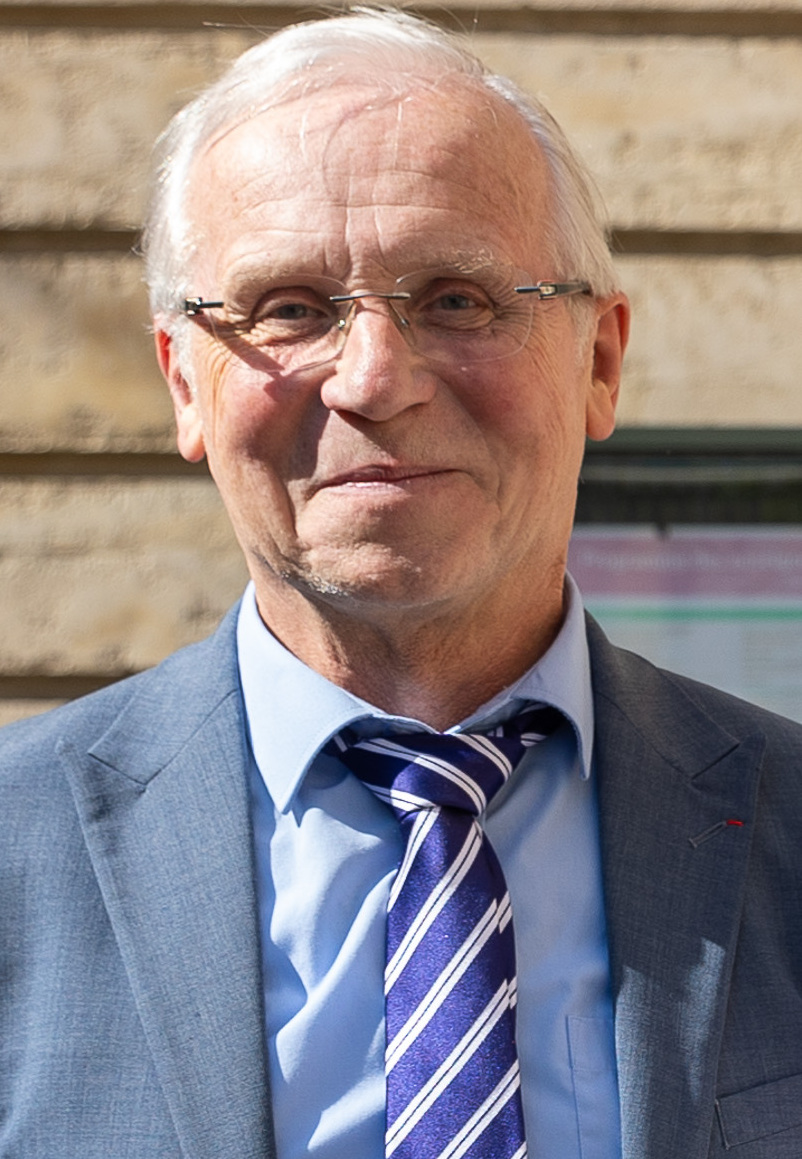
Thomas Römer at the Collège de France in Paris on 23 June 2023. This portrait of the Hebrew Bible scholar was cropped at the source from a group photograph taken during Jutta Urpilainen’s visit to the institution
Persona
Scholar of Hebrew Bible history and composition, holding the Biblical Milieux chair at the Collège de France.
Variantes del nombre: Thomas Römer, Thomas Romer, Thomas C. Römer
Contexto y fuentes →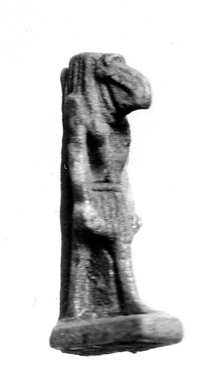
Faience amulet of ibis-headed Thoth, Egypt,664–30 BCE; height2.6cm. Met89.2.364
Entidad
Thoth is an Egyptian god of knowledge and writing, also associated with recording funerary judgment.
Variantes del nombre: Thoth
Contexto y fuentes →
Modern conceptual digital illustration of the primordial waters in Enūma eliš. Created for this article; not an artefact or an authenticated portrait of Tiamat
Entidad
Tiamat is a primeval divine mother and watery figure in Enūma eliš who later opposes Marduk; he divides her body in making the cosmos. No Babylonian portrait of her is securely identified.
Variantes del nombre: Tiamat
Contexto y fuentes →
Contemporary digital interpretation of Typhon inspired by Greek literary descriptions of serpent heads, fire, and volcanoes; not an ancient artifact or a historical scene
Entidad
Typhon (Typhoeus), a serpentine adversary of Zeus in Greek myth; his defeat and punishment vary across Hesiod, Pindar, and the later Library.
Variantes del nombre: Typhon, Typhoeus
Contexto y fuentes →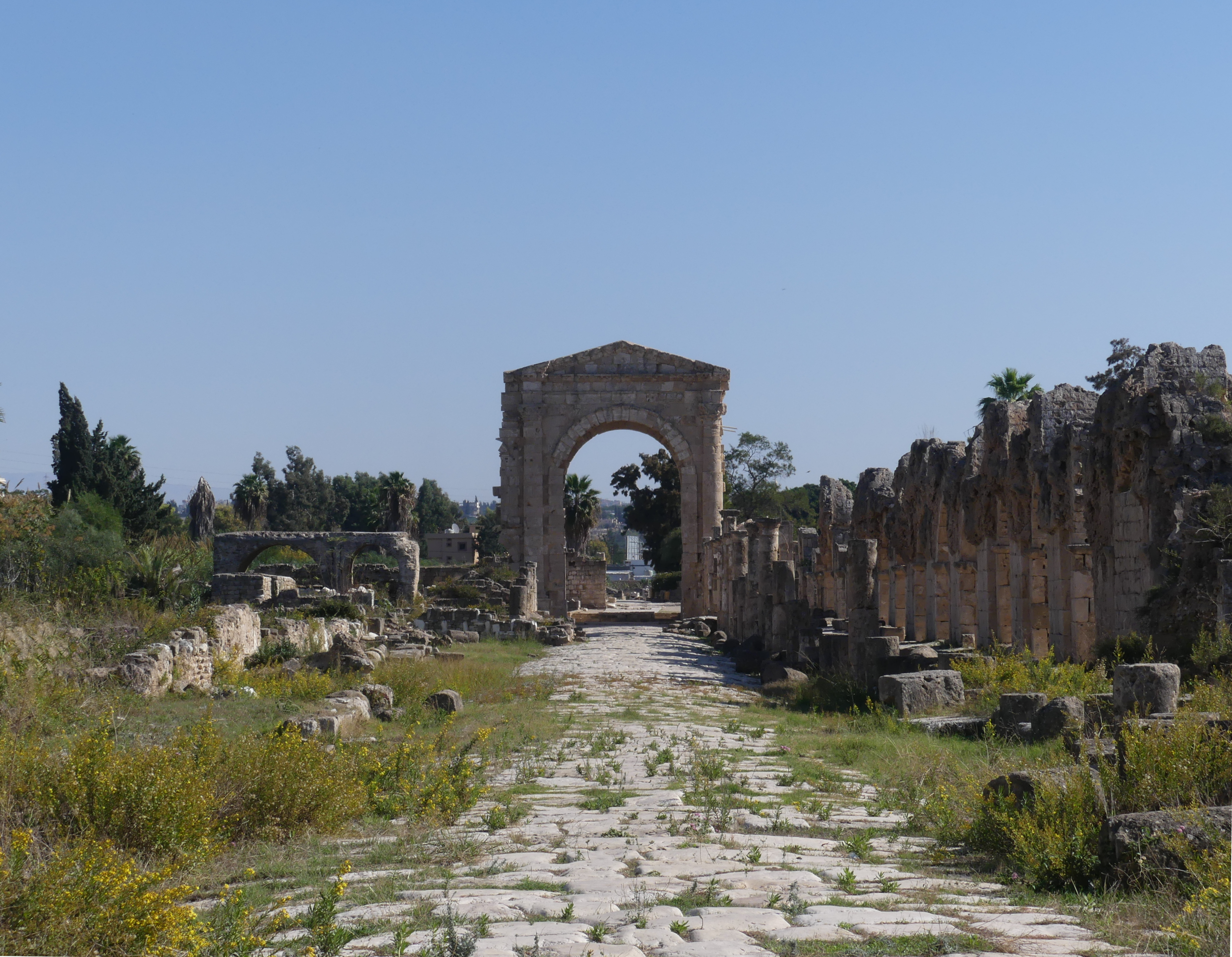
The restored Roman triumphal arch at Al Bass in Tyre, Lebanon, with aqueduct remains on its right. The arch dates to the second century CE. This photograph, taken on 19 November 2019, shows a later phase in the Phoenician city’s history
Yacimiento
Tyre is a city on the coast of present-day southern Lebanon and an important ancient Phoenician center
Variantes del nombre: Tyre
Contexto y fuentes →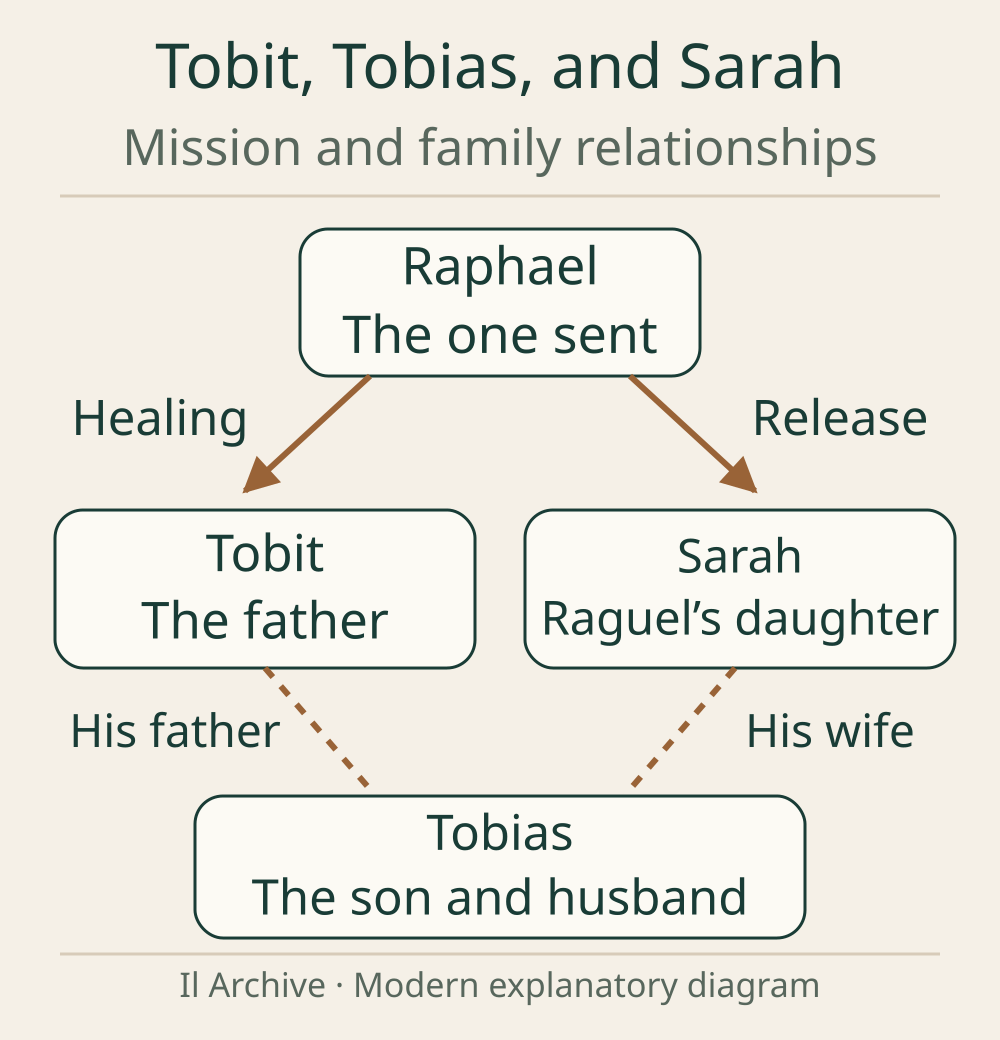
Modern role diagram for Tobit 3 and 11–12. Solid arrows show Raphael’s mission; dashed links show Tobias’s relationships with his father Tobit and his wife Sarah daughter of Raguel. The son treats his father’s eyes under Raphael’s guidance. Not a medical chart or historical portrait
Persona
The father healed of blindness in Tobit, not the traveling son.
Variantes del nombre: Tobit father of Tobias
Contexto y fuentes →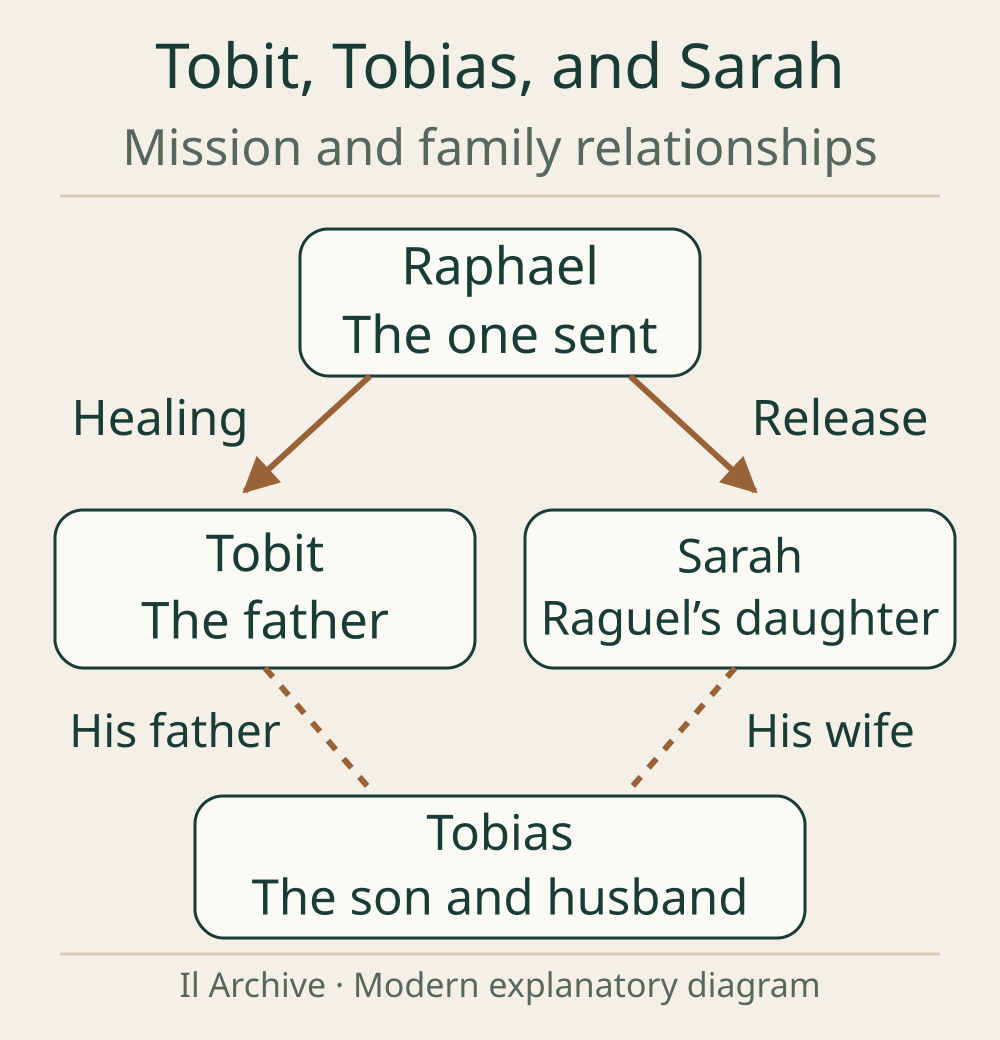
Modern role diagram for Tobit 3 and 11–12. Solid arrows show Raphael’s mission; dashed links show Tobias’s relationships with his father Tobit and his wife Sarah daughter of Raguel. The son treats his father’s eyes under Raphael’s guidance. Not a medical chart or historical portrait
Persona
The traveling son in Tobit and Sarah’s husband; he treats his father under Raphael’s guidance.
Variantes del nombre: Tobias son of Tobit
Contexto y fuentes →Persona
Classics and archaeology scholar at Melbourne studying Greek, Mesopotamian and Indic epic connections.
Variantes del nombre: Tom Hercules Davies
Contexto y fuentes →