Artifact
Moche Portrait-Head Bottle 64.228.21: What the Mold Reveals and the Face Cannot Tell
An object record bringing together its image, metadata, rights, and context.
- Names
- Moche portrait head bottle 64.228.21
- Timeline
- From 400 CE to 599 CE
- Region
- North Coast, Peru (Moche cultural context; excavation site unknown)
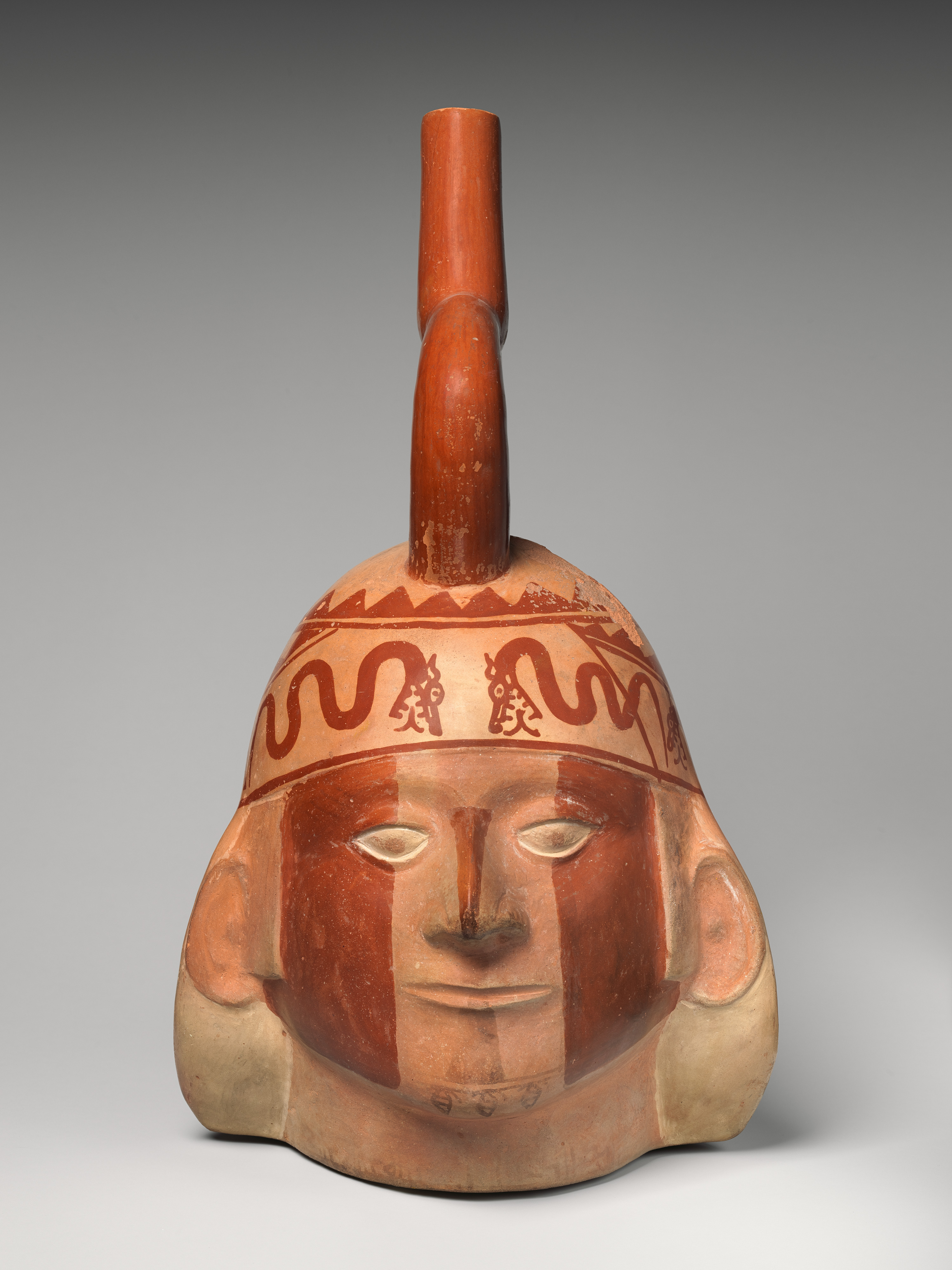
A fifth–sixth-century CE Moche vessel with a modeled face and painted serpent headband, likely sharing a mold or matrix with two vessels in Chicago and Lima, though resemblance cannot reveal the person’s name.
Estimated reading time: 7 min Published Last reviewed:
Share article
Photograph
The Metropolitan Museum of Art, New York; Gift of Mr. and Mrs. Nathan Cummings, 1964 · CC0
Moche portrait-head bottle 64.228.21, frontal view of the modeled face, serpent headband, contrasting paint, and spout rising above the head. The sitter and the object’s excavated context are unknown
License · Image source · Object recordObject details
- Title
- Moche Portrait-Head Bottle 64.228.21: What the Mold Reveals and the Face Cannot Tell
- Timeline
- From 400 CE to 599 CE
- Region
- North Coast, Peru (Moche cultural context; excavation site unknown)
- Rights
- CC0
Text
Introduction
How can a face that appears unmistakably individual recur on several ceramic vessels? The Moche bottle numbered 64.228.21 at The Metropolitan Museum of Art shows carefully modeled facial features and a serpent-decorated headband. Comparison with related vessels, however, raises a question more precise than whether we recognize a historical person: which features could be repeated through a mold, and which could be varied by painting after the clay was shaped?
This article reads the object simultaneously as a container and as a human image. It distinguishes the possibility that several vessels share a mold or a common mold matrix from the identification of a sitter and from the circumstances in which any particular bottle was used or deposited. Each question requires different evidence.
An object from Peru's north coast
The Metropolitan Museum of Art in New YorkNew York CityNew York City is in the United States and houses the Metropolitan Museum of ArtGlossary · Click to read the explanation preserves a Moche vessel from Peru's north coast under the title Portrait Head Bottle, accession 64.228.21. Its catalogue dates it to the fifth–sixth centuries CE and identifies ceramic, slip, and pigment as its materials. Its dimensions are 32.4 cm high, 18.4 cm wide, and 19.1 cm deep. This is an approximate art-historical date for the making of the object, not a date for its excavation or entry into the museum. [1]
“Moche” refers to interconnected communities and centers of the Peruvian coast centuries before the Inca state, not to the name of the vessel's maker. “Portrait-head bottle” identifies a vessel modeled as a three-dimensional human head. Neither the available image nor the catalogue identifies an inscription naming the portrayed individual. What survives is a visual representation, a museum attribution, and scholarly comparisons, not a written biography.
The face: pigment makes part of the likeness
The frontal photograph shows modeled eyes, a projecting nose, ears, lips, and red-and-cream areas of facial paint. A broad pale stripe runs down the middle of the face, with red fields to either side and additional marks around the nose, mouth, and chin. A light-colored headcloth supports a band with a geometric border and undulating serpents approaching the center of the forehead. The museum describes four serpents, two on each side, with open mouths, bared teeth, and forked tongues. Some of those small details are clearer when enlarged than in the reduced frontal image. [2]
The decoration extends beyond the brow. Stepped forms appear on the neck, and lozenge-like forms are painted beneath the chin. Curator Joanne Pillsbury reports archaeologist Steve Bourget's suggestion that the latter could evoke stages in the life cycle of flies, potentially associated with transformation and death. That is an attributed iconographic interpretation, not a name written on the bottle or a scientific identification of its pigment. The painted lines alone cannot supply a person's identity or rank. [6]
Three similar bottles: what does a mold establish?
Pillsbury compares the Met bottle with an example in Chicago's Field Museum, accession 100076, and another in Lima's Museo Nacional de Antropología, Arqueología e Historia. She considers it likely that the three came from one mold or molds descended from a common matrix, while noting that their headbands were painted differently. A matrix is a model from which molds may be derived. A textual comparison and the Met photograph do not demonstrate that the makers handled precisely the same physical mold, and the other two vessels have not been examined firsthand for this article. [3]
An earlier independent study demonstrates why that distinction matters. In the published abstract of his 1962 examination of four other Moche jars, Lee A. Parsons explains that pieces apparently made from one mold can differ in spout form, hue, paint distribution, surface finish, and the sharpness of their relief. He also cautions that resemblance alone does not establish a common mold without close examination. His examples are not direct technical tests of Met 64.228.21 or the Chicago and Lima comparanda. [4]
Repeated features do not disclose a known name
Molding allows a configuration of facial features to be reproduced with considerable consistency, while painting offers room to vary headwear, adornment, and color emphasis. A separate account from the University of California, Davis Anthropology Museum makes a similar observation about other Moche portrait vessels: related faces can recur while garments and hand-applied details change. Such evidence describes a production practice; it does not show that every closely matching face depicts the same historically identifiable person. [5]
Drawing on Christopher Donnan's scholarship, Pillsbury notes that some vessels appear to portray a recurring individual at different ages. This gives the idea of people recognized by their communities genuine interpretive interest. It does not reveal the name or office of the face modeled here, or establish the relationship between an individual and the potter's matrix. If the same modeled face could receive various headbands, neither should a single painted headband automatically be read as the original attire of a particular person. [7]
A bottle, not only an image
Above the head rises a stirrup spout: two curved branches that meet in a single tubular opening, a familiar form in ancient north-coast pottery. The supplied photograph makes the projection above the head clear, but cannot document every side of the vessel or the residue of any former contents. The Met discusses possible practical handling advantages alongside symbolic associations, while also acknowledging that the shape's precise ancient meaning is unknown. [8]
Pillsbury explains that chicha, a fermented maize beverage, has frequently been proposed as a possible content of such bottles, yet what individual vessels held remains uncertain. Neither the opening nor the realistic face proves that this particular bottle contained chicha or belonged to a specific ceremony. Establishing a former liquid would require relevant residue evidence from this object, not just an analogy from its general type. [8]
Use, circulation, and burial
The Met's essay discusses use-wear on some portrait vessels and sherds recovered from refuse, alongside examples excavated in high-status burial assemblages. Taken together, those observations allow for some bottles to have histories of use before their final funerary deposition, rather than all being manufactured expressly for tombs. Pillsbury, following Donnan, notes both male portrait vessels in women's graves and similar portrayals distributed among different tombs. A vessel's face is therefore not a straightforward identifier of the buried person. [9]
Interpretations nevertheless diverge. As Pillsbury explains, Donnan associates some portraits with notable people recognizable in their communities. She also presents Mary Weismantel's proposal to view these vessels as representations of severed heads or objects of reverence toward kin and ancestors. These are competing approaches to larger bodies of evidence, not established identities for the subject of 64.228.21. Donnan's and Weismantel's original publications were not read directly for this article. [10]
A documented collecting history and an unknown findspot
The published provenance reports a twentieth-century sequence: the Bruno J. Wassermann–San Blas Collection in Buenos Aires, where the vessel was present by 1938 and remained until 1954; the Nathan Cummings collection in Chicago from 1954 to 1964; and the gift by Mr. and Mrs. Nathan Cummings to the Met in 1964. That year is an accession-related gift date, not an excavation date. The documented sequence does not identify an archaeological site, tomb, or named ancient owner. [11]
This missing context is crucial. A collection history helps us trace the object during the modern period, but it cannot reconstruct the ancient stratigraphy, associated offerings, or circumstances of deposition. The funerary connections of the broader class therefore cannot be transferred as a fact to this particular vessel. Nor can the face be matched to a hypothetical occupant of an undocumented grave.
Conclusion: a likeness and a life are different kinds of evidence
The object's strongest contribution lies not in recovering a person's name but in showing the coexistence of repeatable modeled form and variable painted detail. That combination gives us a concrete way to ask how Moche workshops produced images that could appear singular while sharing technical models. The proposed link with the Chicago and Lima examples is a documented curatorial hypothesis that would require direct technical comparison to establish use of one physical mold.
The identity and biography of the represented person, the purpose of each version, this bottle's former contents, its excavated context, and the identity of any tomb occupant remain open. Skillfully rendered clay can bring a face before us; it cannot, on its own, restore the life behind that face. This is the essential distinction for reading object 64.228.21.
References and notes
- The Metropolitan Museum of Art, “Portrait Head Bottle,” accession 64.228.21; object identity, date, medium, dimensions and credit line. Artwork Details / Object Information, 5th–6th century CE; 32.4 × 18.4 × 19.1 cm. Return to the text ↑
- Joanne Pillsbury, “Portrait Head Bottle,” The Met collection description; face, headcloth, four serpents and pigment. Catalogue description, paragraphs on headcloth, band and face paint; corresponding frontal photograph. Return to the text ↑
- Joanne Pillsbury, Met object record 64.228.21; proposed mold/matrix relationship to Field Museum 100076 and a Lima vessel, with headband differences. Paragraph beginning “The present example...”; attributed comparison, not an independent examination. Return to the text ↑
- Lee A. Parsons, “An Examination of Four Moche Jars from the Same Mold,” American Antiquity 27.4 (1962), 515–519. Publisher’s abstract only; four other jars. Published abstract, variations in spout, color, finish and relief; the full article was not read. Return to the text ↑
- UC Davis Anthropology Museum, “Moche Portrait Vessel,” June 11, 2015; separate museum account of molds and varying hand details. Complete short object feature, passages on mold reuse and finishing; not Met 64.228.21. Return to the text ↑
- Joanne Pillsbury, Met description, reporting Steve Bourget’s proposal (2001, p. 104) on motifs beneath the chin; Bourget’s work not directly consulted. Paragraphs “Stepped motifs...” and “Archaeologist Steve Bourget...”; attributed interpretation. Return to the text ↑
- Joanne Pillsbury, “Moche Portrait Vessels,” The Met, September 2021; chronological phases, hand modeling, molds and painting; Donnan cited through the essay. Sections on phases III–IV, molded later portraits and painting; full online essay read. Return to the text ↑
- Joanne Pillsbury, “Moche Portrait Vessels”; stirrup spouts and the unverified proposal of chicha as a possible content. Paragraph on form, spout and contents; no residue analysis of 64.228.21. Return to the text ↑
- Joanne Pillsbury, “Moche Portrait Vessels”; use-wear, discarded sherds and high-status excavated burials across the broader corpus. Paragraphs on use and burial assemblages; not this object’s excavation record. Return to the text ↑
- Joanne Pillsbury, “Moche Portrait Vessels”; her account of Christopher Donnan’s and Mary Weismantel’s distinct interpretations, not a direct reading of their publications. Paragraphs on recognizable persons, disembodied heads and ancestors; mediated scholarly claims. Return to the text ↑
- The Metropolitan Museum of Art, “Portrait Head Bottle,” Provenance tab and credit line; modern collection sequence 1938–1964, with no excavated findspot provided. Recorded provenance: Wassermann–San Blas by 1938–1954; Cummings 1954–1964; 1964 gift; no primary sale documents read. Return to the text ↑
Archive records may be reviewed and refined as better evidence or sources become available. Suggest a correction
Suggest a correction · Suggest a source for this record
Cite this record
IL Archive, «Moche Portrait-Head Bottle 64.228.21: What the Mold Reveals and the Face Cannot Tell», https://ilarchive.com/en/artifacts/moche-portrait-head-bottle-met64-228-21