Entity · Concept
Circumferential head shaping
A reference page linking a name, group, or concept to the materials that discuss it.
A pattern of early-growth head shaping associated with circumferential constraint and an elevated or extended vault.
Text
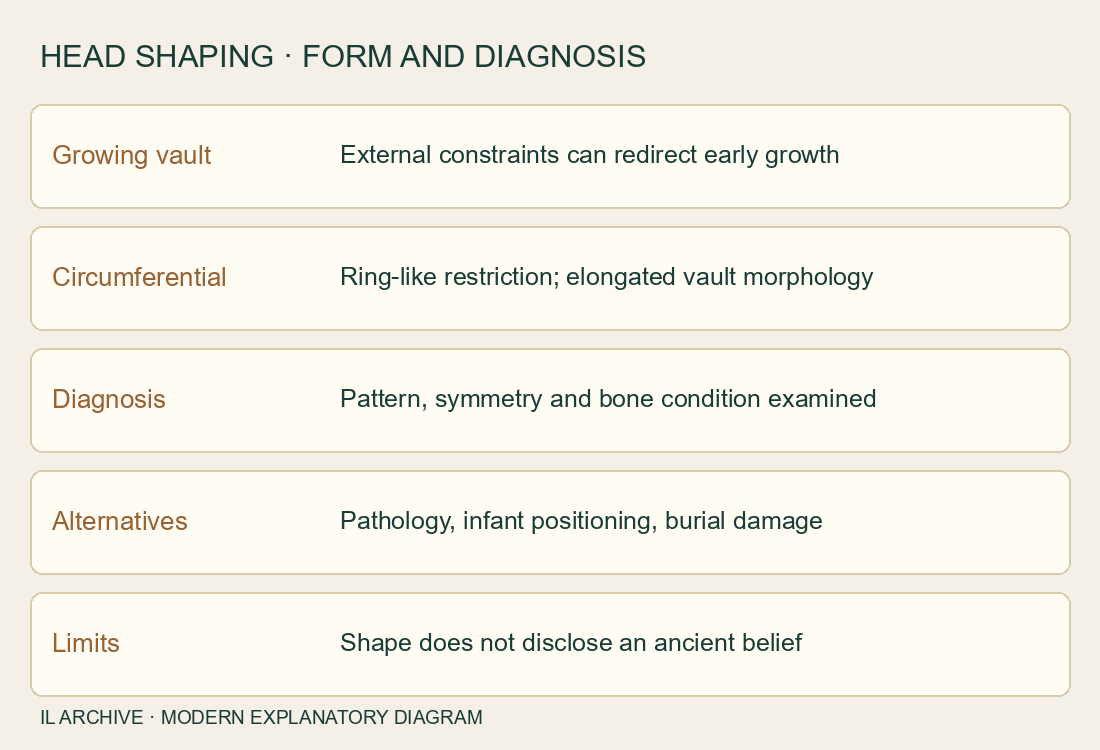
Circumferential modification is one pattern of cultural head shaping. It is associated with a constraint around the vault during early childhood growth, redirecting its development and potentially producing a higher or backward-extended cranium. Elongation alone is insufficient for diagnosis: specialists examine morphology, sutures and bone condition and exclude disease and post-burial distortion. Lorentz distinguishes it from some flattening that may result incidentally from cradles or care positions.[1]
The 2017 Tepe Abdul Hosein study documents a two-band circumferential pattern in four of five adults with assessable crania. This small archaeological sample establishes neither village prevalence nor social meaning. Recognizing a technique differs from knowing caregivers’ motives, such as affiliation, beauty or status.[2]
The modern educational diagram explains stages of inference: early growth, an effect on shape, and examination separating diagnosis from motivation. It is neither an ancient image nor a reconstruction of a particular child.
References and notes
- Kirsi O. Lorentz (2010). Ubaid Headshaping: Negotiations of Identity through Physical Appearance? In R. A. Carter & G. Philip (eds), Beyond the Ubaid, SAOC 63, pp. 125–142. Selected passages, printed pp. 125–131, 134–136, 140–141; Table 9.2 and Figure 9.5 on p. 135 visually inspected. Not the whole chapter. Eridu, Arpachiyah and Değirmentepe samples, intentional/incidental effects and identity models. Preliminary 2010 and 2017 samples kept separate. Return to the text ↑
- Kirsi O. Lorentz (2017). Marking Identity through Cultural Cranial Modification within the First Sedentary Communities (Ninth to Eighth Millennium BCE) in the Near East: Tepe Abdul Hosein, Iran. International Journal of Osteoarchaeology 27, 973–983. DOI: 10.1002/oa.2609. Publisher abstract only: 12 individuals, eight contexts, five assessable adults; four modified (three males, one indeterminate) and one unmodified female. Not proof of male exclusivity. Full article not read. Return to the text ↑
Research history
Substantive changes are retained here. Minor copy edits remain in the internal operational log.
-
Substantive record update
Suggest a correction · Suggest a source for this record
Cite this record
IL Archive, «Circumferential head shaping», Edition 2, https://ilarchive.com/en/entities/circumferential-headshaping