Entity · Concept
Genetic kinship
A reference page linking a name, group, or concept to the materials that discuss it.
Estimating descent relationships from shared genetic material, within sampling and data-quality limits.
Text
Genetic-kinship research uses shared variants or DNA segments to estimate relationships such as parent–child, siblings and more distant relatives. Ancient DNA preservation, coverage and the number of comparable positions affect precision; several relationships may remain possible. These data differ from estimates of affinity based on dental morphology.[1][2]
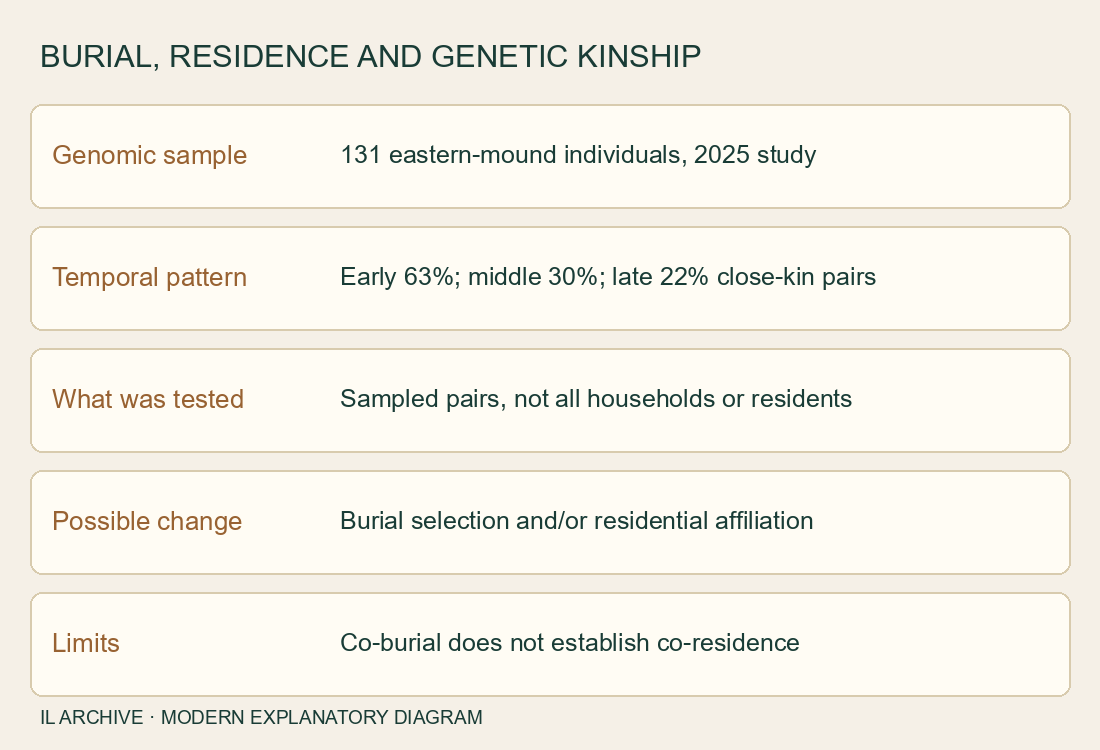
The 2025 ÇatalhöyükÇatalhöyükA Neolithic site in central Anatolia where domestic houses combined dwelling with burial, symbolism and social memory.Glossary · Click to read the explanation study contains data for 131 eastern-mound individuals and extends the 2021 sample. Genetic relationships do not automatically define social family membership, and co-buried people need not have lived together. Failure to detect close kinship does not rule out distant ancestry or establish adoption or ancestor identity. Results must be connected to burial, architecture and chronology, as the modern diagram explains.[1][3]
References and notes
- Eren Yüncü et al. (2025). Female lineages and changing kinship patterns in Neolithic Çatalhöyük. Science 388(6754), eadr2915. DOI: 10.1126/science.adr2915. Liverpool author manuscript: abstract, introduction and sample, PDF pp. 3–6; mobility, kinship, diet, maternal connections, grave goods and discussion, pp. 9–22. Not every supplement page read. 131 eastern-mound individuals; percentages concern tested pairs and fivefold concerns occurrence of goods. Return to the text ↑
- Marin A. Pilloud & Clark Spencer Larsen (2011). “Official” and “practical” kin: Inferring social and community structure from dental phenotype at Neolithic Çatalhöyük, Turkey. American Journal of Physical Anthropology 145(4), 519–530. DOI: 10.1002/ajpa.21520. PubMed abstract only: dental phenotype in 266 individuals. An affinity indicator, not a DNA test; its social-kinship interpretation does not replace later genomic findings. Return to the text ↑
- Reyhan Yaka et al. (2021). Variable kinship patterns in Neolithic Anatolia revealed by ancient genomes. Current Biology 31(11), 2455–2468.e1–e18. DOI: 10.1016/j.cub.2021.03.050. Selected results, discussion and site context examined in the preceding study. Çatalhöyük sample was small; the 2025 study extends individuals and periods. Not every supplement re-read. Return to the text ↑
Research history
Substantive changes are retained here. Minor copy edits remain in the internal operational log.
-
Substantive record update
Suggest a correction · Suggest a source for this record
Cite this record
IL Archive, «Genetic kinship», Edition 2, https://ilarchive.com/en/entities/genetic-kinship