Entity · Concept
Holy Spirit
A reference page linking a name, group, or concept to the materials that discuss it.
Name present in Christian texts and worship, whose relation to Father and Son was defined in Trinitarian formulations.
Last reviewed:
Text
The Holy Spirit is named in early Christian texts and prayers. In 1 Corinthians 12:4–6, Spirit, Lord and God appear together in the description of gifts, ministries and activities; Second Corinthians closes with Christ’s grace, God’s love and fellowship of the Holy Spirit.[1][2]
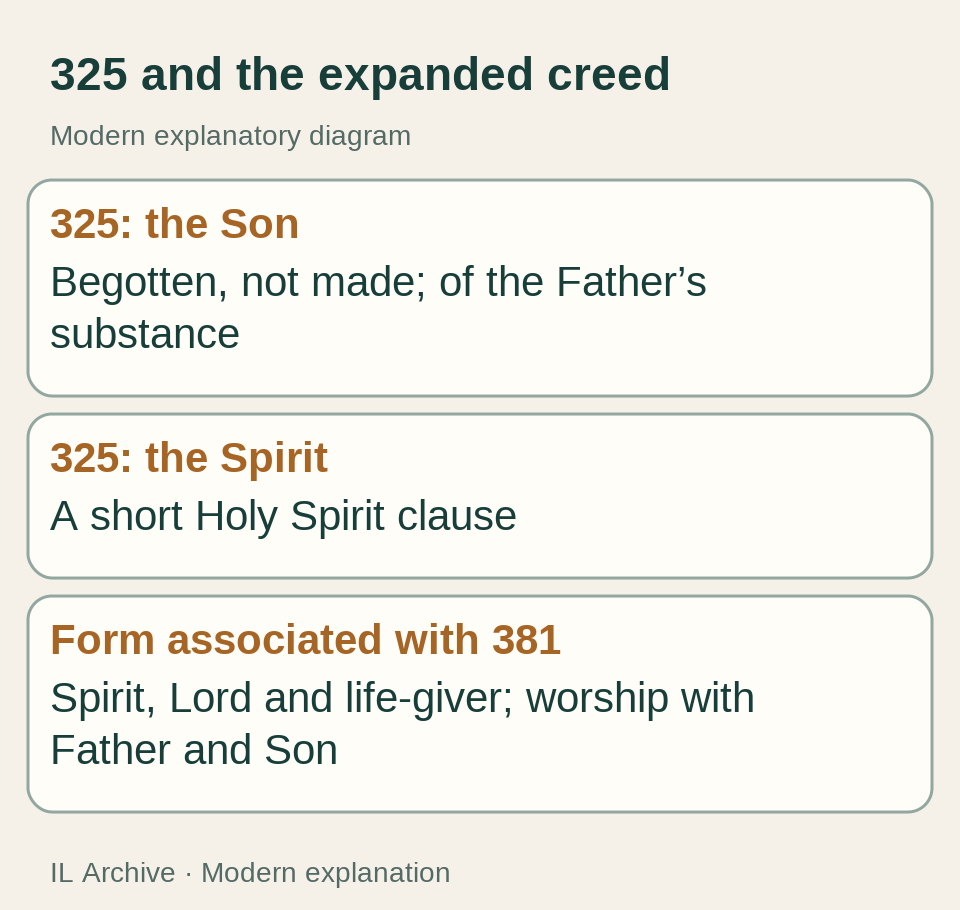
The expanded creed associated with Constantinople in 381 CE and clearly attested in Chalcedon’s acts in 451 describes the Spirit as Lord and life-giver, proceeding from the Father, worshipped and glorified with Father and Son. This elaboration belongs to the history of interpreting the names’ relationship, alongside the Spirit’s presence in earlier texts.[3]
References and notes
- 1 Corinthians 12:4–6, displayed KJV translation. Spirit, Lord and God in gifts, ministries and activities: threefold language, not a definition of three coequal hypostases. Return to the text ↑
- 2 Corinthians 13:14, displayed KJV translation. Christ’s grace, God’s love and fellowship of the Spirit; numbered verse 13 in some editions. Return to the text ↑
- Niceno-Constantinopolitan Creed, received text and editorial introduction, NPNF 14, CCEL. Creed and introduction read: Spirit Lord and life-giver, from Father, worshipped with Father and Son. Heading preserves Chalcedonian presentation. Attribution to 381 distinguished from 451 documentation and earlier related forms. Return to the text ↑
Suggest a correction · Suggest a source for this record
Cite this record
IL Archive, «Holy Spirit», https://ilarchive.com/en/entities/holy-spirit-christianity