Entity · Concept
Sedentism
A reference page linking a name, group, or concept to the materials that discuss it.
Reduced residential mobility and prolonged or recurring occupation; architecture alone does not establish year-round residence.
Text
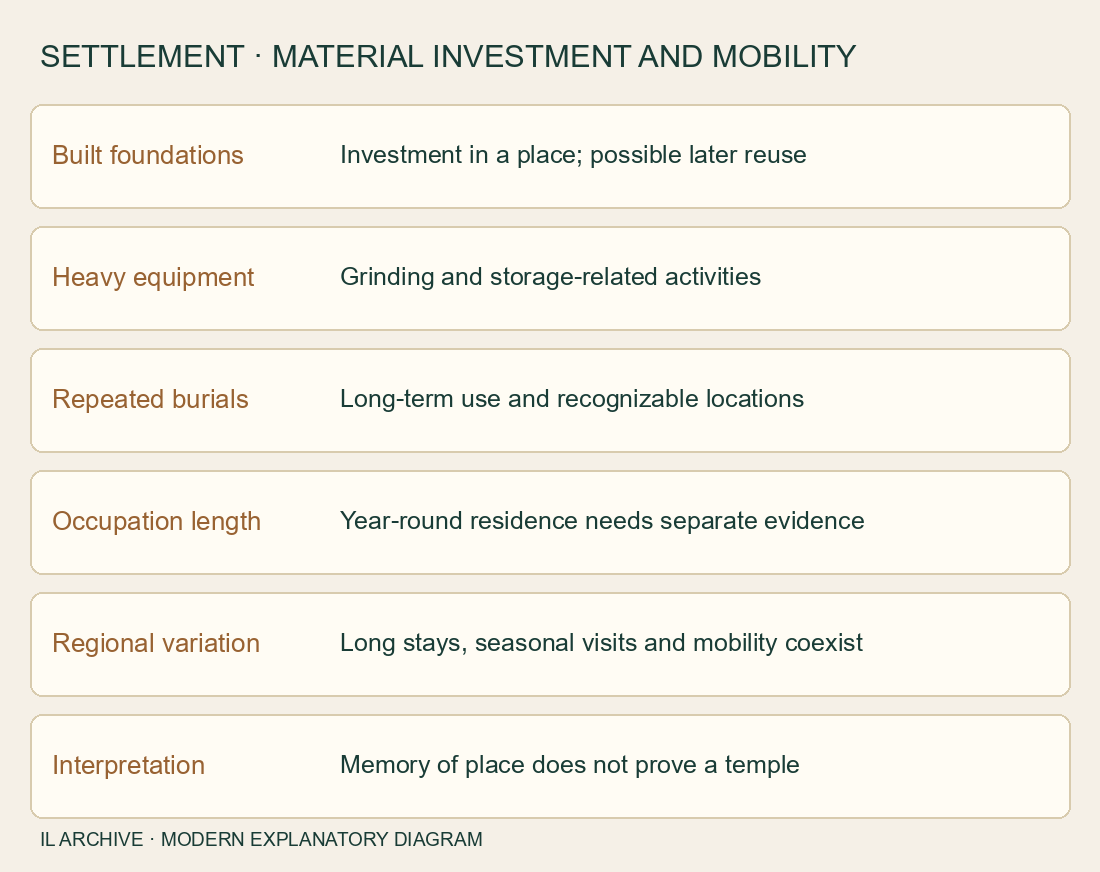
The concept distinguishes material investment from actual occupation duration. Stone foundations and heavy equipment can coexist with seasonal or intermittent use. Calling a village permanent requires additional evidence; degrees of sedentism differ between groups and phases.[1]
Eynan demonstrates settlement before agriculture. Wadi Hammeh 27 illustrates repeated architecture and awareness of an earlier burial, while residence duration remains open. Memory of place is a social interpretation, not automatic proof of a temple.[1][2]
References and notes
- Phillip C. Edwards (2015). Ice Age villagers of the Levant: renewed excavations at the Natufian site of Wadi Hammeh 27, Jordan. Antiquity Project Gallery 89(347), 1–7. DOI: 10.15184/S2978855200900465. Introduction and 2014 excavation section: residence duration remains open; architecture and stone markers over an earlier burial. Memory and place claims are interpretations, not modern legal ownership. Return to the text ↑
- François R. Valla et al. (2017). Eynan (Ain Mallaha). In Quaternary of the Levant, 295–302. DOI: 10.1017/9781316106754.034. Publisher summary only: settlement before agriculture, semi-subterranean buildings, burial phases and foraging. The full chapter was not read. Return to the text ↑
Research history
Substantive changes are retained here. Minor copy edits remain in the internal operational log.
-
Substantive record update
Suggest a correction · Suggest a source for this record
Cite this record
IL Archive, «Sedentism», Edition 2, https://ilarchive.com/en/entities/sedentism