Person
Otanes in the Achaemenid Succession
- Names
- Otanes · Otánēs · Utāna
Darius names Utāna among the Persian nobles who helped him take power in 522 BCE. Herodotus gives Otanes a leading role and a speech for government by the many, preserving a different account of the succession.
Estimated reading time: 5 min Published Last reviewed:
Share article
Text
Introduction
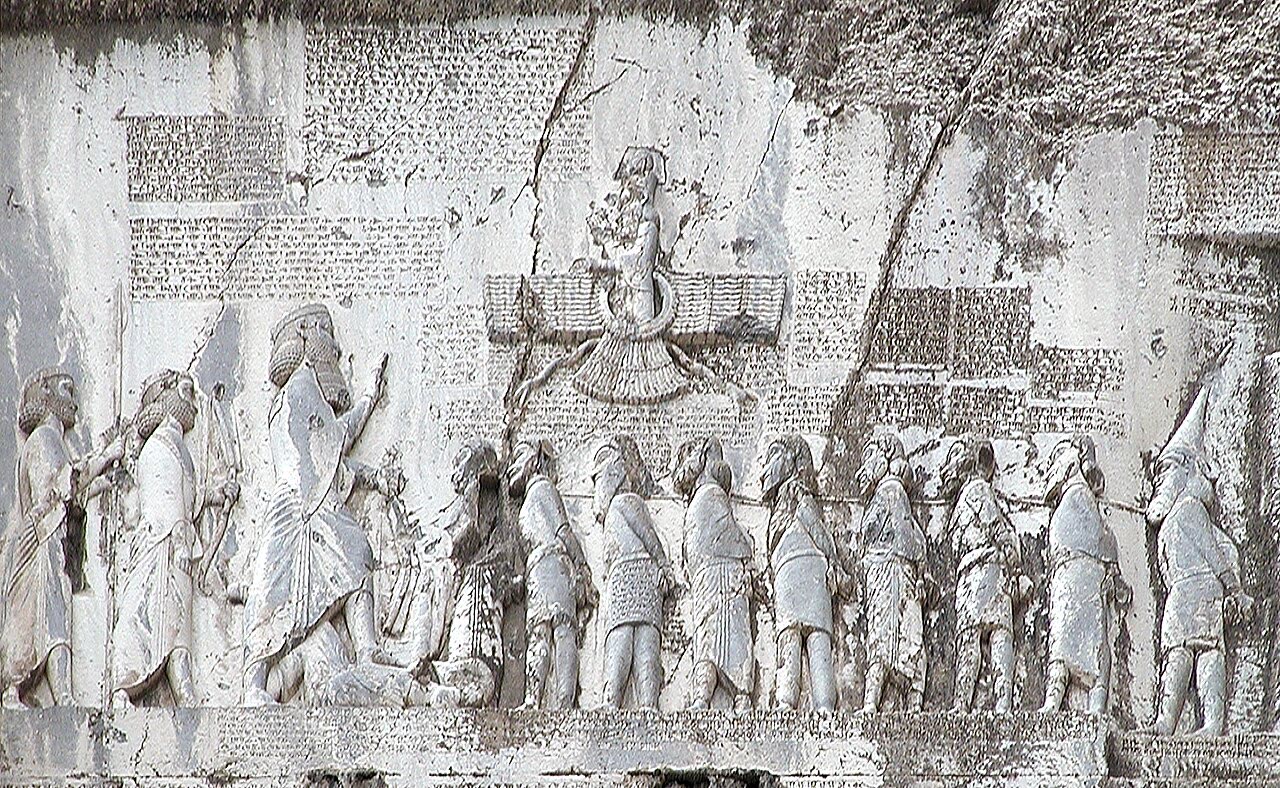
Otanes was one of the Persian nobles associated with Darius I's accession in 522 BCE. Darius's inscription at Behistun names him as Utāna, son of Thukhra, among six supporters present when the king overthrew Gaumata. Herodotus calls him Otanes, names a different father and makes him the first to suspect the man on the throne. In the Greek historian's account he also proposes government by the many. The inscription documents his place among Darius's allies. The speeches and family scenes belong to Herodotus's telling of the succession. [1] [2] [3]
A name on the rock
Darius's monument at Behistun combines a carved relief with text in Elamite, Babylonian and Old Persian. It tells how Darius acquired the throne and then put down resistance in several regions. In the king's account, Gaumata claimed to be Bardiya, a son of Cyrus whom the Greek tradition calls Smerdis. Darius says he removed Gaumata with a small group of men and recovered the kingship with the aid of Ahura Mazda. The message casts the change of ruler as a restoration of the dynasty. [1] [3] [4]
The names of the supporters occur near the end of the fourth Old Persian column, in paragraph 68. Utāna follows Intaphernes and precedes Gobryas, Hydarnes, Megabyzus and Ardumaniš. Each man is named with his father and described as Persian. In the following paragraph Darius asks whoever rules after him to protect their families. This is a collective acknowledgement in a text voiced by the king. It gives no speeches or individual account of what the named men did. [1] [2] [5]
The versions of the inscription also allow the official description itself to be compared. Matheus Treuk Medeiros de Araujo notes that the Old Persian describes cooperation, while the Babylonian wording describes the men as bringing help. In paragraph 70 the king says he circulated his account. The written list was part of the version of the accession he wanted readers in his territories and future rulers to know. [1] [5]
The nobleman in Herodotus
In Book 3 of the Histories, Otanes suspects that the ruler claiming to be the son of Cyrus is an impostor. The man stays out of public view and does not receive prominent Persians. Otanes turns to his daughter Phaidyme, whom the new ruler has taken into his household. She reports that the women are kept apart and that she cannot ask Atossa, Cyrus's daughter, to identify him. Her eventual discovery about the man's missing ears advances the story. By making Phaidyme the person who can check her father's suspicion, Herodotus gives the royal household a part in the course of the succession. [3]
Otanes confides first in Aspathines and Gobryas. The circle grows, and Darius is admitted last. At their meeting Darius calls for immediate action and Otanes counsels deliberation. The lists overlap in five names. Aspathines appears in Herodotus among the conspirators, while the corresponding place in the count is taken by Ardumaniš in Darius's list. Herodotus also calls Otanes a son of Pharnaspes. Rüdiger Schmitt gives priority to the inscription's patronymic and suggests that bearers of the same name could have been confused. [1] [2] [3] [5]
The case for government by the many
After the overthrow, Herodotus gives three men speeches about how Persia should be governed. Otanes opens with a criticism of unchecked power. His argument begins from the conduct he ascribes to Cambyses and the Magus, then considers what the position might do even to a capable ruler. He proposes isonomia, an order associated in the speech with equality, offices assigned by lot, accountability in office and public deliberation. K. Scarlett Kingsley draws attention to the way the language of accountability answers the earlier description of the freedom of a single ruler to act as he wishes. [3] [6]
Megabyzus argues for entrusting power to a smaller group. Darius defends one-man rule and appeals to the Persians' own experience of liberation under a single leader. Four of the seven favor Darius's position. Herodotus acknowledges that some Greeks doubted the speeches and insists that they were delivered. The royal inscription gives evidence of the alliance and presents Darius as the restorer of kingship. The speeches supply a Greek account of political alternatives and make it possible to follow the historian's argument about how power can be checked. [1] [3] [6]
The agreement about his household
When his proposal fails, Herodotus's Otanes withdraws from the contest for the kingship. He asks that his descendants and he be exempt from the authority of the other contestants. The historian adds that his household retained an exceptional freedom within the bounds of Persian law, and that the other nobles agreed to annual gifts in recognition of his initiative. Behistun's appeal for future rulers to safeguard the supporters' families gives an independent reason to take their standing seriously. Its wording applies to all six households and leaves the details of any distinctive privileges unexplained. [1] [2] [3]
The two accounts therefore allow different levels of historical confidence. Utāna's name, father and participation come from Darius's official testimony. The identity of the person in Herodotus's account is generally accepted, with the difference about his father left visible. His initiative, policy and agreement about the position of his descendants can be discussed as features of a detailed ancient tradition, whose details depend on the historian's narrative. [1] [2] [3] [5]
References and notes (6)
- Darius I, Behistun Inscription, Internet History Sourcebooks Project Old Persian DB §§ 11–14 and 68–70 in translation, the succession, the named allies and protection for their families. Return to the text ↑
- Rüdiger Schmitt, Otanes Encyclopaedia Iranica, first numbered entry, names, patronymics, roles in the sources and homonyms. Return to the text ↑
- Herodotus, Histories, Greek and A. D. Godley translation Book 3, §§ 61–88, especially §§ 68–72 and 80–84. Return to the text ↑
- UNESCO World Heritage Centre, Bisotun Description of the relief and the inscriptions in three languages. Return to the text ↑
- Matheus Treuk Medeiros de Araujo, A inscrição de Behistun (c. 520 a.C.) Old Persian §§ 68–70 in Portuguese translation and note 65 comparing Herodotus and the inscription. Return to the text ↑
- K. Scarlett Kingsley, Herodotus and the Presocratics Pages 68–70 on Book 3 and the link between the language of accountability and Otanes's argument. Return to the text ↑
Suggest a correction · Suggest a source for this record
Cite this record
IL Archive, «Otanes in the Achaemenid Succession», https://ilarchive.com/en/people/otanes