Site
Boncuklu Höyük
- Timeline
- From 9400 BCE to 7500 BCE
A Konya Plain Neolithic settlement with oval houses and burials associated with continued building use.
Text
Dating distinguishes the whole site from studied deposits: the June 2026 project publication gives approximately 9400–7500 BCE; the 2018 study examined phases around 8300–8100 and 8100–7800 BCE. A sampled range must not be treated as the definitive onset of the site.[1][2]
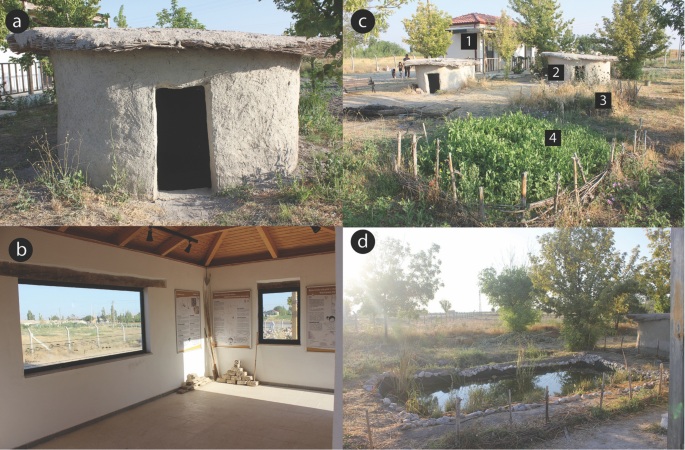
Oval houses have ground-level entrances, with clean-area burials and continued use or rebuilding. The DNA sample includes some close relatives, possibly a mother and adult son, and pairs without detected close kinship. The photograph shows modern visitor facilities and replica houses, not an excavated house.[2][3][4]
References and notes
- Steve Chaddock, Andrew Fairbairn, Douglas Baird & Gökhan Mustafaoğlu (2026). Archaeobotanical storytelling in a landscape of the mind: community engagement and education at Neolithic Boncuklu Höyük, Türkiye. Vegetation History and Archaeobotany. DOI: 10.1007/s00334-026-01118-2. Published 4 June 2026. Abstract, introduction, interpretation, replica-house section, Figure 6 and licence read. Whole-site range c.9400–7500 BCE. Figure 6 depicts modern visitor facilities; AF photos, CC BY 4.0, not an excavated house. Return to the text ↑
- Douglas Baird et al. (2018). Agricultural origins on the Anatolian plateau. PNAS 115(14), E3077–E3086. DOI: 10.1073/pnas.1800163115. Comparative results, Boncuklu context and supplementary chronology read in the author-repository PDF: clean/cooking zones, burial and building continuity. 8300–7800 BCE covers studied phases; Çatalhöyük East began around 7100 BCE. Return to the text ↑
- Michela Spataro, Alexandra Fletcher, Caroline R. Cartwright & Douglas Baird. Boncuklu Höyük: the earliest ceramics on the Anatolian plateau. Journal of Archaeological Science: Reports. DOI: 10.1016/j.jasrep.2016.10.011. Author manuscript. Author-manuscript abstract and introduction: successive oval buildings and ground-level entry, contrasted with Çatalhöyük. Entrance differences do not establish different afterlife beliefs. Return to the text ↑
- Reyhan Yaka et al. (2021). Variable kinship patterns in Neolithic Anatolia revealed by ancient genomes. Current Biology 31(11), 2455–2468.e1–e18. DOI: 10.1016/j.cub.2021.03.050. Aşıklı and Boncuklu results, discussion and STAR Methods site backgrounds read in the full text through Europe PMC. Counts belong to the 2021 report; sampled DNA and proposed relationships do not form a complete population register. Return to the text ↑
Research history
Substantive changes are retained here. Minor copy edits remain in the internal operational log.
-
Substantive record update
Suggest a correction · Suggest a source for this record
Cite this record
IL Archive, «Boncuklu Höyük», Edition 2, https://ilarchive.com/en/sites/boncuklu-hoyuk