Artifact · Inscription
The Getty Gold Lamella: Thirst and Identity in a Passage to the Afterlife
An object record bringing together its image, metadata, rights, and context.
- Names
- Getty Gold Lamella · Lamella Orphica (Getty 75.AM.19)
- Timeline
- From 375 BCE to 325 BCE
- Region
- Ancient Greece
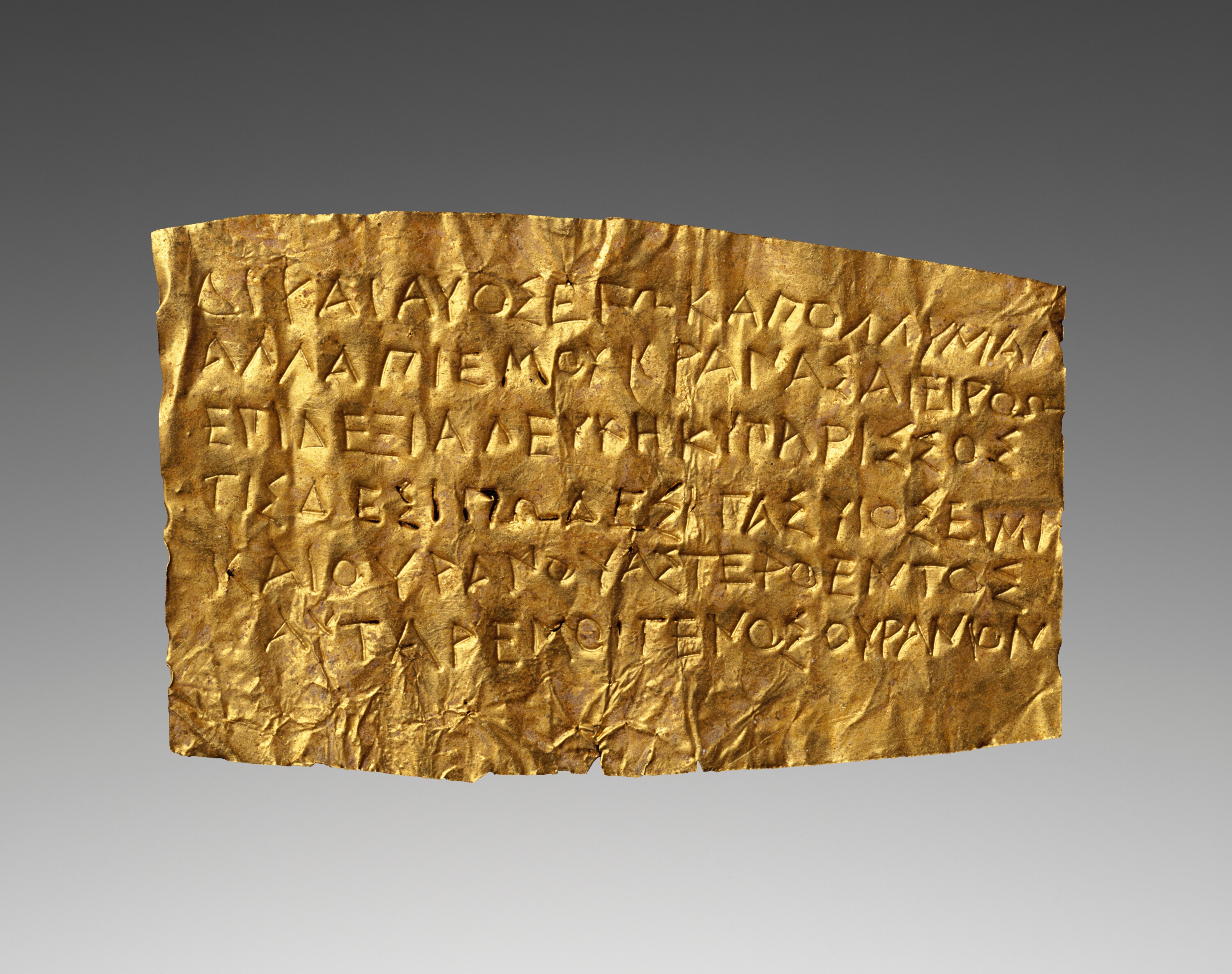
A Greek gold lamella at the Getty from about the mid-fourth century BCE; its six lines join the deceased’s thirst, a spring and white cypress on the right, and a question of origin answered by kinship with earth and sky.
Estimated reading time: 6 min Published Last reviewed:
Share article
Photograph
Digital image courtesy of Getty’s Open Content Program. · CC0
Six-line Greek inscription on a wrinkled gold lamella, Getty 75.AM.19. This is a photograph of the object, not an underworld map or independent collation of each letter
Related reference · Related reference · License · Image sourceObject details
- Title
- The Getty Gold Lamella: Thirst and Identity in a Passage to the Afterlife
- Timeline
- From 375 BCE to 325 BCE
- Region
- Ancient Greece
- Rights
- CC0
Text
Introduction
A gold sheet in the Getty collection is easy to overlook, yet six incised lines turn thirst into a dialogue about direction and identity beyond death. Who says that they are dying of thirst, who asks where they come from, and why does the reply claim kinship with Earth and starry Heaven? This entry examines the particular object 75.AM.19—its surface, wording, dating, and modern collection history—to understand a speech intended to accompany someone into the realm of the dead, without importing rites or myths absent from the inscription. [1][3]
One small sheet of gold
The J. Paul Getty Museum holds the thin gold lamella 75.AM.19, catalogued as Lamella Orphica. Its recorded dimensions are 2.2 × 3.7 × 0.1 cm (height, width, thickness). It is assigned to ancient GreeceAncient Greek worldGreek-speaking communities and cities around the Aegean and beyond, extending across the borders of modern Greece.Glossary · Click to read the explanation, the maker is unknown, and the present catalogue dates it to the mid-fourth century BCE. This is an approximate date for the object, not a known owner's date of death or a recorded moment of ritualRitualAn organised or distinguished practice meaningful to a community; it may leave traces, but its form alone does not reveal an associated doctrine.Glossary · Click to read the explanation performance. [1]
The supplied photograph shows an approximately rectangular sheet with irregular edges and a wrinkled, creased surface inscribed with six lines of Greek lettering. Some creases interfere with letter strokes; a scholarly image catalogue notes places in the fourth line where incisions pierce the metal. It is neither a parchment manuscript nor an independent book, but one inscribed gold object. The photograph shows its physical arrangement and condition; it is not a substitute for epigraphic collation or photographs of every damaged area from other angles. [3]
A Getty article published in 2018 describes the object as dating to 350–300 BCE, whereas the current catalogue says “mid-fourth century.” These are different approximate catalogue formulations, not proof that a revised year of manufacture was established. Likewise “Greece” as the stated place of creation does not establish a particular excavated tomb or a secure Thessalian provenance. Some scholarship associates a short tablet of this group with Thessaly, but Getty’s public object information does not supply a detailed excavation context for 75.AM.19. [2][7]
Six lines and a dialogue shaped by editors
The Greek letters run together without the modern punctuation or speaker labels used to guide a reader. Line 1 expresses extreme thirst and impending death; line 2 asks for water from an ever-flowing spring. Line 3 introduces the right-hand side and a white cypress; line 4 contains the identity questions and the opening claim of being born of Earth; lines 5–6 complete the response with starry Heaven and a heavenly lineage. This order is supplied by the published transcription of this object. Deciding precisely where one speaker stops and another starts belongs to editorial interpretation. [3]
In Roy Kotansky’s 2017 translation as displayed by Getty, “Initiate” is assigned to the opening lament, “Spring” to the invitation and the questions, and the reply then returns to the traveller. Such bracketed speaker labels are not carved on the gold. They make a proposed dramatic structure accessible, but they are not identical with the letters. It is possible to debate who speaks or how an imperative should be segmented while accepting the same surviving Greek text. [4]
A short example from signs to inference
The object transcription places both interrogatives in line 4, followed immediately by the start of the reply within continuous lettering. An editor divides the words and punctuates the question, translated briefly as “Who are you? Where are you from?” The answer, in a short rendering, is “I am a child of Earth and starry Heaven.” The words belong to the recorded inscription, but quotation marks, question marks, and the assignment to an imagined interrogator are editorial and translational choices. The further claim that this is a formula for a deceased traveller's admission is historical interpretation of the funerary use. No independent letter-by-letter Greek reading from the photograph is claimed here. [3][4]
The celestial kinship formula is not evidence of the biological ancestry of someone whose personal name we know: neither the dead person's name nor the engraver's survives on this lamella. Instead, the text supplies an answer that the deceased—or a voice speaking for them—was intended to possess when questioned about identity. That similar gold leaves could be deposited with the dead does not prove how, or even whether, these lines were spoken aloud at this owner's funeral. [1][5]
Which water, and which cypress?
On this particular lamella the white cypress is placed with the spring on the right, from which the thirsty speaker is invited to drink. The six lines, as published, do not explicitly name the “Lake of Memory.” Interpreting its water in light of memory-preserving water elsewhere in the tradition is a comparison, not a verbatim phrase in Getty 75.AM.19. [3][5]
David Saunders' Getty discussion supplies a useful controlled comparison. On the Petelia tablet a cypress marks a spring on the left that must be avoided, while a further water source is associated with Memory. Here the cypress instead accompanies the water to be sought on the right. These distinct instructions cannot be combined silently into one consistent underworld map, nor do they by themselves prove a particular copyist's error. Their variations are evidence that related formulations were circulated and reworked. [5]
What does “Orphic” mean here?
The museum title Lamella Orphica uses a modern scholarly category for small gold leaves known from Greek funerary contexts. Some have been linked to initiatory practices and to interpretations concerning Orpheus or Dionysos. Orpheus is not named on this sheet, and its six lines mention neither Dionysos nor the myth of the Titans. The catalogue label therefore does not establish a single “Orphic church” with one uniform sacred book shared by all holders of gold tablets. [5][6]
Radcliffe Edmonds reviews how scholars grouped otherwise diverse leaves to construct an elaborate doctrine of inherited guilt and human origins using much later mythological interpretation. He distinguishes several text groups, including short versions in the series containing the leaf conventionally catalogued B9, rather than treating them as one word-for-word identical inscription. That criticism does not deny possible shared phrases or practices; it asks for additional textual and archaeological evidence before assigning all holders to a single coherent institution. [6][7]
Collection history and missing context
Getty lists Lenore Barozzi as the donor of the lamella, and its stated collection history places her gift in 1975. A modern chain of possession does not establish the excavated findspot or identify the person with whom the object was buried. Neither the modern photograph's date nor its digital dimensions can date the ancient inscription. [1]
What the object demonstrates is that someone commissioned or preserved a short Greek utterance representing thirst, a question of identity, and a claim of celestial belonging. By itself it does not confirm an actual recitation, a measurable route through a literal afterlife, a belief common to all Greeks, or the direct origin of later funerary texts. It is tangible evidence for an imagined successful passage, not an eyewitness report of one. [4][6]
References and notes
- J. Paul Getty Museum, “Lamella Orphica,” object 75.AM.19; institutional data republished by Google Arts & Culture. The complete provenance tab of Getty’s direct collection page was not independently opened. Object details: inventory number, unknown maker, gold, 2.2 × 3.7 × 0.1 cm, mid-fourth-century BCE date and donor credit; 1975 gift detail follows supplied context from the previously inspected provenance tab. Return to the text ↑
- David Saunders, “Golden Tickets to the Underworld,” Getty, 30 October 2018; its dating of 75.AM.19 differs from the currently displayed collection-card wording. Photograph caption and introduction, dating the object 350–300 BCE; these sections were read directly. Return to the text ↑
- “Lamella Orphica,” shared academic photograph/inscription catalogue on JSTOR; publishes the six-line lettering and an edited Greek text. Used as a reported edition, not a new epigraphic autopsy. Description of creasing and perforations in line 4, plus the six-line diplomatic and edited transcriptions, read on the accessible catalogue page. Return to the text ↑
- Getty object description and Roy Kotansky’s explicitly credited 2017 translation reproduced by Google Arts & Culture. “Initiate” and “Spring” are translation speaker assignments, not original carved stage directions. Object description beginning “On this example,” three translated dialogue turns and translator credit, read on the accessible page. Return to the text ↑
- David Saunders, “Golden Tickets to the Underworld” (2018); compares Getty 75.AM.19 with Petelia, preserving the differing right/left cypress and water instructions. “Take the Right Path” and “Obey Your Thirst,” and surrounding discussion read directly; copyrighted image of the Petelia leaf not reused. Return to the text ↑
- Radcliffe G. Edmonds III, “Who are you? A brief history of the scholarship,” chapter 1 in The “Orphic” Gold Tablets and Greek Religion: Further along the Path (Cambridge, 2011); the publisher excerpt was read, not the entire volume. Publisher excerpt of chapter 1, on groups of tablets, Comparetti, Olympiodorus and the scholarly “Orphic” debate; no claim to reading chapter 2’s restricted critical apparatus. Return to the text ↑
- Edmonds, “Who are you?,” Cambridge excerpt, distinguishing brief B6–B9 leaves and some attributed to Thessaly. This does not establish an excavated provenance for Getty 75.AM.19. Chapter 1 excerpt, paragraph beginning “By contrast, eight more B tablets”; B9 critical apparatus in restricted chapter 2 was not read. Return to the text ↑
Archive records may be reviewed and refined as better evidence or sources become available. Suggest a correction
Suggest a correction · Suggest a source for this record
Cite this record
IL Archive, «The Getty Gold Lamella: Thirst and Identity in a Passage to the Afterlife», https://ilarchive.com/en/artifacts/getty-gold-lamella-75am19