Entity · Concept
Ritual
A reference page linking a name, group, or concept to the materials that discuss it.
A meaningful, ordered practice that may be domestic, public or religious. Texts and archaeological contexts delimit what can be known; unusual objects alone reveal neither intentions nor doctrine.
Estimated reading time: 7 min Published Last reviewed:
Share article
Text
Introduction
What turns a burial, meal, procession or deliberate treatment of an object into a ritual? This entry examines ritual as an ordered, meaningful practice within a community—not as an automatic synonym for religion, mystery or the absence of practical purpose. It separates what an ancient text explicitly reports, what objects and places preserve, and what a scholar proposes when reconstructing actions nobody today witnessed.
Examples come from houses at ÇatalhöyükÇatalhöyükNeolithic site on the Konya Plain in central Anatolia, with clustered houses, subfloor burials and imagery on the East Mound, and later Chalcolithic phases on the West Mound.Glossary · Click to read the explanation, the plastered skullsPlastered skullsHuman skulls whose features were modelled after death with plaster or similar material, sometimes with shell eyes. Distinct from childhood head shaping; they do not by themselves disclose a person’s identity or the community’s beliefs.Glossary · Click to read the explanation of Jericho and accounts of festivals in AnatoliaAnatoliaAnatolia is the region occupying the Asian part of present-day TurkeyGlossary · Click to read the explanation and MesopotamiaMesopotamiaHistorical region associated with the Tigris and Euphrates: Uruk, Ur, Eridu, cuneiform, Sumer, Akkad, Babylon and Assyria, their languages and cults, and the limits of archaeological evidence.Glossary · Click to read the explanation. They belong to different settings; neither a shared creed nor a single line of transmission is assumed.
What counts as ritual?
Ritual may be described as an action or sequence performed in a distinctive way, in which movements, objects, times and participants acquire meanings beyond casual use. It may be public or domestic, collective or limited to a few people, repeated or tied to a singular event. Order by itself is insufficient: recipes and skilled work also follow rules. Nor should an action be called ritual simply because its immediate utility escapes us. Archaeologist Joanna Brück warned against projecting a modern distinction between the “useful” and the “ritual” onto past societies; an act that looks symbolic to us may have been effective work for its performers.[3]
Ritual and ritualization: action in context
It helps to distinguish a ritual as a describable practice from ritualizationRitualizationThe acquisition of special qualities by familiar practices or places; an analytical concept that need not separate ritual from everyday life.Glossary · Click to read the explanation, the process by which certain actions become marked off from others. Catherine Bell argued that a practice may derive its particular significance from how it is carried out and from social relationships, rather than from a fixed inventory of “sacred” gestures. This is a modern analytical framework, not necessarily the language a community used about itself.[4]
Richard Bradley explored the overlap of farming, dwelling, craft and the care of places in prehistoric Europe. In his account, familiar actions could be performed in distinctive ways and come to form part of collective memory. This does not imply that every household task was a ritual; it challenges the assumption that “practical” and “religious” activity always occupied separate domains.[5]
Must ritual be religious?
Comparative uses of the term include ceremonies within recognized worship, but also formal greetings, transitions in social standing and collective commemoration. An action might be related to divine command, social custom or institutional authority. Understanding what it meant locally is essential. Catherine Bell surveyed diverse forms of ritual activity rather than treating any single outward feature as their universal test.[6]
An orderly burial, a feast or a painted wall therefore does not by itself identify a doctrine. Equally, the absence of a separate temple does not establish the absence of ritual practices within homes or open spaces.
Bodies, time and community
The sequence, repetition and timing of acts, as well as the allocation of roles, can make ritual socially consequential: who approaches, speaks, carries an object, and at what moment? Roy Rappaport's approach draws attention to performance, order and meaning; the interpretation of any particular ancient practice nevertheless depends on its own evidence, not on the mechanical application of a general theory.[7]
Performances also have dimensions that rarely survive in the soil: voice, silence, rhythm, gesture and smell. A hearth may remain while the words spoken when lighting it are lost. Those missing words cannot responsibly be supplied by imagination.
How does archaeology identify ritual?
Archaeologists examine where objects were found, their stratigraphic relations and wear, and patterns of recurrence and difference between houses, courtyards and graves. Recurrent deposits or unusually combined objects may support a ritual interpretation, but must be assessed against utility, reuse, rubbish disposal, later disturbance and preservation. Edward Swenson called for comparisons across contexts rather than treating an unusual find as a direct shorthand for belief or power.[8]
Matthew Susnow proposed comparing artifacts and consumption remains across spaces in the Bronze Age southern LevantThe LevantThe Levant is a regional name for lands along the eastern MediterraneanGlossary · Click to read the explanation. The published abstract reports large-scale consumption in some public ritual contexts; it does not establish that every group of bones or vessels is a ritual feast. Negative evidenceNegative evidenceFailure to find an expected trace can test a hypothesis when preservation and investigation make discovery expectable; not every absence is evidence.Glossary · Click to read the explanation matters only when what ought to have survived and the limits of excavation are made explicit.[9]
Houses as places of living and remembering
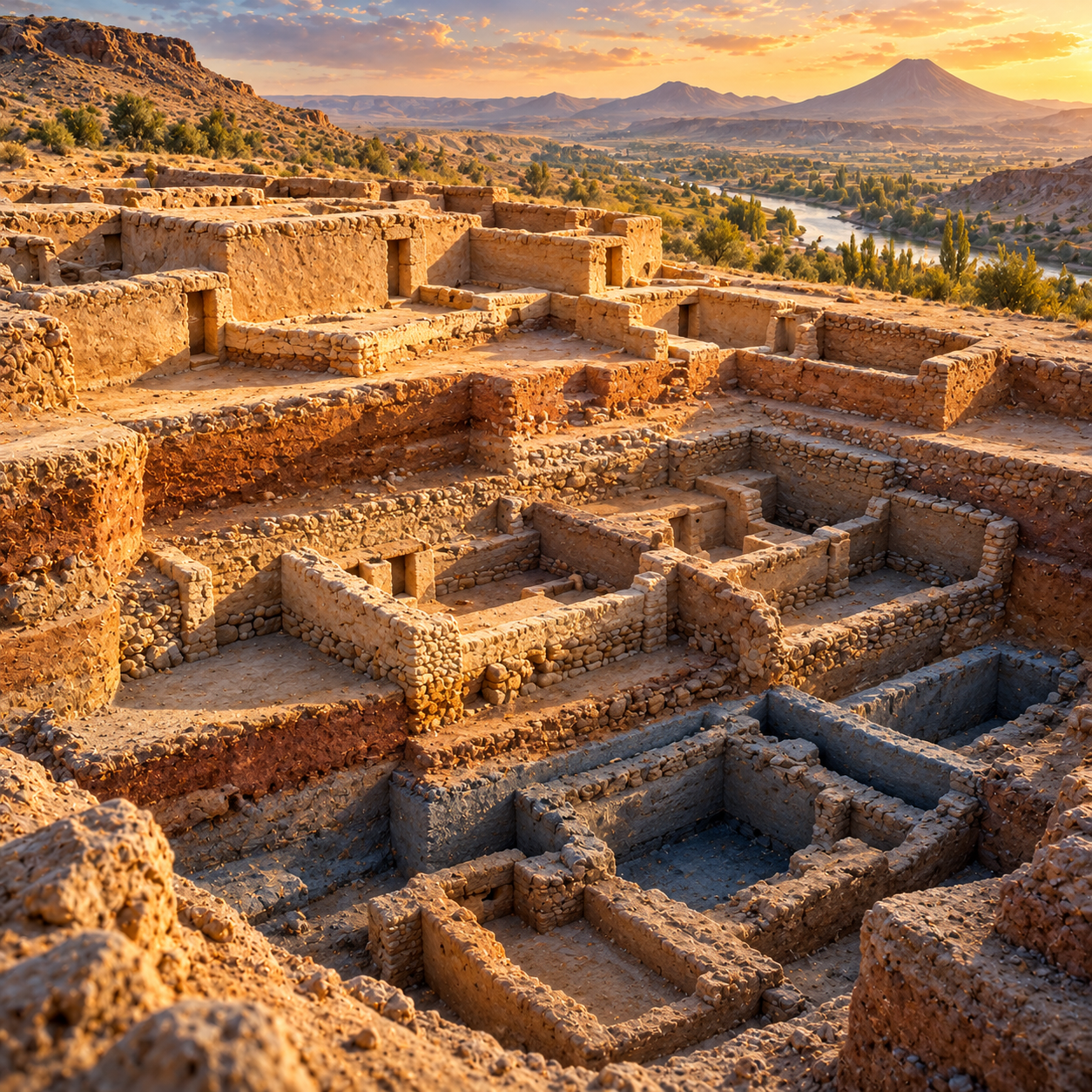
At ÇatalhöyükÇatalhöyükNeolithic site on the Konya Plain in central Anatolia, with clustered houses, subfloor burials and imagery on the East Mound, and later Chalcolithic phases on the West Mound.Glossary · Click to read the explanation in central Anatolia, cooking, storage, sleeping, decoration and burials below floorsIntramural burialDeposition of the dead within a settlement’s built area; burial beneath a domestic floor is one form.Glossary · Click to read the explanation occurred within domestic buildings. The excavation project's description of roof access, ovens and burial platforms records tangible spatial arrangements, not proof of the prayers or beliefs that accompanied any individual burial.[10]
Scott Haddow's 2025 study relates human remains to the building, occupation and renewal of houses, interpreting these as intertwined histories of people and architecture. This is an illuminating social interpretation, but its available abstract does not establish that all house renovations or burials followed an identical rite.[11]
Jericho's skulls: material evidence and its limits
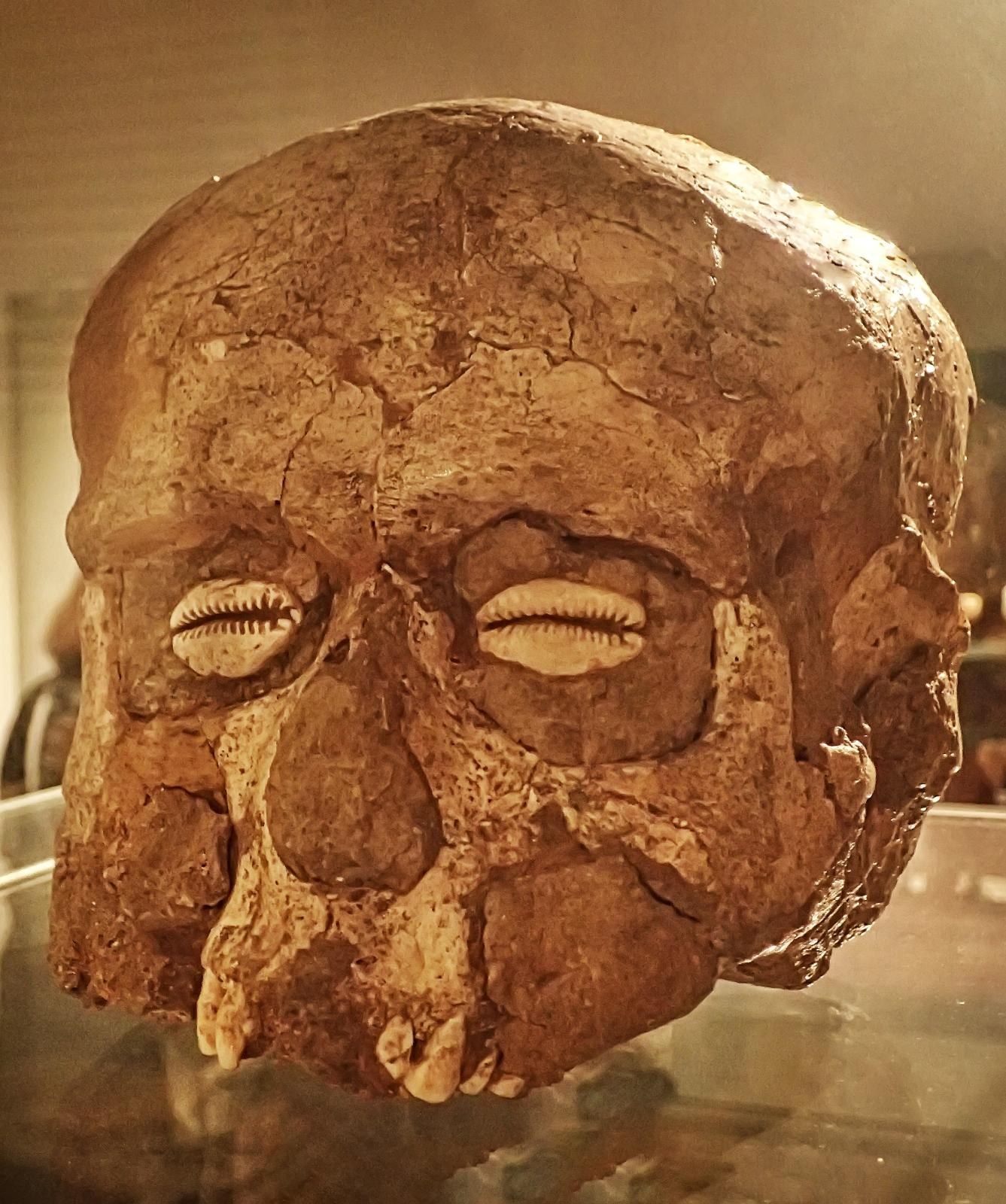
One of the plastered skullsPlastered skullsHuman skulls whose features were modelled after death with plaster or similar material, sometimes with shell eyes. Distinct from childhood head shaping; they do not by themselves disclose a person’s identity or the community’s beliefs.Glossary · Click to read the explanation from JerichoJericho / Tell es-SultanArchaeological mound near present-day Jericho in Palestine’s Jordan Valley, preserving early Neolithic settlement and Bronze Age layers.Glossary · Click to read the explanation has a face modelled in plaster and cowrie shells for eyes. Held by the Ashmolean Museum as AN1955.565, it dates to around 7000 BCE and was discovered with others by Kathleen Kenyon in 1953. The museum identifies it as an adult male skull and suggests that removal and treatment may have followed the decay of soft tissues. Its interpretation as a representation of the deceased or an aid to remembrance is an archaeological proposal, not a statement preserved from its makers.[12]
A separate Jericho plastered skull held by the Royal Ontario Museum confirms that such treatment was not confined to one specimen, while details of treatment and deposition vary. Similar practices alone cannot establish ancestor worship or a uniform creed, and the framing of a modern museum display must not be projected unchanged onto the Neolithic community.[13]
Written records: a different kind of evidence
When tablets specify actions and those responsible for them, the existence of named practices becomes better documented. An edited Hittite passage, CTH 568.5, dealing with questions about festivals, refers to the proper celebration of a festival, the king’s bakers and a supervisor of the queen’s bakers, and offerings of provisions and animals. The surviving text is fragmentary and its English rendering involves editorial restoration. It supports the elements named in that passage, not a fully reconstructed ceremony.[14]
Processions, texts and changing dates
A scholarly entry on MardukMardukBabylon’s leading god, worshipped at Esagil and elevated in the Akkadian Enūma eliš. His symbols include a spade and mušḫuššu dragon. His earliest origins remain obscure; Nibiru is no evidence of a planetary homeland.Glossary · Click to read the explanation describes his Babylonian temple cult and the New Year festival, noting a ritual text from the Parthian period which recounts a recitation of Enūma elišEnuma ElishA seven-tablet Babylonian creation poem in Akkadian, recounting Marduk’s rise, victory over Tiamat, cosmic ordering and human creation, and culminating in praise through fifty names. Its composition date is debated; later manuscripts and recitation traditions preserve it.Glossary · Click to read the explanation before his statue. The date of this late witness is not interchangeable with the earlier history of the festival: its every detail cannot be projected back into second-millennium BCE BabylonBabylonBabylon is an ancient city in central present-day Iraq, south of BaghdadGlossary · Click to read the explanation without independent evidence.[15]
Such accounts differ from silent excavated material in preserving names, personnel and written sequences. Even so, a prescriptive text may record how something ought to be performed rather than everything people actually did.
Sacrifices, feasts and deposited objects
Animals, food and vessels can be part of documented ceremonies. But butchered bones and broken pots can also arise from ordinary cooking, social feasting or later disposal. Burning, cut marks, spatial distribution, group size and relations to neighboring buildings must be evaluated before choosing among interpretations. This does not exclude ritual; it guards against replacing contextual analysis with a ready-made label.[8][9]
Is ritual space separate from everyday space?
Richard Bradley's analysis of ritualization within prehistoric European domestic settings questions any rigid partition between “ritual” and “practical” structures. This is a challenge to classification, not proof that every site used space in the same way. Food preparation, burial and remembrance might meet within one building or be spatially divided according to place and time.[16]
Conclusion: levels of confidence
We can describe what is actually observed: a plastered skull, remains beneath a platform, traces of feasting or lines describing a festival. Calling such actions ancestor commemoration, purification or the assertion of authority is a further interpretation requiring context, argument and comparison. A scholar's hypothesis remains open to revision. Ritual is not another word for the unexplained; a distinctive find does not reveal its makers' intentions by itself, and social or religious life cannot be reduced to the objects that happen to survive.
References and notes (14)
- Joanna Brück (1999). Ritual and Rationality: Some Problems of Interpretation in European Archaeology. European Journal of Archaeology 2(3), 313–344. Abstract; critique of imposing a modern separation between ritual and practical action. Return to the text ↑
- Catherine Bell, Ritual Theory, Ritual Practice, Oxford University Press, 1992; publisher’s book description, not a reading of the full chapters. Publisher description of the ritualization framework only. Return to the text ↑
- Richard Bradley, Ritual and Domestic Life in Prehistoric Europe, Routledge, 2005; publisher’s description and contents. Book description and contents only; not the full book. Return to the text ↑
- Catherine Bell, Ritual: Perspectives and Dimensions, Oxford University Press, 1997; publisher’s abstract. Publisher’s abstract and scope only; chapters not accessed. Return to the text ↑
- Roy A. Rappaport, Ritual and Religion in the Making of Humanity, Cambridge University Press, 1999; introduction listing on Cambridge Core. Introduction summary and listed chapter titles, not the book’s full text. Return to the text ↑
- Edward Swenson, “The Archaeology of Ritual,” Annual Review of Anthropology 44 (2015), 329–345. Published abstract only; full article not accessed. Return to the text ↑
- Matthew Susnow, “Toward a Methodology for Identifying Ritual in the Archaeological Record,” The Journal of Religion 102/3 (2022), 376–409. Published abstract describing spatial comparisons and general results; article paywalled. Return to the text ↑
- Çatalhöyük Research Project, “Architecture,” official project website. Complete accessible webpage on houses, roof entries, platforms, burial and decoration. Return to the text ↑
- Scott D. Haddow, “Bodies in buildings: Human remains and the life histories of houses at Neolithic Çatalhöyük,” Archaeological Research in Asia 41 (2025), 100598. Article abstract and bibliographic record only, not full paper. Return to the text ↑
- Ashmolean Museum, University of Oxford. Jericho Skull, AN1955.565. Object description and interpretation of its treatment; the museum dates it approximately around 7000 BCE. Return to the text ↑
- Queen’s University, Museum of Near Eastern Archaeology, “Plastered Human Skull” (9 March 2020), object 955.165.1, Royal Ontario Museum. Object record of a separate skull from Jericho; not the skull pictured in this entry. Return to the text ↑
- Joseph Barber (ed.), CTH 568.5, “Oracles concerning various festivals,” Corpus of Hittite Divinatory Texts, digital transcription updated 2026. Digital edition, sections 1–3 (lines 1–17), with visible transliteration and editorial English rendering; fragmentary witness. Return to the text ↑
- ORACC, Ancient Mesopotamian Gods and Goddesses, “Marduk (god),” University of Pennsylvania. Accessible scholarly entry, especially cult places and New Year festival; not a full reading of the ancient ritual tablet. Return to the text ↑
- Richard Bradley, “A Life Less Ordinary: the Ritualization of the Domestic Sphere in Later Prehistoric Europe,” Cambridge Archaeological Journal 13/1 (2003), 5–23. Published abstract only; full article not accessed. Return to the text ↑
Suggest a correction · Suggest a source for this record
Cite this record
IL Archive, «Ritual», https://ilarchive.com/en/entities/ritual
Continue reading
Related readings