Site
Aşıklı Höyük
- Timeline
- From 8350 BCE to 7300 BCE
A Neolithic Cappadocian settlement with successive buildings and selected subfloor burials.
Text
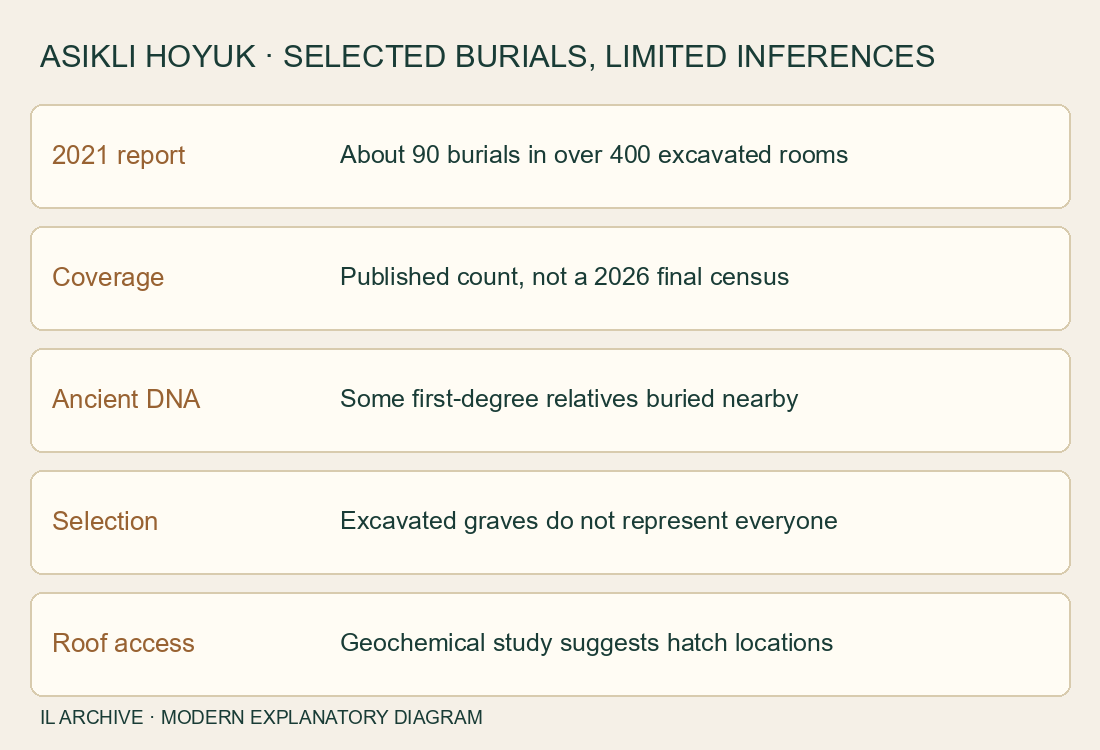
The site lies near the Melendiz River in central AnatoliaAnatoliaAnatolia is the region occupying the Asian part of present-day TurkeyGlossary · Click to read the explanation. The 2021 genetic study places occupation around 8350–7300 BCE and reports about 90 burials in over 400 excavated rooms. These are report figures, not a current final census. Some people buried in the same or nearby buildings were first-degree relatives.[1]
Architectural continuity informs research on social memorySocial memoryHow a group forms relationships to the past through narratives, practices, objects and places.Glossary · Click to read the explanation without identifying a doctrine. A geochemical study proposes roof-hatch locations; it does not establish a cosmology assigning above to the living and below to the dead. The illustration is a modern evidence summary.[2][3]
References and notes
- Reyhan Yaka et al. (2021). Variable kinship patterns in Neolithic Anatolia revealed by ancient genomes. Current Biology 31(11), 2455–2468.e1–e18. DOI: 10.1016/j.cub.2021.03.050. Aşıklı and Boncuklu results, discussion and STAR Methods site backgrounds read in the full text through Europe PMC. Counts belong to the 2021 report; sampled DNA and proposed relationships do not form a complete population register. Return to the text ↑
- Güneş Duru & Mihriban Özbaşaran (2024). Preserving collectivity through continuity. Archaeological Research in Asia 40, 100555. DOI: 10.1016/j.ara.2024.100555. Indexed publisher abstract and short preview passages only; full paper not read. Architectural continuity, memory and social structure are the authors’ interpretation, not direct access to each household’s beliefs. Return to the text ↑
- Fatma Kalkan, Mihriban Özbaşaran & Rana Özbal (2024). Geochemical Analyses to Make the Invisible More Concrete: Cycles of Building Use and Roof Hatches at the Early Neolithic Site of Aşıklı Höyük. Journal of Field Archaeology 49(5), 301–317. DOI: 10.1080/00934690.2024.2338621. Indexed abstract at the author’s university only: five successive floors and proposed roof-hatch locations. Full paper not read; the abstract does not establish an above/below cosmology. Return to the text ↑
Research history
Substantive changes are retained here. Minor copy edits remain in the internal operational log.
-
Substantive record update
Suggest a correction · Suggest a source for this record
Cite this record
IL Archive, «Aşıklı Höyük», Edition 2, https://ilarchive.com/en/sites/asikli-hoyuk