Entity · Deity
Marduk
A reference page linking a name, group, or concept to the materials that discuss it.
- Names
- Bēl · Marduk · dAMAR.UTU
Marduk, Babylon’s leading god: what Hammurabi’s prologue, Enūma eliš, Esagil ritual, and his symbols attest—and what remains uncertain about his origins and Nibiru/Jupiter.
Estimated reading time: 5 min Published Last reviewed:
Share article
Video
Enuma Elish: The first waters, the storm and the fifty names
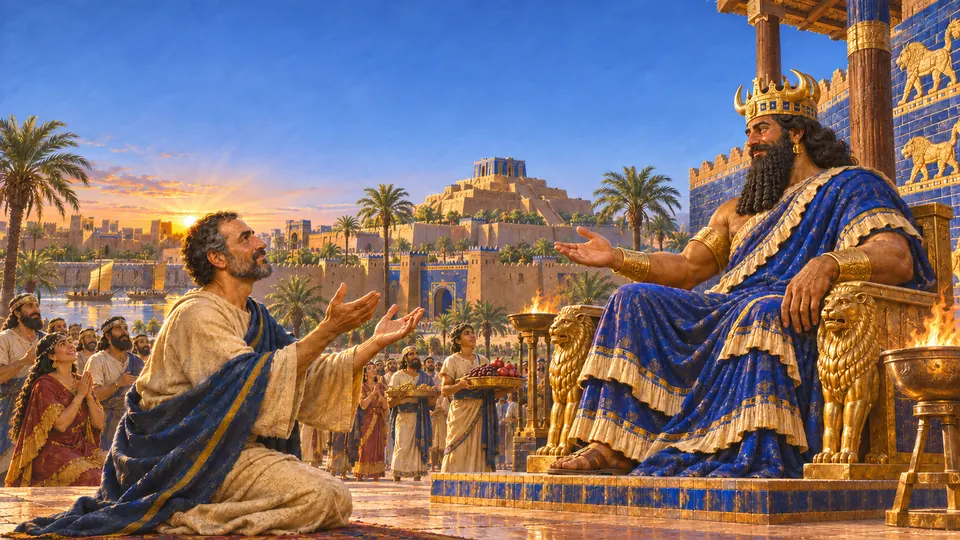
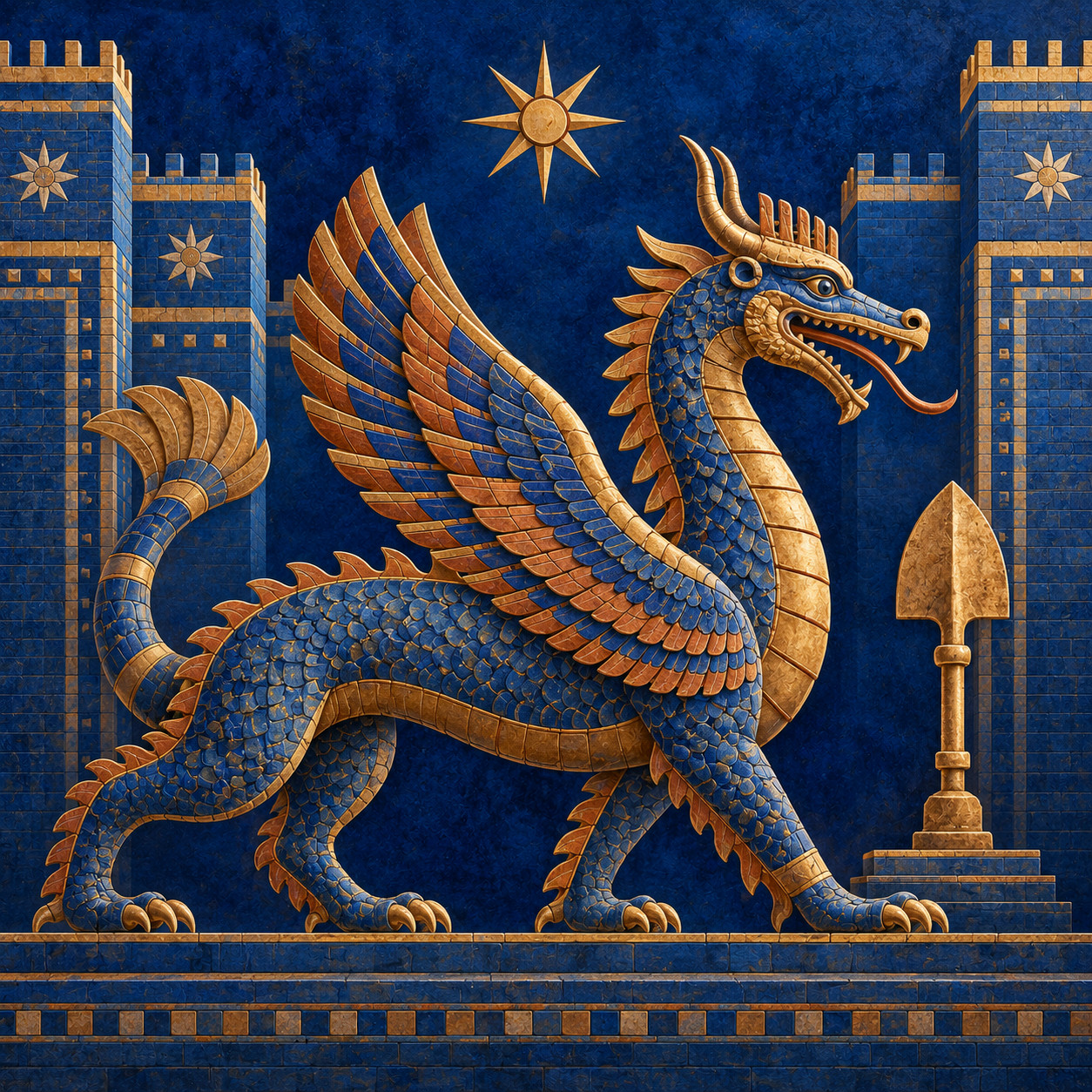
The first waters, the storm and the fifty names. The whole story in four illustrated chapters, told from the ancient clay tablets; where the tablets are broken, the narration says so. Illustrations, narration voice and visual effects were created with AI tools by IL Archive; the text is a faithful retelling based on the ancient tablets.
The YouTube player loads only when you press play. Watch on YouTube
Text
Introduction
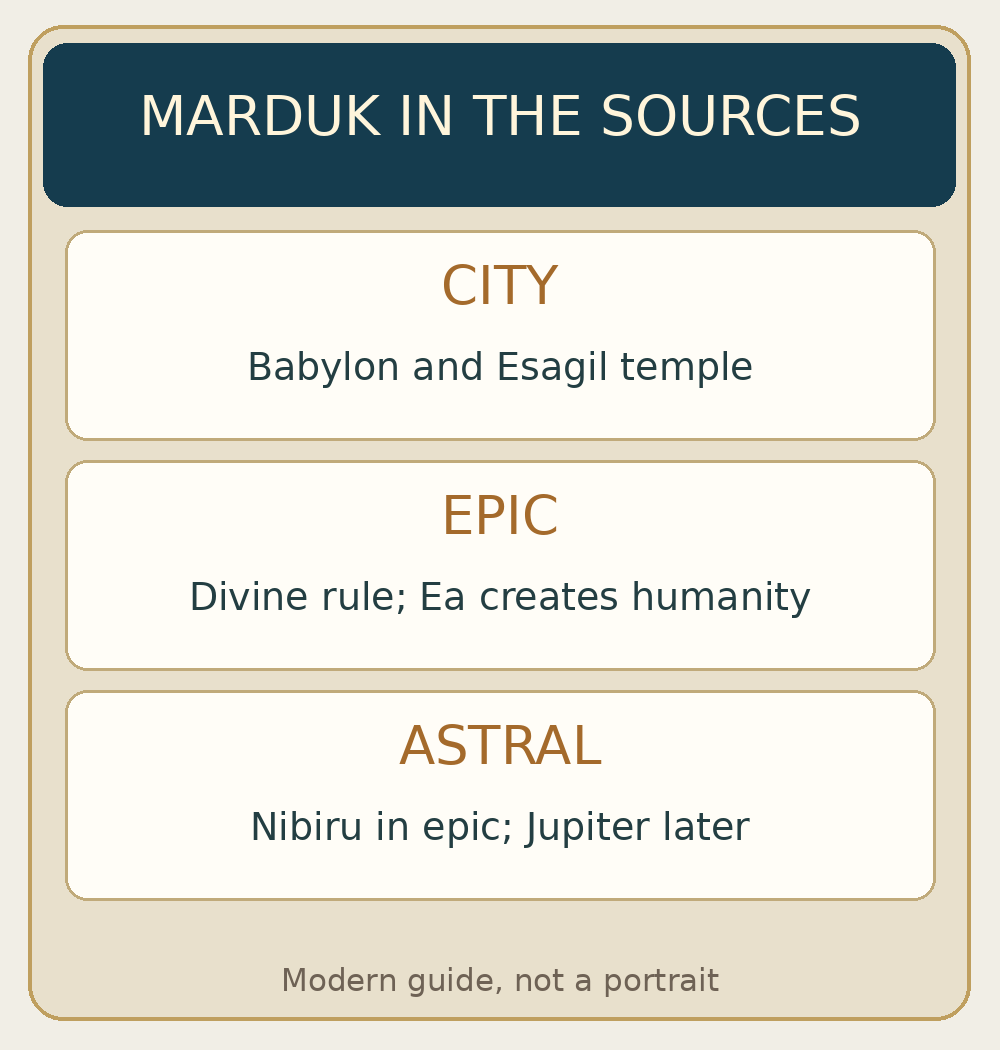
Who was Marduk, the god who became pre-eminent at BabylonBabylonBabylon is an ancient city in central present-day Iraq, south of BaghdadGlossary · Click to read the explanation? Neither the image of a dragon nor his victory over TiamatTiamatTiamat is a primeval divine mother and watery figure in Enūma eliš who later opposes Marduk; he divides her body in making the cosmos. No Babylonian portrait of her is securely identified.Glossary · Click to read the explanation is a complete answer. This entry examines his name, worship, and rise in the sources, distinguishing the literary world of Enūma elišEnuma ElishA seven-tablet Babylonian creation poem in Akkadian, recounting Marduk’s rise, victory over Tiamat, cosmic ordering and human creation, and culminating in praise through fifty names. Its composition date is debated; later manuscripts and recitation traditions preserve it.Glossary · Click to read the explanation from political history and its use of “NibiruNibiru: Crossing and Astral NameAn Akkadian word for a crossing, ford or ferry, also a celestial name associated with Marduk and applied to Jupiter or Mercury in particular contexts; it does not identify one body in every use.Glossary · Click to read the explanation” from later astronomical identifications.
Name and standing
Marduk was closely associated with BabylonBabylonBabylon is an ancient city in central present-day Iraq, south of BaghdadGlossary · Click to read the explanation and became one of MesopotamiaMesopotamiaHistorical region associated with the Tigris and Euphrates: Uruk, Ur, Eridu, cuneiform, Sumer, Akkad, Babylon and Assyria, their languages and cults, and the limits of archaeological evidence.Glossary · Click to read the explanation’s most prominent gods in the first millennium BCE. He was also called Bēl, “Lord,” but the title could apply to other deities and cannot by itself identify Marduk in every context. His earliest origin and functions remain uncertain despite early attestations connected with his name.[1]
His name may be written with the Sumerian cuneiformCuneiformWriting with wedge-shaped signs, developed from Mesopotamian recording traditions and used for several languages from the third millennium BCE.Glossary · Click to read the explanation signs dAMAR.UTU, literally interpretable as “calf of the sun.” This spelling does not prove that he was the sun god’s son or originally a solar or storm deity. Whether certain Early Dynastic spellings already designate Marduk is disputed.[1]
From city patron to senior deity
No single text narrates Marduk’s historical ascent as it happened. The prologue to the Laws of HammurabiLaws of HammurabiAn eighteenth-century BCE Babylonian legal text in Akkadian, presenting property, family, labor and injury provisions within Hammurabi’s account of justice.Glossary · Click to read the explanation, dating to the eighteenth century BCE, presents Anu and EnlilEnlilEnlil/Ellil: a major Mesopotamian god associated with destinies, kingship, and Ekur at Nippur, already prominent in third-millennium god lists. His name’s origin and cult beginnings remain debated.Glossary · Click to read the explanation as granting Marduk Enlil’s authority over the peoples and elevating Babylon. This is royal legitimation, not neutral evidence that a transfer of divine authority occurred on a particular historical day.[3]
His standing grew alongside Babylon’s political and religious influence during the second and first millennia. The Elamite removal of his cult statue and its return under Nebuchadnezzar I in the late twelfth century BCE are important in later accounts; the date when Enūma eliš was composed, however, remains debated. The date of a manuscript or redaction must not be confused with the time of its narrated action.[1]
Genealogy and changing identifications
Traditions call Marduk a son of Enki/EaEnkiMesopotamian deity also known as Ea, linked with Eridu and the Abzu (deep fresh waters), wisdom, incantations, and narratives of creation and cosmic order. Later written attestations do not identify the deity of Eridu’s earliest layers.Glossary · Click to read the explanation, the god of wisdom and deep waters; they name Ṣarpanitum as his consort. Nabû was first described as his minister and subsequently as his son in evolving traditions. Old Babylonian texts also identify Marduk in varying degrees with Asalluhi and Tutu, while at times keeping them distinct. Such divine genealogies did not form an unchanging family tree.[1]
Sanctuary and ritual
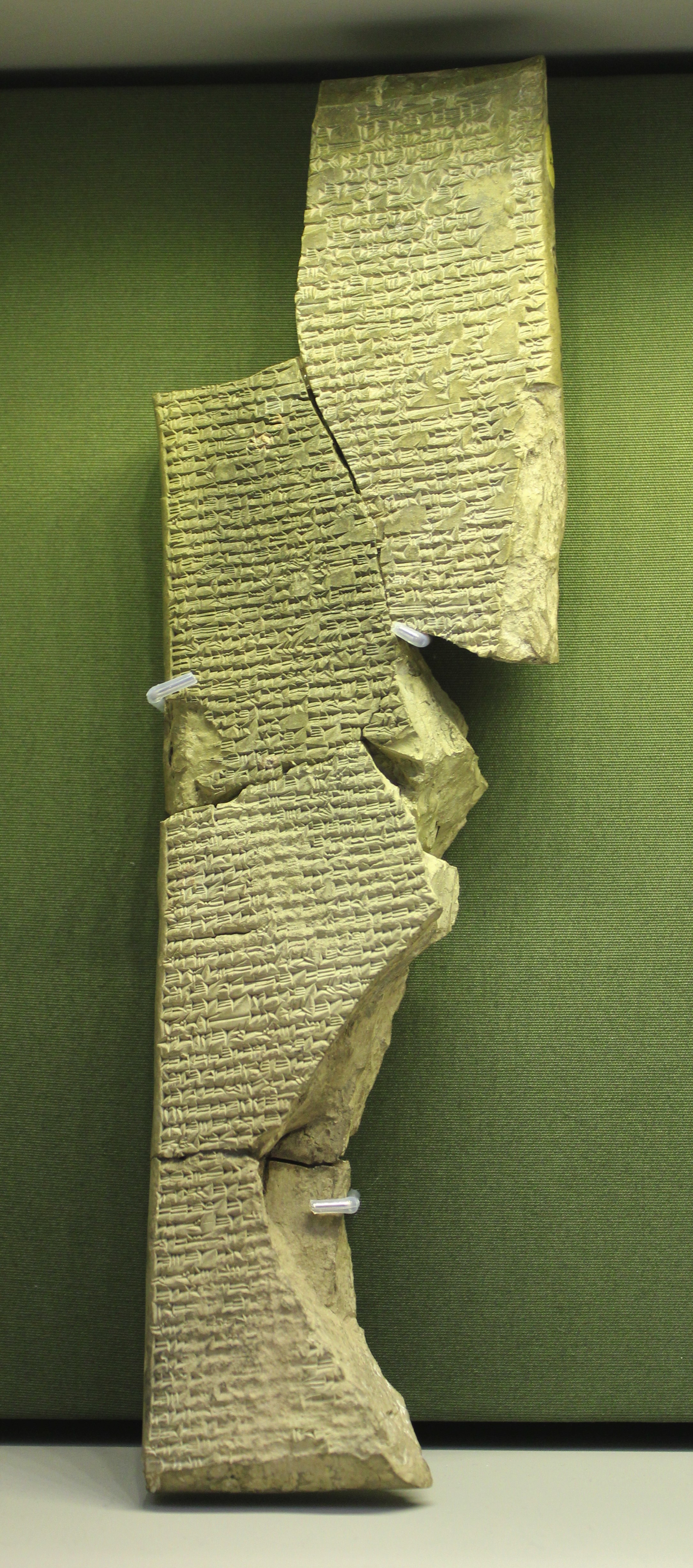
Marduk’s central sanctuary was EsagilEsagil, Marduk’s templeEsagil, also written Esagila, is Marduk’s temple in ancient Babylon, in present-day Iraq, and a central sanctuary of the city’s god.Glossary · Click to read the explanation at Babylon; the temple tower EtemenankiEtemenankiStepped ziggurat in Babylon’s Esagil sacred precinct, associated with Marduk. Excavations establish its base, royal texts attest rebuilding, and a later Esagil Tablet supplies idealized dimensions.Glossary · Click to read the explanation was associated with his sacred precinct. The city also had an akītu-house for the New Year festival. Brisch notes a ritualRitualAn organised or distinguished practice meaningful to a community; it may leave traces, but its form alone does not reveal an associated doctrine.Glossary · Click to read the explanation text from the Parthian period prescribing the recitation of Enūma eliš before Marduk’s statue. That is late evidence for a ritual practice, not proof that the festival had the same form throughout Babylonian history.[1]
Victory in Enūma eliš
In the AkkadianAkkadianAn ancient East Semitic language written in cuneiform from the third millennium BCE; its varieties include Babylonian and Assyrian, and it served in international diplomacy.Glossary · Click to read the explanation composition Enūma elišEnuma ElishA seven-tablet Babylonian creation poem in Akkadian, recounting Marduk’s rise, victory over Tiamat, cosmic ordering and human creation, and culminating in praise through fifty names. Its composition date is debated; later manuscripts and recitation traditions preserve it.Glossary · Click to read the explanation, transmitted in multiple manuscripts and fragments, the gods authorize Marduk to confront TiamatTiamatTiamat is a primeval divine mother and watery figure in Enūma eliš who later opposes Marduk; he divides her body in making the cosmos. No Babylonian portrait of her is securely identified.Glossary · Click to read the explanation. Tablet IV narrates his victory and his ordering of the cosmos. The poem is therefore more than a description of material creation: it vindicates his leadership of the divine assembly. Its story should not be treated as a chronicle of a historical battle or as an exhaustive account of what all Mesopotamians believed.[2]
Who creates humanity, and why?
Tablet VI opens with Marduk’s plan to create humans to relieve the gods of their labour. Ea proposes sacrificing the god responsible for the rebellion; KinguQinguQingu (Kingu): a god whom Tiamat appoints commander and gives the Tablet of Destinies; captured after Marduk’s victory, his blood is used to make humans in Tablet VI.Glossary · Click to read the explanation is named, and people are made from his blood. The passage explicitly credits Ea/Nudimmud with the actual making under Marduk’s plan (VI 1–38). “Marduk alone created humans” therefore obscures the passage’s allocation of roles.[4]
Marduk then assigns duties to the Anunna/AnunnakiAnunna / AnunnakiAnunna/Anunnaki is a collective designation for Mesopotamian gods whose scope varies by text and period; it is not a group with one fixed membership or number.Glossary · Click to read the explanation. In VI 39–46 there are 300 stationed in heaven and 600 in total, in heaven and the lower world in Heidel’s reading. These are divine groupings within the story; the lines make no claim about extraterrestrial settlers.[5]
Nibiru, Jupiter, and distinct kinds of evidence
NibiruNibiru: Crossing and Astral NameAn Akkadian word for a crossing, ford or ferry, also a celestial name associated with Marduk and applied to Jupiter or Mercury in particular contexts; it does not identify one body in every use.Glossary · Click to read the explanation occurs in Tablet V as an astral station or marker for the courses of stars, and in Tablet VII as one of Marduk’s names (approximately VII 124–130). Heidel’s note to V identifies Nibiru with Jupiter; first-millennium astronomical traditions also associate Marduk with Jupiter. An astral name within an epic and later identifications of a celestial object are not a statement that the god lived on a physical planet. Neither claim establishes an inhabited world or an undiscovered orbit.[6]
Symbols are not portraits
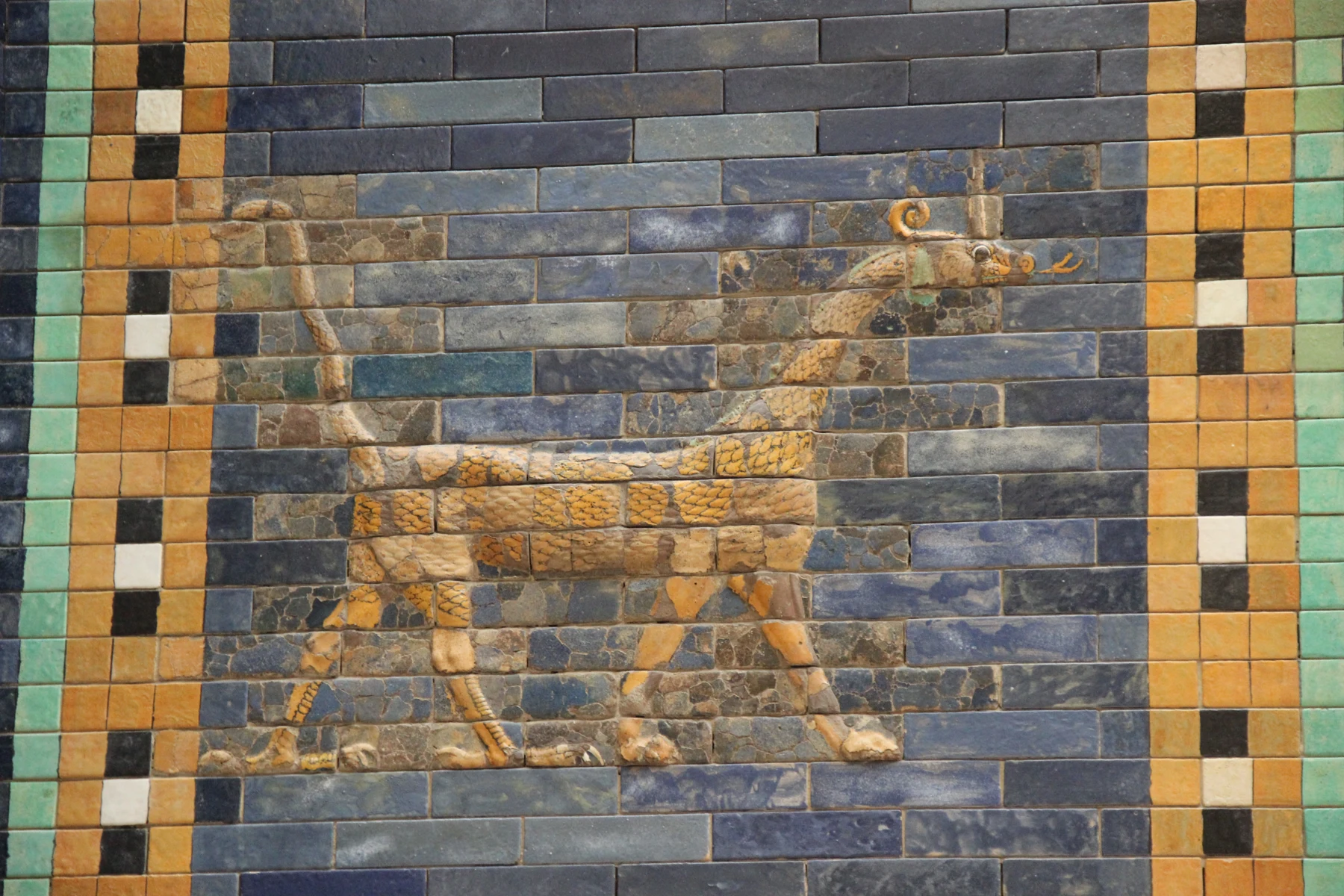
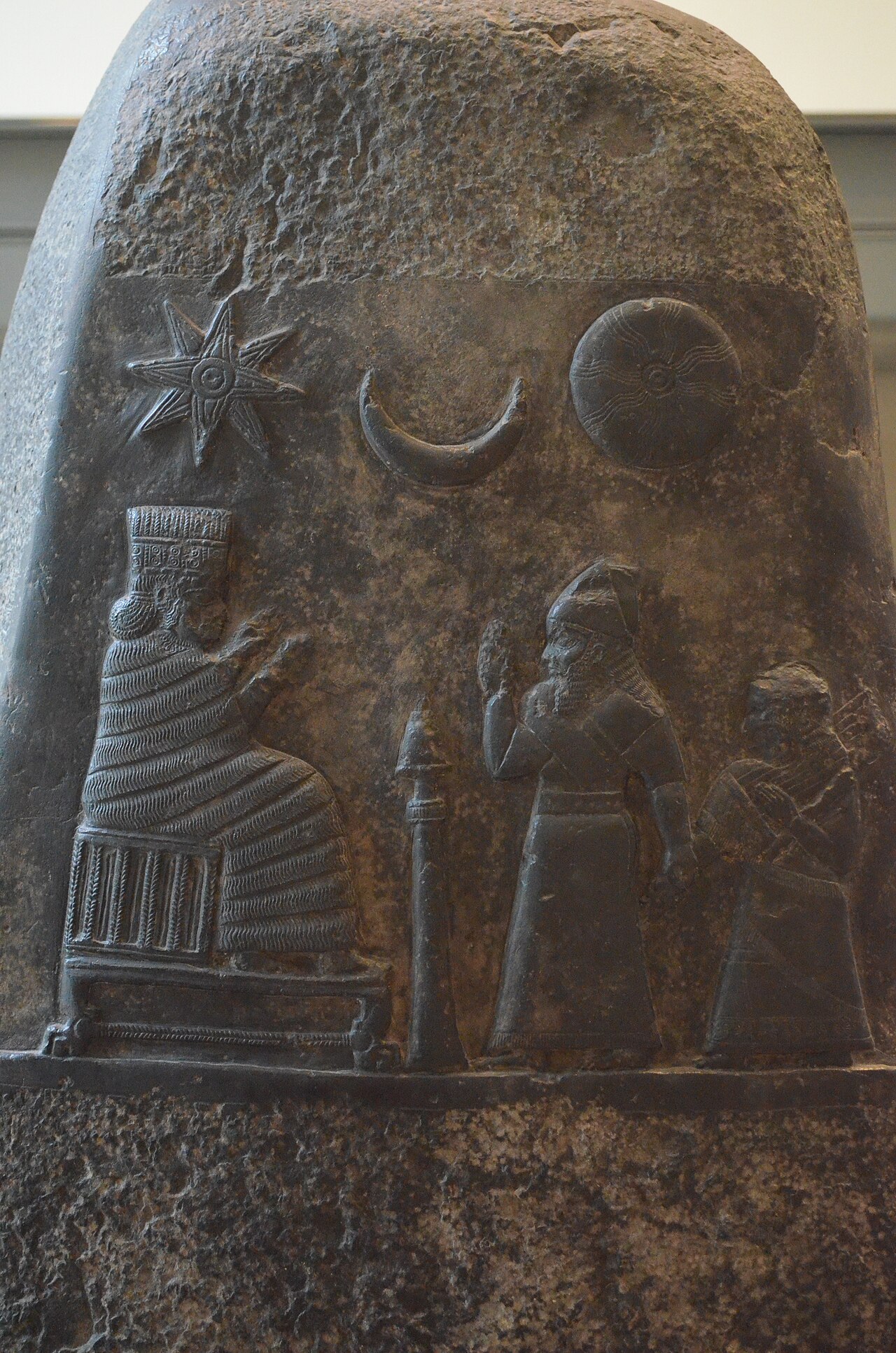
The triangular-headed spade and the composite snake-dragon known as the mušḫuššu are among Marduk’s attributes. A Babylonian kudurru fragment at the Metropolitan Museum of Art (1985.45, ca. 1156–1025 BCE) shows the dragon approaching a spade emblem above a shrine facade. These are representations of the god’s symbols, not a securely established anatomical portrait; the dragon is also associated with Nabû.[7]
Prayer, suffering, and literary reception
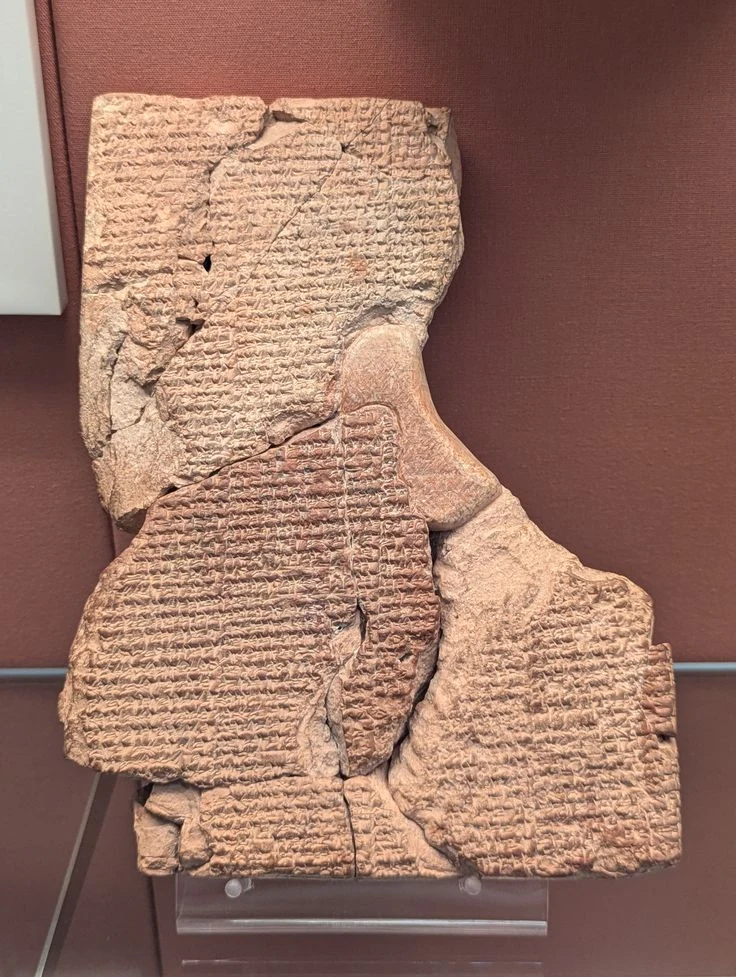
The epic does not exhaust Marduk’s character. In Ludlul bēl nēmeqiLudlul bēl nēmeqiBabylonian Akkadian poem about Šubši-mešrê-Šakkan, his suffering, recovery, and praise of Marduk, examined through its five tablets, manuscript witnesses, dating, and qualified comparison with Job.Glossary · Click to read the explanation, a sufferer praises Marduk amid calamity and eventual recovery. The abstract of a modern scholarly study interprets its opening as carefully reconciling the god’s anger and mercy, an interpretation rather than a universally settled judgment. A fragmentary first-millennium hymn tablet at the Metropolitan Museum (86.11.313) further documents continuing literary devotion to him.[8][9]
What is secure and what remains open?
Babylonian cult and royal texts, the narrative roles of Enūma eliš, and the spade and dragon symbols are well attested. Marduk’s earliest functions, the stages of his rise, and the dates and meanings of individual literary and ritual strata are less certain. He should not be described as originating from “Nibiru” as a populated homeworld, nor should modern explanatory imagery be mistaken for ancient depictions of his body.
References and notes (9)
- Nicole Brisch, “Marduk (god),” Ancient Mesopotamian Gods and Goddesses, ORACC, 2019. Entire online entry read via HTML extraction, including name, origins, genealogy, history, ritual, astral and iconographic sections; works listed in its bibliography were not thereby read. Return to the text ↑
- Alexander Heidel, The Babylonian Genesis: The Story of Creation, 2nd ed., University of Chicago Press, 1951. Read printed pp. 40–41 (Tablet IV) and 44–45 (Tablet V) in scanned images of the Yale-hosted excerpt; not the complete book. Return to the text ↑
- SEAL, “CH Prologue and Epilogue (Hammurāpi),” University of Leipzig / Hebrew University; English translation by Michael P. Streck. Directly read Akkadian transliteration and English translation of the prologue, column i 1–49 and column ii 1–12; not the entire long page. Return to the text ↑
- Alexander Heidel, The Babylonian Genesis, 2nd ed., 1951. Read scanned printed pp. 46–49, Enūma eliš VI 1–87, including Marduk’s proposal, Ea’s creation, Kingu’s blood, and the divine allocations. Return to the text ↑
- ORACC, “Anunna (Anunnaku, Anunnaki),” Ancient Mesopotamian Gods and Goddesses, section on Enūma eliš VI 39–44. Read the indexed search excerpt on 300 above and 300 below, cross-checked against Heidel, printed pp. 46–48; entire entry not read. Return to the text ↑
- Alexander Heidel, The Babylonian Genesis, 2nd ed., 1951. Directly read printed p. 44 (Tablet V 1–8 and n. 99), and pp. 58–60 (Tablet VII 94–157, particularly 118–144). The Jupiter identification is a translator’s note, not a planetary-home claim. Return to the text ↑
- The Metropolitan Museum of Art, “Top fragment of a kudurru with a mushhushshu dragon and divine symbols,” accession 1985.45. Read object record and catalog description (ca. 1156–1025 BCE), including spade, dragon, and Nabû association. Image viewed on museum page, not reproduced here. Return to the text ↑
- M. Piccin and Martin Worthington, “Schizophrenia and the problem of suffering in the Ludlul hymn to Marduk,” Revue d’assyriologie et d’archéologie orientale 109 (2015). University of Cambridge repository abstract only; article pages and arguments not read. The analysis is attributed to its authors. Return to the text ↑
- The Metropolitan Museum of Art, “Cuneiform tablet: hymn to Marduk,” accession 86.11.313. Read the museum’s short object description and dating (first millennium BCE); only the middle survives. The Akkadian cuneiform text was not read in full. Return to the text ↑
Suggest a correction · Suggest a source for this record
Cite this record
IL Archive, «Marduk», https://ilarchive.com/en/entities/marduk
Continue reading
Related readings
Related posts and imagesAll videos and images