Site · Contextual definition
Babylon
Babylon grew on both sides of the Euphrates. Its excavated walls, glazed-brick gateway and temple foundations show how a royal capital took shape, while earlier streets remain harder to recover below the later city.
Estimated reading time: 3 min Published Last reviewed:
Share article
Text
Introduction
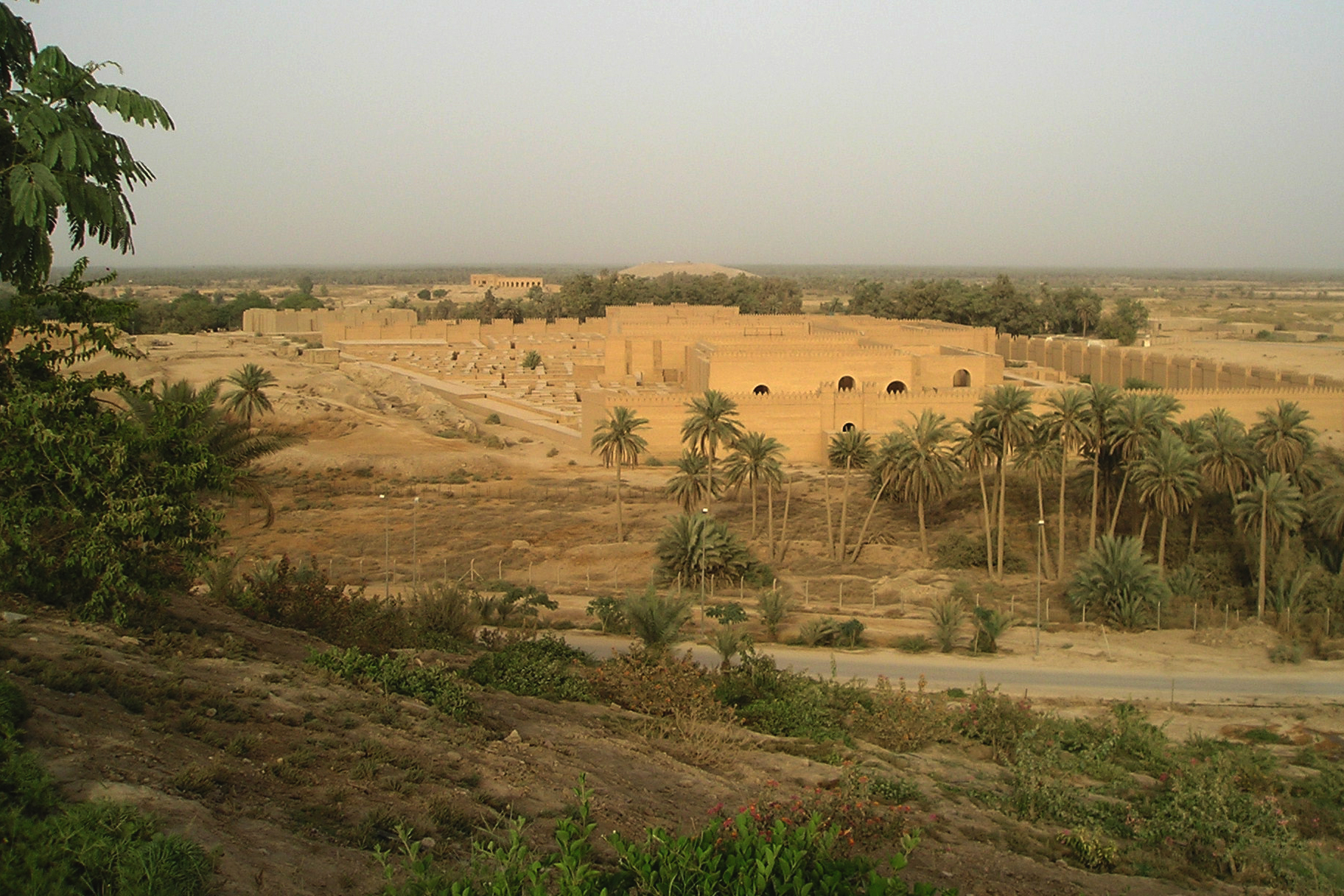
Babylon stood on the Euphrates near modern al-Hillah, about 85 kilometres south of Baghdad in present-day IraqIraqIraq is a modern country encompassing much of ancient MesopotamiaGlossary · Click to read the explanation. It was a seat of kingship under HammurabiHammurabiKing of Babylon in Mesopotamia, reigning around 1792–1750 BCE. A celebrated legal text preserved on a stele and cuneiform copies bears his name.Glossary · Click to read the explanation in the eighteenth century BCE and the capital of the Neo-Babylonian Empire in 626–539 BCE. Many of the remains visible at the site belong to the much later city that Nabopolassar and his son Nebuchadnezzar II rebuilt. The broader region, Babylonia, included cities and farmland beyond Babylon itself. [1][2][3][4]
The earlier city beneath the ruins
Hammurabi made Babylon the centre of a kingdom that extended over much of MesopotamiaMesopotamiaHistorical region associated with the Tigris and Euphrates: Uruk, Ur, Eridu, cuneiform, Sumer, Akkad, Babylon and Assyria, their languages and cults, and the limits of archaeological evidence.Glossary · Click to read the explanation. The surviving city plan is much clearer for the first millennium BCE than for his reign. Earlier remains lie beneath later construction, and groundwater limits excavation at depth. At Merkes, a residential district, German excavators reached Old Babylonian levels in some trial pits when the water table was temporarily lower. The isolated exposures give evidence for early occupation alongside the more extensive remains of later streets and houses. [2][3][4]
A branch of the Euphrates ran through the later city. A bridge linked the two banks, and streets divided the built-up area into districts. Archaeological work has exposed houses and temples away from the royal complex as well as the better-known monuments near the northern gates. At Merkes the excavators documented both private houses and a temple of IshtarInanna / IshtarA prominent Mesopotamian goddess whose Sumerian name Inanna became associated with Akkadian Ishtar across diverse traditions. She was associated with desire, war, royal authority and Venus, while local forms and genealogies varied among texts.Glossary · Click to read the explanation. These finds help locate everyday neighbourhoods within the outline formed by the city's walls. [2][3][4]
From the Ishtar Gate to the temple district
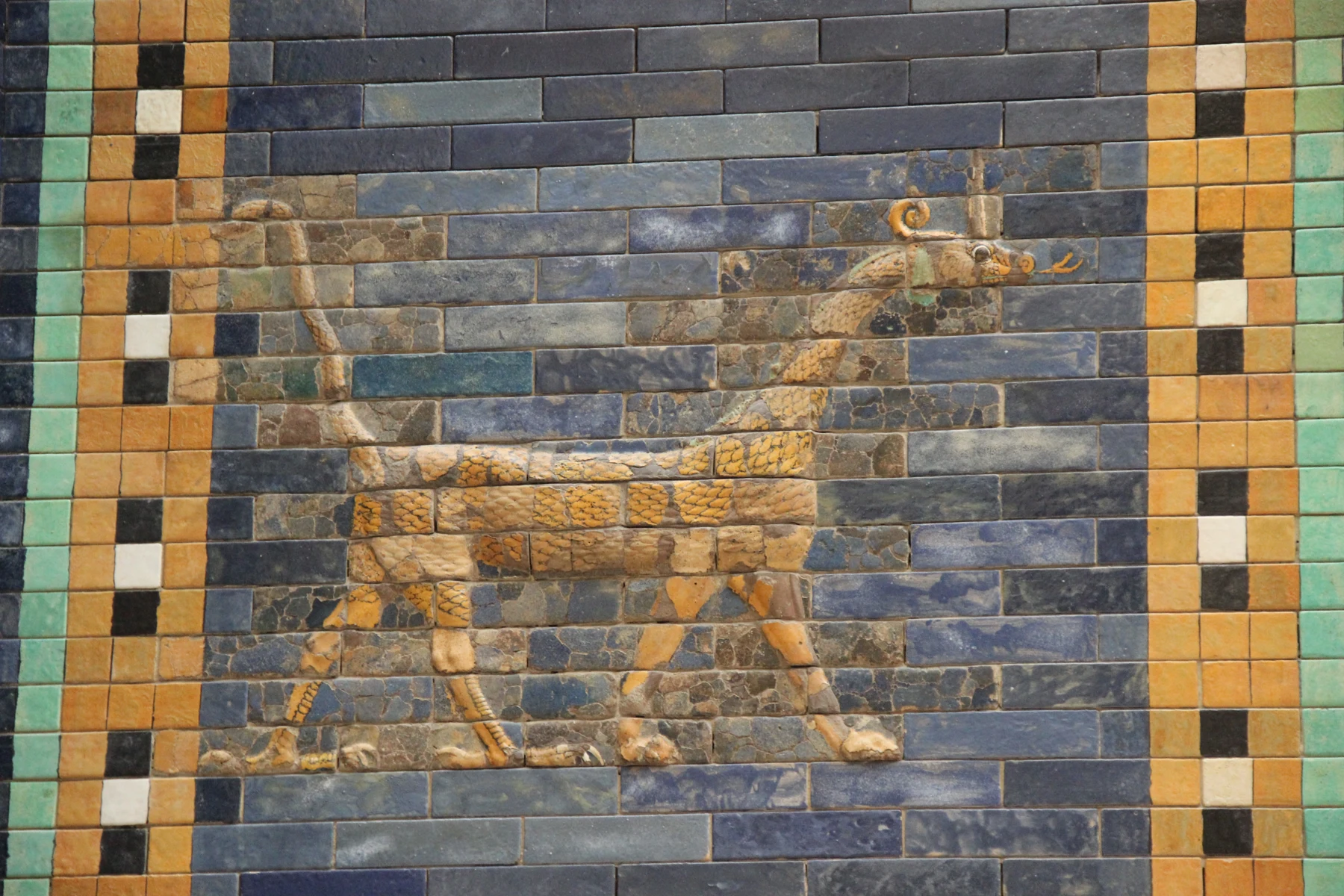
Under Nebuchadnezzar II the walls, palaces and ceremonial streets received extensive building work. The Ishtar Gate stood by the South Palace at the northern approach to the inner city. The Processional Way ran south toward the sanctuary of MardukMardukBabylon’s leading god, worshipped at Esagil and elevated in the Akkadian Enūma eliš. His symbols include a spade and mušḫuššu dragon. His earliest origins remain obscure; Nibiru is no evidence of a planetary homeland.Glossary · Click to read the explanation. Glazed bricks on the Ishtar Gate carried bulls and serpent-dragons in alternating rows. The walls of the Processional Way carried lions. The reconstruction in Berlin uses ancient fragments and modern bricks to present the smaller gateway of the original complex. [3][4][5][6]
Near the Euphrates stood Esagil, Marduk's main temple, and the adjacent temple tower EtemenankiEtemenankiStepped ziggurat in Babylon’s Esagil sacred precinct, associated with Marduk. Excavations establish its base, royal texts attest rebuilding, and a later Esagil Tablet supplies idealized dimensions.Glossary · Click to read the explanation. Their foundations mark distinct buildings within the sacred district. Royal inscriptions describe Nabopolassar beginning work on the zigguratZigguratZiggurat: a monumental stepped or terraced cult structure of ancient Mesopotamia. Not every raised temple platform was a ziggurat, and the form and specific use of lost upper stages often remain uncertain.Glossary · Click to read the explanation, which was already old, and Nebuchadnezzar II continuing the rebuilding. The excavated remains and the inscriptions answer different questions. The foundations locate the structure within the city, while the royal accounts describe the work the kings claimed to have undertaken. [1][3]
The city after 539 BCE
The Nabonidus Chronicle records fighting at Opis on the Tigris in 539 BCE. It says that Cyrus’s army entered Babylon without a battle, that Nabonidus was captured and that Cyrus himself arrived later. Babylon remained inhabited under Persian rule. Excavators also found a Greek theatre at Homera, an example of construction from the city's later history. The ruins on the mound contain remains from several periods, alongside buildings partly reconstructed in modern times. UNESCO inscribed Babylon on the World Heritage List in 2019. [1][2][4][7]
Quick answers
Where was Babylon?
The ruins stand near modern al-Hillah in Iraq, about 85 kilometres south of Baghdad. [1][4]
Which remains are best known?
They include parts of the inner and outer walls, the Ishtar Gate, the palaces, the temple district and traces of the Processional Way. [1][3]
Is the whole Ishtar Gate in Berlin?
Berlin's reconstruction presents the smaller gateway from the original complex. It uses ancient glazed-brick fragments together with modern bricks. [5][6]
What happened in 539 BCE?
The Persian army entered Babylon without a battle, according to the Nabonidus Chronicle. Cyrus himself entered the city later. [1][7]
References and notes (7)
- UNESCO World Heritage Centre, “Babylon,” World Heritage List 278rev Brief synthesis, integrity and inscription data. Location, capital dates, surviving remains, modern reconstruction and World Heritage inscription. Return to the text ↑
- University of Münster, Governance in Babylon, “Babylon” Sections on the German excavations of 1899–1917 and the later excavations. Merkes soundings, groundwater, houses, the Ishtar temple and the Greek theatre. Return to the text ↑
- Jamie Novotny and Frauke Weiershäuser, The Royal Inscriptions of Nabopolassar (625–605 BC) and Nebuchadnezzar II (604–562 BC), Kings of Babylon, Part 1, RINBE 1/1, Eisenbrauns, 2024 Introduction, pp. 4–9, particularly fig. 2 and notes 28–36. City plan, walls, streets, the South Palace, Esagil and the rebuilding of Etemenanki. Return to the text ↑
- Republic of Iraq, Babylon: Nomination Dossier for Inscription of the Property on the World Heritage List (2018) Chapters 1–2. Location, excavated houses, the bridge piers on printed p. 57, the Greek theatre and the historical section on Hammurabi. Return to the text ↑
- Staatliche Museen zu Berlin, “Ischtar-Tor (III. Baustufe),” Vorderasiatisches Museum Object description. The two-part gate, surviving brick reliefs, animals, and the reconstruction of the smaller gateway. Return to the text ↑
- Staatliche Museen zu Berlin, “From Fragment to Monument: The Ishtar Gate in Berlin,” 2020–2021 “The Ishtar Gate in Berlin.” Excavation of the glazed brick fragments and their use, with modern bricks, in the museum reconstruction. Return to the text ↑
- Nabonidus Chronicle (BM 35382, ABC 7), A. K. Grayson’s translation as adapted by Livius Col. III, lines 12–18. Fighting at Opis, entry into Babylon without a battle, Nabonidus’s capture and Cyrus’s later arrival. Return to the text ↑
Suggest a correction · Suggest a source for this record
Cite this record
IL Archive, «Babylon», https://ilarchive.com/en/sites/babylon
Continue reading
Related readings