Study
Marduk’s Rise: Babylon and the Making of Divine Kingship
An extended study of a topic, with evidence and references.
- Timeline
- From 1800 BCE to 500 BCE
- Region
- Mesopotamia / Babylon
From assembly recognition and battle to Babylon and fifty names: how did the poem frame Marduk’s supremacy, and how does it relate to historical evidence?
Estimated reading time: 4 min Published Last reviewed:
Share article
Video
Enuma Elish: The first waters, the storm and the fifty names
The first waters, the storm and the fifty names. The whole story in four illustrated chapters, told from the ancient clay tablets; where the tablets are broken, the narration says so. Illustrations, narration voice and visual effects were created with AI tools by IL Archive; the text is a faithful retelling based on the ancient tablets.
The YouTube player loads only when you press play. Watch on YouTube
Text
Introduction
Why does a story about the world's beginnings make one particular city its center? This study examines the rise of MardukMardukBabylon’s leading god, worshipped at Esagil and elevated in the Akkadian Enūma eliš. His symbols include a spade and mušḫuššu dragon. His earliest origins remain obscure; Nibiru is no evidence of a planetary homeland.Glossary · Click to read the explanation, the god of BabylonBabylonBabylon is an ancient city in central present-day Iraq, south of BaghdadGlossary · Click to read the explanation, through Enuma ElishEnuma ElishA seven-tablet Babylonian creation poem in Akkadian, recounting Marduk’s rise, victory over Tiamat, cosmic ordering and human creation, and culminating in praise through fifty names. Its composition date is debated; later manuscripts and recitation traditions preserve it.Glossary · Click to read the explanation. We follow how victory, creation, divine recognition and names combine to justify his supremacy.
We place this literary construction alongside historical evidence for Babylon's standing. City, deity and poem have connected histories, but they do not all begin at one moment. Elevating a god within an assembly of other deities also differs from denying their existence.
Kingship before battle
The gods face a threat led by TiamatTiamatTiamat is a primeval divine mother and watery figure in Enūma eliš who later opposes Marduk; he divides her body in making the cosmos. No Babylonian portrait of her is securely identified.Glossary · Click to read the explanation, and Marduk offers rescue on one condition: his command must hold supreme authority. The assembly recognizes his standing before the battle occurs. This sequence concerns legitimate rule as well as strength; the champion wants recognition that will outlast the danger.[1]
The rise of a god and a city
Ancient Babylon lies in present-day IraqIraqIraq is a modern country encompassing much of ancient MesopotamiaGlossary · Click to read the explanation. Sources indicate Marduk's increasing importance over a long period, while his earliest function and origins remain less clear. One identifiable early sign occurs in the eighteenth-century BCE prologue to the Laws of HammurabiLaws of HammurabiAn eighteenth-century BCE Babylonian legal text in Akkadian, presenting property, family, labor and injury provisions within Hammurabi’s account of justice.Glossary · Click to read the explanation.[2][4]
The prologue connects Marduk's dominion over humanity with Babylon's elevation, followed by King HammurabiHammurabiKing of Babylon in Mesopotamia, reigning around 1792–1750 BCE. A celebrated legal text preserved on a stele and cuneiform copies bears his name.Glossary · Click to read the explanation's commission to establish justice. It shows that linking deity, city and royal authority preceded Babylon's celebrated sixth-century BCE architecture. It does not date Enuma Elish to Hammurabi's reign: the legal inscription and poem are different witnesses.
From recognition to cosmic order
In the poem, Marduk is born within generations of gods, rather than appearing as a solitary creator at the beginning. Tiamat also changes: she belongs to the initial watery powers and divine family, first objects to destroying the younger gods, then leads the forces Marduk confronts.[1]
After the gods grant him authority and test his command, he defeats her and divides her body to construct the world. Victory is followed by organizing heaven, celestial bodies and time. Creation here orders materials and conditions already present in the story; victory enables the new arrangement.
Humans are assigned work that relieves the gods. The narrative then turns to Babylon and the building of EsagilEsagil, Marduk’s templeEsagil, also written Esagila, is Marduk’s temple in ancient Babylon, in present-day Iraq, and a central sanctuary of the city’s god.Glossary · Click to read the explanation, where the gods gather. It connects the wider cosmos with a particular sanctuary, making the city a home for the order its god established.[1]
Extensive rule within a plural divine world
Other gods continue to work, assemble and honor Marduk even when his command holds the highest position. The poem thus helps explain how a deity can be elevated and acquire extensive powers within a polytheistic world.[1]
That differs from claiming that only one god exists. Nor need we imagine a single throne transferred on one universally accepted date across every city and tradition. EnlilEnlilEnlil/Ellil: a major Mesopotamian god associated with destinies, kingship, and Ekur at Nippur, already prominent in third-millennium god lists. His name’s origin and cult beginnings remain debated.Glossary · Click to read the explanation retained standing in texts and cult centers while Babylonian traditions gave Marduk priority. Differing roles across compositions belong to the religious history being studied.[2]
Why fifty names?
Marduk's celebration culminates in fifty names bearing qualities and functions. The specialist entry connects this number with Enlil. Reading the names shows supremacy expressed through language: capabilities and cosmic arrangements gather around the victorious god.[1][2]
The list cannot be detached from the story's meaning as an incidental appendix. Weapons and building are followed by names that articulate the order in a form people can learn and transmit. Some may reflect relationships between divine traditions; interpreting every name as an independent god absorbed through the same process would require separate evidence.
When did the poem take shape?
Three questions need distinguishing: when did Marduk's standing rise, when was the poem composed, and when were surviving tablets copied? Answering one does not date the others. Nevertheless, alongside difficulties of dating, positive evidence helps estimate the tradition's chronology.
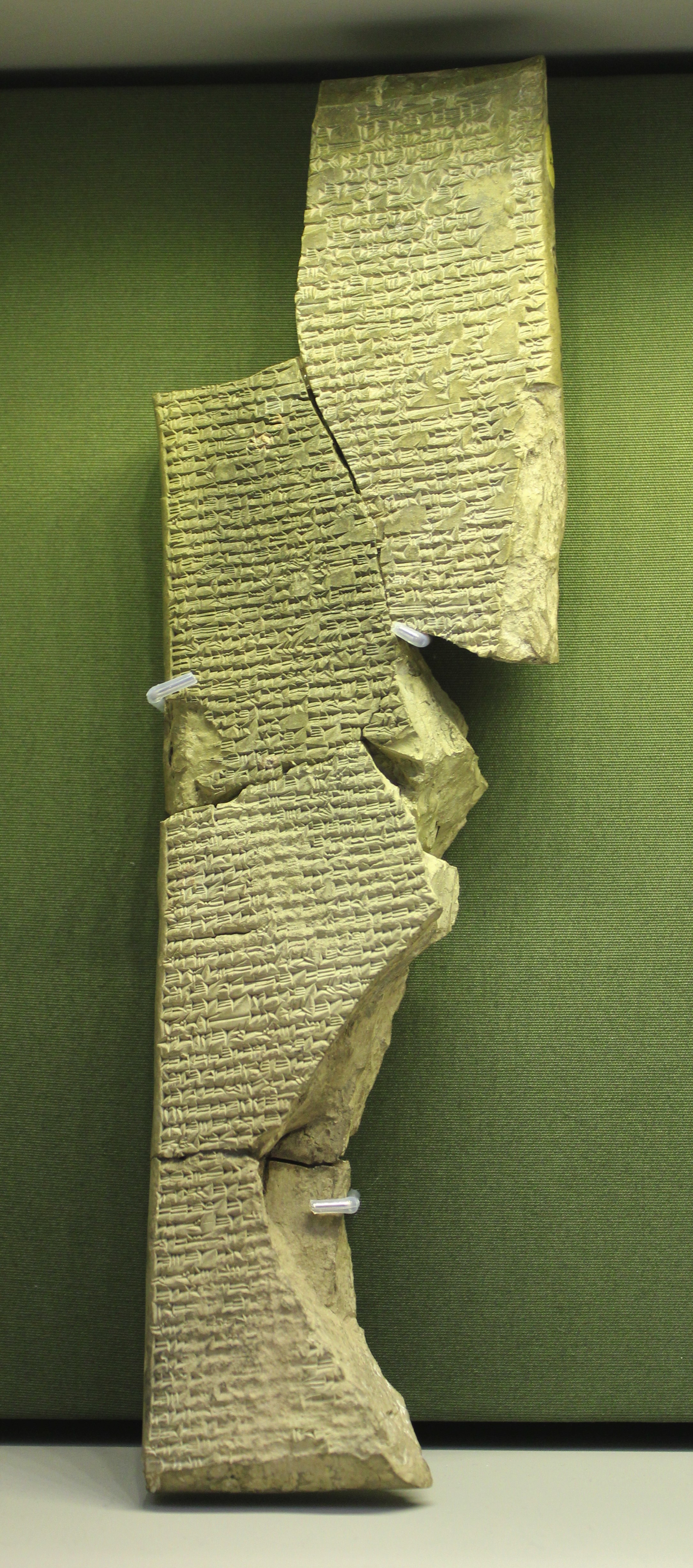
In a recent study, Enrique JiménezEnrique JiménezAssyriologist and scholar of Babylonian literature, professor of ancient Oriental languages at LMU Munich, working on reconstructing and dating cuneiform texts.Glossary · Click to read the explanation brings together textual and historical comparisons supporting early elements of the tradition in the late second millennium BCE. One argument compares a battle phrase with an eleventh-century BCE royal inscription. This is a scholarly argument weighing specific correspondences, not a securely established year or known author.[5]
Likewise, evidence for performance at a later festival illuminates reception and use without independently dating every ritualRitualAn organised or distinguished practice meaningful to a community; it may leave traces, but its form alone does not reveal an associated doctrine.Glossary · Click to read the explanation detail's origin. Story, composition and use remain distinct, while evidence connecting them is retained.
The dragon in later architecture
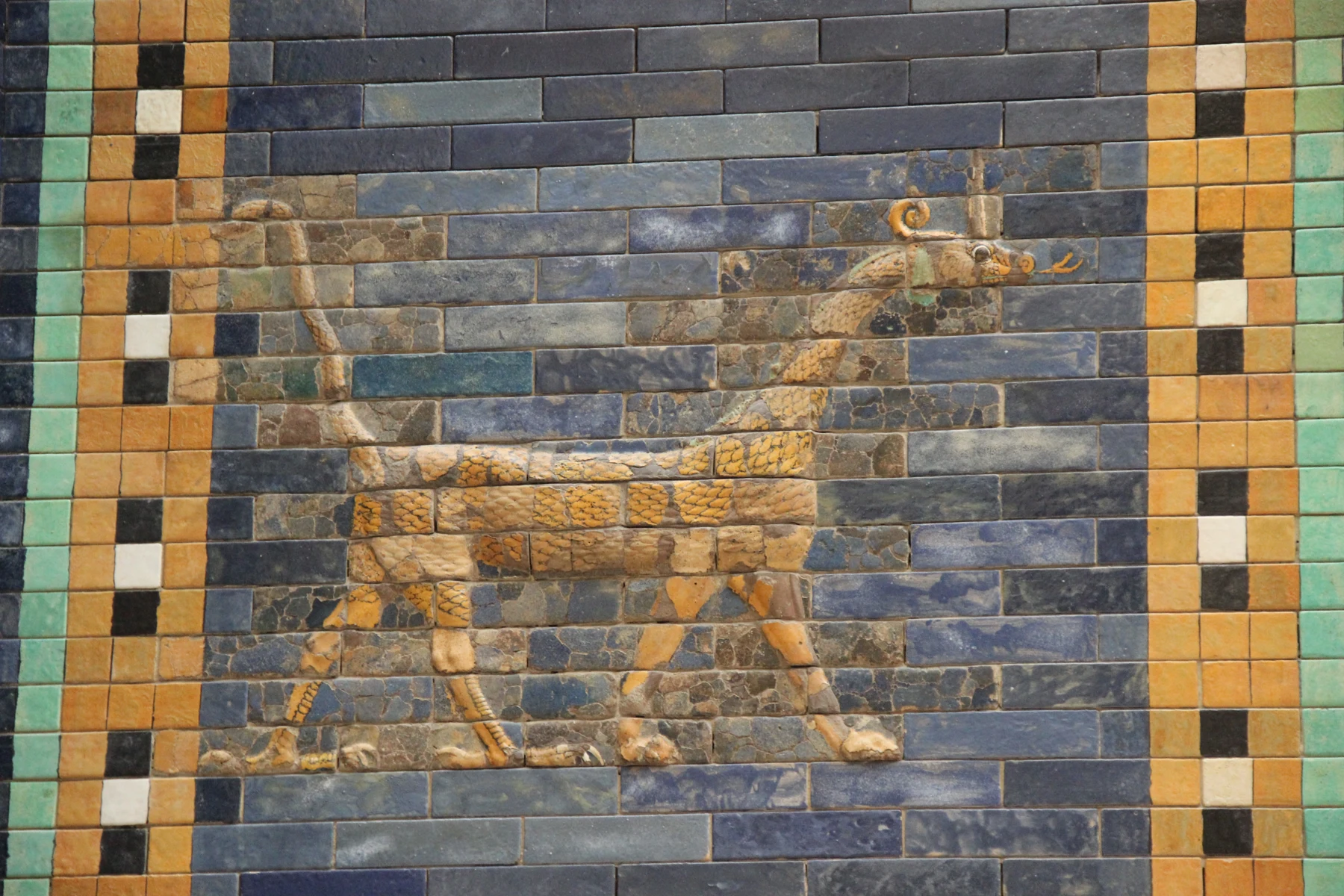
The photograph shows a composite dragon called mushhushshu in a museum reconstruction incorporating ancient bricks from the Ishtar GateIshtar Gate at BabylonA gate in Nebuchadnezzar II’s sixth-century BCE Babylonian building program, decorated with glazed-brick animals associated with Mesopotamian deities.Glossary · Click to read the explanation's decoration. This architecture belongs to Nebuchadnezzar IINebuchadnezzar IIBabylonian king, 605–562 BCE, appearing in Daniel and independently attested in inscriptions and building remains.Glossary · Click to read the explanation's sixth-century BCE building project. The museum account associates the dragon with Marduk, while the Processional Way's lions were connected with IshtarInanna / IshtarA prominent Mesopotamian goddess whose Sumerian name Inanna became associated with Akkadian Ishtar across diverse traditions. She was associated with desire, war, royal authority and Venus, while local forms and genealogies varied among texts.Glossary · Click to read the explanation.[3]
The dragon is an accompanying symbol, not a securely identified image of Tiamat or Marduk's own body. Its setting offers another context for religious authority in Babylon: the poem articulates the city's centrality in words, while public architecture gives it material images. Comparing these witnesses clarifies Marduk's extensive standing without conflating their dates or removing the other gods from the world they represent.
Connected readings
References and notes (5)
- Alexander Heidel, The Babylonian Genesis, 2nd ed., 1951; translation of the seven Enuma Elish tablets. Assembly recognition, battle, cosmic ordering, Esagil and names. Pp. 18–60, Tablets I–VII; the translated tablets, not the whole book. Return to the text ↑
- Nicole Brisch, “Marduk (god),” Ancient Mesopotamian Gods and Goddesses, ORACC, 2019. Marduk’s rise and Babylon, Hammurabi’s evidence, fifty and Enlil, functions and iconography. Functions, attested periods, cult and iconography; indexed institutional entry. Return to the text ↑
- Blair Fowlkes-Childs, “Temporary Encounters, Permanent Galleries,” Metropolitan Museum, 14 October 2014. The mushhushshu dragon is associated with Marduk; Processional Way lions with Ishtar. Glazed-brick panels from Babylon; Ishtar Gate and Nebuchadnezzar II’s building project. Return to the text ↑
- Prologue to the Laws of Hammurabi in L. W. King’s historical translation, Yale Avalon Project; Marduk’s authority, Babylon’s elevation and the king’s commission to administer justice. The three prologue paragraphs preceding the laws, especially the opening. Return to the text ↑
- Enrique Jiménez, chapter on dating Enuma Elish, in the edition by Haubold, Helle, Jiménez and Wisnom, 2025; late-second-millennium textual and historical evidence, including a proposed quotation in a dated royal inscription. Pp. 99–106; specific evidence, not a certain composition year or a claim to have read the whole volume. Return to the text ↑
Suggest a correction · Suggest a source for this record
Cite this record
IL Archive, «Marduk’s Rise: Babylon and the Making of Divine Kingship», https://ilarchive.com/en/studies/marduk-and-babylon
Continue reading
Related readings