Study
Who Headed the Sumerian Divine Assembly? An or Enlil?
An extended study of a topic, with evidence and references.
- Timeline
- From 2600 BCE to 600 BCE
- Region
- Southern Mesopotamia — Fara, Nippur and Babylon
From Fara lists to Lugalzagesi’s inscription and Ekur: An’s seniority, Enlil’s authority and why list order cannot establish a transfer of the throne.
Share article
Text
What does “at the top” mean?
Drawing the Sumerian pantheonPantheonThe set of deities associated with a religious tradition, including their roles and relationships.Glossary · Click to read the explanation as a pyramid with one permanent head creates a problem. Some traditions present AnAn / AnuSumerian/Akkadian sky god; multifunctional AN alone cannot identify him in the earliest texts.Glossary · Click to read the explanation as divine father and supreme heavenly authority. Other texts place EnlilEnlilProminent Mesopotamian god associated with Nippur and Ekur, highly ranked in Early Dynastic texts before the earliest known Anunna attestation.Glossary · Click to read the explanation at the centre of decision: he grants kingship, determines destinies and commands the gods.
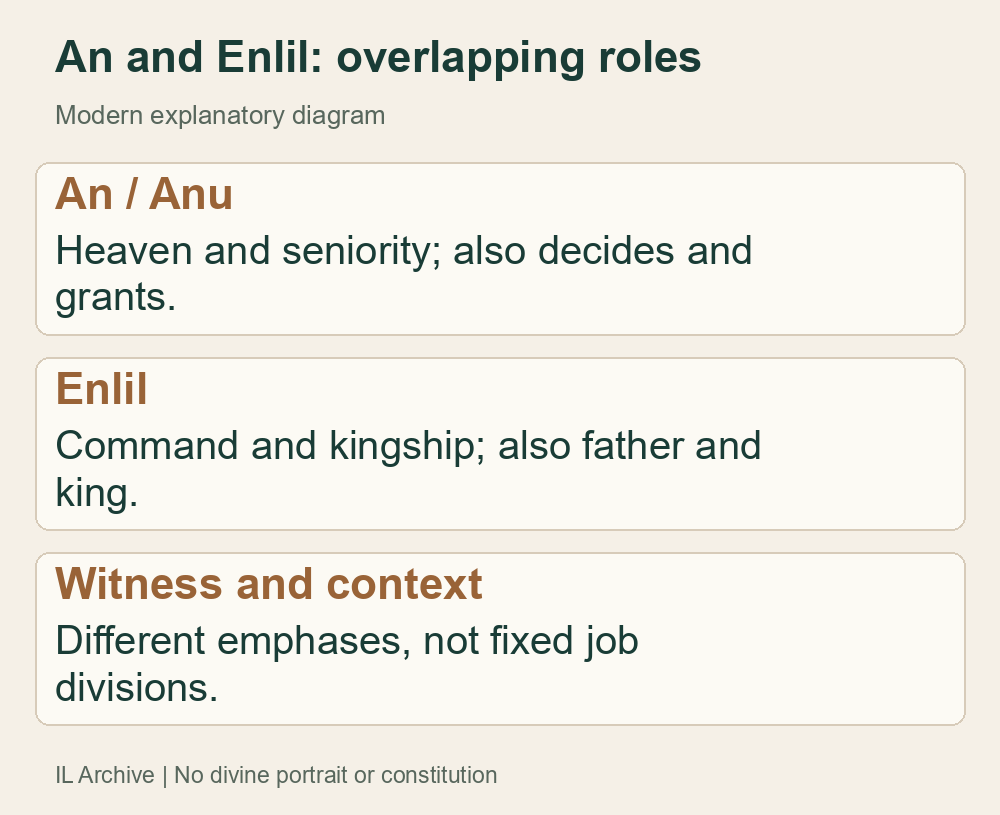
Neither description has to be a mistake. Seniority, descent, heavenly authority, leadership of an assembly and the granting of rule are overlapping aspects of rank. The useful question is which text, from which period and religious centre, assigns which authority to either god. This explains differences in emphasis without inventing a permanent division of responsibilities.[1][2][7]
An: heaven and supreme standing
An is the Sumerian name, Anu its AkkadianAkkadianAn ancient East Semitic language written in cuneiform in Mesopotamia.Glossary · Click to read the explanation form. Traditions associate him with heaven and ancient divine generations. He also makes decisions, raises other gods’ standing and grants kingship. His position cannot be reduced to symbolic respect.[1]
A high source of authority can remain important while other gods dominate stories or political life. The combination of these roles varies between texts. Limited dramatic action alone does not demonstrate that a deity has lost authority.
An ancient sign is not always a divine name
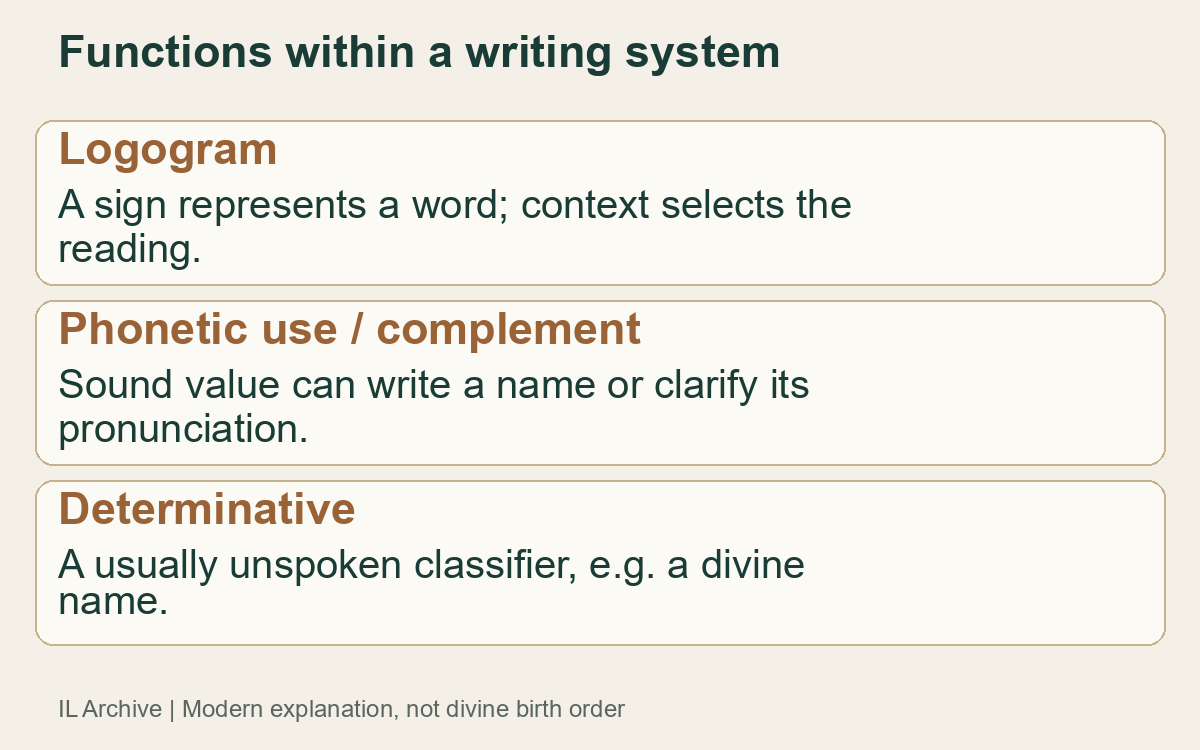
AN can write heaven, participate in expressions of divinity or write An’s name. In early writing these readings can be difficult to distinguish. Identification of the individual deity becomes clearer in third-millennium sources.[1]
This limits our evidence; it does not date the god’s birth. The age of the sign cannot establish a secure narrative in which An ruled first and Enlil arrived later. The age of writing, the clarity of a reading and the history of belief are distinct questions.
Fatherhood does not produce one family tree
An’s fatherhood concerns seniority and standing as well as particular divine genealogies. Mesopotamian descent varies between traditions. Combining every relationship from every period into one contemporary family would distort it.[1][11]
Calling a deity a father neither removes his offspring’s independent standing nor proves a single delegation of government. An early royal inscription already combines An’s fatherhood and Enlil’s efficacy without narrating an abdication.[6]
Enlil: authority expressed through command
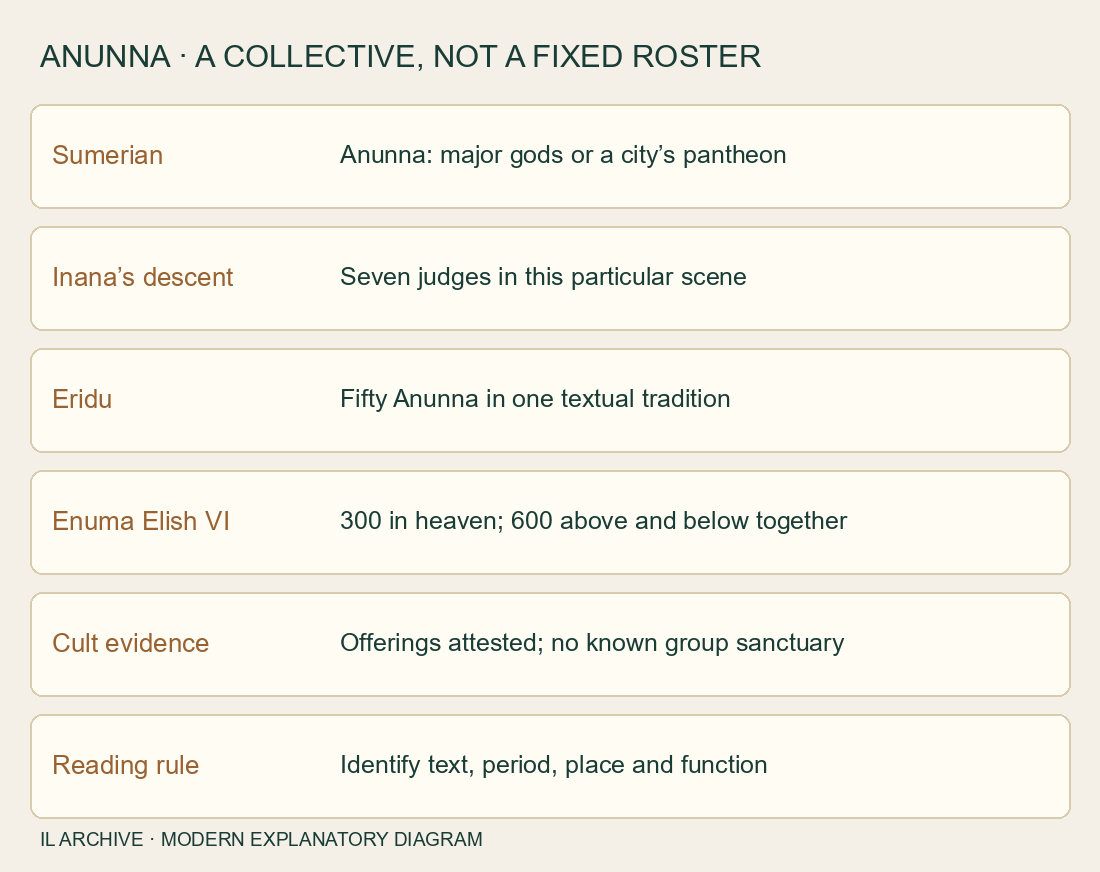
Enlil’s connection with destinies and kingship recurs in poetry and inscriptions. At the opening of Enlil in the E-kurEkur / E-kur“Mountain House,” Enlil’s temple at Nippur, a place of ritual and legitimacy in literary and royal texts.Glossary · Click to read the explanation, gods bow before him and the AnunnaAnunna / AnunnakiCollective designation for gods in Mesopotamian texts, with variable scope and membership; earliest known attestations belong to the late third millennium BCE.Glossary · Click to read the explanation attend and obey him. The composition attributes judicial wisdom and extensive authority to him.[7]
This is praise poetry, not a neutral register of every deity’s rank. Nevertheless, it directly shows the leadership assigned to Enlil by its tradition. Read together with royal inscriptions, it offers stronger evidence than the first line of a list alone.
Fara: what does the current catalogue read?
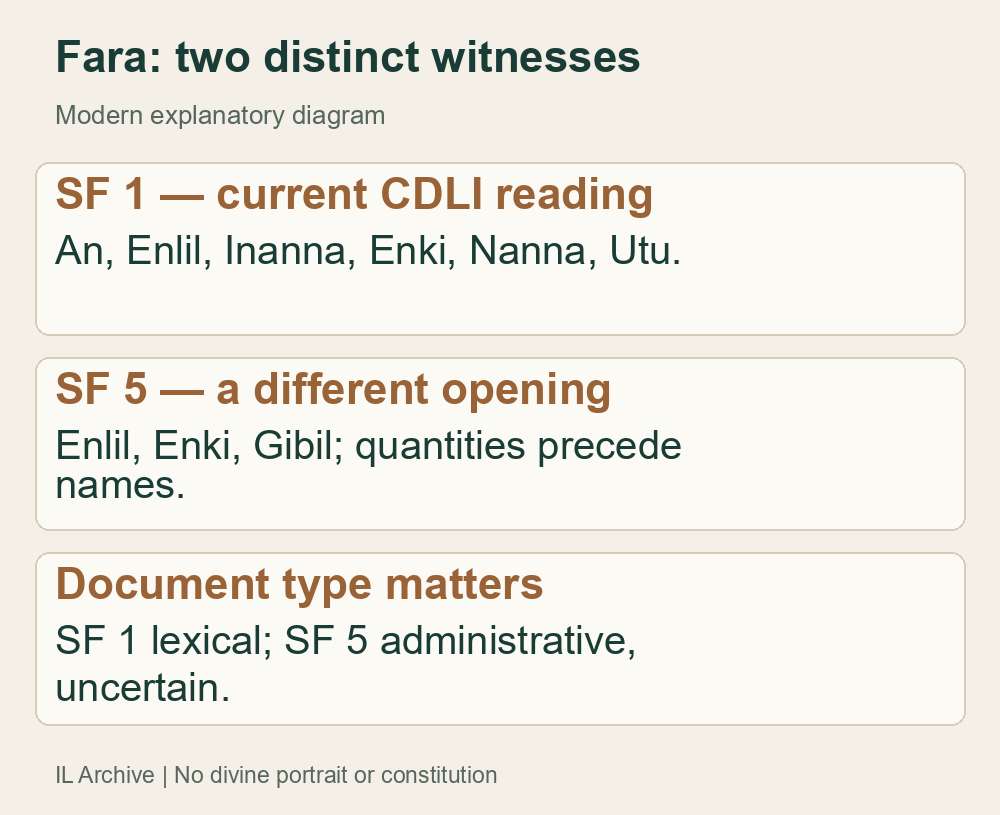
The god listGod listsTexts collecting divine names for preservation, teaching and classification, with varying theological organization.Glossary · Click to read the explanation SF 1 from Fara, ancient Shuruppak, is dated by CDLI to Early Dynastic IIIa, approximately 2600–2500 BCE. Its current transliteration opens with An, Enlil, InannaInanna / IshtarProminent Mesopotamian goddess with a major centre at Uruk, whose parentage and cult traditions vary rather than forming one fixed genealogy.Glossary · Click to read the explanation, EnkiEnkiMesopotamian deity associated with deep fresh water, wisdom and Eridu, known as Ea in Akkadian tradition. The earliest preserved written mention does not date his cult’s origin or identify Ubaid Eridu’s deity.Glossary · Click to read the explanation, NannaNanna / Su’en / SinMoon god associated with Ur, with early name evidence that does not date every later myth.Glossary · Click to read the explanation and Utu.[3]
It is therefore inaccurate to say that the earliest Fara lists exclude An or all begin with Enlil. Each witness and reading must be specified. These prominent early names do not alone yield a ranking valid for every city.
SF 5: Enlil first, but a different document
SF 5, also from Fara and assigned to the same chronological range, begins with Enlil, Enki, Gibil and other gods. CDLI currently classifies it as administrative, with the identification uncertain; numerical quantities precede the names.[4]
Enlil’s leading position matters, but the document should not unreservedly be presented as the same kind of lexical list as SF 1. Its purpose is part of interpreting its arrangement. A document enumerating gods is not automatically a constitution of divine rank.
Why did Litke put Enlil first at Fara?
Richard Litke’s study, published in 1998, describes Enlil as a recurrent first deity and cites SF 5, 6 and 7. Footnote 9 also acknowledges that traces in the opening of SF 1 could suggest restoring An, while reporting Deimel’s earlier rejection of that reading.[5]
The footnote is crucial. We are dealing with the history of an edited reading as well as divine standing. The current catalogue reads An first in SF 1, whereas Litke reflects an older editorial judgement. That judgement is not a present consensus, and these documents do not date a transfer of supremacy.
Order is evidence, not a measurement of power
List arrangement can combine esteem for major gods, family relationships, local traditions and the teaching or preservation of spellings. Litke discusses the difficulty of connecting list traditions and their possible relationship to religious centres and political fortunes.[5]
Position is meaningful when combined with other evidence: offerings, inscriptions, poetry and the temple’s standing. Assigning every line a precise numerical rank within a uniform hierarchy demands more than the document provides.
Nippur: standing beyond the king’s capital
NippurNippur / NuffarMesopotamian city and major Enlil cult centre, connected with kings’ legitimacy beyond the city.Glossary · Click to read the explanation, modern Nuffar in IraqIraqIraq is a modern country encompassing much of ancient MesopotamiaGlossary · Click to read the explanation, was a major centre of Enlil’s worship. Religious importance cannot simply be measured by the size of a state ruled from the city. A king based elsewhere could connect his legitimacy with Enlil and worship at Nippur.[6][8][12]
The archaeological report Nippur V studies Area WF and a sequence of domestic buildings; it is not wholly a study of Enlil’s temple. Its institutional summary supports the city’s importance here. Literary and royal texts support the discussion of temple and kingship. Different kinds of evidence must retain their distinct roles.
Ekur: the temple in the language of authority
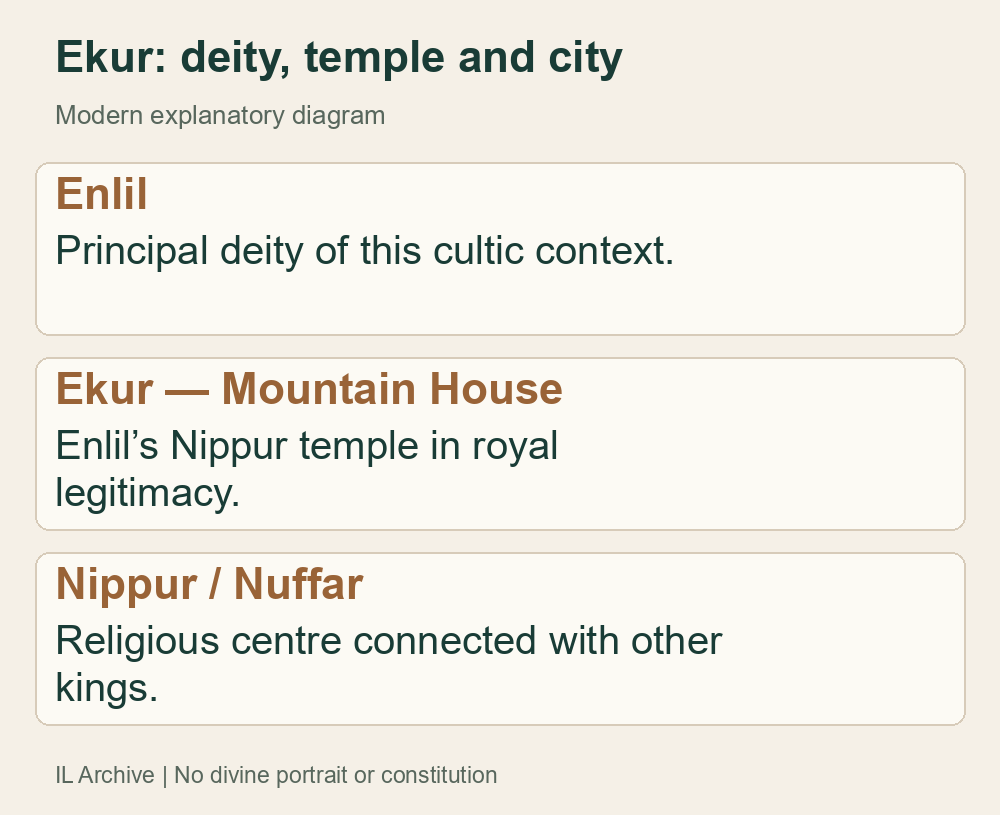
EkurEkur / E-kur“Mountain House,” Enlil’s temple at Nippur, a place of ritual and legitimacy in literary and royal texts.Glossary · Click to read the explanation, “Mountain House,” is the name of Enlil’s temple at Nippur. Enlil in the E-kur presents it as a setting for rites, abundance and verdicts, with rulers bringing offerings and seeking the god’s approval.[2][7]
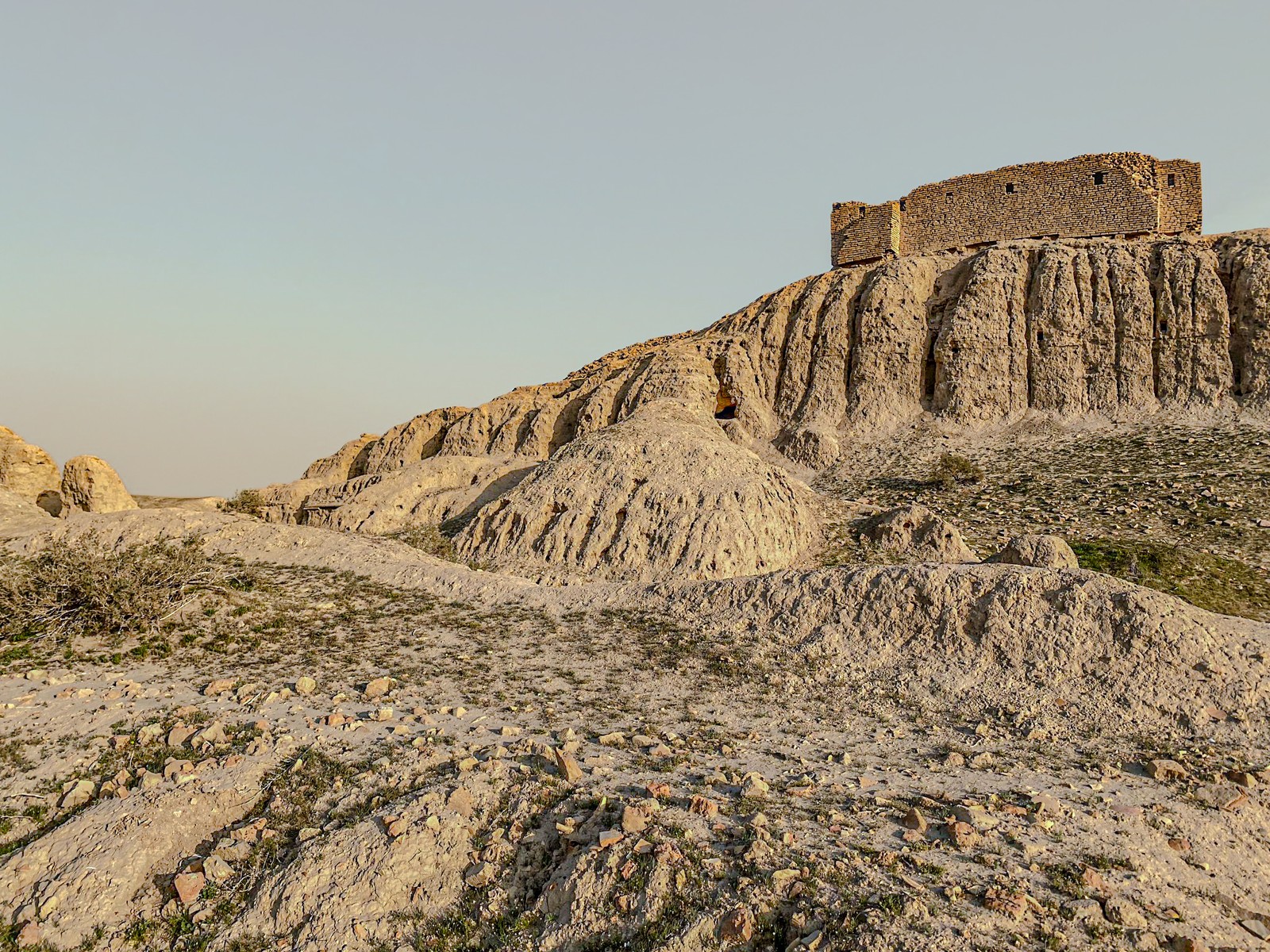
Poetry makes the place a cosmic centre. Its imagery is not always a literal architectural description, but it reveals the temple’s place in the language of legitimacy. The modern Nippur photograph provides site context: the building on the mound dates to modern excavations, not a Sumerian temple preserved in that form.
Lugalzagesi: one witness combining both gods
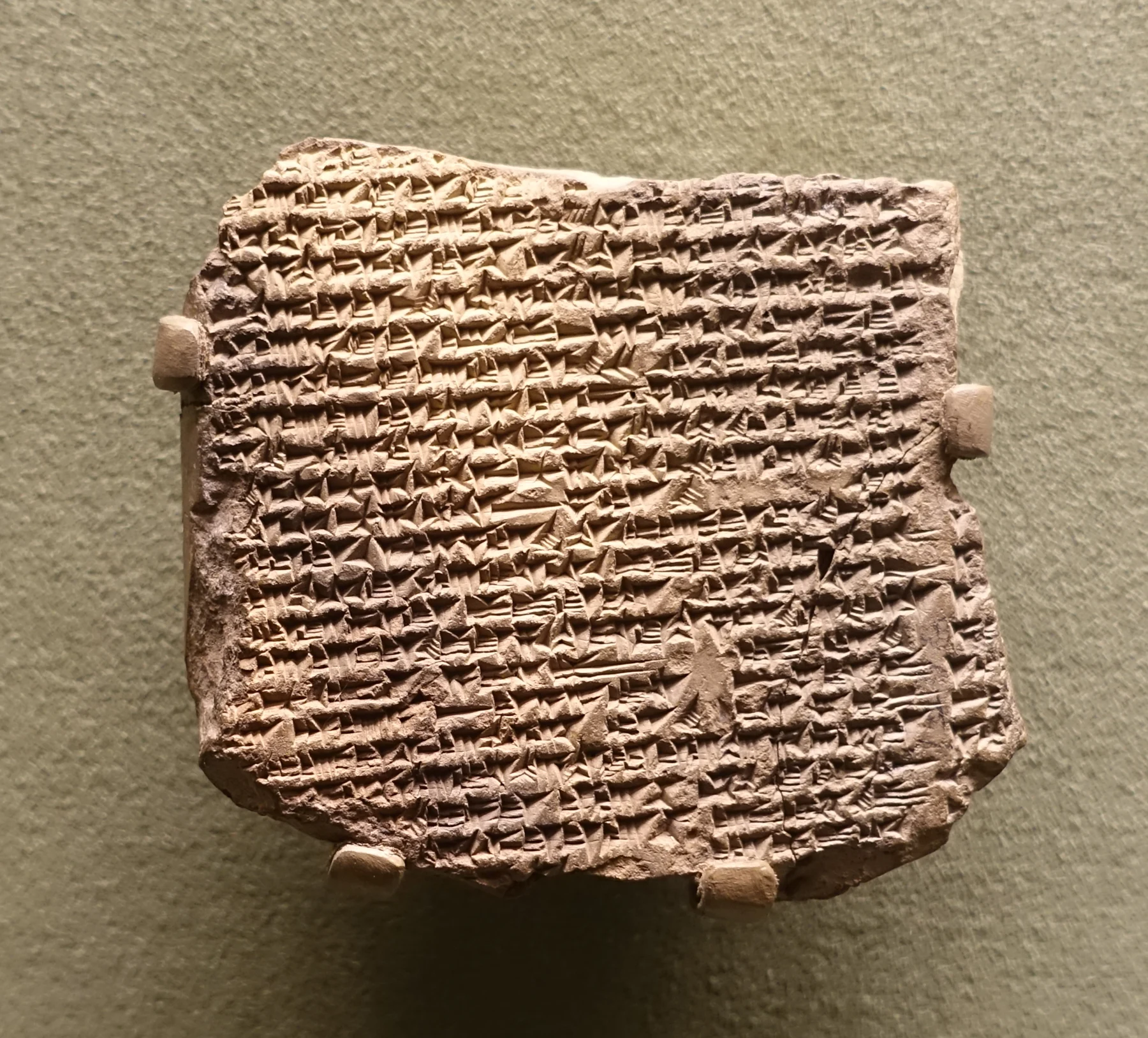
In the composite vessel inscription RIME 1.14.20.01 from Nippur, Lugalzagesi attributes the granting of kingship to Enlil. The same text associates him with An’s favour, applies “king of all the lands” language to both gods and calls An Enlil’s father.[6]
This is Early Dynastic IIIb evidence, not a relationship found only in late genealogies. Near the end, the king asks Enlil to address An on his behalf and wishes the granted destiny to remain unchanged. An’s fatherhood, Enlil’s gift of rule and several divine patrons coexist in one inscription.
Ur-Namma: building for the god who chose him
Ur-NammaNammaA goddess who asks Enki to relieve the gods’ labor in Enki and Ninmah.Glossary · Click to read the explanation B presents Enlil choosing the king, directing him to raise the Ekur and granting him an exalted destiny. Divine patronage, construction and royal power form a single argument.[8]
Ur-Namma was a late-third-millennium king, but the period of a poem’s subject does not necessarily date every surviving manuscript. The hymn need not be treated as a contemporary daily record to establish the tradition’s connection between royal building and Enlil’s decision.
Determining destinies: assigning a place in order
“Determining destinies” need not mean predetermining every human thought and movement. In these witnesses it concerns standing, government, prosperity and outcomes granted to a king or community. Context determines its meaning rather than an assumed modern philosophical doctrine.[6][7][8]
Lugalzagesi’s desired destiny concerns life, lasting rule and prosperity; Ur-Namma’s includes standing and power. These examples clarify the expression’s range without reducing every Mesopotamian use of destiny to a single definition.
The assembly remains behind its leader
The hymn presents the AnunnaAnunna / AnunnakiCollective designation for gods in Mesopotamian texts, with variable scope and membership; earliest known attestations belong to the late third millennium BCE.Glossary · Click to read the explanation attending Enlil, but it also describes NinlilNinlilGoddess later associated with Enlil and Nippur; early writings require distinguishing sign labels from place context.Glossary · Click to read the explanation taking counsel with him and their determining destinies together. His eminence does not render the other gods functionless or make every decision solitary.[7]
The divine assemblyDivine councilA representation of divine beings acting as an assembly with authority and differentiated roles.Glossary · Click to read the explanation contains ranks and relationships. Meeting together does not make its members equal; a leader’s priority does not reserve every function for him. The community matters alongside the figure who commands.
Jacobsen’s model: authority and force
In “The Cosmos as a State,” in The Intellectual Adventure of Ancient Man, Thorkild Jacobsen contrasts Anu’s majesty and authority with Enlil’s force in executing the divine community’s will. Pages 136–143 discuss assembly, command and execution.[9]
This is an influential interpretive model, not an excavated Sumerian constitution. It does not require accepting every mythological reconstruction or name etymology in the chapter. Kingship and the Gods, sometimes cited alongside it, is by Henri Frankfort, not a sole-authored Jacobsen book.
Not a modern head of state and government
Contrasting An’s supreme standing with Enlil’s active authority can help explain emphasis, provided it is not turned into a modern administrative division. An decides and grants; Enlil is also a father and royal figure.[1][6][7]
The royal inscription makes overlap clearer than rigid separation. An was not merely symbolic, and Enlil did not demonstrably monopolize execution in every age. Different genres can emphasize different relationships.
Descent organizes a relationship, not its history
Lugalzagesi’s inscription calls An Enlil’s father. It does not establish a narrative in which An produced an heir and then surrendered government. Descent can organize seniority, rank and kinship within a tradition.[6]
Another example is Ishkur/Adad: ORACC describes his widespread descent from An and his descent from Enlil in some Sumerian literature. The alternatives cannot be combined into one birth or imposed uniformly on every city.[11]
Did supremacy move from An to Enlil?
ORACC summarizes An’s history as sharing or ceding functions as Enlil and later MardukMardukBabylon’s god, elevated with the city’s history. Enuma Elish celebrates his rise and cosmic ordering; sources associate him with Nibiru and Jupiter. Earliest origins and functions remain uncertain.Glossary · Click to read the explanation became prominent, while retaining high standing. This is a useful historical reconstruction, not a continuous record of the process from its beginning.[1]
No dated decision dismissing An survives, and the Fara lists cannot establish one. More securely, surviving texts show Enlil’s considerable priority alongside An’s continuing authority. Explaining how that relationship first arose requires inference beyond direct testimony.
Local and shared traditions
Divine standing depends on religious centre, genre and period. Lugalzagesi’s royal inscription involves several deities and cities; the Ekur hymn focuses praise much more closely on Enlil and his temple.[6][7]
Difference proves neither complete religious isolation nor total uniformity. Cities, scribes, rulers and ritualsRitualAn organised or distinguished practice meaningful to a community; it may leave traces, but its form alone does not reveal an associated doctrine.Glossary · Click to read the explanation connected traditions. This helps explain how a deity rooted in one city could authorize kingship beyond it.
Later lists reorganize the divine world
Later traditions give An/Anu a prominent position while also placing Enlil high. They are not one list copied without change. Litke studies several traditions and the complex relationship between them and the large series An = Anum.[5]
An automatic trajectory from “Enlil first at Fara” to “An restored to first place” is therefore misleading. Readings, document purposes and list structures differ. Arrangement may acknowledge An’s seniority while other sources continue to emphasize Enlil’s authority.
Anu-power, Enlilship and then Marduk
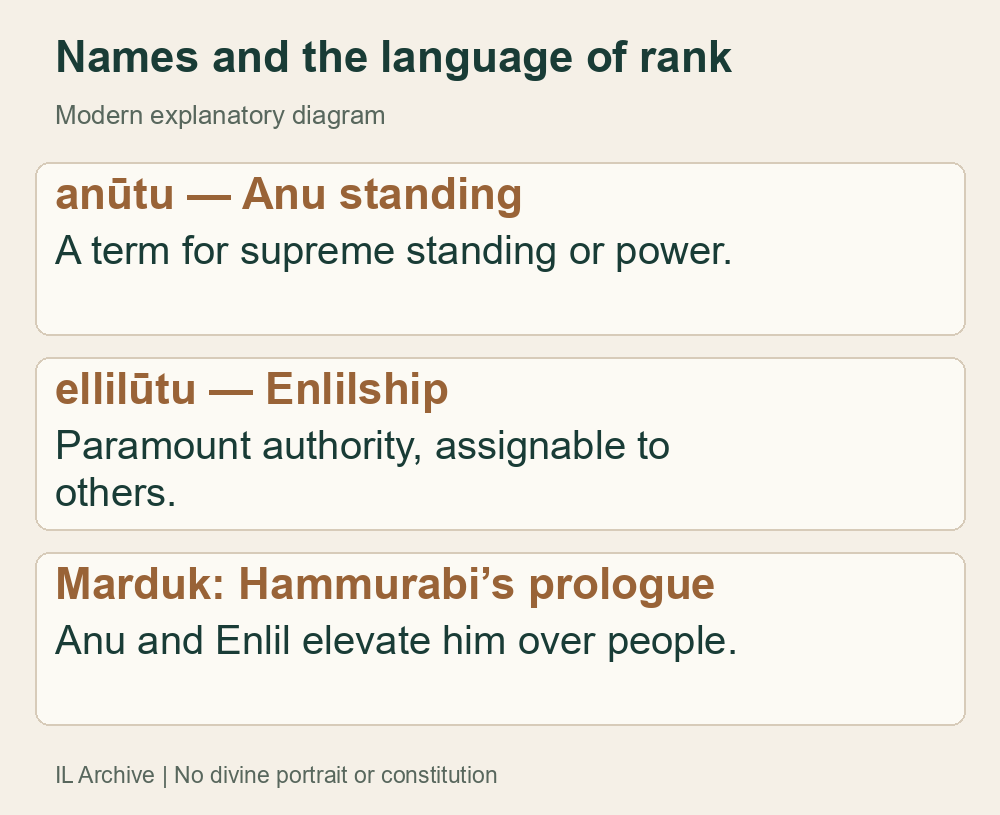
The Akkadian terms anūtuAnu standing — anūtuAkkadian term for supreme standing or power associated with Anu, attributable to another god.Glossary · Click to read the explanation and ellilūtuEnlilship — ellilūtuAkkadian expression of paramount authority associated with Enlil, applicable to others.Glossary · Click to read the explanation describe standing or power associated with Anu and Enlil which can be attributed to others. Transferring standing does not by itself prove merged identities or the end of a cult.[1][2]
MardukMardukBabylon’s god, elevated with the city’s history. Enuma Elish celebrates his rise and cosmic ordering; sources associate him with Nibiru and Jupiter. Earliest origins and functions remain uncertain.Glossary · Click to read the explanation illustrates this: HammurabiHammurabiKing of Babylon in Mesopotamia, reigning around 1792–1750 BCE. A celebrated legal text preserved on a stele and cuneiform copies bears his name.Glossary · Click to read the explanation’s law prologue attributes his elevated authority over people to Anu and Enlil, while Enūma elišEnuma ElishBabylonian Akkadian composition celebrating Marduk’s elevation and cosmic/divine ordering. Human creation is in VI, Nibiru in VII; a Tablet I reference cannot document those passages.Glossary · Click to read the explanation traditions develop a broader supremacy. His rise had stages. It was not one completely documented event or the immediate disappearance of Enlil.[10]
A supreme god in a world of many gods
The Fara list preserves many divine names. The hymn and royal inscription recognize other gods within relationships of patronage and rank. Describing one deity as supreme does not make the religion monotheisticMonotheismBelief in a single God as the only deity, rather than merely the highest among several gods.Glossary · Click to read the explanation.[3][6][7]
An and Enlil demonstrably held overlapping high authority; Enlil is strongly connected with kingship, destinies and Nippur. Witnesses and readings demonstrably differ. The date and precise cause of an initial transfer of supremacy lack a continuous record. These limits permit a stronger account than a throne changing hands once.
An or Enlil?
For heaven, seniority and the highest standing, An is prominent in many traditions. For granting rule, command and destiny in important poems and inscriptions, Enlil is prominent. The functions overlap; neither can be reduced to a symbolic figure opposite a monopolist of real power.
For the earliest Fara lists, start by identifying the tablet: SF 1 currently reads An first; SF 5 begins with Enlil, with a different document classification. The royal inscription combines both. The summit was not a single position defined identically in every text, but a changing relationship between seniority, decision, city and assembly.
References and notes
- Kathryn Stevens. An/Anu (god). Ancient Mesopotamian Gods and Goddesses, ORACC. Indexed original-site passages on authority, decisions, fatherhood, AN/attestation, Anu-power and sharing functions. Direct access unavailable; underlying books not claimed read. Historical transition is a scholarly synthesis, not a continuous record. Return to the text ↑
- Adam Stone. Enlil/Ellil (god). Ancient Mesopotamian Gods and Goddesses, ORACC. Indexed passages on titles, destinies, kingship, Ekur, ellilūtu and Anzu. Direct opening returned 502. Wang’s book and Foster’s full translation not read; functions checked against the primary inscription and hymn. Return to the text ↑
- Cuneiform Digital Library Initiative. SF 001 / VAT12760+, P010566. Fara, ED IIIa, ca. 2600–2500 BCE; large lexical god list. Obverse I 1–6 currently reads An, Enlil, Inanna, Enki, Nanna, Utu. Earlier disputed opening compared with Litke p. 2 n. 9; not generalized to all Fara. Return to the text ↑
- Cuneiform Digital Library Initiative. SF 005 / VAT12626, P010570. Fara, ED IIIa; administrative classification, identification uncertain. Obverse I 1–3: quantities with Enlil, Enki, Gibil; similar reverse opening. Not treated as a securely lexical SF1-type list; protected tablet photographs not reproduced. Return to the text ↑
- Richard L. Litke (1998). A Reconstruction of the Assyro-Babylonian God-Lists, AN: dA-nu-um and AN: Anu šá amēli. TBC 3. Introduction pp. 1–3, especially p. 2 n. 9: possible An restoration in SF1 and Deimel’s earlier rejection, with SF5–7 references; politics and list traditions. Not the whole book. Publication in 1998 does not make every judgement newer than today’s catalogue. Return to the text ↑
- CDLI. Lugalzagesi, RIME 1.14.20.01 composite, P431232. Composite vessel inscription from Nippur, ED IIIb ca. 2500–2340 BCE. Lines 1–16: An/Enlil and royal language; 36–62: Enlil grants rule; 99–126: Nippur, An as Enlil’s father, prayer and enduring destiny. Early fatherhood evidence, not a universal tree. Return to the text ↑
- Electronic Text Corpus of Sumerian Literature, Oxford. Enlil in the E-kur (Enlil A), 4.05.1. Especially lines 1–17, 35–55, 74–123, 139–171: command, Anunna, Nippur, temple, rulers and Ninlil’s counsel. Praise text with witnesses and variants; not an administrative minute or a claim of one date for all manuscripts. Return to the text ↑
- ETCSL, Oxford. A tigi to Enlil for Ur-Namma (Ur-Namma B), 2.4.1.2. Lines 1–19, 31–51, 66–71: choosing Ur-Namma, building Ekur, destiny and kingship. The subject king’s period does not automatically date a manuscript or initial composition. Not all Ur-Namma inscriptions read. Return to the text ↑
- Thorkild Jacobsen. The Cosmos as a State. In The Intellectual Adventure of Ancient Man (1946; Phoenix edition 1977). Selected pp. 136–137, 140, 143–144; p. 143 visually checked: authority and force. Preface frames interpretive essays. Original-Tiamat-myth reconstruction and “Lord Storm” etymology not adopted as facts. Kingship and the Gods is Frankfort’s; its attribution checked in catalogue only. Return to the text ↑
- Nicole Brisch. Marduk (god). Ancient Mesopotamian Gods and Goddesses, ORACC. Indexed original-site passages on Hammurabi’s prologue, Marduk’s elevation and uncertainty about early rise. No fixed composition date for Enūma eliš; not the whole epic or laws read here. Return to the text ↑
- Kathryn Stevens. Iškur/Adad (god). Ancient Mesopotamian Gods and Goddesses, ORACC. Indexed genealogy passage: widespread son of An, sometimes son of Enlil in Sumerian literature; possible local-tradition explanation. Underlying Schwemer studies not fully read. Return to the text ↑
- Augusta McMahon (2006). Nippur V: The Early Dynastic to Akkadian Transition. OIP 129. ISAC publication catalogue. Institutional description and author/publication metadata read: Nippur’s importance, WF and domestic architecture. Downloading is not reading the full report; not used alone to establish Ekur details or all legitimacy rites. Return to the text ↑
Suggest a correction · Suggest a source for this record
Cite this record
IL Archive, «Who Headed the Sumerian Divine Assembly? An or Enlil?», Edition 1, https://ilarchive.com/en/studies/an-enlil-divine-supremacy
Continue reading