Study
The Earliest Divine Names in Mesopotamia: When Writing Preserved the Name
An extended study of a topic, with evidence and references.
- Timeline
- From 3350 BCE to 2500 BCE
- Region
- Southern Mesopotamia — Uruk, Fara and Abu Salabikh
From Uruk tablets to Fara lists: Nanna, Ninlil, Inanna, Enlil and An, and what makes a divine name readable without equating first attestation with the beginning of worship.
Estimated reading time: 11 min Published Last reviewed:
Share article
Text
Introduction
How can a divine name be identified in MesopotamiaMesopotamiaHistorical region associated with the Tigris and Euphrates: Uruk, Ur, Eridu, cuneiform, Sumer, Akkad, Babylon and Assyria, their languages and cults, and the limits of archaeological evidence.Glossary · Click to read the explanation before extended mythological texts appeared? This study distinguishes a written sign from a securely readable divine name, tracing evidence from the UrukUrukAncient city at Warka in southern Iraq, a major urban centre around 3200 BCE that preserved early writing and accounting tablets.Glossary · Click to read the explanation tablets to the god listsGod ListsTexts collecting divine names for preservation, teaching and classification, with varying theological organization.Glossary · Click to read the explanation of Fara and Abu Salabikh, with An, Nanna, NinlilNinlilMesopotamian goddess and consort of Enlil, associated with Nippur, Tummal, destinies and royal ritual. Identified with Sud in literary tradition and known as Mulliltu/Mullissu in Akkadian and Assyrian contexts; her genealogies and roles vary by text and period.Glossary · Click to read the explanation, InannaInanna / IshtarA prominent Mesopotamian goddess whose Sumerian name Inanna became associated with Akkadian Ishtar across diverse traditions. She was associated with desire, war, royal authority and Venus, while local forms and genealogies varied among texts.Glossary · Click to read the explanation and EnlilEnlilEnlil/Ellil: a major Mesopotamian god associated with destinies, kingship, and Ekur at Nippur, already prominent in third-millennium god lists. His name’s origin and cult beginnings remain debated.Glossary · Click to read the explanation as test cases.
Its aim is not to rank gods by the beginnings of their worship but to weigh what an artifact actually records, what its context suggests and what scholars reconstruct. The earliest surviving attestation is not the origin date of a religious tradition.
When a name could survive
One turning point in religious history concerns our ability to recover a god’s name, rather than the birth of a new god. Before writing, a building, figure, burial or ritualRitualAn organised or distinguished practice meaningful to a community; it may leave traces, but its form alone does not reveal an associated doctrine.Glossary · Click to read the explanation trace seldom supplies the name of the being associated with it. With writing at UrukUrukAncient city at Warka in southern Iraq, a major urban centre around 3200 BCE that preserved early writing and accounting tablets.Glossary · Click to read the explanation in the late fourth millennium BCE, clay began preserving something else: words and signs that can lead to divine names.[1]
Yet the earliest surviving name is not the first god humanity knew. Even within Mesopotamia, a definitive ranking is difficult because some signs are clear and others allow several readings. A useful question is when a name becomes recognizable, and with what confidence.
Before the written name
People could identify sacred beings through speech, ritual, place and imagery before recording them on tablets. A community might know whom an emblem represented or who received an offering, while an archaeologist cannot recover that knowledge from shape alone. Not every figurineFigurineA small shaped object depicting a human, animal or abbreviated form, in clay, stone or another medium. Its form alone does not establish its use; manufacture, handling traces and find context matter.Glossary · Click to read the explanation is a god, and not every monumental building is a temple.
Nor must oral tradition disappear when a community vanishes: neighbours or descendants may transmit it. The difficulty is that transmission may leave no independently traceable record. Writing improves the chances of preservation without creating belief from nothing.
When do the tablets begin?
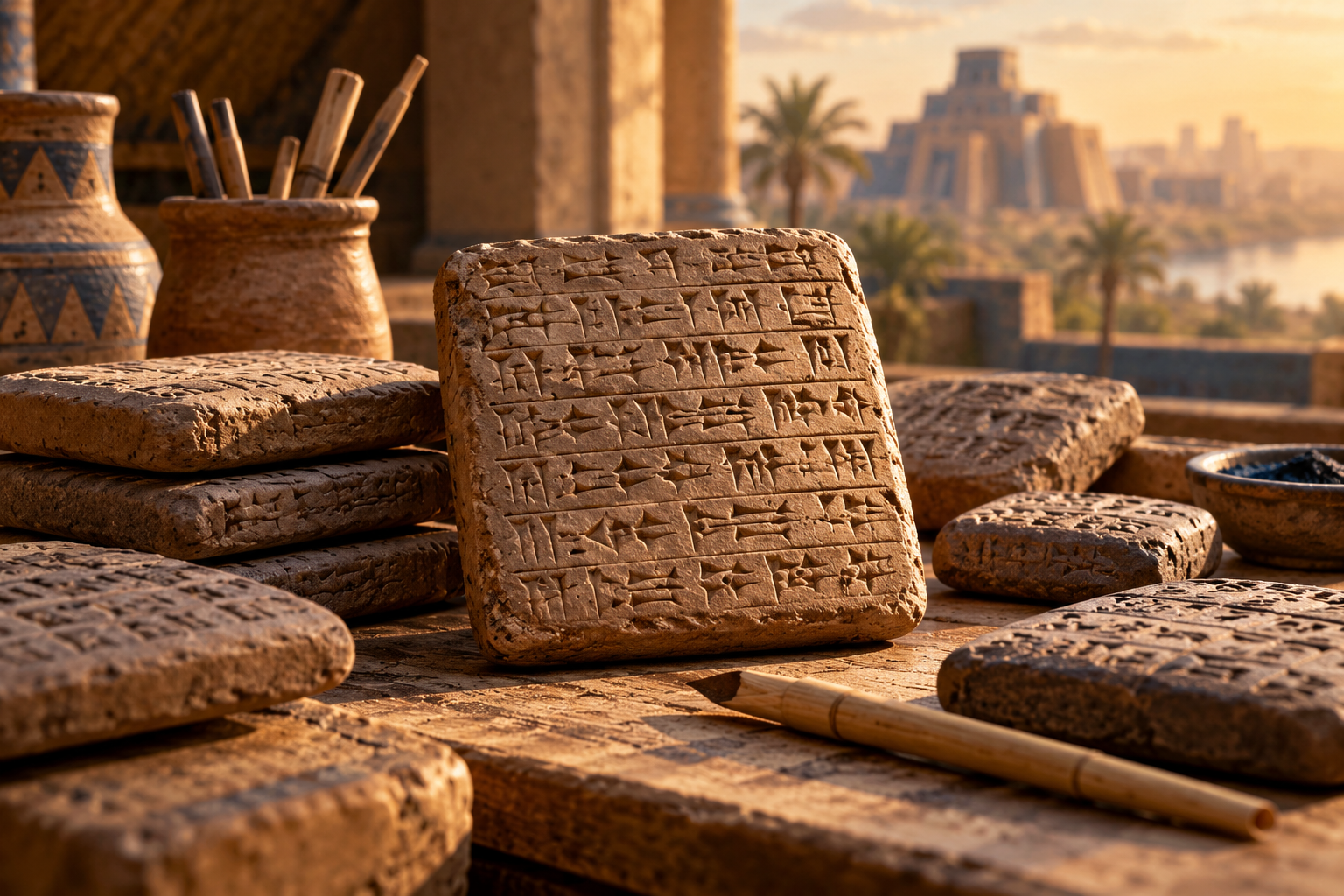
Early proto-cuneiformProto-cuneiformEarly southern Mesopotamian script (c. 3350–3000 BCE): clay tablets with counting systems and signs for commodities, people and offices, as well as lexical lists; not yet a full rendering of speech.Glossary · Click to read the explanation at Uruk belongs to the late fourth millennium. CDLI catalogues use approximate ranges such as 3350–3200 BCE for Uruk IV and 3200–3000 for Uruk III. These are classificatory boundaries, not a precise date for writing’s invention; the relationship between script phases and find layers also requires investigation.[1][2]
As a material comparison, the Metropolitan Museum catalogues a grain-account tablet, dated about 3100–2900 BCE and probably from Uruk. Its image is on the museum’s record, not among the illustrations reproduced here. It documents early administrative writing, not a written attestation of Nanna or Ninlil.[12]
The first writing was not a complete story
Tablets recorded resources, quantities, people and institutions without representing language as later texts would. A scribe could understand an account that a modern reader cannot turn into a complete Sumerian sentence.
Nevertheless, the system was not silent pictures entirely without sound representation. Christopher Woods discusses early evidence of phonetic use alongside the inability to express many grammatical relationships. Limited recording of speech differs from having no relationship to speech.[1]
A sign for a word, a sign for a sound
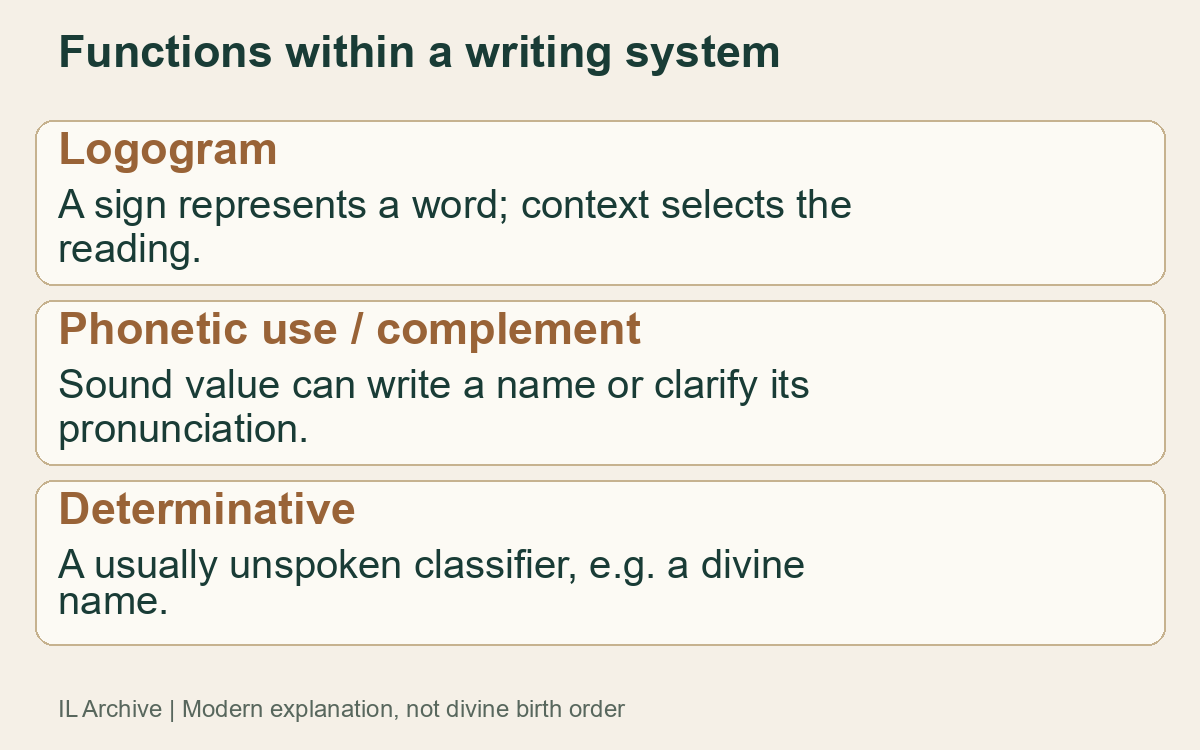
A logogramLogogramA written sign functioning as a word sign in context; the same form may also have syllabic or determinative uses.Glossary · Click to read the explanation can represent a word or semantically related words, while another sign may be used for its sound value. The rebus principleRebus principleA writing principle in which a sign for one word is reused to write another word of similar pronunciation but different meaning; visual similarity alone does not prove an early phonetic use.Glossary · Click to read the explanation allows a sign depicting something to serve a word with a similar pronunciation. A phonetic addition can help clarify an intended reading.[1]
These functions can coexist. They should not become a universal sequence in which every society moves from religious symbol to picture and then sound in the same way. A modern catalogue’s sign name may itself derive from a reading established in later texts.
Why is a divine name difficult to identify?
Finding a sign on clay is a first step. Its context then matters: does it name a person, institution, city, resource or divine being? An emblem associated with a goddess may identify her household or institutional workers in an account, rather than show her as a character in a narrative.
Scholars therefore compare sign forms, name structures, parallel texts and later stages. Comparisons expand what can be read, without removing the distinction between the marks on a tablet and a scholarly reconstruction.[1][7]
AN: more than one function
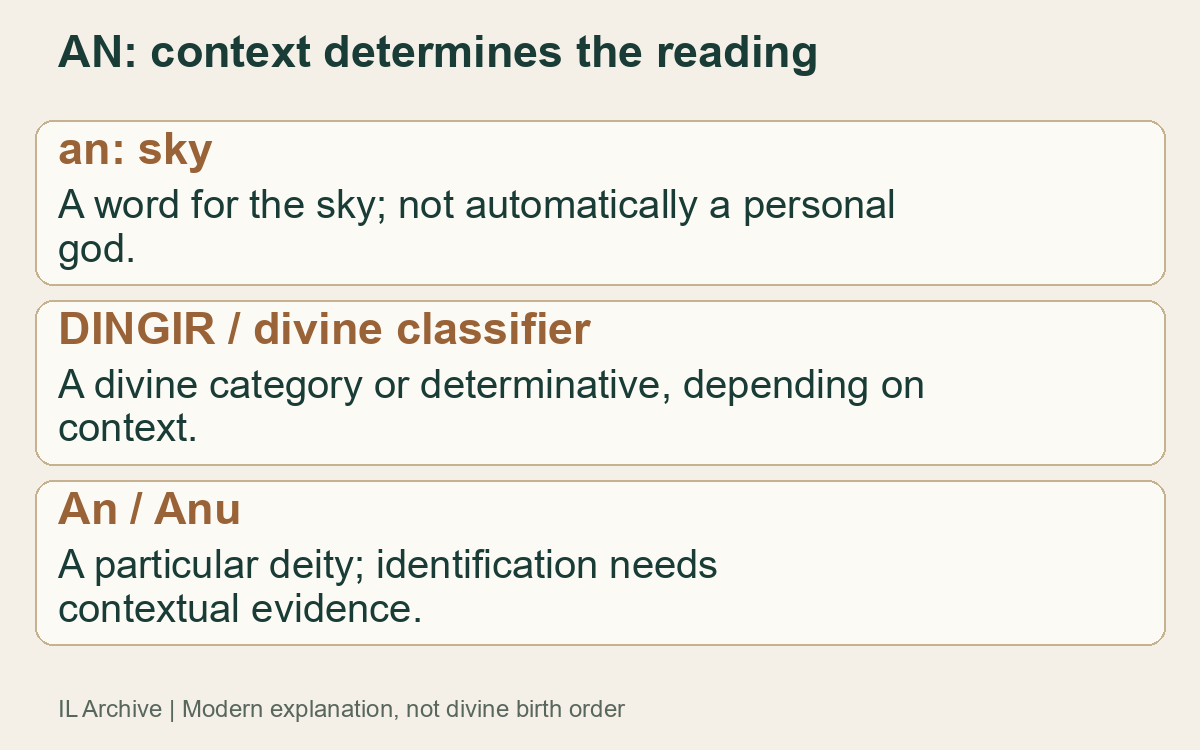
AN is a familiar example. In Sumerian tradition it is associated with “sky,” “god” and the name AnAn / AnuAn is the Sumerian sky god, called Anu in Akkadian. The sign AN by itself does not identify him: it also denotes sky or divinity.Glossary · Click to read the explanation, and can function as a divine classifierThe divine determinative in cuneiformA cuneiform sign used mostly before a divine name to classify it without being spoken independently; shown as raised d or {d} in transliteration. Usage depends on language and context.Glossary · Click to read the explanation. Finding AN in an early text therefore does not by itself establish a reference to the personal god An.[3]
The difference concerns function and context as well as shape. The accompanying diagram presents functions known in Sumerian writing traditions; it does not claim they were equally explicit or settled in the earliest Uruk tablets.
What is a divine determinative?
A divine determinativeThe divine determinative in cuneiformA cuneiform sign used mostly before a divine name to classify it without being spoken independently; shown as raised d or {d} in transliteration. Usage depends on language and context.Glossary · Click to read the explanation classifies a name as divine and normally is not part of its pronunciation. Editors represent it with a raised d, or {d} in some digital transliterations. The Latin letter is a modern convention, rather than the mark an ancient scribe drew.[1]
Usage has exceptions. ORACC explains that Sumerian An normally lacks the determinative, whereas AkkadianAkkadianAn ancient East Semitic language written in cuneiform from the third millennium BCE; its varieties include Babylonian and Assyrian, and it served in international diplomacy.Glossary · Click to read the explanation writings of Anu employ it. Its absence alone does not establish a nondivine name, and later conventions cannot simply be projected onto every early occurrence.[3]
An: an old sign and a clearer personality
An seems an obvious candidate for the earliest name because AN is ancient. Yet the sign’s age cannot decide its function in every occurrence. Evidence for a personal god An becomes clearer in the third millennium, including Fara lists and a dedication attributed to Mesanepada addressing An as his lord.[3]
This concerns the clarity of surviving evidence, not proof that An was invented then. His cult may be older than an ambiguous early spelling can demonstrate. Reading a sign cannot alone fill the gap.
Nanna at the beginning of documentation
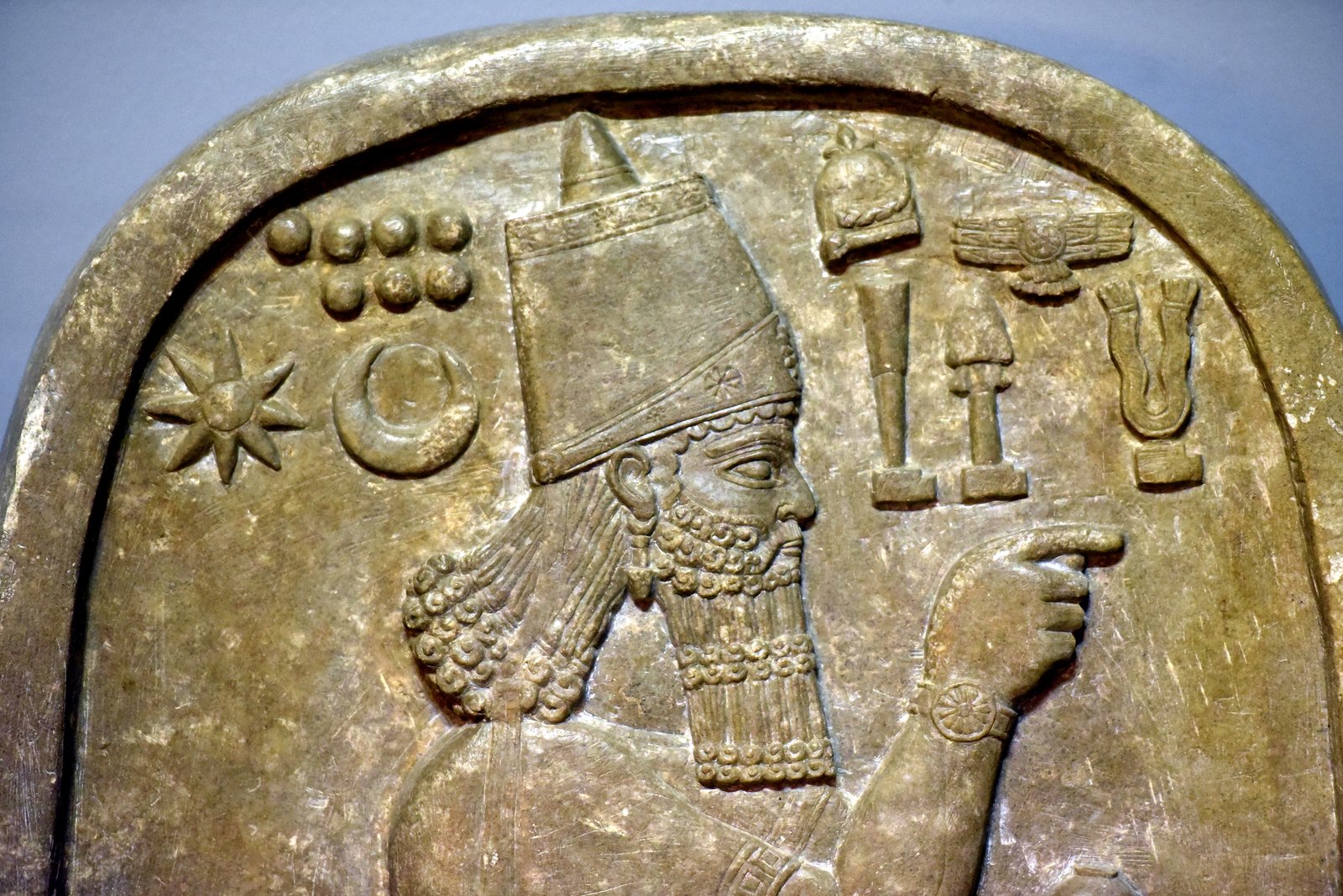
NannaNanna / Su’en / SinMesopotamian moon god known as Nanna, Su’en and Sîn/Sin. Worshipped especially at Ur and Harran, he is associated with the crescent and lunar cycle; names and myths have different histories.Glossary · Click to read the explanation, the moon god associated with Ur, is among ORACC’s strongest examples from the beginnings of written documentation, particularly personal names of late Uruk. The god also appears as Su’en and Sin in Mesopotamian traditions, but not every later name form should be assigned to the first tablets.[4]
A divine element in a human name matters because religious language enters a person’s or family’s relationship with a deity. Such a theophoric nameTheophoric nameA personal name including a deity’s name or another divine element, often as part of a short sentence or invocation, interpreted in its original language and context.Glossary · Click to read the explanation need not be a mythological text to preserve religious information.
A small example with phonetic evidence
Woods presents URI3+NA in connection with Nanna’s name as an example of recovering an early reading through a phonetic addition. This is more than drawing a moon and guessing which god it signifies: a combination of signs can itself help recover a spoken form.[1]
It does not prove that the whole system already represented complete language, or that every early name is equally secure. Its value is to prevent the opposite generalization that the first writing was wholly devoid of phonetic use.
The name arrives before the biography
Nanna’s name may establish that a tradition was known without a text of the same period preserving his birth, marriage or relationships with other gods. The name survives, but the dialogue or myth may not.
Later texts make the personality more visible. They may retain older traditions, introduce new formulations, or do both. A god’s antiquity does not automatically make every later story contemporary with the first attestation of the name.
Ninlil in early evidence
ORACC dates attestations of NinlilNinlilMesopotamian goddess and consort of Enlil, associated with Nippur, Tummal, destinies and royal ritual. Identified with Sud in literary tradition and known as Mulliltu/Mullissu in Akkadian and Assyrian contexts; her genealogies and roles vary by text and period.Glossary · Click to read the explanation to Uruk IV and III, referring to Englund’s discussion. Her familiar identity as EnlilEnlilEnlil/Ellil: a major Mesopotamian god associated with destinies, kingship, and Ekur at Nippur, already prominent in third-millennium god lists. His name’s origin and cult beginnings remain debated.Glossary · Click to read the explanation’s consort and her association with Nippur are clearer in later traditions.[5][7]
The inference needs restraint. Finding a writing classified under Ninlil does not transport every known detail of her marriage, children and rituals back into late Uruk.
A sign name does not decide every occurrence
The Proto-Cuneiform Sign List, PCSL, gives a sign the conventional name NINLIL, with its listed published occurrences in Uruk III. For example, DCCLT P000643 is a city list, not a god list: E₂ NINLIL occurs on the obverse, column ii, line 4. The textual setting is geographical; it is not an independent direct attestation of the goddess.[6]
The catalogue label therefore does not turn all occurrences into four direct references to the goddess. Englund discusses conventional “Ninlil” within problems of identifying early writings. The sound approach retains a possible divine connection while specifying the text type and limits of the reading.[7]
Inanna: a visible emblem
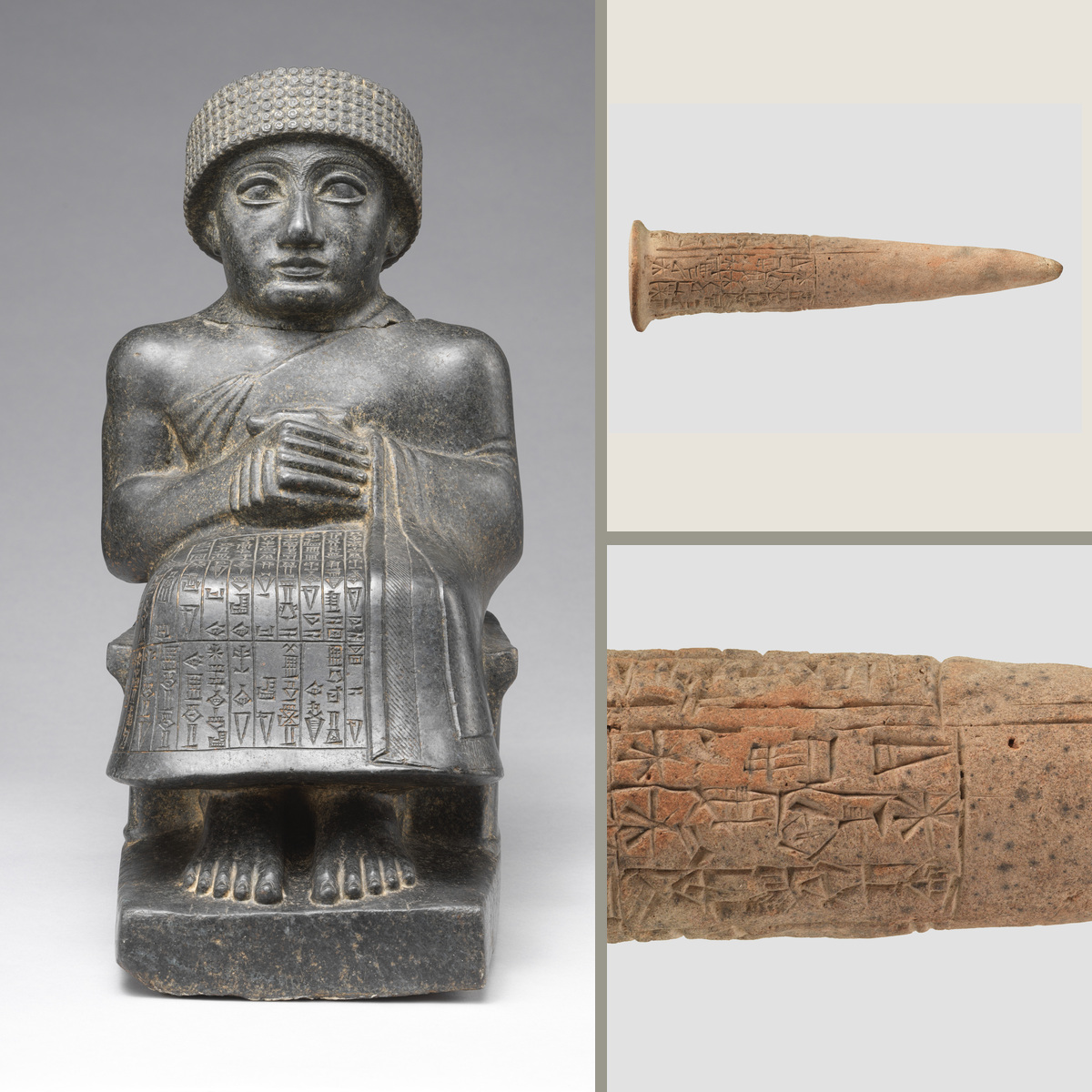
InannaInanna / IshtarA prominent Mesopotamian goddess whose Sumerian name Inanna became associated with Akkadian Ishtar across diverse traditions. She was associated with desire, war, royal authority and Venus, while local forms and genealogies varied among texts.Glossary · Click to read the explanation offers a different kind of evidence: a relationship between visual emblem and written sign. Visible Language publishes a real clay piece, VAT14540, from Uruk’s Eanna precinctEanna at UrukAn archaeological precinct and institutional centre at Uruk associated with Inanna; its name does not fix every early building’s function.Glossary · Click to read the explanation, dated to Uruk IV, about 3200 BCE. Its form is a post ending in a loop; the catalogue connects it with Inanna’s emblem and the writing of her name.[1]
Interpreting the shape through reed bundles or entrance structures is plausible and influential, but also a research question. Van Dijk-Coombes examines architectural origins of standards, rather than treating visual derivation as self-explanatory.[8]
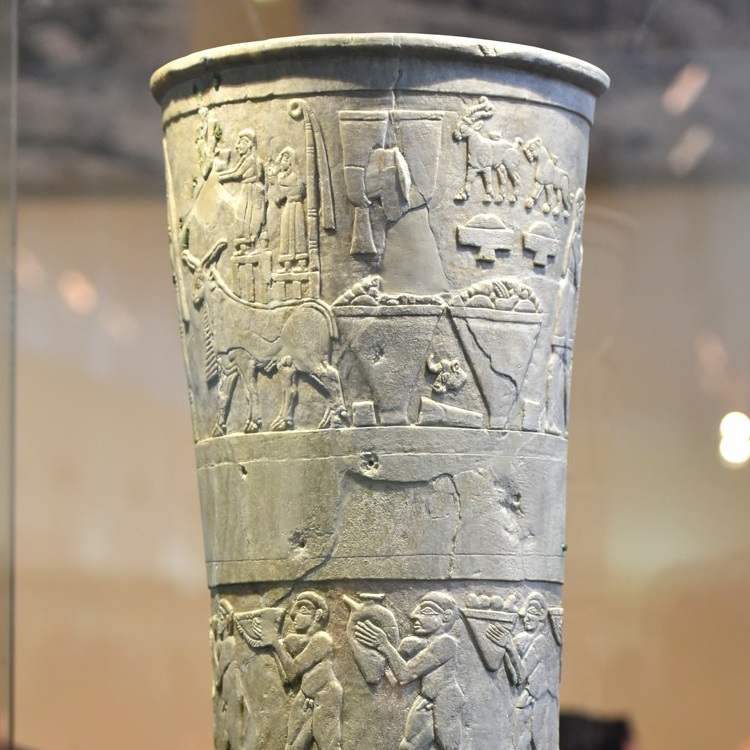
What appears on the Warka Vase?
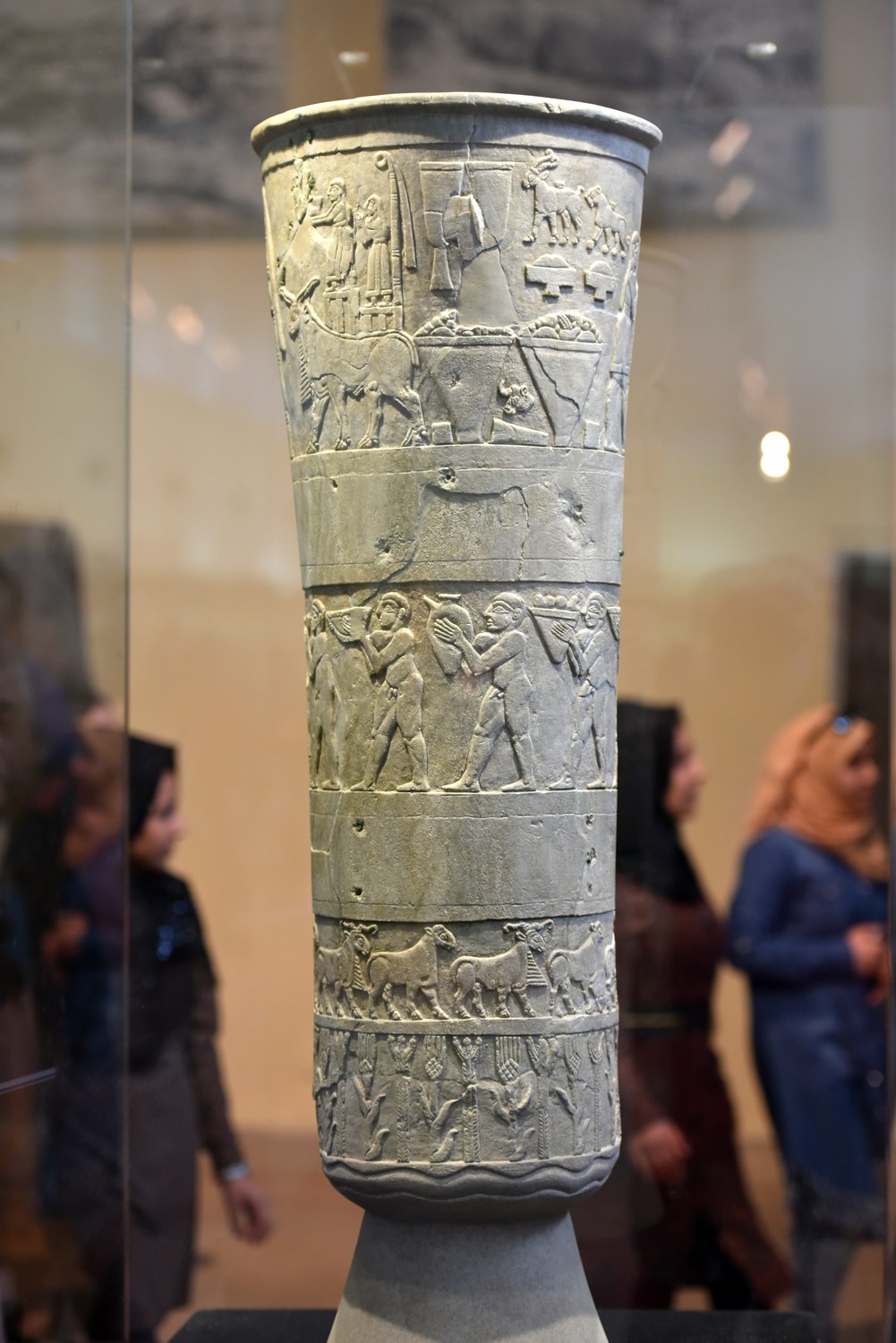
In the Warka Vase’s upper register, two looped emblems stand near a female figure. Comparisons support connecting the scene with Inanna’s sphere. Identifying the woman as the goddess herself or an associated priestess remains disputed.[8]
The image carries no inscription saying “this is Inanna.” An emblem can identify a religious setting without becoming an identity card for every nearby person. The photograph shows the actual vessel in the IraqIraqIraq is a modern country encompassing much of ancient MesopotamiaGlossary · Click to read the explanation Museum; parts have been restored.
From emblem to MUŠ3
The sign conventionally called MUŠ3 is associated with the writing of Inanna’s name. Comparing it with standards connects visual and written evidence, but each occurrence requires its own context.[1][8]
In an administrative account the writing may designate an institution associated with the goddess, while another text employs it in her name. Each repetition is not automatically her appearance or evidence of a particular myth. Institutional and religious meanings can overlap.
Enlil and Nippur: between place and deity
Enlil presents another problem. ORACC discusses a proposal that some earliest writings later used for his name originally designated Nippur. In this model the writing transferred from place to deity between Uruk and the Early Dynastic period.[9]
If correct, this would show the city and its god’s identity overlapping in writing history. It would not establish that Enlil’s cult began when the signs changed function: recording practices may change independently of a tradition’s age.
A hypothesis, not a settled date
ORACC reports Wang’s approximate range, 3200–2800 BCE, for this transfer, explicitly calling the issue highly contested. Englund also warns against excessive confidence in reconstructing some Uruk IV forms and readings.[7][9]
We therefore cannot state the year of Enlil’s “appearance,” or use an ambiguous early spelling to prove him younger than Nanna or Ninlil. The dispute concerns reading and classifying evidence; ranking divine ages is a different question.
The first names are not a complete pantheon
The earliest tablets do not supply a complete early version of the later familiar world: An in heaven, Enlil in authority, EnkiEnkiMesopotamian deity also known as Ea, linked with Eridu and the Abzu (deep fresh waters), wisdom, incantations, and narratives of creation and cosmic order. Later written attestations do not identify the deity of Eridu’s earliest layers.Glossary · Click to read the explanation in freshwater, and a family of spouses, children and messengers. Englund stresses that the clear Early Dynastic pantheon is not found in that form in the proto-cuneiform corpus.[7]
This describes surviving material, without denying broader traditions beyond it. Gods could be known orally while accounts and lists showed little interest in their relationships or stories.
When scribes collect divine names
Early Dynastic IIIa, about 2600–2500 BCE, provides a new window: god listsGod ListsTexts collecting divine names for preservation, teaching and classification, with varying theological organization.Glossary · Click to read the explanation from Fara and Abu Salabikh. Fara SF1, accessible through CDLI, begins with An, Enlil, Inanna, Enki, Nanna and Utu. The catalogue places the Abu Salabikh god-list tradition in approximately the same period.[10][11]
Here the name belongs to a list devoted to divine names, making its function clearer than many archaic occurrences. Nevertheless, a list is not itself a creation story or complete genealogy. Collecting names and teaching spellings does not explain every relationship among the gods.
Three clocks, not one
Three dates must be separated: the beginning of a belief, its earliest surviving record, and the earliest evidence confidently interpreted. The first may precede the second; an ambiguous sign may precede a clear text by centuries.
A name can arrive before a myth, or an emblem before a readable name. These differences cannot be converted into fixed intervals. An identified attestation establishes a minimum age for that tradition, without measuring how long it existed earlier.
What do we know with different confidence?
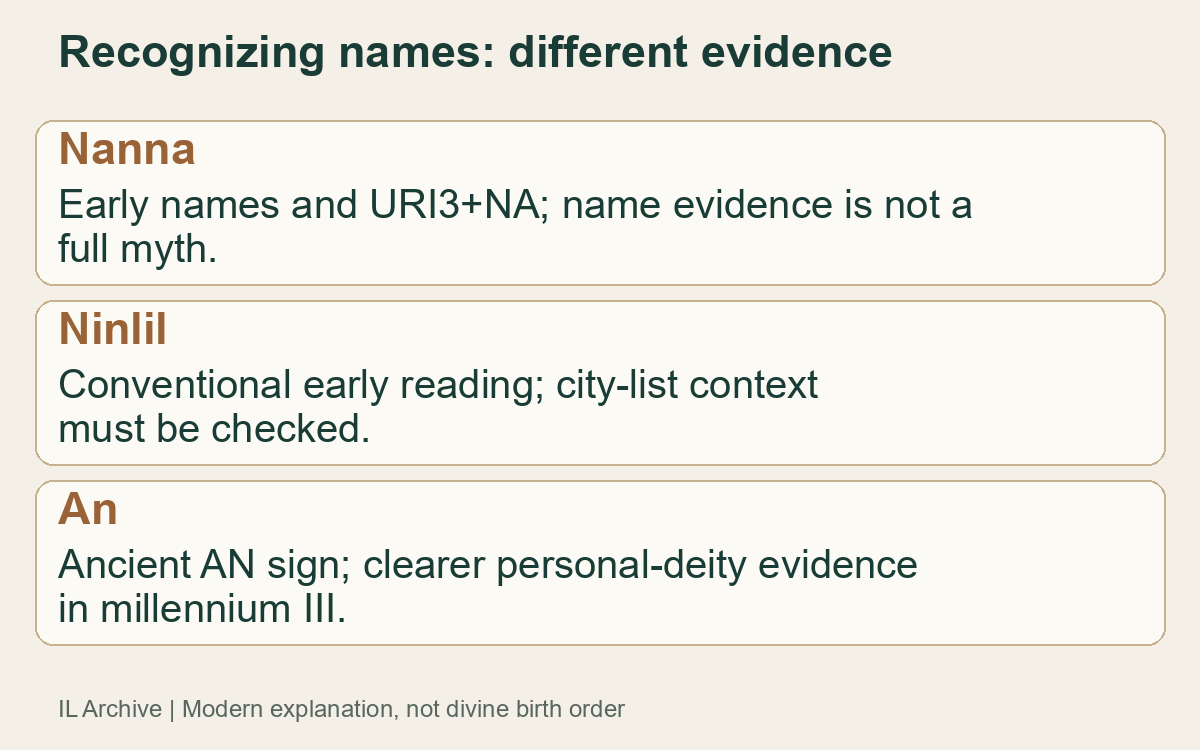
Early writing preserves religious references, and some names are recognizable near the beginning of documentation, Nanna being a prominent example. Inanna’s emblem and associated writing provide strong early evidence. Ninlil’s conventionally identified attestations require geographical context to be distinguished from direct references to the goddess.[1][4][5][6]
Early Enlil writings remain contested, while AN requires separating sky, divinity and the personal god. The evidence offers no “birth certificate” for the first deity, but a map of what can be read with varying clarity.[3][7][9]
When clay preserved the name
Tablets initiated a new kind of religious survival for us. The earth preserved signs, some read as names and others as emblems, institutions or places. Later texts let us see divine characters speak, argue and act.
“What is the earliest divine name?” therefore always requires qualifications: in which region and corpus, and under what criterion of reading? The first recognizable name is not necessarily that of the first god humanity knew. It is a name that writing, preservation and scholarly reading succeeded in bringing to us.
References and notes (12)
- Christopher Woods (2010), “The Earliest Mesopotamian Writing,” pp. 33–50; Joachim Marzahn, catalogue entry 39 (trans. Robert Wagner), in C. Woods, E. Teeter and G. Emberling, Visible Language: Inventions of Writing in the Ancient Middle East and Beyond, OIMP 32. Indexed excerpts of the institutional publication: Woods p. 43, URI₃+NA with the phonetic complement na for Nanna; catalogue no. 39, p. 70, VAT 14540 and Inanna emblem. Relevant excerpt text checked, not the whole book or an independent visual inspection of the original p. 70; an earlier visual check is recorded in the source note. Return to the text ↑
- Cuneiform Digital Library Initiative (CDLI), vocabulary tablet W 09123,d / VAT 15253, P000003, Uruk. Lexical tablet metadata: Uruk IV, ca. 3350–3200 BCE; language catalogued as undetermined. Evidence for catalogue dating, not a particular divine name. Uruk III range checked against Woods. Return to the text ↑
- Kathryn Stevens, “An/Anu (god),” Ancient Mesopotamian Gods and Goddesses, ORACC. Indexed original-site sections: AN functions, Sumerian An without determinative, clearer Fara/Mesanepada evidence. Direct access failed; Frayne’s underlying publication was not read. Return to the text ↑
- ORACC, “Nanna/Suen/Sin (god),” Ancient Mesopotamian Gods and Goddesses. Indexed sections on Ur, earliest documentation, late-Uruk personal names and differing name forms. Not all spellings projected into the earliest stage. Phonetic evidence checked against Woods, p. 43. Return to the text ↑
- Nicole Brisch, “Ninlil (goddess),” Ancient Mesopotamian Gods and Goddesses, ORACC. Indexed Uruk IV/III attestation statement citing Englund, plus later Enlil/Nippur associations. Does not make every archaic occurrence a direct divine name; compared with the sign list and Englund. Return to the text ↑
- Proto-Cuneiform Sign List (PCSL), conventional sign NINLIL, o0901578; DCCLT Archaic Cities text W 23998,1 / P000643. PCSL index lists four published Uruk III occurrences of the sign conventionally named NINLIL, not four secure goddess references. DCCLT indexed transliteration P000643, obverse II 4: E₂a NINLIL, in a city list. Direct site opening failed; indexed text was read, not tablet images. https://oracc.museum.upenn.edu/dcclt/P000643 Return to the text ↑
- Robert K. Englund (2011), “Notes on KIDₐ,” Cuneiform Digital Library Notes 2011:6. Read the complete online article text, argumentative notes and bibliography, not the other works it discusses: Enlil/Nippur and Ninlil spellings, KID/E₂ variation, speculative Uruk IV forms, and the later pantheon not being evident as such in the archaic corpus. Authorial analysis, not settled consensus. Return to the text ↑
- Renate Marian van Dijk-Coombes (2018), “The Architectural Origin of Mesopotamian Standards in Late Uruk/Jemdet Nasr Period Iconography,” Antiguo Oriente 16, pp. 117–146. Read abstract/introduction (pp. 117–118) and the standards/Warka Vase passages (pp. 122–124); visually checked rendered PDF pages 123–124, including notes 17–20 and the broken female headdress. The remainder of pp. 125–146 was not read in full; architectural-origin interpretation remains an argument. Return to the text ↑
- Adam Stone, “Enlil/Ellil (god),” Ancient Mesopotamian Gods and Goddesses, ORACC. Indexed passage reports Wang 2011, p. 245, place-to-deity transfer ca. 3200–2800, explicitly highly contested. Wang’s full book not read. Not a date for the beginning of Enlil’s cult. Return to the text ↑
- CDLI, Fara god list SF 001 / VAT 12760+, P010566, Shuruppak; DCCLT transliteration. Shuruppak/Fara, not Uruk; Early Dynastic IIIa ca. 2600–2500. Obverse column 1, lines 1–6: An, Enlil, Inanna, Enki, Nanna, Utu. No full theological analysis of the entire list. Return to the text ↑
- CDLI, Abu Salabikh God List, composite text P499260 / Q000036. Composite lexical god-list entry, Early Dynastic IIIa ca. 2600–2500. Not one complete tablet; not all witnesses read. Not used to establish a fixed number of gods. Return to the text ↑
- The Metropolitan Museum of Art, “Cuneiform tablet: administrative account concerning the distribution of barley and emmer,” accession 1988.433.2. Tablet ca. 3100–2900 BCE, probably Uruk; grain account. Contextual early-writing photograph, not an attestation of any discussed divine name. Public Domain/Open Access checked; original preserved. Return to the text ↑
Suggest a correction · Suggest a source for this record
Cite this record
IL Archive, «The Earliest Divine Names in Mesopotamia: When Writing Preserved the Name», https://ilarchive.com/en/studies/earliest-divine-names-mesopotamia
Continue reading