Site · City
Uruk
- Timeline
- From 4000 BCE to 3000 BCE
Ancient city at Warka in southern Iraq, a major urban centre around 3200 BCE that preserved early writing and accounting tablets.
Dates
Dates have distinct roles. The timeline uses creation, composition or historical coverage, rather than publication or discovery dates.
- Historical coverage
- Approximately From 4000 BCE to 3000 BCE
Text
City and writing
Uruk was an ancient city at Warka in southern IraqIraqIraq is a modern country encompassing much of ancient MesopotamiaGlossary · Click to read the explanation, within MesopotamiaMesopotamiaA historical region associated with the Tigris and Euphrates, home to many societies and civilisations.Glossary · Click to read the explanation. It was a major urban centre around 3200 BCE, in the late fourth millennium BCE, known for monumental architecture, works of art and early tablets. [1]
Its texts record goods distribution and workers’ rations, and include lists gathering words and signs, known as lexical lists. These witnesses help trace proto-cuneiformProto-cuneiformEarly Mesopotamian writing of the late fourth millennium BCE, combining numerical notation and signs, predominantly accounts with limited phonetic use.Glossary · Click to read the explanation, the early writing that preceded cuneiformCuneiformWriting with wedge-shaped signs, developed from Mesopotamian recording traditions and used for several languages from the third millennium BCE.Glossary · Click to read the explanation in its later form. Uruk names a city; a text’s language is studied through its signs and context. [1][2]
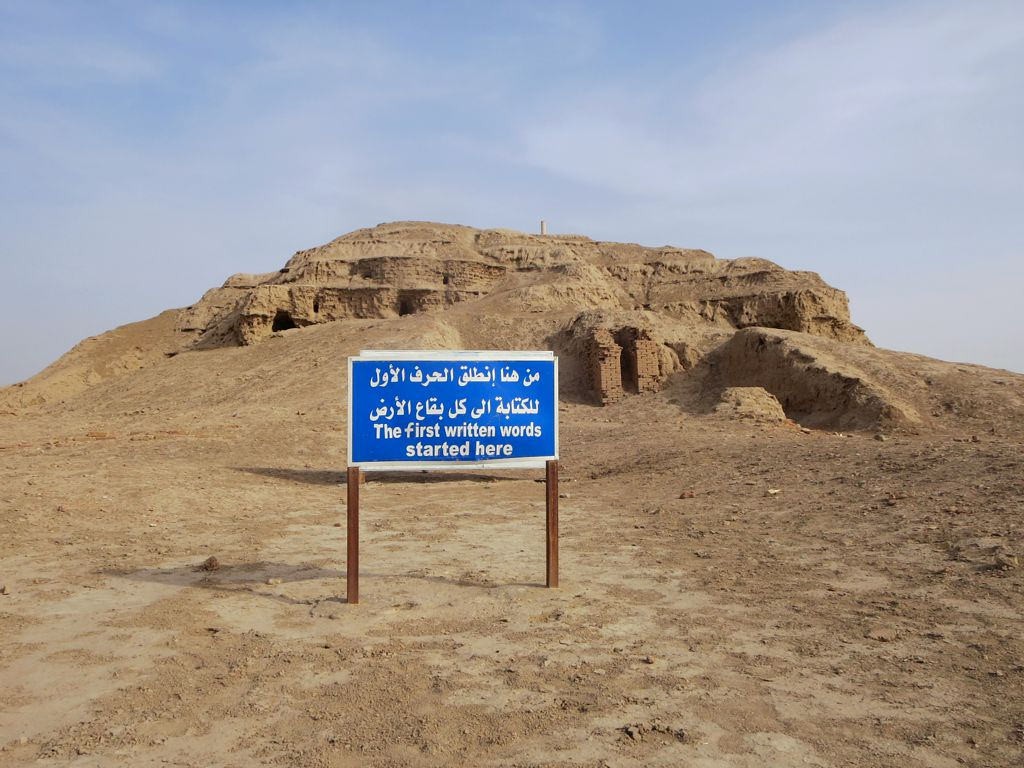
The photograph is a modern view of the remains, taken in 2016. The sign in front is modern visitor information; the beginnings of writing are studied through dated tablets and comparison with evidence from other sites.
References and notes
- Department of Ancient Near Eastern Art (2003). Uruk: The First City. The Metropolitan Museum of Art. Main essay: relative urban scale around 3200 BCE, architecture, goods and rations. “First” is not treated as a verdict on every origin of urbanism worldwide. Return to the text ↑
- Cuneiform Digital Library Initiative — Archaic Wood lexical composite, P471694 Metadata for an archaic lexical composite from Uruk, with reference to the lexical-list edition. Used for text type; the composite is not one physical tablet. Return to the text ↑
Research history
Substantive changes are retained here. Minor copy edits remain in the internal operational log.
-
Substantive record update
-
Substantive record update
-
Substantive record update
Suggest a correction · Suggest a source for this record
Cite this record
IL Archive, «Uruk», Edition 4, https://ilarchive.com/en/sites/uruk