Entity · Concept
Proto-cuneiform
A reference page linking a name, group, or concept to the materials that discuss it.
- Timeline
- From 3350 BCE to 3000 BCE
- Region
- Southern Mesopotamia (present-day Iraq)
The earliest phase of cuneiform in southern Mesopotamia, c. 3350–3000 BCE: numbers and signs on clay, mostly administrative accounts. Representation of language is limited, and many signs’ readings are still under study.
Estimated reading time: 5 min Published Last reviewed:
Share article
Reading path
Links recorded in this entry.
Periods
When does it appear?
- From 3350 BCE to 3000 BCE
Dates
Dates have distinct roles. The timeline uses creation, composition or historical coverage, rather than publication or discovery dates.
- Historical coverage
- Approximately From 3350 BCE to 3000 BCE
Text
Introduction
How did marks used to count grain, animals and labour become part of one of the earliest writing traditions? This entry follows what the UrukUrukAncient city at Warka in southern Iraq, a major urban centre around 3200 BCE that preserved early writing and accounting tablets.Glossary · Click to read the explanation tablets reveal about proto-cuneiform’s purposes, forms and limits of interpretation, distinguishing the evidence impressed into clay from scholarly reconstructions of the language behind it.
What is proto-cuneiform?
Proto-cuneiform is the conventional name for the earliest known phase of the tradition that developed into wedge-shaped cuneiform writingCuneiformWriting with wedge-shaped signs, developed from Mesopotamian recording traditions and used for several languages from the third millennium BCE.Glossary · Click to read the explanation. Its evidence comes from southern MesopotamiaMesopotamiaHistorical region associated with the Tigris and Euphrates: Uruk, Ur, Eridu, cuneiform, Sumer, Akkad, Babylon and Assyria, their languages and cults, and the limits of archaeological evidence.Glossary · Click to read the explanation, particularly UrukUrukAncient city at Warka in southern Iraq, a major urban centre around 3200 BCE that preserved early writing and accounting tablets.Glossary · Click to read the explanation (modern Warka, IraqIraqIraq is a modern country encompassing much of ancient MesopotamiaGlossary · Click to read the explanation). The Cuneiform Digital Library Initiative (CDLI) distinguishes the Uruk IV phase, approximately 3350–3200 BCE, from Uruk III, approximately 3200–3000 BCE. These are approximate archaeological and palaeographic ranges, not exact dates for a single moment of invention.[2]
Many tablets are associated with the EannaEanna at UrukAn archaeological precinct and institutional centre at Uruk associated with Inanna; its name does not fix every early building’s function.Glossary · Click to read the explanation precinct at Uruk. A significant part of the material, however, was recovered from discarded debris or reused fill, not an administrative archive preserved where it was first used. Thus “Uruk IV” and “Uruk III” identify broad phases of the script without fixing the precise date of each tablet or the original purpose of the room in which it was written.[3]
From numbers to signs for goods
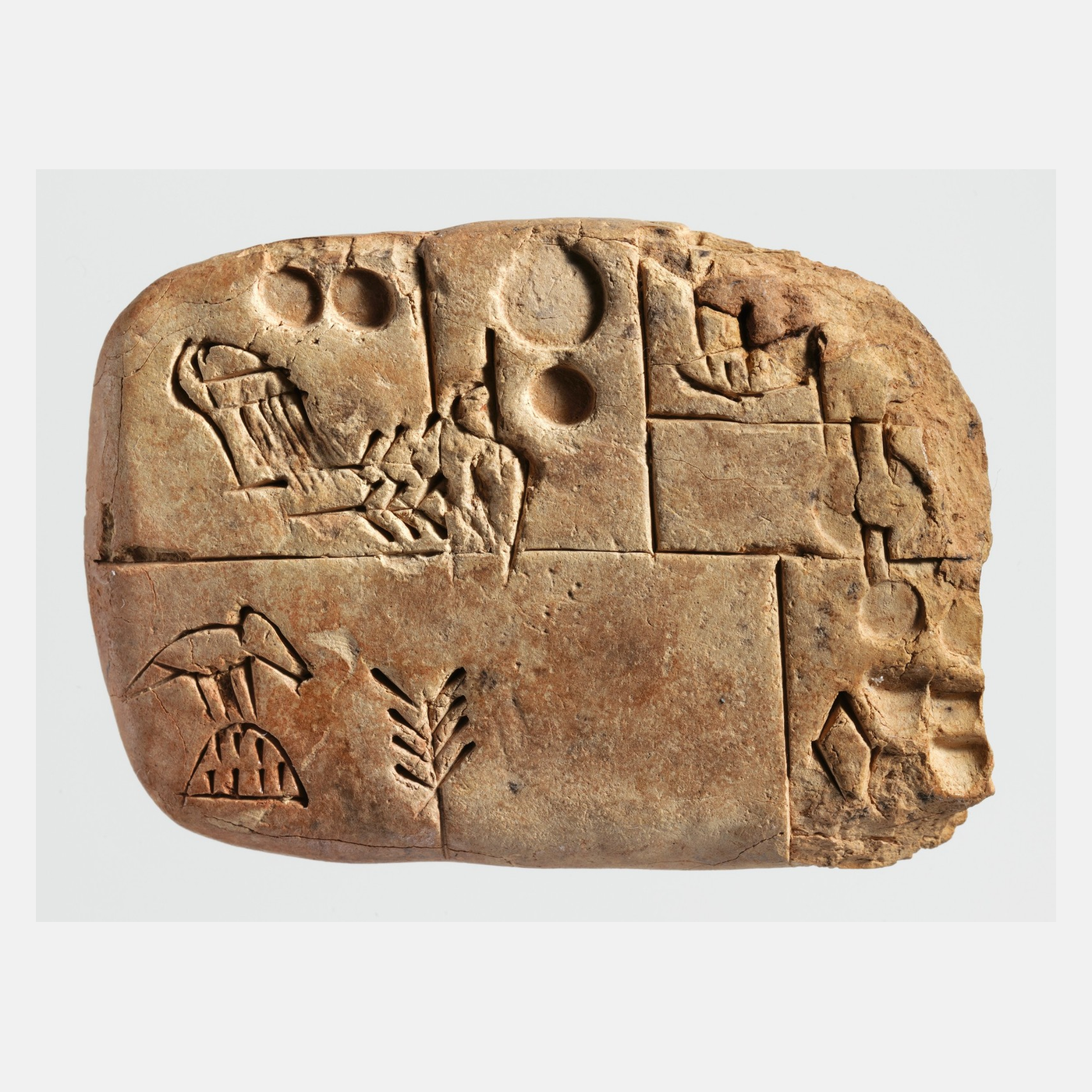
Scribes marked wet clay with circular and other impressions for quantities, alongside incised or impressed signs identifying commodities, people or offices. Not every sign was an intelligible picture: some were conventional or abstract, and many remain difficult to interpret. The term “proto-cuneiform” does not imply that every stroke already had the wedges characteristic of the later script.[4]
Other recording devices predated these tablets, including small clay tokensClay tokensSmall shaped clay objects from West Asia since the Neolithic; some served counting or recording, but there is no evidence of one universal accounting function for all.Glossary · Click to read the explanation, sealed envelopes and numerical tablets. Their relationship to counting is supported by parallels in numerical notation, but the claim that every written sign derived from a particular earlier token is unproven. Combining a quantity with a sign for what was counted greatly expanded the information that an administrative record could preserve.[4][7]
What did scribes record?
Most surviving documents are accounts: quantities of grain and its products, livestock and textiles, rations, work groups and offices involved in receiving or distributing goods. Robert K. Englund distinguishes short primary records of transactions from secondary accounts that assemble and reconcile many entries. In some cases we understand the accounting structure better than the spoken phrasing of the document.[4]
Not everything concerned bookkeeping. Lexical lists also appear: sets of signs or words arranged by topic, such as professions, animals and vessels. They are early evidence for the organisation and teaching of scribal knowledge. Englund points out that such lists form a very small fraction of Uruk IV tablets and a considerably larger share in Uruk III; a single fixed percentage must not be applied to both phases.[4][5]
Why is a number not self-explanatory?
Proto-cuneiform employed several numerical and metrological systems, depending on whether people, vessels, grain capacities or fields were being recorded. Englund shows that one small circular impression, conventionally called N14, can have different values according to the commodity and measuring system: it may qualify a number of containers, a quantity of barley or an area of land. The arrangement of entries, totals and neighbouring signs is essential to interpretation. A circle cannot simply be read as “one” or “ten” regardless of context.[4]
Was it the complete writing of a language?
Many signs function as logogramsLogogramA written sign functioning as a word sign in context; the same form may also have syllabic or determinative uses.Glossary · Click to read the explanation, linking a graph to a word or related words, whereas phonetic and grammatical notation remains limited in the earliest documents. Christopher Woods discusses a few early phonetic uses, including clues to the pronunciation of certain names, but distinguishes these from the subsequent growth of phonetic signs through the rebus principle, by which a sign can represent another word of similar sound. An administrative entry usually does not enable us to reconstruct an entire spoken sentence or its grammar.[1]
Later cuneiform is closely associated with the Sumerian languageSumerian languageAncient language of southern Mesopotamia, clearly attested in third-millennium BCE texts and maintained in learning and ritual after its spoken use declined.Glossary · Click to read the explanation, and many scholarly sign names reflect later Sumerian readings. Yet assigning a later Sumerian name to an ancient sign—or calling a museum object “Sumerian”—does not by itself establish the language underlying every Uruk IV account. The linguistic identity of the earliest records is less secure than their general accounting function.[1]
A specific witness: the Met grain tablet
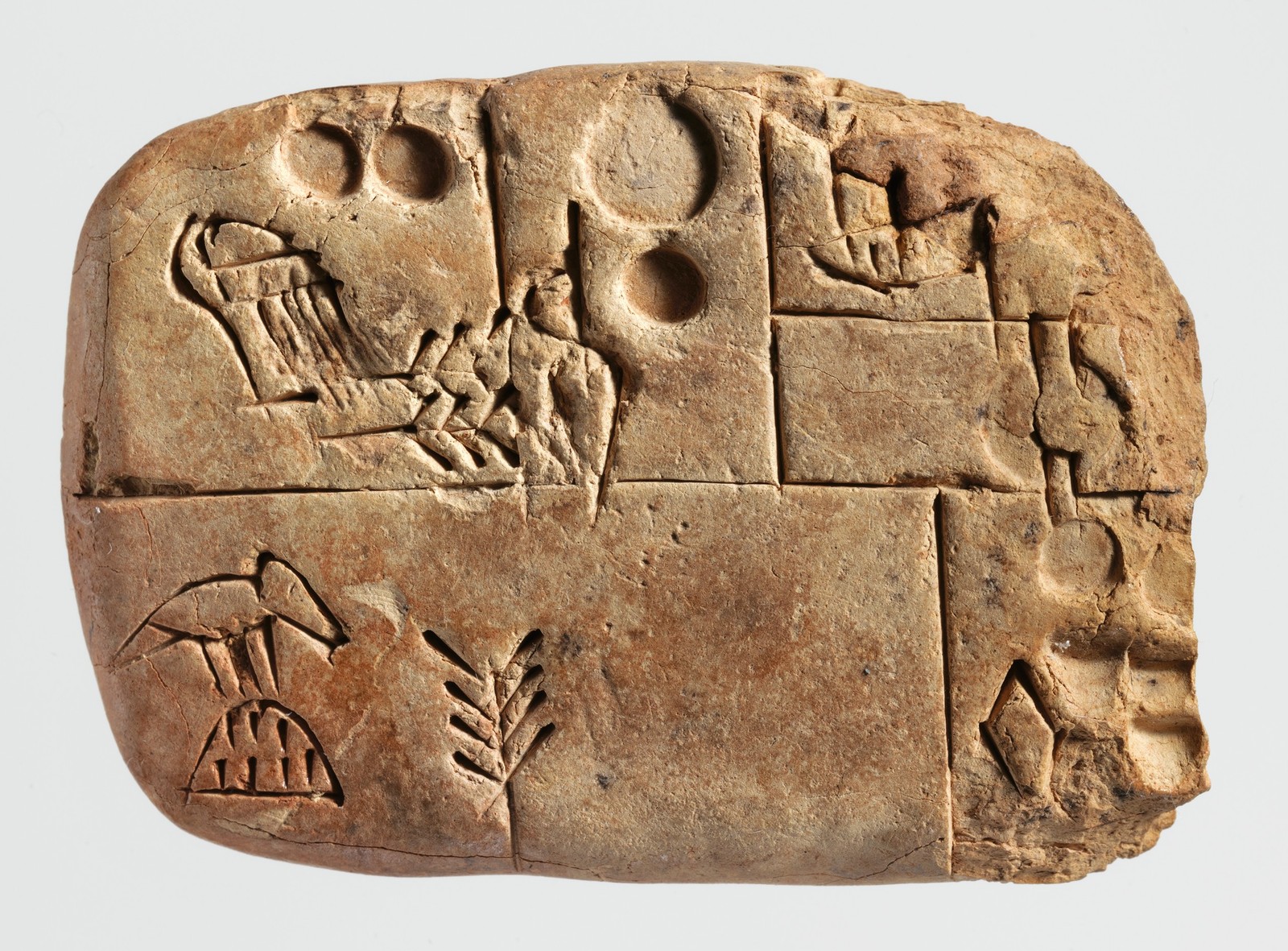
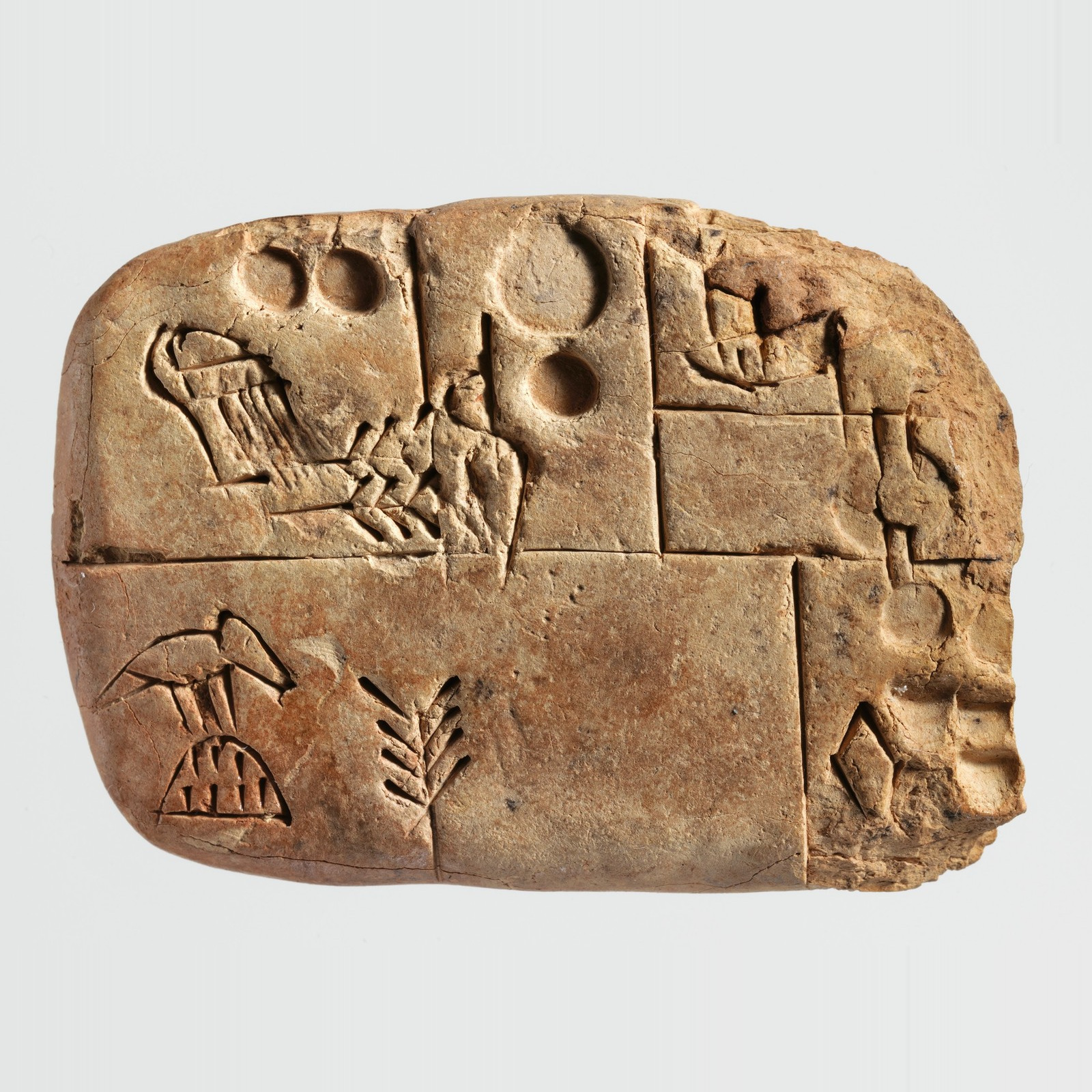
The photograph depicts an actual object, 1988.433.2, in the Metropolitan Museum of Art, New YorkNew York CityNew York City is in the United States and houses the Metropolitan Museum of ArtGlossary · Click to read the explanation. The museum identifies it as a clay administrative account concerning barley and emmer wheat, dates it to ca. 3100–2900 BCE, and describes its origin in Uruk as probable rather than certain. Pictorial signs stand alongside numerical impressions, but the details of the grain deliveries remain the museum’s cautious interpretation, not a translation of an explicit verb. The object overlaps the end of the early phase and subsequent horizons; it is not the earliest known tablet.[6]
Did all signs come from counting devices and seals?
Comparisons between tokens, cylinder sealsCylinder sealSmall engraved cylinder rolled over soft clay to leave an extended image. Used to secure, document and identify administrative actions; its pictures do not automatically constitute writing.Glossary · Click to read the explanation and signs suggest a common administrative environment, not a proven single lineage for every drawing. In a study published online in 2024 and in a 2025 journal issue, Kathryn Kelley, Mattia Cartolano and Silvia Ferrara proposed specific relationships between earlier seal motifs and some signs for vessels and textiles. Resemblances supported by context make these proposals stronger, but do not turn every formal parallel into demonstrated descent. Sealing and writing remained distinct systems even as they interacted.[7]
What the evidence can—and cannot—tell us
The tablets reveal methods of inventory, measurement, resource allocation and labour administration, and illustrate the connection between urban management and durable records. They do not record ordinary speech in full, or independently disclose the origin of every sign, each scribe’s language or every institution’s beliefs. The gradual development of this tradition into more distinctly wedge-shaped and increasingly phonetic cuneiform in the third millennium BCE is the history of a writing system; its exact point of invention and the contributions of each earlier medium remain subjects of research.[1][7]
References and notes (7)
- Christopher Woods, “The Earliest Mesopotamian Writing,” in Visible Language: Inventions of Writing in the Ancient Middle East and Beyond, ed. Christopher Woods, OIMP 32, Chicago 2010; corrected reprint 2015, chapter text pp. 33–50. Verified from an indexed text extract of printed p. 43 on logograms, phonetics and rebus, plus the publisher’s record. The complete book was not obtained; pp. 33–37 and 43–45 described earlier are a previously reported reading, not independently rechecked. Return to the text ↑
- Cuneiform Digital Library Initiative (CDLI), “CDLI search information: Period,” and collection search; Uruk IV c. 3350–3200 BCE and Uruk III c. 3200–3000 BCE. Read the Period entry in the search-guide page and the period filters in search results; no tablet-by-tablet reading of the database. Return to the text ↑
- Michael Everson and Laura F. Hawkins, “Preliminary proposal to encode Proto-Cuneiform in the SMP of the UCS,” ISO/IEC JTC1/SC2/WG2 N4760, 25 September 2016; a technical proposal with archaeological background, not an independent excavation report. Printed p. 1 (PDF page 1): chronology, excavation history and secondary deposits outside secure stratigraphy. The remainder of the proposed character list was not examined. Return to the text ↑
- Robert K. Englund, “Accounting in Proto-Cuneiform,” in The Oxford Handbook of Cuneiform Culture, eds. Karen Radner and Eleanor Robson, Oxford University Press, 2011 (online edition 2012), pp. 32–50. Author chapter PDF on CDLI: printed pp. 32–38, 41 and 44–47; visually inspected pp. 38 and 41. Relevant prose passages, not all diagrams, references, or the whole book. Return to the text ↑
- Digital Corpus of Cuneiform Lexical Texts (DCCLT/ORACC), “Introduction: What is a Lexical List?”, academic project introduction on the Uruk lists and their function. First two paragraphs, §1 and beginning of §1.1 as indexed in search; the remainder of the page could not be opened. Return to the text ↑
- The Metropolitan Museum of Art, object record “Cuneiform tablet: administrative account concerning the distribution of barley and emmer,” accession 1988.433.2; catalogue and curatorial description. Read the curatorial summary and object-details panel: c. 3100–2900 BCE, “probably from Uruk”, accession and Public Domain label; not a new philological decipherment. Return to the text ↑
- Kathryn Kelley, Mattia Cartolano and Silvia Ferrara, “Seals and signs: tracing the origins of writing in ancient South-west Asia,” Antiquity 99, no. 403 (February 2025), pp. 64–82; online 5 November 2024; doi:10.15184/aqy.2024.165. HTML text read: abstract, introduction, Uruk information technologies, inter-related systems, comparisons, vessel/textile cases, symbol-sharing and conclusion; no systematic reading of supplements or every illustration. Return to the text ↑
Suggest a correction · Suggest a source for this record
Cite this record
IL Archive, «Proto-cuneiform», https://ilarchive.com/en/entities/proto-cuneiform
Continue reading
Related readings