Study
Did Writing Appear Suddenly at Uruk?
An extended study of a topic, with evidence and references.
From tokens, envelopes and seals to Uruk’s tablets: how proto-cuneiform emerged, and why fuller linguistic representation took centuries.
Share article
Dates
Dates have distinct roles. The timeline uses creation, composition or historical coverage, rather than publication or discovery dates.
- Historical coverage
- Approximately From 3500 BCE to 2600 BCE
Text
For millennia, people built houses, cultivated land, carved stone, buried their dead and maintained extensive exchange networks without leaving texts in which we can read their speech. Then, in southern IraqIraqIraq is a modern country encompassing much of ancient MesopotamiaGlossary · Click to read the explanation towards the end of the fourth millennium BCE, we encounter clay tablets recording numbers, goods, people and institutions.
The distance seems extraordinary: from a world without surviving texts to a system containing hundreds of signs. Yet UrukUrukAncient city at Warka in southern Iraq, a major urban centre around 3200 BCE that preserved early writing and accounting tablets.Glossary · Click to read the explanation’s writing neither appeared fully formed nor began from nothing. Counting, sealing and documentation preceded it; the new system then developed for centuries before representing speech more flexibly.
Most of the earliest surviving documents do not ask who created the world or what happens after death. They address a practical problem: how to preserve accounts when the things being managed exceed what one person can remember.
Recording before writing
Not every sign is writing. An animal image may refer to an animal, marks may help with counting, and a seal may identify an owner or supervising institution. All convey information without necessarily recording words in a particular language.
Conversely, an emerging script need not record every possible sentence to merit study as early writing. Proto-cuneiformProto-cuneiformEarly Mesopotamian writing of the late fourth millennium BCE, combining numerical notation and signs, predominantly accounts with limited phonetic use.Glossary · Click to read the explanation occupies the boundary between earlier notation and a system increasingly tied to language. The transition was not a clean division between two worlds.[3]
We should ask what information each system preserves, how users recover it, and how much they rely on context and speech. This distinguishes an image from a text while recognizing that the earliest writing differed from ours.
Clay tokens: a long history and varied uses
Small clay objects shaped as balls, cones, discs and other forms are known across South-west Asia. We call them clay tokensClay tokensSmall clay objects of varied shapes; some supported counting, but Neolithic examples do not establish one accounting system or function for all.Glossary · Click to read the explanation. Some date to the Neolithic, thousands of years before Uruk’s tablets.
Denise Schmandt-Besserat’s influential hypothesis proposed a long-lived accounting system in which some token shapes eventually became written signs. It directed attention towards recording before texts, but applying that explanation to every object is unwarranted.
Lucy Bennison-Chapman’s study, based on approximately three thousand objects and additional site data, concludes that Neolithic objects served multiple purposes. Counting may have been one, but it does not explain the entire assemblage or demonstrate a single system unchanged for millennia.[1]
Some tokens can therefore be investigated as counting devices while each group’s function remains a contextual question. We cannot assign a specific commodity to every ancient cone simply because it resembles a later object.
How can a small object represent an absent thing?
Imagine a herd of twenty animals. You can count them while they are present, but how do you preserve the account after they move? How do you record a delivery or compare two days’ totals? Objects or signs used by agreement can carry some of that information.
This is a modern illustration, not a reading of a particular token. It explains representation: information need not remain attached only to the thing counted; another medium can carry it for transfer and review.
Symbol-making long predates Uruk. What distinguishes administrative recording here is the organized, repeatable use of devices combining quantities, things and responsible parties. Writing was not humanity’s first experience of thinking through symbols.
Clay envelopes: accounts under seal
During the fourth millennium BCE we find hollow clay envelopesClay envelopesHollow clay envelopes, sometimes enclosing tokens and bearing seals or numerical impressions; fourth-millennium administrative recording devices.Glossary · Click to read the explanation, some enclosing tokens before being closed and sealed. They are commonly called bullae. Here the term refers specifically to hollow envelopes, since it is also used for other clay sealings.
An envelope could preserve a group associated with an account or transaction and make opening it evident. Enclosed tokens, however, were invisible from outside. Some surviving examples bear numerical impressions as well as seals, placing information on the exterior too.[2]
The illustrated example from Susa, Louvre SB 1932, is dated approximately 3500–2900 BCE in the museum record.[11]
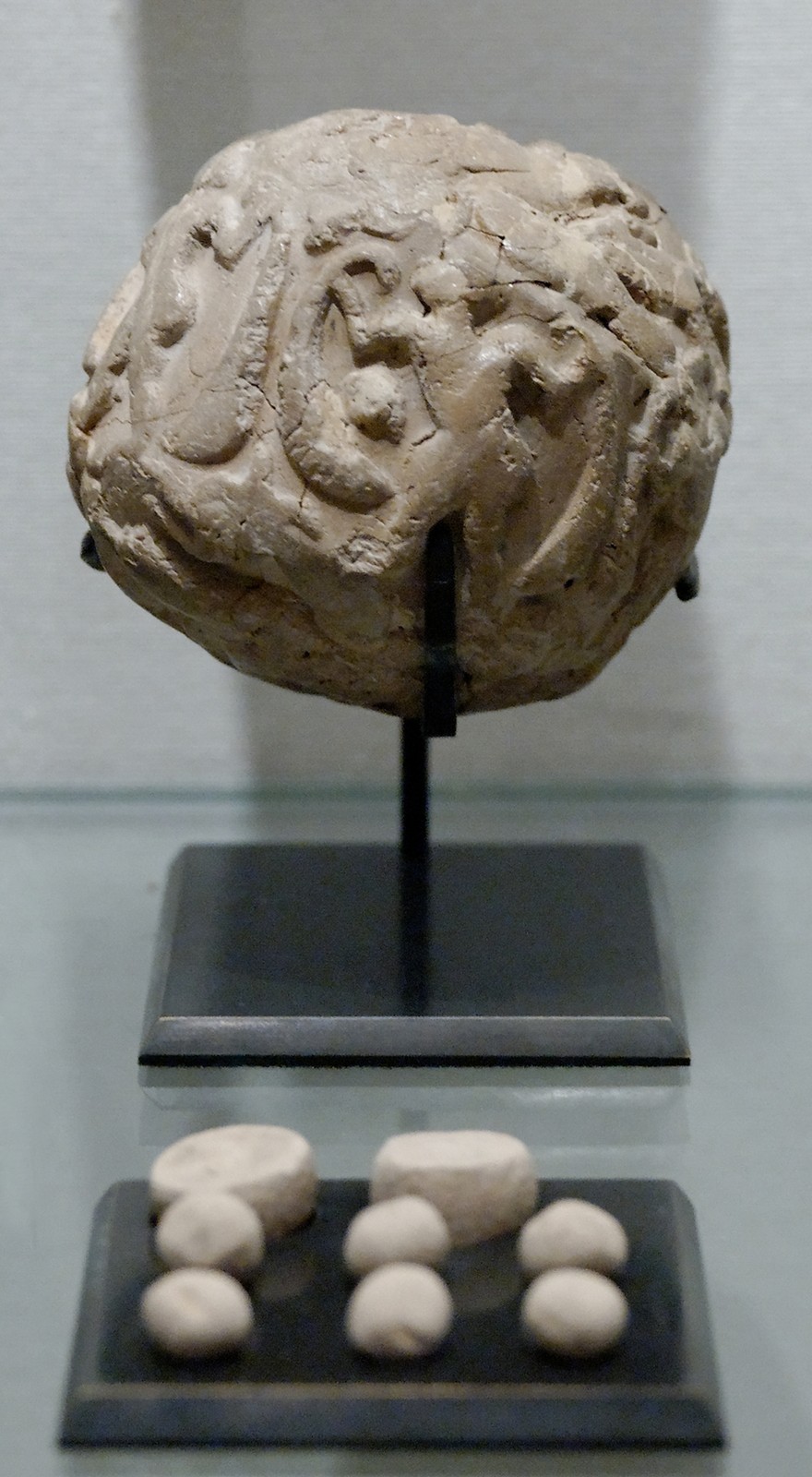
These connections matter for the history of recording, but they do not prove that every written tablet originated in an envelope or that exterior marks always matched interior objects in one standardized way. We are examining overlapping administrative tools rather than an automatic sequence established for every artifact.
The cylinder seal: identification, imagery and authority
Stamp sealsStamp sealA carved surface pressed into soft material to leave an impression that may distinguish a person, object or procedure. Unlike a rolled cylinder seal; imagery alone makes it neither writing nor evidence of a creed.Glossary · Click to read the explanation preceded writing by a long period. Cylinder sealsCylinder sealEngraved cylinder rolled over clay to produce a continuous design; used for documentation, identification and authority, without necessarily encoding language.Glossary · Click to read the explanation appeared during the fourth millennium: rolled over clay, they produced an extended design. By the middle of that millennium the technology was used in Iraq, IranIranIran is the modern country containing Shush, ancient SusaGlossary · Click to read the explanation and Syria.[2]
Seals could be applied to clay securing containers or doors, or to envelopes and tablets. Impressions might identify a person, institution, production unit or destination; they need not always be personal signatures in the modern sense.
The Metropolitan Museum displays a Late Uruk example with a modern impression showing the full design; the impression is modern, the seal ancient.[10]
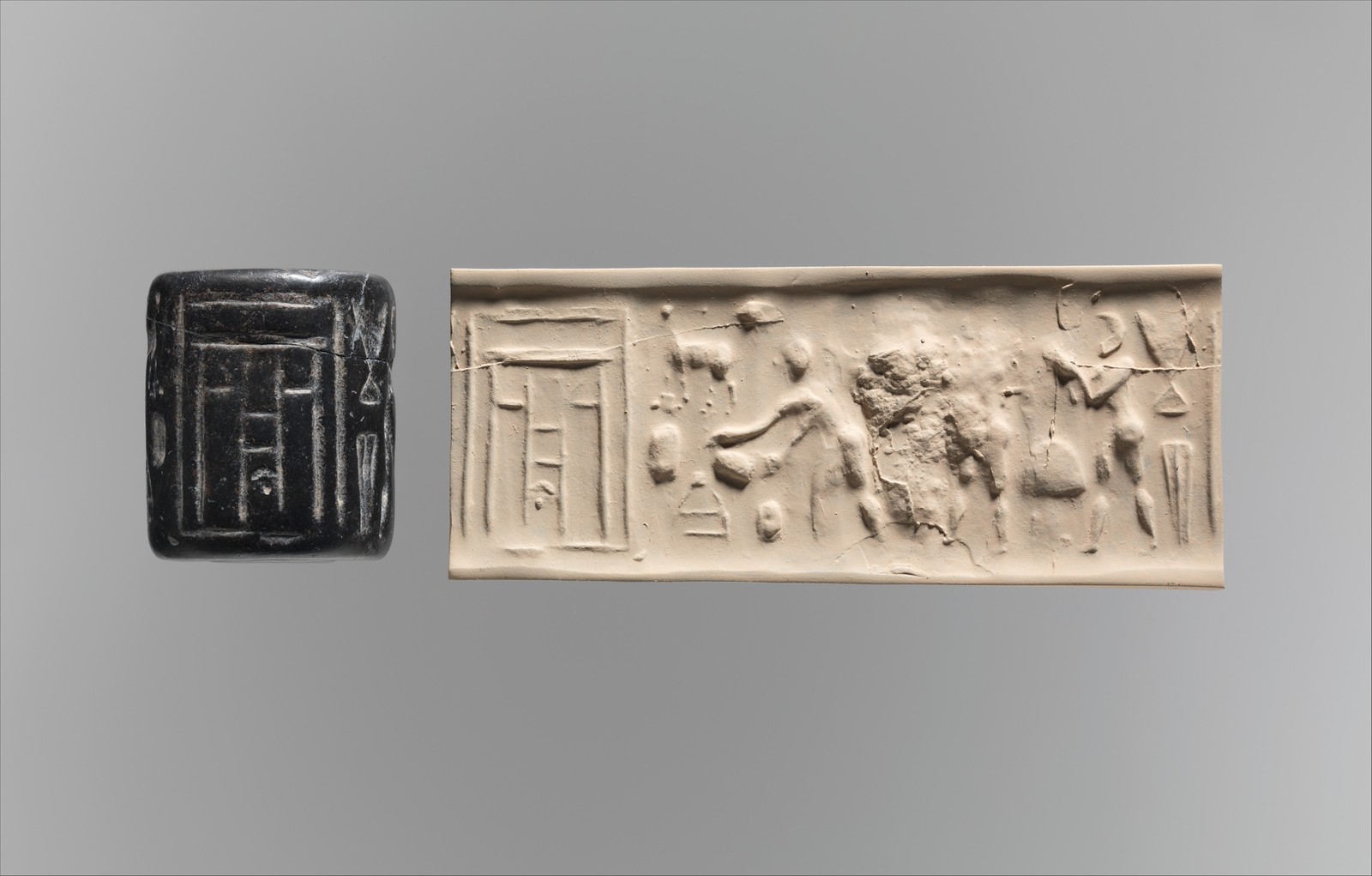
A seal was both a documentary device and an image. Its scenes could depict work, animals, processions or ritualRitualAn organised or distinguished practice meaningful to a community; it may leave traces, but its form alone does not reveal an associated doctrine.Glossary · Click to read the explanation activity, but telling a story visually did not turn them into written sentences. Image and text remain distinguishable even when they share a surface.
Around 3500 BCE: the tablet as an accounting surface
Numerical tablets, and tablets combining numerical notation with indications of what was counted, precede proto-cuneiform. This development is generally placed around the middle of the fourth millennium, with differences in chronology and terminology between sites and publications.[2]
The clay tablet therefore did not necessarily originate with linguistic text. It provided a surface for accounts and sealing before its information capacity expanded. That change is distinct from signs acquiring phonetic uses later.
If we write “20” today, the question remains: twenty of what? This is deliberately simplified. Ancient systems used different methods of counting and measuring, and the notation system could itself help identify a quantity. Their numbers were not simply early versions of ours.[3]
Number and commodity together
Combining quantities with commodity signs produces more specific information: a measure of grain, a count of animals or vessels associated with a transaction. Some tablets at this boundary are termed numero-ideographic.
Adding a commodity image does not mean a tablet preserves a whole sentence. It may supply elements of an account whose users need to understand the document’s conventions. Moving information onto an organized surface does not remove the need for shared meanings.
Nor should we turn these stages into one compulsory recipe: token, envelope, tablet, text. Several tools remained in use together, their functions overlapped, and more than one channel may have contributed to the new system.[2]
The city that enlarged the accounting problem
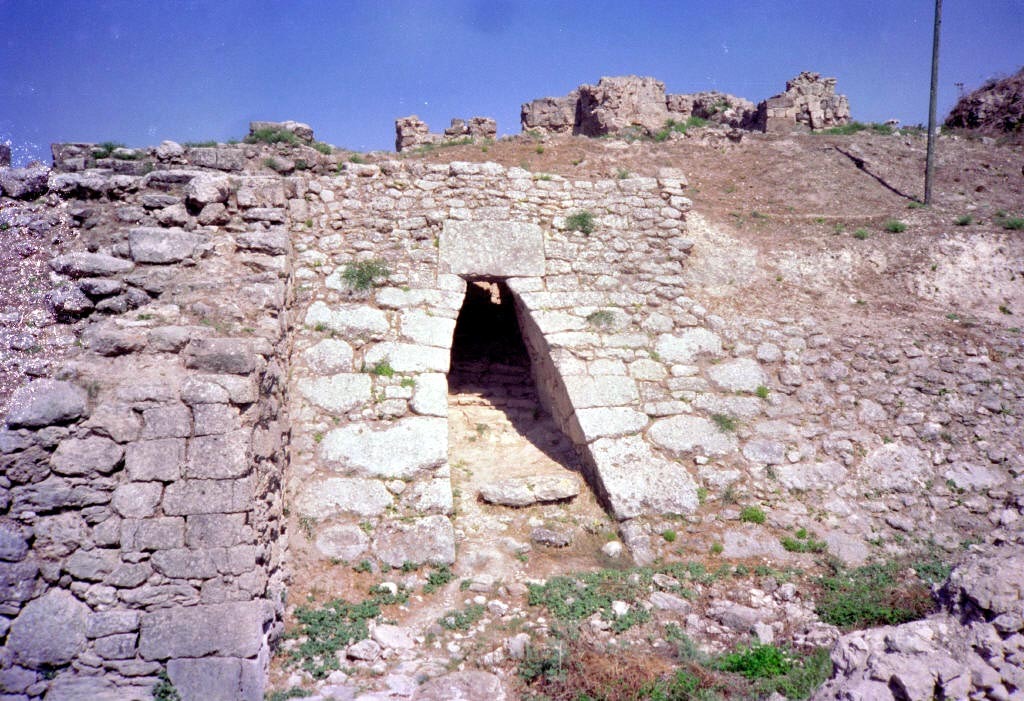
The transformation occurred in Uruk, modern Warka in southern Iraq. By approximately 3200 BCE it was among the region’s largest urban settlements, with monumental architecture, crafts, extensive connections and institutions managing resources and labour.[9]
Recording a household’s grain was no longer the only problem. Larger organizations could need to track incoming and outgoing materials, distributions, animals, vessels, workers and the parties responsible for transactions.
Early documents strongly connect writing with administrative complexity. This helps explain why expanded recording became useful; it does not demonstrate that every city must invent writing or that one cause explains all inventions worldwide.[3]
Proto-cuneiform in Uruk IV and III
The CuneiformCuneiformWriting with wedge-shaped signs, developed from Mesopotamian recording traditions and used for several languages from the third millennium BCE.Glossary · Click to read the explanation Digital Library Initiative uses approximate ranges of 3350–3200 BCE for Uruk IV and 3200–3000 BCE for Uruk III. These phases contain the system conventionally called proto-cuneiform.[7][8]
Such ranges are chronological conventions, not a known birthday for writing. Absolute dating and correlations between sites are difficult. Many Uruk tablets were recovered in secondary deposits after their useful lives, rather than in archives preserved as their owners left them.[3]
Nevertheless, a system of hundreds of signs appearing within a relatively short interval helps explain the impression of a leap. It was rapid by prehistoric standards, yet preceded by a history of numbers, seals and recording devices.
Why does the beginning look unlike familiar cuneiform?
“Cuneiform” suggests wedges, but many early signs were incised or drawn in clay with a pointed tool. Some resemble heads, vessels or plants; others are conventional forms whose origins remain difficult to identify.
Techniques of drawing, impressing and organizing signs changed gradually. Wedge-shaped forms developed alongside increasing abstraction. The emergence of a writing system must therefore be distinguished from the evolution of its visual appearance.[3][5]
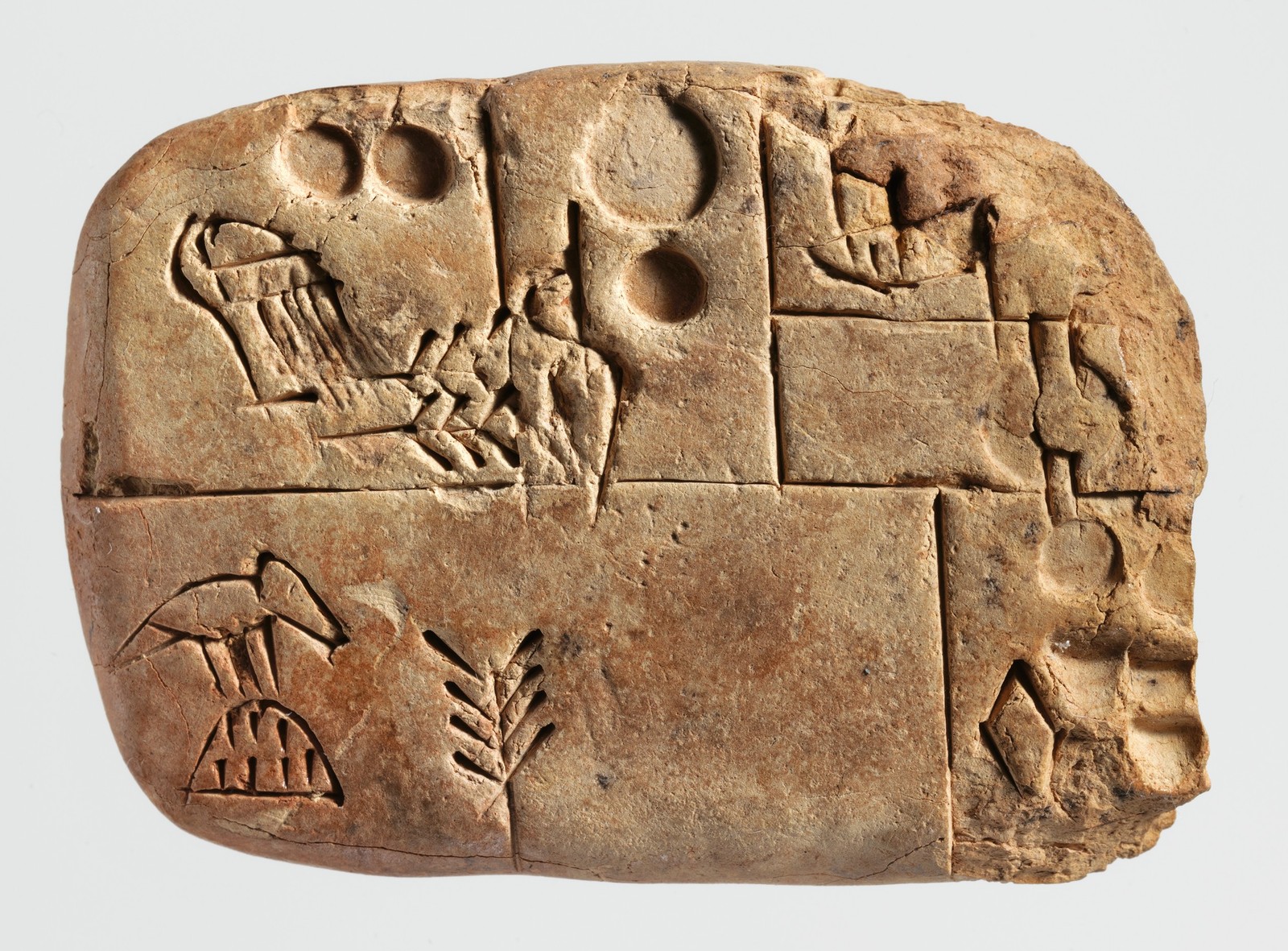
The tablet on this study’s cover, Metropolitan Museum object 1988.433.2, dates to approximately 3100–2900 BCE and is tentatively attributed to Uruk. It illustrates an early administrative phase; it is neither the first known tablet nor a securely identified witness to the beginning of Uruk IV.[5]
A record that does not transcribe all speech
Consider a modern sentence: “The supervisor gave five jars of beer to ten workers yesterday.” It has a verb, agent, recipient, time, quantity and grammatical relations.
An early record could instead supply signs for people, goods, quantities and an institution, arranged in compartments. This is a simplified teaching example, not a translation of a tablet. It explains how documentation can serve its purpose without transcribing an utterance.
A commodity and number alone do not tell us whether goods were delivered, received or still owed. Document format and context may help. The Metropolitan Museum notes that missing verbs can make grain accounts uncertain to interpret.[5]
What language lies behind the signs?
When signs have little explicit connection with sound, identifying the writer’s language is difficult. Knowing that an account concerns barley does not automatically tell us how its name was pronounced.
Many scholars regard Sumerian as underlying the earliest Mesopotamian texts, drawing on limited phonetic evidence and continuity with later documents. Treating every element as a clearly readable Sumerian word, however, exceeds the available evidence.[3]
This does not mean anyone speaking any language could automatically understand the records. Numerical and non-phonetic signs also require learned conventions. Conveying some information without spelling speech differs from having a universal system readable by everyone.
Were all tablets accounts?
Most were administrative, but lexical lists also organized occupations, animals, goods, vessels and other categories. They classify knowledge and participate in transmitting scribal traditions; they are not all records of completed transactions.
In Robert Englund’s 2004 discussion, such lists constitute less than one percent of the Uruk IV group and close to twenty percent of the subsequent Uruk III group. These figures concern the material in that discussion, not a new count of everything published today.[4]
The distinction is between accounts and lists, not between important and marginal texts. Lists show that early writing organized knowledge too. The early corpus does not yet contain the narrative epics and prayers for which later MesopotamiaMesopotamiaA historical region associated with the Tigris and Euphrates, home to many societies and civilisations.Glossary · Click to read the explanation became famous.
When a sign is used for its sound
Images help represent fish or vessels, but names and grammatical elements require further resources. One solution is the rebus principleRebus principleUsing a word sign for its sound in another similarly pronounced word, extending writing beyond depictions of things towards language.Glossary · Click to read the explanation: using a word’s sign for its sound in another similarly pronounced word, rather than only for its original meaning.
A modern English illustration is an eye image used for the pronoun “I”: eye and I share the pronunciation /aɪ/. We are not taking the first letter of the image’s name, but using a whole-word sound correspondence. This is not evidence from Uruk.
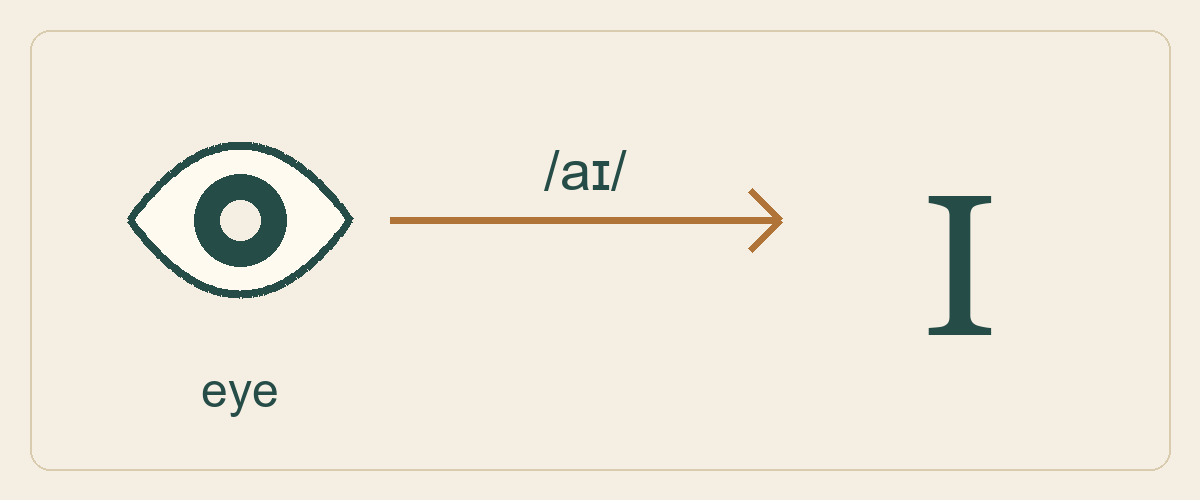
Woods supplies a Sumerian example closer to the subject: the reed sign, pronounced gi, used for the similarly pronounced verb “to return.” A sign can thus extend beyond the depicted object into another linguistic element.[3]
Phonetic development was gradual
Limited phonetic uses are attested in proto-cuneiform, but they were not its dominant organizing principle. Woods describes phonetic signs becoming increasingly important in the first quarter of the third millennium BCE.[3]
Ira Spar’s 2004 Metropolitan Museum introduction mentions a few examples around 3200–3000 BCE and more regular phonetic usage after approximately 2600 BCE.[6] Different formulations remind us that sound being present, becoming common and representing grammar are different developments.
No single year therefore marks an overnight conversion into complete writing. The capacity to represent language expanded over centuries, while abbreviation and reliance on readers’ contextual knowledge remained features of later writing as well.
Where did hundreds of signs come from?
The system’s innovators did not inhabit a visual vacuum. Images, seals, numbers, vessels and recording technologies already existed, alongside a much older capacity to invent and learn symbols.
A study by Kathryn Kelley, Mattia Cartolano and Silvia Ferrara, published online in 2024, proposes connections between selected pre-literate seal motifs and proto-cuneiform signs, particularly textiles and vessels. It analyzes specific comparisons rather than proving that every sign derived from a seal.[2]
A body of conventions can expand quickly when multiple people use it repeatedly. Yet we do not know the inventors’ names or every stage of adoption. Explaining that acceleration remains a historical inference from the environment we can observe, not a surviving report of a meeting to invent writing.
Institutional memory beyond the individual
A tablet can retain information after the witness to a transaction leaves, allowing another person to review and compare it. Recording thus expands an institution’s ability to track more than one individual can remember.
External memory did not begin with writing alone: tokens, seals and other devices preceded it. Nor does a surviving tablet guarantee comprehension after the writer dies. Readers still need the signs, accounting conventions and documentary context.
The new capacity increasingly combined and organized varied information, then linked it more closely to language. It could serve planning, accountability and authority, without letting us infer a specific tax or administrative structure from every tablet.
Did writing emerge from the temple?
Much of Uruk’s tablet material came from the Eanna precinctEanna at UrukAn archaeological precinct and institutional centre at Uruk associated with Inanna; its name does not fix every early building’s function.Glossary · Click to read the explanation, associated in historical sources with InannaInanna / IshtarProminent Mesopotamian goddess with a major centre at Uruk, whose parentage and cult traditions vary rather than forming one fixed genealogy.Glossary · Click to read the explanation. This helped establish the familiar account of writing arising within a temple economy.
Yet discovery within that area does not identify every building’s function or every official’s role. The secondary contexts of many tablets complicate links to original offices or particular rooms.[3]
The stronger conclusion is an institutional setting managing resources, labour and distribution. Economic, ritual and political activities could overlap there. We need neither impose modern separations nor label every early scribe a priest.
What might have disappeared?
Clay preserved extraordinary evidence, whereas wood and leather perish in many conditions. The earliest surviving tablet is therefore not necessarily humanity’s first experiment in recording.
Parts of the development could be missing, including marks on materials that did not survive. That possibility does not establish an earlier complete linguistic script. Such a claim requires independent evidence.
Uruk is among the strongest candidates for the birthplace of Mesopotamian cuneiform because of its large early corpus. It is not thereby the origin of all writing worldwide: Egyptian writing appears at a comparable period and deserves study through its own evidence.[3]
Did writing appear suddenly?
If the question means a leap from no recording to fully developed cuneiform in one moment, the answer is no. There is a long history of symbols, fourth-millennium sealing, envelopes and numerical tablets, proto-cuneiform in Uruk IV and III, and expanding linguistic representation during the third millennium.
This is a set of converging and overlapping paths, not one proven route for every device. The evidence can be distinguished by confidence:
- Established: non-linguistic recording preceded Uruk’s earliest texts, and administration dominated the early written corpus.
- Strongly supported: expanded recording was tied to cities and institutions, while writing’s relationship with speech developed gradually.
- A research proposal: particular seal images contributed to some sign forms alongside other precursors.
- Unproven: every Neolithic token was an accounting token, every written sign derived from one, or a known individual invented a complete system in a day.
The final transition was nevertheless relatively rapid. Tablet, number, symbol, seal and institutional demand converged in a setting able to expand their uses.
The tool that later preserved epics and prayers did not begin, in most surviving evidence, by recording them. It began with grain, rations and people, then acquired broader uses. As its linguistic capacity expanded, divine names and human speech could survive those who pronounced them.
That is writing’s power for studying religious history: it preserves names and meanings that stone alone cannot identify. But the first written occurrence of a god’s name dates our surviving evidence, not necessarily the beginning of belief in that god.
References and notes
- Lucy E. Bennison-Chapman (2019; online 2018). Reconsidering “Tokens”: The Neolithic Origins of Accounting or Multifunctional, Utilitarian Tools? Cambridge Archaeological Journal 29(2), 233–259. doi:10.1017/S0959774318000513. Abstract only: approximately 3,000 objects and data from 56 additional sites; multiple functions including counting. Paywalled full text not read. Return to the text ↑
- Kathryn Kelley, Mattia Cartolano & Silvia Ferrara (2025; online 5 November 2024). Seals and signs: tracing the origins of writing in ancient South-west Asia. Antiquity 99(403), 64–82. doi:10.15184/aqy.2024.165. Introduction, Information technologies, Inter-related systems, and conclusion: recording and sealing precursors and proposed textile/vessel sign relationships. Table 1 not visually inspected; broad dates are approximate, with IV/III ranges independently checked in CDLI. Return to the text ↑
- Christopher Woods (2010; corrected reprint 2015). The Earliest Mesopotamian Writing, in Visible Language: Inventions of Writing in the Ancient Middle East and Beyond, OIMP 32, pp. 33–50. Selected pp. 33–37 and 43–45: Uruk, secondary deposits, sign forms, language, rebus and phonetic development. Page 43 visually checked. Not the complete book. Current CDLI ranges used instead of treating the older 3200 BCE convention as a fixed boundary. Return to the text ↑
- Robert K. Englund (2004). Proto-Cuneiform Account-Books and Journals, in Michael Hudson & Cornelia Wunsch (eds.), Creating Economic Order: Record-keeping, Standardization and the Development of Accounting in the Ancient Near East, pp. 23–46. Pages 23–24 and 28; p. 28 visually checked. Less than 1% lexical lists in IV and close to 20% in III refer to the group discussed in 2004, not a current census of all texts. Return to the text ↑
- The Metropolitan Museum of Art. Cuneiform tablet: administrative account concerning the distribution of barley and emmer. Object 1988.433.2. Description and object data: ca. 3100–2900 BCE, probably from Uruk; missing verbs and interpretive limits. Correct accession 1988.433.2, not the different object 1988.433.3. Image is public domain under museum policy. Return to the text ↑
- Ira Spar (2004). The Origins of Writing. The Metropolitan Museum of Art, Heilbrunn Timeline of Art History. Main essay, particularly eye/I and phonetic usage. Dated 2004 overview; 2600 is not treated as a hard boundary overriding Woods’s gradual account. Earlier organic-media proposals are not presented as established scripts. Return to the text ↑
- Cuneiform Digital Library Initiative. Uruk IV (ca. 3350–3200 BC), period entry. Current period heading and approximate range, not an exact invention date. Return to the text ↑
- Cuneiform Digital Library Initiative. Uruk III (ca. 3200–3000 BC), period entry. English period heading; the page’s Arabic translation displays a mismatched range and was not reproduced. Return to the text ↑
- Department of Ancient Near Eastern Art (2003). Uruk: The First City. The Metropolitan Museum of Art. Main essay: relative urban scale around 3200 BCE, architecture, goods and rations. “First” is not treated as a verdict on every origin of urbanism worldwide. Return to the text ↑
- The Metropolitan Museum of Art. Cylinder seal and modern impression: ritual scene before a temple facade. Object 1983.314.1. Description and metadata: Late Uruk, ca. 3500–3100 BCE. Impression is modern to display the design; temple interpretation is the museum’s and identifies no deity. Public-domain image. Return to the text ↑
- Musée du Louvre. Bulle avec empreinte et jetons, SB 1932. Collection des Antiquités orientales. Object record: Susa, ca. 3500–2900 BCE. Establishes identification and broad date; photograph separately licensed by Marie-Lan Nguyen, CC BY 2.5, on Commons. Return to the text ↑
Suggest a correction · Suggest a source for this record
Cite this record
IL Archive, «Did Writing Appear Suddenly at Uruk?», Edition 1, https://ilarchive.com/en/studies/uruk-origins-of-writing
Continue reading