Entity · Concept
Cylinder seal
A reference page linking a name, group, or concept to the materials that discuss it.
- Region
- Mesopotamia and the ancient Near East
An engraved cylinder rolled over clay to leave a continuous impression: an administrative and visual tool from the fourth millennium BCE. The entry separates a possible temple scene from unproven divine identification.
Estimated reading time: 6 min Published Last reviewed:
Share article
Text
Introduction
A cylinder seal is a small engraved object rolled across soft clay to leave a continuous band of images or marks. It provides evidence for the management of goods, authority and visual expression in the societies of MesopotamiaMesopotamiaHistorical region associated with the Tigris and Euphrates: Uruk, Ur, Eridu, cuneiform, Sumer, Akkad, Babylon and Assyria, their languages and cults, and the limits of archaeological evidence.Glossary · Click to read the explanation. Yet not every engraved scene is a written story, nor is every impression the signature of a particular individual.
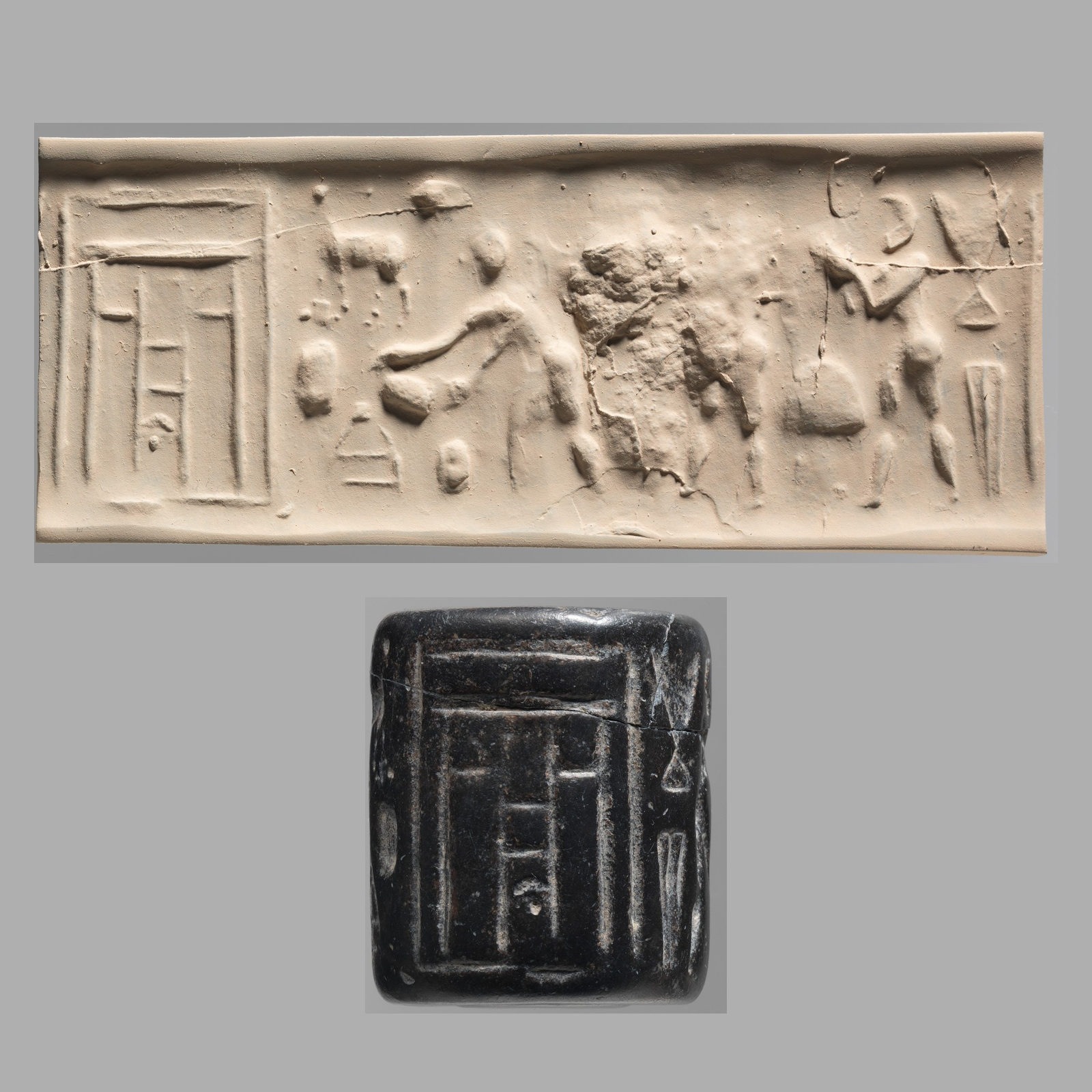
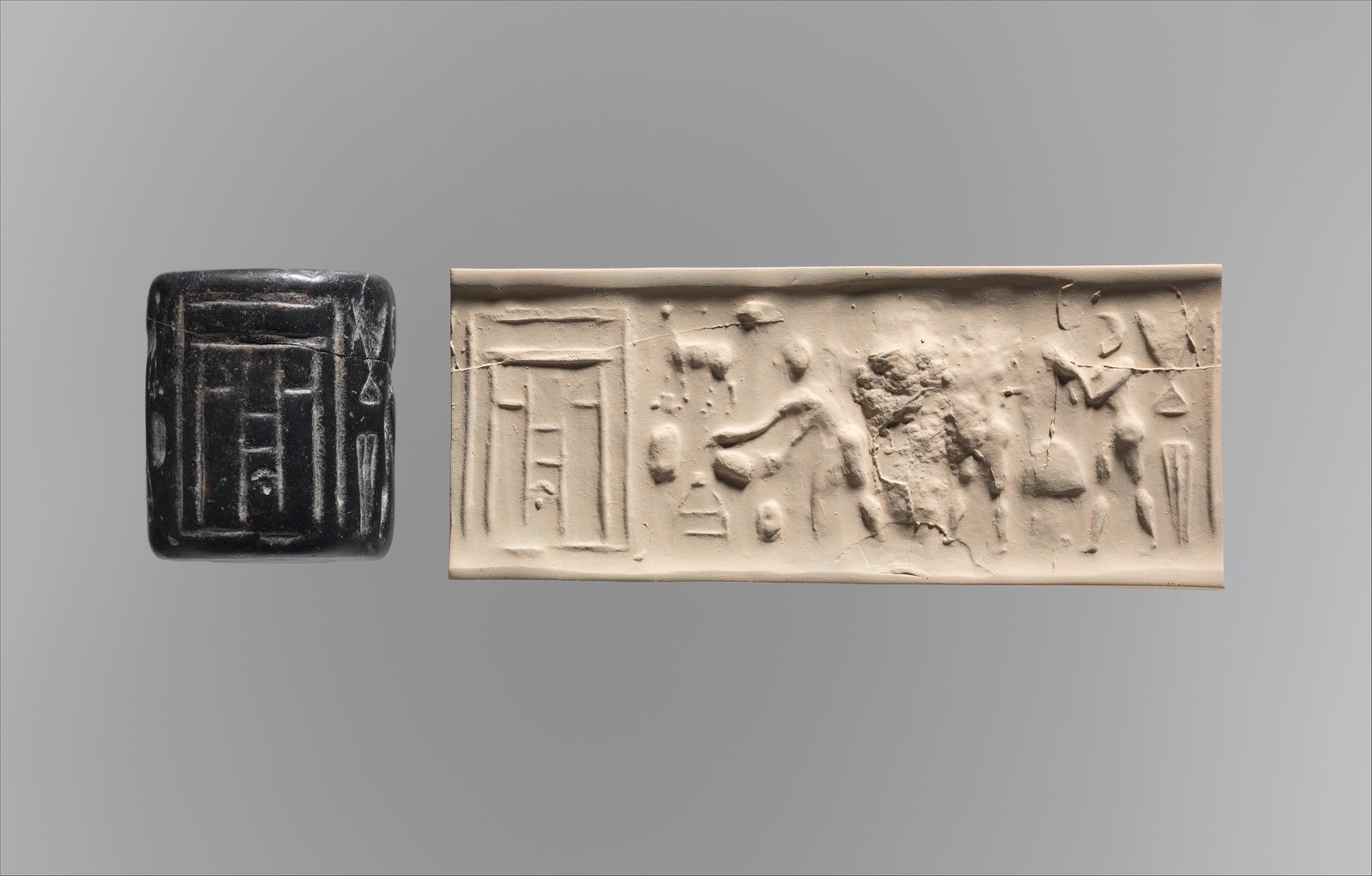
This entry examines the seal's manufacture, use and relationship to the emergence of writing, then considers the limits of identifying a religious scene on an object in the Metropolitan Museum of Art. The impression displayed alongside that seal was made in modern times to reveal its design; it is not a second ancient artefact.[1]
What is a cylinder seal, and how does it work?
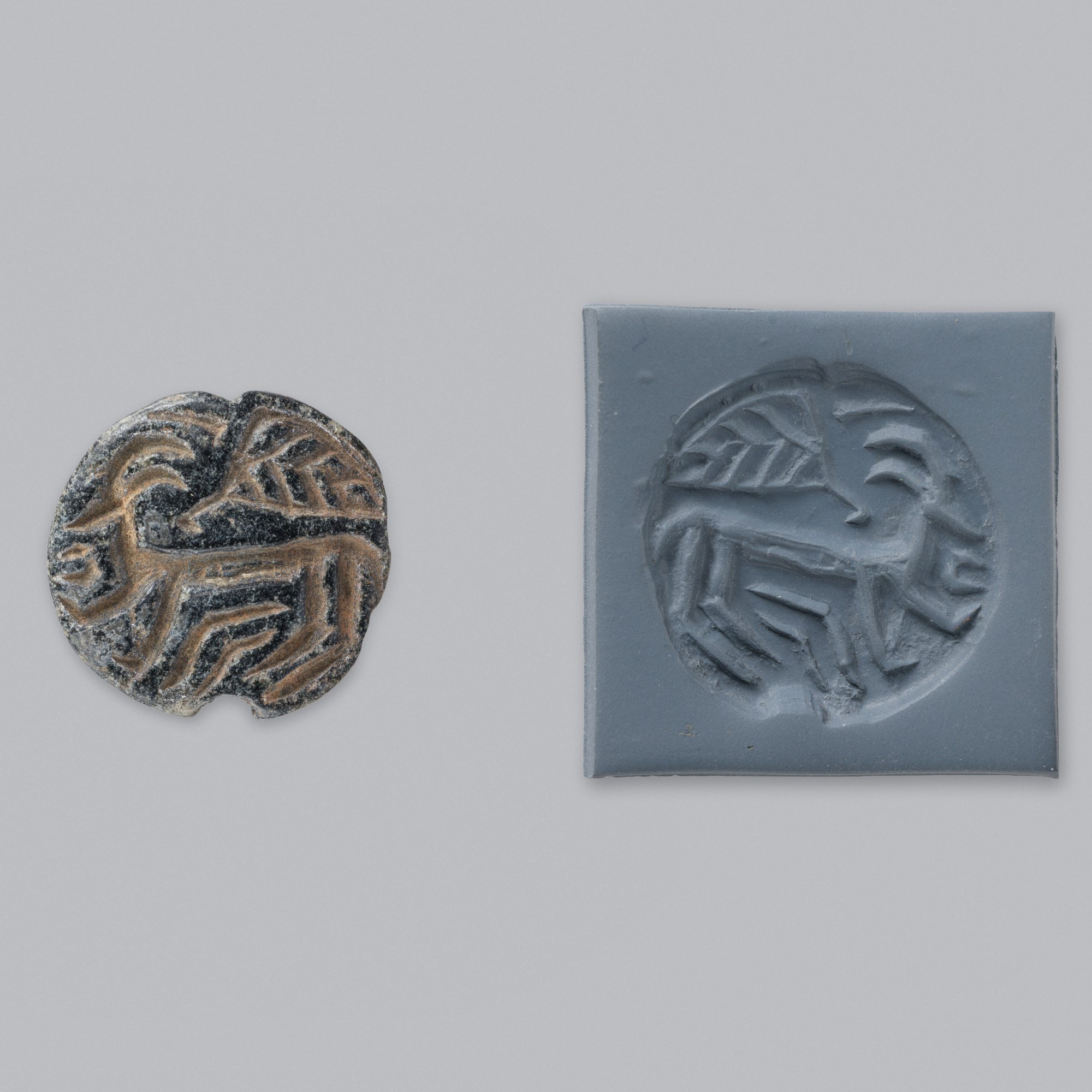
A cylinder seal is a small cylinder, usually of stone, with a design cut in intaglio into its curved surface. Rolling it across damp clay produces a raised, extended image; parts of the design can recur if the cylinder is rolled over a longer surface. This differs from a stamp sealStamp sealA small engraved implement pressed into soft clay to leave an impression, unlike a rolled cylinder seal. Its uses are investigated through sealings, find contexts and wear; imagery alone establishes neither writing nor belief.Glossary · Click to read the explanation, whose flat face is pressed onto one spot. The design is generally easier to interpret in the positive impression than in its reversed form on the stone.
Materials, sizes and manufacturing methods varied over time. Many seals were pierced lengthwise so they could be carried or suspended. Production involved shaping, drilling and engraving. Leonard Gorelick and A. John Gwinnett proposed that the craft may have drawn on bead-making and earlier stamp-seal technologies. That is an interpretive reconstruction of technological history, not a demonstrated sequence of inventions in every archaeological workshop.[2]
Origins and spread: not all seals were cylindrical
Stamp seals preceded cylinder seals by millennia. Engraved cylinders came into use in the second half of the fourth millennium BCE, alongside the development of urban administration in southern Mesopotamia and the circulation of material practices associated with the UrukUrukAncient city at Warka in southern Iraq, a major urban centre around 3200 BCE that preserved early writing and accounting tablets.Glossary · Click to read the explanation period in surrounding regions. “Uruk” names both a city and an archaeological horizon: dating an object to “Late Uruk” does not prove it was excavated in that city.[3]
Cylinders did not universally replace stamps. Preferences changed with region, period and administrative setting; stamp seals again became prominent in some later administrations. Their history therefore cannot be compressed into a single progression followed everywhere in the ancient Near EastAncient Near EastModern scholarly label for ancient societies of Mesopotamia, the Levant, Anatolia and Iran, sometimes extending to Egypt and other neighbours depending on the study; not one civilization or religion.Glossary · Click to read the explanation.[3]
What did an impression do?
Sealed clay was applied to closures on jars, doors, containers and baskets, and impressions also appeared on tablets and transactional documents. Breaking the clay closure could reveal that a store or vessel had been opened. On a document, the impression could signify authorization or participation in an administrative or legal action. We should distinguish the seal, the portable implement, from the impression, the mark left at the point of use.[1]
A particular motif did not invariably identify one private owner or function as a personal signature. Research on Uruk-period administration suggests that imagery could identify production units, institutions, goods or occasions of dispatch and delivery. The meaning of any impression depends on its find context, the clay object and its accompanying marks. Seals might also have been valued for protective qualities in some settings, but this should not be projected onto every surviving specimen.[4]
Seals and the beginnings of writing
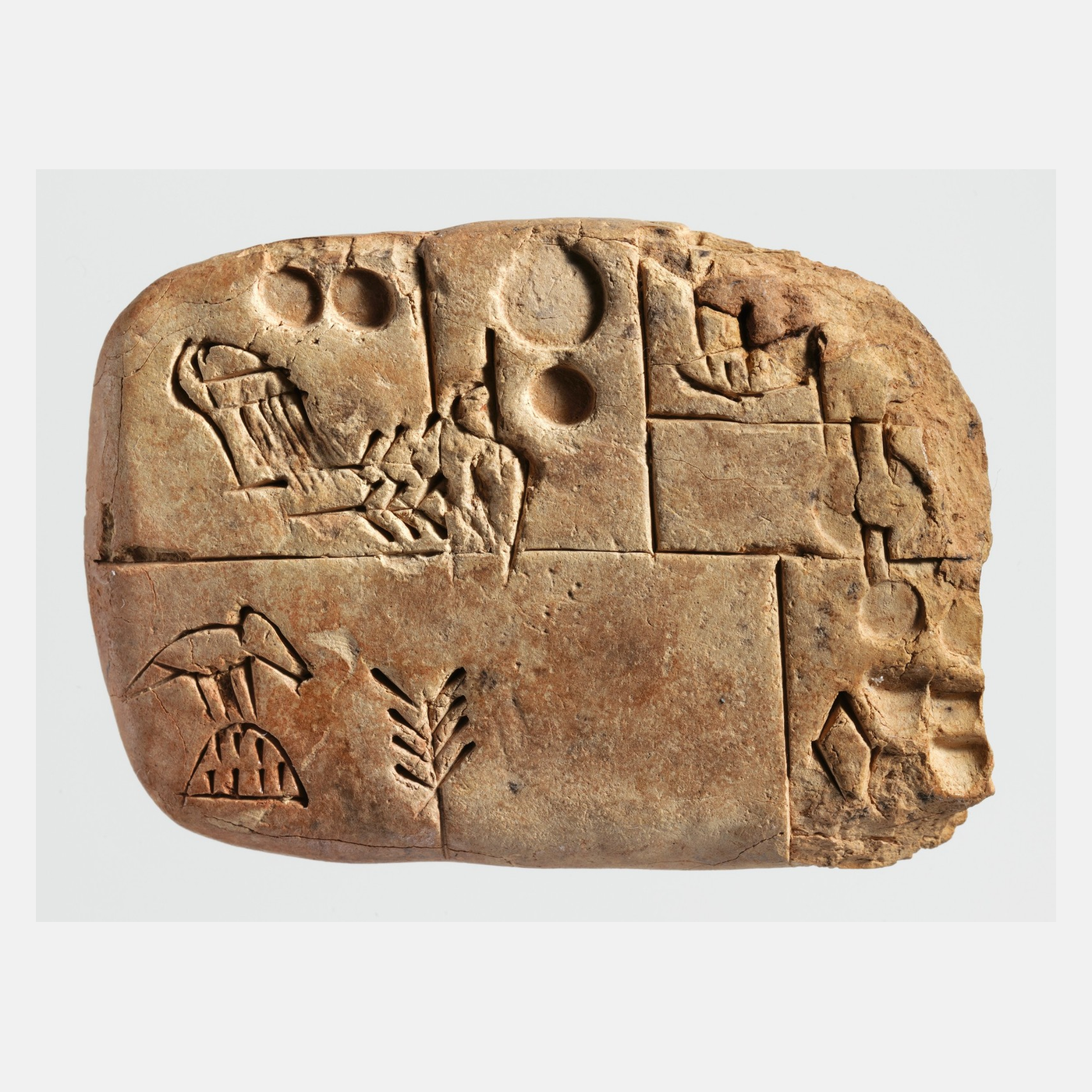
Sealing practices existed alongside clay bullae sometimes containing counting tokens, numerical tablets, and eventually tablets with early script at Uruk. A distinction is essential between images produced by a seal and cuneiform writingCuneiformWriting with wedge-shaped signs, developed from Mesopotamian recording traditions and used for several languages from the third millennium BCE.Glossary · Click to read the explanation. A scene can communicate social or administrative meaning without expressing sentences in a language; script uses signs organized within scribal conventions.[4]
In a study published online in 2024 and in a 2025 journal issue, Kathryn Kelley, Mattia Cartolano and Silvia Ferrara compared motifs of fringed textiles and suspended vessels on seals with certain proto-cuneiformProto-cuneiformEarly southern Mesopotamian script (c. 3350–3000 BCE): clay tablets with counting systems and signs for commodities, people and offices, as well as lexical lists; not yet a full rendering of speech.Glossary · Click to read the explanation signs. They proposed specific links supported by shape and the administrative context of moving goods, while acknowledging that individual paths from image to written sign remain difficult to prove. Visual resemblance alone is insufficient. Seal imagery and writing remained distinct systems even where they shared some forms.[4]
When does a seal actually contain writing?
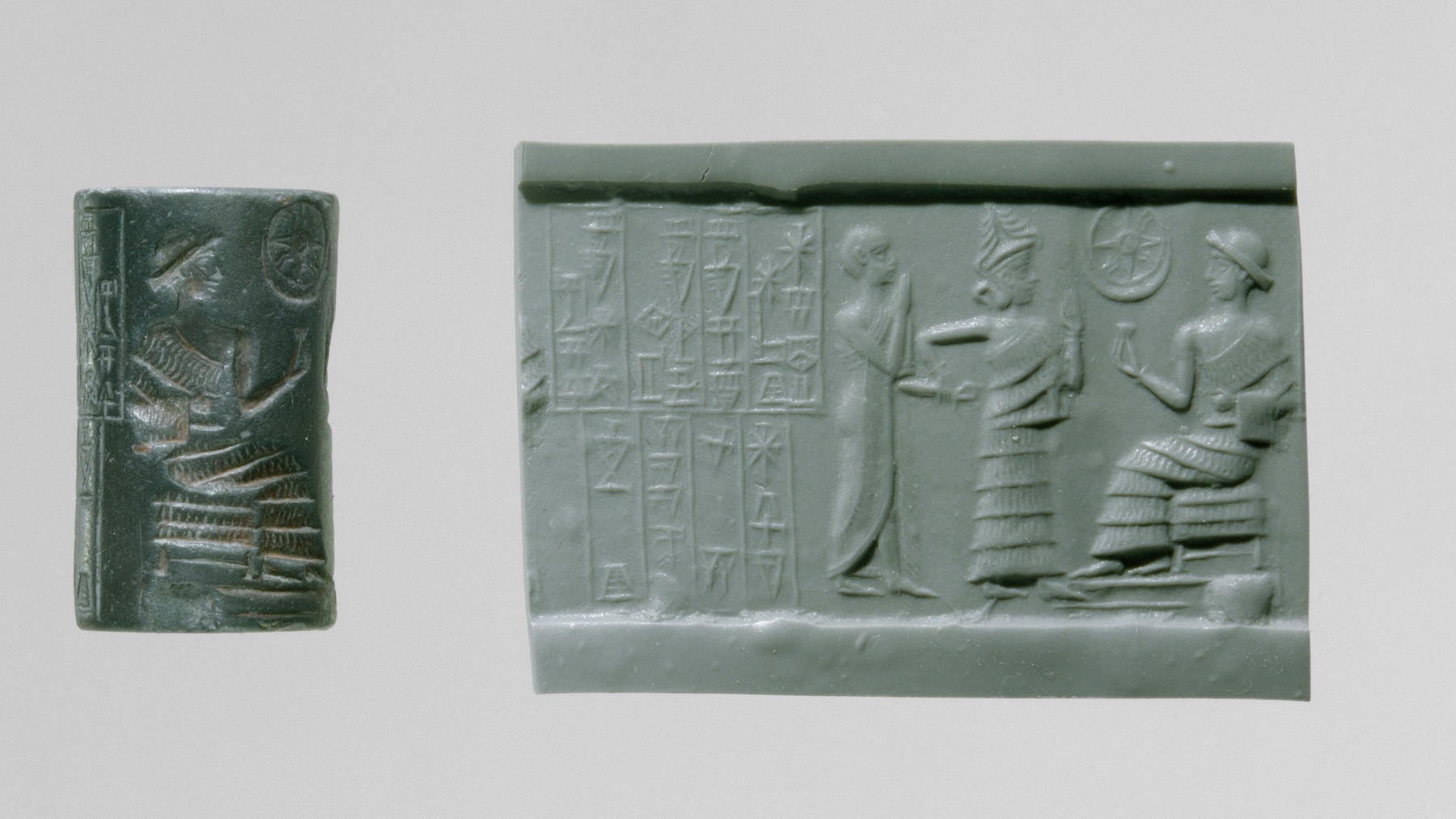
In later periods some seals combined a pictorial scene with a readable cuneiform inscription, sometimes giving a person's name, parentage or relationship to a god. The Metropolitan Museum's seal 47.115.1, dated to approximately the seventeenth–sixteenth centuries BCE, bears an AkkadianAkkadianAn ancient East Semitic language written in cuneiform from the third millennium BCE; its varieties include Babylonian and Assyrian, and it served in international diplomacy.Glossary · Click to read the explanation inscription identifying Parga, son of Ageya, as a servant of the god Sîn. The name comes from the inscription on the seal, not from guessing the identity of the depicted figures.[5]
Another example, the Metropolitan Museum's Akkadian seal 41.160.281, is dated to approximately 2250–2150 BCE. Its impression depicts combats involving animals and composite or heroic figures beside an inscription which the museum reads as naming Shusiba, a servant of the house or temple of the god Ishkur. The writing supports an identification of allegiance; it does not demonstrate that every image represents someone named in the text.[6]
The illustrated object: a facade and a procession
The seal featured here is made of bituminous limestone and is catalogued by the Metropolitan Museum of Art as 1983.314.1. It is dated to Late Uruk, about 3500–3100 BCE. In the modern impression the museum describes a procession approaching a schematic facade: three nude figures, the first pouring from a vessel, the second partly obscured by damage, and the third raising an object that may be a container. A quadruped and other partly unidentified shapes and vessels also occur in the scene.[1]
The museum interprets the facade and the accompanying activities as indicating a temple. The object's description does not establish a named deity, a precisely identifiable rite or a preserved religious text. The geographic metadata available on the catalogue page does not name a documented excavation spot for this object. “Late Uruk” is a chronological attribution, not proof of discovery at the city of Uruk.[1]
Reading the evidence without overreading it
A careful interpretation separates observable features (facade, humans, animal and vessels), the museum's interpretation (a procession before a probable temple) and unverified claims (the participants' names, a particular deity or a complete ritualRitualAn organised or distinguished practice meaningful to a community; it may leave traces, but its form alone does not reveal an associated doctrine.Glossary · Click to read the explanation meaning). Damage, the sequence of elements, other impressions and comparisons with dated objects all affect confidence. A modern rolling impression helps reveal an ancient design but is not independent ancient evidence.[1]
The British Museum's record for Kassite seal 130697 notes that an earlier reading of its seven-line inscription was subsequently corrected. This illustrates why imagery alone cannot replace examination of the text and why museum interpretations may be revised. Cylinder seals are consequently important contextual evidence for administration, artistic styles and religious ideas—not automatic keys to named gods or to complete ancient narratives.[7]
References and notes (7)
- The Metropolitan Museum of Art, “Cylinder seal and modern impression: ritual scene before a temple facade,” object 1983.314.1, Late Uruk, ca. 3500–3100 BCE. Online object entry: introductory description, scene, bituminous limestone, dimensions, geography, accession number and public-domain status; no excavation findspot stated in the displayed geographic data. Return to the text ↑
- Leonard Gorelick and A. John Gwinnett, “The Origin and Development of the Ancient Near Eastern Cylinder Seal: A Hypothetical Reconstruction,” Expedition 23, no. 4 (1981), Penn Museum. Online article, passages on reversed intaglio, shaping, drilling and engraving; the proposed technological ancestry is expressly hypothetical. Return to the text ↑
- The Metropolitan Museum of Art, “Stamp seal,” Hittite Old Kingdom, object page 327799, discussion of stamp and cylinder seals. Online explanatory object text: stamp seals before cylinders, variation between Mesopotamia and Anatolia, and renewed later importance of stamps. Return to the text ↑
- Kathryn Kelley, Mattia Cartolano and Silvia Ferrara, “Seals and signs: tracing the origins of writing in ancient South-west Asia,” Antiquity 99, no. 403 (February 2025), pp. 64–82; online 5 November 2024. DOI: 10.15184/aqy.2024.165. Selected sections in the accessible HTML: Introduction; Uruk information technologies; Comparing seals and signs; textile and netted-vessel motifs; symbol-sharing; inter-regional context; Conclusion. Not the full PDF, online supplements or every figure. Return to the text ↑
- The Metropolitan Museum of Art, “Cylinder seal and modern impression: suppliant goddesses,” Babylonian or Kassite, object 47.115.1, ca. 17th–16th century BCE. Object description and the three-line Akkadian inscription reading “Parga, son of Ageya, servant of [the god] Sin”; museum lists the origin as “said to be from Dilbat,” not excavated provenance. Return to the text ↑
- The Metropolitan Museum of Art, “Cylinder seal and modern impression: bull-man wrestling with lion; nude bearded hero wrestling with a water buffalo,” object 41.160.281, Akkadian, ca. 2250–2150 BCE. Museum scene description and Akkadian inscription read as “Shusiba, servant of the house/temple of [the god] Ishkur”; object metadata. Return to the text ↑
- British Museum, “Cylinder seal,” museum no. 130697, registration 1945,1015.24, Kassite period; curatorial comment on revised inscription reading. Online record: seven lines of inscription and a former reading corrected according to a 2012 note; no independent edition of the inscription checked. Return to the text ↑
Suggest a correction · Suggest a source for this record
Cite this record
IL Archive, «Cylinder seal», https://ilarchive.com/en/entities/cylinder-seal
Continue reading