Entity · Concept
Stamp seal
A reference page linking a name, group, or concept to the materials that discuss it.
A small engraved tool pressed into clay to leave an impression. Sites in northern Mesopotamia and Syria attest its use in sealing and storage before writing; the entry separates possible function from symbolic reading.
Estimated reading time: 6 min Published Last reviewed:
Share article
Text
Introduction
What can a small engraved object tell us about communities before writing? This entry distinguishes a stamp seal from the clay impression it makes, then follows evidence of storage, control and imagery from Neolithic northern Syria to the Ubaid horizon. Its aim is to test possible functions against archaeological context, rather than treating a carved animal as a readable religious or administrative message.
The tool and the impression are different things
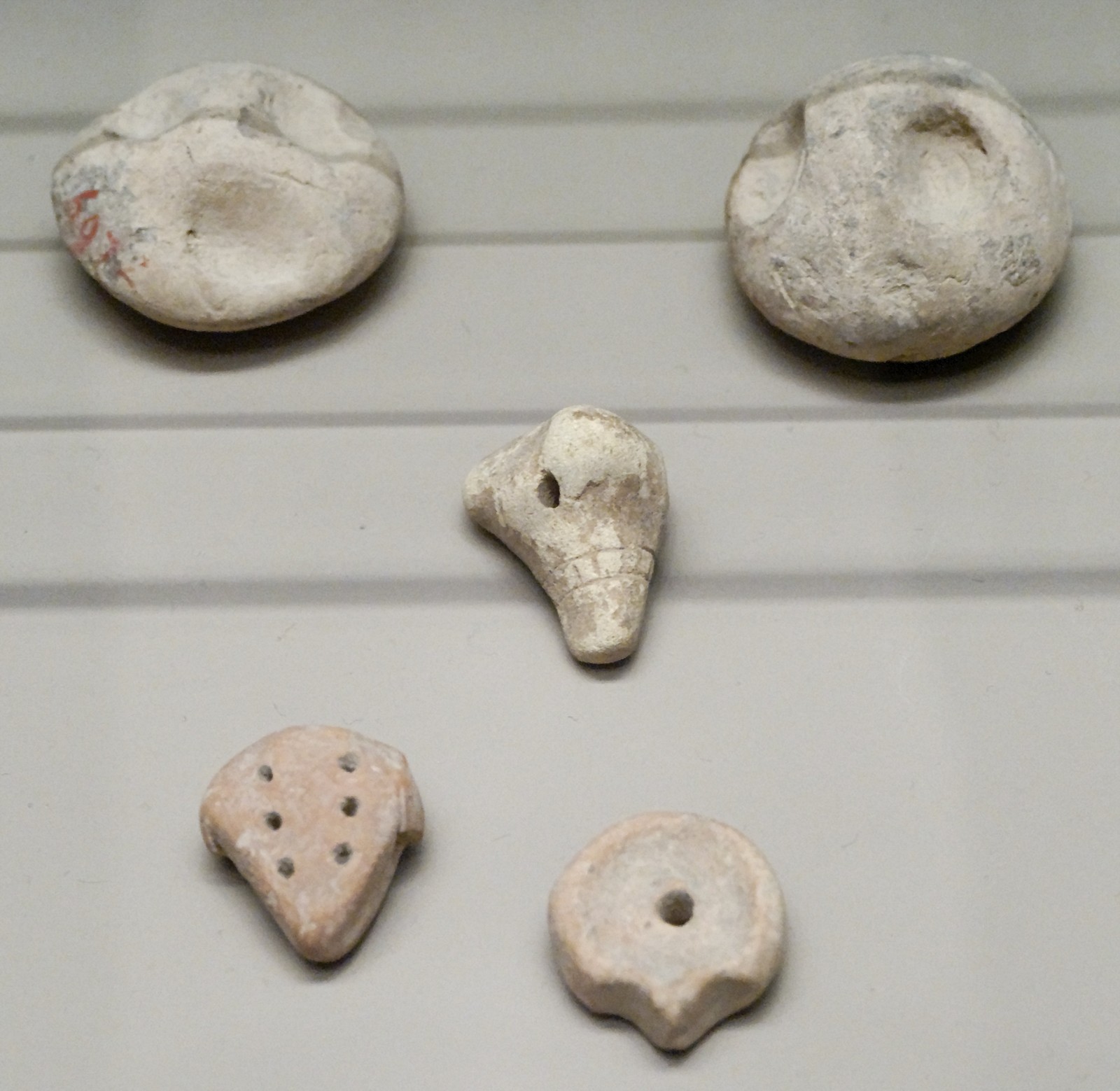
A stamp seal is a small object, often made of stone, with a design cut into one face. Pressing it into damp clay or another yielding material leaves an impression. A sealing is the lump of clay placed over an opening or fastening and marked with a seal. Some seals have knobs or holes for suspension, making them portable personal possessions; a perforation alone, however, does not establish how they were used.
Unlike the cylinder sealCylinder sealSmall engraved cylinder rolled over soft clay to leave an extended image. Used to secure, document and identify administrative actions; its pictures do not automatically constitute writing.Glossary · Click to read the explanation, whose carved circumference is rolled across clay to produce a longer strip of imagery, the stamp makes its design through pressure. Not every engraved pendant classified as a stamp seal can be shown to have made ancient impressions. Wear, secure find contexts and matching sealings make the case stronger.
What exactly is in the museum photograph?
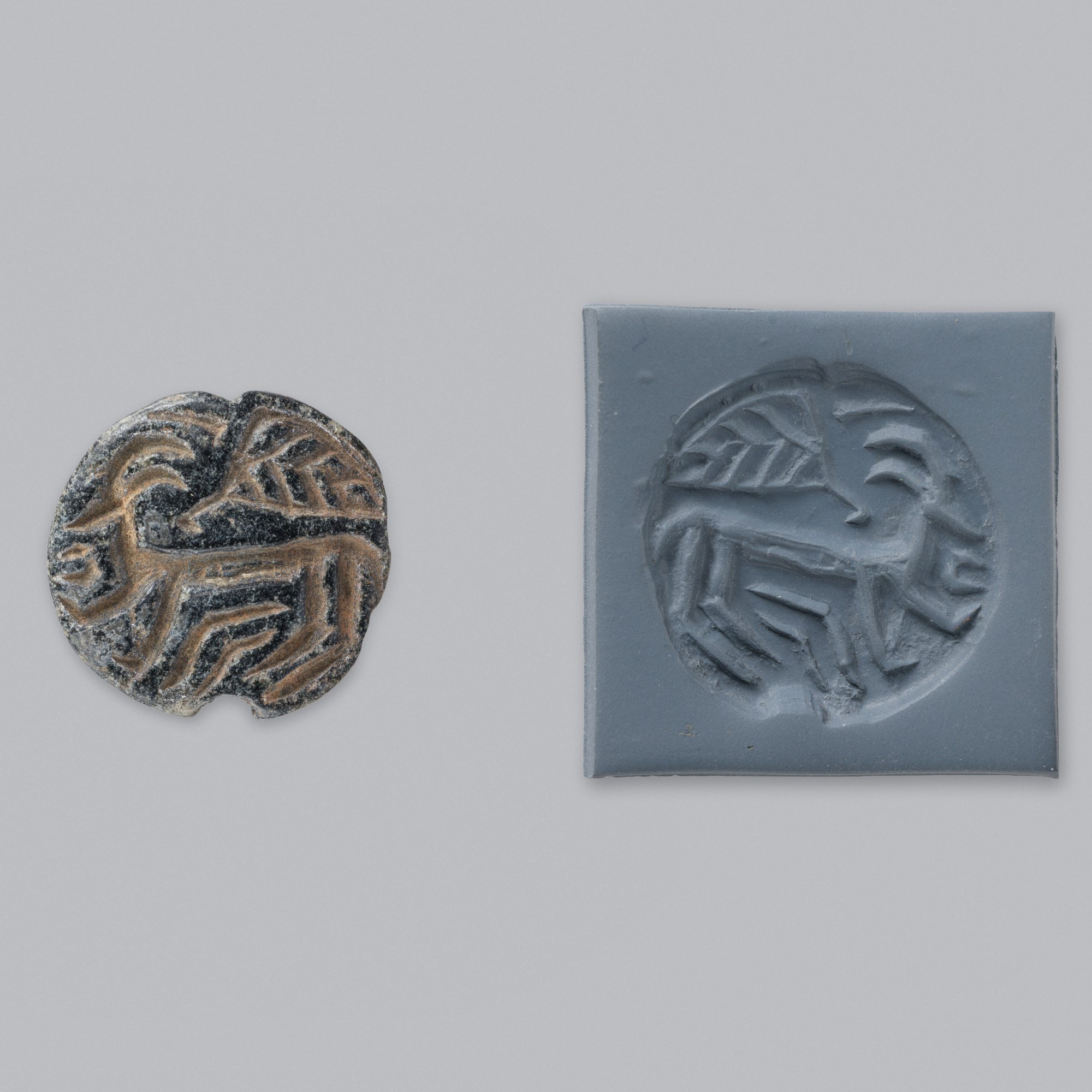
The Metropolitan Museum of Art holds a small stamp seal of steatite or chlorite dated to the sixth–fifth millennium BCE and broadly attributed to “Syria or AnatoliaAnatoliaAnatolia is the region occupying the Asian part of present-day TurkeyGlossary · Click to read the explanation”. A horned, four-legged animal occupies the design. The Museum describes a leaf-shaped element above it as possibly a stylized bird, and two lines below as perhaps vegetation or snakes. These are readings of shapes, not identifications of named deities. The photograph pairs the ancient stone at left with a modern impression made to show its design at right. The grey square is neither an ancient tablet nor an excavated sealing.[1]
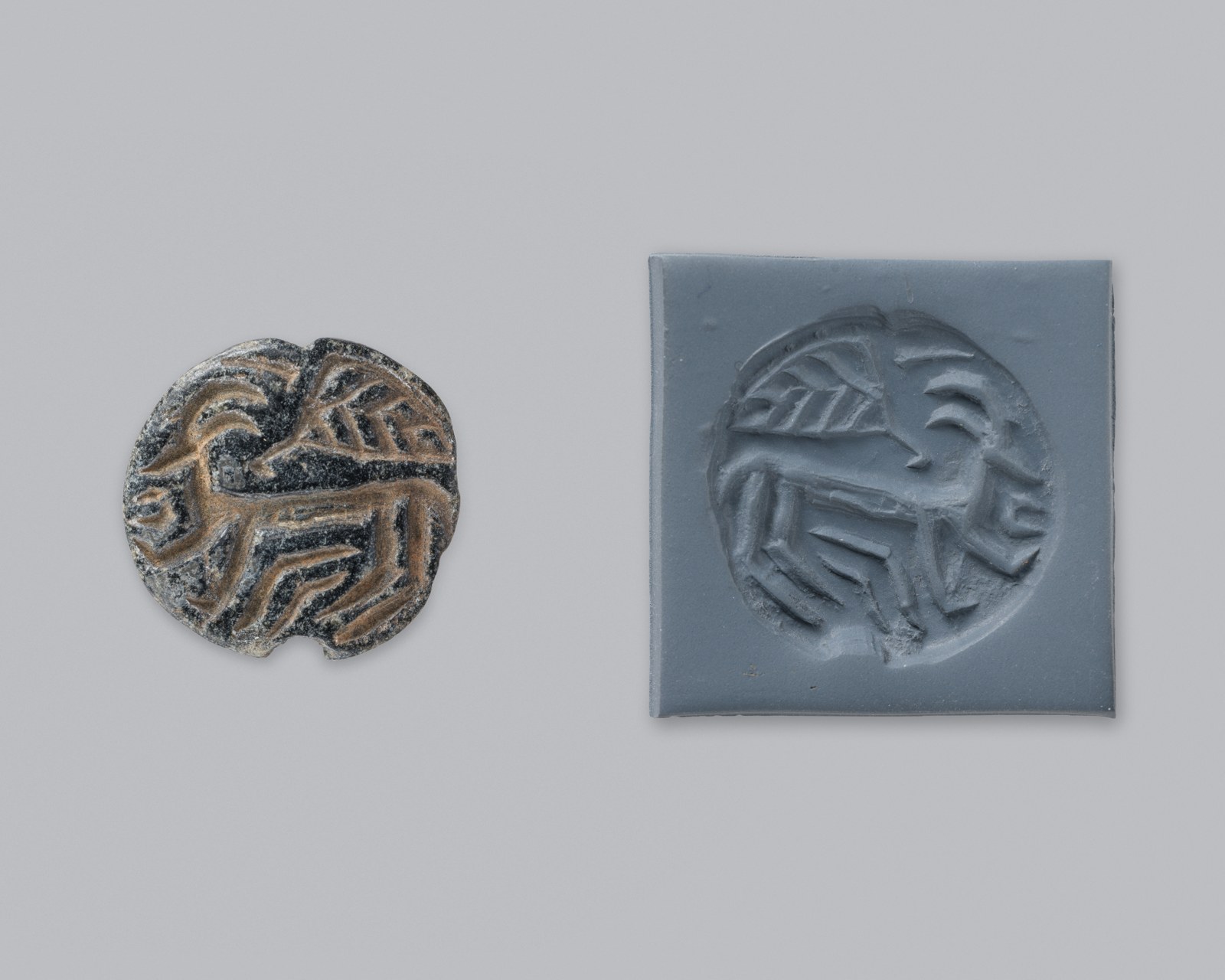
The image demonstrates the relationship between engraving and impression, but the Museum's regional attribution is not an excavated findspot from which we can infer a particular owner or local practice.
Before the Ubaid: the sealings of Tell Sabi Abyad
At Tell Sabi Abyad, in the Balikh valley of northern Syria, excavators recovered stone seals and marked clay sealings in Late Neolithic levels. Their excavation report places the appearance of the sealing practice there around 6200 BCE or shortly afterwards. The best-known group came from storage-related buildings in the so-called Burnt Village, destroyed around 6000 BCE. This evidence predates the Ubaid object illustrated here: stamp sealing was not invented simply at the start of the Ubaid tradition.[2]
Finding a seal and finding a sealing are not equivalent. The portable instrument could be taken away or lost, while a broken clay closure can survive as evidence that something was fastened or reopened, even if the organic contents have vanished.
The back of a sealing is evidence too
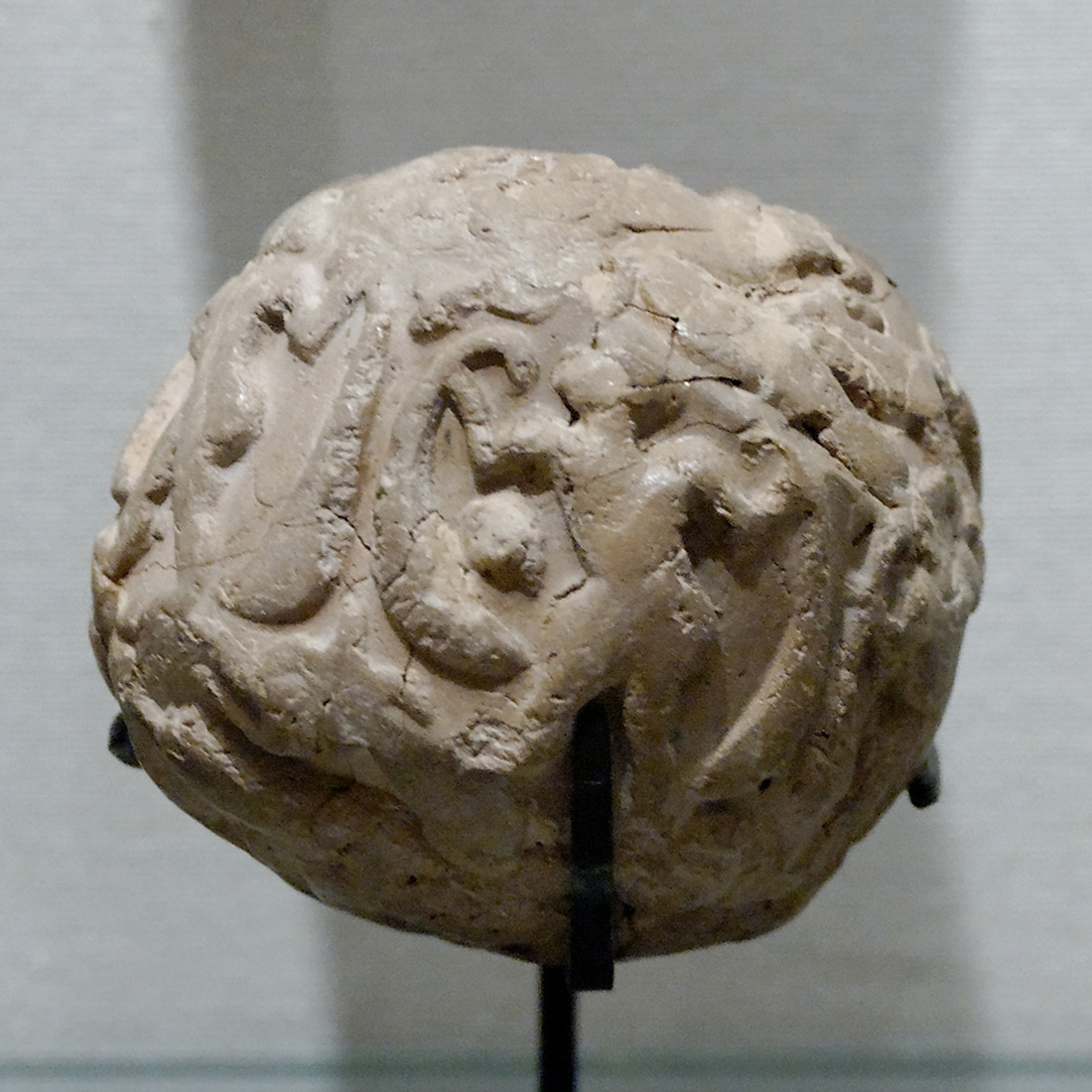
The fronts of sealings preserve carved designs; their backs can retain marks from coiled baskets, vessel rims, string and plant fibres. At Tell Sabi Abyad, the excavators identified narrow cord impressions and traces of portable containers. Taken together, these indicate plausible procedures: binding a basket or jar covering with clay, marking access to stored goods and breaking the lump when contents were retrieved. Such a reconstruction is better grounded than a motif alone, though it does not always identify what was stored or who owned it.[3]
Some clay sealings were concentrated in storerooms, while others came from refuse deposits accumulated over repeated episodes. Not every sealed lump was deliberately filed as an “archive”. Even the original excavators discuss alternative interpretations of some accumulations as rubbish rather than purposeful records.
Property control does not automatically mean a state
Peter Akkermans and Kim Duistermaat interpret these early practices mainly as means of securing stored property and identifying who could access it, perhaps among communities moving between pastures and storage bases. From a single phase of the Burnt Village, they inferred at least 77 distinct seals from their impressions—not 77 surviving stone seals. The diversity sits uneasily with a model of sealing monopolized by a tiny ruling elite, though the authors recognize that the same technology could later be used to exercise power.[4]
A seal may therefore indicate a relationship to goods or an authorized act without revealing an individual's name or establishing a centralized governing institution.
The Ubaid horizon was regionally diverse
Stamp seals are well attested at northern sites associated with the Ubaid horizonUbaid cultureAn archaeological designation for material traditions associated with southern Mesopotamia and its regional connections. The broad southern sequence spans c. 6500–3800 BCE, with regional variation; the label alone identifies neither a people nor a language.Glossary · Click to read the explanation, including Tepe Gawra and Değirmentepe. Gil Stein contrasts this northern pattern with their apparent absence or scarcity in the southern MesopotamianMesopotamiaHistorical region associated with the Tigris and Euphrates: Uruk, Ur, Eridu, cuneiform, Sumer, Akkad, Babylon and Assyria, their languages and cults, and the limits of archaeological evidence.Glossary · Click to read the explanation region of Ur and EriduEriduEridu (Abu Shahrain), a multi-mound site in southern Iraq occupied since the Ubaid, later home to a religious precinct associated with Enki. Its eighteen sounding levels are not proof that every early building was a temple.Glossary · Click to read the explanation, and in the Hamrin basin, during the Ubaid. Similar pottery over great distances did not entail a uniform administrative technology or a single homogeneous population.[5]
Geometric designs coexist with an increasingly varied range of animals and sometimes humans on Ubaid-related seals. The Metropolitan Museum describes this expansion as a development in imagery. Its existence is not, on its own, proof that every community shared the same religious code.[6]
Images may express affiliation without naming a god
In a comparative study of seals and pendants from northern Mesopotamia in the later seventh and sixth millennia BCE, Çiğdem Atakuman proposes that some objects helped articulate personal and collective identity. She also develops an interpretation involving male sexuality in her sample. That is a scholar's hypothesis about a particular corpus, not an established reading of all seals, still less of the horned animal in the Museum's object.[7]
Augusta McMahon surveys several possible roles for seal imagery: marking a proprietor, social position, commodity origin or culturally significant themes, some possibly religious. These alternatives cannot be assigned equal certainty in every case. An animal figure by itself neither names a deity nor demonstrates the worship of that animal.[8]
Sealing came before writing, but was not itself writing
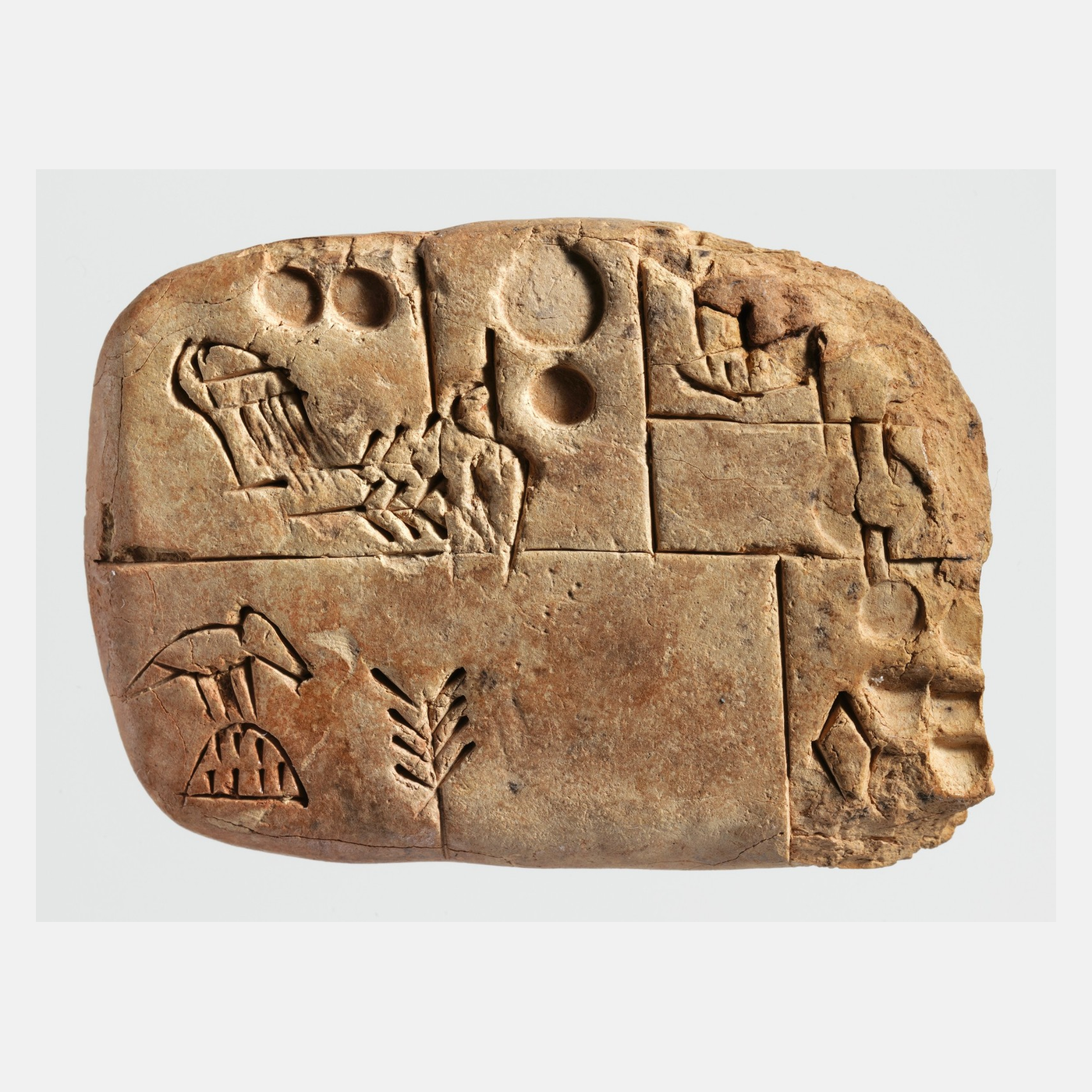
Stamp seals and clay sealings were in use long before proto-cuneiform writingProto-cuneiformEarly southern Mesopotamian script (c. 3350–3000 BCE): clay tablets with counting systems and signs for commodities, people and offices, as well as lexical lists; not yet a full rendering of speech.Glossary · Click to read the explanation emerged in the late fourth millennium BCE. Cylinder seals also developed in that millennium and allowed longer designs to be rolled onto clay and, eventually, onto tablets and documentary surfaces. The Metropolitan Museum describes this technical development. Yet a prehistoric animal seal is not a written sentence or a sign with a securely recoverable linguistic value. Clay tokensClay tokensSmall shaped clay objects from West Asia since the Neolithic; some served counting or recording, but there is no evidence of one universal accounting function for all.Glossary · Click to read the explanation and clay envelopesClay envelopesA hollow clay container used in early administration, sometimes enclosing counting tokens and carrying external seal impressions or marks. Distinct from solid sealings; it is not an established ancestor of all writing.Glossary · Click to read the explanation belong to related histories of accounting and material recording, each requiring its own context rather than an inevitable single path toward writing.[9]
How should an uninscribed seal be studied?
A sound investigation begins with the material, measurements, engraving and orientation, and distinguishes an original archaeological impression from a modern museum casting. It then examines the sealing's reverse, archaeological layer, and any repetitions made by the same device. Modern photographic processes may themselves alter perceptions of colour or orientation; a recent methodological study calls for transparency about such imaging choices.[10]
In short: the stamp seal offers evidence for making marks and for possibly overlapping economic, social and symbolic practices. It is not a ready-made key to an unwritten creed. A secure find context and actual ancient sealings allow more precise arguments than an isolated image, while still leaving room for competing interpretations.
References and notes (10)
- The Metropolitan Museum of Art, “Stamp seal and modern impression: horned animal and bird,” Ubaid, accession 1984.175.13. Full object record: description, date, regional attribution, material, dimensions and modern impression. Return to the text ↑
- Peter M. M. G. Akkermans and Kim Duistermaat, “Late Neolithic Seals and Sealings,” chapter 4 in Excavations at Late Neolithic Tell Sabi Abyad, Syria: The 1994–1999 Field Seasons, ed. Akkermans et al. (2014). Chapter 4, §§4.1–4.3, pp. 113–115: sealed contexts, dates and levels. Return to the text ↑
- Akkermans and Duistermaat, “Late Neolithic Seals and Sealings” (2014). §4.2, pp. 113–115: strings, baskets, jars, refuse dumps and storerooms. Return to the text ↑
- Akkermans and Duistermaat, “Late Neolithic Seals and Sealings” (2014). §4.5, around p. 116: property-control interpretation, ≥77 distinct seals inferred from impressions and critique of elite monopoly. Return to the text ↑
- Gil J. Stein, “Local Identities and Interaction Spheres: Modeling Regional Variation in the Ubaid Horizon,” in Beyond the Ubaid, ed. Carter and Philip (Chicago, 2010). Chapter 2, especially pp. 28–30 and 38–39: regional differences in seal-use evidence; not the entire volume. Return to the text ↑
- Department of Ancient Near Eastern Art, The Metropolitan Museum of Art, “The Ubaid Period (5500–4000 B.C.),” Heilbrunn Timeline of Art History (October 2003). Complete short institutional essay: imagery and regional Ubaid overview; its chronology is an interpretive frame. Return to the text ↑
- Çiğdem Atakuman, “Deciphering Later Neolithic Stamp Seal Imagery of Northern Mesopotamia,” Documenta Praehistorica 40 (2013): 247–264. Published abstract plus indexed opening excerpt only; full article was not accessible in this review. Return to the text ↑
- Augusta McMahon, “Composite Human–Animal Figures in Early Urban Northern Mesopotamia: Shamans or Images of Resistance?”, Oxford Journal of Archaeology (2022). Accessible HTML introduction and “Seals in Mesopotamian Prehistory” section; later figure interpretations are not transferred to the illustrated Ubaid seal. Return to the text ↑
- The Metropolitan Museum of Art, “Cylinder seal and modern impression: geometric design,” Early Dynastic I. Object essay on rolling technique, fourth-millennium invention and relation to documents; accession number not inferred. Return to the text ↑
- Ben Greet, “New Precedents and Insights from Stamp Seal Photography,” Near Eastern Archaeology 86/4 (2023): 284–290. Publisher abstract only; methodological discussion of later southern Levantine photography, not Ubaid evidence. Return to the text ↑
Suggest a correction · Suggest a source for this record
Cite this record
IL Archive, «Stamp seal», https://ilarchive.com/en/entities/stamp-seal
Continue reading