Entity · Concept
Clay envelopes
A reference page linking a name, group, or concept to the materials that discuss it.
Hollow clay containers, some closed around counting tokens, from fourth-millennium BCE administration in South-west Asia; they show possible links between numerical recording and writing, not one proven route to writing.
Estimated reading time: 5 min Published Last reviewed:
Share article
Text
Introduction
Before accounts became lines on tablets, quantities could be recorded inside a small clay sphere. What can these “clay envelopes” tell us, and how did their sealed surfaces relate to their contents and to the beginnings of written recording in South-west Asia? This entry examines their physical construction, their use and their archaeological contexts, distinguishing surviving evidence from scholarly explanations of the development of writing.
A hollow container, not simply a sealing
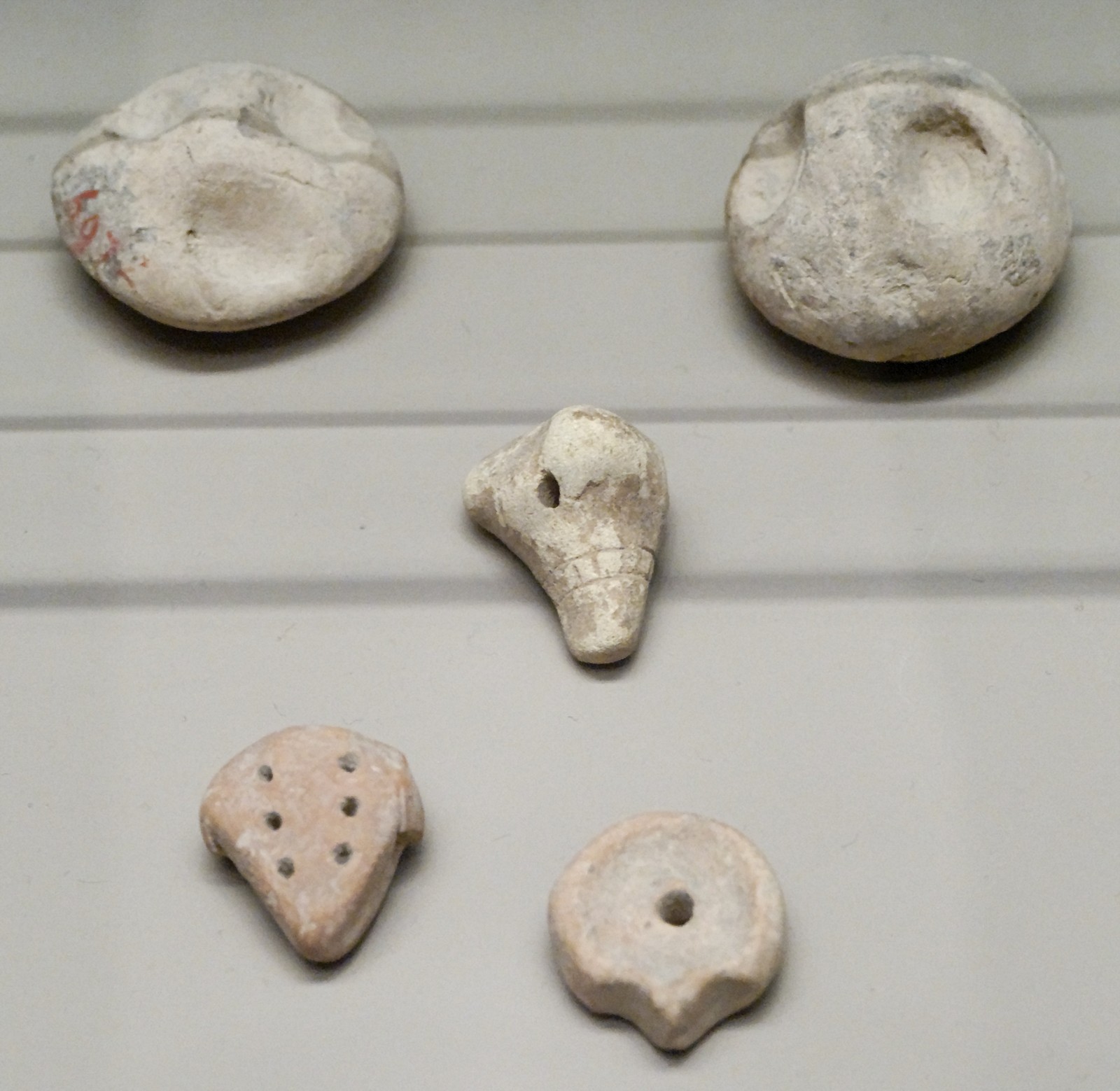
Here a clay envelope means a hollow sphere or ovoid formed from damp clay and closed after small objects had been placed inside. These objects are called clay tokensClay tokensSmall shaped clay objects from West Asia since the Neolithic; some served counting or recording, but there is no evidence of one universal accounting function for all.Glossary · Click to read the explanation or counters and occur in shapes such as spheres, discs and cones. Envelopes used in this way are attested in the second half of the fourth millennium BCE and belong among early administrative and recording technologies. They are not tablets containing readable sentences.[1][2]
Some catalogues call this spherical envelope a bulla, but the term is not used consistently. It can also denote a lump of sealing clay attached to a cord, a container or a document. Some researchers therefore reserve bulla for solid sealings and call the objects discussed here “hollow clay balls”. The defining feature of this entry is the cavity, not merely the presence of a seal impression.[3]
The contents and the outside surface
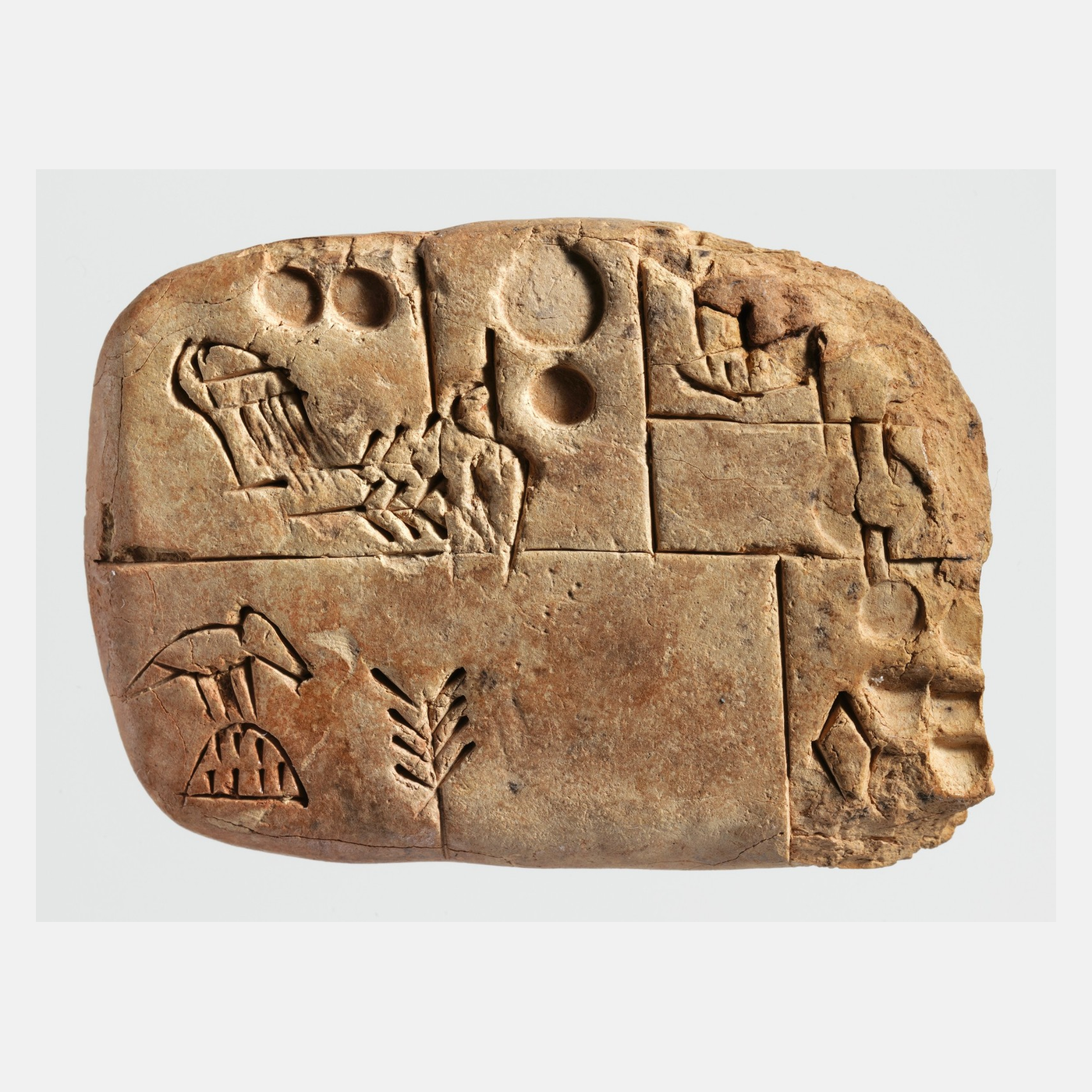
Under the prevailing administrative interpretation, the enclosed objects could register units of goods or quantities. Some envelopes carry impressed or numerical marks on their outer surfaces; in certain cases these correspond to the number or forms of the tokens inside. The match is not universal, however, and the shape of an individual token does not always reveal which commodity it represented in a particular place and period.[4]
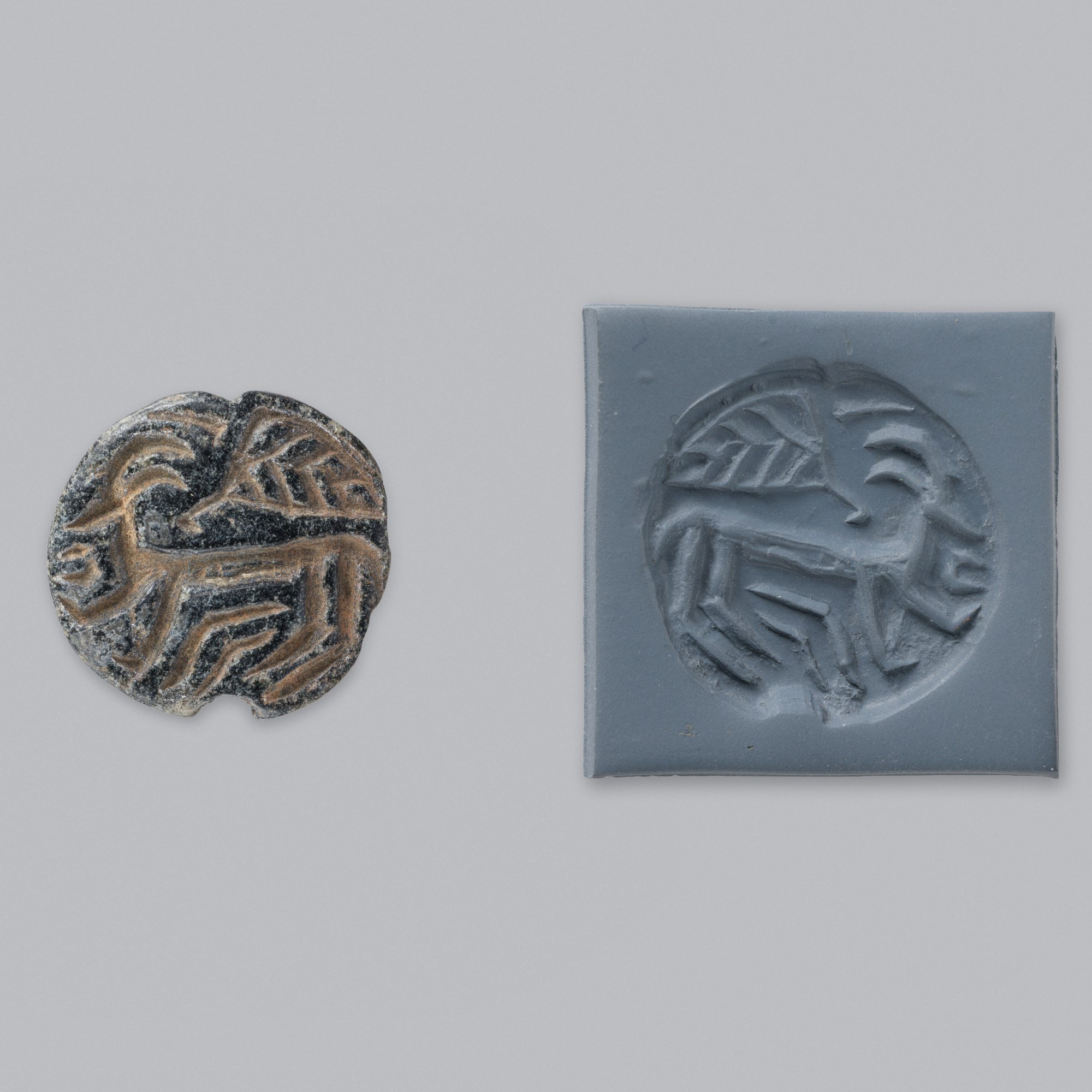
The surface may also bear the repeated impression of a cylinder sealCylinder sealSmall engraved cylinder rolled over soft clay to leave an extended image. Used to secure, document and identify administrative actions; its pictures do not automatically constitute writing.Glossary · Click to read the explanation rolled across wet clay, or an impression from another kind of seal. Such marks are evidence relevant to identifying and controlling a record and to the possibility of detecting interference when an envelope was broken. The figures shown by seals are not necessarily letters or linguistic statements. Whether a particular envelope was a receipt, a guarantee or an inventory record is an interpretation requiring archaeological context, not a label legible from the object itself.[4]
A surviving example: Susa Sb 1932
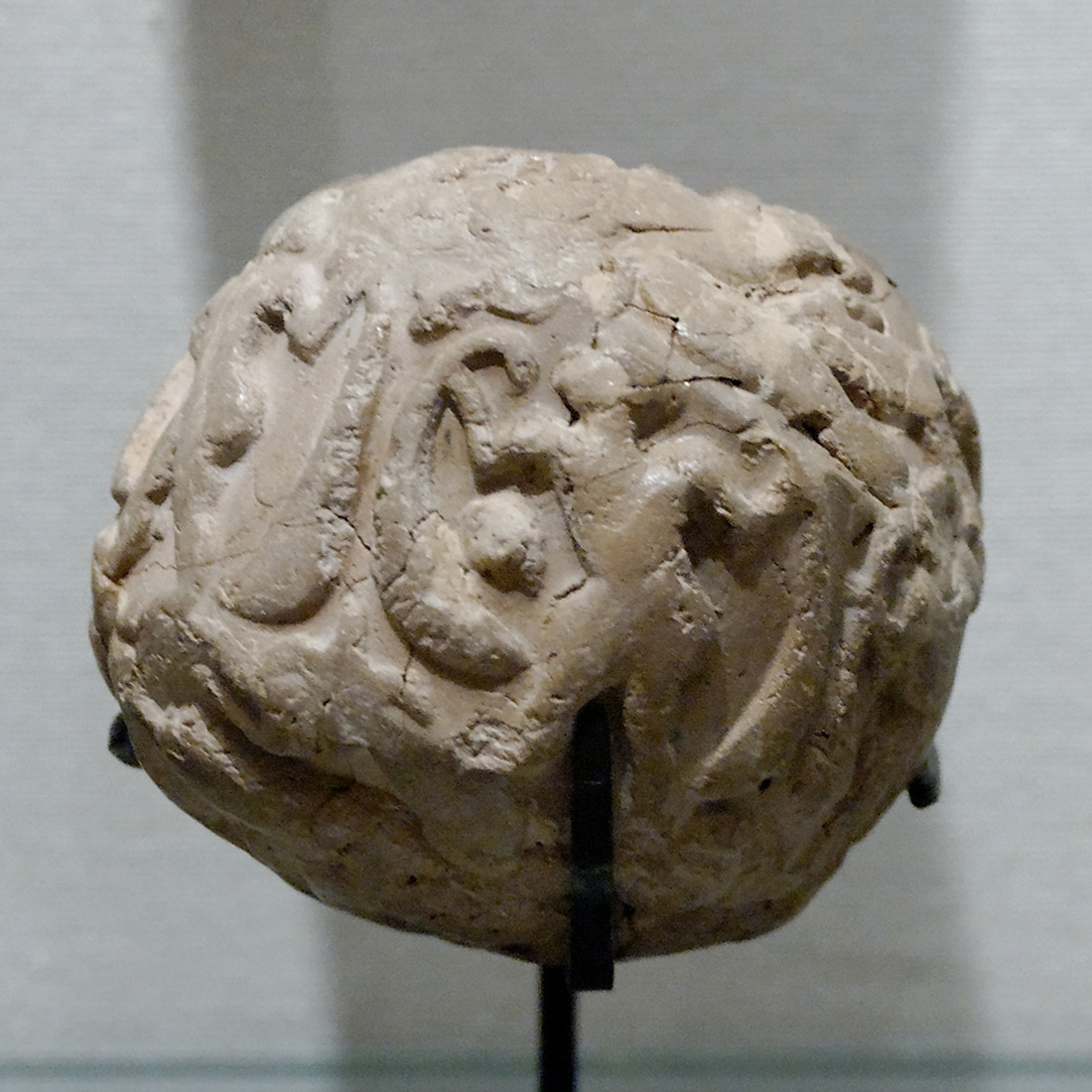
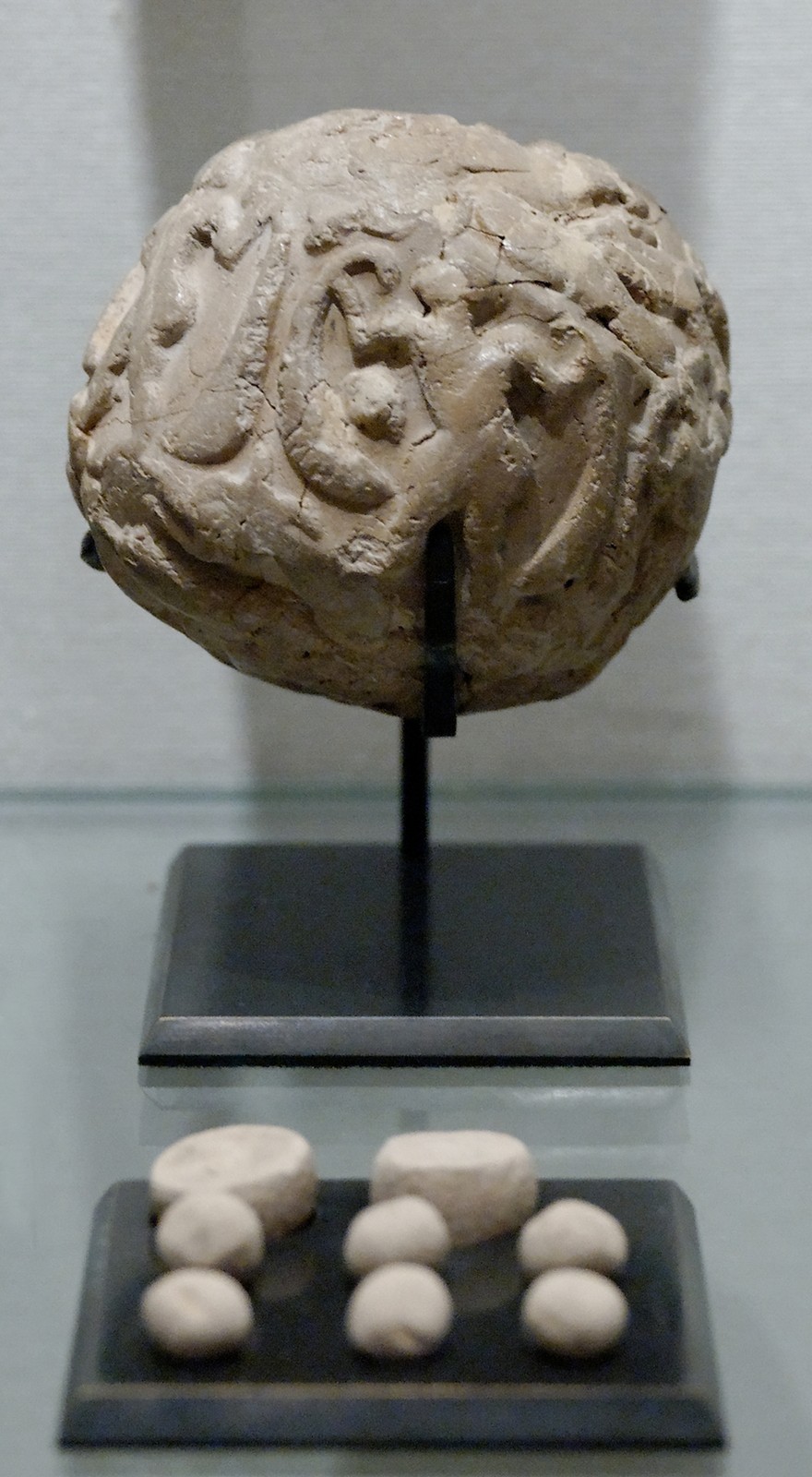
One photographed example comes from SusaSusa, ancient ShushSusa is an archaeological city at Shush in southwestern present-day IranGlossary · Click to read the explanation, at modern Shush in south-western IranIranIran is the modern country containing Shush, ancient SusaGlossary · Click to read the explanation, and is held by the Louvre MuseumLouvre MuseumMuseum in Paris holding the Mesha Stele as AO 5066 among its archaeological and art collections.Glossary · Click to read the explanation under inventory number Sb 1932. The museum calls it a “bulla with impressions and tokens” and assigns the broad date c. 3500–2900 BCE. It is 5.1 cm in diameter and was discovered during campaigns of 1933–1939. That is the museum's range for this object, not an exact year of manufacture.[5]
The Louvre describes several cylinder-seal impressions on the sphere, including fantastic creatures and human figures. It records six vertical strokes followed by a question mark over their possible interpretation as numbers; they should not be presented as securely deciphered numerals. The photograph shows the sealed sphere together with small clay objects in a museum display. It does not show those objects exposed inside its cavity today.[5]
Dating and geographical setting
Envelopes from archaeological levels 18 and 17 of the Susa Acropolis have been discussed within an approximate 3500–3300 BCE chronology. That dating concerns published archaeological contexts and must not automatically replace the broader catalogue date for Sb 1932. Comparable tools occur at other Iranian sites and in the wider Mesopotamian sphere, including Chogha Mish, but the numbers of finds and the security of their stratigraphic contexts vary.[6][3]
These envelopes coexisted with other recording practices: loose tokens, clay sealings on vessels or closures, and tablets bearing numbers but no linguistic text. At UrukUrukAncient city at Warka in southern Iraq, a major urban centre around 3200 BCE that preserved early writing and accounting tablets.Glossary · Click to read the explanation in southern IraqIraqIraq is a modern country encompassing much of ancient MesopotamiaGlossary · Click to read the explanation, proto-cuneiformProto-cuneiformEarly southern Mesopotamian script (c. 3350–3000 BCE): clay tablets with counting systems and signs for commodities, people and offices, as well as lexical lists; not yet a full rendering of speech.Glossary · Click to read the explanation appears in the late fourth millennium, approximately 3350–3000 BCE in one commonly used chronological framework. The overlapping evidence does not support a tidy progression in which each technique vanished as soon as its successor appeared.[4][1]
Did writing emerge from envelopes?
The archaeologist Denise Schmandt-Besserat advanced an influential model linking tokens used to count goods to enclosed tokens, marks impressed on the envelopes, numerical tablets and finally signs on proto-cuneiform tablets. Archaeological objects substantiate the existence of these different practices, and some matches between contents and surfaces illuminate the history of numerical notation. Claiming that every later written sign derives from a particular three-dimensional token goes further than the available evidence permits.[7][4]
Other studies suggest that seal imagery also contributed to the shapes of some early signs. Kathryn Kelley, Mattia Cartolano and Silvia Ferrara compare older seal motifs with signs on Uruk tablets, arguing for specific relationships especially involving textiles and vessels. They explicitly caution against comparisons based on shape alone and find that seals and written signs remained distinct systems even where they interacted.[1]
What the evidence establishes
Direct evidence consists of hollow clay objects, tokens preserved in or associated with them, seal impressions or marks on some exteriors and occasional correspondences between two sets of information. A plausible interpretation is that some of these objects served to register quantities and oversee transactions. More ambitious hypotheses include treating every envelope as a debt contract, assigning a precise commodity to every token or deriving all writing from a single necessary sequence. Testing such claims requires archaeological strata, object assemblages and accompanying marks, not visual resemblance alone.[3][4]
The importance of clay envelopes lies in the interplay between inside and outside: information kept within and traces made visible on the surface. They document a varied history of administration before writing came to represent language more fully. They are neither the first written sentence nor a proven ancestor of every subsequent tablet.
References and notes (7)
- Kathryn Kelley, Mattia Cartolano and Silvia Ferrara, “Seals and signs: tracing the origins of writing in ancient South-west Asia,” Antiquity 99, no. 403 (2025): 64–82; online 5 November 2024. DOI: 10.15184/aqy.2024.165. Read online HTML introduction, “Information technologies and the Uruk phenomenon”, “Inter-related systems of symbols”, sections on seal motifs and proto-cuneiform, and conclusion. Table 1 and all visual figures were not examined individually. Return to the text ↑
- CDLI contributors, “Bulla – Artifact Types,” Cuneiform Digital Library Initiative, object-type definition (19 August 2026). Read the complete short artifact-type description; not the 2,470 linked object records. Return to the text ↑
- Roger Matthews, Amy Richardson, Hassan Fazeli Nashli and Donna de Groene, “Information Revolutions and Information Transitions: Counting, Sealing, Writing in Iran 10,000–300 BC,” Journal of Ancient Near Eastern History 12, no. 2 (2025): 215–305. DOI: 10.1515/janeh-2024-0027. Only the PubMed abstract, bibliographic metadata and indexed excerpts on bulla terminology and Susa were accessible. The full 215–305 article was NOT read. Return to the text ↑
- Massimo Maiocchi, “Writing in Early Mesopotamia: The Historical Interplay of Technology, Cognition, and Environment,” in Beyond the Meme: Development and Structure in Cultural Evolution (University of Minnesota Press, 2019), 395–424. DOI: 10.5749/j.ctvnp0krm.13. Read relevant introduction, “Tokens and Clay Envelopes,” and the opening passages of “Numerical Tablets: A Space for Counting, a Space for Thought” in the publisher’s HTML. The complete 30-page chapter was NOT read. Return to the text ↑
- Musée du Louvre, Département des Antiquités orientales, “Bulle avec empreinte et jetons,” online collections record Sb 1932, updated 30 March 2026. Read object-page title, inventory, description, iconography, dimensions, chronology, discovery and collection data. Books named in the page’s bibliography were NOT read. Return to the text ↑
- Denise Schmandt-Besserat, “Prehistoric Administrative Technologies and the Ancient Near Eastern Redistribution Economy: The Case of Greater Susiana,” author’s University of Texas at Austin website, web-post date not established. Read “4th Millennium BC (3500–3300 BC) ... Envelopes and the Invention of Writing,” especially Susa levels 18–17 and site distribution. The author’s interpretive model is not treated as consensus. Return to the text ↑
- Denise Schmandt-Besserat, “An Archaic Recording System in the Uruk-Jemdet Nasr Period,” American Journal of Archaeology 83, no. 1 (1979): 19–48. DOI: 10.2307/504234. ONLY publisher abstract and article metadata read; the article’s pages 19–48 were not accessible and were NOT read. Return to the text ↑
Suggest a correction · Suggest a source for this record
Cite this record
IL Archive, «Clay envelopes», https://ilarchive.com/en/entities/clay-envelope
Continue reading
Related readings