Entity · Concept
Akkadian ilu
A reference page linking a name, group, or concept to the materials that discuss it.
Akkadian ilu means “god” as a common noun. Its inflected forms, cuneiform spellings and use in names such as Ilum-bani do not automatically identify the deity El.
Estimated reading time: 3 min Published Last reviewed:
Share article
Video
The Name No One Owns | The Road of El
More than four thousand years ago a palace burned at Ebla, and one small word waited in its clay: ʾl, El. We follow it through names and inscriptions, from Ebla, Mari and Ugarit to the kings of Samʾal, Karatepe and Saba and the stones of the basalt desert, then set the Torah's names and the Arabic question side by side. Some scenes are AI-generated illustrations.
The YouTube player loads only when you press play. Watch on YouTube
Text
Introduction
When an AkkadianAkkadianAn ancient East Semitic language written in cuneiform from the third millennium BCE; its varieties include Babylonian and Assyrian, and it served in international diplomacy.Glossary · Click to read the explanation text has ilu, are we seeing the word “god” or the name of the deity El? The answer depends on its meaning, inflection, written form and referent in context. This entry compares lexical evidence with an inscribed cylinder sealCylinder sealSmall engraved cylinder rolled over soft clay to leave an extended image. Used to secure, document and identify administrative actions; its pictures do not automatically constitute writing.Glossary · Click to read the explanation whose owner's name contains the element ilum.
The distinction matters because related words across Semitic languages do not, by themselves, establish the identity of two divine figures. A common nounCommon nounA noun referring to a member of a class, such as “city” or “god”, unlike a proper name designating a particular entity. Semitic il/El may fulfill either function in context.Glossary · Click to read the explanation and a proper nameProper nameA name that identifies a particular person, place, group, or entity in context, unlike a common noun denoting a class. Spelling alone may not settle the distinction.Glossary · Click to read the explanation perform different functions, and context determines which is intended. [1][2]
What does ilu mean?
In AkkadianAkkadianAn ancient East Semitic language written in cuneiform from the third millennium BCE; its varieties include Babylonian and Assyrian, and it served in international diplomacy.Glossary · Click to read the explanation, a Semitic language of MesopotamiaMesopotamiaHistorical region associated with the Tigris and Euphrates: Uruk, Ur, Eridu, cuneiform, Sumer, Akkad, Babylon and Assyria, their languages and cults, and the limits of archaeological evidence.Glossary · Click to read the explanation, ilu is a common noun meaning “god” or “deity.” It can refer to an unnamed god, to a particular god identifiable from context, or, in the plural, to gods as a group. This lexical use is not the same as a proper nameProper nameA name that identifies a particular person, place, group, or entity in context, unlike a common noun denoting a class. Spelling alone may not settle the distinction.Glossary · Click to read the explanation, which identifies an individual, and it illustrates how a common nounCommon nounA noun referring to a member of a class, such as “city” or “god”, unlike a proper name designating a particular entity. Semitic il/El may fulfill either function in context.Glossary · Click to read the explanation may have different referents in different sentences. [1][2]
ORACC records multiple written forms of the word, including i-lu, i-lum and i-lim, as well as spellings using Sumerian signs familiar to scribes. These forms should not be treated as separate divine identities. [2]
Why ilum, ilim and ilam?
In the nominal inflection characteristic of Old Babylonian Akkadian, ilum is nominative, ilam accusative and ilim genitive. They share the stem il-; the endings mark grammatical function. The final -m in those endings belongs to a feature commonly called mimation. [3]
This describes a historical grammatical system, not an invariant rule for every Akkadian period: case endings and final -m became less regular or disappeared in later stages. The modern dictionary form ilu may also omit an ending present in a particular ancient text. Changing from ilum to ilim therefore does not, on its own, imply a different deity or doctrine. [2][3]
Cuneiform writing cannot settle identity by itself
The word may be written syllabically, as i-lu, or with the sign conventionally transliterated DINGIR, inherited from Sumerian. This sign can serve as a logogram for deity in Akkadian writing; before a divine name it can instead function as an ordinarily unpronounced determinative. We must distinguish the reading of a word from the role of a sign in a specific passage. [2][4]
This is part of the history of cuneiform writingCuneiformWriting with wedge-shaped signs, developed from Mesopotamian recording traditions and used for several languages from the third millennium BCE.Glossary · Click to read the explanation, a script used to write several languages. The appearance of DINGIR does not, by itself, spell the name of Ugaritic El or identify the deity or cult being described. [4]
A concrete witness: Ilum-bani's seal
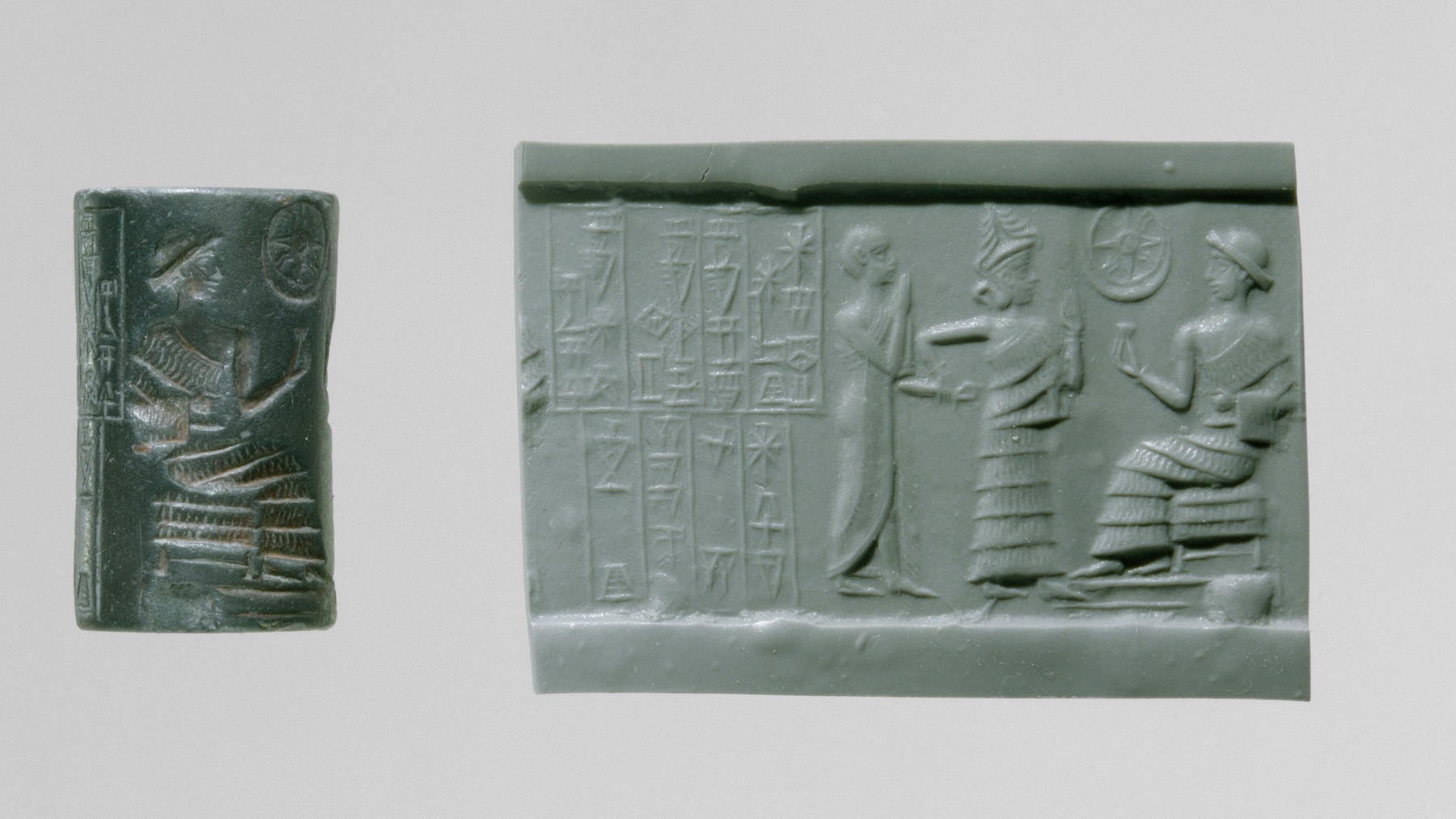
The Metropolitan Museum of Art holds a cylinder sealCylinder sealSmall engraved cylinder rolled over soft clay to leave an extended image. Used to secure, document and identify administrative actions; its pictures do not automatically constitute writing.Glossary · Click to read the explanation of the Ur III period, dated about 2028–2004 BCE and numbered 1988.380.2. Its photograph includes a modern impression that reveals the full engraving. According to the museum's reading, the inscription names the official Ilum-bani, son of Ili-ukin, in a formula of loyalty to King Ibbi-Sin. It provides material evidence for a divine element within a personal name—not a verified image of the god El. [5]
The scene shows a figure led by a goddess toward a seated, deified king. It is essential to distinguish the seal owner's name from the figures depicted, and both from the titles and signs in the inscription. Understanding the artifact does not require identifying them all as the same divine being. [5]
How does this relate to Semitic El?
Ilu belongs to a set of related words found across the Semitic languagesSemitic languagesA branch of the Afroasiatic language family, including Akkadian, Ugaritic, Hebrew, Aramaic, Arabic, Ethio-Semitic and South Arabian languages; a linguistic, not racial or religious, classification.Glossary · Click to read the explanation, discussed in the entry on the Semitic word ElSemitic ilAn ancient Semitic word meaning “god,” with cognates across several languages. It may function as a common noun or a proper name according to context; it is not always Ugaritic El.Glossary · Click to read the explanation. But lexical kinship does not automatically turn the Akkadian common noun into El in Ugaritic textsElEl is a senior deity in Late Bronze Age Ugaritic texts, portrayed as father of the divine family and a council authority, alongside his consort Athirat. This entry does not cover every linguistic use of El.Glossary · Click to read the explanation, where il can also function as the name of a particular deity. Language, syntax and surrounding evidence determine a word's referent. [6]
When assessing an occurrence, we therefore ask whether the form is a general noun or part of someone's name, whether it is written syllabically or logographically, and whether the text actually identifies a deity. This allows us to use linguistic comparison without exceeding the historical evidence. [2][5][6]
References and notes (6)
- Chicago Assyrian Dictionary (CAD), vol. I/J, Oriental Institute, University of Chicago, 1960, entry ilu; inherited bibliographic reference, cross-checked here against ORACC [2]. Entry ilu in volume I/J. Publisher metadata checked; the page 91 locator was not independently checked. Return to the text ↑
- ORACC, Digital Corpus of Cuneiform Lexical Texts, ilu [GOD] (N), lexical entry with written and normalized forms. Full online entry, especially Written forms, Normalized forms and sense 1 “god”. Return to the text ↑
- Giorgio Buccellati, “Akkadian,” in Robert Hetzron (ed.), The Semitic Languages, Routledge, 1997. Chapter pp. 77–78, External Inflection, especially singular case endings, mimation and diachronic variation; passage read. Return to the text ↑
- ORACC / ePSD2, Sumerian entry diŋir [deity], its Akkadian lexical equivalents including ilu and iltu. Senses and Lexical Associations, including diŋir = i-lu and diŋir = i-lum; the sign alone is not a specific divine name. Return to the text ↑
- The Metropolitan Museum of Art, “Cylinder seal: seated figure approached by a goddess leading a worshiper,” accession 1988.380.2, Ur III period. Complete object entry, notably dating, the inscription naming Ilum-bani and his father Ili-ukin, and the modern impression. Return to the text ↑
- “God, Names of,” Encyclopaedia Judaica, section “El,” reproduced by Jewish Virtual Library; comparison of Akkadian ilu and Ugaritic il. Section “ʾEl,” paragraph on Semitic cognates and the common/proper-name contrast; not the whole encyclopedia. Return to the text ↑
Suggest a correction · Suggest a source for this record
Cite this record
IL Archive, «Akkadian ilu», https://ilarchive.com/en/entities/akkadian-ilu
Continue reading