Study
Allah before Islam
An extended study of a topic, with evidence and references.
Following the name from inscriptions and personal names to Quranic discourse, distinguishing continuity of language from changing belief and stone testimony from scholarly interpretation.
Share article
Text
A name that did not begin with the Quran
When the QuranQuranCentral text of Islam, used here as evidence of its religious discourse.Glossary · Click to read the explanation spoke of AllahAllahThe Arabic name for God, used before Islam and in several Arabic-speaking religious traditions.Glossary · Click to read the explanation in the seventh century CE, it was not presenting its interlocutors with an entirely unfamiliar name. It portrays opponents acknowledging that Allah created heaven and earth, then contests what follows from that acknowledgment. As the text presents it, the disagreement concerns worship and partners, rather than hearing the name for the first time. [9][10]
Nor does our knowledge depend solely on later Islamic narratives. Centuries before the Quran, inscriptions preserve the name in personal names, prayers and oaths. Yet using the same word does not give all its users the same creed. The more precise historical question is what the name meant in different communities and how its religious position changed.
Stone adds earlier voices
Epigraphic studyEpigraphyStudy of inscriptions on surviving materials, including writing, context and dating.Glossary · Click to read the explanation has changed the balance of research into ancient Arabian religion. An inscription is a trace left by its maker or contemporaries; a later account may stand centuries away from the world it describes. This does not erase literature’s value, but prevents assigning both kinds of evidence equal weight without examination.
OCIANAOCIANADigital corpus of Ancient North Arabian inscriptions, with texts, images and commentary.Glossary · Click to read the explanation brings together readings, translations, commentary, images and contextual information for Ancient North Arabian inscriptions. It lets us move from a general assertion to an identifiable witness: what letters are carved, how does the catalogue read them, and which explanation is modern interpretation? Digital consultation here is not a field examination of the stone. [8]
What is Safaitic, and when was it written?
SafaiticSafaiticAncient North Arabian script preserving names and prayers; not one uniform creed.Glossary · Click to read the explanation is a conventional name for a script used by desert populations in areas including southern Syria, northeastern Jordan and northern Saudi Arabia. It does not name one religion or a unified people, and should not be equated with the later Arabic script.
Its 28 signs represent consonants without recording vowels, and texts can run in several directions. OCIANA conventionally places much of the tradition between the first century BCE and fourth century CE, with evidence suggesting earlier beginnings. This is a range for a writing tradition, not an exact date for every inscription cited here. [7]
When Greek preserves the pronunciation
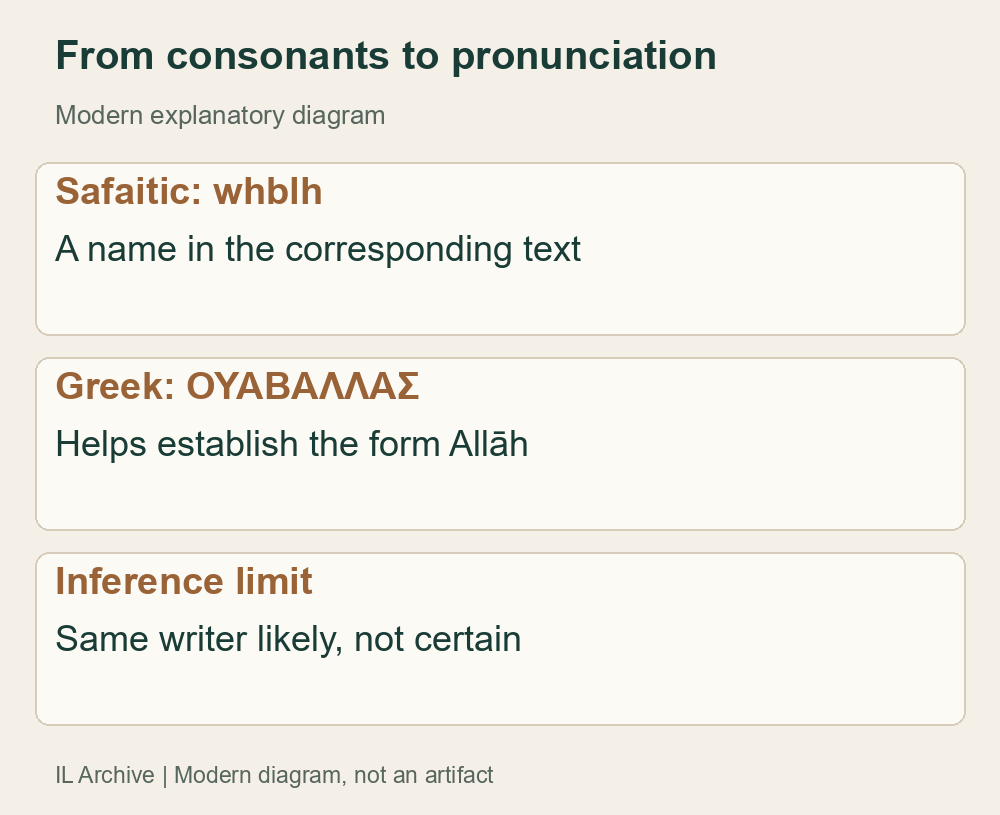
If the script omits vowels, how can we know that lh was read as Allah? Greek offers valuable evidence. WH 1860 records ΟΥΑΒΑΛΛΑΣ, corresponding to Wahballah, while an associated Safaitic inscription has whblh.
The two preserve corresponding name sequences, and OCIANA considers a common author likely. That attribution need not become certain for the phonetic comparison to matter: the Greek spelling supports Allāh as the pronunciation of lh in this name. It does not make every similar sequence in every language and context automatically the same word. [2]
An oath by the living Allah
SIJ 293 from Jawa in Jordan’s Mafraq Governorate preserves something clearer than a personal name alone. It records an act read as a burnt offering, then an oath by ʾlh described as ḥy, “living.” The catalogue compares the oath formula with Arabic “he swore by Allah.”
The commentary identifies a military context involving leadership. We need not identify the commander completely or determine an exact year to distinguish the evidence: a divine being is invoked in a religious act. Interpretations of verb and epithet remain tied to the published reading, rather than yielding a complete theology from one line. [3]
Abd Allah before Islam
The divine name also appears in personal names. NSR 6.2 from the Arar area of northern Saudi Arabia records l ʿbdlh bn mqm, read by the catalogue as Abd Allah son of Mqm. The consonantal spelling itself does not preserve every vowel. [4]
It belongs to theophoric namesTheophoric nameA personal name containing the name of a deity or a divine element.Glossary · Click to read the explanation, which contain a divine element, such as Wahb Allah and Abd Allah. Islam did not invent this naming pattern. Yet the name cannot establish that its bearer was a monotheist or disclose his attitude to other gods. A personal name is valuable linguistic and religious evidence, not a detailed declaration of every belief.
Etymology does not exhaust usage
A widespread etymological analysis connects Allāh with al-ʾilāh, “the god.” ElEl at UgaritA deity prominent in West Semitic traditions, especially as head of the divine family in Ugaritic texts.Glossary · Click to read the explanation, ilahArabic ilahThe Arabic common noun meaning “god” or “deity”, with the plural aliha.Glossary · Click to read the explanation and Aramaic alahaAlahaA Syriac word for God or a deity, part of the related Semitic divine vocabulary.Glossary · Click to read the explanation belong to an interconnected Semitic linguistic history. Related words, however, do not record one deity’s migration from community to community.
A word with a descriptive origin can become a recognized proper nameProper nameA name identifying a particular individual, place or other entity.Glossary · Click to read the explanation for a particular being. We must distinguish how a word formed from whom a writer means by it. A simple chain of El, then ilah, then Allah cannot explain doctrinal history, even where linguistic kinshipLinguistic relatednessA relationship through shared linguistic ancestry, distinct from direct borrowing or identical beliefs.Glossary · Click to read the explanation is real. [6]
Common noun and divine name
Safaitic offers a useful distinction. Its usual definite article is h-, allowing “the god” as a definite expression to be distinguished from lh or ʾlh functioning as a particular name in context. Omitted vowels do not necessarily make these uses identical.
Al-Jallad and Sidky’s 2026 study makes the distinction between a common nounCommon nounA word naming a class of things, such as “god”, rather than one particular individual.Glossary · Click to read the explanation and a personal divine name central to the question. An etymological origin does not prevent an expression from naming a specific deity in an ancient setting. Even so, individual occurrences of ʾlh cannot be judged apart from their sentence, script and language. [6]
Allat and Allah in the same text
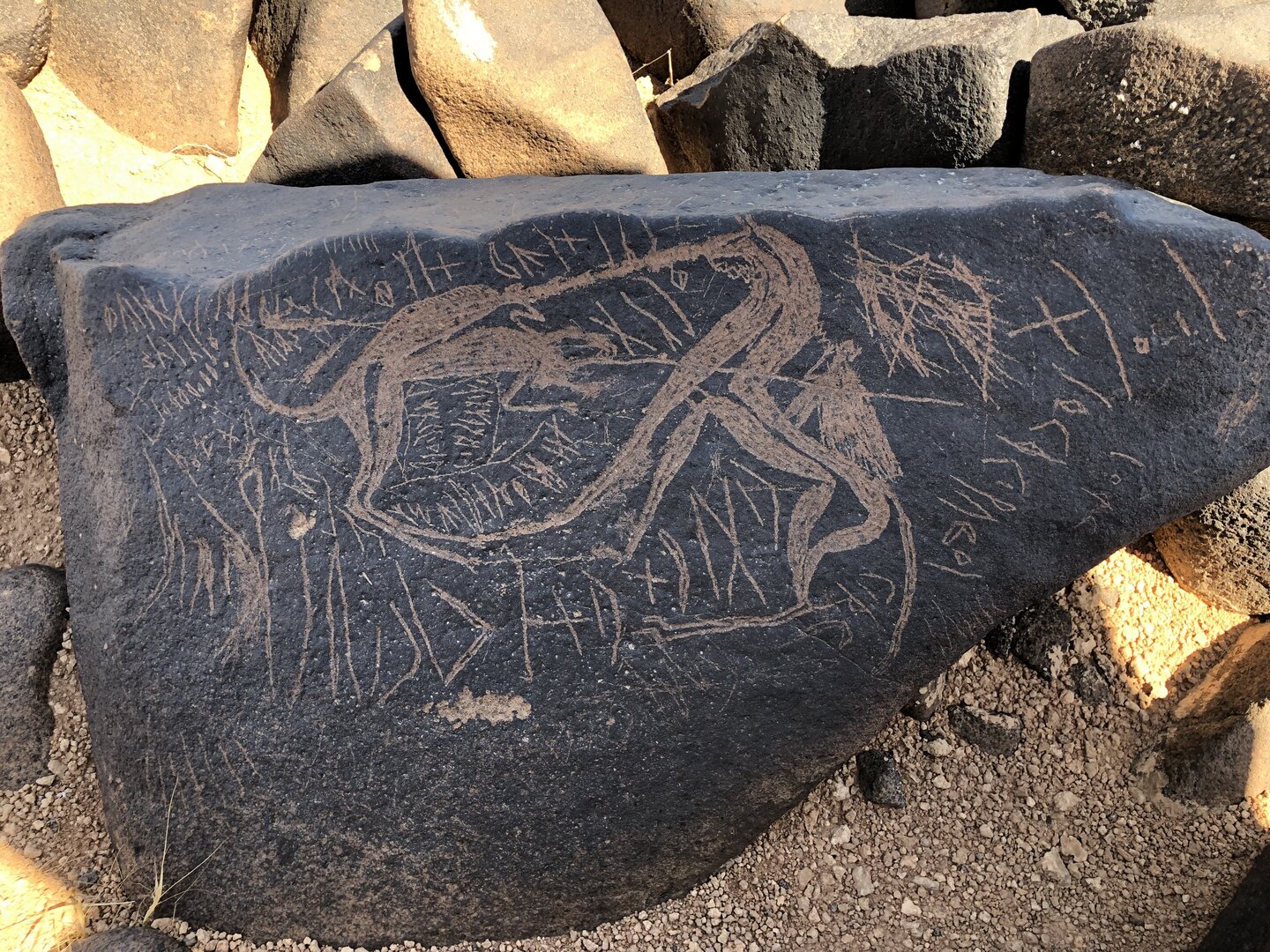
BES19s 77.1 decisively challenges the equation of knowing the name with monotheismMonotheismBelief in a single God as the only deity, rather than merely the highest among several gods.Glossary · Click to read the explanation. The same inscription invokes AllatAllatName of an ancient Arabian deity, attested in inscriptions and mentioned in the Quran.Glossary · Click to read the explanation, then requests relief from Lh, read as Allah in the catalogue. These are not two people from different periods being compared: both names occur in one text.
The commentary connects the request with drought, suggesting recourse to the creator during a rainfall crisis. That is a modern contextual explanation; the two invocations are direct textual evidence. They establish that recognizing Allah could coexist with worship of another divine being in some settings, without yielding one creed for the entire peninsula. [5]
Was he the high god of all Arabs?
Allah’s presence in a polytheistic environment does not prove marginality, nor does it automatically establish the same position everywhere. A high godHigh godA deity with a senior position among other gods; this does not itself mean monotheism.Glossary · Click to read the explanation must be specified: highest in creation, authority, frequency of prayer or official cult? These questions need not share one answer.
The peninsula had no single pantheonPantheonThe set of deities associated with a religious tradition, including their roles and relationships.Glossary · Click to read the explanation or central religious institution. Allat, Radu, Dushara, BaalBaalStorm god and protagonist of Ugarit’s Baal Cycle; exercises active kingship while El retains importance and authorizes the palace.Glossary · Click to read the explanation Shamin and Manat appear in different traditions. We cannot draw a fixed pyramid with Allah above every other deity and project it across every century and community. Local variation belongs to the evidence rather than being an obstacle to remove. [6]
A witness to the light-giving creator
Ancient Allah, published in 2025, presents an inscription from MH09 in northeastern Jordan’s Harrah. The publisher’s abstract describes a mortuary context and interprets the text as strong evidence for Allah as a light-giving creator invoked against death represented by darkness. [1]
This is important testimony about the deity’s character, beyond the name’s existence. Its scope still matters: a scholar’s reading of one text in a northern setting. It does not give every dialect and community the same mythology, provide a complete creation narrative or document every ritualRitualAn organised or distinguished practice meaningful to a community; it may leave traces, but its form alone does not reveal an associated doctrine.Glossary · Click to read the explanation of worship.
What does “two thousand years ago” mean?
The abstract places this world roughly two thousand years ago. That approximation must not become an exact year carved into the stone or a date for every invocation of Allah. Other inscriptions use royal or event-based datings that require their own interpretation.
The material’s precedence over the Quran establishes that the name and some religious functions did not begin with it. Identifying the first user, the first community to regard Allah as creator or the initial date of worship exceeds what the surviving sample can prove. The earliest preserved witness is not necessarily an idea’s birth. [1][7]
The final centuries before Islam
Paleo-Arabic inscriptionsPaleo-ArabicDesignation for early Arabic inscriptions in writing traditions preceding Islam; the sample is limited.Glossary · Click to read the explanation of late antiquityLate antiquityHistorical frame for late ancient transformations; boundaries vary by region and subject.Glossary · Click to read the explanation change the kind of evidence available. Here the term refers to Arabic texts in an early script related to later Arabic writing, rather than Safaitic continuing unchanged.
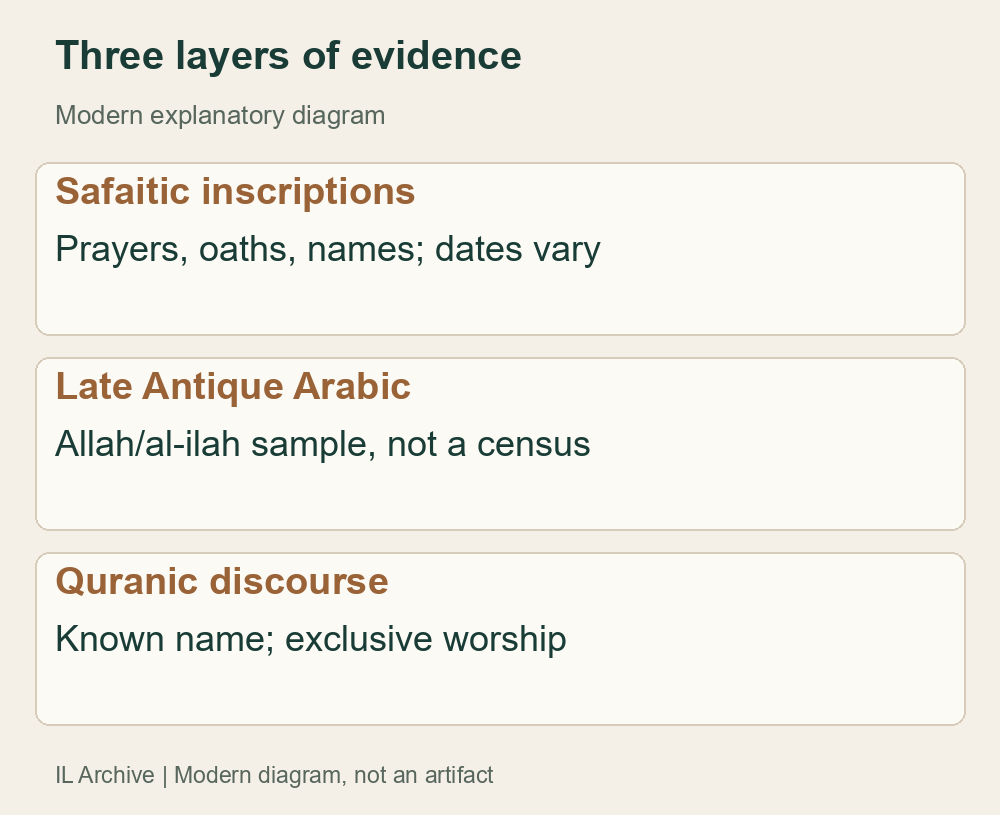
In their February 2026 study, Al-Jallad and Sidky discuss a sample exceeding forty texts from several regions. They observe that the available invocations focus on Allah or al-ilah, while invocations of older gods abundant in earlier corpora do not appear there. The number describes the sample known when the study was written, not a permanent total of everything inscribed in Arabia. [6]
Absent invocations are not a census of belief
The change is clear in written religious language, but it does not establish that every individual became a monotheist in the same sense. A short text can focus on one deity without stating its author’s views about every other being.
This is a question of negative evidenceNegative evidenceFailure to find an expected trace can test a hypothesis when preservation and investigation make discovery expectable; not every absence is evidence.Glossary · Click to read the explanation: where was the search made, how large is the sample, and which practices were normally recorded? Disappearing names in prayers require explanation, but are not a complete excavation of everyone’s life. The finding must therefore concern the known corpus, separately from a broader social interpretation. [6]
The language of Arab Christians
Some late texts are associated with Christianity through crosses, context and formulas. The study discusses inscriptions at Hima north of Najran, some dating to around 470 CE, alongside evidence from Dumat al-Jandal, the LevantThe LevantThe Levant is a regional name for lands along the eastern MediterraneanGlossary · Click to read the explanation and northern Arabia.
Christian material uses al-ʾilāh, “the god,” including formulas asking that God remember a person. These witnesses must not be automatically merged with inscriptions spelling Allah without Christian markers. They nevertheless establish that pre-Islamic Arabic religious language could express the one God within a Christian setting as well. [6]
Allah and al-ilah: a convergence to explain
Al-Jallad and Sidky argue that the preference for al-ilah in Christian texts and Allah in western texts without overt Christian features goes beyond a spelling difference. They propose that Allah’s older Arabian profile made identification with the supreme God of biblical traditions possible.
This is a historical model attributed to two scholars, not an explicit statement in each inscription that such identification occurred. Etymological relations help explain possible convergence, but do not establish its route or each community’s creed. The history cannot be reduced to Islam taking the name from Christians, or to all Christian and Arabian uses having always been identical. [6]
What does a text without a cross mean?
An inscription invoking Allah without a cross does not automatically prove a non-Christian author: silence about a symbol cannot determine affiliation by itself. Equally, one prayer does not establish membership of a particular church or Jewish community.
Some witnesses may come from settings centered on the creator while retaining practices or intermediaries difficult to classify neatly. “Pagan” and “monotheist” require working definitions: are we counting beings, identifying the recipient of prayer or asking about exclusive worshipMonolatryWorship of one deity without necessarily denying others; variable analytical term, not one uniform doctrine of all Israelites.Glossary · Click to read the explanation? The evidence does not always answer all three questions together. [6]
A diverse and changing peninsula
“The Arabs before Islam” were not one fixed religious community. Pastoral areas, cities, kingdoms, Jewish and Christian groups and local traditions did not necessarily produce a single system. Earlier corpora do not show the same picture as the period immediately before Islam.
MonotheismMonotheismBelief in a single God as the only deity, rather than merely the highest among several gods.Glossary · Click to read the explanation must therefore be accompanied by questions of time, place and evidence. Monotheistic transformations in southern Arabia, Christian communities and regional connections supply important context. They do not themselves demonstrate that a particular doctrine traveled in the same way among all populations. [6]
The Quran presupposes the name
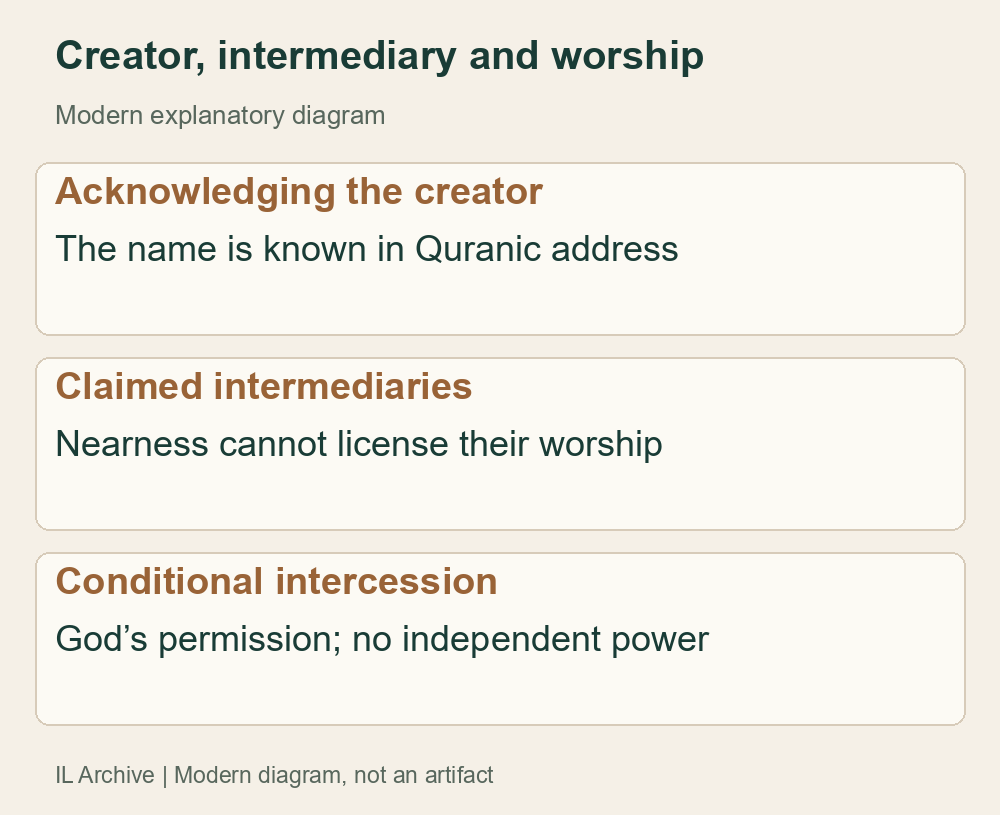
Quran 29:61 asks who created heaven and earth and subjected the sun and moon, and presents the answer as Allah. Quran 31:25 repeats the acknowledgment of the creator. This is evidence from seventh-century discourse, not a conclusion from biography alone. [9][10]
The kind of witness matters: we are reading how the Quran portrays and addresses its opponents. It is not an independent questionnaire covering every inhabitant of Mecca, much less the peninsula. Even so, the argument is difficult to understand if the name were unfamiliar, and inscriptions independently establish its earlier use.
Intermediaries and association
Quran 39:3 presents the argument of those worshipping others to draw nearer to Allah. Quran 10:18 presents their claim that these are intercessors with Allah. The text can therefore accuse a group of shirkShirkAssociating others with God in Quranic discourse; not equivalent to denying God’s existence.Glossary · Click to read the explanation, association, without that group denying Allah or granting every object of worship equal power. [11][12]
A model reinterpreting older beings as subordinate intermediaries offers one explanation for recognizing the creator while retaining other cult practices. This historical interpretation has supporters and disagreements. Paleo-Arabic inscriptions do not establish it alone, and it must not be projected onto BES19s 77.1 as though its earlier prayers explicitly describe an intercessionIntercessionMediation subject in the cited Quranic texts to permission and approval, not divine independence.Glossary · Click to read the explanation system. [6]
Allat, al-Uzza and Manat
Quran 53:19–20 names Allat, al-Uzza and Manat, then criticizes the allocation of male and female in the divine sphere. This can be compared with traditions describing the figures as Allah’s daughters, but the verses are not a genealogical register furnishing a complete family. [13]
The names are not confined to later Islamic literature; external witnesses attest cults bearing them or their historical counterparts. Later accounts of locations, rituals and kinship require separate testing. Hawting’s chapter summary expressly distinguishes the names’ earlier attestation from how much authentic knowledge lies behind elaborated reports. [15]
How should the Book of Idols be used?
Sources such as Ibn al-Kalbi’s Book of Idols are valuable for religious memory and reports circulating among their authors. They nevertheless postdate many practices described, so every detail cannot become a direct portrait of the sixth century.
Al-Jallad and Sidky propose that some stories conflate older divine beings with locally venerated stones, places and objects. This is the authors’ critical interpretation, not a verdict that all later reports are invented. Each name and account should be compared with its witnesses, preserving uncertainty rather than constructing an entire pantheon from one narrative. [6][15]
Did Allah have a statue?
The witnesses consulted here do not supply an archaeological object securely identified as an image of Allah. A statue or stone mentioned in a later source cannot simply be selected and declared his representation without a direct connection between object and name.
This differs from asserting that depiction was always forbidden or that no image ever existed anywhere. The lack of a secure identification does not establish a universal prohibition. Our Safaitic photograph depicts stone and writing, not Allah or Allat; its animal and human drawings are not assigned an unattested divine identity. [5]
An absent image does not erase worship
Oaths, prayers and requests for relief make religious invocation of Allah visible even without an identified statue. SIJ 293 also records an act read as a burnt offering within its oath context. An image is not necessary to recognize this kind of practice. [3][5]
The opposite mistake must also be avoided: these witnesses do not specify a central temple, priestly organization or complete festival calendar. Some acts can be established without reconstructing a whole institution. The difference between attested worship and missing detail is a limit of the epigraphic record itself.
Does the evidence establish a moon god?
The inscriptions presented here do not establish a chain identifying Allah as a moon god. We find an oath, the epithet “living,” requests for relief and, in the reading of MH09, creation and the giving of light. Such roles do not amount to a particular astronomical identity. [1][3][5]
Lunar deities in Arabian traditions cannot simply be merged with Allah. Nor does every reference to light denote the moon, or every celestial drawing identify its worshipped being. “Allah was a moon god” therefore remains unproven by this material; resemblance and geographical proximity cannot replace evidence of identity.
Two evidence layers, not two sealed religions
In older evidence, invoking Allah can coexist with invoking Allat and does not eliminate other powers. Known later Arabic invocations concentrate on Allah or al-ilah. These are two textual pictures, not exhaustive divisions of all people. [5][6]
Practices can overlap and transitions occur at different times in different places. The 2026 model proposes an increasing identification of the older creator with the supreme universal God, alongside reinterpretation of other beings. No decision record or detailed transmission map survives; proposed paths require more than similar names.
What does the Quran change?
The Quran makes acknowledgment of the creator a basis for exclusive worship: knowing Allah does not justify granting others a share in it. The change concerns more than selecting the highest name; it draws boundaries around worship, divine kinship and authority. [11][12][13]
This does not empty heaven of angelsAngel / Divine MessengerHebrew malʾakh means messenger, human or celestial according to context; the word alone proves neither wings nor origin from a particular Canaanite god.Glossary · Click to read the explanation or abolish every use of intercession language. Quran 53:26 conditions angelic intercession on Allah’s permission. The dependent being has neither independent authority nor a claim to worship. This is more precise than saying the Quran categorically denies every intermediary or every intercession. [14]
The same name and the same creed?
Was pre-Islamic Allah “the same God”? Linguistically and historically, the name is earlier and some witnesses connect it with a creator. If the question asks whether every earlier creed was identical to Islamic belief, the evidence does not support that.
A historian can follow words, acts and religious representations, but cannot settle metaphysical identity from a stone. Two people can use the same name with different conceptions of the cosmos. Continuity of name does not erase changed usage or mean that a later religion secretly worships every earlier religious representation bearing the word.
What is established, and what remains interpretation?
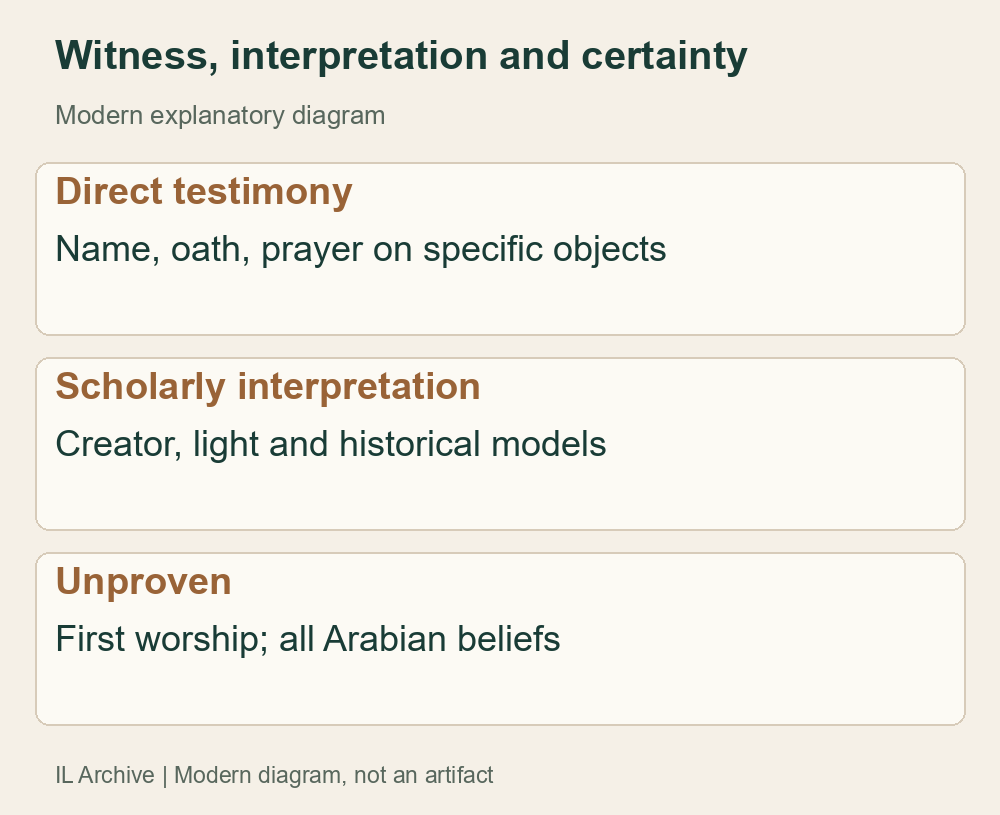
The name’s pre-Islamic use in prayers, oaths and names is established. Some texts allow Allah and Allat to coexist, and the Abd Allah naming tradition is not an Islamic invention. These conclusions concern identifiable witnesses rather than an imagined picture of Arabia. [2][3][4][5]
Assigning a creator’s position to all Arabs, identifying worship’s first occurrence or turning epigraphic absence into universal monotheism is unproven. The development into the supreme universal God is an important scholarly model explaining intersecting evidence, but it remains distinct from each inscription’s direct testimony. [1][6]
An old name within a changing history
Taken together, the witnesses do not show a name invented from nothing in the seventh century. They show it on stone, in personal names, oaths and prayers, then in later religious language increasingly focused on one creator. They do not show one immutable creed across all those periods.
That is why the history matters. The Quran enters a debate already familiar with the name and demands exclusive worship as the consequence of recognizing Allah. The name remains while its boundaries within the religious world change. Inscriptions preserve part of the road to that debate, with continuities, differences and gaps that must not be filled with manufactured certainty.
References and notes
- Ahmad Al-Jallad (2025). “Ancient Allah: An Epigraphic Reconstruction.” Journal of Semitic Studies 70(2): 693–748. DOI 10.1093/jss/fgaf012. Publisher abstract: MH09, roughly two thousand years ago, light-giving creator reading. Full article not read; no absolute date for every inscription. Return to the text ↑
- OCIANA. “WH 1860 / WH Greek 2.” Editors A. Al-Jallad and M. C. A. Macdonald. Greek ΟΥΑΒΑΛΛΑΣ and Safaitic whblh; same writer is likely, not certain. Return to the text ↑
- OCIANA. “SIJ 293.” Reading and commentary: Al-Jallad (2015), updated 2025. Jawa: oath, burnt offering and ʾlh ḥy; no individual commander or exact date established here. Return to the text ↑
- OCIANA. “NSR 6.2.” Arar area: l ʿbdlh bn mqm; corrected mqm reading, not a complete creed from a name. Return to the text ↑
- Ahmad Al-Jallad / OCIANA. “BES19s 77.1.” Updated 25 June 2026. Firʿ Wadi al-Khudari, Jordan: Allat then Lh; drought explanation is commentary, and ʿbdt does not identify which Obodas here. Original image © Al-Jallad, CC BY as stated, no version number supplied. Return to the text ↑
- Ahmad Al-Jallad and Hythem Sidky (2026). “Late Antique Allāh: Ancestral Arabian Religion and the Monotheistic Zeitgeist.” Arabian Archaeology and Epigraphy. First published 15 February 2026. DOI 10.1111/aae.70019. Selected passages on the 40-plus corpus, Allah/al-ilah, intermediaries and later sources. Epigraphic observation separated from the authors’ model; their cited bibliography not all read. Return to the text ↑
- OCIANA. “Safaitic.” 28 consonantal signs, variable direction; conventional first century BCE–fourth CE range with evidence suggesting earlier origins, not each object’s date. Return to the text ↑
- OCIANA. “About This Project.” The Ohio State University. Corpus provides readings, translations, commentary, context and images; digital consultation, not physical stone inspection. Return to the text ↑
- Qurʾān 29:61. Quranic Arabic Corpus, verse and parallel translations. Acknowledgment of creator and subjection of sun and moon. Return to the text ↑
- Qurʾān 31:25. Quranic Arabic Corpus, verse and parallel translations. Acknowledgment of creator; evidence of textual address, not a census of Arabian belief. Return to the text ↑
- Qurʾān 39:3. Quranic Arabic Corpus, verse and parallel translations. Drawing nearer to God and rejection of worship directed elsewhere. Return to the text ↑
- Qurʾān 10:18. Quranic Arabic Corpus, verse and parallel translations. Claimed intercessors and rejection of association. Return to the text ↑
- Qurʾān 53:19–22. Quranic Arabic Corpus. Allat, al-Uzza and Manat and the male/female polemic, not an archaeological genealogy. Return to the text ↑
- Qurʾān 53:26. Quranic Arabic Corpus. Angelic intercession conditioned on permission; criticizing intermediaries does not negate all intercession. Return to the text ↑
- G. R. Hawting (1999). “The daughters of God.” The Idea of Idolatry and the Emergence of Islam, pp. 130–149. Cambridge University Press. Summary distinguishes attested names from elaborated later cult reports; full chapter not read. Return to the text ↑
Suggest a correction · Suggest a source for this record
Cite this record
IL Archive, «Allah before Islam», Edition 1, https://ilarchive.com/en/studies/allah-before-islam
Continue reading
![Quran manuscript folio, Met 1979.201, late eighth–early ninth century, Central Islamic Lands; ink, colours and gold on parchment. Later codex transmission, not a seventh-century copy or an image of the verses cited here. [28]](/media/1332)