Entity · Religious text
The Quran
A reference page linking a name, group, or concept to the materials that discuss it.
Islam’s central scripture and an early witness to debates about monotheism and intercession, considered alongside manuscripts, reading traditions, and limits on reconstructing Arabian religious life.
Estimated reading time: 10 min Published Last reviewed:
Share article

Text
Introduction
The Quran is the central scripture of Islam, but it is also an early Arabic witness to religious discourse that emerged in the Arabian Peninsula in the seventh century CE. This entry examines the work's form, message, and transmission. It asks how historians can use its verses to investigate the beliefs it challenges without turning the text's depiction of its opponents into a census of all Arabian religious practices.
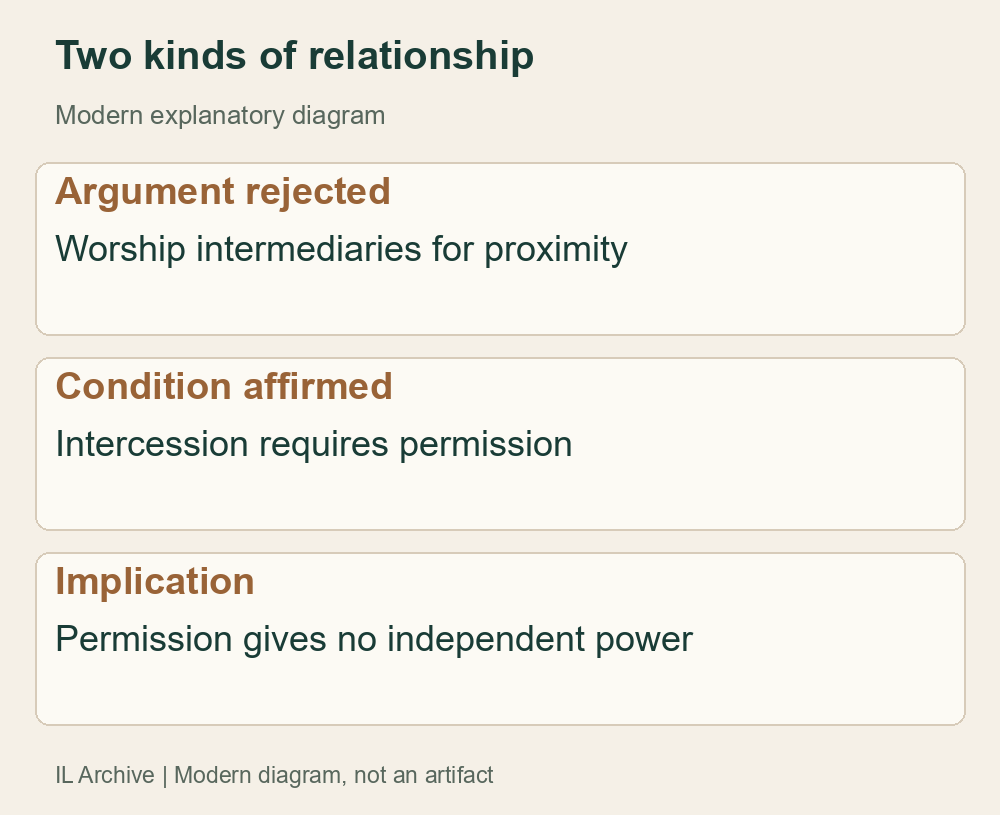
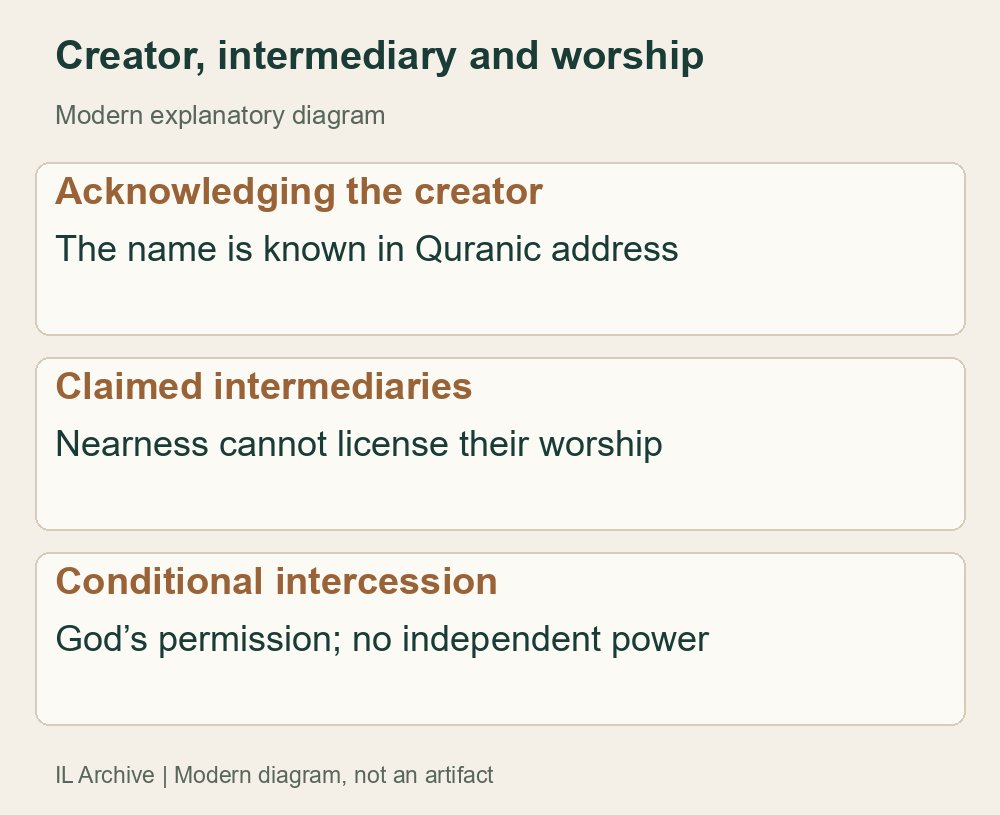
Our starting point is the distinction between acknowledging God as creator, objecting to the worship of intermediaries, and restricting intercession to God's permission. Quran 29:61, 39:3, and 53:26 make different contributions to that argument and must each be read in context. [1][2][3]
What is the Quran, and what is its textual scope?
The Quran comprises 114 surahs (chapters) of unequal length, divided into ayahs (verses) and recited in prayer, devotion, and teaching. According to Islamic belief, it is the speech of God (Allah)AllahAllāh: the Arabic designation of the one God in Islam, also used in other Arabic-speaking traditions. Its pre-Islamic attestations vary in context and historical meaning.Glossary · Click to read the explanation revealed to MuhammadMuhammad, prophet of IslamMuhammad is the prophet of Islam, living about 570–632 CE in the setting of Islam’s seventh-century emergenceGlossary · Click to read the explanation, the prophet of Islam (approximately 570–632 CE). Historical research, by contrast, asks about the language of the discourse and the material evidence for its copying and circulation, without deciding whether revelation is true or false.
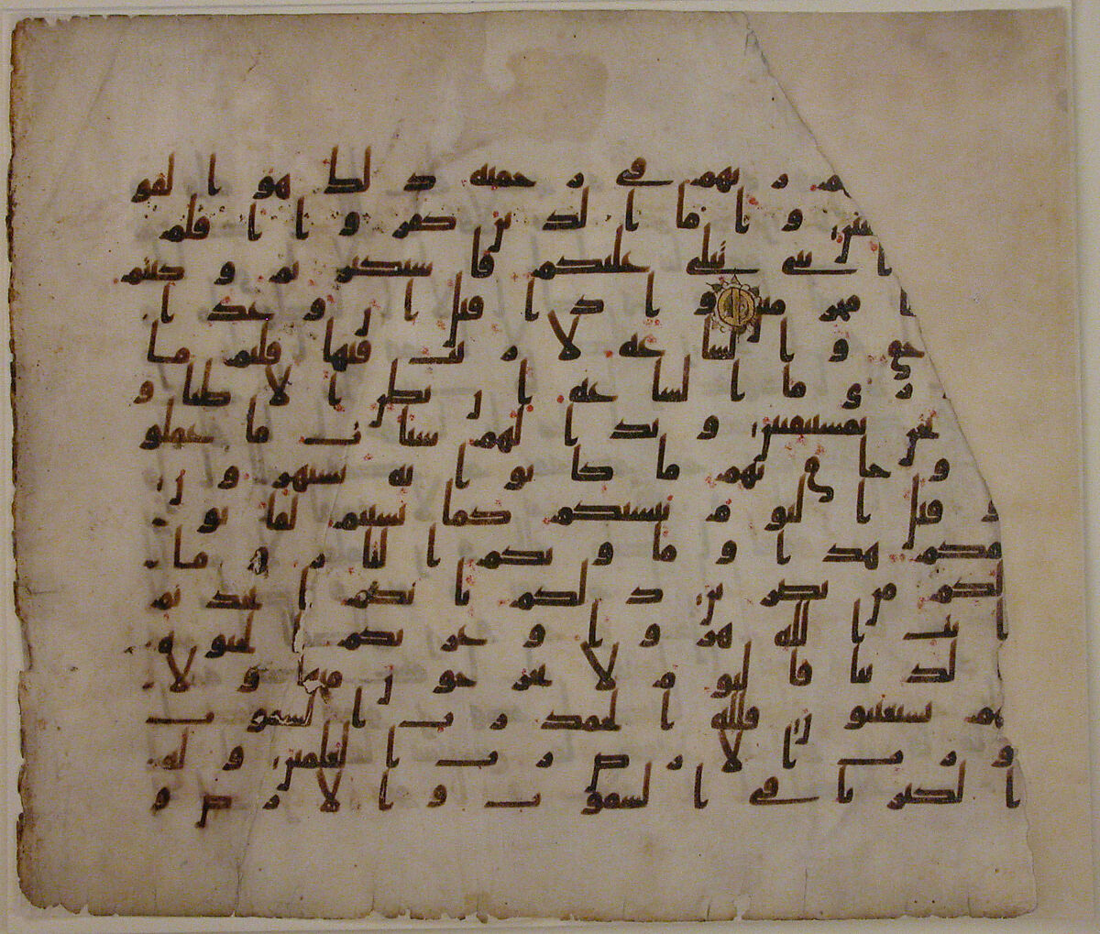
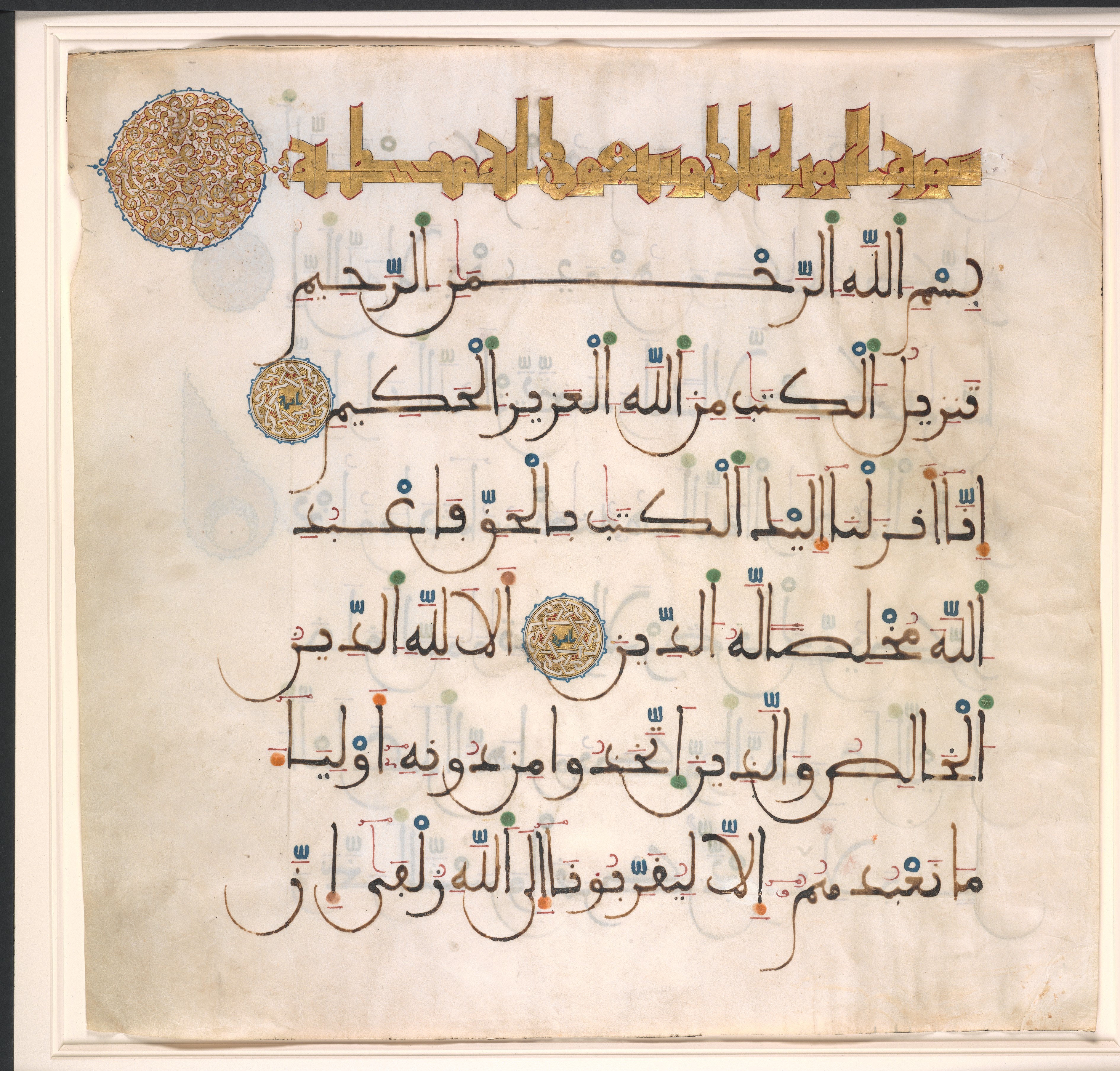
The word “Quran” is associated with recitation, whereas a mushaf is a particular physical written copy, bearing distinctive material and scribal features. Consequently, a photograph of one early codex leaf cannot establish the form of every codex or the original pronunciation of every passage. The text calls itself an “Arabic Quran” at 12:2. [4]
Surahs, verses, and kinds of discourse
The order of surahs in the received codex is not a direct chronological register of what was uttered first and last. Prayers, stories, warnings, argument, law, and reflections on judgment stand alongside each other. The conventional classification of surahs as “Meccan” or “Medinan” comes from the Islamic scholarly tradition. Researchers may question the dating of a particular passage by examining its language and relationships with other texts; a surah's broad label does not settle the chronology of every verse.
Across these genres are recurring concerns with divine oneness, resurrection, human accountability, justice, and the community's relations with others. Surah 112:1–4 is a concentrated statement of divine uniqueness, not a historical survey of all the populations addressed by the Quran. [5]
Knowing the creator is not the whole of worship
Quran 29:61 puts a question to its interlocutors: who created heaven and earth and subjected the sun and moon? The verse says that their answer would be “God.” A similar argument occurs at 31:25. This establishes how the Quran represents a group of people involved in its polemic: they acknowledge the creator in that exchange. It does not supply their individual identities or a comprehensive map of Arabian religion.
Recognizing a creator or supreme deity is not identical to monotheismMonotheismBelief that only one God possesses divinity in its fullest sense. Historically distinct from exclusively worshipping one deity without denying others; its theological forms vary.Glossary · Click to read the explanation as advocated in the passage, understood as directing worship to God alone and not granting competing powers a share of divine authority. The challenge is therefore: if the creator is acknowledged, why direct acts of reverence or worship elsewhere? The verse on its own does not document practices in every town and tribe.
Patrons and nearness in surahs 39 and 10
At 39:3 the Quran challenges people who take patrons other than God and reproduces their rationale: they worship them only to bring themselves nearer to God. Quran 10:18 likewise describes objects of worship that neither benefit nor harm and the assertion that they are intercessors before God. In context the criticism targets worship offered to intermediaries; it is not simply the claim that the addressees were unfamiliar with the creator's name. [6]
“Patron,” “intercessor,” “god,” and “idol” are not interchangeable labels in every source or historical context. The passage determines what a given actor or object is said to do. Moreover, the opponents' words are reported within a polemical framework: a valuable witness to a debate, but not a substitute for evidence of how worshippers themselves understood their practices.
Intercession denied or permitted
Quran 53:26 refuses the idea that angels can intercede with effect independently of God; efficacy depends on divine permission and approval. Quran 2:255 asks rhetorically who can intercede before God without permission. Thus it is inaccurate to infer that intercessionIntercessionAn appeal made to God by an intercessor on another’s behalf; its actors, conditions, and acceptability differ by text and tradition. Not a synonym for every mediation, prayer, or tawassul.Glossary · Click to read the explanation is rejected under all circumstances: the passages deny autonomous entitlement or power. [7]
Equally, the elaborate doctrines subsequently developed in Islamic commentary about the intercession of prophets or the righteous cannot simply be read back into these particular verses. We first distinguish what the text explicitly says from later debates and explanations in different interpretive traditions.
Named beings and polemic in surah 53
Quran 53:19–23 names al-Lat, al-Uzza, and Manat and challenges the attribution of feminine status or daughters to God as well as the names assigned to these beings. Their appearance proves that the text and its milieu knew the names; it is not, by itself, an archaeological description of any particular statue or a full list of ritualsRitualAn organised or distinguished practice meaningful to a community; it may leave traces, but its form alone does not reveal an associated doctrine.Glossary · Click to read the explanation and divine figures. [8]
Comparing these names with older inscriptions can test their continuity and changing roles. It does not establish that a goddess invoked in one earlier region was worshipped in an identical manner throughout seventh-century Arabia. Nor does a person's theophoric nameTheophoric nameA personal name including a deity’s name or another divine element, often as part of a short sentence or invocation, interpreted in its original language and context.Glossary · Click to read the explanation by itself establish the continuing performance of that deity's rituals at the time the name was recorded.
Arabic inscriptions and the sixth-century setting
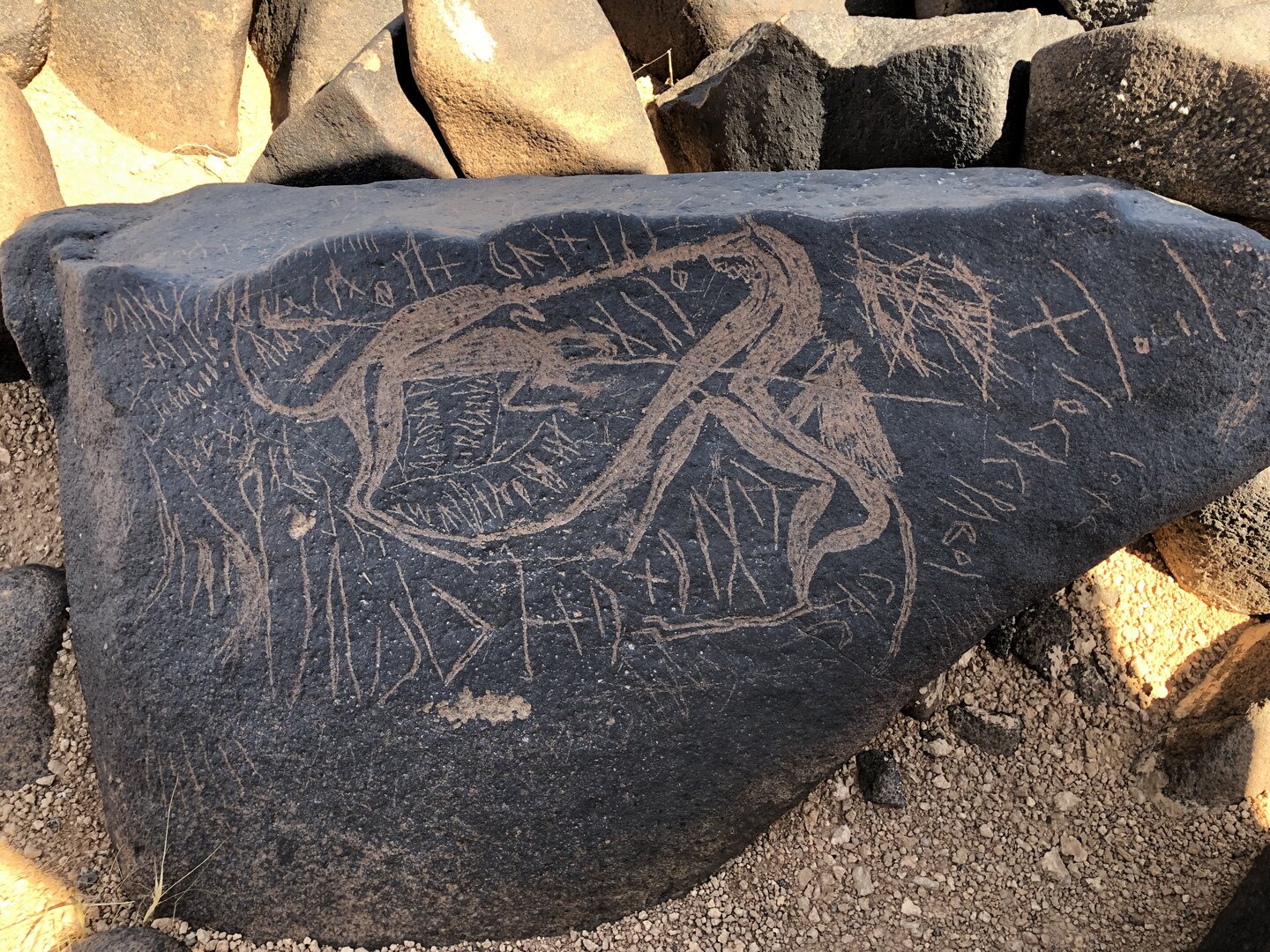
In a study published in 2026, Ahmad Al-Jallad and Hythem Sidky compare Arabian inscriptions from different periods with the Quran and later Islamic reports. Invocations to numerous deities are conspicuous in some earlier epigraphic corpora, while the known religious invocations in a set of sixth-century Paleo-Arabic inscriptions are directed to Allah or “the God.” The authors analyze this shift in the language of devotion within broader religious changes. Inscriptional silence does not, however, prove that every other form of practice had ceased. [9]
Their examples include western Arabian inscriptions asking God's forgiveness or enjoining piety before the rise of Islam. They propose that increasing emphasis on a creator deity could coexist with intermediaries and popular practices and that later memories of “idols” need more precise historical categories. This is an argued model supported by identified evidence and open to criticism, not an established consensus that all Arabs followed a uniform religion. [10]
The Quran and earlier scriptural traditions
The Quran addresses Jews and Christians and retells narratives of prophets and earlier communities known in different traditions, with significant convergences and differences in detail and purpose. In 5:48 it calls the revealed Book a confirmation of earlier scripture and an authority over it, while discussing different religious laws and the pursuit of good works. This defines the Quran's place in its own religious discourse; a historian seeking a specific literary connection must also compare the relevant HebrewHebrewA Northwest Semitic language of the Canaanite group, encompassing Iron Age epigraphy, Biblical, Rabbinic, medieval and Modern Hebrew; its scripts and pronunciations changed over time.Glossary · Click to read the explanation, Greek, SyriacSyriacAn Aramaic literary language rooted in Edessa, first attested in non-Christian inscriptions and later prominent in Christian writing, scholarship, translation and liturgy.Glossary · Click to read the explanation, and other witnesses. [11]
A shared theme must be distinguished from proof that one verse directly borrowed from a particular recension of an older work. Late-antique Arabia connected multiple languages and traditions. Similarity alone does not establish the precise route by which an idea travelled or a shared interpretation of a scriptural figure.
Recitation, memorization, and writing
The Quran circulated through oral recitation, memorization, and written copying. Muslim accounts describe Muhammad's receiving revelation in stages, companions learning passages by heart and recording them, and materials later being assembled in written collections. These narratives were written down after the events they describe and must be compared with early physical witnesses, rather than either automatically accepted in every detail or dismissed wholesale. [12]
The rasm, or written consonantal framework of a word, is not equivalent to every feature of its recitation and vocalization. Early Arabic manuscripts often contain less consonantal pointing and vowel marking than later codices; reconstructing any reading therefore calls for comparisons across manuscripts, medieval reading literature, and linguistic evidence.
The Uthmanic collection: report and reconstruction
Sahih al-Bukhari 4987 reports that differences between reciters prompted Hudhayfa ibn al-Yaman to ask for a common written form and that the caliph Uthman ibn Affan (r. 644–656 CE) commissioned a group to produce and distribute copies. This is testimony preserved in later Islamic literary tradition, not a surviving contemporary administrative record issued by the committee.
Working from manuscripts rather than the report alone, Marijn van Putten examined unusual spelling patterns shared across fourteen early copies and argued that the Uthmanic text type descended from a common written archetype during Islam's first century. Nicolai SinaiSinai: peninsula and biblical mountainSinai is a peninsula in eastern Egypt; in the Torah the name also denotes the mountain of revelation to MosesGlossary · Click to read the explanation assessed competing dates for the closure of the consonantal skeleton and, in a 2014 article, favored an early date near 650 as the default over extensive late-seventh-century revision. Neither argument verifies every detail in the later report. [13][14]
Birmingham's leaves and the limits of radiocarbon dates
The University of BirminghamBirmingham, United KingdomBirmingham is a city in England whose university preserves early Qur’anic parchment leavesGlossary · Click to read the explanation holds two early Quran leaves, Mingana collection `Islamic Arabic 1572a`, containing portions of surahs 18, 19, and 20. Radiocarbon testing yielded a calibrated range of 568–645 CE for the parchment at 95.4% confidence. This dates the organic material of the writing support, not the precise moment when ink was applied or the composition of all surahs; script is evaluated through separate palaeographic study. [15]
The university itself declines to call these the world's oldest Quran manuscript with certainty. Those leaves also cannot be cited as physical witnesses to our opening verses in surahs 29, 39, and 53: none of the three passages is preserved on them.
The lower text of the Sanaa palimpsest
The manuscript known as Ṣanʿāʾ 1 is a palimpsest: an earlier Quranic writing was erased and the parchment reused. Behnam Sadeghi and Mohsen Goudarzi studied the lower writing as evidence for an early textual type that does not coincide at every point with the predominant Uthmanic tradition. They examined its variants and possible history of transmission without presuming that each variant was necessarily the earliest reading. [16]
The two written layers are not two complete books available for comparison verse by verse across every surah. Only parts survive and their legibility varies. The relationship between this witness and standard copies requires material and philological analysis: a distinctive early text type does not on its own place the composition of the entire Quran in a much later era.
Reading traditions and the history of Quranic Arabic
The Islamic tradition recognizes multiple canonical readings whose recitation, vocalization, and sometimes the meaning of particular forms differ. Van Putten's Quranic Arabic (2022) explores the relationship between the language of the early Hijaz and subsequent developments in Arabic and the reading traditions. The publisher's accessible overview describes its general argument; that description alone should not be treated as full examination of every chapter. [17]
The Corpus Coranicum research project compares manuscript evidence with textual and linguistic history, making changes in spelling and pointing visible. In citing any passage, it matters whether the source is a specific manuscript leaf, a critical reconstruction based on several witnesses, or the widely used Cairo printed edition of 1924. [18]
A text is evidence for a debate, not a census
The Quran is indispensable for studying the terms of early Islamic religious disagreement and the assumptions behind its arguments, but it does not alone supply a complete tribal census or a neutral record of rituals. In the abstract of a scholarly chapter on the Quran's Arabian setting, Harry Munt outlines both its historical importance for the Hijaz and the difficulties of using it in isolation. Only the publisher's description and abstract of that chapter were available in this review. [19]
Historical interpretation gains strength when a verse is compared with a dated inscription, a securely identified manuscript, or a traditional narrative whose transmission period is specified. The formula “they will surely say: God” cannot settle what every individual believed, just as the omission of a deity from a single inscription cannot establish the disappearance of that deity's cult.
Conclusion
The Quran is both a central Arabic religious text and an unparalleled witness to the disputes of early Islam. The three starting verses articulate a careful sequence: acknowledgment of a creator, rejection of worship directed towards mediators as a means of drawing near, and intercession that works only by God's permission. Their historical significance becomes clearer in dialogue with inscriptions, readings, and manuscripts, without making the text's representation of the world into a complete, unquestionable account of the world outside it.
References and notes (19)
- Quran 29:61 (al-ʿAnkabūt); Quranic Arabic Corpus, University of Leeds, verse and parallel translations. Verse 29:61 only: interlocutors asked who created the heavens and earth. Return to the text ↑
- Quran 39:3 (al-Zumar); Quranic Arabic Corpus, University of Leeds. Verse 39:3 only: the claim of attaining nearness through patrons. Return to the text ↑
- Quran 53:26 (al-Najm); Quranic Arabic Corpus, University of Leeds. Verse 53:26 only: angelic intercession, permission, and approval. Return to the text ↑
- Quran 12:2 (Yūsuf); Quranic Arabic Corpus, University of Leeds. Verse 12:2: the text described as an Arabic Quran. Return to the text ↑
- Quran, surah al-Ikhlāṣ 112:1–4, Arabic text at Quran.com. Full four-verse surah on divine uniqueness. Return to the text ↑
- Quran 10:18 (Yūnus); Quranic Arabic Corpus, University of Leeds. Verse 10:18 only: worshipped beings and intercessors. Return to the text ↑
- Quran 2:255 (al-Baqarah); Quranic Arabic Corpus, University of Leeds. Verse 2:255: intercession only by divine permission. Return to the text ↑
- Quran 53:19–23 (al-Najm), Arabic text and translation at Quran.com. Verses 19–23: al-Lāt, al-ʿUzzā, Manāt, and the argument concerning them. Return to the text ↑
- Ahmad Al-Jallad and Hythem Sidky, “Late Antique Allāh: Ancestral Arabian Religion and the Monotheistic Zeitgeist,” Arabian Archaeology and Epigraphy, published online 15 Feb. 2026, DOI:10.1111/aae.70019. Sections 1–2: early and late Arabic inscriptions and devotional formulas; full relevant HTML sections examined via web reader. Return to the text ↑
- Al-Jallad and Sidky, “Late Antique Allāh,” 2026, as above. Sections 2–4 and cited inscription examples NRAA 4, FaS 7, JPICM 2; proposal about mediation and later idol reports. Return to the text ↑
- Quran 5:48 (al-Māʾidah); Quranic Arabic Corpus, University of Leeds. Verse 5:48 on earlier scriptures and different ordinances. Return to the text ↑
- Ṣaḥīḥ al-Bukhārī, Book of the Virtues of the Quran, hadith 4987, Anas ibn Mālik’s report on Ḥudhayfah and ʿUthmān; Arabic and online translation. Full hadith 4987; a later literary report, not a contemporary administrative document. Return to the text ↑
- Marijn van Putten, “The Grace of God as Evidence for a Written Uthmanic Archetype: The Importance of Shared Orthographic Idiosyncrasies,” Bulletin of SOAS 82/2 (2019), pp. 271–288. Selected passages of the “Introduction,” “The Uthmanic text type,” and “Conclusion” sections read in full-text HTML; shared spelling patterns across 14 early manuscripts. Return to the text ↑
- Nicolai Sinai, “When Did the Consonantal Skeleton of the Quran Reach Closure? Part II,” Bulletin of SOAS 77/3 (2014), pp. 509–521. Publisher abstract only; full article pp. 509–521 not read; cited solely for the abstract’s dating argument. Return to the text ↑
- University of Birmingham, Cadbury Research Library, “Birmingham Qur’an: Frequently Asked Questions,” manuscript Mingana Islamic Arabic 1572a. FAQ subsections on the two leaves, surahs 18–20, parchment dating 568–645 CE (95.4%), and caution about “oldest”. Return to the text ↑
- Behnam Sadeghi and Mohsen Goudarzi, “Ṣanʿāʾ 1 and the Origins of the Qurʾān,” Der Islam 87/1–2 (2012), pp. 1–129. Abstract, introduction, and selected passages on printed pp. 1–3, 16–19 and 27–28 read in extracted PDF text; not all 129 pages. Return to the text ↑
- Marijn van Putten, Quranic Arabic: From Its Hijazi Origins to Its Classical Reading Traditions, Brill, 2022, ISBN 9789004506251. Publisher’s open-access overview and table of contents only; individual book chapters not examined in full. Return to the text ↑
- Corpus Coranicum, Berlin-Brandenburg Academy, “Research on Textual History,” project overview. Search-indexed project description (including Manuscripta Coranica) only; full JavaScript page was unavailable. Return to the text ↑
- Harry Munt, “The Arabian Context of the Qur’an: History and the Text,” in The Oxford Handbook of Qur’anic Studies, Oxford University Press, 2020, pp. 97–110. Publisher abstract and chapter description only; pp. 97–110 not available for full reading. Return to the text ↑
Suggest a correction · Suggest a source for this record
Cite this record
IL Archive, «The Quran», https://ilarchive.com/en/entities/quran
Continue reading