Entity · Concept
Allah
A reference page linking a name, group, or concept to the materials that discuss it.
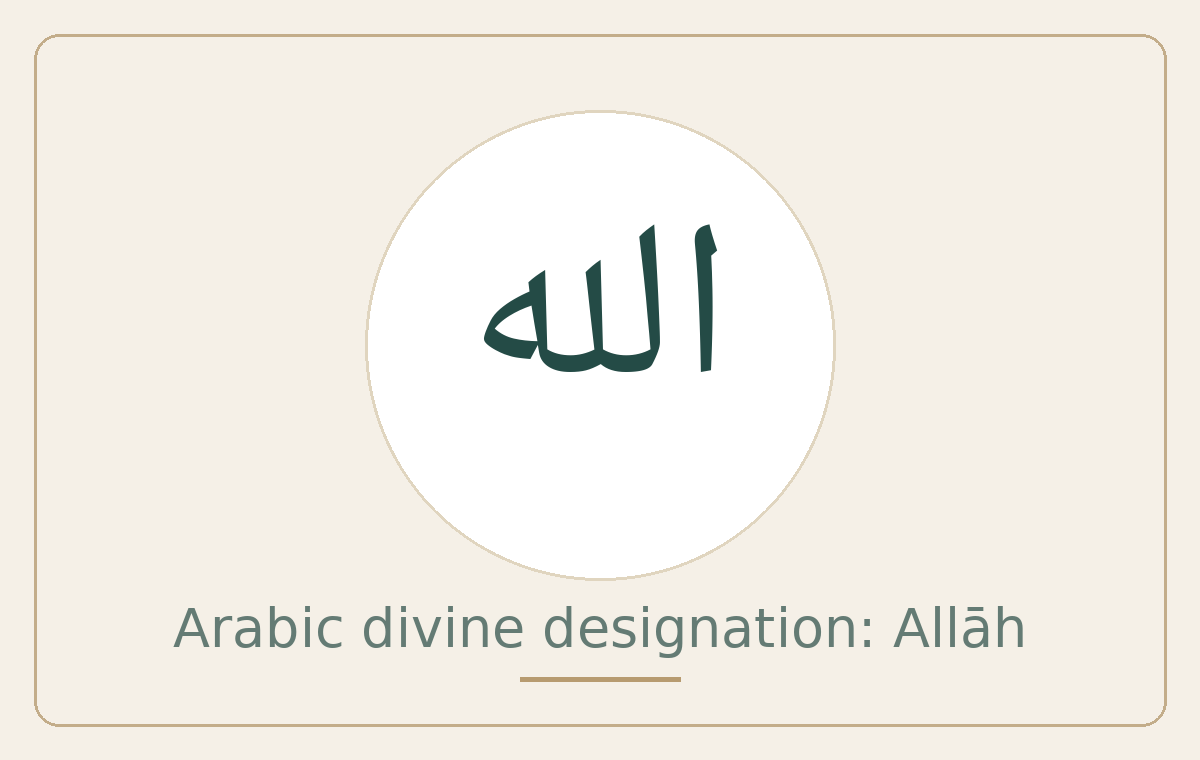
Allāh is an Arabic designation of God with a pre-Islamic inscriptional history. The entry distinguishes etymology, early cultic evidence, Quranic monotheism and later uses among Arabic speakers of different faiths.
Estimated reading time: 7 min Published Last reviewed:
Share article
Text
Introduction
How did Allāh become the central Arabic designation of the one God, and what can actually be known about its uses before Islam? This article examines linguistic and inscriptional evidence, then the name's functions in the QuranThe QuranThe central scripture of Islam, consisting of 114 Arabic surahs; its study distinguishes Quranic discourse from manuscript history, reading traditions, and historical inference.Glossary · Click to read the explanation and in Arabic-speaking religious traditions. It distinguishes three questions that should not be conflated: a word's etymology, the identity of the deity invoked in a particular source, and the theology expressed by that source. [1] [2]
A name and its meanings in Arabic
Allāh is the Arabic designation of the one God in Islam; Arabic-speaking Christians and members of other religious communities also use it. Unlike ilāhArabic ilahʾIlāh: Arabic common noun for a god or deity, with the broken plural āliha; distinct from the specific designation Allāh and understood from context.Glossary · Click to read the explanation, a common nounCommon nounA noun referring to a member of a class, such as “city” or “god”, unlike a proper name designating a particular entity. Semitic il/El may fulfill either function in context.Glossary · Click to read the explanation that can be indefinite or plural, Allāh normally functions in Islamic usage as the particular designation of God. Its present religious function, however, does not explain the whole earlier history of the word. In other settings a form can serve as a proper divine name or identify “the god” understood within a given context, while conceptions of that deity differ by community. [3]
The question, therefore, is not merely whether Allāh is “ancient” or “Islamic”. The name is attested before Islam, while the QuranThe QuranThe central scripture of Islam, consisting of 114 Arabic surahs; its study distinguishes Quranic discourse from manuscript history, reading traditions, and historical inference.Glossary · Click to read the explanation gives it its distinctive theological role in a discourse on oneness, creation and judgment. The historical question concerns who used the name, where, and in what kind of prayer or dedication.
Etymology and Semitic connections
A widespread etymological explanation relates Allāh to al- plus ilāh, “the god”, involving sound changes that account for the doubled l. David Kiltz argues that an internal Arabic development can explain this form. That argument does not prove that every historical detail of pronunciation or dialect distribution has been directly documented. Comparison also links Arabic ilāh with HebrewHebrewA Northwest Semitic language of the Canaanite group, encompassing Iron Age epigraphy, Biblical, Rabbinic, medieval and Modern Hebrew; its scripts and pronunciations changed over time.Glossary · Click to read the explanation EloahEloahEloah (אֱלוֹהַּ) is a singular Hebrew noun meaning “a god” or “God,” common in Job but also used for other gods. It is not the proper name of a separate deity.Glossary · Click to read the explanation and SyriacSyriacAn Aramaic literary language rooted in Edessa, first attested in non-Christian inscriptions and later prominent in Christian writing, scholarship, translation and liturgy.Glossary · Click to read the explanation AlāhāAlahaAlāhā (ܐܠܗܐ): a Syriac masculine singular common noun for “a god” or “God,” with Eastern and Western pronunciations; linguistic kinship does not itself establish shared doctrines.Glossary · Click to read the explanation, which belong to a wider Semitic lexical family; resemblance alone cannot establish a particular direction of borrowing. [4]
The Comprehensive Aramaic Lexicon likewise records a related Aramaic noun referring, according to its context, to the God of Israel or to other gods. The shared sounds therefore establish neither a unique object of worship nor an automatic borrowing pathway. Nor should two historically distinct terms be equated merely because both are translated as “God” in English or Dieu in French. [5]
Early inscriptions: a name is not a complete creed
Kiltz discusses a Qaryat al-Fāw inscription, often tentatively dated to the first centuries CE, whose individual readings require caution. It places a tomb under the protection of several deities; a form plausibly read as Allāh appears alongside Kahl and ʿAthtarAthtarDeity who tries Baal’s throne in a Ugaritic myth and descends; the name Athtar also occurs in ancient South Arabian inscriptions and local cults. The text does not describe a revolt against El.Glossary · Click to read the explanation al-Shāriq. Another inscription from the same milieu contains a spelling with a clearer initial letter. The evidence matters because it situates the designation outside later Islamic monotheismMonotheismBelief that only one God possesses divinity in its fullest sense. Historically distinct from exclusively worshipping one deity without denying others; its theological forms vary.Glossary · Click to read the explanation. It does not justify treating each phonetic reconstruction as certain or generalizing about the beliefs of all Arabian inhabitants. [6]
Theophoric personal names, including forms comparable to “Wahb Allāh”, also carry divine elements. Yet a personal name can preserve inherited family usage without revealing its bearer's religious practice or the degree of personal commitment involved. The occurrence of a divine name in one funerary text does not disclose the god's position everywhere.
Safaitic testimony and recent scholarship
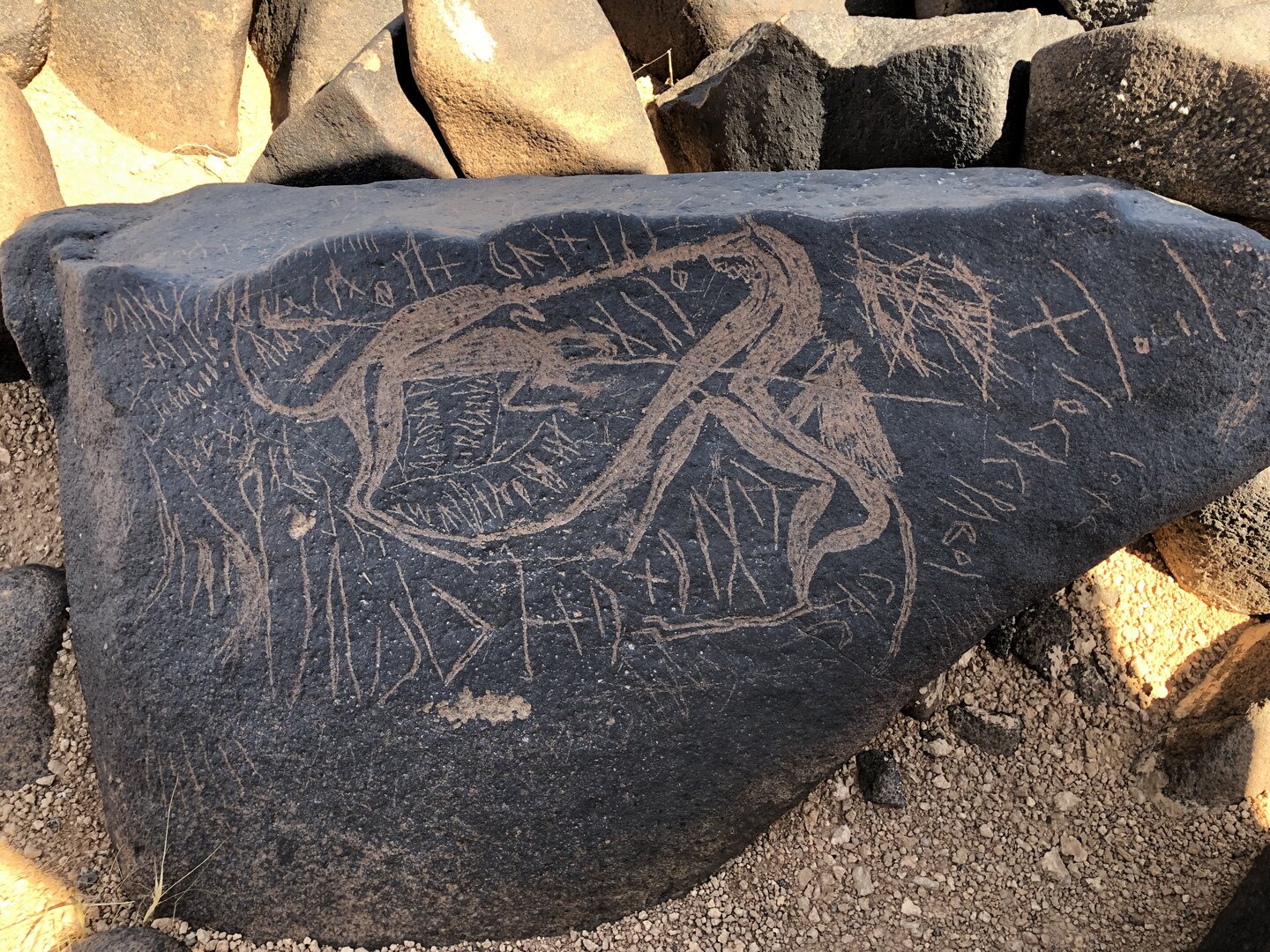
In 2025, Ahmad Al-Jallad reported a group of Safaitic inscriptionsSafaiticAn Ancient North Arabian consonantal script used for rock inscriptions recording names, kinship, pastoral movement and prayers in the pre-Islamic deserts of Syria, Jordan and northern Arabia.Glossary · Click to read the explanation associated with a newly identified mortuary site, MH09, in the northeastern Jordanian Ḥarrah. According to the article's abstract, one inscription supports a reconstruction of Allāh as a creator who gives light and is invoked against death, envisaged as darkness, among communities east of Ḥawrān roughly two thousand years ago. This is the scholar's interpretation of a specific inscription. The present review consulted the abstract, not the full edition, and does not reproduce an unverified transcription or translation of the original text.
Such evidence makes the ancient deity's attributes a concrete subject of research. It does not permit Safaitic, Nabataean and South Arabian evidence to be collapsed into one invariant religion, or require every mention of Allāh to imply precisely the same attributes.
From multiple cults to late antique invocations
An open-access study published by Al-Jallad and Hythem Sidky in 2026 compares older North Arabian inscriptions with sixth-century Paleo-Arabic writings. Older texts invoke several divine names, whereas the currently known late inscriptions concentrate on Allāh or al-ʾilāh, incorporating appeals for forgiveness and blessing and exhortations to piety. The change in public inscriptional vocabulary is significant. It does not prove that every individual's unrecorded practices and beliefs conformed to a single monotheistic system. [7]
The authors further note a contextual distinction within part of the corpus: inscriptions with explicit Christian features tend to use al-ʾilāh, while others use Allāh without an overt Christian marker. That describes a specific body of evidence, not an eternal language rule, nor proof that Arabic-speaking Christians never used Allāh in other places and periods. [8]
The Creator and intermediaries in the Quran
The Quran portrays its interlocutors in more than one way. Q 29:61 says that, when asked who created heaven and earth, they would answer “Allāh”. This attests to the Quran's representation of its opponents' acknowledgment of a creator; it is not an independent census of pre-Islamic Meccan beliefs. Q 39:3, meanwhile, attributes to people who take protectors besides God the explanation that they worship them to bring themselves nearer to Him. These passages distinguish recognition of a supreme deity from disputes over exclusive worship and intermediaries. [9] [10]
It is therefore sound to say that the name Allāh was known before Islam in the general epigraphic sense, but not that the Quran endorsed all earlier modes of mediation or all previously attributed divine characteristics. Identifying deities solely through a shared word requires stronger evidence.
Divine oneness and names in Islamic discourse
Q 112:1–4 affirms God's oneness and rejects likeness and divine descent; Q 2:163 also insists on the one God. These are theological statements of the Quran, not automatically descriptions of communities that left inscriptions centuries earlier. A history of a transmitted name must thus be distinguished from a history of the doctrines formulated around it. [11]
Q 17:110 puts “Allāh” and “al-RaḥmānAl-RaḥmānQuranic divine designation co-referring with Allah.Glossary · Click to read the explanation” side by side as names of the God addressed in prayer. The Merciful One also has a pre-Islamic history in southern Arabia, including the designation RaḥmānānRaḥmānānA divine designation written rḥmnn in Late South Arabian inscriptions, especially in Ḥimyar (fourth–sixth centuries CE), used in Jewish and Christian contexts; its referent is not always unambiguous.Glossary · Click to read the explanation in ancient inscriptions. Functional resemblance does not erase differences of region, period or religious setting. [12] [13]
Allāh, ilāh and al-ʾilāh
The three expressions can coexist in Arabic material but need not operate in identical ways. Ilāh is a common noun; al-ʾilāh is its definite form and may designate the deity intended in context; Allāh became an established particular designation in widely familiar religious usage. The distinction matters when reading a personal name such as ʿAbd Allāh or an early Christian text with al-ʾilāh. A difference in form does not automatically imply a different referent, and identical vocabulary need not settle theological differences.
Kiltz connects Arabic developments with the history of contact with SyriacSyriacAn Aramaic literary language rooted in Edessa, first attested in non-Christian inscriptions and later prominent in Christian writing, scholarship, translation and liturgy.Glossary · Click to read the explanation, opposing a simplistic and certain one-way Syriac-to-Arabic borrowing. Cultural influence on the use of a word should be distinguished from the linguistic origin of its morphological shape. [14]
Allāh among Arabic-speaking Christians
Arabic-speaking Christians use Allāh in prayer, Arabic biblical texts and ordinary references to God; the word is not exclusive to Muslims. Q 29:46 addresses the People of the Book and says, “Our God and your God is one.” Neither the shared expression nor that passage removes differences between Jewish, Christian and Islamic conceptions of God. It does show why portraying Allāh as the name of an altogether different being merely because the speaker belongs to another faith is historically and linguistically misleading. [15]
An early Islamic inscription on coinage
The Metropolitan Museum of Art holds a gold dinar dated AH 79 / 698–699 CE, inventory number 99.35.2386. Its catalog describes an Arabic inscription of the profession of faith following the monetary reforms of the Umayyad caliph ʿAbd al-Malik. This is material evidence for the written expression of monotheism in early Islamic official media. It does not show how the name was originally written before Islam, or establish what every pre-Islamic inscription meant. [16]
What the evidence can and cannot settle
The long history of the word does not establish a straight, unchanged religious trajectory from an “ancient deity” to Quranic theology. Inscriptions tell us which names were invoked in surviving texts; the Quran presents a theological and polemical discourse; modern studies propose accounts of how ideas moved and divine names acquired new prominence. The 2026 study relates the concentration on one deity in late inscriptions to wider religious change, while emphasizing that inscriptional silence about other cults is not proof that all such practices had ceased. [7]
Allāh has a pre-Islamic linguistic and epigraphic history, but the theological significance the name has in Islam cannot be inferred from its spelling alone. Reading the evidence layer by layer is more reliable than arguing either that “the ancient word proves an unchanged doctrine” or that “the Quranic use means nobody knew the word earlier”.
References and notes (16)
- Ahmad Al-Jallad, “Ancient Allah: An Epigraphic Reconstruction,” Journal of Semitic Studies 70, no. 2 (2025), 693–748. Publisher abstract and article metadata only; neither the full article nor the MH09 inscription was read in full. Return to the text ↑
- Celene Ibrahim, Islam and Monotheism, Cambridge University Press, 2022. Publisher’s summary, contents and bibliographical metadata; neither the whole book nor a restricted chapter was read. Return to the text ↑
- David Kiltz, “The Relationship between Arabic Allāh and Syriac Allāhā,” Der Islam 88, no. 1 (2012), 33–50. Accessible article consulted selectively, especially pp. 33–39 and 43–47; its full bibliography was not independently read. Return to the text ↑
- Kiltz, “The Relationship between Arabic Allāh and Syriac Allāhā.” Sections on Semitic comparison and the Arabic phonological derivation, pp. 34–39; scholarly analysis, not a contemporary pronunciation record. Return to the text ↑
- Comprehensive Aramaic Lexicon (CAL), s.v. ˀlh / ˀlhˀ. Online dictionary entry, its definition and sample attestations for the God of Israel and other gods, accessed 18 October 2026. Return to the text ↑
- Kiltz, “The Relationship between Arabic Allāh and Syriac Allāhā.” Qaryat al-Fāw inscriptions and alternative readings, pp. 35–38; the author’s edition was consulted, not the stone itself. Return to the text ↑
- Ahmad Al-Jallad and Hythem Sidky, “Late Antique Allāh: Ancestral Arabian Religion and the Monotheistic Zeitgeist,” Arabian Archaeology and Epigraphy (2026). Open-access §§1–2 and §5 conclusion consulted, with sixth-century Paleo-Arabic examples; not all footnotes or bibliography read. Return to the text ↑
- Al-Jallad and Sidky, “Late Antique Allāh.” Section 2 and subsequent discussion of al-ʾilāh/Allāh, Christian inscriptions, and changing usage; a corpus-specific observation. Return to the text ↑
- Quran 29:61, with al-Ṭabarī’s commentary as displayed online. The verse and the displayed passage of al-Ṭabarī’s interpretation were read; not treated as an independent historical survey. Return to the text ↑
- Quran 39:3. Verse and immediate context read in the online display; mediation is described in the Quranic discourse. Return to the text ↑
- Quran 112:1–4 and 2:163. Both passages consulted in the online Quran; used for doctrinal expression, not projected onto older inscriptions. Return to the text ↑
- Quran 17:110. The verse was consulted: Allāh and al-Raḥmān in the context of divine names and prayer. Return to the text ↑
- Kiltz, “The Relationship between Arabic Allāh and Syriac Allāhā.” Section III and conclusion, pp. 45–47, on rabb, raḥmān and divine designations in Quranic usage. Return to the text ↑
- Kiltz, “The Relationship between Arabic Allāh and Syriac Allāhā.” Morphology and Arabic–Syriac contact, pp. 40–47; conclusion on the limits of borrowing hypotheses. Return to the text ↑
- Quran 29:46. Verse and its People-of-the-Book context read; modern Arabic Christian usage is not offered as a comprehensive historical census. Return to the text ↑
- The Metropolitan Museum of Art, gold dinar, AH 79 / 698–699 CE, accession 99.35.2386. Specific catalog record and museum commentary on inscription and coinage consulted; not evidence for pre-Islamic spellings. Return to the text ↑
Suggest a correction · Suggest a source for this record
Cite this record
IL Archive, «Allah», https://ilarchive.com/en/entities/allah
Continue reading