Entity · Concept
Eloah
A reference page linking a name, group, or concept to the materials that discuss it.
Eloah is a singular Hebrew noun for “god” or “God,” frequent in Job. Its referent depends on context; its relation to El and Elohim is linguistic, not a separate divine identity.
Estimated reading time: 6 min Published Last reviewed:
Share article

Text
Introduction
Eloah (אֱלוֹהַּ, ʾĕlōah) is a HebrewHebrewA Northwest Semitic language of the Canaanite group, encompassing Iron Age epigraphy, Biblical, Rabbinic, medieval and Modern Hebrew; its scripts and pronunciations changed over time.Glossary · Click to read the explanation word meaning “a god” or “God,” depending on its context. Its significance lies in the varied vocabulary for divinity in the Hebrew Bible, not in its being the proper nameProper nameA name that identifies a particular person, place, group, or entity in context, unlike a common noun denoting a class. Spelling alone may not settle the distinction.Glossary · Click to read the explanation of a separate deity. This entry examines its spelling and distribution, its uses in poetry and references to other peoples' gods, and its relationship to El, ElohimElohimA Hebrew word with plural morphology, used for “gods” or for a singular deity according to context.Glossary · Click to read the explanation, and cognate Semitic words.
A common noun, not a separate proper name
In biblical HebrewHebrewA Northwest Semitic language of the Canaanite group, encompassing Iron Age epigraphy, Biblical, Rabbinic, medieval and Modern Hebrew; its scripts and pronunciations changed over time.Glossary · Click to read the explanation, eloah is a masculine common nounCommon nounA noun referring to a member of a class, such as “city” or “god”, unlike a proper name designating a particular entity. Semitic il/El may fulfill either function in context.Glossary · Click to read the explanation, translated as “god” or “God” according to the passage. Where the God of Israel is in view, the context identifies the referent; the word does not itself function as an exclusive proper name. By contrast, YHWHYahwehThe proper name of Israel’s deity, written יהוה (YHWH), the Tetragrammaton. Its exact ancient pronunciation is not directly preserved; texts and inscriptions witness its history.Glossary · Click to read the explanation is treated as a divine proper name in the Hebrew text. Eloah can function as a more general designation. [1]
It is therefore essential to separate three questions: what grammatical word is used, whom it refers to in a particular sentence, and what the author says about that referent. Agreement on the first question does not settle the other two.
Writing, pronunciation, and manuscripts
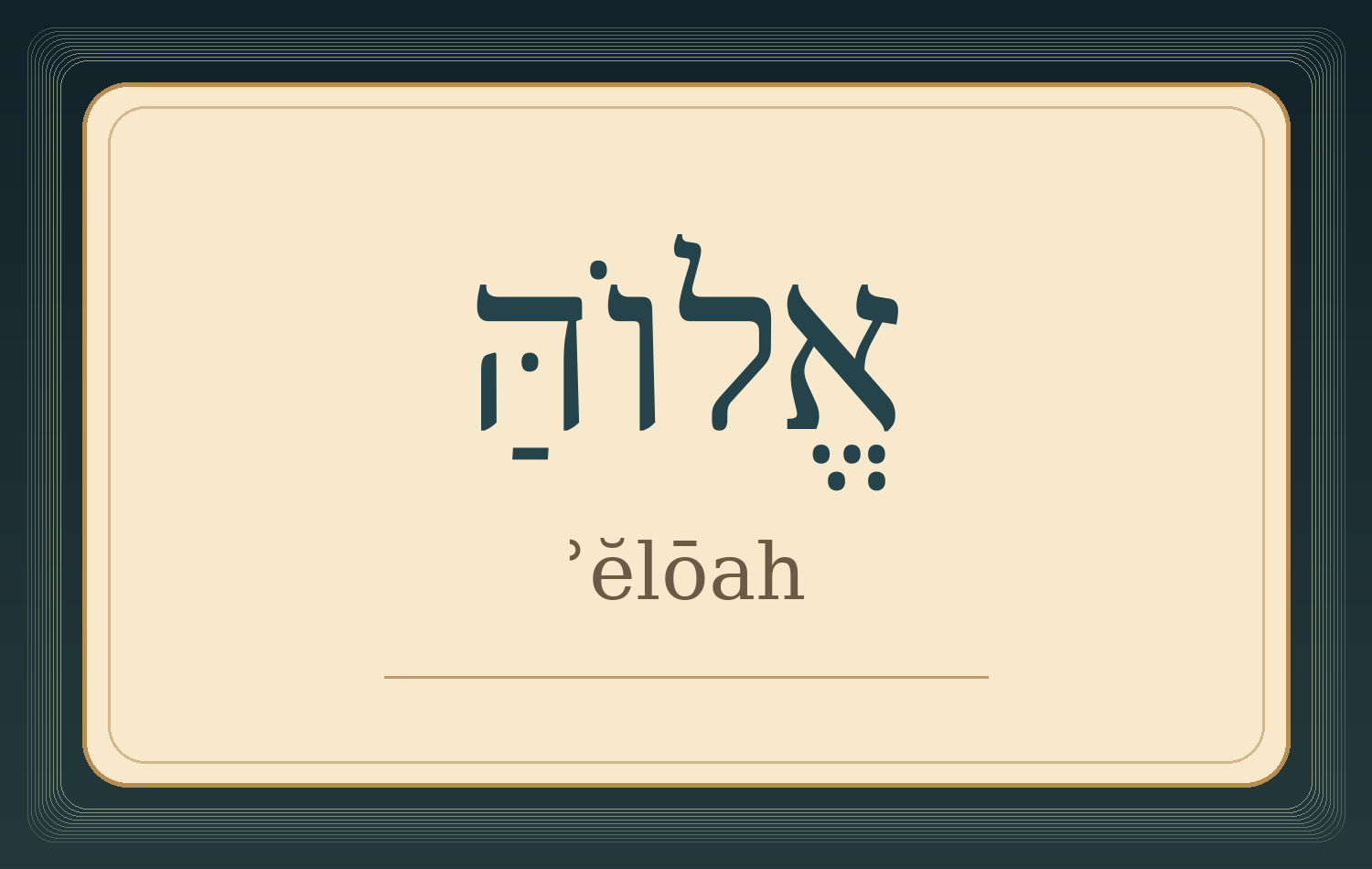
The pointed Hebrew form is אֱלוֹהַּ, conventionally transliterated ʾĕlōah. Without the Masoretic vowel points it is written אלוה. The vocalization transmitted by Masoretic manuscripts helps readers interpret the text; it does not mean that every earlier witness carried the same notation. The figure below displays the word in modern typography, not a facsimile of an ancient manuscript. [1] [2]
Its inflected forms and variant spellings require attention in a lexical search. Differences between the Romanized forms Eloah and Eloahh, or between the spellings used in other languages, do not by themselves indicate different divine beings. They reflect different conventions for representing a Hebrew word.
Distribution and the literary character of the evidence
A commonly used lexical concordance indexes approximately 57 occurrences in the Hebrew Bible, 41 of them in the Book of JobBook of JobHebrew wisdom text exploring suffering, justice and the limits of human knowledge through dialogue and poetry.Glossary · Click to read the explanation. Counts can vary slightly according to which forms or textual witnesses an index groups together. Most instances occur in poetry or elevated discourse, although the word also appears in later biblical writing. A poetic register does not, by itself, establish an early date for the composition of a passage. [1]
The concentration in Job should not be treated as a recording of the exact language spoken by a recoverable historical Job. It is first of all a feature of the Hebrew literary text that survives, including its dialogues and speeches.
Job: lament, argument, and divine speech
In Job 3:4, JobJobCentral figure of the Book of Job, introduced as upright and subjected to suffering after a heavenly discussion of his fidelity.Glossary · Click to read the explanation wishes that the day of his birth might escape the attention of eloah above. The noun belongs to a poetic complaint addressed to divine power; it does not introduce a second god distinct from the deity involved in Job's ordeal. [3]
In Job 5:17, EliphazEliphaz the Temanite in JobEliphaz the Temanite is one of Job’s three friends in the Hebrew book.Glossary · Click to read the explanation describes a person corrected by eloah and immediately invokes Shaddai (“the Almighty”) in the parallel line. Job 6:4 likewise places “the arrows of Shaddai” alongside the terrors of eloah. Such parallelism shows poetic variation in designations, not evidence that the writer has divided the divine agent into two characters. [4] [5]
The word also occurs in Job 39:17, in a remark about the wisdom denied to a bird, within the divine discourse near the end of the book. It is thus inaccurate to say that eloah appears only in speeches by Job and his human companions. [6]
Deuteronomy's song: affirming and denying divinity
In the song of DeuteronomyBook of DeuteronomyTorah book presenting commandments in Moses’ discourse and grounding Sabbath rest in slavery and liberation from Egypt.Glossary · Click to read the explanation 32:15, eloah designates the one who made Israel, as the poem rebukes the people's abandonment of that deity. Verse 17 contains the phrase loʾ eloah, “not a god” or “no god,” followed by a reference to gods they had not known. The juxtaposition shows that the noun can both designate a deity and be used in a polemical denial of divine status; it is not a fixed identity label with one referent in every sentence. [7]
The song directly documents the language of its own polemic. Reconstructing the practices of an ancient community from it requires further evidence; the verse is not an independent inventory of every god people actually worshipped.
Psalms and textual parallels
Psalm 18Book of PsalmsCollection of ancient Hebrew poems and prayers; Leviathan has different roles in Psalms 74 and 104.Glossary · Click to read the explanation:32 (Hebrew numbering) asks who is eloah except YHWH, and who is a rock except our God. The question explicitly sets the common designation beside the proper name. A parallel in 2 Samuel 22:32 has El where the psalm has eloah. Comparing these two textual settings reveals lexical flexibility within closely related traditions; it does not by itself demonstrate that one god historically replaced another. [8] [9]
Referring to other gods
In 2 Chronicles 32:15 an Assyrian king is made to argue that no eloah of any nation or kingdom could deliver its people from his power. Here the term is generic, embracing other peoples' gods within the rhetoric of the speaker. DanielBook of DanielA book combining court tales of wisdom and deliverance with visions of kingdoms and the future, formed in stages.Glossary · Click to read the explanation 11:37–38 similarly speaks of “any god” and a “god of fortresses.” The identification of the latter is an exegetical question, not something determined by the word's singular form. [10] [11]
Habakkuk 1:11 offers another example in its description of an aggressor's might and the god to which that might is attributed, or which becomes a god in the interpretation of the phrase. These passages rule out defining eloah as exclusively a name for Israel's God in every instance. [12]
A later devotional use
Nehemiah 9:17 calls the deity an eloah of forgiveness in a confession recalling the community's rebellion and divine mercy. This usage demonstrates that the term is not confined to Job or to archaic-looking poems. In this setting it functions as a descriptive expression in prayer, not as a new divine proper name. [13]
Eloah, Elohim, and El: language rather than arithmetic
Eloah belongs to a lexical family related to El, the Semitic word for a godSemitic ilAn ancient Semitic word meaning “god,” with cognates across several languages. It may function as a common noun or a proper name according to context; it is not always Ugaritic El.Glossary · Click to read the explanation, and ElohimElohimA Hebrew word with plural morphology, used for “gods” or for a singular deity according to context.Glossary · Click to read the explanation. Elohim has a morphologically plural ending, but it can govern a singular verb when referring to Israel's God: Genesis 1:1 employs singular “created.” Elsewhere it has a genuinely plural sense, “gods.” Neither grammatical form alone can establish how many beings a particular author means, still less provide a complete account of the author's theology. [14]
The classic Brown–Driver–Briggs lexicon suggested that Hebrew eloah may be a singular analogically formed from the already existing plural elohim. In a 2025 linguistic study, Benjamin D. Suchard offered a broader reconstruction of the history of the ʾilāh- stem and the development of Hebrew plural morphology. This is a scholarly argument, not an uncontested replacement for all older accounts. The attested lexical relationship must be distinguished from disputed reconstructions of its prehistoric derivation. [2]
Cognates do not establish religious identity
Related vocabulary includes AramaicAramaicNorthwest Semitic language varieties documented since the early first millennium BCE, including Old and Imperial Aramaic, Syriac, Jewish dialects, and living Neo-Aramaic forms.Glossary · Click to read the explanation ʾĕlāh, Syriac alāhāAlahaAlāhā (ܐܠܗܐ): a Syriac masculine singular common noun for “a god” or “God,” with Eastern and Western pronunciations; linguistic kinship does not itself establish shared doctrines.Glossary · Click to read the explanation, and Arabic ʾilāhArabic ilahʾIlāh: Arabic common noun for a god or deity, with the broken plural āliha; distinct from the specific designation Allāh and understood from context.Glossary · Click to read the explanation. The phonological and semantic correspondences are important evidence for the history of Semitic languages. They do not, on their own, prove that all the communities using these words conceived of the same historical divine personality, or that one attested word was directly borrowed from another. Language, date, speaker, and context still need separate examination. [2]
Likewise, the ordinary word El should not be equated automatically with the deity El of Ugaritic mythologyElEl is a senior deity in Late Bronze Age Ugaritic texts, portrayed as father of the divine family and a council authority, alongside his consort Athirat. This entry does not cover every linguistic use of El.Glossary · Click to read the explanation whenever related consonants appear. Identifying a particular god requires evidence of function and setting, not simply similar letters.
Translating and reading responsibly
Where eloah refers to the God of Israel, “God,” French Dieu, or Arabic «الله» can be appropriate functional translations. Where the text discusses one god among others, “a god,” French un dieu, or Arabic «إله» better preserves the generic sense. Translation into one familiar word can conceal the source's distinction between El, Eloah, and Elohim: arguments about the wording must check the Hebrew.
Historically, the term is valuable for comparing style, grammar, and usage across biblical textual layers. On its own it does not supply a simple evolutionary story about monotheismMonotheismBelief that only one God possesses divinity in its fullest sense. Historically distinct from exclusively worshipping one deity without denying others; its theological forms vary.Glossary · Click to read the explanation or documentary proof of a separate deity named Eloah.
References and notes (14)
- Francis Brown, S. R. Driver and C. A. Briggs, A Hebrew and English Lexicon of the Old Testament (1906), s.v. אֱלוֹהַּ, H433. Hebrew lemma H433, forms, semantic examples, occurrence count; historical lexicon consulted in full at the entry level. Return to the text ↑
- Benjamin D. Suchard, “Semitic *ʾilāh- and Hebrew אלהים: From plural ‘gods’ to singular ‘God’”, Journal for the Study of the Old Testament 49, no. 4 (2025). Introduction and sections on stem reconstruction, levelling and the singular; actual online sections examined, not every cited work or the full article. Return to the text ↑
- Hebrew Bible, Job 3:4, Hebrew text with parallel English translation, Mechon-Mamre. Job 3:3–5, especially the Hebrew noun in v. 4 and its speaker. Return to the text ↑
- Hebrew Bible, Job 5:8 and 5:17, Hebrew text with parallel English translation, Mechon-Mamre. Job 5:8 and 5:17–18, including Eliphaz’s parallel use of Eloah and Shaddai. Return to the text ↑
- Hebrew Bible, Job 6:4 and 6:8–9, Hebrew text with parallel English translation, Mechon-Mamre. Job 6:4,8–9, the image of arrows and terrors. Return to the text ↑
- Hebrew Bible, Job 39:17, Hebrew text with parallel English translation, Mechon-Mamre. Job 39:16–18, Eloah in the divine speech. Return to the text ↑
- Hebrew Bible, Deuteronomy 32:15–18, Hebrew text with parallel English translation, Mechon-Mamre. Deut 32:15–18; Eloah abandoned and the phrase “not a god.” Return to the text ↑
- Hebrew Bible, Psalm 18:32, Hebrew text with parallel English translation, Mechon-Mamre. Psalm 18:31–33, especially v. 32 in Hebrew numbering. Return to the text ↑
- Hebrew Bible, 2 Samuel 22:32, Westminster Leningrad and Aleppo Hebrew text displays, BibleHub. 2 Sam 22:32, comparison with the parallel wording in Psalm 18. Return to the text ↑
- Hebrew Bible, 2 Chronicles 32:14–16, Hebrew text with parallel English translation, Mechon-Mamre. 2 Chronicles 32:14–16, the general noun within the Assyrian king’s reported speech. Return to the text ↑
- Hebrew Bible, Daniel 11:36–39, Hebrew text with parallel English translation, Mechon-Mamre. Daniel 11:36–39, “any god” and “god of fortresses.” Return to the text ↑
- Hebrew Bible, Habakkuk 1:10–12, Hebrew text with parallel English translation, Mechon-Mamre. Habakkuk 1:10–12, especially the attribution of might to a god in v. 11. Return to the text ↑
- Hebrew Bible, Nehemiah 9:16–18, Hebrew text with parallel English translation, Mechon-Mamre. Nehemiah 9:16–18, “a forgiving Eloah” in communal confession. Return to the text ↑
- Hebrew Bible, Genesis 1:1, Hebrew text with parallel English translation, Mechon-Mamre. Genesis 1:1, singular verbal agreement with morphologically plural Elohim. Return to the text ↑
Suggest a correction · Suggest a source for this record
Cite this record
IL Archive, «Eloah», https://ilarchive.com/en/entities/eloah
Continue reading