Entity · Concept
Monotheism
A reference page linking a name, group, or concept to the materials that discuss it.
The oneness of God and exclusive worship are not identical claims. Ancient Egyptian and Israelite evidence, Jewish, Christian and Islamic traditions, and Iranian and Indian comparisons illuminate their history and interpretive limits.
Estimated reading time: 7 min Published Last reviewed:
Share article

Text
Introduction
Does monotheism mean that a community worships only one god, or that it believes no other god exists? This distinction opens the history of the idea. We examine religious statements from ancient Egypt, Israel, Judaism, Christianity and Islam, then compare cases from IranIranIran is the modern country containing Shush, ancient SusaGlossary · Click to read the explanation and India, without turning them into stages along one inevitable path.
The aim is to establish what texts and practices actually attest in their own settings, and what modern interpretation adds. A confession found in a book does not automatically describe everyone in a society; elevating one deity does not always mean denying the existence of others.
What does one God mean?
In the narrower sense used here, monotheism holds that divinity in its fullest sense belongs to only one God. Traditions may express this through creation, universal sovereignty and a unique claim to worship, but their philosophical and theological formulations differ. MonolatryMonolatry: Exclusive WorshipExclusive worship of one deity, without automatically denying the existence of others; a modern term for allegiance, not necessarily a dated religious stage.Glossary · Click to read the explanation, or exclusive worship, is devotion to one god without necessarily denying the existence of others. HenotheismHenotheismHenotheism is a scholarly term for privileging or exalting one deity without necessarily excluding other gods. Its boundaries with monolatry and monotheism are debated; Vedic, Ugaritic, Moabite and Hebrew evidence is examined without assuming a universal sequence.Glossary · Click to read the explanation emphasizes a preferred or supreme god in a setting where other gods are acknowledged. Scholars sometimes use these categories with overlapping boundaries; they need not denote successive stages of history. [1]
A useful distinction is between an injunction such as “worship no other god,” regulating allegiance, and the assertion “no other god exists,” which makes a claim about divine reality. A tradition may combine both claims, or many years may separate their explicit formulations. Celene Ibrahim's study shows how tawḥīd in Islamic discourse concerns both knowing God's oneness and responding through worship: it is not merely a count of divine beings. [2] [3]
One sentence cannot reveal an entire society's religion. We need to ask what kind of document survives, when it was composed and transmitted, who is speaking and to whom, and what inscriptions, practices and preserved objections can corroborate it. A text may prescribe an ideal that its author wishes to establish, while other evidence points to more varied practices.
Aten and Akhenaten: an experiment, not a universal template
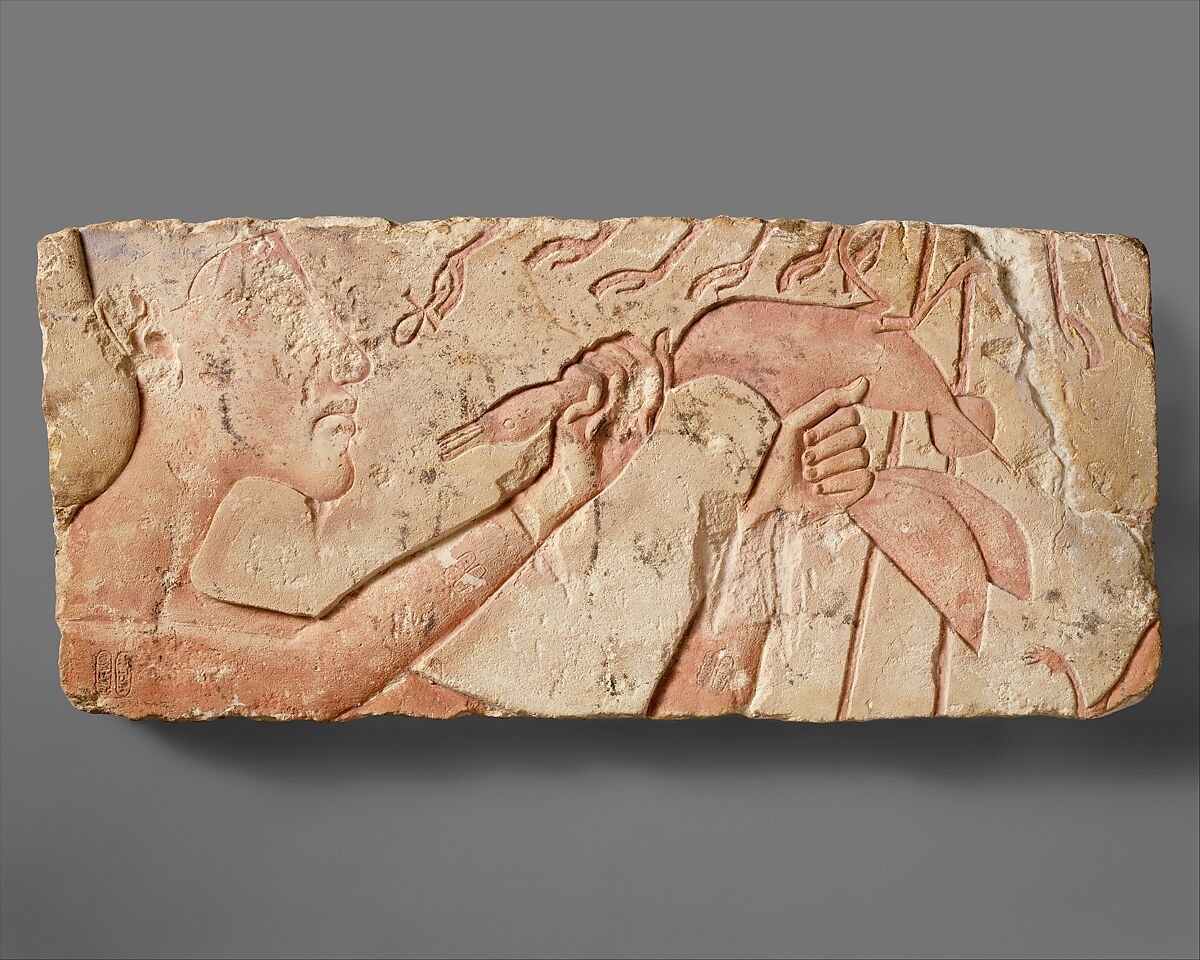
In fourteenth-century BCE Egypt, King AkhenatenAkhenatenEgyptian eighteenth-dynasty king, formerly Amenhotep IV, who reorganized royal religion around Aten and founded Akhetaten.Glossary · Click to read the explanation reorganized royal worship around AtenAten: The Solar Disk and Akhenaten’s CultAten is the solar disk and the divine power associated with its light in ancient Egypt. Akhenaten made Aten the exclusive focus of his official cult; Amarna reliefs show rays ending in hands, while household finds reveal other religious practices.Glossary · Click to read the explanation, represented by the sun disk and its rays. A limestone relief in the Metropolitan Museum of Art shows the king offering a bird in the context of Aten worship. The museum dates the object to approximately 1347–1330 BCE, probably originating at AmarnaAmarna / AkhetatenAmarna is the archaeological site of Akhetaten, Akhenaten’s fourteenth-century BCE capital in Middle Egypt, preserving royal boundary stelae, temples, houses and cemeteries.Glossary · Click to read the explanation. This is a witness to the representation of a royal rite, not a census of every Egyptian's beliefs. [4]
The Great Hymn to AtenGreat Hymn to AtenEgyptian hymn from Akhenaten’s fourteenth-century BCE reign, preserved in thirteen columns in Ay’s Amarna tomb. It praises Aten as life-giver and privileges royal knowledge; neither personal royal authorship nor Psalm 104’s dependence follows automatically.Glossary · Click to read the explanation, known from the tomb of Ay, celebrates Aten as the life-giving power of the world. The Met's account notes the king's privileged mediating role and places the reform against earlier Egyptian solar traditions. Here that hymn is known through the museum's discussion and a modern translation cited there, not through direct collation of the hieroglyphic original. [5]
According to the abstract of a chapter published by Oxford, James K. Hoffmeier argues that the erasure of other gods' names and changes in Aten's official imagery support calling the religion monotheistic. Whether that label best fits the royal theology—and how far it reflected ordinary people's worship—remains a question for research. Akhenaten cannot on this basis be called the founder of every later monotheism, nor can transmission to other traditions be assumed. [6]
Ancient Israel: exclusive allegiance and denial of other gods
Exodus 20:3 commands Israel to have no other gods before YahwehYahwehThe proper name of Israel’s deity, written יהוה (YHWH), the Tetragrammaton. Its exact ancient pronunciation is not directly preserved; texts and inscriptions witness its history.Glossary · Click to read the explanation within a covenantal address. It demands loyalty in worship; taken alone, it does not formulate a philosophical denial that every other god exists. The narrated time of MosesMosesCentral figure in Exodus, Torah traditions and the Qur’an; childhood accounts differ in detail.Glossary · Click to read the explanation must also be distinguished from the history of the surviving biblical wording. [7]
The Shema in the Book of DeuteronomyBook of DeuteronomyTorah book presenting commandments in Moses’ discourse and grounding Sabbath rest in slavery and liberation from Egypt.Glossary · Click to read the explanation 6:4–5 is exceptionally compressed in HebrewHebrewA Northwest Semitic language of the Canaanite group, encompassing Iron Age epigraphy, Biblical, Rabbinic, medieval and Modern Hebrew; its scripts and pronunciations changed over time.Glossary · Click to read the explanation. A recent Jewish translation takes it to mean that Yahweh alone is Israel's God, whereas a familiar rendering foregrounds Yahweh's oneness. This question of how “our God” and “one” relate matters. The verse later became a central declaration of Judaism, but its early wording and subsequent religious reception must be studied separately. [8]
In Second IsaiahSecond IsaiahScholarly label for Isaiah 40–55, associated substantially with exile and Cyrus; neither an identified biography nor proof of a single author or date.Glossary · Click to read the explanation, a scholarly designation for much of Isaiah 40–55, often associated with exile in BabylonBabylonBabylon is an ancient city in central present-day Iraq, south of BaghdadGlossary · Click to read the explanation and the sixth century BCE, Isaiah 45:5–7 explicitly denies another god and ascribes universal rule to Yahweh. Dating the broad setting does not establish the composition year of every sentence. Mark S. SmithMark S. SmithScholar of the Hebrew Bible and Ugaritic religion whose work examines the divine family and biblical monotheism.Glossary · Click to read the explanation places such discourse amid changing ideas of divinity and Israel's exclusive relationship to its deity, in conversation with evidence from UgaritUgaritAncient city and kingdom at Ras Shamra on the Syrian coast, flourishing between the fourteenth and early twelfth centuries BCE and preserving multilingual archives.Glossary · Click to read the explanation; he rejects treating monotheism as a necessary evolutionary stage in every religion. [9] [1]
The texts therefore do not yield a simple straight line from “many gods” to “one God.” Commands, polemics and statements about existence belong to different genres and settings. They attest what their writers said; reconstructing the lived worship of ancient IsraelitesAncient IsraelName attested for a population on the Merneptah Stele around 1208 BCE, later for the northern Iron Age kingdom and for broader textual and religious identities; the senses are not identical.Glossary · Click to read the explanation requires other evidence as well.
Jewish divine unity and the history of interpretation
The Shema became central to Jewish practice and religious self-expression; the centrality of divine oneness in a living tradition does not erase the interpretive questions raised by an ancient sentence. Some Jewish mystical writings, including Kabbalah, speak of multiple divine manifestations or attributes while affirming a single divine source. Philosophical analysis examines how practitioners reconcile apparent plurality and unity instead of assuming that every plural expression counts separate gods. [3]
Christianity: one God and the Trinity
In 1 Corinthians 8:4–6, a letter attributed to PaulPaul the ApostlePaul was a first-century CE Christian letter writer whose letters preserve early Christian formulations.Glossary · Click to read the explanation, the claim that God is one appears in a discussion of food offered to idols. The passage speaks of “one God, the Father” and “one Lord, Jesus Christ.” It is an early Christian witness to the language of divine unity amid many named gods and lords; it should not automatically be made to say everything expressed in theological vocabulary formulated centuries later. [10]
Later mainstream Christian teaching describes the TrinityTrinityChristian formulation of divine unity and Father/Son/Spirit distinction, with a history of debate.Glossary · Click to read the explanation as one God in three persons, not three gods. The Catholic Catechism explains one divine substance and the distinct relations of Father, Son and Holy SpiritHoly SpiritName present in Christian texts and worship, whose relation to Father and Son was defined in Trinitarian formulations.Glossary · Click to read the explanation. This reports how the tradition defines itself; it is not a historical proof of the doctrine's truth or a demand that other traditions accept its terms. Christian thinkers themselves have debated how real distinction and oneness are related. [11] [3]
Islam: oneness and the rejection of partners
The QuranThe QuranThe central scripture of Islam, consisting of 114 Arabic surahs; its study distinguishes Quranic discourse from manuscript history, reading traditions, and historical inference.Glossary · Click to read the explanation in 2:163 affirms one God besides whom there is no deity; surah 112:1–4 (al-Ikhlāṣ) elaborates singularity, the denial of begetting and being begotten, and the absence of any equal. These are explicit statements about belief and worship, not simply the preference of one god among several. Later commentators' wording should not be passed off as the Quran's own words. [12] [13]
In creedal and theological traditions, tawḥīd became a central category for God's oneness, attributes and sole right to worship; schools differ on how divine attributes and interpretation are understood. Ibrahim notes that the technical verbal noun tawḥīd itself does not occur in the Quran, even though its subject permeates the text. The language of scripture and the later history of a scholastic term are distinct layers. [2] [3]
Beyond the Abrahamic traditions: changing boundaries
In ZoroastrianZoroastrianism: Hymns, Rituals and the Changing TraditionA living Iranian religious tradition examined through Avestan hymns, Middle Persian writings and royal inscriptions, separating textual evidence, later interpretation and hypotheses of influence.Glossary · Click to read the explanation traditions, Ahura MazdaAhura MazdaWise Lord in Iranian traditions, associated with truth, goodness and creation; not a Persian name for Yahweh.Glossary · Click to read the explanation is described as creator and the sovereign source of good, in opposition to evil powers, across texts and periods that are not all alike. William W. Malandra describes ZarathustraZoroaster / ZarathustraFoundational figure associated with Zoroastrian tradition and the Old Avestan Gathas. His priestly role, teaching and relationship to the poems are subjects of research; his lifetime and biographical details remain disputed.Glossary · Click to read the explanation's elevation of this figure as approaching monotheism, while recognizing ethical dualism. It would therefore be misleading either to reduce Zoroastrianism to “two equal gods” or to place it automatically in the same conceptual box as Jewish or Islamic monotheism. Claims of direct influence on other religions require evidence of contact, not resemblance alone. [14]
The Shri Vaishnava school in India offers a further comparison. It identifies Vishnu or Brahman as the unsurpassed ultimate reality while explaining other divine figures within its own metaphysical framework. The Stanford Encyclopedia of Philosophy also explores the place of Lakshmi in that account. Whether we call such a system monotheistic depends on how “god,” “independence” and “manifestation” function within it; no single judgment should be projected onto all Indian religions. [15]
Philosophical arguments are not dates of religious origin
Philosophers have defended divine uniqueness by appealing, for instance, to cosmic order or the impossibility of two conflicting absolute wills. The Stanford Encyclopedia examines arguments about sovereignty, power and perfection, together with objections to their assumptions. A plausible philosophical argument does not establish archaeologically that a particular ancient society was monotheistic. [16]
Quran 21:22 likewise argues that multiple gods governing heaven and earth would bring both into disorder. This is a line of reasoning within a religious text. Its development in later theology belongs to the history of interpretation, rather than to the wording of the Quranic witness itself. [17]
Conclusion
“Monotheism” is most useful when we specify whether it refers to exclusive worship, the denial of other gods' existence, or a philosophical account of ultimate reality. The cases from Egypt, Israel, Christianity, Islam, Iran and India show varied ways of framing that question; each must be read in its own language, period and context. A single sequence linking them all, or the categorical identification of the “first monotheist,” remains a hypothesis demanding more evidence than these examples supply.
References and notes (17)
- Mark S. Smith, The Origins of Biblical Monotheism: Israel's Polytheistic Background and the Ugaritic Texts, Oxford University Press, 2001. Publisher abstract and contents of Parts I–III only; neither the full book nor an Ugaritic text was consulted here. Return to the text ↑
- Celene Ibrahim, Islam and Monotheism, Elements in Religion and Monotheism, Cambridge University Press, 2022. Read selected passages in the publisher’s ten-page PDF excerpt (printed pp. 1–10), especially pp. 1–3, 5–6 and 9–10; the remainder of the book was not read. Return to the text ↑
- William J. Wainwright, “Monotheism,” Stanford Encyclopedia of Philosophy, substantive revision 30 July 2018. Read introduction, section 1 and selected parts of section 7 on Judaism, Christianity and India, plus selected argument passages in §§2–6; no reading of works cited in the bibliography. Return to the text ↑
- The Metropolitan Museum of Art, “Akhenaten Sacrificing a Duck,” object 1985.328.2, Egypt, ca. 1347–1330 BCE. Read museum description, object identification, qualified provenance and Public Domain statement; the photograph itself could not be obtained and is not reproduced here. Return to the text ↑
- Marsha Hill, “Art, Architecture, and the City in the Reign of Amenhotep IV / Akhenaten,” Heilbrunn Timeline of Art History, The Met, 2014. Read opening discussion of Aten, the royal intermediary and the cited modern translation of the hymn (attributed there to William J. Murnane); no hieroglyphic collation. Return to the text ↑
- James K. Hoffmeier, “Is Atenism Monotheism?” chapter 7 in Akhenaten and the Origins of Monotheism, Oxford University Press, 2015, pp. 193–210. Publisher chapter abstract and page range only; the paywalled chapter was not read, and the argument is attributed at abstract level. Return to the text ↑
- Exodus 20:2–4, Hebrew text and Revised JPS (2023) translation on Sefaria. Read the short passage Exodus 20:2–4 in Hebrew and the supplied English translation; not the entire book. Return to the text ↑
- Deuteronomy 6:4–5, Hebrew Shema and Revised JPS (2023) compared with JPS (1917), Sefaria. Consulted verses 4–5 and two displayed translations; the alone/one distinction follows these translations, not a full philological study. Return to the text ↑
- Isaiah 45:5–7, Hebrew text and displayed Revised JPS translation on Sefaria; with the scholarly context of Isaiah 40–55. Consulted verses 5–7 as displayed in Sefaria search/text results; no complete critical edition of Isaiah was consulted. Return to the text ↑
- 1 Corinthians 8:4–6, New Revised Standard Version Updated Edition (2021), Bible Gateway. Read verses 4–6 in a modern English translation; no Greek collation or reproduction of the copyrighted translation. Return to the text ↑
- Catholic Church, Catechism of the Catholic Church, §§252–255, “The Father,” on the Trinity and divine substance. Read paragraphs 252–255 as a Christian doctrinal self-description, not an impartial survey of every church. Return to the text ↑
- Quran, al-Baqara 2:163, Arabic text on Quran.com. Read the Arabic verse 2:163 and its displayed English translation; no complete tafsir consulted. Return to the text ↑
- Quran, al-Ikhlas 112:1–4, Arabic text on Quran.com. Read the four Arabic verses and displayed English translation; commentary is not represented as Quranic wording. Return to the text ↑
- William W. Malandra, “Zoroastrianism I: Historical Review up to the Arab Conquest,” Encyclopaedia Iranica, 2005, updated 2015. Read introductory paragraphs on Zarathustra, the Gathas and dualism, plus Achaemenid context on the article page; the Avestan original was not collated. Return to the text ↑
- William J. Wainwright, “Monotheism,” Stanford Encyclopedia of Philosophy, §7.3, “The Shri Vaishnavas and Monotheism.” Read secondary philosophical entry §7.3; no direct reading of the school’s Sanskrit primary texts. Return to the text ↑
- William J. Wainwright, “Monotheism,” Stanford Encyclopedia of Philosophy, §§2–6, arguments for divine uniqueness and objections. Read selected passages of §§2–6 on simplicity, perfection, sovereignty, omnipotence, devotion and objections; not the original philosophical works cited. Return to the text ↑
- Quran, al-Anbiya 21:22, verse and translations on Quran.com / Quranic Arabic Corpus. Read verse 21:22 and parallel English translations; no direct reading of later kalam treatises on the argument. Return to the text ↑
Suggest a correction · Suggest a source for this record
Cite this record
IL Archive, «Monotheism», https://ilarchive.com/en/entities/monotheism
Continue reading