Entity · religious_doctrine
Trinity
A reference page linking a name, group, or concept to the materials that discuss it.
Christian formulation of divine unity and Father/Son/Spirit distinction, with a history of debate.
Text
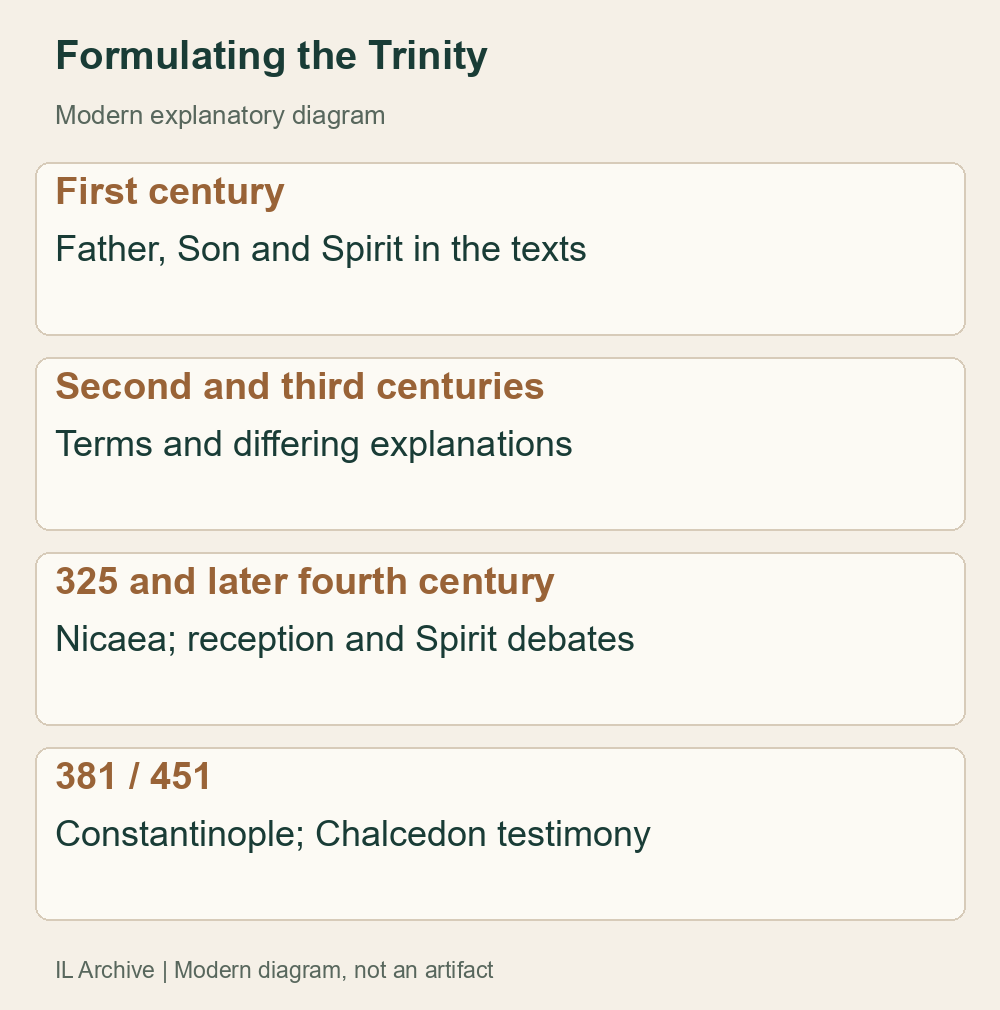
The technical formula has roots in earlier texts and worship, but does not occur verbatim in every detail in the New Testament. Later Nicene usage speaks of one essenceOusia — essenceGreek term for essence or nature, with meanings changing between authors.Glossary · Click to read the explanation and three hypostasesHypostasisTerm later used for distinguishing Father, Son and Spirit within one divinity.Glossary · Click to read the explanation, not three independent gods. [1][2]
The modern diagram dates witnesses, without depicting the divine being or judging the doctrine’s truth.
References and notes
- Keith Ward, Christ and the Cosmos (2015), ch. 6, “Three Centres of Consciousness?”, pp. 33–42. Publisher summary and metadata only: distinguishes New Testament language from three coequal persons in one substance. Not a full chapter reading or consensus on early Christianity. Return to the text ↑
- Basil of Caesarea, Letter 236.6, translated in NPNF 8. Distinguishes general ousia from particular hypostasis, one divinity with Father/Son/Spirit properties. Section 6 only read. Return to the text ↑
Research history
Substantive changes are retained here. Minor copy edits remain in the internal operational log.
-
Substantive record update
Suggest a correction · Suggest a source for this record
Cite this record
IL Archive, «Trinity», Edition 2, https://ilarchive.com/en/entities/trinity