Study
Akhenaten and Aten
An extended study of a topic, with evidence and references.
Solar disk, Amarna, Amun erasures and the Great Hymn: assessing Akhenaten’s exclusive theology without equating it with every Egyptian’s religion or assuming transmission to Moses.
Share article
Text
A king remakes the religious world
In fourteenth-century BCE Egypt, AkhenatenAkhenatenEgyptian eighteenth-dynasty king, formerly Amenhotep IV, who reorganized royal religion around Aten and founded Akhetaten.Glossary · Click to read the explanation attempted to reshape a religious world long inhabited by many gods. He made AtenAtenSolar divine power central to Akhenaten’s program, depicted by disk and rays, with a history predating the king.Glossary · Click to read the explanation central to royal worship, changed his name, founded a capital and attacked AmunAmunEgyptian god associated with Thebes, a major target of Atenist erasure whose cult later regained royal support.Glossary · Click to read the explanation on monuments. Art, temples and the royal family’s position changed with this program. [1][2]
He consequently became famous as the “first monotheist.” Historical inquiry needs more than that label. Did Aten monopolize official worship, or did royal theology also deny other gods’ existence? Did ordinary Egyptians share the court’s outlook? These related questions require different kinds of evidence.
Amenhotep IV before the transformation
The eighteenth-dynasty king was the son of Amenhotep III and Queen Tiye. One common chronology places his reign around 1351–1334 BCE, while other studies differ by several years. Year 17 is the highest attested regnal year; disagreement over absolute dates does not undermine the historical existence of his experiment. [1]
His initial name, Amenhotep, referred to Amun’s satisfaction. He began within Egyptian kingship, rather than proclaiming a fully developed abolition of every god upon accession. His religious changes must be followed through the reign, without projecting their final form onto its beginning. [2]
Aten was not invented from nothing
The Egyptian word conventionally rendered Aten referred to the solar disk. Solar worship was ancient, and attention to the disk increased during the eighteenth dynasty, including under Amenhotep III. The son’s experiment drew on this background; sunlight did not first enter Egyptian religion with him. [2]
The innovation concerned religious legitimacy. Something familiar within a plural world became the center of a royal program restricting other deities. The age of a word or symbol differs from the creation of a system that gives it exclusive authority. Continuity in the former does not erase change in the latter.
The divine name changed during the reign
The early didactic name of Aten retained connections to Re-Harakhty and Shu. A later version removed divine names present in the earlier formula. Hoffmeier uses this change, together with erasures and imagery, to argue for monotheismMonotheismBelief in a single God as the only deity, rather than merely the highest among several gods.Glossary · Click to read the explanation in the mature phase. [9]
The date of the final revision remains debated, so no single year is treated as consensus. Official theology developed during the reign, moving from solar language with traditional connections toward greater exclusivity. Texts produced under Akhenaten do not necessarily represent the same stage. [2]
A new name and a new project
Around regnal years 5–6, the name Akhenaten became part of the new program. It is commonly understood as “effective/beneficial for Aten.” The king’s official identity now foregrounded Aten, replacing a name that had included Amun. [1][4]
Chronological details require care. Reference pages place the name change in year 5 or 6, whereas boundary inscriptions date the initial foundation proclamation to year 5. The transformation can be situated in this period without making renaming, proclamation and relocation a single event on a known day. [3]
Akhetaten: a claim inscribed in the landscape
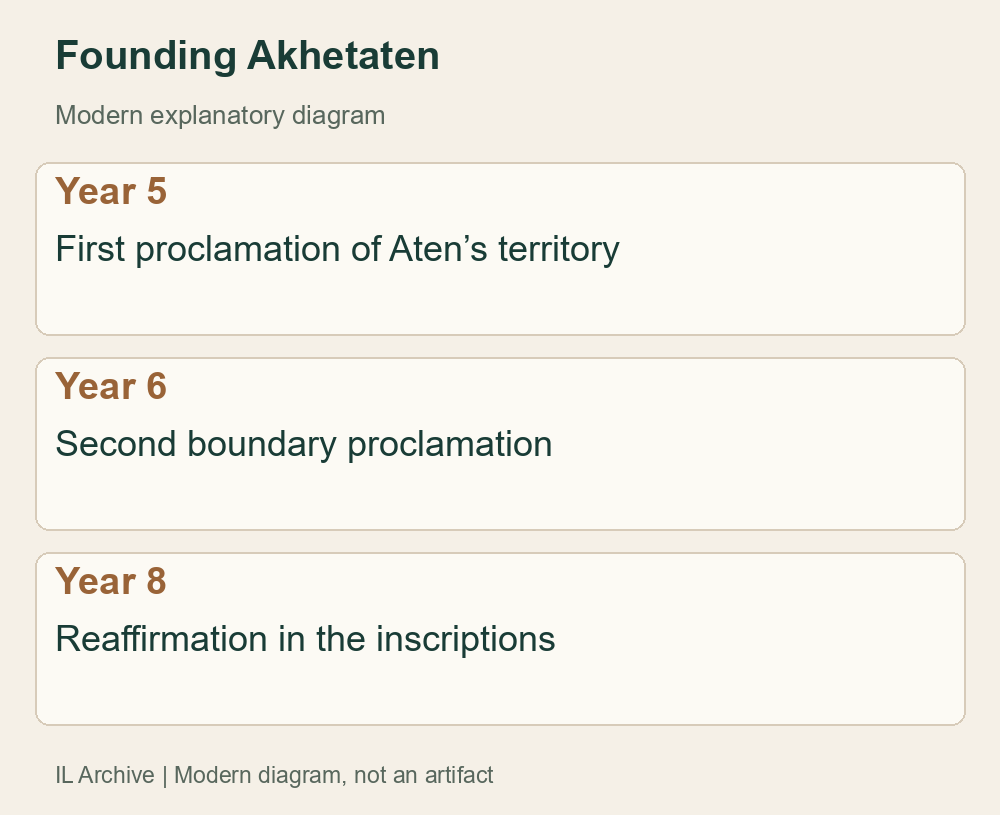
The king founded Akhetaten, modern AmarnaAmarna / AkhetatenSite of Akhenaten’s capital in Middle Egypt; boundary stelae record successive proclamations and reaffirmation.Glossary · Click to read the explanation, in Middle Egypt. Its name means “Horizon of Aten.” Boundary stelae preserve a first proclamation in year 5, another in year 6 and reaffirmation in year 8. They directly document a sacred royal territory and how the king presented its selection. [3]
The royal account says the land belonged to no earlier god, goddess or ruler, and that Aten directed the choice. It documents a claim, without independently establishing revelation. The city spatially distinguished his project from older centers, while remaining a place inhabited by people rather than theology alone.
Why leave Thebes?
A familiar political explanation connects the project with distancing the court from Amun’s powerful Theban institutions. Resources and authority may be part of the story, but evidence does not reduce theology to an economic maneuver. Changes in texts, images and ritualRitualAn organised or distinguished practice meaningful to a community; it may leave traces, but its form alone does not reveal an associated doctrine.Glossary · Click to read the explanation also demand explanation. [2][9]
Religion and politics should remain in view together, without claiming direct access to the king’s mind. Personal conviction, kingship and institutional competition are possible motives, rather than a surviving confession. His actions are more accessible to us than a single underlying intention.
Disk, rays and hands
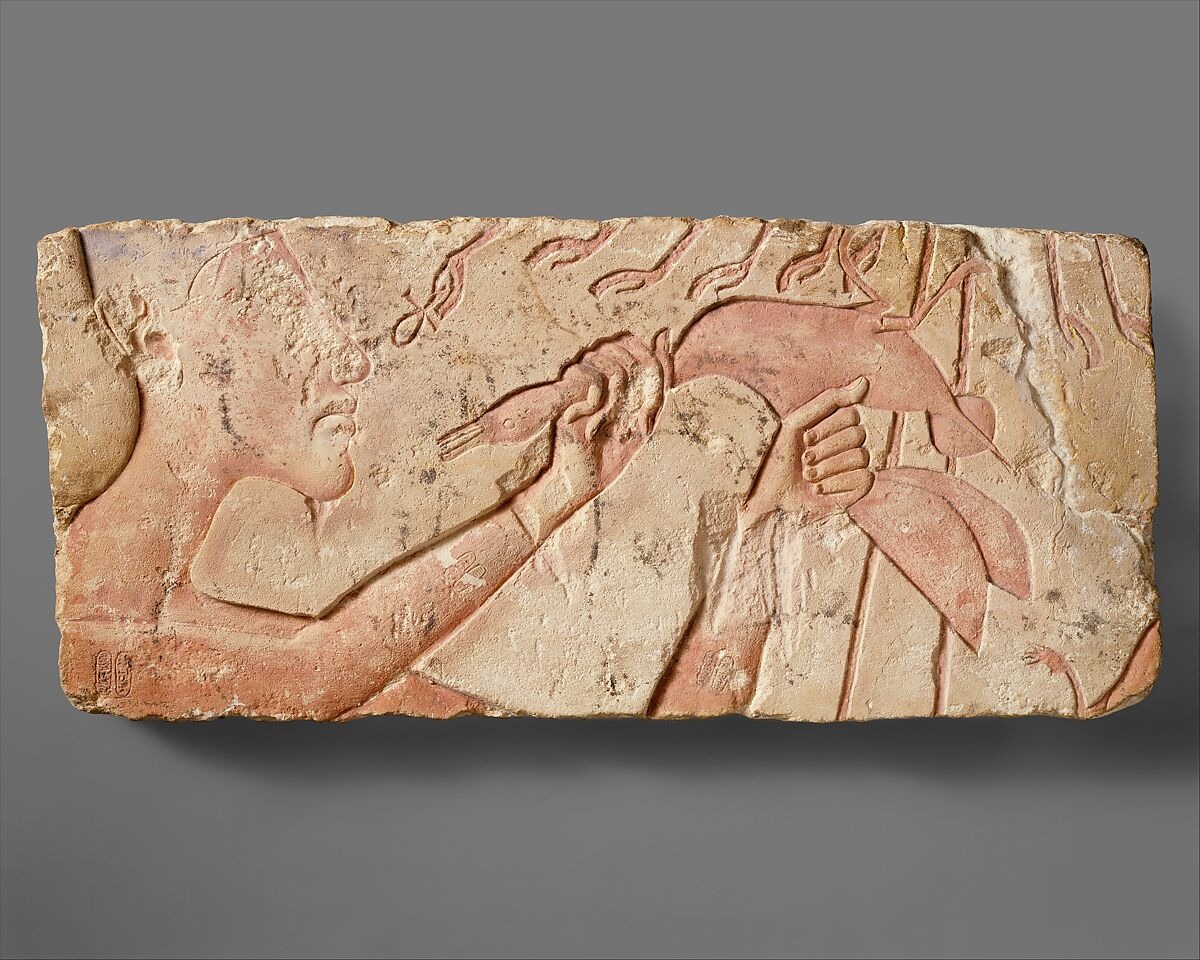
Mature Aten imagery uses a disk with rays ending in hands, some extending the life sign to royalty. In the relief illustrated here Akhenaten offers a duck; surviving rays and hands appear, while the complete scene and entire solar disk are not preserved. This is an actual artifact photograph. [13]
The image differs from familiar human or animal divine bodies, but it does not abolish imagery. Hands remain, royalty is portrayed and worship uses pictures. Departure from conventional divine form cannot be equated with banning art or every form of anthropomorphismAnthropomorphismRepresenting a thing or being with human features, such as arms, hands and dress. The term describes a form, without establishing an ordinary human or divine identity.Glossary · Click to read the explanation. The mode of depicting divine power changed. [5]
A temple open to light
Aten temples differ from the familiar image of a dark sanctuary containing a cult statue. At Amarna, open courts and offering tables are prominent, allowing light into ritual space. Great Temple remains establish the significance of spaces and offerings, while architectural reconstruction remains a research question. [15]
No invented wall heights or complete plan are needed to understand the principle: something visible in the sky reorganized temple space. Architectural openness, however, does not demonstrate equal religious access for everyone. Seeing sunlight differs from possessing standing within official worship.
The king between Aten and humanity
Images center on the king and his family receiving life from Aten. Akhenaten was not simply a worshipper with the same standing as everyone else. Court language emphasizes his special knowledge of the god; kingship had a central role in interpreting Aten and presenting him to people. [2][5]
The sun was visible to everyone, yet religious knowledge and mediationIntercessionMediation subject in the cited Quranic texts to permission and approval, not divine independence.Glossary · Click to read the explanation centered on royalty. “One god” does not fully explain this system. We must also ask who could represent the deity, and how that relationship organized authority.
Amun: a target visible in stone
Material evidence records the erasure of Amun’s names and images across Egypt and Nubia. This is not merely an inference from silence: damage itself is evidence. It differs from reconstructing personal belief or royal intention from a poem. [1][6]
Erasures alone do not explain the entire theology. Removing a god’s name could express rejection of worship, legitimacy or existence; context must distinguish these readings. The physical action is better established than the philosophical wording every participant might have used to explain it.
Uneven erasures and disputed timing
Laura Taronas’s lecture abstract describes a catalogue from 37 sites, alongside objects in collections. Amun and his composite forms dominate erasure targets in this corpus, while expressions of divine plurality receive less attention. This is not a census of every Egyptian monument or proof that other gods were never affected. [6]
The abstract proposes activity beginning between years 5 and 9, before the final didactic-name revision. The campaign therefore cannot simply be dated to the late reign, nor can its uneven reach become a claim that every deity was comprehensively and equally eliminated.
Temples and the Restoration Stela
The Restoration Stela under TutankhamunTutankhamunEighteenth-dynasty king, formerly Tutankhaten, associated with renewed royal support for traditional cults.Glossary · Click to read the explanation presents a royal return to tradition and claims that ruined temples were restored. The Karnak catalogue describes this account, offerings to Amun-Re and Mut, and Horemheb’s subsequent appropriation of the monument. [7]
The document matters, but also glorifies a restorer. It supports institutional disruption and recovery without becoming a neutral report on every temple and household. A change in state support and ritual is better established than a universal end to traditional worship among Egyptians.
The hymn that gave the experiment a voice
The Great Hymn to AtenGreat Hymn to AtenPraise text preserved in Ay’s Amarna tomb, depicting the world’s life, Aten and the king’s special knowledge.Glossary · Click to read the explanation survives in Ay’s tomb at Amarna, in thirteen columns of writing. It belongs to a court setting, without proving that Akhenaten personally inscribed the copy or that it summarizes every resident’s belief. [4]
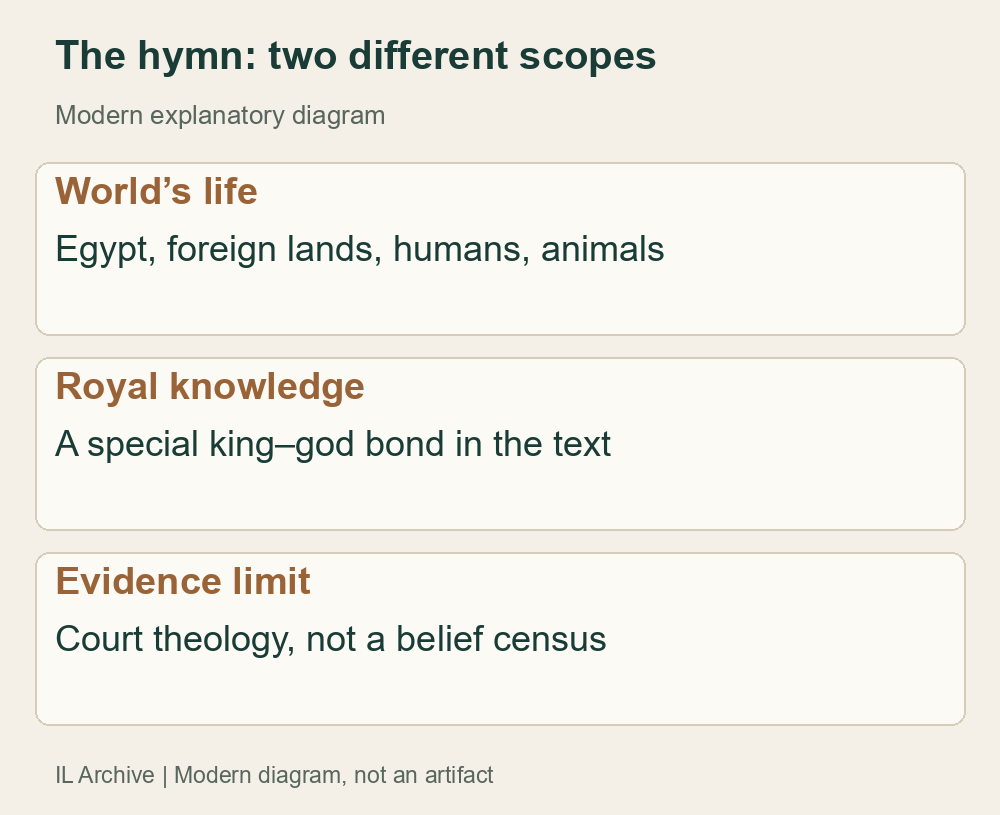
It offers a window into the theology the regime presented. Content must be read alongside setting and audience: divine praise in a royal official’s tomb, rather than a survey of Egyptian faith. It articulates an extensive official vision while leaving other social voices largely unheard.
Life beyond Egypt
The hymn encompasses humans, animals, birth and growth, Egypt and foreign lands such as Khar and Kush. It notices differences in speech and appearance, and a world dependent on Aten’s life-giving power. The god cannot adequately be described as concerned only with a small Egyptian territory. [4][10]
Universal creation does not automatically mean identical worship among nations or a declaration of modern political equality. The reach of divine power in the text differs from the society and institution carrying it. A creator sustaining the world can remain ritually centered on one royal family.
One-god language and its limits
The hymn uses emphatically exclusive language, presenting Aten as a unique source of life. Hoffmeier reads this language together with the rejection of other gods as evidence of mature monotheism, beyond merely elevating one deity over others. [9][10]
The force of that language should neither be diluted nor made to answer every question. Textual exclusivity, ritual implementation and popular acceptance are distinct issues. Scholars can agree about an expression or image while disagreeing about the religious classification that best explains it.
Three claims to distinguish
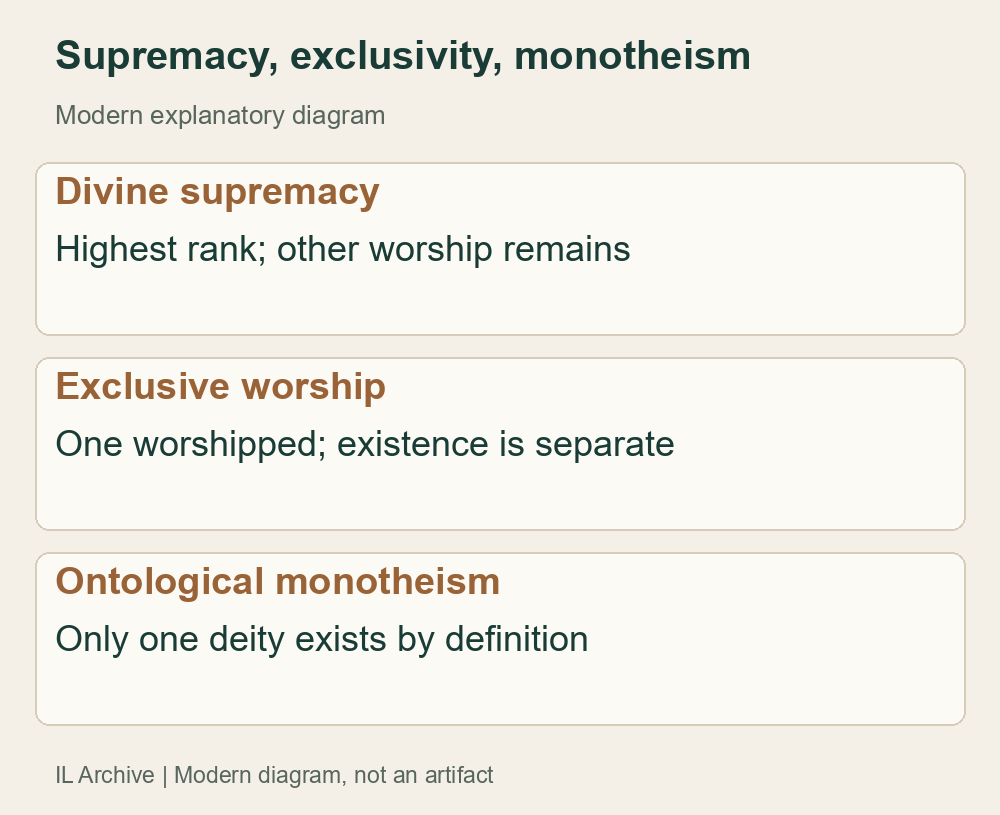
A religion may rank one god above others while retaining their worship. It may restrict worship to one without expressly denying others’ existence: monolatryMonolatryWorship of one deity without necessarily denying others; variable analytical term, not one uniform doctrine of all Israelites.Glossary · Click to read the explanation. It may also assert that only one deity exists: a specific meaning of monotheismMonotheismBelief in a single God as the only deity, rather than merely the highest among several gods.Glossary · Click to read the explanation. [9]
These are modern comparative tools, not labels Akhenaten used. They are not an inevitable three-stage ladder for every society. Their value is to prevent confusion between supremacy, exclusive worship and denial of other gods, allowing each claim to be assessed through texts and practice.
Did texts deny other gods’ existence?
It is inaccurate simply to say that the texts contain no denial. In her Amarna study, Jacquelyn Williamson reports a Karnak declaration understood as saying that other deities had “ceased,” except Aten. It belongs in the debate, although it is reported here through her reading rather than independent inspection of the Egyptian inscription. [8]
Hoffmeier explicitly argues for monotheism. Williamson cautions against applying the label to society’s religion, particularly given surviving household practices. The strength of court denial must be distinguished from its social success. The latter does not alone settle what the king believed. [9]
Households did not simply mirror the court
Williamson notes continuing domestic devotion to Bes and Taweret at Amarna, and the difficulty of demonstrating widespread Atenist adoption beyond royalty and the inner court. This prevents treating an official city as a population with an entirely uniform creed. [8]
The choice is not between universal monotheism and no change at all. Institutions and public imagery may change while some family rituals persist. Nor does one household symbol reveal every resident’s complete theology. Evidence establishes diversity, without supplying a comprehensive census of belief.
One deity, a family of mediators
Royalty was central to the sacred structure itself. King and queen appear in worship images, while domestic altars demonstrate the importance of their portrayal in relation to Aten. Counting deities cannot explain Atenism while ignoring the king’s position. [5]
This does not make every royal an independent god equal to Aten, or automatically disprove every definition of monotheism. It means a system centered on royal mediation needs specific description. “Exclusive royal worship” illuminates the institution; “monotheism” addresses claims about divinity. The descriptions can overlap.
After year seventeen
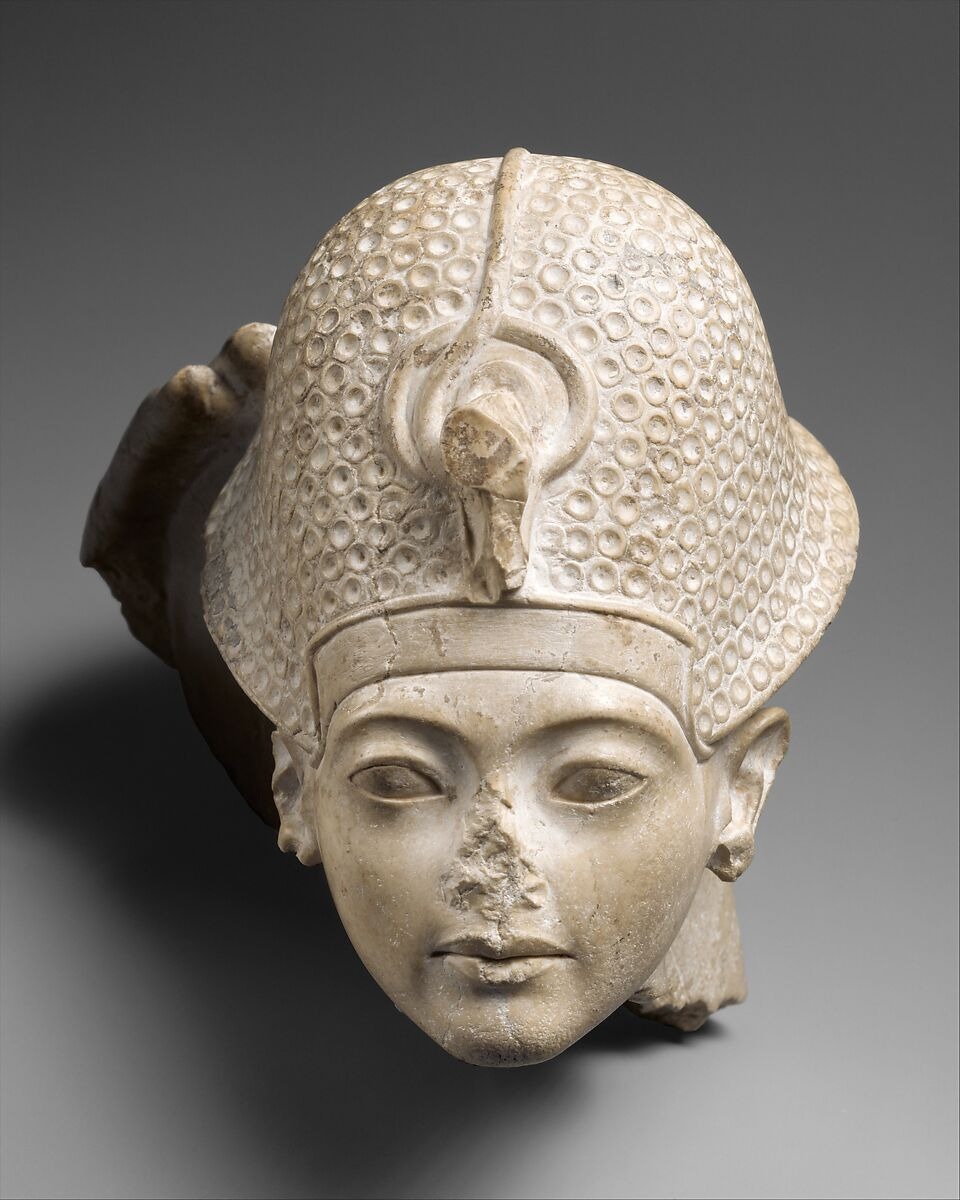
Akhenaten’s succession was complex; brief reigns and disputed identities should not be compressed into a settled simple sequence. Renewed royal support for traditional cults under Tutankhamun is clearer. Formerly Tutankhaten, he adopted a name containing Amun. [2][14]
The photograph shows his head and remnants of Amun’s hand on the crown, from an original statue group. It does not show the complete deity, but appropriately illustrates renewed king–Amun relations. Renaming, restoration and dismantling were related developments, rather than one action the day after Akhenaten’s death. [7][15]
The collapse does not explain itself
Amarna’s stone architecture was dismantled and reused after the Atenist period, while the Restoration Stela articulates a return to the earlier order. This reversal is documented. Assigning it one cause, such as popular hostility or priestly power alone, goes beyond the evidence. [7][15]
Dependence on the king plausibly made the system vulnerable when power changed; surviving traditions also offered continuity. Plausibility is not proof of one exclusive cause. Institutional reversal does not establish the day on which Egypt’s last prayer to Aten disappeared.
Can we declare a historical “first”?
Akhenaten offers one of the clearest early documented state experiments restricting legitimate worship to a single divine power. This conveys his significance without declaring the first human ever to believe in one god. Written evidence does not cover all human history. [9]
No older text does not prove no older idea, just as missing evidence does not license inventing unknown monotheists. A disciplined answer concerns what can be documented and compared. Classification of Atenism still depends on the definition of monotheism and the level of evidence being discussed.
Akhenaten and Moses: resemblance is not transmission
Egypt and one-god language have encouraged readers to connect Akhenaten and MosesMosesCentral figure in Exodus, Torah traditions and the Qur’an; childhood accounts differ in detail.Glossary · Click to read the explanation. Freud’s famous hypothesis about Moses and Atenism belongs to this modern reception history. It is not an ancient record of a meeting, instruction or a group carrying Atenism to Israel. [12]
Specific transmission requires a traceable sequence: chronology, intermediaries and independent texts or traditions connecting the parties. Assmann’s publisher-indexed public excerpt distinguishes memory from history and denies a direct causal link. An origin story must remain distinct from evidence establishing that origin.
The Aten hymn and Psalm 104
Descriptions of nature and life in the hymn and Psalm 104 have attracted comparison. Shared subject matter alone is insufficient. In the abstract of his concluding chapter, Hoffmeier finds no direct connection between the texts, despite defending Atenism as monotheism. [11]
One can therefore recognize strong exclusive theology without accepting that Akhenaten instructed Moses or that a psalm directly copied his hymn. Circulation of ideas and imagery is a broad possibility; a particular transmission route is a narrower claim requiring its own evidence. Resemblance does not supply it.
Aten and Yahweh are not identical models
Aten is closely tied to sunlight and royal mediation, whereas YahwehYahwehThe divine proper name written YHWH in the Hebrew Bible.Glossary · Click to read the explanation in Israelite tradition does not become the solar disk. Comparison should retain differences in institutions, texts and formulations of human–divine relationships. [4][11]
One-god discourse does not automatically establish religious ancestry. A sweeping assertion about every form of Judaism, Christianity and Islam is unnecessary for understanding Akhenaten. His experiment should first be situated in its setting, then compared through specific features with chronological and evidentiary differences intact.
Degrees of certainty belong in the answer
Official transformation is strongly documented: royal name, city, Aten imagery, attacks on Amun, hymn language and eventual restoration. An influential interpretation sees mature theology as radical exclusivity beyond preference, described by some scholars as monotheism. This is not consensus about every Egyptian’s creed. [1][3][6][9]
A single motive, popular conviction, absolute human priority and transmission to Moses are less established. “Uncertain” should not flatten all evidence: a campaign’s existence is better attested than its intention, and a surviving poem better attested than the faith of an entire population.
A brief experiment redistributed the sacred
Akhenaten is best approached as a documented early experiment combining intense religious exclusivity with central royal mediation. Monotheism is a seriously defended scholarly description; exclusive royal worship captures institutional and social limits. The terms need not conflict under every definition. [8][9]
Royal power could transform official religion within a lifetime, without erasing earlier history. Traditional gods and institutions returned afterward. The enduring question is how to distinguish the court texts’ one god from the many religious voices of lived society. That distinction is essential when assessing the title “first monotheist.” [7][8][15]
References and notes
- UCL Digital Egypt (2001). “Akhenaten (Amenhotep IV).” Approximate chronology 1351–1334 BCE, parentage and year 17. Entry dates the name change to year 6; foundation proclamations begin in year 5. Different chronologies are not forced into one. Return to the text ↑
- Marsha Hill (2014). “Art, Architecture, and the City in the Reign of Amenhotep IV / Akhenaten.” The Metropolitan Museum of Art. Early cult, Aten names, royal mediation and succession sections read. Older solar background and a later didactic name of disputed date. No claim to have read the essay’s entire bibliography. Return to the text ↑
- Amarna Project. “Boundary stelae.” First proclamation in year 5, second in year 6, reaffirmation in year 8; the king’s account of Aten’s territory. Royal claims do not independently verify revelation. Return to the text ↑
- UCL Digital Egypt. “Belief and the Great Hymn to the Aten.” Ay’s tomb, 13 columns; creation, life, lands and the king’s special knowledge. Displayed text used, without claiming a royal autograph. Return to the text ↑
- UCL Digital Egypt (2002). “The Amarna period: ideology and art.” Royal family at the center of domestic altar images; rays ending in hands. Changed Aten imagery does not mean a ban on all images. Return to the text ↑
- Laura Taronas (2020). “The Amarna Period and the Politics of Iconoclasm in Ancient Egypt.” Harvard Museum of the Ancient Near East, lecture abstract. Lecture abstract reports a catalogue from 37 sites: Amun and his forms dominate, plurality is less targeted; proposes years 5–9. Not a full dissertation reading or census of every Egyptian monument. Return to the text ↑
- C. Zarnoch and E. Sullivan. “Restoration Stela of Tutankhamen.” Digital Karnak, UCSC. Restoration of traditional cults, temple ruin/restoration claims and Horemheb’s usurpation. Catalogue description read, not a complete translation of the ancient inscription. Return to the text ↑
- Jacquelyn Williamson (2015). “Amarna Period.” UCLA Encyclopedia of Egyptology. Print pp.6–7 on the Karnak declaration, royal mediation, Bes and Taweret in households; p.10 on restoration. Karnak statement reported through Williamson, not an independent inspection of the inscription or cited editions. Return to the text ↑
- James K. Hoffmeier (2015). “Is Atenism Monotheism?” Akhenaten and the Origins of Monotheism, pp.193–210. Abstract argues for monotheism from exclusivity, rejection or denial of other deities, erasures and name/imagery changes. Scholarly position; full chapter not read. Return to the text ↑
- James K. Hoffmeier (2015). “The Hymns to Aten: A Monotheistic Manifesto,” pp.211–237. Author reads older solar language with new monotheistic nuances; Aten as creator and sustainer. No undisplayed details inferred from the abstract. Return to the text ↑
- James K. Hoffmeier (2015). “The Influence of Atenism in Egypt and the Bible?” pp.238–266. Abstract concludes no direct connection between Psalm 104 and the Great Hymn; considers Mosaic monotheism by analogy, without a demonstrated transmission chain. Full chapter not read. Return to the text ↑
- Jan Assmann (2014). “Moses and Akhenaten: Memory and History.” From Akhenaten to Moses. Publisher-indexed public excerpt denies a direct causal link between Akhenaten and Moses. Full chapter not read; used only for this limited history/memory distinction. Return to the text ↑
- The Metropolitan Museum of Art. “Akhenaten Sacrificing a Duck,” 1985.328.2. Limestone relief with paint, king offering a duck and Aten rays; Norbert Schimmel gift, 1985; probable Amarna origin. Main image Public Domain, not one of the restricted additional views. Return to the text ↑
- The Metropolitan Museum of Art. “Head of Tutankhamun,” 50.6. King’s head with Amun’s hand on the crown from a statue group; Rogers Fund 1950, Public Domain. Image does not show a complete Amun statue. Detailed dates differ across language pages; caption uses Dynasty 18. Return to the text ↑
- Amarna Project. “Central City.” Open spaces, offering tables and post-Amarna dismantling/reuse of stonework. Editorial diagram is not an excavation plan or wall-height reconstruction. Return to the text ↑
Suggest a correction · Suggest a source for this record
Cite this record
IL Archive, «Akhenaten and Aten», Edition 1, https://ilarchive.com/en/studies/akhenaten-aten-monotheism
Continue reading

![Gold coin of Ptolemy II, Alexandria, ca. 261–246 BCE; the illustrated obverse bears Arsinoe II’s head. Context for Hellenistic Egypt, not a portrait of Philo or proof of a Torah translation commission. [24]](/media/1436)