Study
Where Did Yahweh Come From?
An extended study of a topic, with evidence and references.
Seir, Edom, Midian and the earliest trace of the name: what Egyptian Yhw lists, southern poetry and the Moses story establish, and where a hypothesis of religious transmission begins.
Share article
Dates
Dates have distinct roles. The timeline uses creation, composition or historical coverage, rather than publication or discovery dates.
- Historical coverage
- Approximately From 1400 BCE to 800 BCE
Text
A name whose traces point south
We know YahwehYahwehThe divine proper name written YHWH in the Hebrew Bible.Glossary · Click to read the explanation well from HebrewHebrewA Northwest Semitic language in the Canaanite group, with ancient and modern forms.Glossary · Click to read the explanation texts. Yet attempts to trace the name before historical Israel do not begin in JerusalemJerusalemJerusalem is a city of religious importance in Judaism, Christianity and IslamGlossary · Click to read the explanation or Samaria. Several witnesses turn attention toward Seir, Edom, Teman, Paran, SinaiSinai: peninsula and biblical mountainSinai is a peninsula in eastern Egypt; in the Torah the name also denotes the mountain of revelation to MosesGlossary · Click to read the explanation and MidianMidianName for groups and a wilderness-associated landscape in Hebrew narratives; Moses’s link to its priest supports a hypothesis, not proof of Yahweh worship’s transfer.Glossary · Click to read the explanation: a landscape of mountains and wilderness south or southeast of Israel’s heartland.
Hebrew poetry depicts the deity arriving from those regions. A fourteenth-century BCE Egyptian list includes a name usually transcribed Yhw associated with the ShasuShasuEgyptian designation for mobile pastoral groups; Yhw occurs in their lists without automatically identifying a deity or Israel.Glossary · Click to read the explanation. The MosesMosesCentral figure in Exodus, Torah traditions and the Qur’an; childhood accounts differ in detail.Glossary · Click to read the explanation story then makes Midian and the wilderness the setting for revelation of the name. Do these materials preserve memory of worship arriving from the south? This is an influential hypothesis, but each kind of evidence raises a different question. The task is to establish what the surviving witnesses permit, without assuming a homeland in advance.
Yahweh is not a linguistic derivative of El
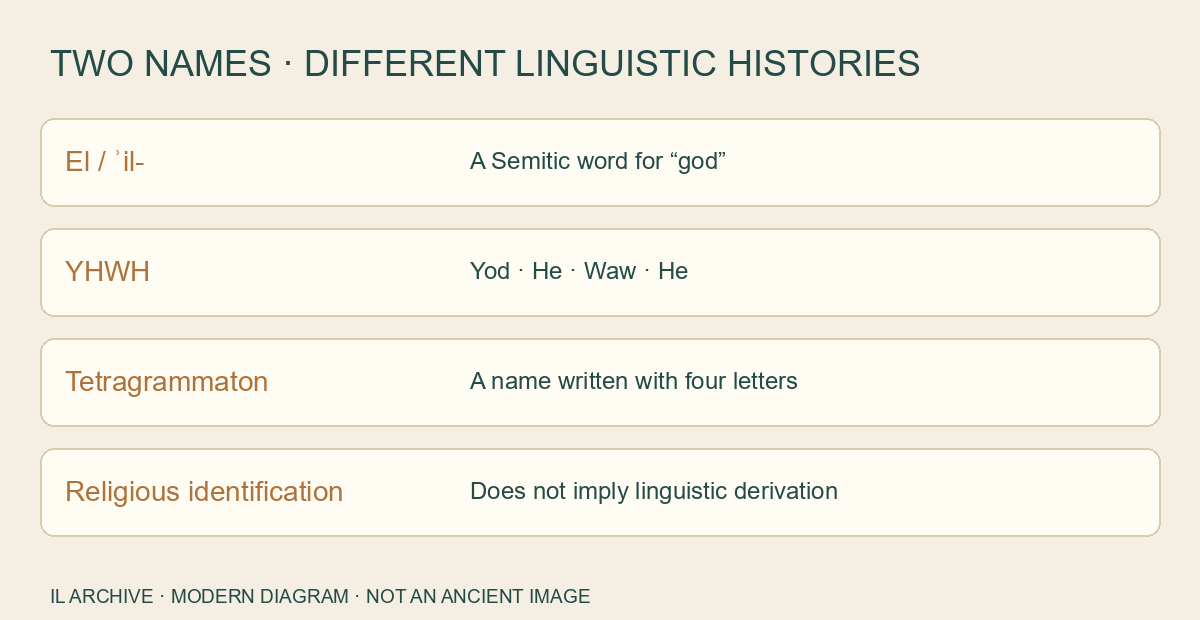
ElSemitic ilAn ancient Semitic word for a deity; its linguistic use does not alone identify a particular divine figure.Glossary · Click to read the explanation belongs to the ancient Semitic word family ʾil-, meaning “god.” It can be a common nounCommon nounA word naming a class of things, such as “god”, rather than one particular individual.Glossary · Click to read the explanation or the name of a particular deity, as at UgaritUgaritAncient city and kingdom at Ras Shamra on the Syrian coast, flourishing between the fourteenth and early twelfth centuries BCE and preserving multilingual archives.Glossary · Click to read the explanation. YHWH — יהוה is a different name, written with four Hebrew letters: yod, he, waw, he. Hence the designation TetragrammatonTetragrammatonDesignation for YHWH written with four Hebrew letters; it does not settle the earliest pronunciation or etymology.Glossary · Click to read the explanation.
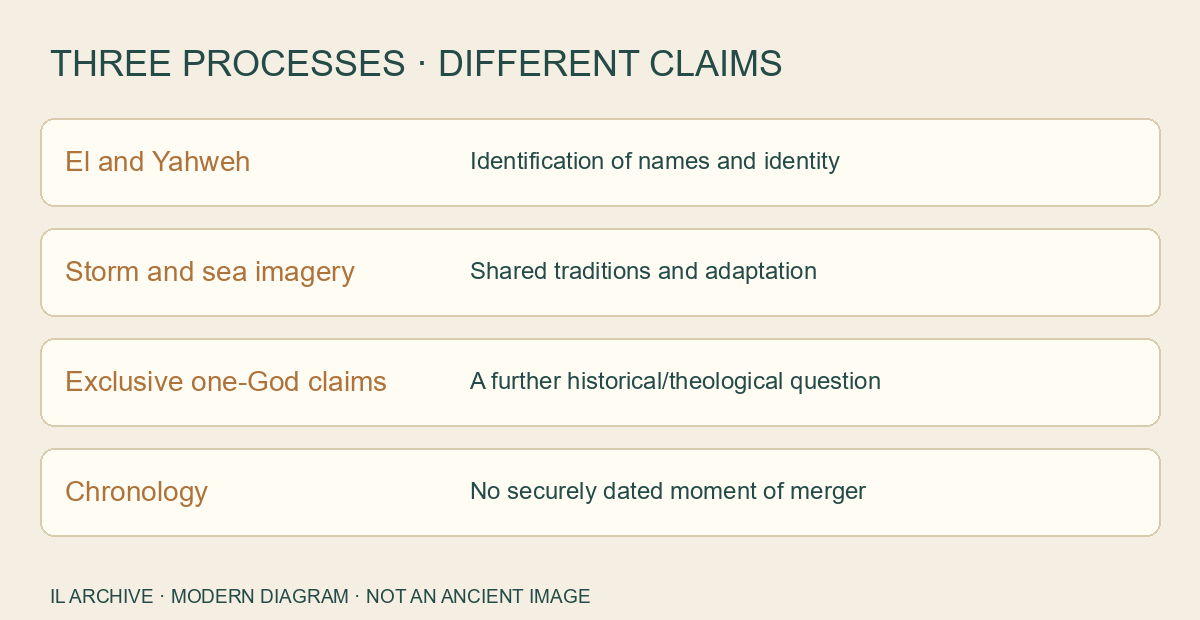
El and Yahweh can converge religiously, and El’s names and epithets can become ways of describing Yahweh. That does not make one name a linguistic derivative of the other. Questions about convergence, or about Yahweh’s origin as an independent deity or a manifestation of El, differ from questions about the origins of the words. [1]
What does the name mean?
Exodus 3:14 contains ehyeh asher ehyeh, with a meaning close to “I am who I am” or “I will be who I will be.” Its context relates the name to being, but does not guarantee preservation of its first historical etymology. [11]
Studies debate connections with h-w-y / h-y-y, a causative reading such as “he causes to exist,” and a connection with blowing. No explanation settles the question. Heath Dewrell discusses difficulties in familiar proposals and cautions that etymology does not automatically reveal every characteristic of a deity or later generations’ understanding of him. A disputed derivation alone cannot establish an “original storm god.” [2]
How Exodus’s authors interpreted the name is a question the text addresses. How the name arose before them is a separate matter.
A deity arriving from elsewhere
Several poetic passages attract attention because their point of departure is not Jerusalem:
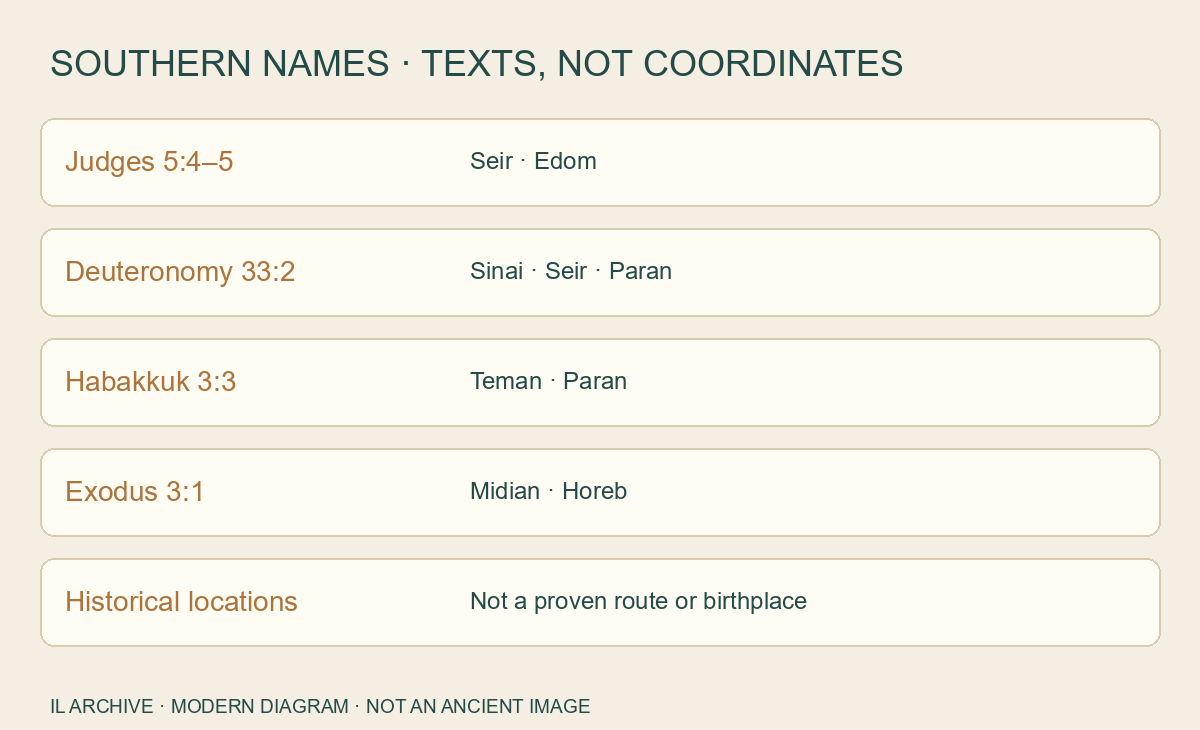
- In Judges 5:4–5, the Song of Deborah, Yahweh leaves Seir and marches from the field of Edom, while earth trembles and water falls. [3]
- In Deuteronomy 33:2 he comes from Sinai, rises from Seir and shines forth from Mount Paran. [4]
- In Habakkuk 3:3 God comes from Teman and the Holy One from Mount Paran; Midian appears in verse seven within the imagery of trembling. [5]
- In Psalm 68:8–9, using Hebrew verse numbering, God marches before his people through the wilderness and the scene evokes Sinai. Some translations number these verses 68:7–8. [6]
This geographical recurrence deserves explanation. It does not make the texts entirely independent: they may share a literary tradition or rework one another. A recurring southern direction cannot, by itself, prove where worship was invented.
Seir, Edom and Teman
Biblical geography associates Seir with Edom, south and southeast of the Dead SeaDead SeaThe Dead Sea is a salt lake in the Jordan Rift Valley, near sites where ancient manuscripts were foundGlossary · Click to read the explanation. In the Song of Deborah the names appear together. Teman also has Edomite and southern associations, and words of this family can denote south. These are regional names and traditions, rather than coordinates for a single point.
The text places the deity’s appearance in that landscape. Identifying his first worshippers as Edomites, or making the Iron Age kingdom of Edom the exporter of his cult, requires additional evidence. An older pastoral world should not be equated with political boundaries that developed later. Juan Manuel Tebes discusses these witnesses within a southern-origin model, while precise locations and routes of transmission remain research questions. [7]
Paran and Sinai: no certain map
Paran appears beside Seir, Sinai and Teman in southern-wilderness traditions. There is no agreed archaeological identification of the Mount Paran meant in the poetry. Nor can the entire cluster be converted into a journey with established stops.
Sinai, or Horeb in other traditions, is the place of revelation in the biblical narrative. The historical mountain’s location remains unsettled. Later traditions locating it in the southern Sinai Peninsula do not establish the location of the earliest divine appearance. Historical weight lies in the cluster of names and their context, rather than a pin on a modern map.
Is the poetry old enough?
Poetry may preserve traditions older than the framework transmitting it, but that possibility needs testing. Every line in Judges or Deuteronomy does not necessarily date to the twelfth century BCE. These passages are disputed in date, and archaic style alone does not establish the age of an idea or a text’s last revision. Tebes discusses varying dates for the Song of Deborah and objections to assuming that all the witnesses are early. [7]
Daniel Fleming gives poetry weight in reconsidering the Midianite hypothesis, but does not regard it as proof that inhabitants of the named regions were Yahweh’s first worshippers. “Yahweh comes from the south” remains a narrower statement than “his worship originated there.” [9]
Soleb: Yhw before the mention of Israel
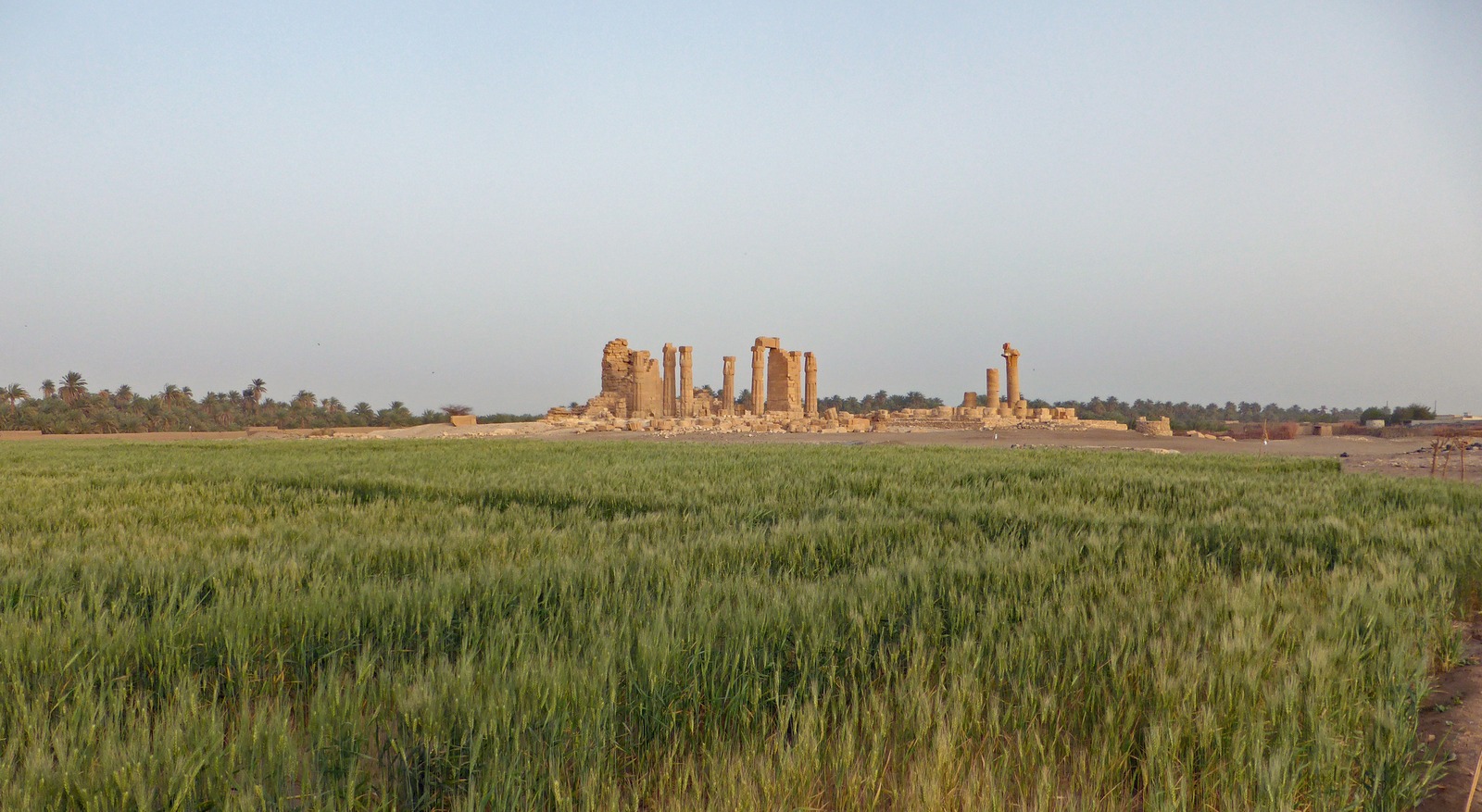
At the temple of Soleb in present-day northern Sudan, an Egyptian list from Amenhotep III’s reign, approximately 1390–1352 BCE, preserves an expression transcribed roughly tꜣ šꜣsw yhwꜣ. It is commonly translated along the lines of “Shasu-land of Yhw.” This belongs to an Egyptian display of foreign lands and groups, rather than a text of Yahweh worship. The inscription’s survival in Nubia does not locate the group it names. [8]
A similar name occurs in a list at Amarah West from Ramesses II’s reign in the thirteenth century BCE. However, this list may be a revised copy of the Soleb tradition; the two should not be counted as wholly independent testimonies to one group or cult. [7]
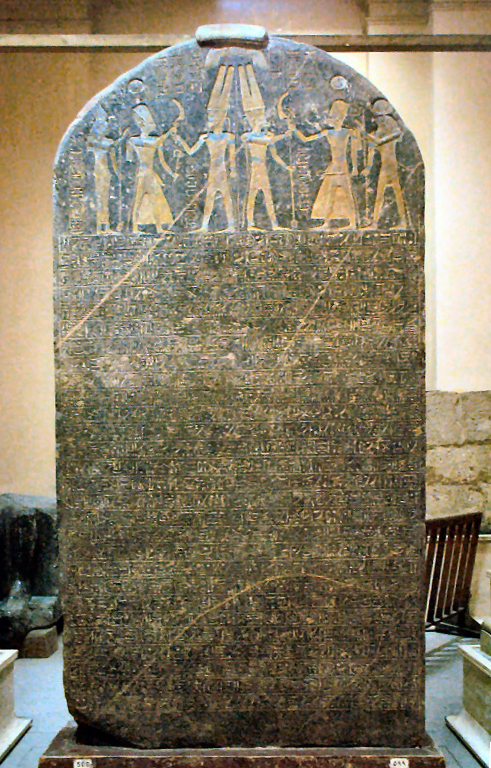
These witnesses precede the Merneptah SteleMerneptah SteleAn Egyptian royal inscription containing an early external attestation of the name Israel.Glossary · Click to read the explanation, which mentions Israel around 1208 BCE, and are centuries older than the Mesha SteleMesha SteleNinth-century BCE inscription of King Mesha of Moab; line 18 mentions Yahweh’s vessels, clear external evidence for the deity associated with Israel.Glossary · Click to read the explanation. [20] Their chronological order does not resolve Yhw’s identity.
Who were the Shasu?
ShasuShasuEgyptian designation for mobile pastoral groups; Yhw occurs in their lists without automatically identifying a deity or Israel.Glossary · Click to read the explanation was an Egyptian designation for mobile or partly mobile pastoral groups, rather than the established name of a single people or unified state. It was an external designation, and we do not know that the groups used it for themselves.
“Shasu of Yhw” therefore does not automatically mean “Israelites worshipping Yahweh.” The text names neither Israel nor the worship of a deity. Fleming stresses reading the list’s units within a pastoral world and argues that a Seir or Edom location for Yhw cannot be established from the Egyptian list alone. [8][9]
The name and pastoral setting are significant. Equating the group with later Israel is another inference.
Is Yhw a divine name in the inscription?
The familiar reading connects Yhw with Yahweh, perhaps as a land or group associated with a deity. Yet the Egyptian expression does not explicitly say “the god Yahweh.”
Fleming argues for starting with the name of a unit in the Shasu world and then investigating its relationship to the later divine name. He challenges deductions of a specific southern homeland or an explicitly attested cult directly from this witness. Tebes’s model gives greater weight to the southern connection. The disagreement concerns interpretation, rather than the name’s presence in the list. [8][9]
A precise formulation is that Yhw is the earliest known external candidate for a connection with the name later attested as YHWH, rather than an unambiguous attestation of the deity. Even when a historical connection is judged likely, resemblance alone does not explain how a group or place name became a divine name, or establish the direction of that development.
Why does the Egyptian witness still matter?
It contributes independently dated material to the name’s history, outside the biblical narrative. There is Yhw in a Late Bronze AgeLate Bronze AgeAn archaeological period conventionally around 1600–1200 BCE in much of the Near East, with regional variation.Glossary · Click to read the explanation list, poetry about a deity arriving from the south, and a story connecting Moses with Midian. Their intersection calls for explanation while preserving distinctions between them.
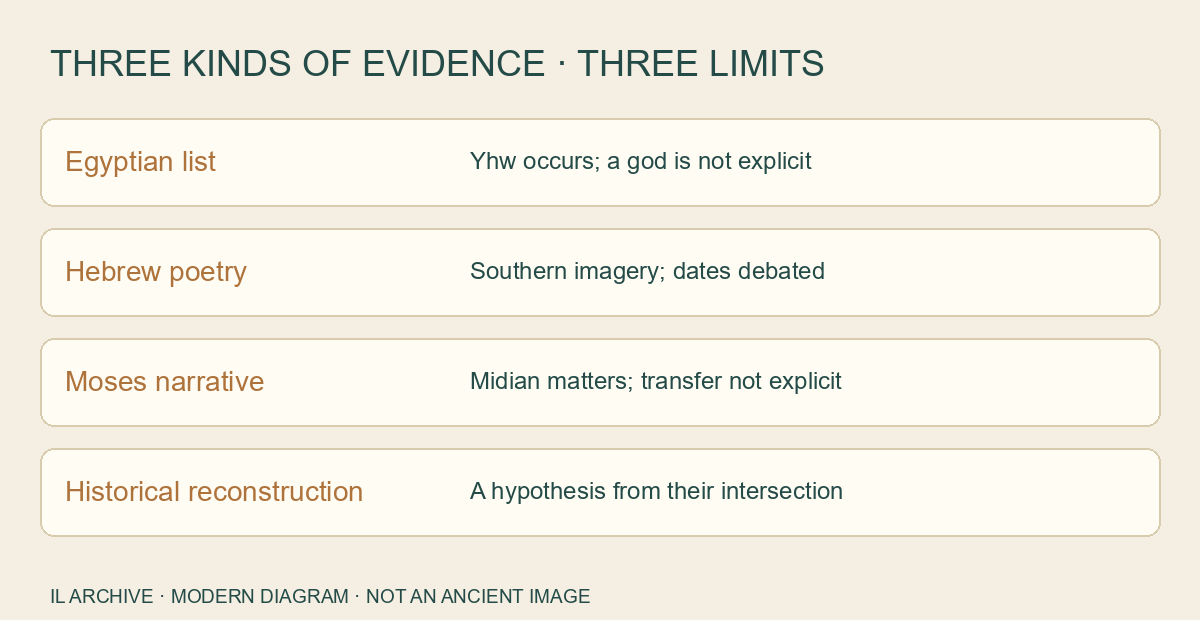
The inscription establishes occurrence of a name. The poetry establishes a geographical tradition in the text that survives. The narrative establishes Midian’s importance in the Moses story. Transfer of worship between particular groups at a particular time is a historical reconstruction based on these materials, and remains revisable.
Moses in Midian
In Exodus 2:15–22 Moses flees Egypt for MidianMidianName for groups and a wilderness-associated landscape in Hebrew narratives; Moses’s link to its priest supports a hypothesis, not proof of Yahweh worship’s transfer.Glossary · Click to read the explanation, joins a priestly family and marries Zipporah. Her father is named Reuel in this context. [10] In Exodus 3:1 Moses tends the flock of Jethro, priest of Midian and his father-in-law, and reaches Horeb, the mountain of God; there begins the burning-bush revelation of the name. [11]
This explains historians’ interest in a possible connection between Yahweh worship and Midian. The narrative nevertheless does not explicitly state that Jethro was Yahweh’s priest before Moses. In Exodus 18:10–12 he blesses Yahweh, acknowledges his greatness and offers sacrifices after hearing about the Exodus. This establishes his role in the story, without establishing an earlier direction of religious transmission. [12]
The Midianite-Kenite hypothesis
Its classical form proposes that southern groups, Midianite or Kenite, knew Yahweh worship before Israel and that Moses or a group associated with him transmitted it. The familiar claim that “Moses encountered Jethro’s god” summarizes the hypothesis, rather than an explicit statement in Exodus.
Joseph Blenkinsopp summarizes this model’s history, prominent since the nineteenth century, through four lines of argument: Moses’s Midianite connections, southern poetry, Egyptian lists, and traditions about Cain and the Kenites. These are overlapping arguments, rather than four texts making the same statement. [13]
Even if a historical core is assumed behind Moses, residence in Midian does not establish adoption of its priest’s religion. The priest’s deity, earlier worship and transmission mechanism would also need to be identified. The sources do not supply these links unambiguously. [9]
The problem of connecting the Kenites to Moses’s family
The relatives’ names and relationships differ among texts. Judges 4:11 connects Hobab with Moses’s family and the Kenites, while Numbers 10:29 connects him with the Midianite Reuel. Judges 1:16 makes descendants of Moses’s father-in-law part of the movement with Judah. These relationships do not provide a matching historical genealogy.
Jacob Wright reads some of these connections as literary work incorporating the Kenites into Israel’s memory through its founder’s family. This is a scholarly interpretation of connections between traditions, rather than a claim that any historical relationship is impossible. It prevents treating a composite family tree as a direct Bronze Age document. [14]
Narrative may preserve memory of relationships between groups and also reconstruct those relationships. Distinguishing the possibilities is part of the investigation.
Was Yahweh Edom’s god?
Seir and Teman in the poetry do not establish Yahweh as the national deity of the kingdom of Edom. Qos is prominent in Iron Age Edom and should be distinguished from Yahweh. Evidence for a deity in a later kingdom neither determines older pastoral groups’ beliefs nor excludes diversity among them. [7]
A cautious southern-origin model concerns a landscape of groups and contacts, rather than a documented institutional transfer from Edom to Israel. The place from which a deity arrives in poetry may be a cult centre, a place of manifestation or sacred geography, rather than the first homeland of his worship. [9]
Storm and warrior: the first function remains unsettled
Earth trembles and water falls in the Song of Deborah; mountains, chariots and a bow appear within Habakkuk’s divine-warrior imagery. These characteristics occur in the texts. [3][5] Some scholars use them to reconstruct an early Yahweh as a warrior with storm attributes.
His depiction in surviving poetry nevertheless does not establish his function for the first group that bore the name. BaalBaalStorm god and protagonist of Ugarit’s Baal Cycle; exercises active kingship while El retains importance and authorizes the palace.Glossary · Click to read the explanation and the Canaanite divine world may have influenced some later imagery. Disputed etymology cannot settle the question, and storm imagery alone cannot locate an origin. Name, geography and divine characteristics are connected research problems, without any one automatically answering the others. [2]
Where does El fit into Israel’s history?
The name IsraelAncient IsraelA name for an ancient population and later historical traditions, attested on the Merneptah Stele.Glossary · Click to read the explanation contains El, and the traditions preserve names such as El ShaddaiEl ShaddaiA compound El name or title associated with ancestral narratives and identified with Yahweh in Exodus 6; Shaddai’s meaning and etymology remain uncertain.Glossary · Click to read the explanation and El ElyonEl ElyonA name or title meaning “God Most High,” joined to Yahweh in Hebrew Genesis 14. Elyon does not always designate an independent deity.Glossary · Click to read the explanation. A divine element in a group’s name, however, does not establish every member’s deity or the sequence of changes in belief.
In Exodus 6:2–3 the speaker distinguishes appearing to the ancestors as El Shaddai from being known by the name Yahweh. This is an important literary witness, but should not be generalized to the whole Bible: Genesis itself uses Yahweh in ancestral narratives. [19]
An influential model proposes convergence or identification between Yahweh and El, with Yahweh acquiring El’s epithets and position. Studies also discuss origin from a local manifestation of El. There is no single agreed account of the transition. What can be defended is a distinction between religious convergence and linguistic derivation, and between the final texts’ portrayal and the history scholars attempt to recover. [1][18]
A god arriving in Israel, or a name within its formation?
The traditional picture assumes an Israel already in Canaan, borrowing a deity from the south. Fleming proposes another model: a name connected to a pastoral group may reveal the diversity involved in Israel’s own formation, rather than a completed people simply adopting outsiders’ worship. This is a proposal for historical reconstruction, rather than something the Egyptian list establishes alone. [16]
His reconsideration of the name concludes that poetry and prose connecting Israel with neighboring groups do not identify the deity’s first worshippers, and that the Egyptian witness does not explicitly name him as a god. [15] The mechanism of transmission therefore remains open even among scholars who take these materials seriously.
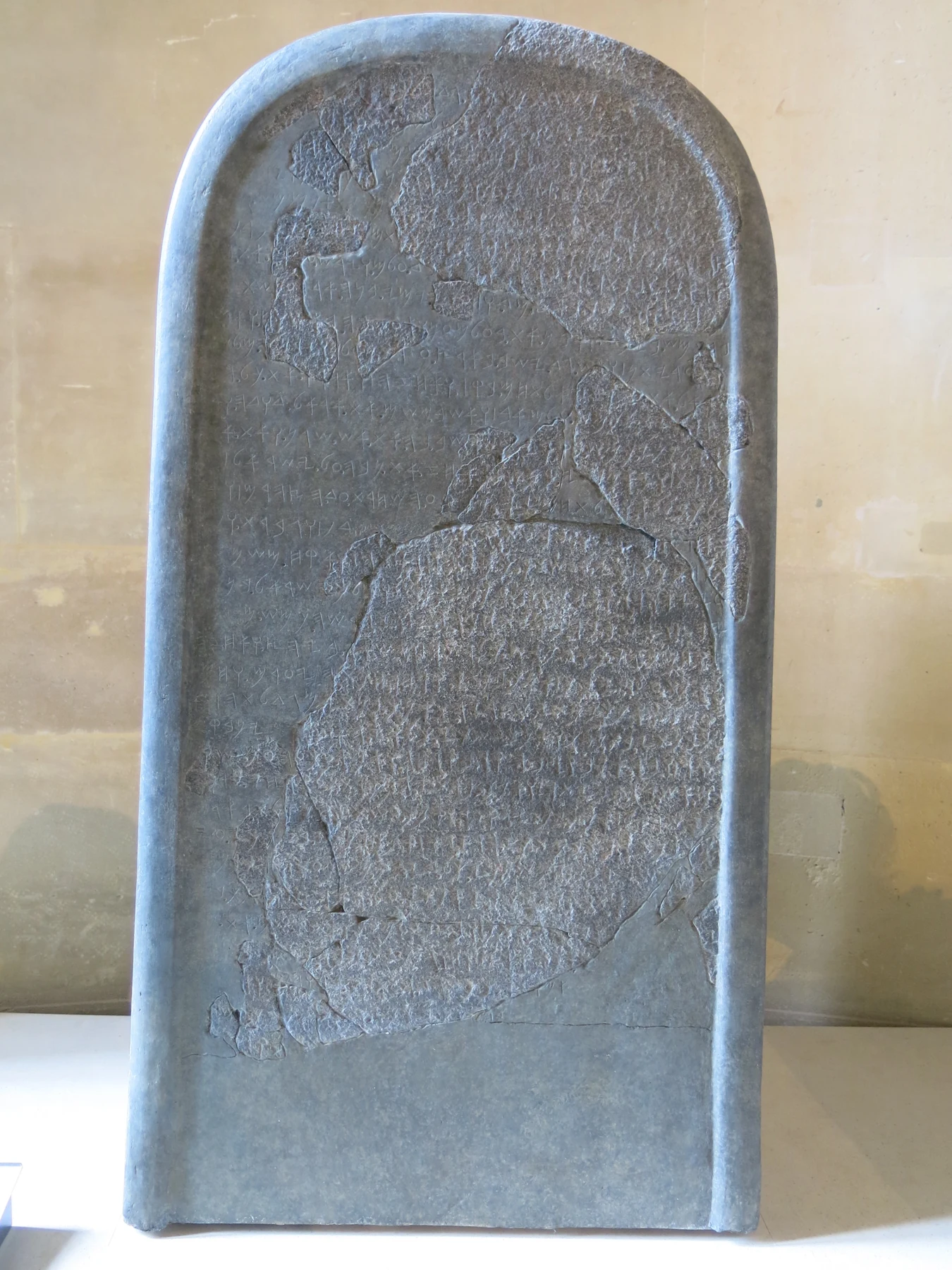
The ninth-century BCE Mesha Stele from Moab mentions Yahweh’s vessels in line 18, in the account of the capture of Nebo. Here we reach clear external evidence for the deity associated with Israel. [2] Louvre AO 5066 is basalt, broken, reassembled and supplemented; not every part of its photographed surface is intact ancient stone. [17]
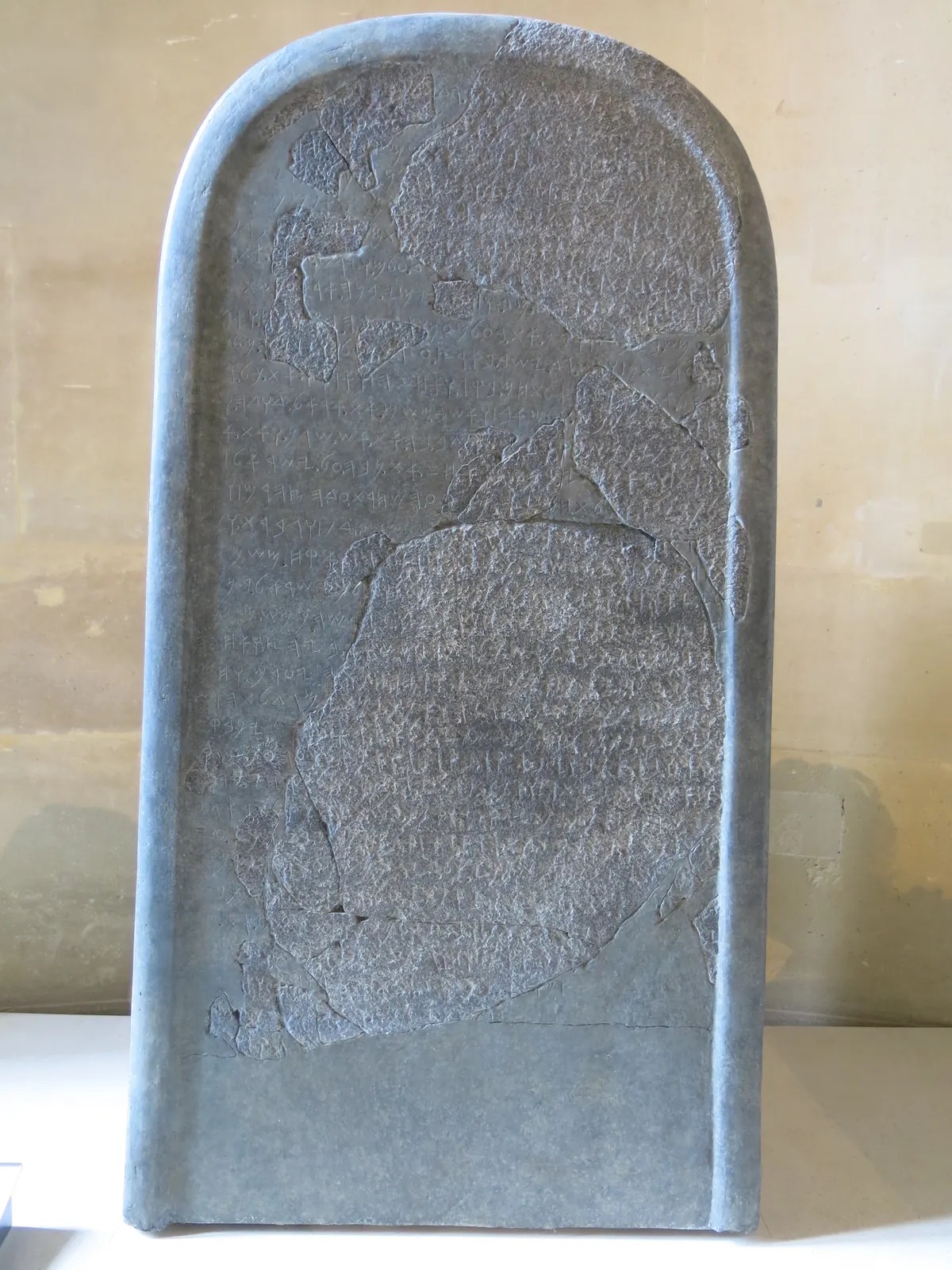
Between fourteenth-century Yhw and the clear ninth-century Yahweh lies a gap in evidence, rather than centuries that can be filled with a certain story. The earliest surviving witness need not be the name’s first use.
What we know and what we do not
- Certain: YHWH and El are linguistically different names, even when later traditions use them for the same deity.
- Certain: several Hebrew passages preserve southern geography of divine appearance; their dates and literary relationships are not all settled.
- Certain: Yhw occurs in Egyptian Shasu lists of the Late Bronze Age; its identity as a divine name and its precise location are unproved.
- Likely in many scholarly models: there is a historical connection between this name and later Yahweh, and southern traditions matter for interpreting his early history.
- Possible: Midianite or Kenite groups, or another pastoral group, played a role in spreading worship or forming Israel.
- Unproved: Jethro worshipped Yahweh before Moses, Moses adopted worship from him, or a known tribe or mountain represents the first beginning.
A deity who came
With the fewest assumptions, the poetry directs the question toward the southern mountain margins: Seir, Edom, Teman, Paran and Sinai. Midian opens a narrative avenue, while Egyptian Yhw provides a dated avenue into the Shasu world, with its location still uncertain.
We know neither the first temple nor the first priest. No fourteenth-century BCE text unambiguously says “we worship the god Yahweh.” Yet the surviving memory preserves a striking image: the deity moves, the earth trembles, he appears from the wilderness and becomes associated with Israel and Judah.
Later Yahweh brings together the language of kingship, creation and judgment, characteristics associated with El and storm imagery. How these elements came together belongs to another historical investigation, rather than an inevitable conclusion of the Soleb list. The earliest witnesses let us follow threads of a name without supplying a divine birth certificate. Research must preserve the distance between a thread and certainty.
References and notes
- Heath D. Dewrell & Andrew M. Garbarino (2023). Names of God in the Hebrew Bible. Oxford Bibliographies. doi:10.1093/obo/9780195393361-0318. Open introductory extract: El as noun or deity, compound El names, convergence and local-manifestation models. Full article and bibliography not read. Return to the text ↑
- Heath D. Dewrell (2022). Yahweh the Destroyer: On the Meaning of יהוה. In Biblical and Ancient Near Eastern Studies in Honor of P. Kyle McCarter Jr., eds. Christopher Rollston, Susanna Garfein & Neal H. Walls. SBL Press. Selected pp. 5–10: debated etymologies, yhwh/yhw/yh/yw forms and caution about deriving divine character from a name; p. 7, Mesha KAI 181.18. P. 5 visually checked. The chapter title is not treated as consensus on “destroyer.” Whole book not read. Return to the text ↑
- Hebrew Bible, Judges 5:4–5. Mechon-Mamre Hebrew–English text. Judges 5:4–5: Seir, Edom, trembling earth and water. Displayed text checked; does not date the song’s composition. Return to the text ↑
- Hebrew Bible, Deuteronomy 33:2. Mechon-Mamre Hebrew–English text. Deuteronomy 33:2: Sinai, Seir and Mount Paran. Does not establish mountain coordinates or text age. Return to the text ↑
- Hebrew Bible, Habakkuk 3:3, 7–10. Mechon-Mamre Hebrew–English text. 3:3 Teman/Paran; 3:7 Midian; 3:8–10 chariots, bow and mountains. Literary depiction, not proof of the god’s function among first worshippers. Return to the text ↑
- Hebrew Bible, Psalm 68:8–9, Hebrew numbering. Mechon-Mamre Hebrew–English text. Hebrew numbering 68:8–9; 68:7–8 in some translations. Wilderness march and Sinai. No assumed composition date adopted. Return to the text ↑
- Juan Manuel Tebes (2018). The Southern Home of YHWH and Pre-Priestly Patriarchal/Exodus Traditions from a Southern Perspective. Biblica 99(2), 166–188. doi:10.2143/BIB.99.2.3284919. Selected pp. 169–172 on lists, poetry, dating and transmission problems; p. 183 on Qos. P. 170 visually checked. Southern origin is the author’s model, not consensus. Full article and all place identifications not verified. Return to the text ↑
- Daniel E. Fleming (2020). Yhwʒ of Shasu-Land. Yahweh before Israel, chapter 2, pp. 23–66. doi:10.1017/9781108875479.003. Publisher summary/metadata: Soleb/Amenhotep III, Amarah West/Ramesses II, conditional link to the divine name. Not full chapter or independent hieroglyphic reading. Group/location qualifications also checked in chapters 3/5 summaries. Return to the text ↑
- Daniel E. Fleming (2020). The Midianite Hypothesis: Moses and the Priest of Midian. Yahweh before Israel, chapter 3, pp. 67–110. doi:10.1017/9781108875479.004. Publisher summary: Egyptian evidence does not straightforwardly yield southern origin, Yhw not fixed in Seir/Edom, shift from prose toward poetry. Summary only; limits on identifying first worshippers also supported by chapter 5 summary. Return to the text ↑
- Hebrew Bible, Exodus 2:15–22. Mechon-Mamre Hebrew–English text. Flight to Midian, priest, Reuel and Zipporah. Narrative events not treated as a contemporary record of Moses. Return to the text ↑
- Hebrew Bible, Exodus 3:1, 13–15. Mechon-Mamre Hebrew–English text. 3:1 Jethro as priest of Midian and Horeb; 3:13–15 ehyeh and the name’s revelation. Textual interpretation distinguished from first etymology. Return to the text ↑
- Hebrew Bible, Exodus 18:10–12. Mechon-Mamre Hebrew–English text. Jethro’s blessing, acknowledgment and offerings after hearing of the Exodus; does not prove Yahweh worship before Moses. Return to the text ↑
- Joseph Blenkinsopp (2008). The Midianite-Kenite Hypothesis Revisited and the Origins of Judah. Journal for the Study of the Old Testament 33(2), 131–153. doi:10.1177/0309089208099253. Publisher abstract only: hypothesis since the nineteenth century and four lines of argument, including Cain/Kenite traditions. Full text not read. Return to the text ↑
- Jacob L. Wright (2020). Jael’s Identities. War, Memory, and National Identity in the Hebrew Bible, chapter 14, pp. 222–236. doi:10.1017/9781108691512.016. Selected open HTML sections Kenites and Solidarity / The Kenites in the Biblical Landscape: Judges 1:16, 4:11, Numbers 10:29 and incorporation through Moses’s kinship. Literary interpretation attributed to Wright. PDF unavailable; whole book not read. Return to the text ↑
- Daniel E. Fleming (2020). The Name Yahweh. Yahweh before Israel, chapter 5, pp. 162–184. doi:10.1017/9781108875479.006. Publisher summary: neighboring kinship does not identify first worshippers; explicit Egyptian usage is not divine and does not fix a particularly southern location. Summary only, not full chapter. Return to the text ↑
- Daniel E. Fleming (2020). Yahweh before Israel: Glimpses of History in a Divine Name. Cambridge University Press. doi:10.1017/9781108875479. Publisher book description: pastoral group and Israel’s diverse background rather than simple borrowing from outsiders. Print date 3 December 2020. Description and selected summaries read, not whole book. Return to the text ↑
- Musée du Louvre. Stèle de Mesha, AO 5066 / MNB 752 / KAI 181. Original object record: Dhiban, basalt, reassembled/supplemented; museum range 830–805 BCE, description also says after 842. Article uses ninth century without fixing a year. Tangopaso rights separately checked on Commons; received web copy documented. Return to the text ↑
- Mark S. Smith (2001). El, Yahweh, and the Original God of Israel and the Exodus. The Origins of Biblical Monotheism. Oxford University Press. Indexed publisher abstract only: El element in Israel and hypothesis of El as its original deity. Direct access unavailable. Name alone does not establish homogeneous religion or a certain sequence for all traditions. Return to the text ↑
- Hebrew Bible, Exodus 6:2–3. Mechon-Mamre Hebrew–English text. This passage distinguishes El Shaddai and the name Yahweh. Not generalized as a unified view of every biblical book or proof of the name’s first historical appearance. Return to the text ↑
- National Museum of Egyptian Civilization. Merenptah (Baenre Merinetjeru). Merenptah paragraph: Israel Stele and earliest recorded mention. Later mixed-in Ramesses III paragraphs not used. Approximate 1208 BCE agrees with the archive’s existing stele entry; page is not a detailed object record. Return to the text ↑
Suggest a correction · Suggest a source for this record
Cite this record
IL Archive, «Where Did Yahweh Come From?», Edition 1, https://ilarchive.com/en/studies/yahweh-origins
Continue reading