Study
El in Human and Angelic Names
An extended study of a topic, with evidence and references.
Seven names containing El—Israel, Ishmael, Daniel, Michael, Gabriel, Raphael and Uriel—examined across Egyptian inscription, Hebrew texts, angelic literature and the Qurʾan. Etymology, dated evidence and each bearer’s beliefs are kept distinct.
Estimated reading time: 11 min Published Last reviewed:
Share article
Video
The Name that Crossed Millennia: Who is El?
Our first documentary follows the name El back through 4,000 years of surviving evidence, from names we use today to the tablets of Ugarit and Ebla. Some scenes are AI-generated illustrations.
The YouTube player loads only when you press play. Watch on YouTube
Dates
Dates have distinct roles. The timeline uses creation, composition or historical coverage, rather than publication or discovery dates.
- Historical coverage
- Approximately From 1400 BCE to 700 CE
Text
Introduction
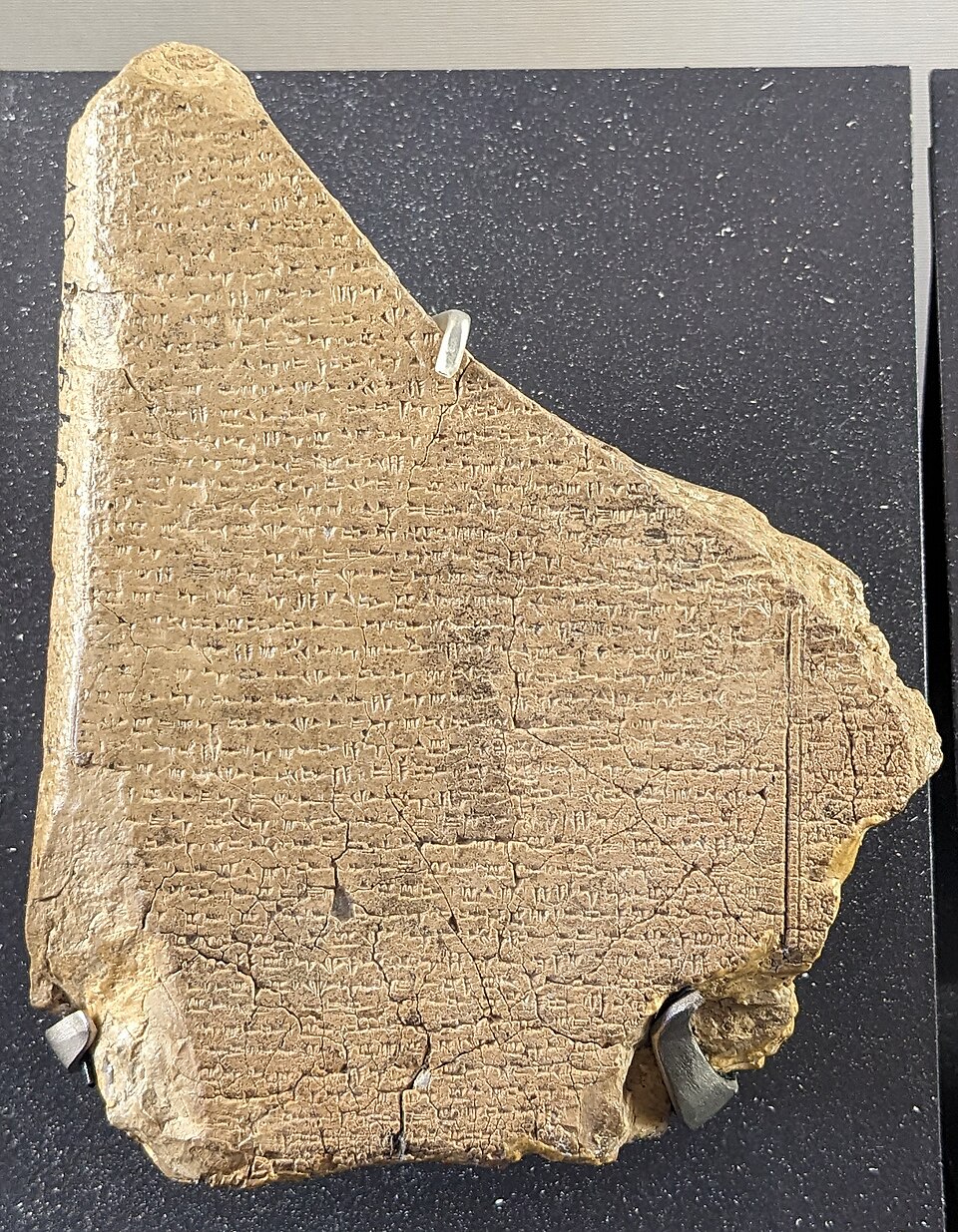
Why does “El” occur in names such as Israel, Ishmael and Daniel, and in the names of heavenly figures such as Michael and GabrielGabriel / JibrīlA Semitic theophoric name for an interpreter of visions in Daniel and a messenger in Luke; named Jibrīl in the Qurʾan. His functions depend on each textual context.Glossary · Click to read the explanation? This study examines seven Semitic names through their linguistic structures, relevant attestations and later uses in Jewish, Christian and Islamic texts. Beyond asking what each name means, it asks what a name can—and cannot—tell us about religious history.
The evidence ranges from an Egyptian inscription naming a population to human names in HebrewHebrewA Northwest Semitic language of the Canaanite group, encompassing Iron Age epigraphy, Biblical, Rabbinic, medieval and Modern Hebrew; its scripts and pronunciations changed over time.Glossary · Click to read the explanation texts, named heavenly figures in Daniel, Tobit and 1 EnochFirst EnochA composite Second Temple Jewish apocalyptic collection on the Watchers, parables, celestial cycles, historical visions, and judgment, preserved complete in Geʽez.Glossary · Click to read the explanation, and selected Qurʾanic forms. At each stage we distinguish etymology from the bearer’s identity, the story’s setting from the text’s date, and established linguistic patterns from proposed religious connections.
Words preserved in names
Beliefs and languages can change while personal names endure. Israel, Ishmael, Daniel, Michael, Gabriel, Raphael and Uriel contain a recurring element in their Semitic forms: ElSemitic ilAn ancient Semitic word meaning “god,” with cognates across several languages. It may function as a common noun or a proper name according to context; it is not always Ugaritic El.Glossary · Click to read the explanation, ʾEl. Its survival does not establish that everyone bearing these names worshipped the deity known from UgaritUgaritAncient city and kingdom at Ras Shamra on the Syrian coast, flourishing between the fourteenth and early twelfth centuries BCE and preserving multilingual archives.Glossary · Click to read the explanation.
El could mean a god and could designate a particular deity. No simple sequence establishes that the proper nameProper nameA name that identifies a particular person, place, group, or entity in context, unlike a common noun denoting a class. Spelling alone may not settle the distinction.Glossary · Click to read the explanation necessarily preceded the common nounCommon nounA noun referring to a member of a class, such as “city” or “god”, unlike a proper name designating a particular entity. Semitic il/El may fulfill either function in context.Glossary · Click to read the explanation. In Hebrew texts it can refer to Israel’s God. Names first preserve linguistic material; identifying its divine referent requires context.[1]
A name bearing a divine element
A theophoric nameTheophoric nameA personal name including a deity’s name or another divine element, often as part of a short sentence or invocation, interpreted in its original language and context.Glossary · Click to read the explanation contains a divine element. It may be a nominal construction or a short sentence about divine hearing, healing or judgment, sometimes expressing a wish. Such formations belonged to many ancient Near Eastern communities, not only Israel or the naming of angels.
In Hebrew names El may occur at the beginning or end, alongside elements referring to YahwehYahwehThe proper name of Israel’s deity, written יהוה (YHWH), the Tetragrammaton. Its exact ancient pronunciation is not directly preserved; texts and inscriptions witness its history.Glossary · Click to read the explanation such as yeho-, -yahu and -yah. Yehoshua, from which the later form Joshua derives, is an example of a different theophoric construction, outside the seven names considered here.[26] These patterns help researchers study naming traditions without automatically identifying a person’s community or beliefs. Families could use names in different languages, and inherited names could survive a changed setting.[2]
Which El does a name mean?
Ugaritic ElElEl is a senior deity in Late Bronze Age Ugaritic texts, portrayed as father of the divine family and a council authority, alongside his consort Athirat. This entry does not cover every linguistic use of El.Glossary · Click to read the explanation, the father and head of the divine household, must be distinguished from El as a generic word. Once El and Yahweh were identified in Israelite tradition, a bearer could understand the old element simply as God without invoking Ugarit’s character.
This is no rule that all later names are Yahwistic or all early names invoke a particular El. It is a problem of reference: the same word in different languages, periods and communities. The convergence model explains part of the continuity; every name is not an independent document of that convergence.[1]
Israel: a clear element, a debated interpretation
Yiśrāʾēl unmistakably contains El. Analyses of the first element vary. Genesis 32 associates it with Jacob’s wrestling; lexical interpretations include persistence, struggle or rule. The narrative explanation should not be mistaken for a single settled historical etymology: proposals involving “El rules” and a verb of struggle also present distinct grammatical questions.[4]
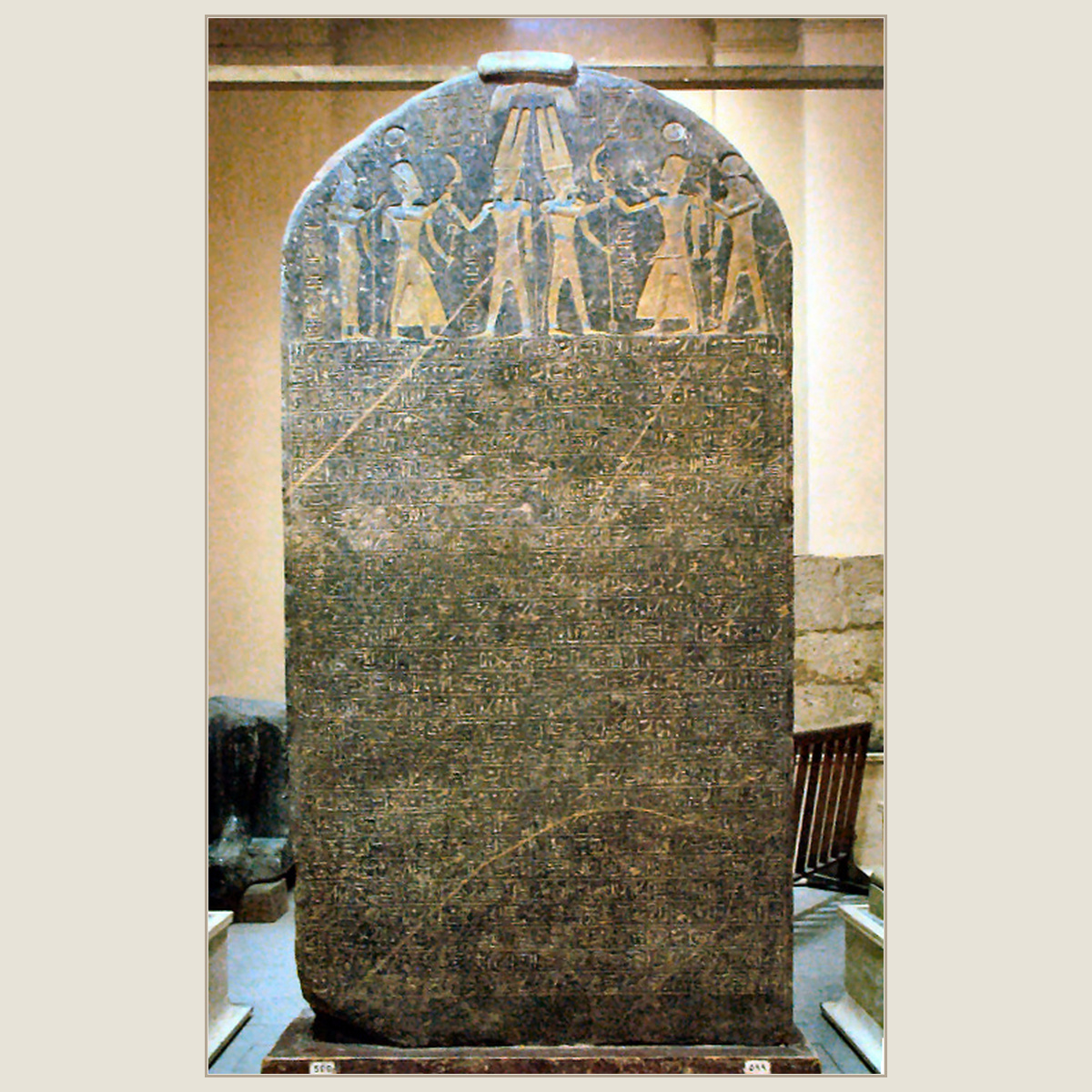
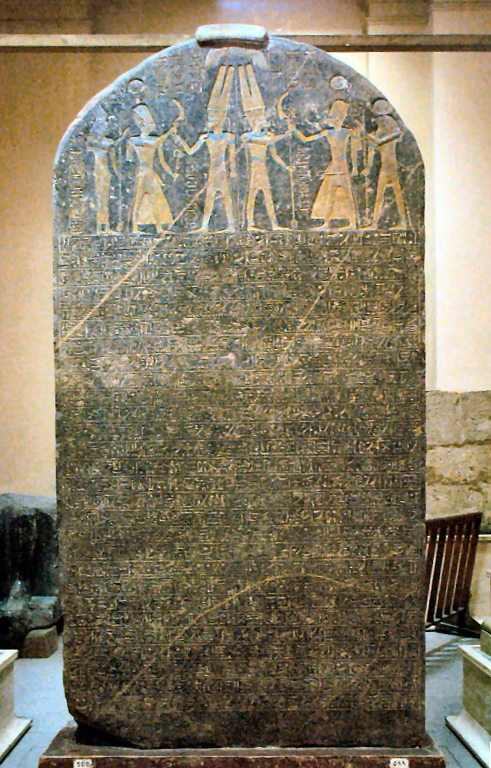
The name of ancient IsraelAncient IsraelName attested for a population on the Merneptah Stele around 1208 BCE, later for the northern Iron Age kingdom and for broader textual and religious identities; the senses are not identical.Glossary · Click to read the explanation is attested outside the Bible on the Merneptah SteleMerneptah SteleAn Egyptian royal victory inscription of c. 1208 BCE on the reverse of a monument of Amenhotep III; it contains the earliest widely accepted external attestation of the name Israel.Glossary · Click to read the explanation, around 1208 BCE, before the known Israelite kingdoms. The Egyptian writing classifies Israel as a population rather than a city, but provides no Hebrew spelling that parses the element El. It attests a group name, not the people’s religious beliefs or ritualRitualAn organised or distinguished practice meaningful to a community; it may leave traces, but its form alone does not reveal an associated doctrine.Glossary · Click to read the explanation practices.[3]
Ishmael: God hears
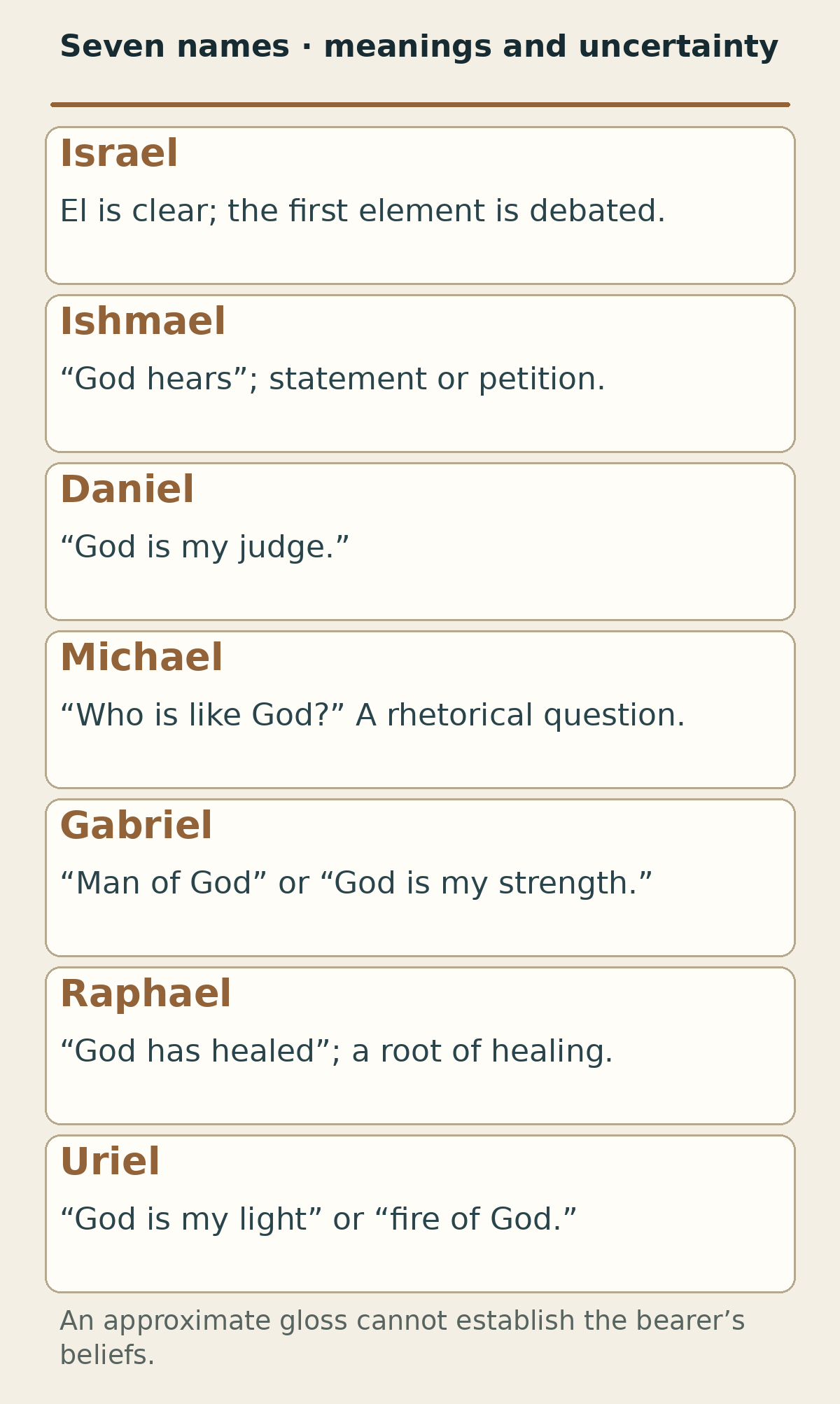
יִשְׁמָעֵאל — Yišmāʿēl combines the root š-m-ʿ, hearing, with El. God hears is an approximate rendering. The name sentence can convey a statement or a wish; temporal and modal interpretations include hears, will hear, has heard and may hear, depending on grammar and context.[5]
Genesis 16:11 explains the child’s name through Yahweh hearing Hagar’s affliction. El in the name and the action attributed to Yahweh coexist naturally in the surviving narrative. The writer does not present a change of deity. This shows the text’s identification without independently dating its beginning.[6]
Daniel: God is my judge
דָּנִיֵּאל — Dāniyyēl relates to judgment and is normally understood as God is my judge. It states something about God, not that its bearer is divine. The University of Iowa entry explains the construction through my judge and El.[7]
This pattern illuminates the other names. A divine element in a human name does not classify its bearer as a god; the same element in a heavenly figure’s name does not establish independent divinity. The whole sentence must be understood before drawing conclusions about its bearer.
Michael: who is like God?
MichaelMichael / MīkālA name meaning “Who is like God?”, borne by humans and an angel. The angel protects Daniel’s people, is called archangel in Jude and fights the dragon in Revelation. The Qurʾan names Mīkāl without assigning a task; later traditions develop different roles.Glossary · Click to read the explanation, מִיכָאֵל — Mîkhāʾēl, asks who is like El or God. Usually understood rhetorically, it asserts divine uniqueness rather than claiming equality for its bearer.[8]
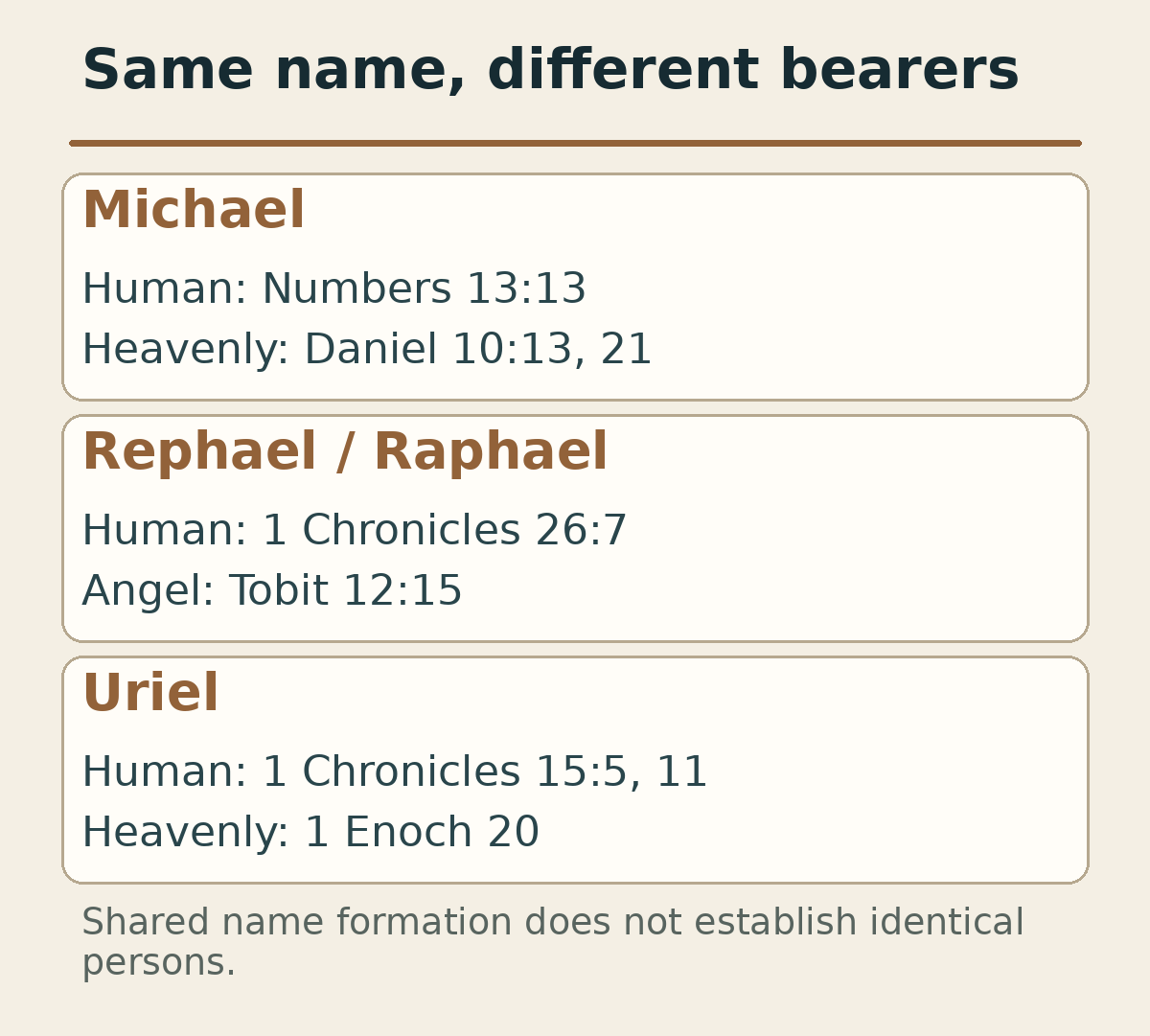
Humans also bear the name: Numbers 13:13 names Sethur’s father Michael.[9] Daniel 10:13,21 presents a heavenly Michael, one of the chief princes and the community’s prince.[10] Both usages are attested. The ordering of books and dates within their stories do not establish which usage historically arose first.
Gabriel: man and strength
GabrielGabriel / JibrīlA Semitic theophoric name for an interpreter of visions in Daniel and a messenger in Luke; named Jibrīl in the Qurʾan. His functions depend on each textual context.Glossary · Click to read the explanation, גַּבְרִיאֵל — Gaḇrîʾēl, combines El with an element related to g-b-r, the semantic field of man and strength. Renderings include man of God and God is my strength. Iowa presents both analyses; neither should be treated as the sole possible interpretation.[11]
Daniel 8:16 commissions Gabriel to explain a vision. His identity and role come from the narrative, while etymology explains the name’s formation.[12] Man of God alone supplies neither an earlier human biography for the angel nor an origin as a Canaanite deity.
Raphael: healing in a name
RaphaelRaphael / RephaelRaphael means “God has healed,” a name borne by a human in Chronicles and an angel in Tobit and 1 Enoch. In Tobit he accompanies the travelling son, helps heal the father and presents prayer before God; in Enoch he executes judgment and explains the places of the dead. Similarity of names does not settle his relationship to Israfil.Glossary · Click to read the explanation, Rəfāʾēl, combines the healing root r-p-ʾ and El, conveying divine healing, commonly God has healed. Its theophoric structure remains recognizable despite different transmitted forms.[13]
In Tobit 12:14–15, Raphael explains his healing commission and membership among seven angels before God.[14] A human Rephael appears in 1 Chronicles 26:7. Shared consonants and formation do not erase differences in vocalization, transliteration or personal identity.[15]
Uriel: light or fire?
UrielUrielHebrew name containing “El,” borne by humans in Chronicles and an angel in 1 Enoch and 4 Ezra. Roles vary by text; no Ugaritic divine origin is established.Glossary · Click to read the explanation, אוּרִיאֵל — ʾÛrîʾēl, has renderings involving God as my light or divine fire. NET’s collected dictionaries preserve both analyses. They are presented as alternatives, without deciding the issue from a sound resemblance or one role attributed to the figure.[16]
A human Uriel leads Levites in 1 Chronicles 15:5,11.[17] First Enoch 20 lists a heavenly Uriel.[18] The texts attest the name in two settings without making the human leader and angel the same person.
One naming language, different bearers
Michael, Raphael and Uriel demonstrate theophoric formations used for humans and heavenly beings. Israel, Ishmael and Daniel likewise prevent treating -el as an exclusively angelic ending.
The figure’s position in its text distinguishes an angel from a human. Matching names require further evidence before their bearers can be identified. The same applies to a proposed former deity: etymology is not a record of transferred religious identity.
When were angels given names?
Many Hebrew texts present unnamed heavenly messengers. Daniel gives Michael and Gabriel clear names and roles. But an observation about the Hebrew biblical collection cannot establish that angelic naming historically began with Daniel.
Annette Reed situates the formation of written angelologyAngelologyStudy and organization of angels and heavenly beings: names, ranks and roles within particular traditions, without assuming one fixed system.Glossary · Click to read the explanation in the third-century BCE context and Second Temple Aramaic literature.[19] Daniel’s final form is commonly dated to the second century BCE, incorporating earlier material.[20] Tobit and Enoch have complex compositional and transmission histories. Story setting, composition and surviving manuscript date are separate questions.
What exactly does a dated witness date?
The Merneptah Stele belongs to the late thirteenth century BCE and renders a population’s name in Egyptian language and script; it does not supply a Hebrew etymology. The human Michael in Numbers, and the human Rephael and Uriel in Chronicles, reach us through textual compositions and transmissions later than the periods narrated. These passages do not, on their own, yield an unbroken chronology for when each name first appeared.[3][9][15][17]
The forms of Daniel, Tobit and 1 Enoch that name heavenly figures have distinct histories of composition and transmission; they are not a single list from one founding date. Even where a literary layer or manuscript can be dated, its date establishes the age of the attestation, not the first utterance of a name or the beginning of belief in the named being.[18][19][20]
Former sons of El?
Ugarit knew a divine councilDivine councilA divine council is a religious and literary scene in which divine beings gather before a superior authority for discussion, commissioning or judgment; it is not identical to a pantheon list.Glossary · Click to read the explanation; Hebrew texts preserve heavenly groups; named angelic worlds subsequently expanded. Comparing these structures is useful without yielding a table identifying a particular Ugaritic deity with Michael or Gabriel.
The persistence of theophoric language and some court or messenger functions does not establish each character’s survival under another identity. El within an angel’s name is insufficient to demonstrate former membership in El’s council. The earlier study From El’s Council to Yahweh’s Court separates structural continuity from proposed individual transfers.
Names and family religion
A name may preserve a healing memory, an answered prayer or a hope for a child. It may also be an inherited relative’s name or a familiar choice whose etymology is not actively recalled. Every name referring to divine healing is not a report of a historical cure.
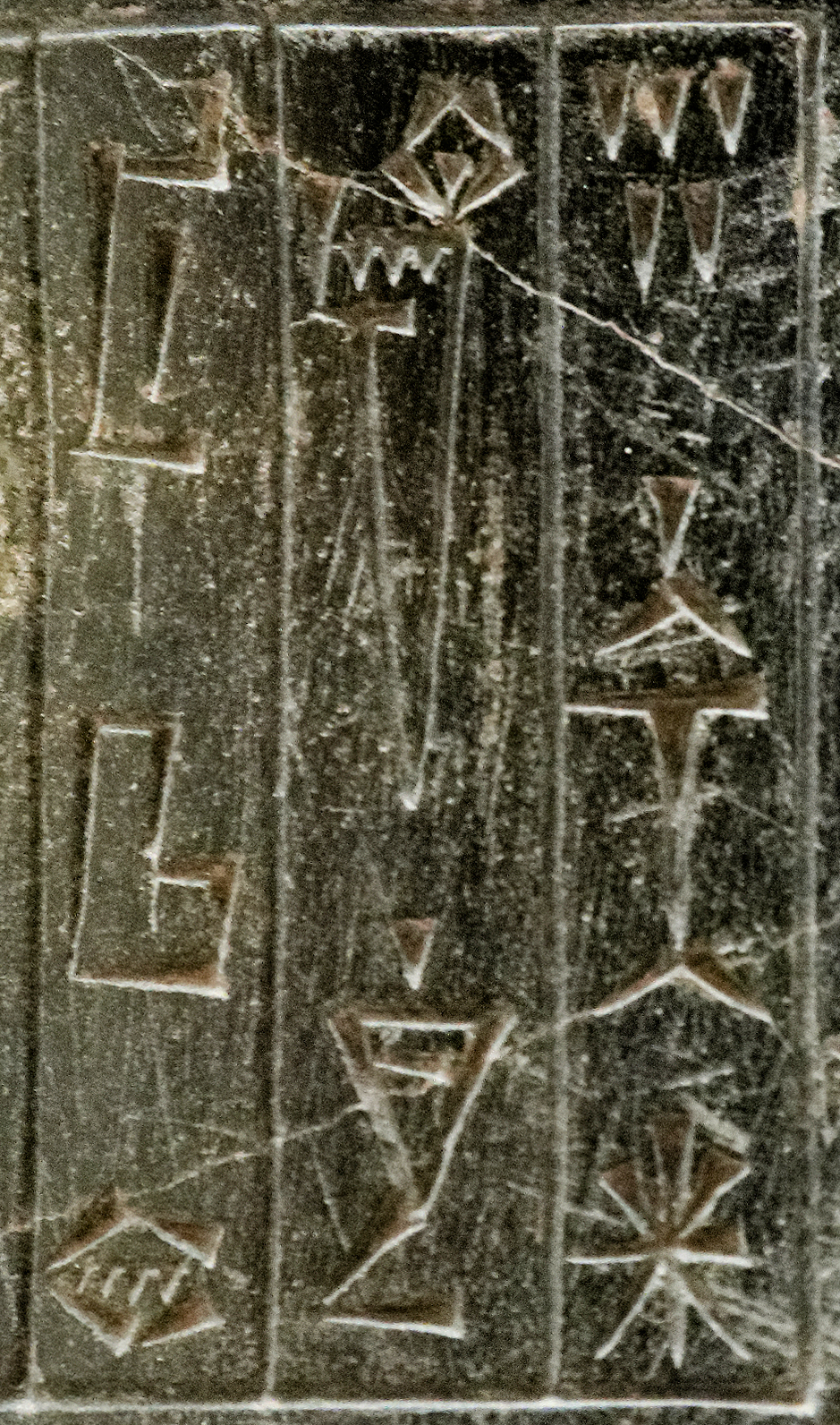
OnomasticsOnomasticsStudy of proper names, especially personal and place names, through their forms, languages, histories and social uses; a name alone does not establish its bearer’s identity or religion.Glossary · Click to read the explanation compares personal names with family records. Kathleen Abraham studies Hebrew and Yahwistic names in Babylonian cuneiformCuneiformWriting with wedge-shaped signs, developed from Mesopotamian recording traditions and used for several languages from the third millennium BCE.Glossary · Click to read the explanation archives, particularly administrative and family documents from the sixth and fifth centuries BCE. Family links, documentary context and spelling are needed to distinguish Hebrew names from Aramaic and Canaanite parallels. A divine element alone cannot mechanically identify its bearer’s background or belief.[2]
Judaism: named heavenly characters
Daniel distinguishes Michael as a heavenly prince and Gabriel as an interpreter. Tobit presents Raphael in a journey and healing narrative; First Enoch 20 lists several angels and their functions.[10][12][14][18] These are different witnesses, not a universally fixed Jewish roster.
More named subordinate beings need not contradict divine supremacy. Their names make statements about God: who is like God, God has healed. Names alone do not establish angelic rank, numbers or universal agreement about their functions.
Christianity: transmission through different texts
Luke 1:19,26 presents Gabriel in birth announcements.[21] Other names continue through Jewish writings and traditions received by Christians. Michael, Gabriel, Raphael and Uriel in European languages illustrate continuity alongside changing pronunciation.
Churches differ over the standing of particular writings. Tobit, Enoch and Fourth Ezra should not be treated as a single canon shared by every church. An angel’s position in Christian worship or tradition requires evidence for that community, not Hebrew etymology alone.
The Qurʾan: selective continuity
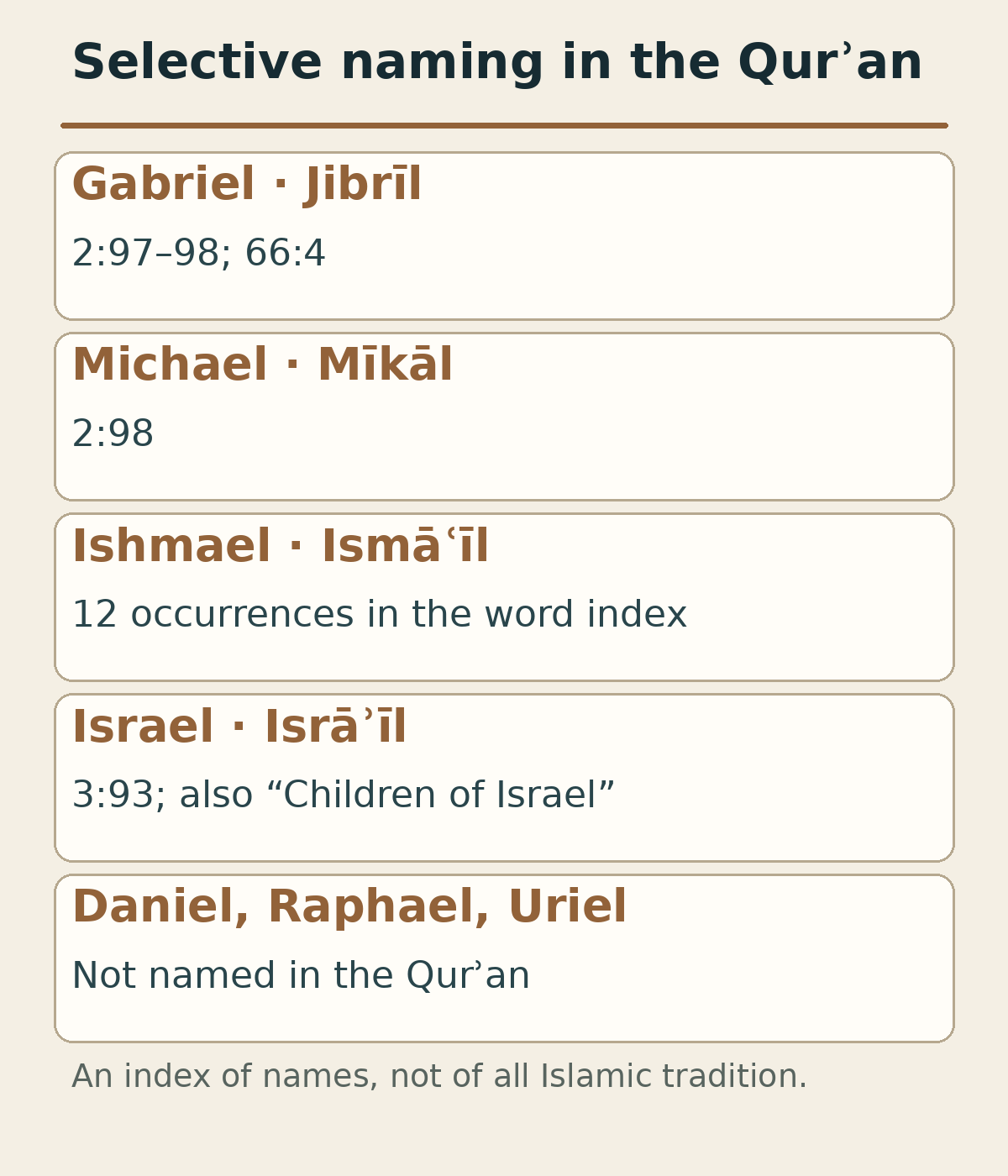
Of the seven names, the Qurʾan names Gabriel, Michael, Ishmael and Israel. Gabriel and Michael occur together at 2:98; Gabriel also occurs at 2:97 and 66:4.[22] The Quranic Arabic Corpus indexes twelve occurrences of Ishmael and identifies Israel at 3:93 and within the Children of Israel tradition.[23]
Daniel, Raphael and Uriel are not named in the Qurʾan; “Israel” in 3:93 functions in a Qurʾanic setting, not as a transcription of the Egyptian Merneptah inscription. This is not a claim that all are absent from every Islamic tradition, nor permission to equate figures with Jewish counterparts without investigation. Linguistic continuity is real and selective.
A borrowed name becomes a whole
An Arabic speaker can say Ismāʿīl or Jibrīl without separating a Hebrew root and El. Borrowed names can become complete lexical units in their new language. Their survival does not establish Ugaritic El as an independent divine name in Islamic doctrine.
The Turkish Encyclopaedia of Islam (TDV) explains Mīkāʾīl from Hebrew “who is like God?” and discusses possible transmission through Hebrew or SyriacSyriacAn Aramaic literary language rooted in Edessa, first attested in non-Christian inscriptions and later prominent in Christian writing, scholarship, translation and liturgy.Glossary · Click to read the explanation, without proving a single route for every form.[24] Some earlier scholars’ knowledge of a name’s components differs from independent use of the word in the language. Not every name must have followed the same route.
Raphael and Israfil: distinction without overclaiming
Raphael in Tobit is associated with healing; Israfil in Islamic tradition with sounding the trumpet, although the Qurʾan does not name him. Similar endings and sounds do not justify simply equating the figures.
An unproven equation, however, does not prove the impossibility of every etymological connection. TDV describes Israfil’s origin as uncertain and reports proposed links with Hebrew vocabulary associated with seraphim.[25] Distinguish the characters while treating Israfil’s etymology as a separate evidentiary question.
What survives, and what can be established?
These names preserve an old Semitic divine element, and their formation is used for humans and angels. Some meanings are clearer than others: Michael’s question and Daniel’s judgment statement are less disputed than the precise analysis of Israel or Uriel.
The bearer’s beliefs or an angel’s proposed former identity as a god cannot be proved from -el alone. Names must be compared with texts, inscriptions, period and setting. When a name survives changed beliefs, linguistic memory can outlast the meaning its users consciously recall.[2]
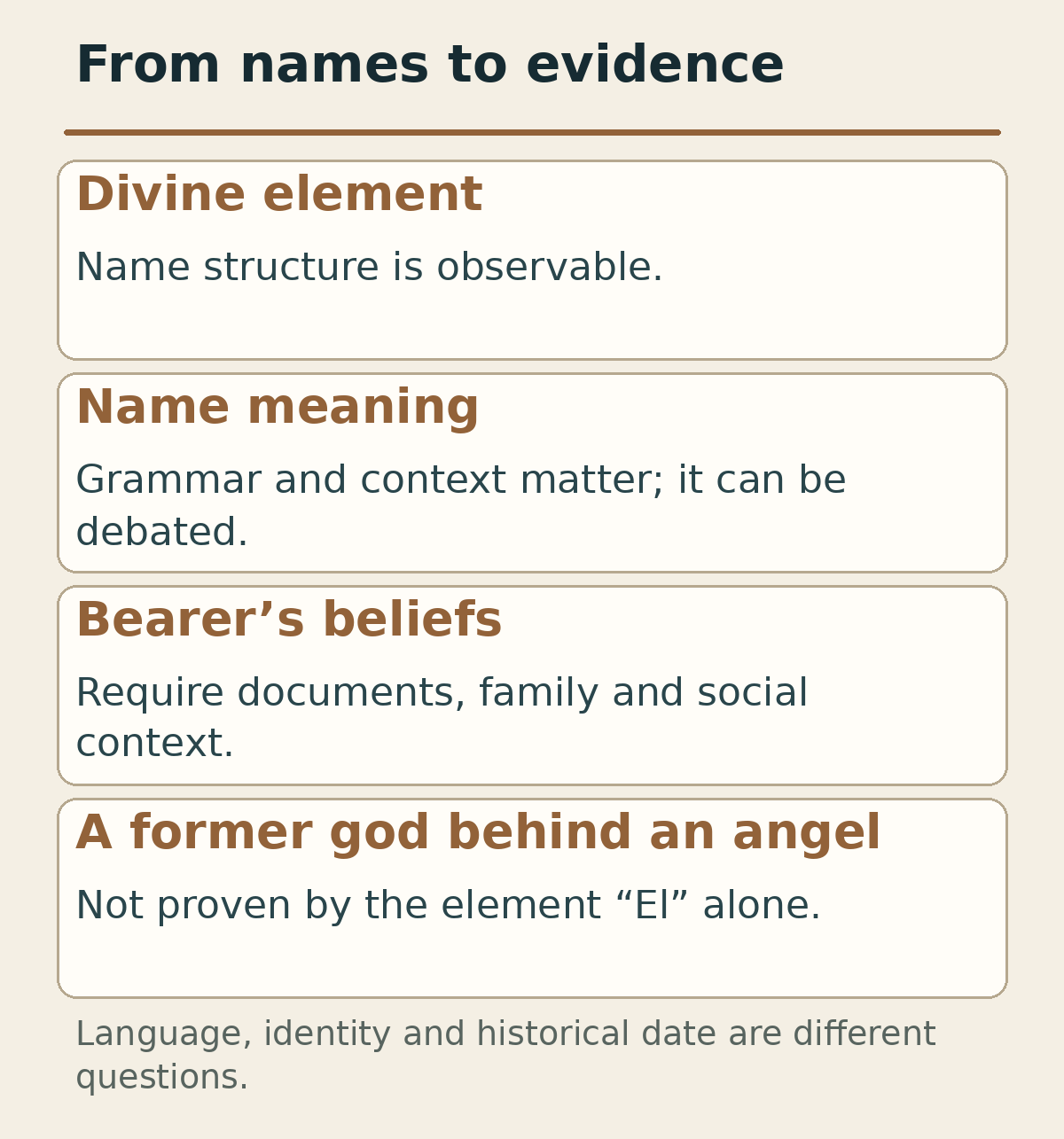
Languages and heavenly worlds changed as names travelled between communities. This does not make Judaism, Christianity and Islam concealed worship of Ugaritic El. It shows how religious vocabulary can enter human and heavenly names and preserve history older than their users’ awareness.
References and notes (26)
- Heath D. Dewrell & Andrew M. Garbarino (2023). Names of God in the Hebrew Bible. Oxford Bibliographies. doi:10.1093/obo/9780195393361-0318. Open introductory extract: El as common noun or divine name, compounds and convergence model. Full article not read; no chronological precedence of common noun or proper name inferred. Return to the text ↑
- Kathleen Abraham (2024). Hebrew Names. In C. Waerzeggers & M. Groß (eds.), Personal Names in Cuneiform Texts from Babylonia (c. 750–100 BCE), chapter 9, pp. 139–165. doi:10.1017/9781009291071.011. Selected HTML introduction and Historical and Ethno-Linguistic Background: contextual identification, overlapping languages/names and cuneiform ambiguity. Not the whole chapter or a review of every tabulated name. Return to the text ↑
- Global Egyptian Museum, “Merneptah Stele,” institutional object record JE 31408. English, Arabic and French object descriptions: re-used stela, Merenptah’s regnal year five, Israel as a people in line 27. No independent sign-by-sign collation; c. 1208 BCE remains approximate. Return to the text ↑
- Hebrew Bible, Genesis 32:29 (28 in many translations), Mechon-Mamre; Brown–Driver–Briggs, Israel, s.v. יִשְׂרָאֵל. Hebrew v.29, v.28 in many translations: narrative explanation. BDB entry inspected at https://biblehub.com/hebrew/3478.htm: persistence/struggle and alternatives. Added devotional commentary excluded; no single gloss settles the etymology. Return to the text ↑
- Encyclopedia of the Bible, “Ishmael,” §1 Name, hosted by Bible Gateway. Name paragraph only: El as subject, hearing predicate and tense/wish alternatives. Remaining narrative, patriarchal dating and social judgments are not historical evidence here. Return to the text ↑
- Hebrew Bible, Genesis 16:11. Mechon-Mamre, Hebrew and JPS 1917. Verse 11: Ishmael and Yahweh hearing Hagar’s affliction. Evidence for the surviving wording, not a contemporary document of the story’s setting. Return to the text ↑
- Robert R. Cargill (2023). Daniel. Bible & Archaeology, University of Iowa, 1 March. Short etymological paragraph: my judge + El. Its claim that the divine name later became the generic Semitic word is not adopted; that sequence is not established here. Return to the text ↑
- Joseph Jacobs, M. Seligsohn & Mary W. Montgomery. Michael. Jewish Encyclopedia (1901–1906), opening “Israel’s Advocate” paragraph. Etymology and Daniel context in opening paragraph. Historical reference work, not adopted as authority for every later legend or date of the name’s origin. Return to the text ↑
- Hebrew Bible, Numbers 13:13. Mechon-Mamre, Hebrew and JPS 1917. V.13: Sethur son of Michael, a human bearer. Narrative setting does not date the name’s earliest formation. Return to the text ↑
- Hebrew Bible, Daniel 10:13,21. Mechon-Mamre, Hebrew and JPS 1917. Vv.13,21: Michael among chief princes and as the community’s prince. Heavenly identity in the text, not evidence of Ugaritic divine origin. Return to the text ↑
- Bible & Archaeology, University of Iowa (2022). Gabriel, 24 February. Etymological paragraphs: man/strength semantic field and Man of God / God is my strength analyses. No single analysis is imposed. Return to the text ↑
- Hebrew Bible, Daniel 8:16. Mechon-Mamre; Brown–Driver–Briggs, Gabriel, s.v. גַּבְרִיאֵל. V.16, commission to interpret the vision. BDB at https://biblehub.com/hebrew/1403.htm also inspected: man of El and Daniel 8:16;9:21. Added devotional material is not used. Return to the text ↑
- Brown–Driver–Briggs and Strong, Rephael, Hebrew entry 7501, reproduced on Bible Hub. Original lexical sections: healing root + El and human name in 1 Chronicles 26:7. Added religious commentary is not used to date the figure. Return to the text ↑
- Tobit 12:14–15,18. King James Version, transcribed on Wikisource. Vv.14–15,18: healing, seven angels and divine commission; also 3:17 inspected. Historical translation, not an original manuscript; no identical wording assumed across all Tobit recensions. Return to the text ↑
- Hebrew Bible, 1 Chronicles 26:7. Mechon-Mamre, Hebrew and JPS 1917. V.7: וּרְפָאֵל, a human, rendered Rephael in JPS. Different transliteration from Raphael made explicit; no identity with the angel inferred. Return to the text ↑
- NET Bible Study Dictionary, Uriel: reproduced Strong, Easton, Smith and ISBE entries. Lexical sections preserving light/fire alternatives, human attestations and Enoch 20. Collected historical dictionaries, not a modern lexical consensus; old narrative dates are not used to date name formation. Return to the text ↑
- Hebrew Bible, 1 Chronicles 15:5,11. Mechon-Mamre, Hebrew and JPS 1917. Vv.5,11: Uriel as a Levitical leader. Book ordering does not establish precedence of human over heavenly naming. Return to the text ↑
- R. H. Charles (1912), The Book of Enoch, chapter 20, translation hosted by Internet Sacred Text Archive. Chapter 20: named angels including Uriel, Raphael, Michael and Gabriel. Published translation read, not Enoch manuscripts or a modern critical edition; roles and lists vary across passages and traditions. Return to the text ↑
- Annette Yoshiko Reed (2020). Rethinking Scribalism and Change in Second Temple Judaism. Demons, Angels, and Writing in Ancient Judaism, chapter 2. doi:10.1017/9781139030847.004. Publisher summary only: written angelology/demonology and third-century BCE Aramaic context. Full chapter not read; proposal does not date the first belief in a heavenly messenger. Return to the text ↑
- USCCB, New American Bible Revised Edition, Introduction to Daniel. Introduction: composition in 167–164 BCE context and traditional stories. Date applies to final form without assuming every component or tradition began then. Return to the text ↑
- New Testament, Luke 1:19,26. USCCB, NABRE. Vv.19,26: Gabriel identifies his commission and appears in Mary’s annunciation. Does not establish a universal canon or one angelic tradition for all churches. Return to the text ↑
- Qurʾan 2:98; 66:4. Quranic Arabic Corpus, text and translation pages. 2:98 names Gabriel and Michael; 66:4 read at https://corpus.quran.com/translation.jsp?chapter=66&verse=4. Word-by-word 2:97–98 entries also inspected, including lijib’rīla and wamīkāla. Qurʾanic names distinguished from all Islamic tradition. Return to the text ↑
- Quranic Arabic Corpus, Ishmael and Israel concept entries and occurrence indexes. Ishmael entry/index: 12 occurrences; Israel at https://corpus.quran.com/concept.jsp?id=israel and 3:93. Count refers to the name Ishmael, not stories; Israel’s index does not enumerate all references to Jacob. Return to the text ↑
- Lütfullah Cebeci. Mîkâil. TDV İslâm Ansiklopedisi, electronic entry. Origin paragraph: Hebrew mikaʾel and possible Hebrew or Syriac transmission. Alternatives are not proof of one route for every name. Return to the text ↑
- Lütfullah Cebeci (2001). İsrâfil. TDV İslâm Ansiklopedisi 23, pp. 180–181, electronic entry. Opening paragraphs: uncertain origin, seraphim proposals and absence of the name from Qurʾan. Used to delimit certainty, neither prove derivation from Raphael nor rule out every possible relationship. Return to the text ↑
- Robert R. Cargill, “Hello, My Name Is: JOSHUA,” Bible & Archaeology, University of Iowa, 3 May 2023. Name-formation paragraph: Hebrew יהושע / Yehoshua joins a Yahwistic element and a verb of saving or helping; comparative example outside the seven names, not historical proof about an individual family. Return to the text ↑
Media
Photograph
Merneptah Stele, JE 31408, Egyptian Museum, Cairo; photographed in 2003. The inscription attests Israel around 1208 BCE. Evidence for the group’s name, not a Hebrew analysis of El or a stand-alone statement of its beliefs. Perspective-corrected version reused unchanged
Webscribe; perspective correction: Dontworry · Wikimedia Commons · CC BY-SA 3.0
License · Image sourceSuggest a correction · Suggest a source for this record
Cite this record
IL Archive, «El in Human and Angelic Names», https://ilarchive.com/en/studies/el-in-names
Continue reading