Study
When Was the Torah Written?
An extended study of a topic, with evidence and references.
A historical review separating the time of the Moses narratives from the origin of the traditions and the editing of the five books in monarchic and Persian times, with evidence from Ketef Hinnom to the Masoretic text.
Estimated reading time: 15 min Published Last reviewed:
Share article
Dates
Dates have distinct roles. The timeline uses creation, composition or historical coverage, rather than publication or discovery dates.
- Historical coverage
- Approximately From 900 BCE to 1100 CE
Text
Introduction
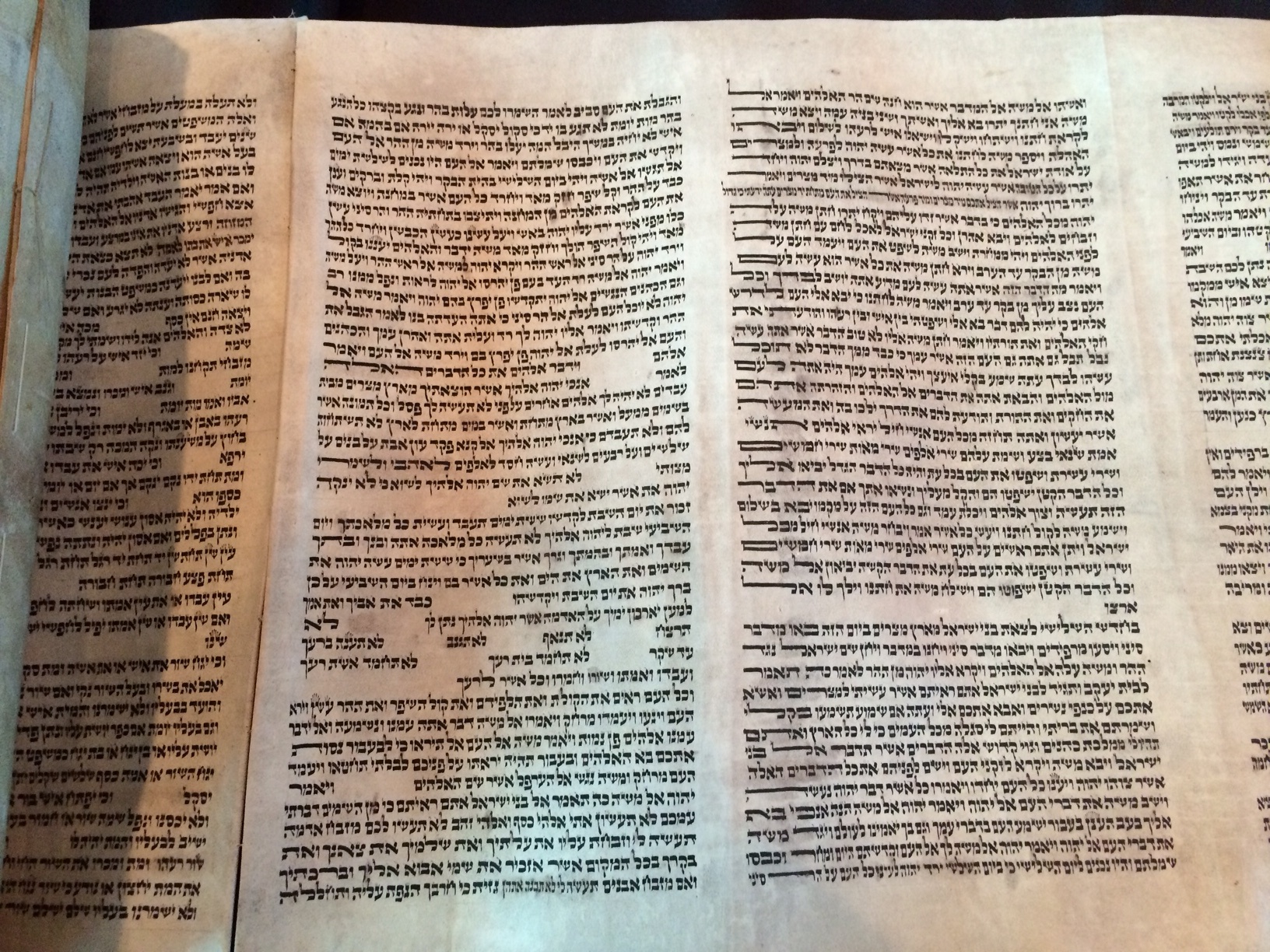
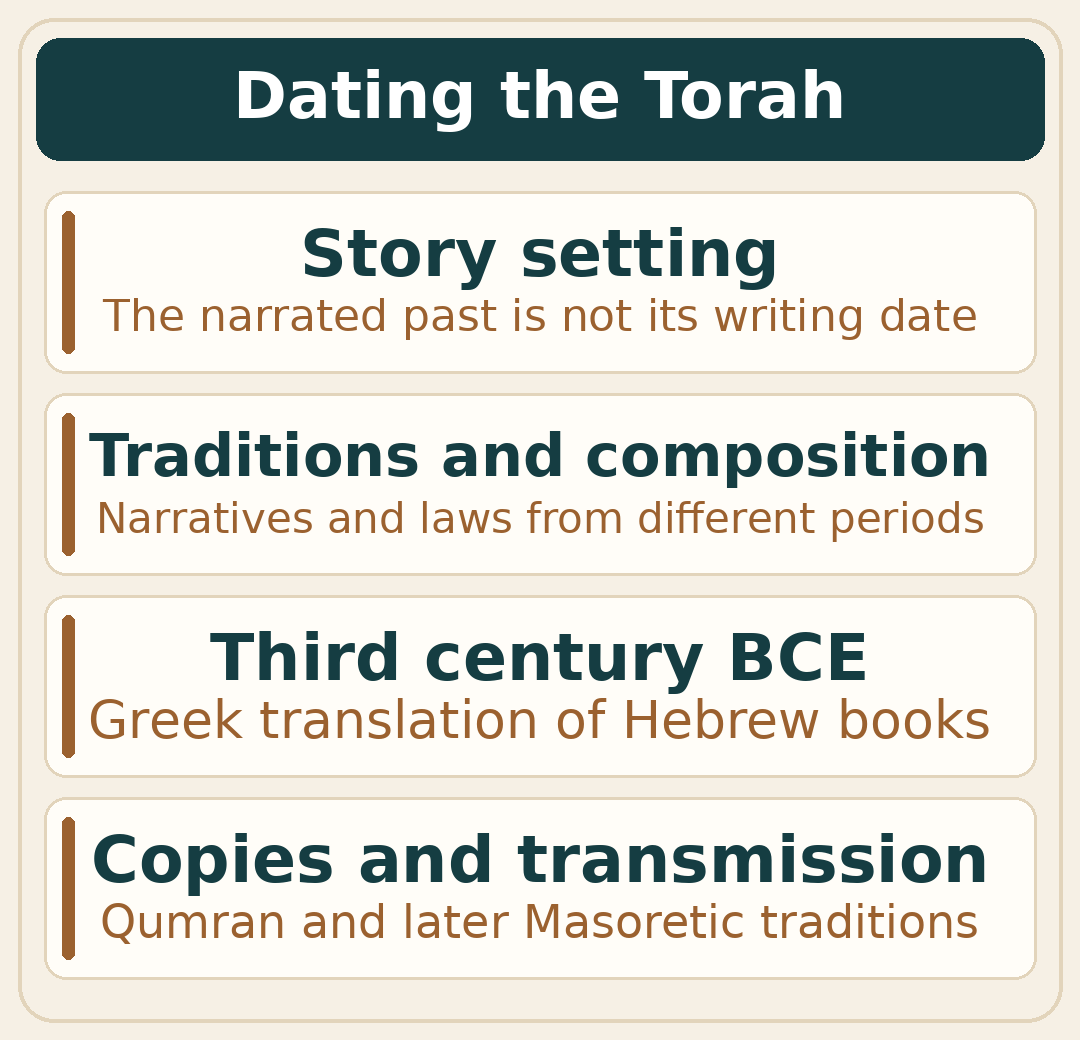
“When was the Torah written?” is not a question with one date. We must distinguish the period in which the narrative sets its events, the age of oral and written traditions, the formation and editing of the five-book PentateuchTorah / PentateuchThe first five books of the Jewish and Christian Bible: Genesis, Exodus, Leviticus, Numbers and Deuteronomy. They combine narrative and law from creation to Moses’ death; in Jewish usage, “Torah” can also encompass a wider body of authoritative teaching.Glossary · Click to read the explanation, and the history of manuscripts and translations transmitting its wording. A blessing preserved on an early silver object does not prove that an entire biblical book already existed; a late manuscript does not establish that all the material it transmits was composed late.
This study compares the literary and material evidence with modern scholarship without treating any single compositional theory as settled fact. Multiple layers and editorial processes are well supported, yet the dating of particular passages, the agents of collection and the point at which the corpus took shape remain disputed. Each section distinguishes direct testimony from scholarly interpretation and unresolved hypotheses.[1]
What “Torah” means and the attribution to Moses
In later Jewish and Christian usage, Torah can designate Genesis, Exodus, Leviticus, Numbers and Deuteronomy: the PentateuchTorah / PentateuchThe first five books of the Jewish and Christian Bible: Genesis, Exodus, Leviticus, Numbers and Deuteronomy. They combine narrative and law from creation to Moses’ death; in Jewish usage, “Torah” can also encompass a wider body of authoritative teaching.Glossary · Click to read the explanation, or five books of MosesMosesCentral figure in Exodus, Torah traditions and the Qur’an; childhood accounts differ in detail.Glossary · Click to read the explanation. HebrewHebrewA Northwest Semitic language of the Canaanite group, encompassing Iron Age epigraphy, Biblical, Rabbinic, medieval and Modern Hebrew; its scripts and pronunciations changed over time.Glossary · Click to read the explanation torah also means instruction, guidance or law. It was not always a technical title for exactly the present five-book collection. Even in Second Temple JudaismSecond Temple JudaismDiverse Jewish traditions between the rebuilding of Jerusalem’s temple around 515 BCE and its destruction in 70 CE: institutions, diaspora, groups and texts, with distinctions between events, composition, manuscripts and the limits of evidence.Glossary · Click to read the explanation its uses could extend beyond that corpus.[2]
Consequently, an ancient reference to a book of Moses’ law does not automatically identify a copy identical to today’s Pentateuch. It might designate that collection, an earlier form or a smaller body of legislation. The evidence must decide.
Moses is the central human figure in four of the five books. From Exodus to Deuteronomy he receives laws, speaks with YahwehYahwehThe proper name of Israel’s deity, written יהוה (YHWH), the Tetragrammaton. Its exact ancient pronunciation is not directly preserved; texts and inscriptions witness its history.Glossary · Click to read the explanation, transmits instruction and writes particular things. Deuteronomy presents his final speeches and describes his writing of this Torah.[3] Such claims underlie ancient Jewish and Christian attribution of the Torah to Moses.
Historical inquiry asks a different question: when did the surviving work take shape, according to its language, literary structure, historical context and manuscripts? Attribution of authority and date of composition need not coincide. A law associated with a founding figure may be expanded and edited by later generations. Conversely, later writing does not establish that every tradition was invented then. The time of a story is not the time of writing that story.
An Exodus manuscript securely dated to the Late Bronze AgeLate Bronze AgeAn archaeological period around 1600–1200 BCE in much of the Near East, with international diplomacy, exchange and religious diversity; its endpoints vary by region.Glossary · Click to read the explanation would change the discussion. We have no such witness, nor a surviving Pentateuch manuscript from the thirteenth, twelfth or tenth century BCE. The substantial ancient manuscript evidence comes much later, especially the Qumran biblical copies, generally dated from the mid-third century BCE to the first century CE.[4]
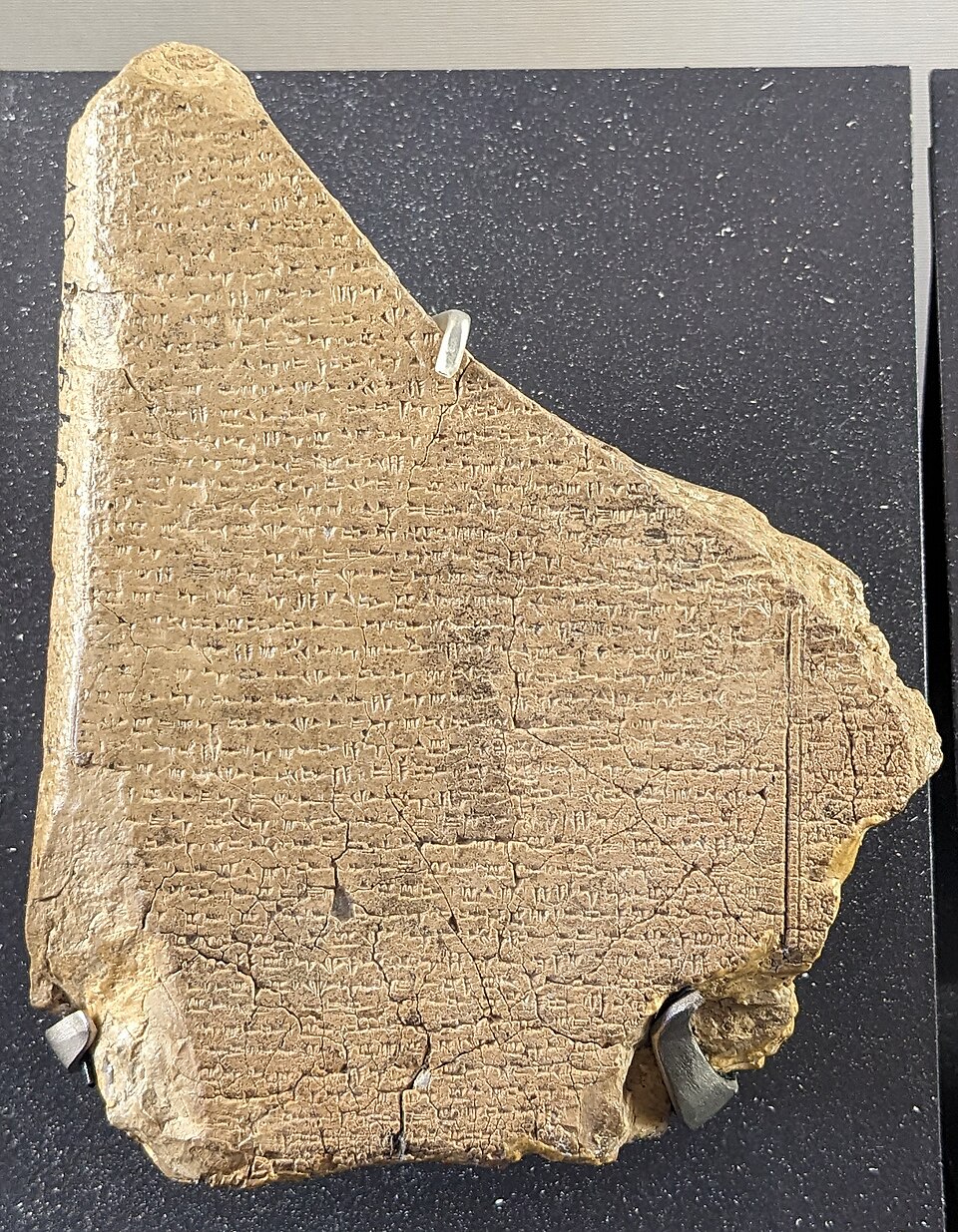
Dating earlier composition therefore depends on indirect evidence: language, institutions, laws, relationships between passages, repetitions, differences and editorial work; parallels with Assyrian, Babylonian and other texts; inscriptions; and later manuscripts and translations. The result is a historical reconstruction, not a radiocarbon date for an original author’s copy.
How researchers identify textual layers
The Torah does not present a single simple literary voice. Events can be narrated differently; language and divine names vary; related laws contain different provisions. Priesthood, sacrifice, sacred space and leadership receive differing treatment. Such observations prompted nineteenth-century theories of sources and layers.
The best-known is the documentary hypothesisDocumentary hypothesisA hypothesis explaining the formation of the Torah through the combination of previously independent literary works. Its classical form distinguishes four sources, Yahwistic, Elohistic, Deuteronomic and Priestly (J, E, D and P); modern versions differ over their extent, dates and manner of combination.Glossary · Click to read the explanation, with sources conventionally called J, E, D and P. Some scholars retain revised documentary models; others describe basic texts expanded through successive supplements and redactions. The general case for a compositional history does not require agreement with the classical model in every detail.[5][23]
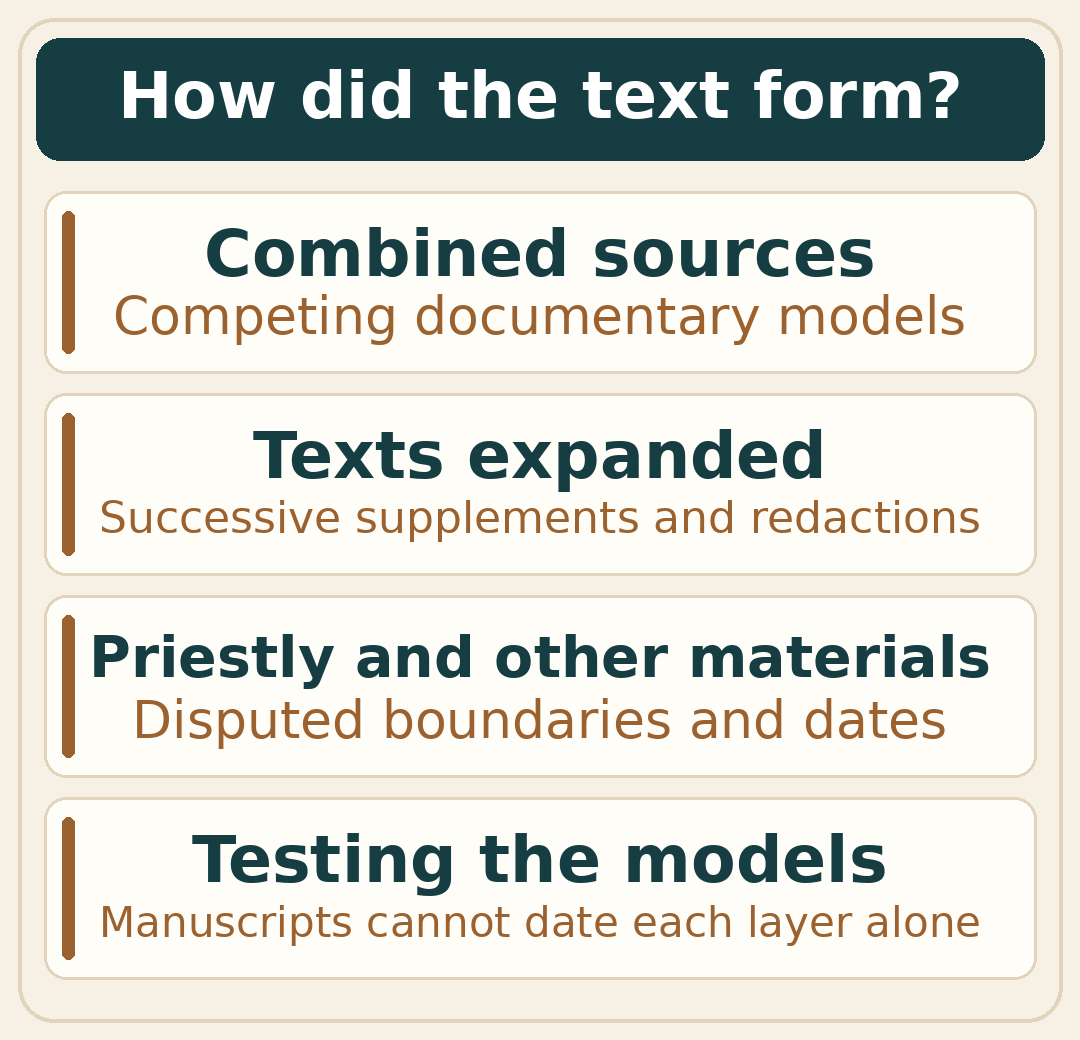
Yes. A comparatively late collected form need not make every tradition equally late. Scholars identify possible preexilic narrative, poetic and legal materials, sometimes with an earlier oral background.
Frank Polak, for example, correlates linguistic features and social context and proposes an oral/written narrative stage in the ninth or early eighth century BCE. That is his reconstruction, not an agreed date for every passage.[6] Dating a final collection to the fifth century would not by itself date all its stories to that century.
Ketef Hinnom: an old blessing is not an entire old book
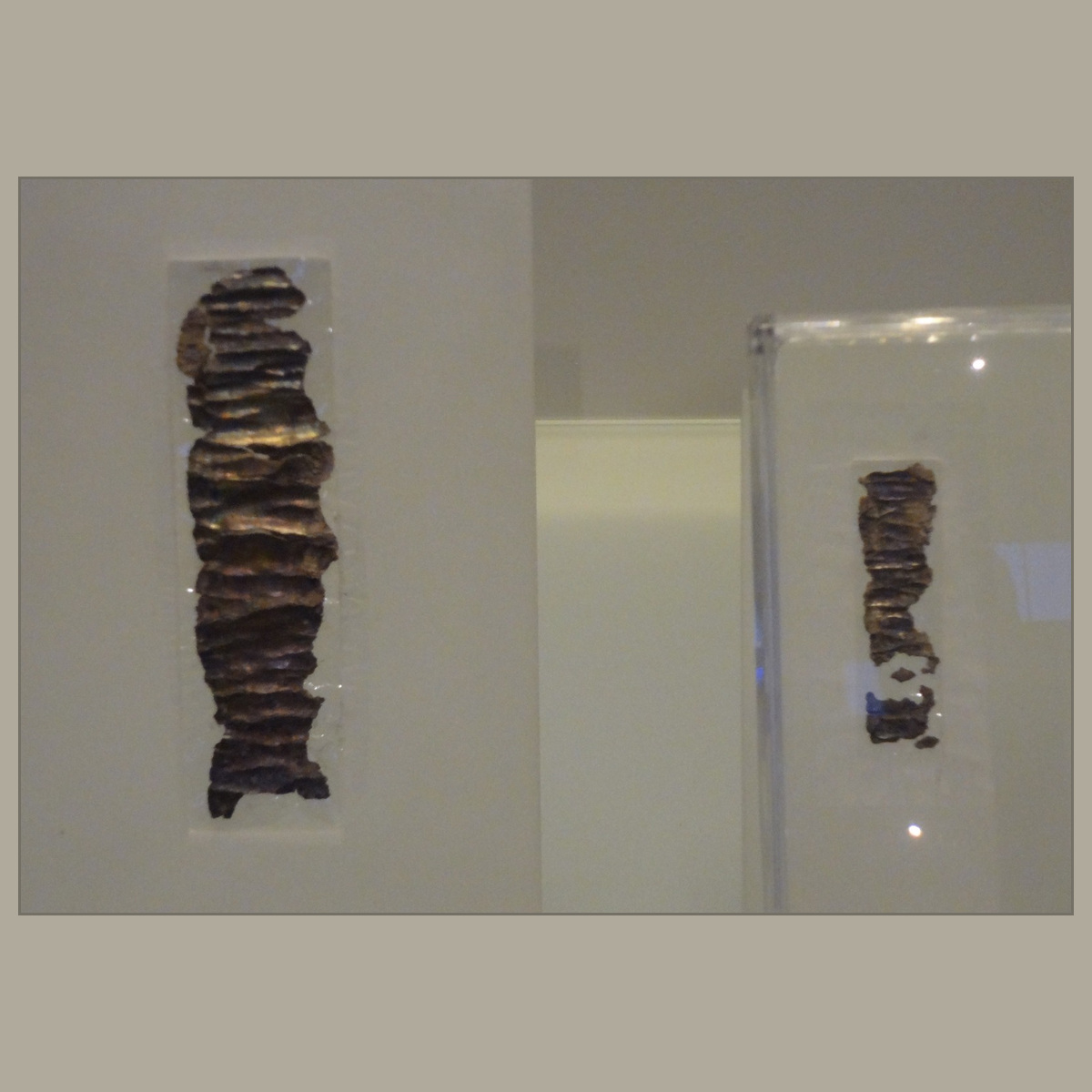
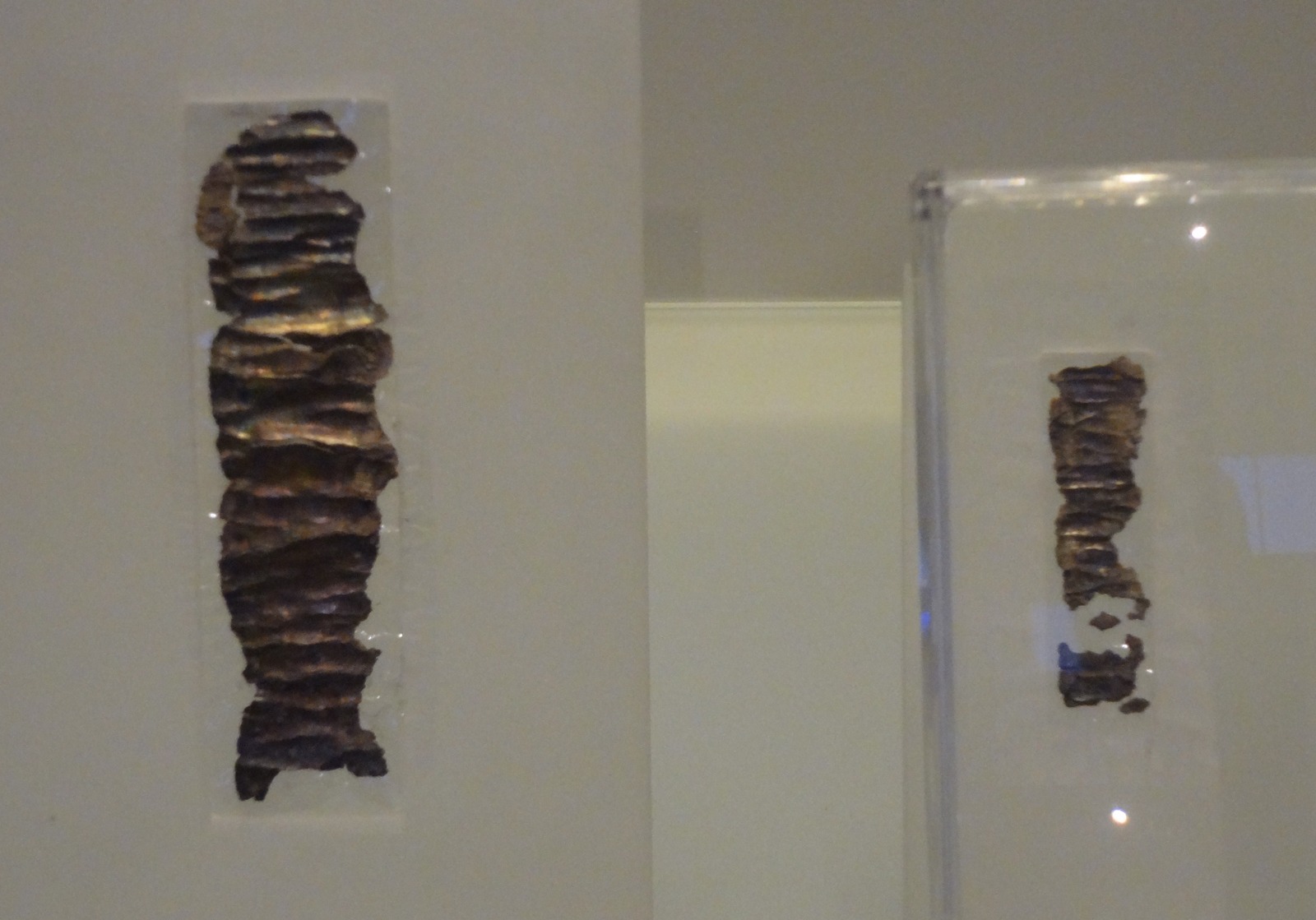
The Ketef Hinnom amuletsKetef Hinnom amuletsTwo inscribed silver amulets found at Ketef Hinnom near Jerusalem in 1979, bearing protective blessings parallel to Numbers 6:24–26. Generally dated to the late seventh or early sixth century BCE, though disputed; they do not date the entire book.Glossary · Click to read the explanation make the distinction concrete. Two small silver scrolls discovered in JerusalemJerusalemJerusalem is a city of religious importance in Judaism, Christianity and IslamGlossary · Click to read the explanation contain wording closely related to the priestly blessing in Numbers 6. They are usually placed in the late seventh or early sixth century BCE; the 2004 reevaluation supports a late preexilic context, while the museum catalogue uses a broader sixth-century dating.[7][24]
They attest an old blessing or a related tradition. They do not establish that all of Numbers, in its current sequence, already existed. An ancient component within a book is not evidence that the entire book had reached its present form.
A crucial qualification from more recent specialist work: the two inscribed texts are not complete verbatim copies of Numbers 6:24–26. They witness related blessings used for protection. Their amuletic function cannot date the final editing of Numbers; the phases of use of the burial complex also need to be distinguished from the exact date when each silver strip was inscribed.[27]
Deuteronomy and Josiah’s reform in the seventh century BCE
Second Kings describes a book of law discovered in Jerusalem’s temple under Josiah, in the later seventh century BCE, prompting reforms. A longstanding scholarly interpretation identifies it with an early form of Deuteronomy rather than the whole Pentateuch. Centralized worship is a major point of comparison.
This remains influential, but the dating and precise relationship are contested. Sweeney’s discussion compares a Josianic setting with earlier northern reconstructions.[8] Other models give greater weight to exilic or later editing. An earlier nucleus and later layers are different questions.
The narrative itself has Hilkiah find “the book of the law” in the temple and has it read to the king in 2 Kings 22:8–20; chapter 23 then recounts covenant renewal and cultic reforms. This is an ancient literary witness with a narrative and political purpose. Identifying the found scroll with the Deuteronomy known today is an influential scholarly inference, not a statement made explicitly by Kings.[26]
The Babylonian exile and the rewriting of the past
BabylonBabylonBabylon is an ancient city in central present-day Iraq, south of BaghdadGlossary · Click to read the explanation’s destruction of Jerusalem and its temple, the end of the Judahite monarchy and deportations of part of the elite created a profound crisis. How could the community survive without its kingdom? How should defeat be understood in relation to Yahweh, covenant and land?
Scholars often connect substantial literary and theological work with exile and its aftermath. Deuteronomistic traditions interpret catastrophe through disobedience rather than Yahweh’s defeat. Priestly materials are frequently related to exilic or postexilic settings, although their dates, scope and formation remain debated.[9][10] Writing could preserve older stories while redefining communal identity, membership and law.
The Persian period and the combination of traditions
Babylon fell to Persia in 539 BCE. Persian rule in the region continued until Alexander’s conquests in the later fourth century. This period is central to many reconstructions of pentateuchal formation: combining priestly and non-priestly traditions and connecting Genesis with the Mosaic story.
The model does not require an author to have invented five books from nothing in 450 BCE. Scribes and editors could combine materials of different ages into a narrative extending from creation to Moses’ death. Persian-period origins are an important research framework, but no single final closure date commands universal agreement.[12]
A strong version of the imperial authorization theory proposes that Persian authorities required or approved a unified local law. The evidence does not securely establish that the empire ordered the production of the Pentateuch.
Brett’s analysis favors more indirect imperial pressures and compromises among local traditions and institutions over official authorization.[11] Persian governance, rebuilding Judah and negotiations among priestly and other groups could matter without a documented decree to write five books.
Ezra and the authority of a written law
Nehemiah 8 depicts Ezra bringing a written law to a gathered community, reading and explaining it, followed by communal observance.[13] Its narrative setting is Persian. The scene portrays the authority of a Mosaic Torah; it is not an independently dated transcript of the event or an inventory of every passage in the book.
Lim points to differences between Ezra-Nehemiah’s regulations and the present Pentateuch, including temple contributions and festival observance.[14] Proposals range from a collection close to the five books to another arrangement of Mosaic materials. The story’s setting, its date of writing and the precise contents of Ezra’s book must remain distinct.
Neither the narrative nor the available evidence warrants saying that Ezra composed the entire Torah. He is presented as a scribe learned in an already existing Mosaic law. Later traditions gave him a major restorative role after exile.
His period may have been important for collecting, editing, disseminating, interpreting or establishing the authority of Torah. These possibilities do not establish authorship of all five books by one person.
The Greek Pentateuch and the Letter of Aristeas
The Greek Pentateuch was translated in Ptolemaic Egypt, probably in or around Alexandria, generally dated to the middle or later third century BCE.[15][16] Translation presupposes available Hebrew source texts. By this period it is therefore difficult to speak of the Pentateuch as a collection that had not yet taken shape.
This is a substantial chronological limit for the existence of the Hebrew books, not evidence that every reading was permanently fixed. Nor does translation alone reveal how old its source texts were before the translators used them.
The Letter of Aristeas narrates a royal initiative involving seventy-two Jewish elders translating law into Greek. Most scholars place the letter itself in the second century BCE, later than its purported setting, and treat it as a literary foundation story rather than a contemporary administrative record.[22]
It describes translation of an existing law, not its first composition. It cannot by itself establish when all Hebrew materials were written. Independent study of the Greek texts supports their character as translations; translating them in the third century does not measure their previous age.
Qumran: an established corpus with multiple textual forms
Completion can mean recognition of the five-book literary collection. It can also mean that every word was identical across copies. Those processes need not coincide.
An authoritative corpus can circulate in different copies with variant readings, expansions and arrangements. That is what the next group of witnesses makes visible.
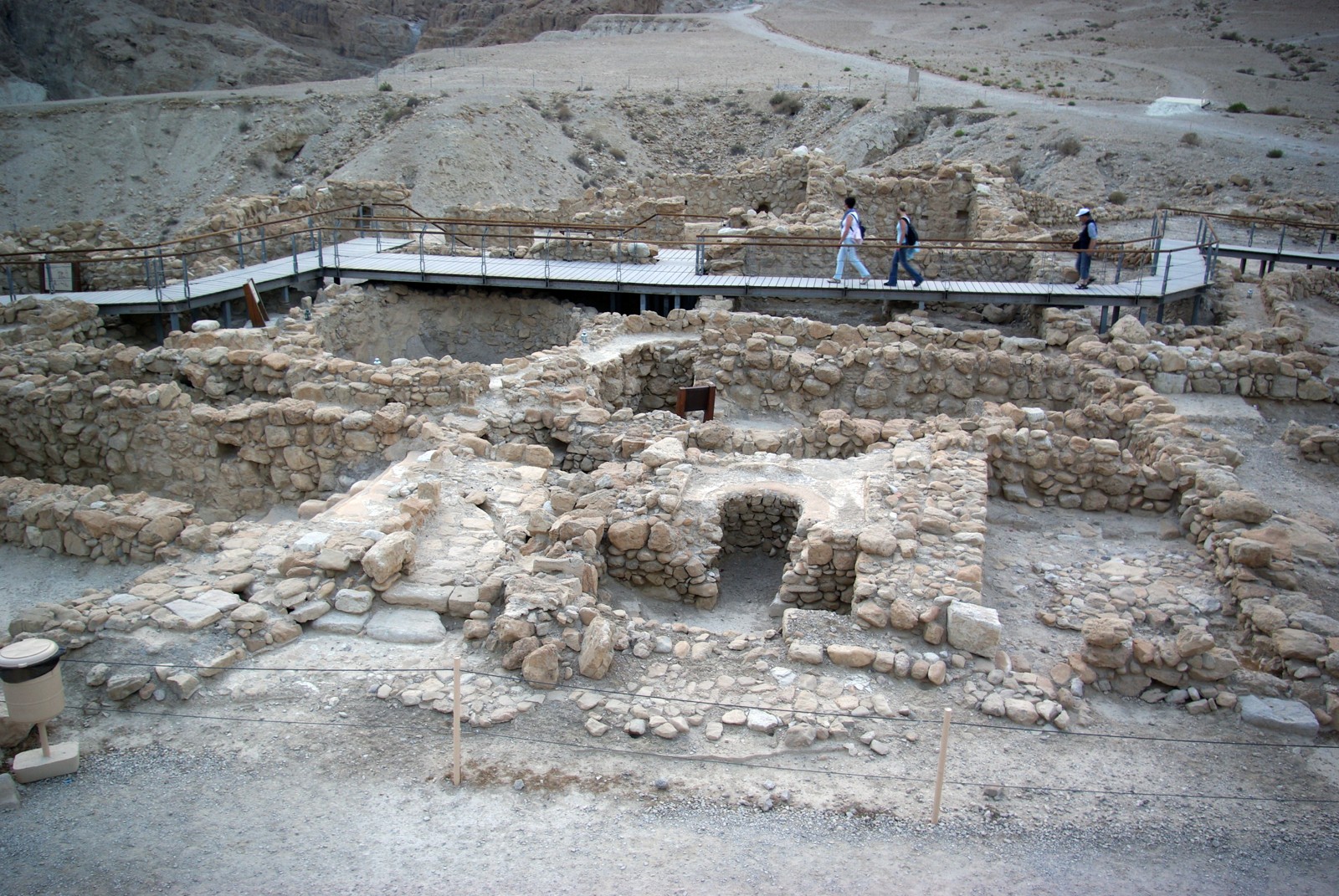
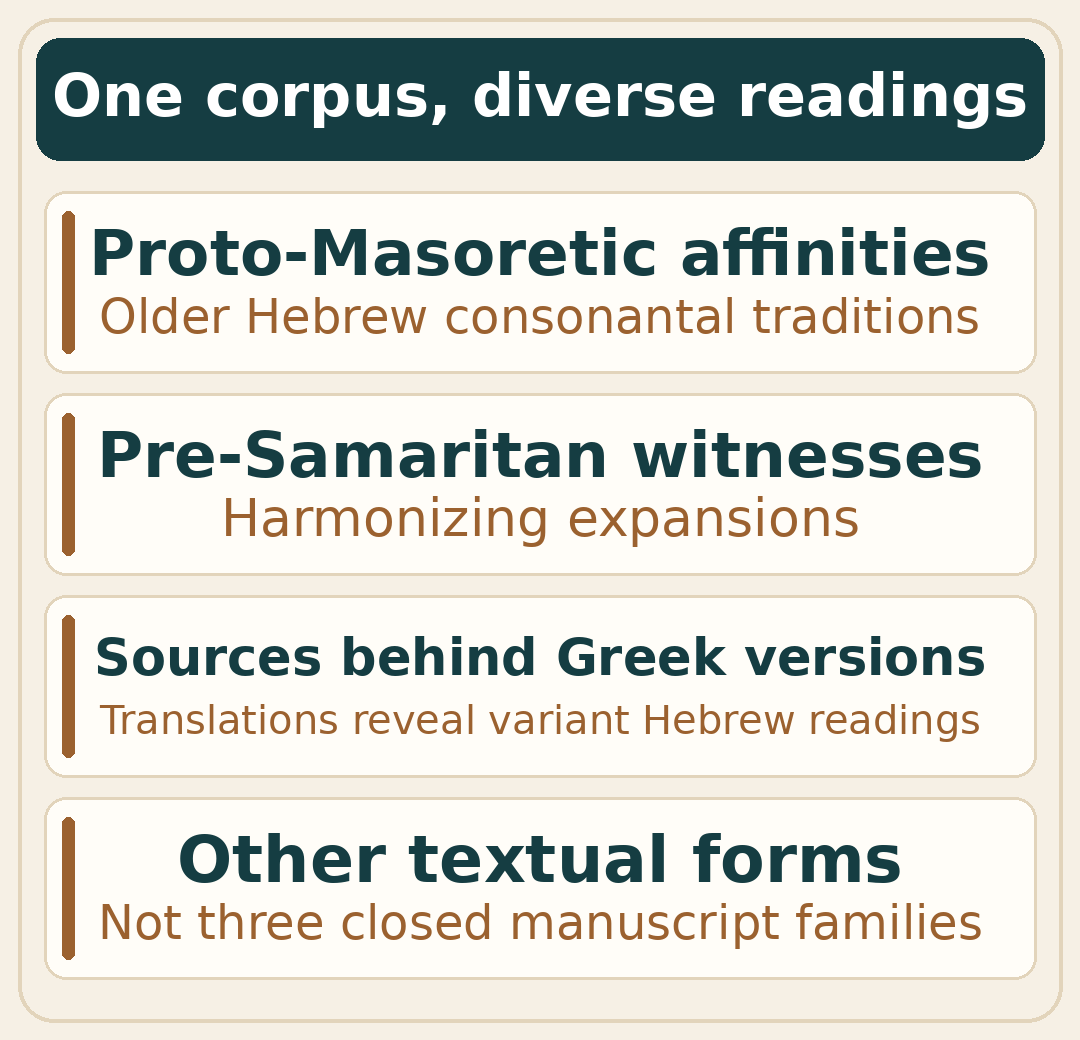
The Dead Sea ScrollsDead Sea ScrollsManuscript collections from the Judaean Desert, best known through Qumran: diverse works, languages and textual forms, with copying distinguished from composition.Glossary · Click to read the explanation, discovered from 1947, preserve biblical manuscripts from the last centuries BCE and the first century CE, alongside many other works.[25] Some resemble the later Masoretic textMasoretic TextThe Hebrew Bible’s transmission tradition combining its consonantal text, transmitted vocalization and accentuation, and Masorah notes. The consonantal text has ancient roots; surviving codices that bring these layers together in their Masoretic form are medieval.Glossary · Click to read the explanation; others have readings related to Hebrew sources behind Greek translations or to harmonizing, pre-Samaritan traditions. Other copies resist a neat classification.
The manuscripts changed textual criticismTextual criticismComparison of written witnesses and ancient translations to explain variant readings and textual transmission, distinguishing attested text from restorations and inferred ancestors.Glossary · Click to read the explanation by exposing diversity within works already treated as authoritative.[19] These affinities are not three perfectly sealed textual families. They show why asking when writing ended requires specifying what kind of completion is meant.
The Samaritan Pentateuch and Mount Gerizim
The Samaritan PentateuchSamaritan PentateuchSamaritan Hebrew five-book tradition sharing an older textual history, with linguistic and theological variants, including readings involving Mount Gerizim.Glossary · Click to read the explanation is the Samaritans’ scriptural corpus. It differs from the Jewish Masoretic tradition in many details, often involving spelling or language, with fewer larger literary and theological differences, notably readings concerning Mount Gerizim.
Qumran’s harmonizing witnesses complicate a picture in which all distinctive Samaritan features were invented by changing an already fixed Jewish text. The traditions share an older textual history alongside subsequent communal developments.[17][18] That does not mean every Samaritan reading has the same origin or date.
Samaritan adoption of the Pentateuch complicates a model of a finished Jerusalem-only text simply sent elsewhere. Deuteronomy’s law speaks of a place chosen by Yahweh without explicitly naming Jerusalem. Different communities could read that language in relation to different sanctuaries.
Some scholars consider negotiations or shared traditions between Judah and Samaria important to formation. This remains a reconstruction, not evidence for a documented political meeting that drafted the Torah by agreement. It reminds us that the relevant religious world was diverse.
The Qumran manuscripts commonly called “pre-Samaritan” must not be equated with the later specifically Samaritan religious recension. Many expansions and harmonizations belonged to a wider shared scribal history; not every variation is a sectarian intervention. Recent textual criticism treats these variants as evidence for editorial expansion during transmission, rather than merely “errors” against an assumed eternally fixed text.[29]
Textual authority and the Masoretic tradition
Textual variation does not in itself mean that a work lacked sacred authority. A modern expectation of identical printed copies can distort manuscript culture. Scribes copied, corrected, clarified and sometimes harmonized texts; parallel literary forms could develop.
Such plurality need not imply absence of religious authority. Qumran shows that highly valued writings could exist in different textual forms at the same time. Their status and their exact wording are related but distinct questions.
This belongs to transmission history, not the initial composition of the Torah. The Masoretic tradition underlies many modern editions of the Hebrew Bible. Its medieval codices preserve a much older consonantal text, with close relatives among ancient manuscripts.
Vowels, accents, reading marks and Masoretic notes were added and cultivated by medieval specialists.[20] Dating a surviving codex to the Middle Ages does not date the Torah’s composition to that period. Nor was one textual form ever imposed on all Jewish, Samaritan and Christian communities alike.
Distinguishing earlier tradition from later editing
Imagine a song beginning in the tenth century BCE, circulating orally, then being written, incorporated into a larger work and later given an introduction or conclusion. The eventual fifth-century book could contain a much older song.
This is an illustration of possible accumulation, not the history of a specific verse. A statement that a book took shape after exile is different from saying that everything in it was invented after exile. Conversely, an old tradition does not guarantee that its later wording preserves an event unchanged.
There is no clock inside a verse. Researchers compare institutions, political settings, language, independently dated inscriptions, reuse in other works and apparent editorial relationships. Sometimes the evidence establishes a relative sequence more readily than an absolute date.
Each method has limits. Later writers can imitate older styles; traditions can preserve old details while undergoing revision; a story’s historical setting can be a literary reconstruction. Dates are usually proposed as periods, centuries or contextual possibilities, not an exact year for each line.
Five books and many literary genres
A model in which one author wrote all of Genesis, another all of Exodus and a later collector merely bound them together is too simple. Literary materials cross current book boundaries. Priestly passages, for example, extend across several books; laws and revisions connect different portions.
Researchers also investigate the division into five unequal scrolls and its relation to earlier narrative units.[21] The question is both when parts were written and how a five-book corpus emerged.
The Torah includes beginnings, ancestral stories, Moses’ career, laws, poems, genealogies, priestly instructions, purity rules, itineraries and festivals. There is no reason to assume that all these genres began together.
A law may precede its narrative frame; a story may precede its present theological explanation; an editor may incorporate an old poem or adapt a law to another institution. The more productive question is how these materials became the text called Torah.
Persian or Hellenistic formation? The limits of dating
Many reconstructions place decisive collection and editing in the Persian period, especially the fifth and fourth centuries BCE. Others allow substantial work to continue in Hellenistic times. The dating of the corpus and of particular additions need not be identical.
The third-century Greek Pentateuch provides a strong limit for the existence of Hebrew source books. It does not settle every proposed stage before translation or every textual development after it. Authority, collection and textual stabilization require separate histories.
It is also risky to treat every late-Persian or Hellenistic use of priestly traditions as evidence that a “base text” identical to the received Pentateuch was already fixed. Liane Feldman’s peer-reviewed study of Chronicles, the Letter of Aristeas and the Aramaic Levi Document examines how authors engaged priestly traditions rather than assuming the existence of a settled common Vorlage. This characterization rests on the published research abstract, not a reading of the full article.[28]
Four different clocks
The time of events is the world in which the narrative places Abraham, Moses and the Exodus. The time of traditions is their circulation orally or in smaller written units. Composition and redaction describe the assembling and reworking of materials. Textual stabilization concerns copying traditions and the predominance of particular forms.
Ketef Hinnom attests an old blessing, not all of Numbers. Ezra’s scene portrays written Mosaic law, not an inventory identical to a modern Torah. Greek translation attests Hebrew source books; Qumran shows that authoritative texts still differed across copies. No witness should be made to prove a different kind of date.
From inherited traditions to an authoritative book
The collected narrative links creation to Abraham, a family to a people in Egypt, departure to Moses, and law to a foundational story, ending at the border of the land. That sequence is a major literary achievement, not a self-evident arrangement of unrelated traditions.
Written narrative and law could travel with a community after the loss of political institutions. Their capacity to preserve and reinterpret communal identity helps explain the Torah’s enduring role beyond the lifetime of any particular kingdom or temple.
No. A fifth-century text can preserve an older name, poem or local memory as well as an editor’s newer interpretation. Composition date is not automatically the invention date of every element.
The reverse inference is equally unsafe: later writing does not necessarily reproduce an older event exactly. Each case requires evidence. Historical criticism tries to distinguish memory, editing and event without assuming that they are identical.
The historical answer: when was the Torah written?
No surviving evidence dates the composition of the five books in their received form to a manuscript from Moses’ lifetime. Conversely, late editing does not rule out earlier stories, poems or laws. Many critical reconstructions emphasize work in the late monarchy—especially proposals linking parts of Deuteronomy to the seventh century BCE—followed by the Babylonian exileBabylonian exileJudean deportations to Babylonia and the kingdom’s collapse in the early sixth century BCE; several phases, not everyone removed or returned at once.Glossary · Click to read the explanation and the Persian period as major settings for combination and reinterpretation. How much belongs to each phase and when the collection came together remain contested.[1][5][6][8][10][12]
Translation of the Pentateuch into Greek in Ptolemaic Egypt during the third century BCE presupposes Hebrew texts available for reading and translation, but does not date every passage within them.[15][16] Qumran manuscripts and the Samaritan Pentateuch show that textual differences continued after the five books acquired religious authority.[17][19][25]
The answer: the Torah was not written at one recoverable moment. It took shape over centuries of inherited narrative, law, composition and editorial work, whose exact sequence is still debated. Narrative time, the age of inherited material, the formation of the five-book corpus, and the dating and standardization of textual witnesses are distinct historical questions. No single witness resolves all four.
References and notes (29)
- Joel S. Baden & Jeffrey Stackert (2021). Introduction: Convergences and Divergences in Contemporary Pentateuchal Research. The Oxford Handbook of the Pentateuch, pp. 1–19. Diverse approaches and scholarly agreement/disagreement. Publisher abstract only; full chapter not read. Return to the text ↑
- Molly M. Zahn (2021). The Relevance of Moses Traditions in the Second Temple Period. The Oxford Handbook of the Pentateuch, pp. 79–94. Torah not always coterminous with the Pentateuch; textual plurality and authority. Publisher abstract only; full chapter not read. Return to the text ↑
- Hebrew Bible, Deuteronomy 31:9,24–26; Mechon-Mamre. Moses writes this Torah within the narrative; not an independent manuscript date. Return to the text ↑
- Ronald S. Hendel (2011). Assessing the Text-Critical Theories of the Hebrew Bible after Qumran. The Oxford Handbook of the Dead Sea Scrolls, pp. 281–302. General mid-third-century BCE to first-century CE dating and relationships among Exodus witnesses. Publisher abstract only; full chapter not read. Return to the text ↑
- Reinhard Müller (2021). Positions on Redaction. The Oxford Handbook of the Pentateuch, pp. 237–254. Redactional theories, compositional models and Persian/Hellenistic witnesses. Publisher abstract only; full chapter not read. Return to the text ↑
- Frank Polak (2021). The Identification of Preexilic Material in the Pentateuch. The Oxford Handbook of the Pentateuch, pp. 315–344. Language/context model beginning in the ninth/early eighth century. Author’s reconstruction, not consensus. Publisher abstract only; full chapter not read. Return to the text ↑
- Gabriel Barkay, Marilyn J. Lundberg, Andrew G. Vaughn & Bruce Zuckerman (2004). The Amulets from Ketef Hinnom: A New Edition and Evaluation. BASOR 334, pp. 41–71. doi:10.2307/4150106. Abstract: image rereading, late preexilic dating and protective amulet function. Does not date the entire book of Numbers. Return to the text ↑
- Marvin A. Sweeney (2020). Deuteronomy and the Reigns of Kings Hezekiah and Josiah of Judah. The Oxford Handbook of Deuteronomy, pp. 252–266. History of debate, Josianic model versus earlier northern models, centralization. Publisher abstract only; full chapter not read. Return to the text ↑
- Jakob Wöhrle (2021). The Priestly Writing(s): Scope and Nature. The Oxford Handbook of the Pentateuch, pp. 255–275. Date, scope and ending of priestly writing are debated. Publisher abstract only; full chapter not read. Return to the text ↑
- Rainer Albertz (2021). The Identification of Postexilic Material in the Pentateuch. The Oxford Handbook of the Pentateuch, pp. 345–360. Historical, linguistic and literary dating methods; author’s case for postexilic material. Publisher abstract only; full chapter not read. Return to the text ↑
- Mark G. Brett (2021). The Imperial Context of the Pentateuch. The Oxford Handbook of the Pentateuch, pp. 443–462. Critique of Persian imperial authorization and model of local compromises. Publisher abstract only; full chapter not read. Return to the text ↑
- John J. Collins (2021). The Pentateuch in Second Temple Judaism. The Oxford Handbook of the Pentateuch, pp. 61–78. Persian-period origins and Hellenistic/Roman reception. Publisher abstract only; full chapter not read. Return to the text ↑
- Hebrew Bible, Nehemiah 8:1–8,13–18; Mechon-Mamre. Ezra’s reading, interpretation and booths festival. Persian setting is narrative time, not independent dating of the book’s composition. Return to the text ↑
- Timothy H. Lim (2022). How was the Canon Formed? The Expository Times. doi:10.1177/00145246221088365. Selected sections on canon terminology, Persian-period Torah and Greek translation: Ezra-Nehemiah differences and limits of Aristeas. Return to the text ↑
- Oxford Bibliographies in Biblical Studies. Septuagint, Introduction. Open introduction: Pentateuch translated in Ptolemaic Egypt, likely Alexandria, mid/late third century BCE. Full entry not read. Return to the text ↑
- Cécile Dogniez (2021). The Greek Translation of the Pentateuch. The Oxford Handbook of the Pentateuch, pp. 111–132. Early translation and interpretation; differences between Greek books and Hebrew texts. Publisher abstract only; full chapter not read. Return to the text ↑
- Ingrid Hjelm (2020). The Samaritan and Jewish Versions of the Pentateuch: A Survey. Religions 11(2), 85. doi:10.3390/rel11020085. Read the introduction, selected passages in sections 3–5 and section 6.2 in an open ResearchGate rendering; did not read the entire article. Return to the text ↑
- Magnar Kartveit (2021). The Pentateuch and the Samaritans. The Oxford Handbook of the Pentateuch, pp. 95–110. Witnesses, variants and reconstruction of origins across Persian/Hellenistic periods. Publisher abstract only; full chapter not read. Return to the text ↑
- Eugene Ulrich & Sidnie White Crawford (2025). The History of Textual Criticism of the Hebrew Bible from Antiquity to the Twentieth Century. The Oxford Handbook of Textual Criticism of the Bible, pp. 131–146. Qumran diversity and revised textual models. No three closed families inferred. Publisher abstract only; full chapter not read. Return to the text ↑
- James C. VanderKam (2016). Texts, Titles, and Translations. The Cambridge Companion to the Hebrew Bible/Old Testament, pp. 9–27. doi:10.1017/CBO9780511843365.002. Summary and available opening: older consonants, medieval vowels, accents and Masorah. Copy date is not Torah composition date. Return to the text ↑
- Olivier Artus (2021). The Pentateuch: Five Books, One Canon. The Oxford Handbook of the Pentateuch, pp. 22–40. Division into five unequal scrolls and relation to literary formation. Publisher abstract only; full chapter not read. Return to the text ↑
- Oxford Classical Dictionary. Aristeas, Letter of. Open summary: literary origin story of the Septuagint; most date the letter to the second century BCE within a broader proposed range. Return to the text ↑
- Christine Hayes (2006). Critical Approaches to the Bible: Introduction to Genesis 12–50, lecture 5, Introduction to the Old Testament. Open Yale Courses. Selected transcript on J/E/D/P, criticism and limits of reconstructing sources. Historical teaching model, not current consensus on each date. Return to the text ↑
- Israel Museum, Jerusalem. “Priestly Benediction” on amulets. Google Arts & Culture collection record. Catalogue: Ketef Hinnom, silver, Iron Age II/sixth century BCE, Numbers 6 connection. Display dating broader than 2004 study. Museum image rights do not license the separate Commons photo. Return to the text ↑
- Israel Antiquities Authority. The Dead Sea Scrolls: Introduction. Leon Levy Dead Sea Scrolls Digital Library. Qumran Caves Scrolls and Biblical Manuscripts: discovery, languages, date range, variation and authority. Other collections have other dates; Qumran’s range is not universal. Return to the text ↑
- Hebrew Bible, 2 Kings 22:8–20 and 23:1–25; Hebrew text and English translation, Mechon-Mamre. Directly examined 22:8–20 and 23:1–25 on the found scroll, its reading and reforms; Kings does not identify a finished Deuteronomy. Return to the text ↑
- Jeremy D. Smoak (2026), “The Ketef Hinnom Amulets: Wearing the Priestly Blessing for Protection,” TheTorah.com. Read sections on discovery, KH1/KH2 readings and protective use; did not check every linked footnote. Distinguishes inscriptions from the fuller form in Num 6. Return to the text ↑
- Liane M. Feldman (2022), “Rethinking the Place of the Pentateuch in Late Persian and Hellenistic-era ‘Priestly’ Literature,” Journal of Ancient Judaism 13(3):257–284. DOI:10.30965/21967954-bja10026. Princeton-hosted publication abstract only; full article not read. Addresses Chronicles, Letter of Aristeas and Aramaic Levi Document. Return to the text ↑
- Hila Dayfani (2025), “The Samaritan Pentateuch and Its Value for Textual Criticism of the Hebrew Bible,” scholarly book chapter; institutional listing, Bar-Ilan University. Institutional abstract only, not the full chapter; mentions 4QpaleoExodm and the earlier expansionist tradition. Return to the text ↑
Suggest a correction · Suggest a source for this record
Cite this record
IL Archive, «When Was the Torah Written?», https://ilarchive.com/en/studies/torah-composition
Continue reading