Entity · Concept
Documentary hypothesis
A reference page linking a name, group, or concept to the materials that discuss it.
A model of the Torah’s formation from earlier works: J, E, D and P, the classical theory and its renewal, supplementary and fragmentary alternatives, and the limits of scholarly agreement.
Estimated reading time: 7 min Published Last reviewed:
Share article
Text
Introduction
The documentary hypothesis is a scholarly explanation of how the TorahTorah / PentateuchThe first five books of the Jewish and Christian Bible: Genesis, Exodus, Leviticus, Numbers and Deuteronomy. They combine narrative and law from creation to Moses’ death; in Jewish usage, “Torah” can also encompass a wider body of authoritative teaching.Glossary · Click to read the explanation—Genesis, Exodus, Leviticus, Numbers and Deuteronomy—took shape. It proposes that earlier works were combined into the surviving text. What do J, E, D and P mean, and why does accepting composite authorship not require accepting one reconstruction of its history?
What are the four documents?
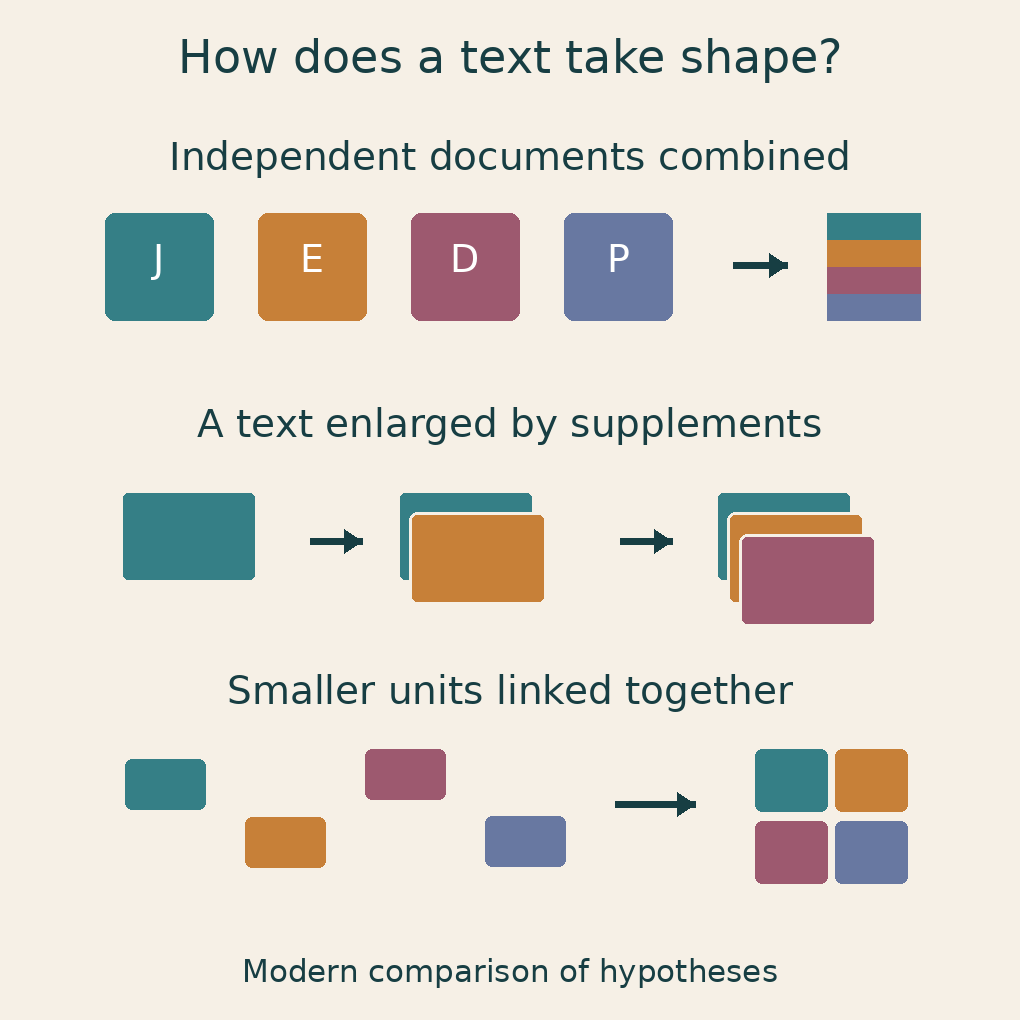
In the classical formulation, J denotes the Yahwistic source, E the Elohistic, D the Deuteronomic source associated with Deuteronomy, and P the Priestly source. The first two names arose from the use of YahwehYahwehThe proper name of Israel’s deity, written יהוה (YHWH), the Tetragrammaton. Its exact ancient pronunciation is not directly preserved; texts and inscriptions witness its history.Glossary · Click to read the explanation and ElohimElohimA Hebrew word with plural morphology, used for “gods” or for a singular deity according to context.Glossary · Click to read the explanation, but source division also considers narrative, style and law. These are labels for reconstructed literary units, not names of four discovered original manuscripts.[1]
The tension is sharper when we quote the words rather than count divine names. In GenesisBook of GenesisHebrew book of the Torah containing Noah’s flood, survival offering and covenant with living creatures.Glossary · Click to read the explanation 12:8, Abram, the ancestor later called Abraham, invokes the name; in ExodusBook of ExodusTorah book recounting Israel’s departure from Egypt and containing different formulations of seventh-day rest.Glossary · Click to read the explanation 6:3, God contrasts the ancestors with the revelation to MosesMosesCentral figure in Exodus, Torah traditions and the Qur’an; childhood accounts differ in detail.Glossary · Click to read the explanation.[7][8]
Genesis 12:8, concluding clause:
Exodus 6:3, concluding clause:
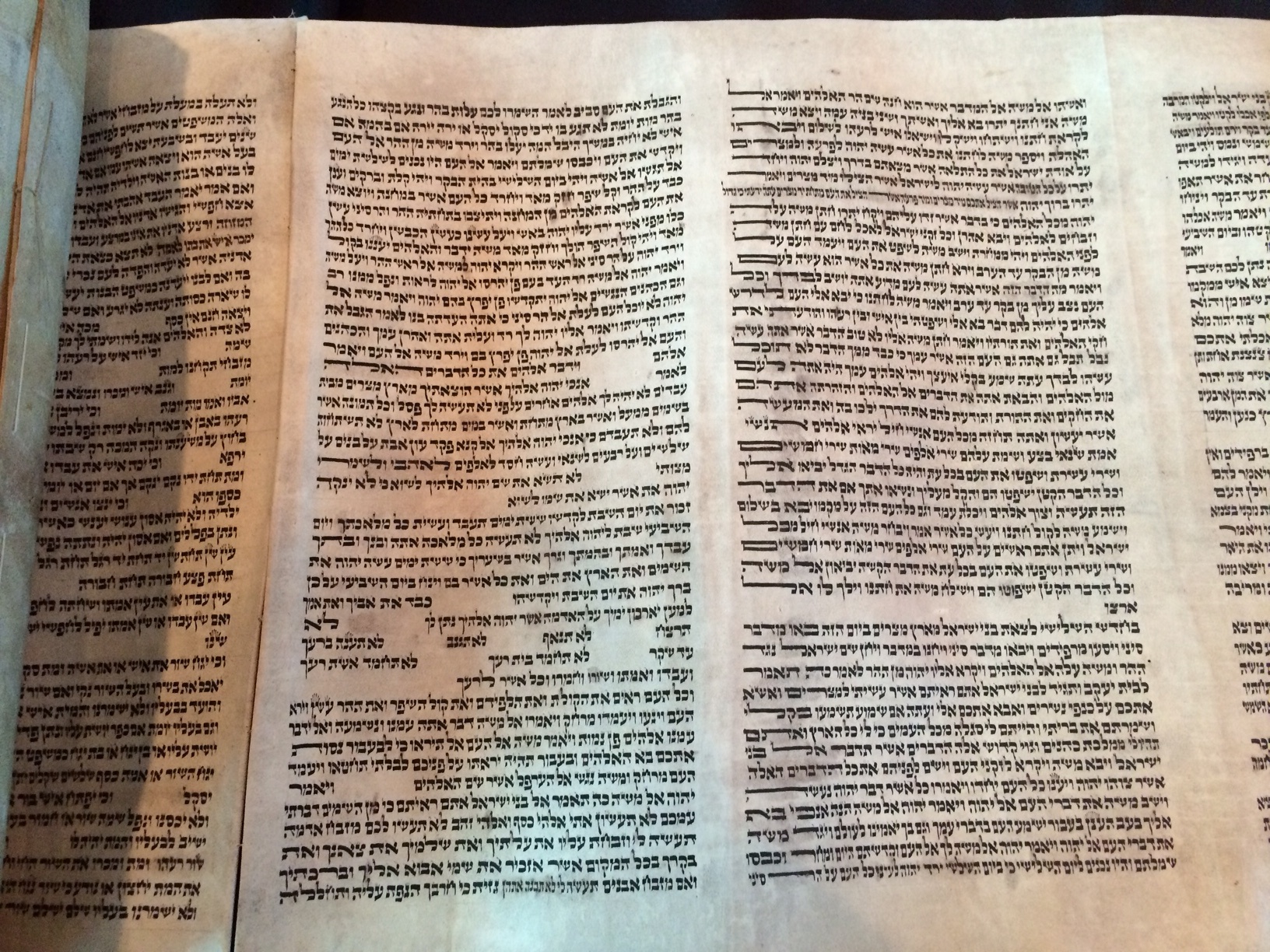
These are short excerpts from the transmitted HebrewHebrewA Northwest Semitic language of the Canaanite group, encompassing Iron Age epigraphy, Biblical, Rabbinic, medieval and Modern Hebrew; its scripts and pronunciations changed over time.Glossary · Click to read the explanation, not reconstructed source manuscripts. The preceding clause in Exodus names Abraham, Isaac and Jacob and El Shaddai. The problem is therefore not merely a narrator using a later name: Genesis depicts an ancestor invoking it. A documentary account assigns different histories of revelation to different sources. An alternative reads “knowing” as experiencing the name’s power through fulfilled promises, rather than first hearing its syllables. That can make sense of the final sequence, especially Exodus 6:4–8, but must explain why 6:3 explicitly contrasts names. The pair makes divergent traditions a serious explanation; by itself it neither proves four continuous documents nor dates them.[1][8][9]
The classical model and its renewal
The late nineteenth-century synthesis of Julius WellhausenJulius WellhausenGerman biblical and Semitic-studies scholar associated with historical-critical analysis of the Pentateuch’s sources.Glossary · Click to read the explanation, a German biblical scholar, built on earlier scholarship; he did not invent the question of sources. The classical model connected the sequence J, then E, D and P with the development of Israelite religion. That sequence and chronology are not requirements shared by all modern documentary approaches.[1][3]
Wellhausen’s historical argument was not just a list of names. In Prolegomena, chapter I, II.1–3, he contrasts the altar law of Exodus 20:24–26, which he reads as allowing multiple sanctuaries, with Deuteronomy 12’s demand for one chosen place, and with the Priestly tabernacle legislation, which presupposes one sanctuary from the wilderness onward. He treats these as successive situations: tolerated plurality, a reforming demand for centralization, then centralization projected into Israel’s beginnings. This connects literary analysis with institutional history, but depends on judgments about the relation between law, literary ideal and actual practice; a narrative set in Moses’ lifetime is not thereby an eyewitness record of that period.[10]
The dates consequently belong to different questions:
- Narrative time: ancestors, exodus and wilderness are the events represented; their placement inside the story does not date the writing.
- Proposed composition: the classical reconstruction placed J/E before D, connected D with the late seventh-century BCE reform associated with Josiah, and located P later, especially in exilic/postexilic developments of the sixth–fifth centuries BCE. These are scholarly assignments, not colophons; modern reconstructions revise both boundaries and dates.[1][10]
- Physical transmission: ancient scroll fragments and translations attest already transmitted forms of the Pentateuch, while medieval codices preserve much fuller Hebrew texts. They can constrain compositional claims but are not recovered autograph copies of J, E, D or P.[5]
In his 2012 account, Old Testament scholar Joel S. BadenJoel S. BadenHebrew Bible and Pentateuch scholar who developed a renewed argument for the Documentary Hypothesis.Glossary · Click to read the explanation prioritizes continuity of plot and conflicting narrative claims, treating style as supporting evidence. He focuses on the documents available to their compiler, without making a date in a particular year or century a prerequisite. Nor does he deny earlier development within the documents or later additions to the combined text.[3]
Documents, supplements or smaller units?
A documentary model posits works that could be read independently before combination. A supplementary model instead proposes a base text that was reworked and enlarged; an addition may not make sense apart from what it supplements. Biblical scholar Tzemah Yoreh explains this distinction while noting that supplementary models themselves vary.[4]
Fragmentary models start with shorter literary units brought into a larger framework. A “fragment” here is a proposed unit in compositional history, not necessarily an excavated scrap of manuscript. One explanation may combine composition, supplementation and compilation rather than apply a single mechanism to every book.[5]
Testing a mechanism: Balaam’s interrupted journey
In NumbersBook of NumbersTorah book addressing daughters’ inheritance and tribal retention of land.Glossary · Click to read the explanation 22, Balak, king of Moab, invites Balaam son of BeorBalaam son of BeorA figure in Numbers whose path is blocked by the angel of Yahweh acting as his “adversary”.Glossary · Click to read the explanation, a foreign diviner, to curse Israel. After refusing the first delegation, Balaam receives conditional permission to go with the second. The sequence supplies three precise checkpoints.[11]
Numbers 22:20, permission within the divine speech:
Numbers 22:22, after his departure:
Numbers 22:35, the messenger’s renewed permission:
The restriction is also repeated: Balaam must act according to God’s word in verse 20 and speak according to it in verse 35. Between them, his donkey sees the threatening messenger before he does. The final form makes the diviner dependent on revelation even to perceive the danger before him; that literary effect is observable without deciding how the passage grew.[11]
Alexander Rofé’s specialist discussion presents the classic documentary division as E’s permission in the dream versus J’s obstructing messenger, then argues for an inserted donkey episode framed by resumed instructions. His report of the older division is mediated scholarship, not our claim to have read every reconstruction he cites.[12]
What can the reader test? The documentary explanation accounts for the abrupt change of divine attitude as the joining of different plots. Its extra burden is to recover independently intelligible sequences rather than merely label each side of a contradiction. If missing transitions are supplied by presumed losses or by an editor, those interventions must be counted as costs, not treated as evidence already in hand. The supplementary explanation treats the reprise in verse 35 as a return to the journey after an inserted warning; its advantage is that the episode’s characters and destination already exist in the surrounding story. Its cost is an author who intentionally introduced a tension and a backward-looking command. The repetition alone cannot prove insertion, since a single author can repeat an instruction for emphasis.[3][6][11][12]
For this bounded passage, supplementation is the more economical working explanation: dependence on the surrounding journey and the return to its instructions require less reconstruction than two complete continuous accounts. This is a local judgment, not a demonstration that the entire Pentateuch grew by supplements. Reading the final text as a warning against Balaam’s intentions remains possible, but verses 20–22 do not explicitly describe a new intention or disobedience between permission and anger. Nor does the talking animal date the episode: literary genre is not a chronological clock.[11][12]
What remains disputed?
In his 2021 study, biblical scholar Konrad SchmidKonrad SchmidScholar of the Hebrew Bible and ancient Judaism studying the Pentateuch’s literary history and the formation of biblical texts.Glossary · Click to read the explanation distinguishes broad agreement within historical-critical research on literary composition and identifiable Priestly material from disagreement about the continuity and boundaries of J and E. He particularly questions a sharp separation of literary and historical analysis and the almost mechanical compiler. Neither universal consensus nor wholesale abandonment accurately describes the hypothesis in all its forms.[6]
Manuscripts and translations allow comparison of surviving textual forms; they do not directly supply the proposed earlier documents. Editorial intervention, relationships between units and their dates remain questions to test against evidence, not conclusions established by displaying four letters. Research on redaction offers several models for these processes, not one agreed recipe.[2][5]
References and notes (12)
- Christine Hayes, “Critical Approaches to the Bible,” Lecture 5, Introduction to the Old Testament, Open Yale Courses, 2006. Transcript: opening discussion of Astruc and Wellhausen; definitions of J/E/D/P and Exodus 6:2–3 example. Classical chronology is a history-of-scholarship account. Return to the text ↑
- Reinhard Müller, “Positions on Redaction,” The Oxford Handbook of the Pentateuch, 2021, pp. 237–254. Publisher abstract only: diverse redactional theories, compositional history and external evidence; full chapter not read. Return to the text ↑
- Joel S. Baden, “The Re-Emergence of Source Criticism: The Neo-Documentary Hypothesis,” The Bible and Interpretation, May 2012. Entire article before reader comments; especially points 1, 3, 4 and 5. A proponent’s account, not a statement of consensus. Return to the text ↑
- Tzemah Yoreh, “Speculating about the Original Text of the Decalogue,” TheTorah.com, 2015. Section “Supplementary versus Documentary: A Note on Method”; used for the methodological distinction, not to adopt his reconstruction of the commandments. Return to the text ↑
- Emanuel Tov, “Do We Know the Original Text of the Torah?”, TheTorah.com, 2026. Passages on textual traditions and composition, especially the paragraph distinguishing documentary, fragmentary and supplementary models. Return to the text ↑
- Konrad Schmid, “The Neo-Documentarian Manifesto: A Critical Reading,” Journal of Biblical Literature 140/3 (2021), pp. 461–479. pp. 461–464 on agreement and disagreement; pp. 476–478 on the mechanical compiler and methodological economy. Selected passages, not all works discussed. Return to the text ↑
- Genesis, Hebrew text at Mechon-Mamre. 12:7–8; final clause of 8, with short editorial translation. Return to the text ↑
- Exodus, Hebrew text at Mechon-Mamre. 6:2–8; quotation of final clause of 3 without adding “fully.” Return to the text ↑
- NET Bible, Exodus, notes on 6:3. P. 132, note 5: knowledge and significance of the name; alternative reading, not an established solution. Return to the text ↑
- Julius Wellhausen, Prolegomena to the History of Israel, trans. J. S. Black and Allan Menzies (1885), Gutenberg text. Chapter I, II.1–3: altars, Deuteronomy and tabernacle; read in English translation, not checked against German. Return to the text ↑
- Numbers, Hebrew text at Mechon-Mamre. 22:12–35, especially 20–22 and 35; short unrestored excerpts, cantillation omitted for readability. Return to the text ↑
- Alexander Rofé, “The Account of Balaam’s Donkey: A Late Polemical Burlesque” (2019), translated/adapted by Zev Farber in consultation with the author. Article and principal notes, especially “Two Sources?” and “A Supplement to the Story”; older division mediated through Rofé, not full reading of his 1979 book. Return to the text ↑
Suggest a correction · Suggest a source for this record
Cite this record
IL Archive, «Documentary hypothesis», https://ilarchive.com/en/entities/documentary-hypothesis
Continue reading