Study
The Flood Before Noah: Ziusudra, Atrahasis, Utnapishtim and Genesis
An extended study of a topic, with evidence and references.
- Timeline
- From 1900 BCE to 300 BCE
Older Mesopotamian flood accounts and Noah: vessels, birds and sacrifice; changing motives and survival; the strength and limits of literary comparison.
Share article
Text
From ZiusudraZiusudraKing and priest in the fragmentary Sumerian Flood Story, preserved in an Old Babylonian copy. Survives, sacrifices and receives divine life in Dilmun; historicity is unproven.Glossary · Click to read the explanation and AtrahasisAtrahasis: Epic and HeroAkkadian epic: humans created for divine labor, multiplication, noise and flood. Atrahasis, “exceedingly wise,” survives through Enki’s warning; human reproduction is regulated afterward.Glossary · Click to read the explanation to UtnapishtimUtnapishtimGilgamesh’s flood hero narrates survival to a king seeking immortality. Ea warns him; life is preserved; hero and wife receive exceptional life. Literary character, not an archaeologically established person.Glossary · Click to read the explanation and Genesis.
Before NoahNoahNoah is the flood-story figure in Genesis and a prophet in the Qur’anGlossary · Click to read the explanation appeared in Genesis, MesopotamiaMesopotamiaA historical region associated with the Tigris and Euphrates, home to many societies and civilisations.Glossary · Click to read the explanation already knew a story about a man chosen to survive a flood through which divine powers intended to destroy humanity. It preserved more than one version: ZiusudraZiusudraKing and priest in the fragmentary Sumerian Flood Story, preserved in an Old Babylonian copy. Survives, sacrifices and receives divine life in Dilmun; historicity is unproven.Glossary · Click to read the explanation in Sumerian tradition, AtrahasisAtrahasis: Epic and HeroAkkadian epic: humans created for divine labor, multiplication, noise and flood. Atrahasis, “exceedingly wise,” survives through Enki’s warning; human reproduction is regulated afterward.Glossary · Click to read the explanation in the AkkadianAkkadianAn ancient East Semitic language written in cuneiform in Mesopotamia.Glossary · Click to read the explanation epic, and UtnapishtimUtnapishtimGilgamesh’s flood hero narrates survival to a king seeking immortality. Ea warns him; life is preserved; hero and wife receive exceptional life. Literary character, not an archaeologically established person.Glossary · Click to read the explanation in the Epic of GilgameshEpic of GilgameshMesopotamian literary tradition with multiple versions, concerning Uruk’s king, Enkidu and mortality. Standard Tablet XI preserves Utnapishtim’s flood; manuscript date does not date the tradition’s origin.Glossary · Click to read the explanation.
Names, reasons for the disaster, gods and theological meanings change. Yet a recognizable structure recurs: a divine decision to destroy humanity; a man warned in advance; a boat built to preserve humans and animals; a flood overwhelming the known world; the vessel coming to rest as the waters retreat. Some versions release birds to test for dry land. The survivor offers a sacrifice, and human life begins again.
The nineteenth-century decipherment of the Gilgamesh flood tablet caused a sensation precisely because several details resembled Noah's story so closely. The historical question is therefore no longer whether an older, similar written story exists. That has long been established. The harder question concerns the relationship: did one story travel between cultures, did different floods produce similar tales, or was an inherited tradition repeatedly reshaped? Answering requires a careful chronology.[2][14][15]
Before Noah, there was Ziusudra
The flood hero preserved in Sumerian is Ziusudra, also written Zi-ud-sura. A king and priest, he appears in what scholars call the Sumerian Flood Story, sometimes the EriduEriduAbu Shahrain in southern Iraq, with a long architectural sequence beginning before writing. Associated with Enki in historical times, which does not establish the sacred being’s identity in its earliest layers.Glossary · Click to read the explanation Genesis. The surviving tablet from NippurNippur / NuffarMesopotamian city and major Enlil cult centre, connected with kings’ legitimacy beyond the city.Glossary · Click to read the explanation in IraqIraqIraq is a modern country encompassing much of ancient MesopotamiaGlossary · Click to read the explanation is badly damaged. Whole portions are lost; we cannot read the story continuously as we can much of Gilgamesh.
The language of a composition and the age of its manuscript must be distinguished. A Sumerian text is not automatically a tablet from the earliest Sumerian periods. The surviving copy belongs to the Old Babylonian period in the early second millennium BCE. Its material may be older, but we cannot measure that interval precisely. Studies place Ziusudra and Atrahasis among the earliest surviving literary witnesses to the classical flood narrative in the Old Babylonian period.[1][2]
What caused Ziusudra's flood?
Here the temptation to fill a gap must be resisted. The text is broken at important points. We know that the divine assembly decrees a flood and the destruction of humanity's seed. An, EnlilEnlilProminent Mesopotamian god associated with Nippur and Ekur, highly ranked in Early Dynastic texts before the earliest known Anunna attestation.Glossary · Click to read the explanation, EnkiEnkiMesopotamian deity associated with deep fresh water, wisdom and Eridu, known as Ea in Akkadian tradition. The earliest preserved written mention does not date his cult’s origin or identify Ubaid Eridu’s deity.Glossary · Click to read the explanation and Ninhursag belong to its divine world.
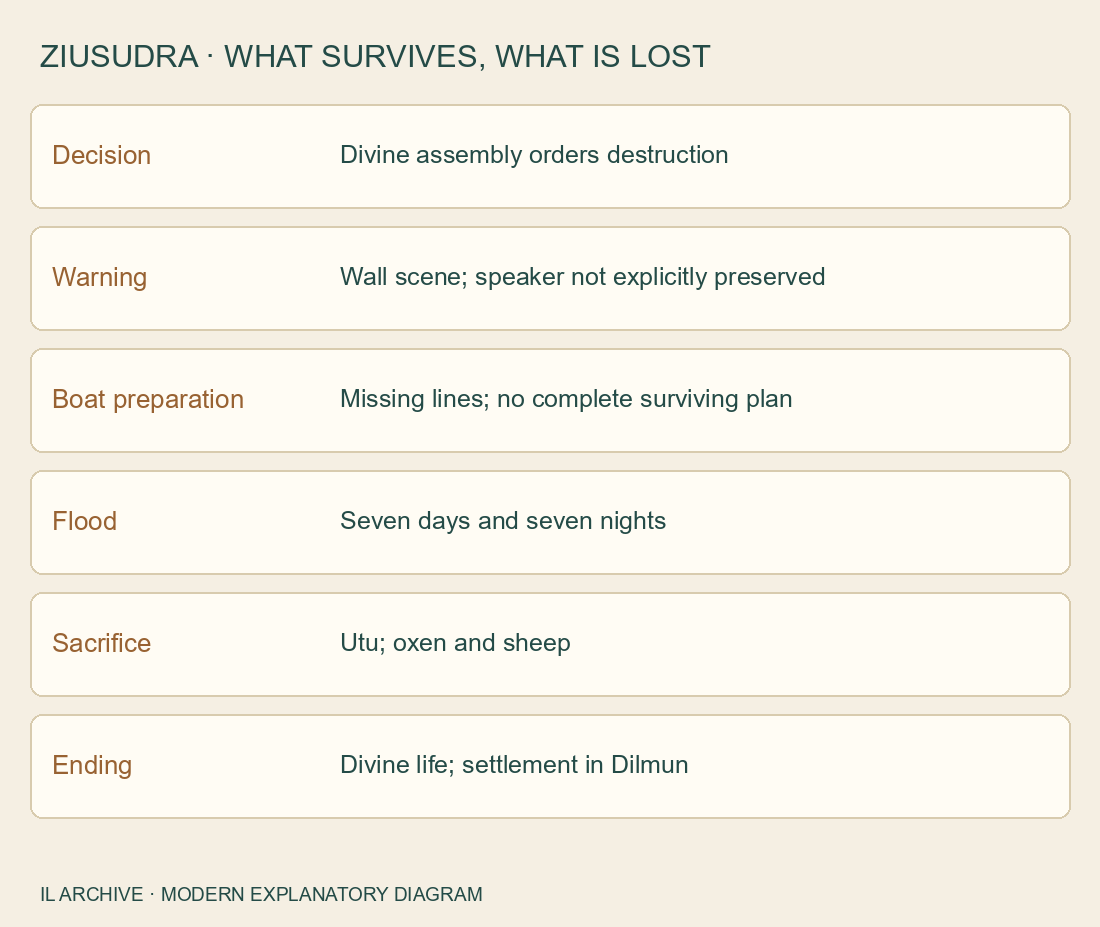
A warning reaches Ziusudra in a scene involving a wall. The saving role is conventionally associated with Enki, but the speaker's name is not explicitly preserved at this point. Dozens of missing lines then interrupt the preparations and the boat's construction.
The reason for the decision is not clearly preserved. We cannot simply import human noise and multiplication from Atrahasis into this Sumerian version. We have the decision; its motivation has disappeared in the damaged text.[1]
Seven days and seven nights
When readable passages resume, the flood has begun. Winds and storms converge, and the great boat is battered for seven days and nights. The sun god Utu appears, and Ziusudra makes an opening in the boat to admit his light.
A recurring element follows: the survivor offers a sacrifice. Ziusudra prostrates himself before Utu, slaughters oxen and presents sheep. After further gaps, animals emerge onto the ground and Ziusudra stands before An and Enlil. They grant him life like a god's and settle him in DilmunDilmun: Ancient Gulf Land and Literary SettingAn ancient Gulf trading region linked archaeologically to Bahrain and also a Sumerian literary setting whose mythical scenes are not all historical descriptions.Glossary · Click to read the explanation, far away where the sun rises.
Long before the final Noah narrative in the written record, this version already contains a chosen man, warning, boat, preserved animal life, flood, survival, sacrifice and a new life afterward. Its incompleteness limits detailed comparison. Atrahasis preserves much more.[1]
Atrahasis: why the gods wanted to drown humanity
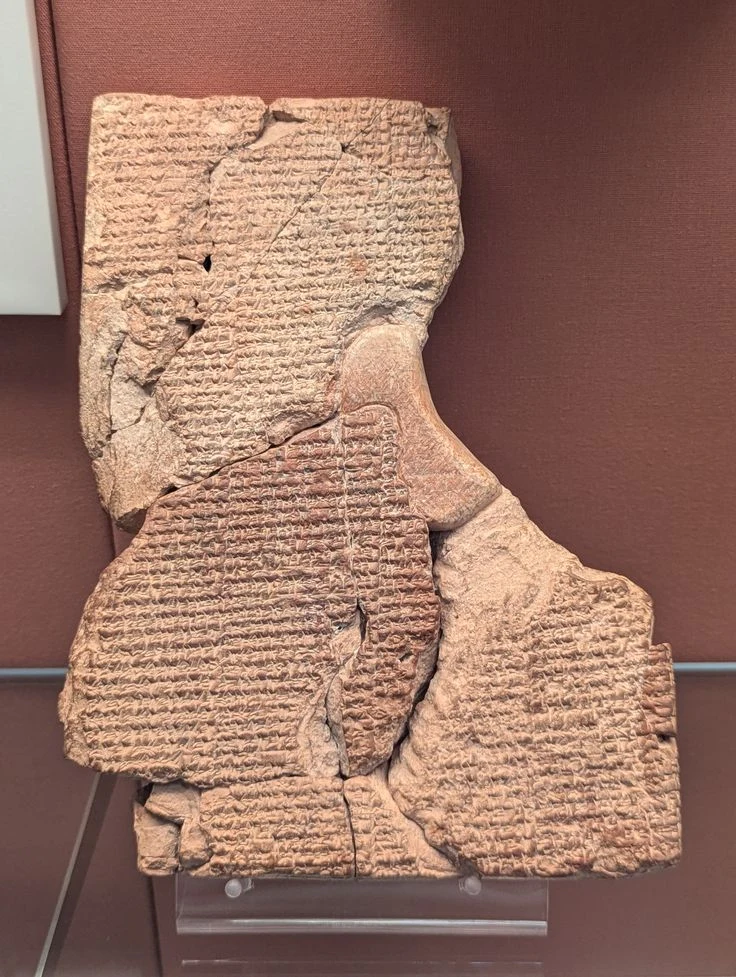
In the Akkadian epic called Atrahasis, the flood belongs to an entire history of humanity. The hero's name means approximately “exceedingly wise.” Old Babylonian witnesses include manuscripts from the reign of Ammi-saduqa in the seventeenth century BCE under the Middle Chronology. CDLI assigns one tablet to the broad Old Babylonian range, approximately 1900–1600 BCE. That is a catalog period, not the composition date of the whole epic. Copies continued to be made later.
The poem begins before humans exist. Lesser gods dig canals and perform exhausting work, then rebel. Humans are created to carry their burden. This solution creates another problem: people multiply, and their noise becomes intolerable to Enlil.
Plague, drought and famine are used to reduce their numbers. Enki helps humanity survive, frustrating these measures. Finally Enlil turns to the most drastic solution, the flood. George and Al-Rawi describe this sequence of attempts to control human reproduction; the traditions also explicitly associate human noise with Enlil's inability to sleep.[3][4][5]
This flood is not primarily a moral punishment
The main trigger in Atrahasis differs sharply from Genesis. Humanity is not condemned here principally for wickedness: the problem is population and noise. Created to work for the gods, humans have become too successful at surviving and reproducing. Enlil wants their numbers reduced.
The narrative concerns population, labor and relations between humans and gods. After the flood, the solution is not a morally transformed humanity. New restrictions prevent unlimited reproduction, so the crisis will not recur in the same way. Genesis instead makes wickedness, violence and corruption central to divine judgment.[6][15]
Enki goes against the decision to destroy humanity
The divine world contains conflicting wills. Enlil seeks destruction; Enki/Ea, the god associated here with wisdom, fresh water and human protection, preserves life. Bound by the gods' oath, he uses an indirect warning involving a reed structure or wall that the hero can hear.
The message is to abandon the house and property, build a vessel and save life. Atrahasis boards with his household and the creatures he can preserve. ORACC's Enki/Ea entry documents his warning and saving role. John Day discusses the ship instructions in his comparison. Not every wording of the dialogue survives completely in every manuscript.
The crucial point extends to the comparison with Noah: the god who decides on destruction is not the god who rescues the hero. A world of several gods allows disagreement between divine wills. Genesis removes that possibility: the same God sends the flood and selects Noah for survival.[5][15]
After the flood, the gods go hungry
When humans drown, offerings cease. The gods, dependent on human provisions and worship in this narrative, suffer. The survivor's sacrifice draws them eagerly to its smell, a feature also famous in Gilgamesh.
The story contains an internal criticism of the divine decision. The gods created humans to work for them, almost eliminated them, and discovered that they needed them. When Enlil learns that a human survived, he is initially angry. Relations between humanity and the gods are then reorganized so that complete destruction need not recur.[7][15]
Utnapishtim enters the Epic of Gilgamesh
The third name is Uta-napishti or Utnapishtim, the flood hero of the Babylonian Gilgamesh epic. Again, textual history matters. Gilgamesh as a literary figure and tradition is much older than the famous surviving flood tablet.
Mehmet-Ali Ataç notes that the character Utnapishtim occurs in the Old Babylonian Gilgamesh tradition, although its flood narrative has not survived. We should not automatically fill that absence with the later standard text.
The nearly complete account read today appears in Tablet XI of the Standard Babylonian version. Its best-known manuscript comes from AshurbanipalAshurbanipalAshurbanipal was an Assyrian king of the seventh century BCE, reigning about 668–631 BCEGlossary · Click to read the explanation's library at NinevehNineveh and KuyunjikNineveh is an ancient Assyrian city near Mosul in northern Iraq; Kuyunjik is one of its archaeological moundsGlossary · Click to read the explanation and dates to the seventh century BCE. That date does not mean the flood story was first composed in that century. The tradition is older than the physical copy preserving it.[2][16]
Why does Utnapishtim tell his story?
Gilgamesh is seeking escape from death, rather than information about a flood. After his friend Enkidu dies, he realizes that he too will die. He searches for the human who survived the flood and exceptionally obtained everlasting life.
Meeting Utnapishtim, he asks how a man apparently like himself entered the assembly of the gods and obtained life. Utnapishtim reveals a divine secret. The flood account thus explains how one man acquired immortality within Gilgamesh's larger quest.
The SOAS project provides Tablet XI, lines 1–163, with Akkadian and Andrew George's translation. These cover the opening dialogue, flood, birds and sacrifice. The rest of the scene requires another reference.[8][9]
Shuruppak appears again
Utnapishtim begins with Shuruppak, also among the ancient pre-flood cities of the Sumerian tradition. He describes an old city on the Euphrates where the great gods decided to cause a flood.
The Standard Babylonian Gilgamesh does not explain that decision as fully as Atrahasis. It states the decision, but we should not insert the story of noise depriving Enlil of sleep into Tablet XI as though those words appeared there.
The relationship is strong and the Gilgamesh account adapts an older Atrahasis tradition. Nevertheless, each text should be read for what it actually says.[8][15]
The boat is described in greater detail
Ea, identified with Enki in these traditions, warns Utnapishtim through a reed structure and wall. He tells him to dismantle the house and build a boat, then gives instructions for its proportions and roof.
The preserved narrative loads family, relatives, craftspeople, possessions, animals and the seed of living creatures aboard. The door is closed and the storm begins. The Metropolitan Museum's overview also describes the family, craftspeople and animal life preserved in the vessel.
This is more specific than a man escaping a flood in a boat. It is a collective vessel of survival carrying both humanity and animal life.[8]
Six days and seven nights
The destructive storm in Gilgamesh lasts six days and seven nights. Utnapishtim describes a catastrophe that frightens even the gods. Calm finally returns; he sees water and humanity turned to clay. The vessel comes to rest on Mount Nimuš.
Genesis names the “mountains of Ararat,” a regional designation that does not by itself identify today's peak called Mount Ararat. These locations should not be conflated.
The vessel remains on Nimuš before the next stage: testing the land with birds.[8]
Dove, swallow, then raven
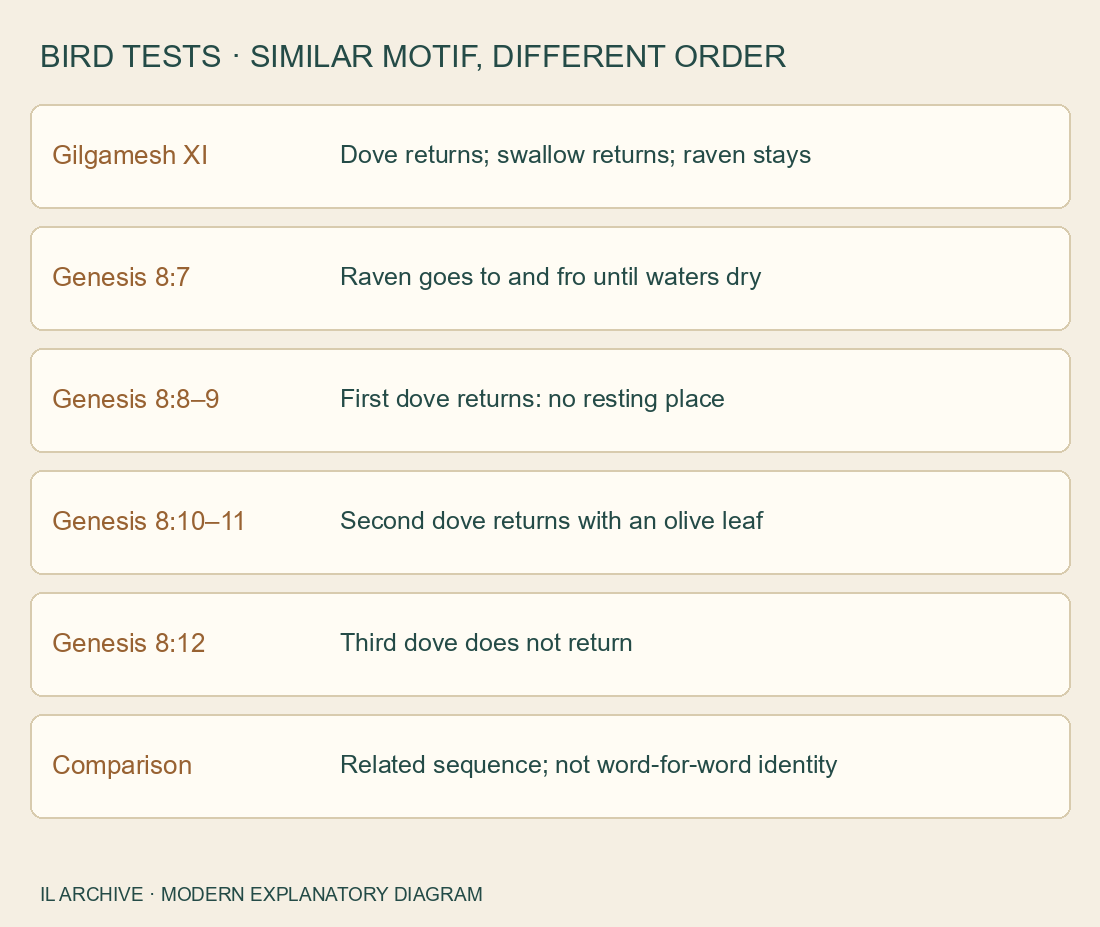
Once the boat has settled, Utnapishtim releases a dove. Finding nowhere to perch, it returns. A swallow does the same. A raven sees the retreating waters, finds food and does not return. The Akkadian text and George's SOAS translation preserve this order clearly.
Genesis has a raven followed by a dove released repeatedly. The dove is sent three times: it returns first, then returns with an olive leaf, and finally does not return. Genesis 8:7 says the raven goes to and fro until the waters dry up.
The details differ. But boat, mountain, birds testing the waters, and sacrifice afterward make the comparison more specific than the mere presence of a flood in two cultures.[8][12]
Sacrifice appears again
Utnapishtim offers a sacrifice on the mountain and sets out aromatic materials. The gods smell its pleasing scent and gather around the sacrificer like flies. Enlil sees the boat and is angry that anyone escaped destruction.
Ea challenges the collective punishment. In the passage's argument, the sinner should bear the sin and the wrongdoer the wrongdoing, rather than everyone being eliminated by a flood. Utnapishtim and his wife are finally granted life like the gods' and removed far from ordinary humanity.
This ending concerns more than survival. It presents disagreement over justice, wisdom and the limits of punishment. For the later lines, beyond SOAS's line 163, including Enlil's anger, debate and divine life, see Alexander Heidel's translation, pp. 87–88. His line numbering differs from George's. The SOAS excerpt alone does not document the ending.[8][9]
Then comes Noah
Genesis 6–9 places the familiar structure in a different divine world. Humanity has multiplied, but its problem is not noise. Human wickedness has grown and the earth is filled with violence and corruption. Noah is righteous within his generation.
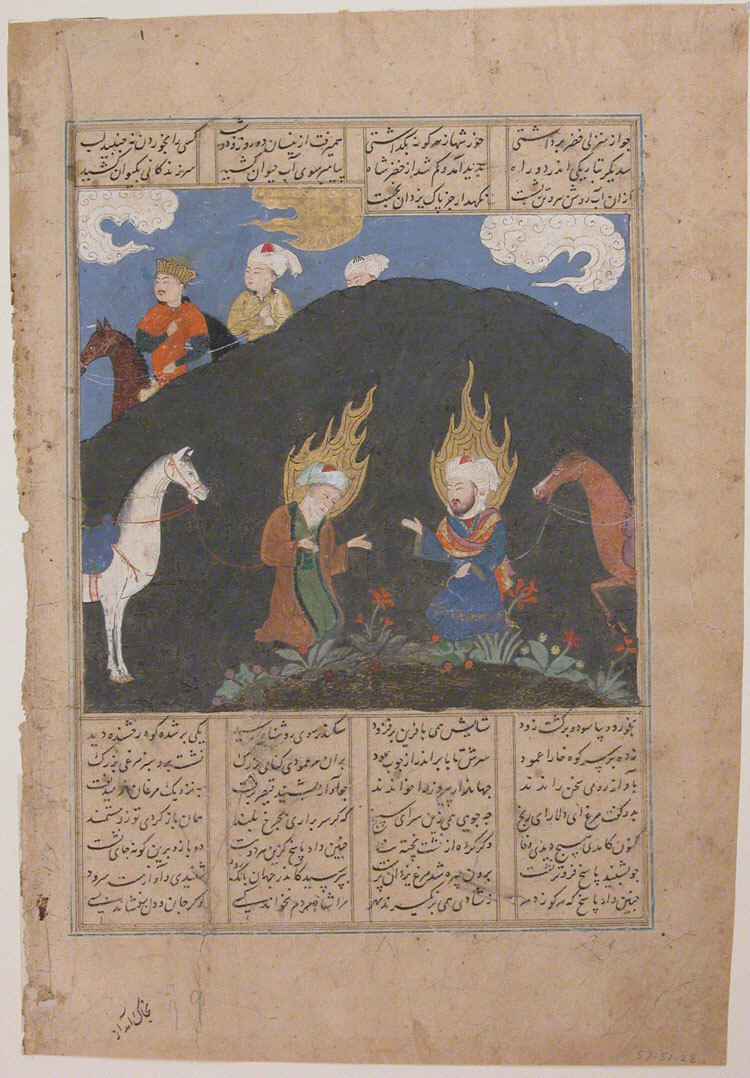
God decides to destroy the world by flood but tells Noah to build an ark, specifies dimensions and pitch covering, and preserves his wife, sons, daughters-in-law and animals. Waters cover the earth; the ark rests on the mountains of Ararat; birds are released. Noah emerges, builds an altar and offers a sacrifice. God smells the pleasing odor.
A promise follows that every living being will not again be destroyed in this way. The section usually identified as Priestly presents a covenant with NoahThe Noahic Covenant in GenesisGenesis 9’s covenant with Noah, descendants and all living creatures, marked by the bow in the clouds and a promise against another destroying flood.Glossary · Click to read the explanation, his descendants and all living creatures, with the rainbow as its sign.
The present account need not have been written at one sitting. Much modern criticism analyzes a combination of Priestly and non-Priestly traditions, helping explain variations in animal numbers and chronology. David Carr argues that both Israelite flood traditions were shaped with reference to earlier Mesopotamian traditions, particularly Atrahasis and Gilgamesh XI.[10][11][12][13][14]
Two of each kind, or seven?
Noah's narrative illustrates its complex formation. One passage requires two of each kind, male and female. Another calls for seven pairs of clean animals and a pair of unclean ones. The HebrewHebrewA Northwest Semitic language in the Canaanite group, with ancient and modern forms.Glossary · Click to read the explanation “seven seven” of Genesis 7:2–3 is interpreted as seven pairs in many translations, although the number has been explained differently in the history of interpretation. The wording and its analysis should be distinguished.
This difference is not necessarily a copying error. Traditional source criticism assigns the details to different narrative layers combined in the final account. Chronology also varies: forty days of rain and a more detailed calendrical framework in which waters prevail for 150 days.
These features become evidence for literary analysis alongside repetitions, vocabulary and structure. Forty days of rain and 150 days of water do not contradict one another merely because the numbers differ. Carr discusses combined Priestly and non-Priestly accounts, while scholars differ about the editorial process.[11][14]
The greatest difference concerns the cause of the disaster
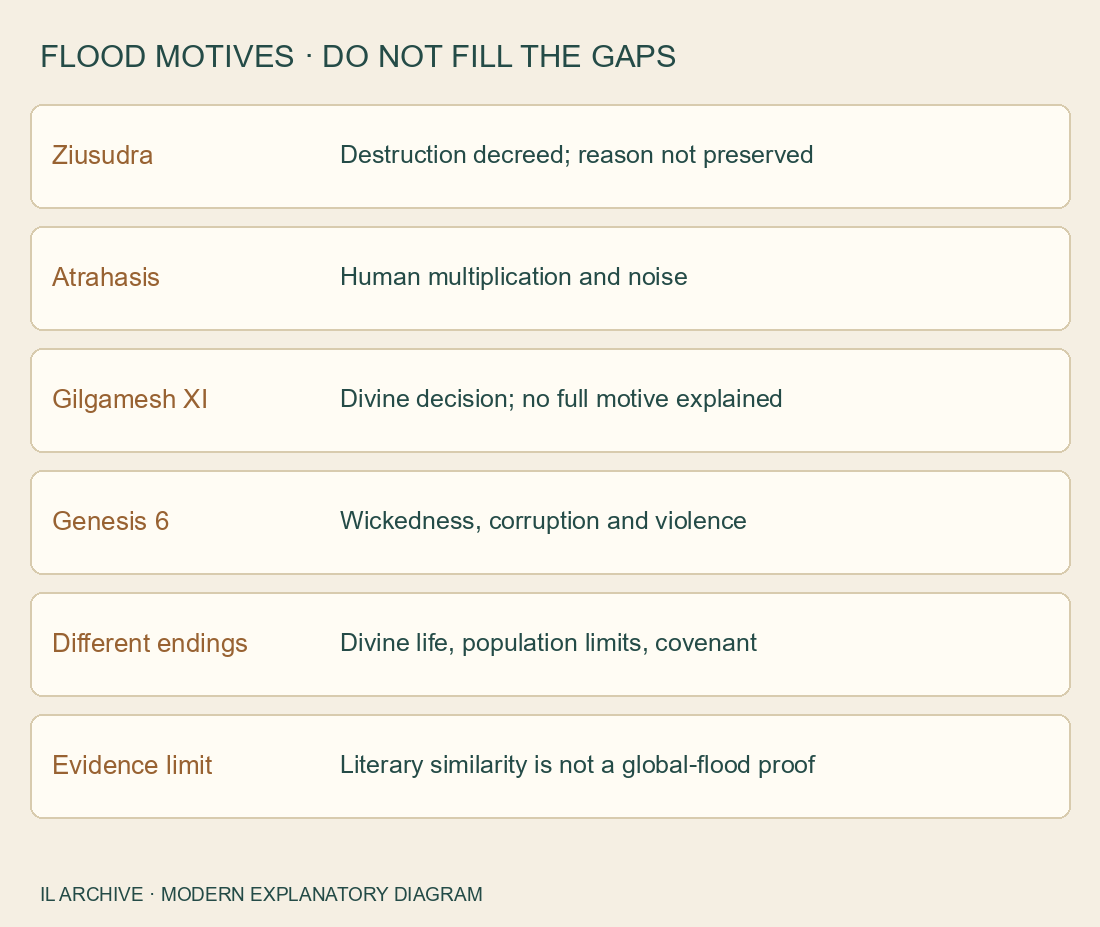
Similarities are immediately visible. Differences show what each tradition did with the story. The surviving Ziusudra text does not preserve the motive. In Atrahasis, population and noise disturb Enlil. Gilgamesh XI records the gods' decision without the fuller explanation given in Atrahasis.
Genesis makes the catastrophe a judgment on wickedness, corruption and violence. That changes the meaning of the whole narrative. Atrahasis presents humanity's numbers and noise as a problem for the divine order; Genesis presents moral conduct corrupting the earth.
An inherited narrative structure can therefore remain visible while its theological explanation changes deeply. The difference follows from comparing the texts, rather than treating their shared structure as identical theology.[1][5][8][10]
Genesis has no god rescuing humans from another god
Atrahasis and Gilgamesh allow conflicting divine intentions. The gods decide on destruction; Enki/Ea secretly preserves the hero; Enlil is angry that someone escaped; debate follows the flood.
Genesis puts judgment and rescue within the will of the same God. He sees the corruption, decides on the flood, chooses Noah, gives the ark instructions and closes its door. He causes the waters to retreat, receives the sacrifice and promises not to repeat the destruction.
Moving the narrative into a monotheistic framework required more than replacing several names with one. The rescuer can no longer evade the destroying god. Justice, mercy, punishment and preservation must now be represented within one divine will.[8][9][10][11][12][13]
Sacrifice remains, but its meaning changes
Ziusudra, Atrahasis, Utnapishtim and Noah all offer sacrifices. Gilgamesh portrays gods gathering around the pleasing scent, against a tradition in which the loss of human offerings causes divine distress. Genesis also says YHWHYahwehThe divine proper name written YHWH in the Hebrew Bible.Glossary · Click to read the explanation smells the pleasing odor.
Yet the Hebrew story does not describe God becoming hungry while humans are absent or needing food to remain alive. A literary image survives within a different theological setting. The shared sacrifice and scent do not erase the difference between Genesis and the embodied crisis of Atrahasis's gods.[8][12][15]
Birds: a detail that strengthens the comparison
A flood story by itself does not establish transmission. Floods occur in many places, and independent communities can imagine a boat preserving a survivor. Specific, less inevitable parallels carry greater weight.
A story need not include a closed vessel, animals, a mountain landing, birds testing for dry land, some returning and another not, followed by a sacrifice and a divine response to its smell. This combination does not follow automatically from the premise that a flood occurred.
Gilgamesh's order is dove, swallow, raven. Genesis presents a raven going to and fro, a dove returning, a dove bringing an olive leaf, and a dove not returning. The order differs; this is not a word-for-word reproduction.
The argument rests on an interconnected group of distinctive features. Comparative work weighs their specificity and structure rather than merely counting how many stories contain water.[8][12][15]
Are Ziusudra, Atrahasis and Utnapishtim three different people?
Their names differ within the texts. Literarily, however, they belong to a related tradition rather than three necessarily independent disasters. Ziusudra is the Sumerian hero; Atrahasis gives his name to the Akkadian poem; Utnapishtim fills the flood hero's role in Gilgamesh.
Gilgamesh itself also uses Atrahasis as a designation for its hero, including Ea's account of disclosing the secret through a dream near the end of the flood scene. Scholars discuss Tablet XI's adaptation of the Atrahasis tradition. A different name does not establish a different event.
These accounts cannot therefore be treated as three independent witnesses proving the same historical catastrophe. Their importance partly lies in their retelling of inherited material.[9][15]
Which story is actually older?
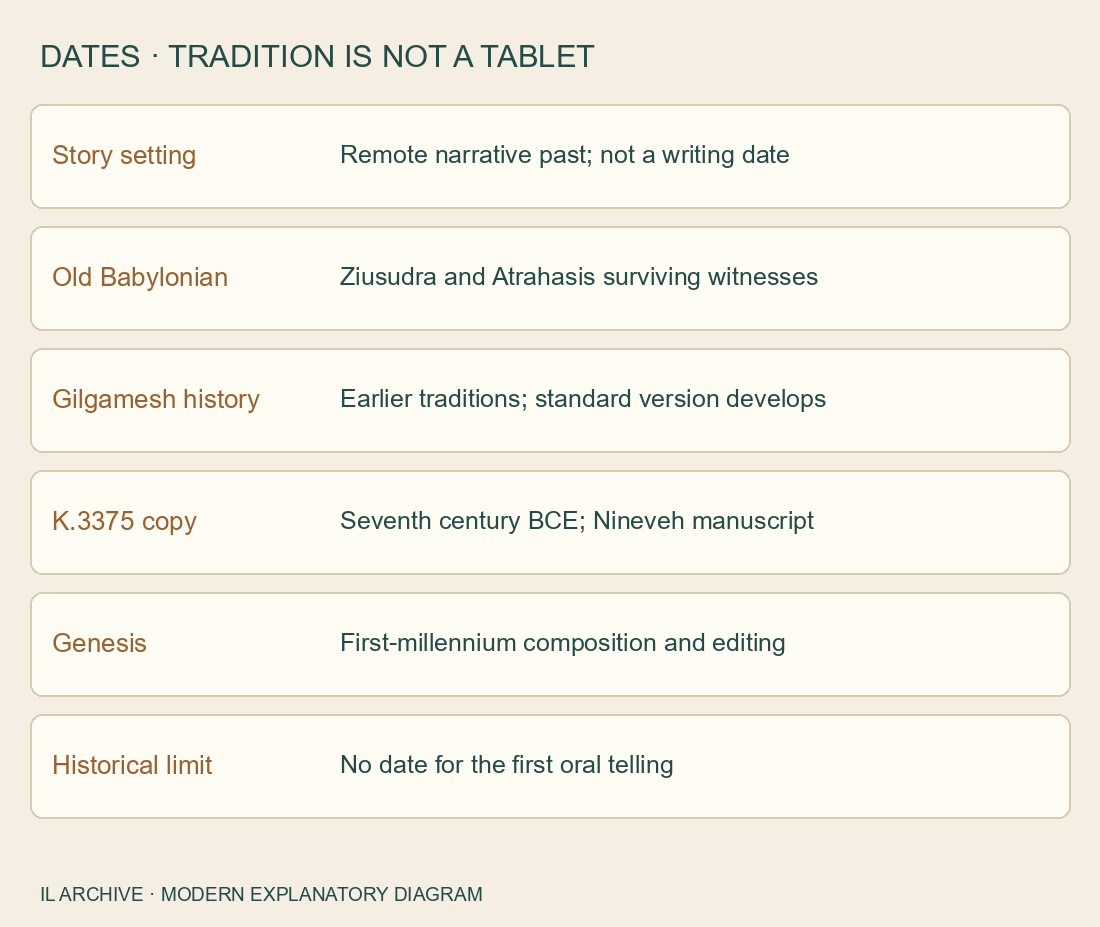
Three dates must be separated: the event's supposed time within a story, the age of the tradition, and the age of the surviving physical tablet. A Sumerian tradition may be older than an Akkadian one while their remaining manuscripts are close in date. A seventh-century Gilgamesh tablet can preserve older material. A first-millennium Genesis account places events in a remote age before Abraham.
Stories cannot be dated by their internal narrative settings. The secure outline is that written Mesopotamian flood traditions are well attested in the Old Babylonian second millennium BCE through Ziusudra and Atrahasis. Gilgamesh has its own long textual history, with a nearly complete Utnapishtim account in the standard version.
Genesis in its present form belongs to a first-millennium process of composition and editing. A substantial part of critical scholarship identifies combined Priestly and non-Priestly material and Mesopotamian antecedents for both.
Written Mesopotamian flood accounts thus precede the final Noah account by many centuries, in some witnesses by more than a millennium. That does not date the first oral telling of Noah's story. Oral traditions leave no publication date.[1][2][3][14][16]
Did a Genesis writer copy a Gilgamesh tablet directly?
We cannot demonstrate that. A literary or traditional relationship does not mean that a Hebrew writer sat with Gilgamesh XI and began translating it.
The story could have traveled orally, through other Akkadian versions or intermediate Syrian traditions. Several Mesopotamian texts may have contributed, and different elements may have entered Israelite tradition at different times.
Genesis does not resemble Gilgamesh alone. Important parallels concern Atrahasis. Carr argues that both main components were shaped in relation to earlier Mesopotamian traditions, particularly Atrahasis and Tablet XI. That does not establish simple direct copying from one particular manuscript.[14][15]
Why Atrahasis matters more than Gilgamesh's fame suggests
Gilgamesh is better known today, but Atrahasis becomes especially important when the larger Genesis structure is considered. Both place the flood within early human history after creation. A problem concerning humanity prompts radical divine intervention. A man is selected to survive. Both endings address how human life will continue without the same disaster recurring.
John Day argues that Atrahasis is a more likely background than an exclusive dependence on Gilgamesh, considering the post-creation setting, announcement of the disaster and ordering of life afterward. This is a scholarly judgment. Carr likewise stresses Atrahasis and Gilgamesh traditions for both Priestly and non-Priestly components.
“Noah resembles Gilgamesh” is therefore accurate but incomplete. The comparison concerns a wider Mesopotamian flood tradition represented by Ziusudra, Atrahasis, Utnapishtim and other versions.[14][15]
Similarity does not mean everything was borrowed
Resemblance can arise from shared human experience, repeated natural phenomena, independently invented simple plots, an older common tradition, indirect transmission or direct literary borrowingLiterary borrowingUse of material from an earlier text or tradition in a new work.Glossary · Click to read the explanation. The most dramatic possibility cannot be chosen simply because it is dramatic.
Evidence for transmission includes chronological priority or availability at the right time, actual opportunities for contact, a dense cluster of similarities and the specificity of the shared elements. Rare details recurring in a similar sequence strengthen the case.
Differences also matter: a receiving text can rebuild a narrative to fit its theology. Plausible media of transmission include translation, bilingual scribes, schools, imperial rule, deportation, trade and documented circulation.
Serious comparison therefore weighs parallels rather than merely counting them, and distinguishes direct dependence from indirect inheritance of Mesopotamian tradition.[15]
Contact is historically plausible in Noah's case
Israel and Judah were not isolated from Mesopotamia. They became part of its imperial sphere. BabylonBabylonBabylon is an ancient city in central present-day Iraq, south of BaghdadGlossary · Click to read the explanation destroyed JerusalemJerusalemJerusalem is a city of religious importance in Judaism, Christianity and IslamGlossary · Click to read the explanation in 587/586 BCE and deported part of Judah's population and elite. Judean communities remained in Mesopotamia for centuries.
This does not mean that flood traditions first reached them in 587/586. Levantine–Mesopotamian contacts were much older. The exile and Persian period nevertheless provide a recognizable setting for scribal encounters with Mesopotamian traditions.
These opportunities distinguish the comparison from an unexplained resemblance between stories separated by continents with no known contact. They establish a plausible setting, not a specific handoff of a tablet.[14][15]
Is Noah's story a “copy” of Gilgamesh?
“Copy” is historically inadequate if it implies that Hebrew writers merely replaced names. Genesis rebuilds the material within a different worldview.
The Mesopotamian accounts have several gods and conflicting wills. Atrahasis creates humans for divine labor; crisis leads to the flood; one god warns the hero against another's decision; gods suffer when offerings disappear.
Genesis presents one God, a judgment on violence and corruption, rescue by the same judge, preservation of animals within the world's renewal, and a sacrifice that does not feed a hungry deity. It ends with a covenant encompassing humans and animals and the rainbow as a cosmic sign.
An older narrative framework can survive while its meaning changes. Such transformation is one of the ways stories travel between cultures.[10][12][13][15]
Could the Mesopotamian flood reflect a real disaster?
That is a separate question from literary dependenceLiterary dependenceA relationship explaining a text’s composition through another text.Glossary · Click to read the explanation. Southern Mesopotamia is a floodplain. The Tigris and Euphrates can cause devastating floods, and ancient settlements faced major local disasters.
Large local floods, perhaps around Shuruppak, could have contributed to the memories underlying the tradition. Identifying a single event as its origin requires independent links between archaeological dating and textual history. Literary comparison alone cannot supply them.
Even a securely identified flood deposit would not by itself prove Ziusudra's historicity, the vessel's described size, a catastrophe covering the planet, or a single origin for every flood story. Archaeology may show that a flood occurred; linking that event to a particular narrative requires further evidence.
The natural event and the remembered story must be distinguished. This methodological point announces no discovery of a global flood or historical ark. Literary texts and sediment layers are different kinds of evidence.[1][3][14]
Similarities should not conceal differences
Ziusudra: the destructive decision is clear, its cause lost. The hero is warned; boat instructions are missing; the flood lasts seven days and nights; animals survive; sacrifice follows. He receives divine life and settles in Dilmun.
Atrahasis: population and noise are the problem. Enlil seeks destruction, Enki warns the hero, household and animals survive, and a sacrifice is offered. Human reproduction is then regulated.
Utnapishtim: the gods decide on a flood without explaining its cause in detail. Ea warns him. His great vessel carries family, craftspeople and animal life, rests on Nimuš, and releases dove, swallow and raven. He sacrifices, and he and his wife become immortal.
Noah: violence and corruption lead to judgment. God both warns and preserves him. His family and animals survive; the ark rests on the mountains of Ararat; raven and dove are released; sacrifice follows. Noah remains mortal. A covenant begins, while human birth and death continue.
This is a related narrative structure whose implications change with its religious setting, rather than one unchanged story.[1][5][8][9][10][12][13]
Gilgamesh is not the origin of the tradition either
Its fame can mislead. George Smith's nineteenth-century decipherment brought the comparison with Noah to worldwide attention, but Gilgamesh itself inherited flood material. Atrahasis predates the standard Gilgamesh version; Ziusudra preserves another old Sumerian tradition.
The Met overview also mentions a Late Bronze AgeLate Bronze AgeAn archaeological period conventionally around 1600–1200 BCE in much of the Near East, with regional variation.Glossary · Click to read the explanation flood-tradition fragment from UgaritUgaritAncient city and kingdom at Ras Shamra on the Syrian coast, flourishing between the fourteenth and early twelfth centuries BCE and preserving multilingual archives.Glossary · Click to read the explanation and Berossus's Babylonian account in Greek during the Hellenistic period, preserved through later quotations. These show circulation, not an unbroken transmission chain.
The historical picture is wider than “Gilgamesh to Noah”: an old Mesopotamian tradition with several forms, centuries of transmission and rewriting, and its contribution to the Hebrew narrative. Gilgamesh is a major witness, not necessarily the only text available to Genesis's writers.[7][15][16]
Can we speak of “borrowing”?
Yes, if the term is defined. Literal copying of Noah's story from a specific Gilgamesh tablet is unproven. Formation in dialogue with inherited Mesopotamian flood traditions has strong support in comparative scholarship.
Carr explicitly considers both major Genesis flood components to have been modeled on earlier Mesopotamian traditions, especially Atrahasis and Gilgamesh. Day emphasizes Atrahasis while leaving the earlier tradition's precise route and timing open.
These are comparative interpretations, not records identifying a Hebrew writer and the manuscript on their desk. The relationship is strongly supported; its exact route remains unknown.[14][15]
What can comparison establish?
Confirmed: written Mesopotamian flood narratives precede the known final Noah account by centuries. Some surviving copies belong to the Old Babylonian early second millennium BCE.
Confirmed: Ziusudra, Atrahasis and Utnapishtim precede Noah in the available textual record. Manuscript date and tradition date must remain distinct.
Confirmed: the accounts share a substantial cluster of elements: chosen survivor, vessel, preservation of life, flood, emergence and sacrifice, with mountains and bird tests especially visible in Gilgamesh and Genesis.
Confirmed: their motives, divine worlds and endings differ substantially.
Strongly probable: Noah's story belongs literarily to the world of older Mesopotamian flood traditions rather than developing in complete isolation.
Possible: transmission involved several stages and intermediaries, perhaps beginning before the Babylonian exileBabylonian exileJudean deportations to Babylonia and the kingdom’s collapse in the early sixth century BCE; several phases, not everyone removed or returned at once.Glossary · Click to read the explanation and continuing through and after it.
Unproven: a Genesis writer directly copied one particular Gilgamesh tablet.
Unproven: similar narratives alone demonstrate a worldwide flood covering the earth at a particular time in human history.[1][3][8][10][12][13][14]
Before Noah, a flood had already been written
When Noah's story entered Hebrew literature, the idea of divine powers destroying humanity by water while a chosen man preserved life in a vessel and later sacrificed was already old in the ancient Near EastAncient Near EastA historical and geographical term covering Mesopotamia, the Levant and neighbouring ancient societies.Glossary · Click to read the explanation.
Related versions bore the names Ziusudra, Atrahasis and Utnapishtim. The surviving evidence does not establish a simple sequence in which each name replaced its predecessor. Gods had disagreed about humanity; a vessel had sailed; animals had boarded; birds had been sent out; sacrificial smoke had risen. These elements preceded the final Noah narrative by a long time.
This does not make Genesis an uninteresting reproduction. It lets us observe religious memory in motion. Stories travel and change. Atrahasis concerns populous, noisy humanity. Gilgamesh places the flood within the question of immortality. Genesis makes it judgment on corruption and violence, followed by a covenant with living creatures.
The older framework remains recognizable while its meaning changes. In the written record, Mesopotamian flood heroes precede Noah. The deeper historical question is how a tradition from a world of several gods crossed languages, cultures and centuries into a monotheistic narrative that changed the disaster's cause, the rescuer's identity, the meaning of survival and the future relationship between God and humanity.
The flood is therefore also a history of texts crossing time, with each tradition reshaping the disaster according to its understanding of the world.[1][8][13][14]
References and notes
- ETCSL, The Flood Story, 1.7.4, University of Oxford. Complete published translation, segments A–E. Gaps are marked; warning speaker and motive are not clearly preserved. Return to the text ↑
- Mehmet-Ali Ataç, The Flood Myth as Paradigm, 2018. Chapter 3, pp. 81–101; opening paragraphs on Old Babylonian and standard witnesses read, not the entire chapter or Mari painting analysis. Return to the text ↑
- CDLI, P285811, Old Babylonian Atrahasis witness. Artifact metadata: Old Babylonian c.1900–1600 BCE; reference to Ammi-saduqa year 12. Period range does not date all epic copies. Return to the text ↑
- A. R. George and F. N. H. Al-Rawi, Tablets from the Sippar Library VI. Atra-ḫasīs, Iraq 58 (1996), pp.147–190. Available/indexed opening, p.147: creation, reproduction, plague, drought, famine, flood and population measures. Entire edition not read. Return to the text ↑
- Ruth Horry, Enki/Ea, ORACC, 2019. Creator and protector of humanity: noise, sleeplessness and warning Atrahasis; does not restore the missing speaker in Ziusudra. Return to the text ↑
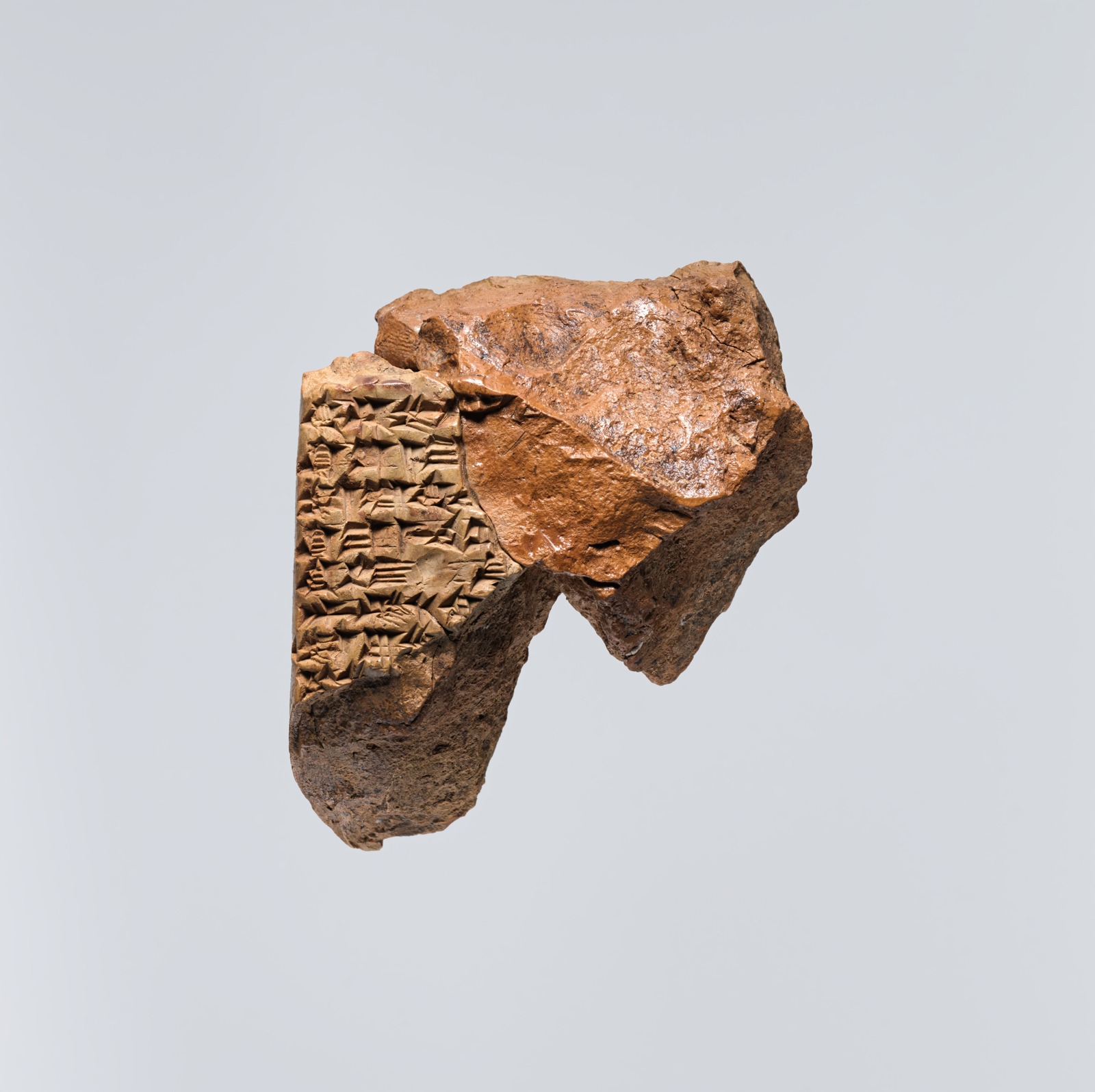
- The Met, 86.11.378a, Atrahasis-tradition fragment. Catalogue, obverse/reverse description and Open Access image metadata: c.seventh–sixth centuries BCE. Reverse names Utnapishtim; not an Old Babylonian copy. Return to the text ↑
- Ira Spar, Flood Stories, The Met, 2009. Museum essay read; Sumerian/Akkadian witnesses and circulation at Ugarit and in Berossus. Hero endings checked against texts; Atrahasis’s ending is not equated with Utnapishtim’s immortality. Return to the text ↑
- Andrew George, Gilgamesh XI, lines 1–163, SOAS project. Published Akkadian and translation read; based on Oxford 2003 with minor modifications. Excludes later Enlil anger and immortality after line 163. Return to the text ↑
- Alexander Heidel, The Gilgamesh Epic and Old Testament Parallels, Chicago, 1949. University PDF, pp.78–88; especially XI pp.87–88: Enlil’s anger, Ea’s protest, Atrahasis’s dream, hero and wife’s life. Numbering differs from George; rest of book not read. Return to the text ↑
- Genesis 6, Hebrew and English text, Mechon Mamre. Wickedness, corruption and violence; Noah; ark instructions and pairs. Return to the text ↑
- Genesis 7, Hebrew and English text, Mechon Mamre. 7:2–3 “seven seven”; 7:12 forty days; 7:16 closing door; 7:24 150 days. Return to the text ↑
- Genesis 8, Hebrew and English text, Mechon Mamre. 8:4 mountains of Ararat; 8:7–12 raven, three dove releases and olive leaf; 8:20–22 sacrifice and promise. Return to the text ↑
- Genesis 9, Hebrew and English text, Mechon Mamre. 9:1–17 life, covenant with living creatures and bow; 9:29 Noah’s death. Return to the text ↑
- David M. Carr, Precursors to the Flood Narrative, The Formation of Genesis 1–11 (2020), pp.141–177. Public abstract read: Priestly and non-Priestly components, older Atrahasis/Gilgamesh traditions, conflation and coordinating additions. Full chapter not read. Return to the text ↑
- John Day, The Mesopotamian Origin of the Biblical Flood Story, 2020. Author’s article read: argument for Atrahasis, weighing parallels and theological transformation. Birds hypothesized in an Atrahasis lacuna are not preserved evidence; route remains uncertain. Return to the text ↑
- British Museum, catalogue result for Flood Tablet K.3375. Indexed catalogue result checked: Ashurbanipal library, Kouyunjik, Neo-Assyrian, seventh century BCE. Does not date the story’s initial composition. Return to the text ↑
Suggest a correction · Suggest a source for this record
Cite this record
IL Archive, «The Flood Before Noah: Ziusudra, Atrahasis, Utnapishtim and Genesis», Edition 1, https://ilarchive.com/en/studies/flood-before-noah
Continue reading