Entity · Book
Epic of Gilgamesh
A reference page linking a name, group, or concept to the materials that discuss it.
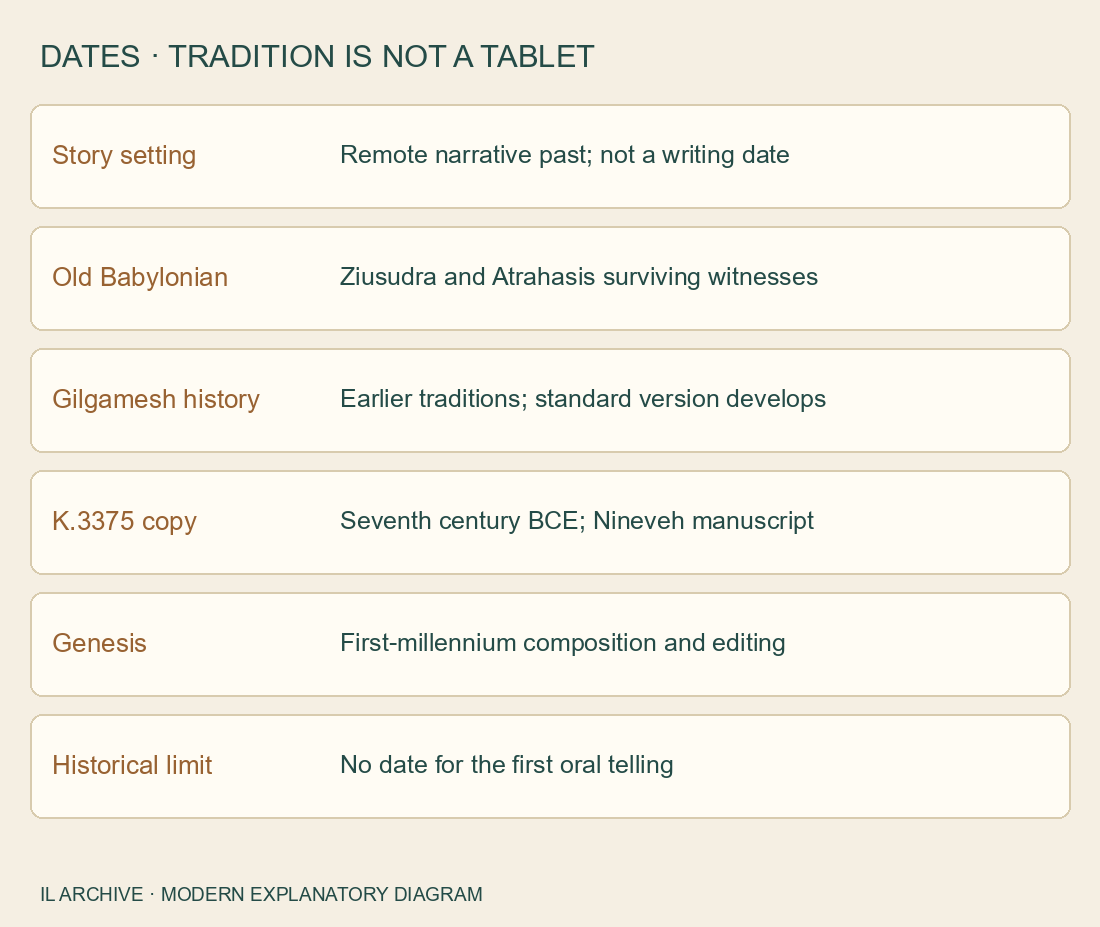
Mesopotamian literary tradition with multiple versions, concerning Uruk’s king, Enkidu and mortality. Standard Tablet XI preserves Utnapishtim’s flood; manuscript date does not date the tradition’s origin.
Text
Story and version
Gilgamesh literature developed across versions and periods. The flood hero is known in Old Babylonian tradition, while the fuller surviving Tablet XI narrative belongs to the standard version.[1] SOAS displays only lines 1–163.[2]
Tablet date is not composition date
K.3375, AshurbanipalAshurbanipalAshurbanipal was an Assyrian king of the seventh century BCE, reigning about 668–631 BCEGlossary · Click to read the explanation’s library, KouyunjikNineveh and KuyunjikNineveh is an ancient Assyrian city near Mosul in northern Iraq; Kuyunjik is one of its archaeological moundsGlossary · Click to read the explanation/Nineveh, seventh century BCE, is a famous physical witness.[3] It establishes neither initial composition then nor the manuscript read by a Genesis writer. Image: modern distinction of narrative time, tradition and copy.
References and notes
- Mehmet-Ali Ataç, The Flood Myth as Paradigm, 2018. Chapter 3, pp. 81–101; opening paragraphs on Old Babylonian and standard witnesses read, not the entire chapter or Mari painting analysis. Return to the text ↑
- Andrew George, Gilgamesh XI, lines 1–163, SOAS project. Published Akkadian and translation read; based on Oxford 2003 with minor modifications. Excludes later Enlil anger and immortality after line 163. Return to the text ↑
- British Museum, catalogue result for Flood Tablet K.3375. Indexed catalogue result checked: Ashurbanipal library, Kouyunjik, Neo-Assyrian, seventh century BCE. Does not date the story’s initial composition. Return to the text ↑
Research history
Substantive changes are retained here. Minor copy edits remain in the internal operational log.
-
Substantive record update
Suggest a correction · Suggest a source for this record
Cite this record
IL Archive, «Epic of Gilgamesh», Edition 2, https://ilarchive.com/en/entities/epic-of-gilgamesh