Entity · Text or methodological concept
Literary dependence
A reference page linking a name, group, or concept to the materials that discuss it.
A proposed use of one text in composing another, tested through wording, structure and chronology while separating relationship from direction.
Estimated reading time: 9 min Published Last reviewed:
Share article
Text
Introduction
Literary dependence is a historical hypothesis that an author or editor used another text in composing a work; it is not a label for every similarity between books. It raises two separate questions: is there evidence of a relationship of transmission or use, and, if so, which text drew on which other text, and how? This entry tests those questions against three comparisons with different evidential outcomes: the Zion oracle in Isaiah and Micah, David's census in Samuel and Chronicles, and the healing of the paralytic in the Synoptic Gospels. Neither a direct quotation nor a settled direction of borrowing is assumed in advance.
What the term does—and does not—mean
A claim of literary dependence, when justified, explains a text's wording or arrangement through an author's use of an earlier text or a version of it. The use may involve verbatim reproduction, abbreviation, expansion or rearrangement. Literary borrowingLiterary borrowingUse of verbal or narrative material from an earlier text or tradition in a later work, distinguishing evidence of transfer from mere resemblance.Glossary · Click to read the explanation designates the appropriation of a particular phrase or passage, which may or may not be acknowledged. Such borrowing can be evidence of dependence, but dependence is broader: a writer may reshape the architecture of a narrative without reproducing any lengthy sentence. Both must be distinguished from general influence by a theme or school and from intertextuality understood as connections drawn in reading, which need not demonstrate historical contact between authors.
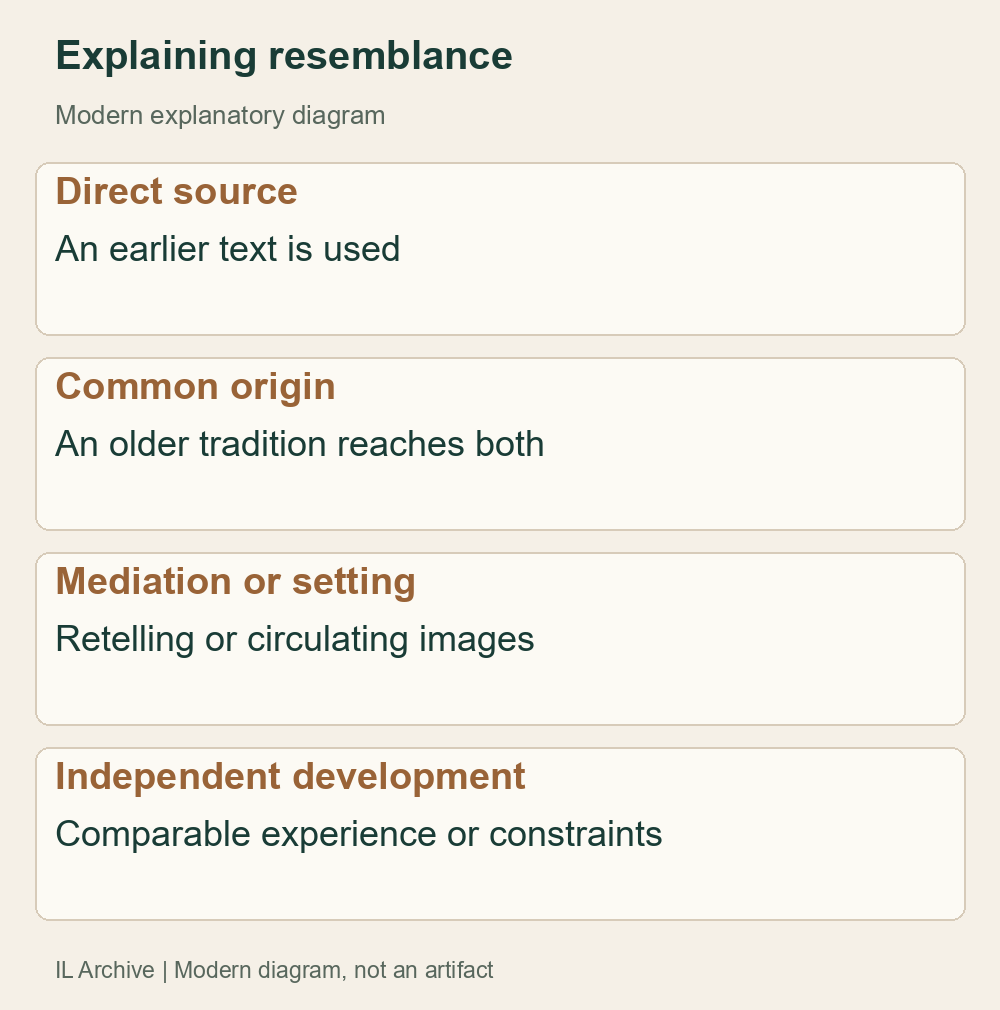
Shared words such as “king” or “peace” carry little weight. A long, unusual sequence of matching expressions in corresponding positions, followed by shared narrative details, is much more significant. Yet prayers, proverbial forms and legal formulas can circulate across a cultural milieu; use of the same lost third source or of orally transmitted tradition is a real historical alternative, not a device for dismissing evidence. The aim is to find the most economical account of agreement and difference together, rather than count the greatest possible number of resemblances. [1] [2]
Weighing the evidence
- Wording: An unusual phrase, unexpected succession of words, or even a distinctive shared error or construction can be telling; a familiar liturgical formula has less discriminating power.
- Sequence and structure: Agreement in the ordering and transitions of several units normally carries more weight than one shared motif, unless genre or the nature of an event already imposes that order.
- Context and editorial change: A substituted name, transposed scene or omitted detail may help explain how a later author repurposed earlier material; simply calling every difference an “editorial change” does not establish direction.
- Chronology and possible access: There must be a plausible route by which a text or its tradition reached the author's setting. A surviving manuscript dates a particular physical witness, not necessarily the first composition of its contents; the absence of an earlier copy does not prove that none existed.
These indicators are not independent numbers that can be added. Shared order and wording may both result from copying one unit; treating them as separate votes would overcount evidence. Each proposed account must therefore be compared with specific alternatives: a common source, conventional formulas, oral performance, or independent developmentIndependent developmentSimilar narrative or cultural elements arising in different settings without historical transmission of the specific feature between them; a testable explanation, not a default assumption when records of borrowing are absent.Glossary · Click to read the explanation. An alternative should not be required to produce impossibly complete proof of a lost document; equally, appealing to an unspecified lost source explains little unless it fits the observed data. Cooper Smith distinguishes establishing a relationship from arguing its direction. The detailed operation of his eight criteria is not presented here as though the entire article had been read when only its abstract was accessible. [1]
Isaiah and Micah: close correspondence, uncertain direction
An oracle about nations ascending the mountain of the Lord and the end of warfare appears in the Book of IsaiahBook of IsaiahProphetic collection in the Hebrew Bible; its first chapter addresses justice and the cases of the fatherless and widow.Glossary · Click to read the explanation 2:2–4 and the Book of Micah 4:1–3. These texts share more than the general idea of peace: nations travel to Zion, instruction proceeds from the city, and weapons become agricultural implements in the same broad progression. In the Masoretic HebrewHebrewA Northwest Semitic language of the Canaanite group, encompassing Iron Age epigraphy, Biblical, Rabbinic, medieval and Modern Hebrew; its scripts and pronunciations changed over time.Glossary · Click to read the explanation, Isaiah 2:3 and Micah 4:2 share precisely this short clause: [3] [4]
In the present translation: “For from Zion instruction/the law shall go forth.” The Hebrew torah may denote teaching or law, depending on context; this one line cannot establish who composed it first. Both passages continue with swords turned into ploughshares and spears into pruning tools, but they vary in their description of the nations. Their endings diverge: Micah 4:4–5 adds security beneath vine and fig tree, whereas Isaiah 2:5 calls the house of Jacob to walk in the light. These differences are intelligible as adaptations, but do not by themselves identify who adapted whom. [3] [4]
In the present book of Micah the passage follows an announcement of Zion's devastation in 3:12, thus reversing judgement into hope. Wilhelm Wessels examines that juxtaposition; scholars also propose different stages of growth and editing for the Micah collection. A shared older oracle, or adaptation within one of the collections, demands evidence beyond mere verbal identity. Marvin Sweeney studies Micah's engagement with Isaiah, but his published abstract alone does not resolve the direction of this particular passage. Best-supported judgement: a strong textual relationship, with route and direction unsettled. [5] [6]
Samuel and Chronicles: a stronger direction, a changed account
Second Samuel 24 and First ChroniclesFirst Book of ChroniclesBiblical retelling of Israel’s monarchy; its census passage ascribes the incitement of David to “satan”.Glossary · Click to read the explanation 21 narrate David's census, Joab's protest, a plague and the choice of an altar site in a closely parallel sequence. Their openings, however, assign the prompting differently. Second Samuel 24:1 first refers to divine anger: [7]
Rendered briefly here: “Again the Lord's anger burned against Israel; and he incited David.” First Chronicles 21:1 begins otherwise: [8]
Rendered here: “An adversary stood against Israel and incited David.” Hebrew śāṭān can mean an adversary or accuser; whether it functions here as the name of a fully individuated supernatural figure is an interpretive question, not something demonstrated by translating the word. The significant comparison is the changed agent of incitement at the opening of an otherwise shared narrative, not a reconstruction of the whole history of Satan from one verse. [7] [8]
Agreement across numerous narrative stages, together with Chronicles' place within a later historiographical work that reuses Samuel–Kings, makes Chronicles' use of a Samuel-like textual tradition much more likely than the reverse. Geyser-Fouché and Chukwuka discuss the shaping role of the temple and its chosen location in this account. This does not establish that the Chronicler possessed precisely the later Masoretic textMasoretic TextThe Hebrew Bible’s transmission tradition combining its consonantal text, transmitted vocalization and accentuation, and Masorah notes. The consonantal text has ancient roots; surviving codices that bring these layers together in their Masoretic form are medieval.Glossary · Click to read the explanation of Samuel: textual exemplars may have differed, and both accounts may preserve layers of editing. Alexander Rofé proposes editorial activity within Samuel itself; that proposal is reported here from the article's abstract, not from an examination of its pages. [9] [10] [11]
The Synoptic Gospels: extensive dependence, disputed sources
Matthew, Mark and Luke are called the Synoptic Gospels because many of their episodes can be read side by side. In the paralytic's healing, a dispute over forgiving sins leads to a renewed address to the man: Mark 2:1–12, MatthewGospel of MatthewOne of the New Testament’s four Gospels, from the late first century CE, relating inherited law and Jesus’ sayings.Glossary · Click to read the explanation 9:1–8 and LukeGospel of LukeNew Testament gospel where Satan asks to test the disciples in 22:31–32.Glossary · Click to read the explanation 5:17–26. In the published Greek of the SBL Greek New Testament (2010), the shift at Mark 2:10 and Matthew 9:6 begins: [12] [13]
That is, “But so that you may know that he has authority ...”. Luke 5:24 uses a matching introduction but places “the Son of Man” before “has authority”: [14]
That is, “But so that you may know that the Son of Man has authority ...”. Shared phrasing, the turn in address within the episode, and the narrative sequence offer more evidence than the theme “a healing miracle.” This comparison uses modern printed Greek texts, not a claim that the quoted words were personally inspected in a particular ancient manuscript; Greek editions also differ in details that matter when citing exact wording. [12] [13] [14]
Across the Gospels, Markan priority, favoured by a substantial majority of scholars, explains much of the shared ordering and wording in Matthew and Luke. But it does not automatically decide whether Luke also knew Matthew. The Two-Source Hypothesis posits a shared sayings source, conventionally called Q, in addition to Mark; the Farrer model instead proposes that Luke used Matthew, dispensing with Q. No manuscript of Q is known. This makes Q a reconstructed source, neither invalid merely because the hypothetical exemplar is missing nor an extant documentary fact. Mark Goodacre invokes some agreements of Matthew and Luke against Mark in his case for the Farrer model, whereas John Kloppenborg challenges that explanation. Luke 1:1 mentions earlier attempts to compose accounts without naming those works. A broad network of literary relationships is well supported; its complete transmission map remains debated. [15] [16] [17] [18]
Three different kinds of date
- The time represented in the story: David belongs to the ancient royal narrative and Jesus' activity to the first century CE. These are periods as represented in the sources, not dates when the respective books were composed.
- Proposed composition and editing: The Isaiah and Micah oracles belong to traditions associated with the Assyrian period, with substantial debate over later editing of these passages within their collections. Samuel developed in stages, often placed through exilic and post-exilic periods. Proposed dates for Chronicles range across the fifth to second centuries BCE, although influential reconstructions favour the Persian period or an early Hellenistic setting. Mark is commonly dated around 65–75 CE, and Matthew and Luke to later first-century decades, with disputed boundaries. These are scholarly ranges, not dates attached to surviving authorial signatures. [5] [11] [15] [21]
- The date of a surviving witness: The Great Isaiah Scroll among the Dead Sea ScrollsDead Sea ScrollsManuscript collections from the Judaean Desert, best known through Qumran: diverse works, languages and textual forms, with copying distinguished from composition.Glossary · Click to read the explanation is commonly dated to roughly 125–100 BCE, much later than the prophetic setting; it attests a physical copy, not the oracle's first composition. The Greek Codex Sinaiticus is generally assigned to the fourth century CE—centuries after the proposed composition of the Gospels—and older Christian fragments also survive. Neither witness personally proves a direction of borrowing: each can document the existence or condition of a text when it was copied. [19] [20]
What a conclusion can establish
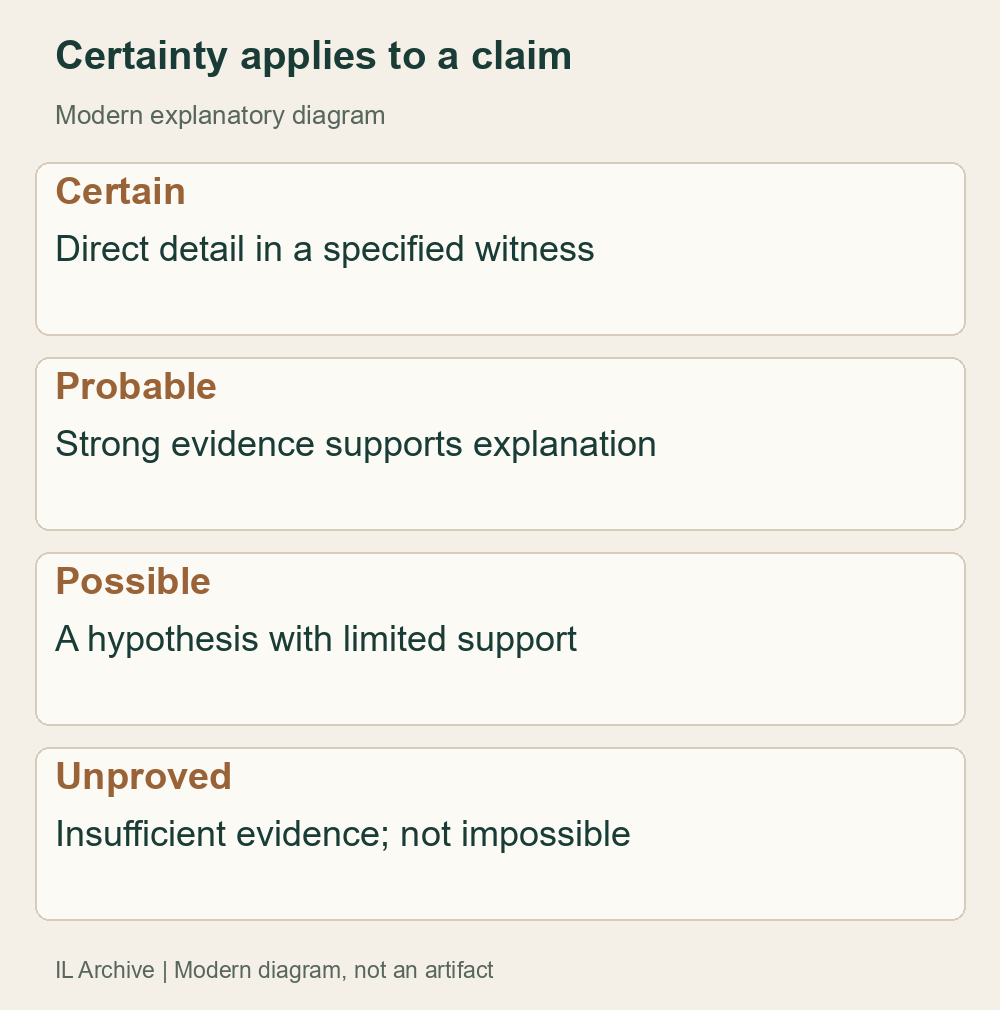
The relationship may be strong even when its direction is uncertain, as with Isaiah and Micah. A later reworking can be likely without settling the readings or revisions of every surviving version, as with Chronicles. A broad network of dependence may be accepted while scholars dispute an unattested intermediate source, as with the Gospels. Each claim should identify the compared passages, the witness or edition actually examined, possible chronology, serious alternatives and the evidence that could change the conclusion. The accompanying conceptual diagram makes one point: relationship, source identity, direction and detailed route may carry different levels of confidence, not one automatic verdict extracted from similarity.
References and notes (21)
- Cooper Smith, “Inner-Biblical Allusion and the Direction of Dependence: Toward a Comprehensive List of Criteria,” Journal of Hebrew Scriptures 22, art. 6 (2022; published online 2023). Journal abstract and publication metadata only; the full PDF and its pp. 25–26 were not read. Return to the text ↑
- David M. Carr, The Formation of the Hebrew Bible: A New Reconstruction (Oxford University Press, 2011). Publisher abstract for chapter 4, “From Documented Growth to Method in Reconstruction of Growth”; pp. 102–149 not accessed. Return to the text ↑
- Masoretic Hebrew text of Isaiah as displayed by Mechon-Mamre (with a parallel English rendering). Isaiah 2:2–5, Hebrew lines directly read; quoted clause in 2:3; this entry provides its own translation. Return to the text ↑
- Masoretic Hebrew text of Micah as displayed by Mechon-Mamre. Micah 4:1–5, quoted clause in 4:2; Hebrew and accompanying English examined. Return to the text ↑
- Wilhelm Wessels, “YHWH, the God of New Beginnings: Micah’s Testimony,” HTS Theological Studies 69/1 (2013). Open-access full text: composition of Micah and discussion of Micah 3:12 alongside 4:1–5; relevant sections read. Return to the text ↑
- Marvin A. Sweeney, “Micah’s Debate with Isaiah,” Journal for the Study of the Old Testament 25, no. 93 (2001), pp. 111–124. Publisher abstract and bibliographic details only; restricted pp. 111–124 were not read. Return to the text ↑
- Masoretic Hebrew of 2 Samuel 24, as displayed by Mechon-Mamre. 2 Samuel 24:1–25, opening 24:1 checked against surrounding census/altar narrative; Hebrew cited with a fresh short translation. Return to the text ↑
- Masoretic Hebrew of 1 Chronicles 21, as displayed by Mechon-Mamre. 1 Chronicles 21:1–30, verse 1 read in its census/altar context; Hebrew from the online text, translations newly supplied. Return to the text ↑
- Ananda B. Geyser-Fouché and Ebele C. Chukwuka, “Tradition Critical Study of 1 Chronicles 21,” HTS Theological Studies 77/4 (2021). Open-access article: introduction and relevant analysis of the chapter, its traditions and temple interests; HTML text read. Return to the text ↑
- Alexander Rofé, “Writing, Interpolating and Editing: 2 Samuel 24 and 1 Chronicles 21 as a Case Study,” Hebrew Bible and Ancient Israel 3/3 (2014), pp. 317–326. Publisher abstract and bibliographic details only; article pp. 317–326 not accessed. Return to the text ↑
- Michael D. Coogan et al., A Brief Introduction to the Old Testament, 4th ed., Oxford Learning Link, chapter 23 summary. Entire publicly available chapter 23 summary read: Chronicles’ use of Samuel–Kings and contested dating; not the full chapter. Return to the text ↑
- Michael W. Holmes (ed.), SBL Greek New Testament (2010), Mark 2:10; © Society of Biblical Literature and Logos Bible Software, CC BY 4.0. SBLGNT 2010 Greek text of Mark 2:10 directly read, with displayed edition variants; license/source https://www.sblgnt.com/; not an ancient manuscript. Return to the text ↑
- Michael W. Holmes (ed.), SBL Greek New Testament (2010), Matthew 9:6; © Society of Biblical Literature and Logos Bible Software, CC BY 4.0. SBLGNT 2010 Greek text of Matthew 9:6 directly read, with displayed edition variants; license/source https://www.sblgnt.com/; not an ancient manuscript. Return to the text ↑
- Michael W. Holmes (ed.), SBL Greek New Testament (2010), Luke 5:24; © Society of Biblical Literature and Logos Bible Software, CC BY 4.0. SBLGNT 2010 Greek text of Luke 5:24 directly read, with displayed edition variants; license/source https://www.sblgnt.com/; not an ancient manuscript. Return to the text ↑
- J. V. M. Sturdy, “The Relationship of the Synoptic Gospels,” in Redrawing the Boundaries: The Date of Early Christian Literature (Acumen, 2008), pp. 31–34, Cambridge Core. Cambridge chapter extract/summary: Markan priority, Q theory and approximate 65–75/80–95 CE dates; not full pp. 31–34. Return to the text ↑
- Mark Goodacre, “The Case Against Q FAQ,” author’s explanatory research page. Author’s FAQ directly read, especially on Luke’s use of Matthew and minor agreements of Matthew/Luke against Mark; it presents his position. Return to the text ↑
- John S. Kloppenborg, “On Dispensing with Q?: Goodacre on the Relation of Luke to Matthew,” New Testament Studies 49 (2003), pp. 210–236. Publisher abstract and bibliographic metadata only; full article pp. 210–236 not read. Return to the text ↑
- Luke 1:1 in Michael W. Holmes (ed.), SBL Greek New Testament (2010); © Society of Biblical Literature and Logos Bible Software, CC BY 4.0. Greek wording of Luke 1:1 directly read: prior attempts to compile a narrative, without named source; license https://www.sblgnt.com/. Return to the text ↑
- Israel Museum, Jerusalem, “The Great Isaiah Scroll MS A (1QIsa),” museum object record via Google Arts & Culture. Object metadata and approximate date around 100 BCE (other scholarly reporting c.125 BCE); no physical inspection and no museum image reproduced. Return to the text ↑
- Codex Sinaiticus Project, “Date,” official custodial project website. Full date information page: palaeographical dating generally to fourth century CE; selected Greek verses not read from the codex. Return to the text ↑
- Steven Shawn Tuell, “First and Second Chronicles,” Oxford Bibliographies in Biblical Studies (Oxford University Press, 2010; updated 2023). Published article introduction read, including scholarly dating range fifth–second centuries BCE; linked bibliography items not read. Return to the text ↑
Suggest a correction · Suggest a source for this record
Cite this record
IL Archive, «Literary dependence», https://ilarchive.com/en/entities/literary-dependence
Continue reading