Study
How did “the adversary” become Satan?
An extended study of a topic, with evidence and references.
From human opponents and Balaam’s angel to Job, Zechariah and Chronicles, then Enoch, Jubilees, Qumran and the New Testament: expanding opposition, and what names and roles can establish.
Share article
Text
A figure that did not arrive complete
Today “Satan” often evokes an evil being who misleads humanity, commands hostile powers and confronts angels. Especially in Christian tradition, the figure is associated with the ancient serpent, temptation and the final conflict. This picture does not appear complete in the earliest HebrewHebrewA Northwest Semitic language in the Canaanite group, with ancient and modern forms.Glossary · Click to read the explanation uses of the word. Its history involves changes in the adversary’s role, authority and relationship to God across different texts, rather than one continuous biography of an unchanging individual. [1]
The word begins with opposition and hostility. Job and Zechariah present a heavenly adversary within the divine councilDivine councilA representation of divine beings acting as an assembly with authority and differentiated roles.Glossary · Click to read the explanation. Second Temple literature develops varied hostile powers, and early Christian texts unite some roles in Satan/the Devil. This does not make every text the next chronological stage, or imply that all Jews shared one view. The historical question is how the adversary acquired, in some traditions, the role of a cosmic enemy.
A human adversary before a famous name
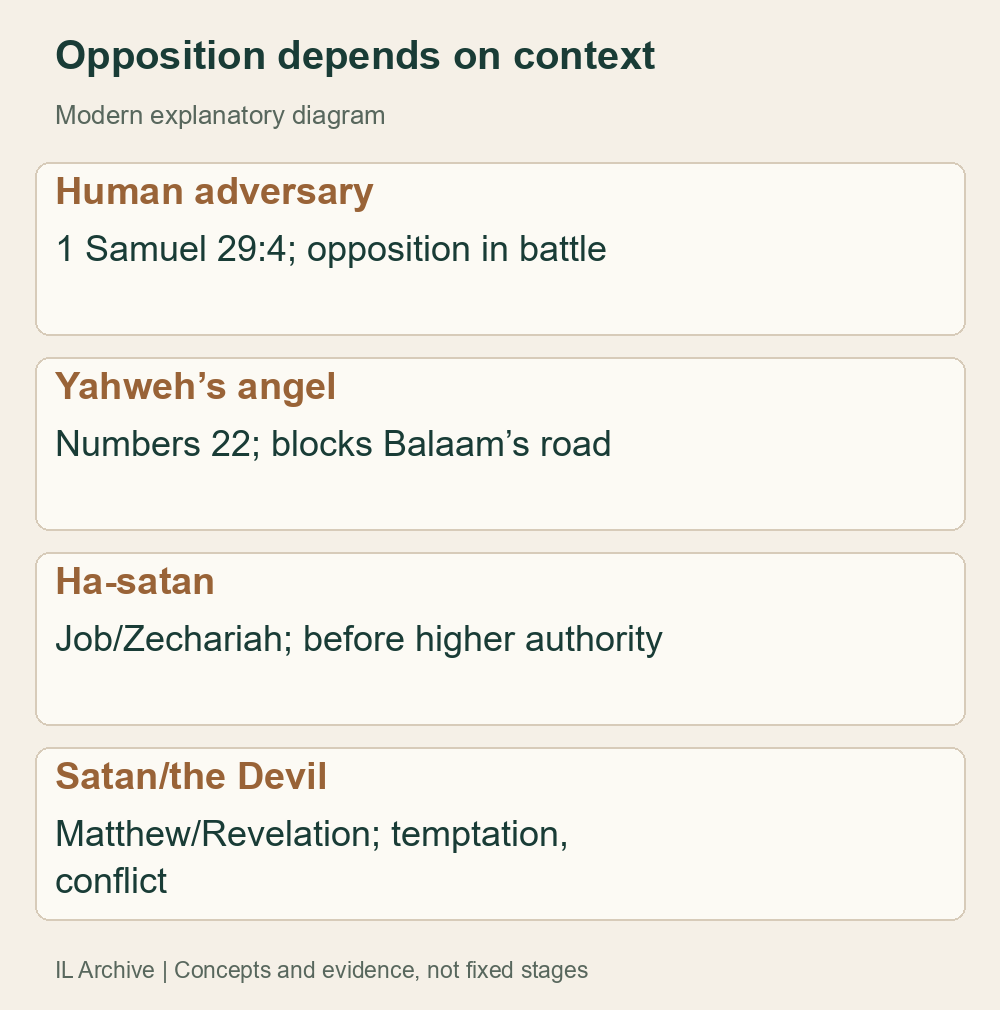
The Hebrew שָׂטָן — śāṭān means an adversary or opponent; opposition can be political or military. In 1 Samuel 29:4 the Philistine commanders fear that David might turn against them in battle and become their adversary. In 1 Kings 11:14 Hadad is described as Solomon’s adversary. Neither context requires a supernatural evil being. [2]
Every occurrence should therefore not be translated as the personal Satan familiar from later doctrine. A word can begin as a description of a role and become a familiar individual’s name. Dictionaries alone cannot resolve the distinction: the actor, action and context identify what is intended.
Yahweh’s angel blocks the road
In Numbers 22:22 Yahweh’s angelAngel / Divine MessengerHebrew malʾakh means messenger, human or celestial according to context; the word alone proves neither wings nor origin from a particular Canaanite god.Glossary · Click to read the explanation stands in Balaam’s path as his adversary; the Hebrew phrase is לְשָׂטָן לוֹ — leśāṭān lô. In 22:32 the angel explains that he has come to oppose him. The actor is YahwehYahwehThe divine proper name written YHWH in the Hebrew Bible.Glossary · Click to read the explanation’s own messenger, whose opposition serves a divine purpose within the story. [3]
This example breaks the automatic associationShirkAssociating others with God in Quranic discourse; not equivalent to denying God’s existence.Glossary · Click to read the explanation between the word and cosmic evil. Being someone’s satan means opposing that person in this context. It does not establish that the figure is the Devil or the leader of a revolt against God. Read the function before imposing the later name.
Genesis does not call the serpent Satan
Genesis 3 presents the serpent, nāḥāš, speaking with the woman. It does not call the figure Satan or the Devil. Identifying the serpent with Satan is familiar in later Christian reading and is explicit in Revelation 12, but that does not change Genesis’s own designation. [4]
A later tradition can reinterpret an older figure and connect it with another. Historians can study that interpretation and its development, but cannot treat it as the name given by the earlier text. The distinction between original wording and subsequent reception remains essential throughout this history.
Job: the adversary enters the council
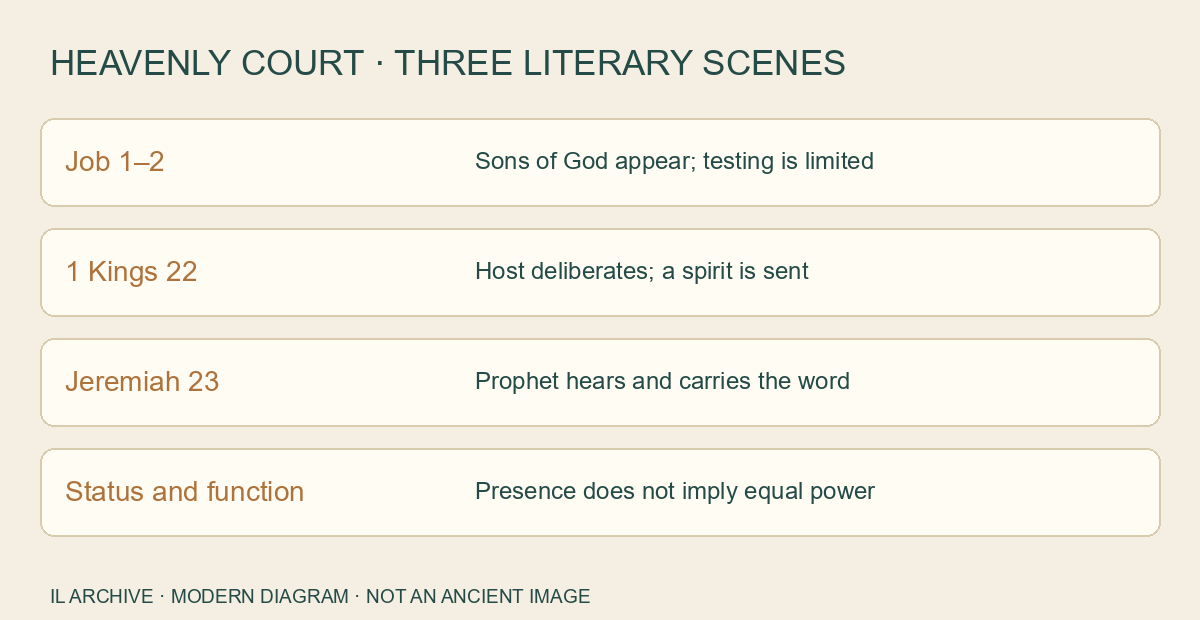
In Job 1 the sons of GodSons of GodA Hebrew expression for heavenly beings in texts such as Job; context determines its meaning, rather than biological descent or a fixed angelic roster.Glossary · Click to read the explanation assemble before YahwehYahwehThe divine proper name written YHWH in the Hebrew Bible.Glossary · Click to read the explanation, and ha-satanHa-satan in JobThe adversary or accuser in Job, with the Hebrew definite article; among the sons of God, acting within permission and limits rather than carrying every later Satanic trait.Glossary · Click to read the explanation comes among them. Yahweh asks where he has been; he answers that he has roamed the earth. This is a heavenly court scene in which the adversary addresses the sovereign, not a declaration of war by a power outside his order. [5]
The Hebrew article ha makes the expression closer to “the adversary” or “the opponent/accuser” than an ordinary personal name. A functional designation does not make the figure an empty word. He speaks and acts in the narrative. The question concerns his authority, not whether the story presents a character at all.
The challenge concerns Job’s motives
Yahweh praises Job, and the adversary challenges the meaning of his piety. Does Job fear God without reward, or because God has protected and prospered him? Removing that protection, the adversary proposes, will expose his motives. This is not yet a story of seizing heaven’s throne; it tests the sincerity of the human relationship with God. [5]
That observation does not make the adversary benevolent. His challenge opens the way to catastrophe. The structure of the scene shows that harm proceeds through a request, permission and limits. The adversary does not claim power equal to Yahweh’s.
Two permissions with different limits
In Job 1:12 Yahweh permits action against what Job possesses while prohibiting harm to Job himself. In Job 2:6 the limit changes: his body may be harmed, but his life must be spared. The narrative then describes his disease. Request, permission and action form an explicit sequence. [5][6]
This adversary differs from the simplified picture of an independent enemy acting without a higher authority. Causing suffering alone does not distinguish the figures. The historical difference concerns the relationship between harmful action and divine sovereignty, rather than the amount of suffering inflicted.
Severe harm does not establish cosmic revolt
A reader may object: how can he be anything other than an evil Devil when he causes Job’s suffering? The moral question is legitimate, but judging an act and identifying the actor’s place in the narrative universe are different tasks. Job does not portray him as the king of a rival cosmos or a commander waging war on Yahweh. [6]
Nor does his presence in the council securely date the book’s composition. A later text may preserve an earlier structure or adapt it for another purpose. Job, Zechariah and Chronicles cannot be arranged as fixed chronological steps on the basis of the adversary’s role alone.
Zechariah: opposition in the heavenly court
Zechariah 3 shows Joshua the high priest before Yahweh’s angel, with ha-satan at his right to oppose him. Yahweh then rebukes the adversary. The scene concerns the priest’s purification, removal of dirty clothing and renewed commission. Opposition operates within a judicial and ritualRitualAn organised or distinguished practice meaningful to a community; it may leave traces, but its form alone does not reveal an associated doctrine.Glossary · Click to read the explanation vision, not a war between two gods. [7]
The visions have a clearer historical setting than Job’s court scene: Zechariah’s opening dates itself to Darius’s second year, in the late sixth century BCE, during rebuilding after exile. That setting does not mean all editing of the book occurred at the same time. [8]
“Prosecutor” describes a role
Calling ha-satan an accuser or prosecutor helps explain these scenes. The description concerns the one bringing opposition, not the defendant under accusation. Comparing the scenes with human courts does not establish a permanent heavenly bureaucratic office. [5][7]
In Job he challenges a righteous man’s motives; in Zechariah he opposes the high priest and is rebuked. Both involve adversarial speech before a higher authority. They do not tell a single story or give the character an identical task in every detail.
Harm from Yahweh or by his authorization
In 1 Samuel 16:14 a harmful spirit from Yahweh afflicts Saul. In 1 Kings 22 Micaiah sees Yahweh enthroned with the host of heavenHeavenly HostA heavenly group whose meaning varies: celestial bodies in some texts, attendants around the throne deliberating in 1 Kings 22.Glossary · Click to read the explanation around him. A spirit proposes enticing Ahab through lies in the prophets’ mouths, and Yahweh authorizes its mission. Neither spirit is called Satan. [9][10]
These narratives allow harm, deception and punishment within a heavenly order subject to Yahweh, without assigning them to an independent leader of evil. They should not be made into one picture of all Israelite religion. They are particular witnesses to conceptions preserved in the texts.
The census: two accounts, different agents
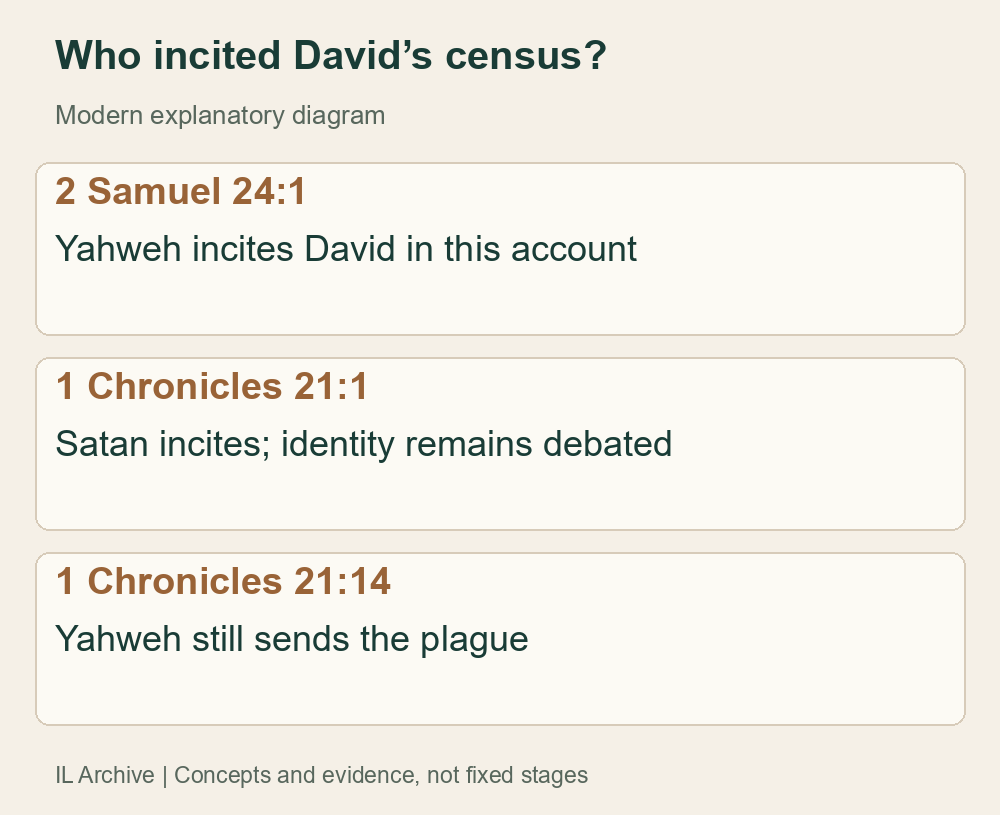
In 2 Samuel 24:1 Yahweh’s anger burns against Israel and he incites David to conduct the census. In 1 Chronicles 21:1 satan stands against Israel and incites David to the same action. The comparison is explicit: responsibility for the opening incitement is assigned differently. [11][12]
This can be read as a redistribution of responsibility between God and another actor. By itself it supplies neither a complete doctrine of Satan nor certain access to the editor’s intention. In 1 Chronicles 21:14 Yahweh still sends the plague; the account does not remove every harmful punishment from his authority. [12]
Chronicles is not Satan’s birth certificate
Chronicles is later than the material it retells and is commonly situated in the Persian or early Hellenistic period, with scholarly disagreement. One proposal places it in the late fourth or early third century BCE. That proposal should not become a settled year or the earliest possible date of an idea’s existence. [1]
The census comparison helps investigate reinterpretation of agency. Dating a text, however, is not dating the birth of the character it may describe. A later account can preserve older traditions or give an old word a new meaning.
The missing article is a limited clue
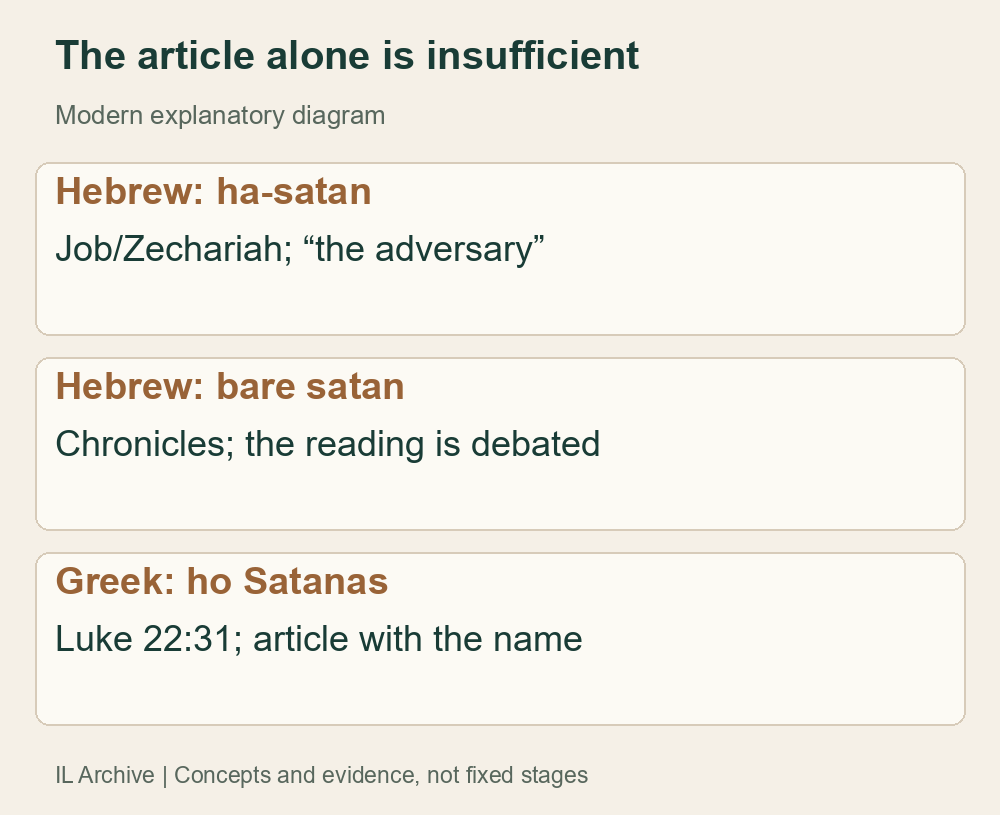
Job and Zechariah use ha-satan with the article; Chronicles has bare satan. Many readers consequently understand a proper nameProper nameA name identifying a particular individual, place or other entity.Glossary · Click to read the explanation for a heavenly being. Absence of the article does not settle every case: an indefinite common nounCommon nounA word naming a class of things, such as “god”, rather than one particular individual.Glossary · Click to read the explanation can mean “an adversary,” and readings involving a human or heavenly opponent remain in discussion. [12][1]
Chronicles is an important witness in debate about the adversary’s personalization, not a single grammatical proof closing it. Three questions should be distinguished: is the word definite, does it designate a particular character, and does that character have the later cosmic Devil’s attributes? The answers need not coincide.
The difference requires no invented revolt
Neither census account supplies an intervening scene in which a council adversary revolts and becomes God’s enemy. Such a story might conveniently connect the witnesses, but would add a link they do not provide. The available evidence is narrower: different attribution of the action and more than one possible reading of the word. [11][12]
That does not rule out development in the adversary’s portrayal. It limits what each witness establishes. Filling a gap with a story familiar from a later religion or text does not make the reconstruction more accurate.
Second Temple Judaism: several hostile figures
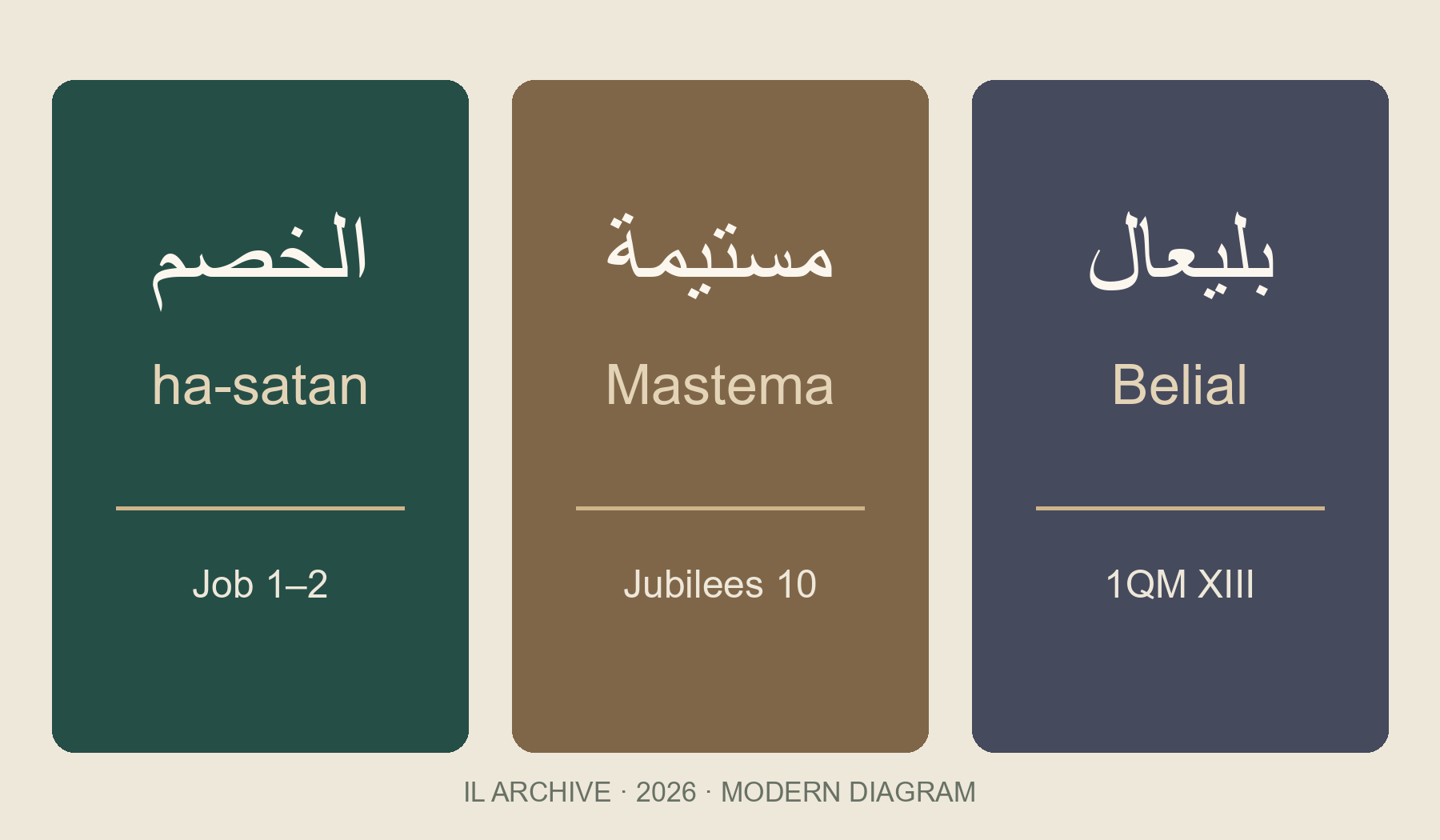
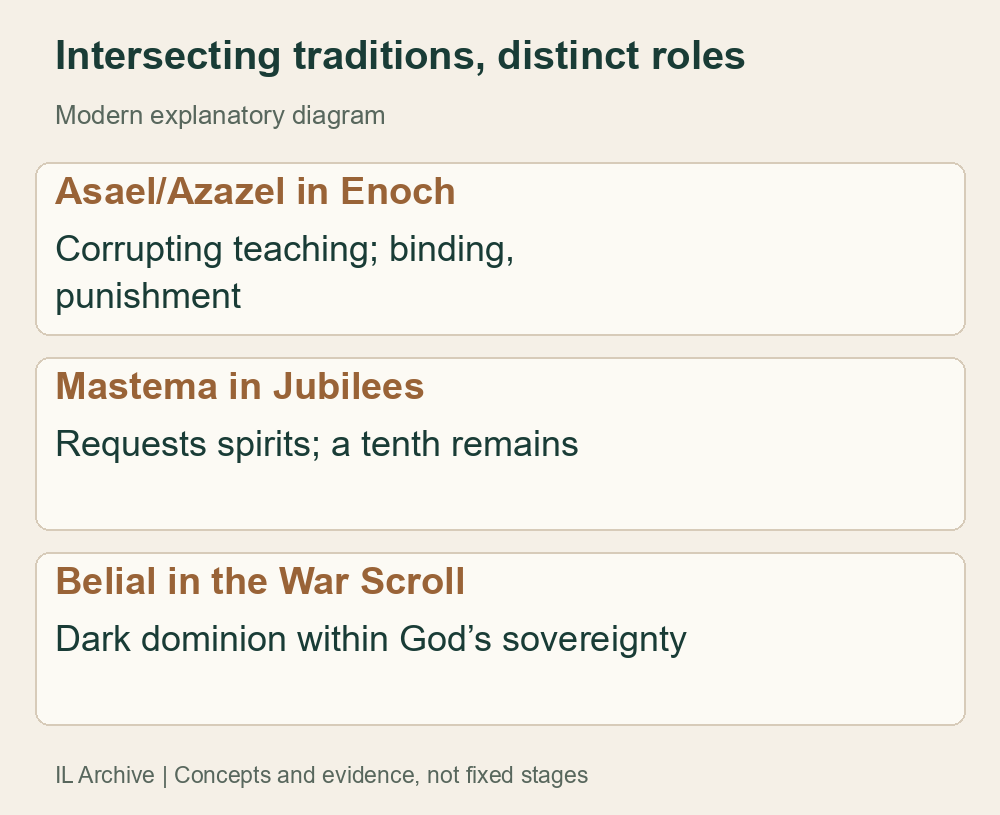
Second Temple literature expands portrayals of superhuman evil. We encounter rebellious WatchersWatchersDesignation for heavenly beings in Daniel and Enochic literature, covering an obedient holy watcher or a rebellious group according to context.Glossary · Click to read the explanation, Asael/AzazelAsael / AzazelName forms in Enochic tradition associated with corrupting teaching and punishment; witness variation cautions against one fixed form and identity everywhere.Glossary · Click to read the explanation, MastemaMastemaLeader of harmful spirits in Jubilees; requests some spirits and proposes Abraham’s test, subject to divine limits.Glossary · Click to read the explanation, BelialBelialFigure associated with darkness and wickedness in some Qumran texts; not a fixed alias for every heavenly adversary.Glossary · Click to read the explanation, the Angel of Darkness and evil spirits. These designations do not necessarily constitute alternative names for a single individual. Each text has its own narrative, relationships and vocabulary. [17]
Traditions do sometimes intersect, and a text may connect names or roles. That does not turn every difference into a fixed stage in Satan’s biography, or justify attributing one system to all Judaism. The surviving library contains multiple voices; a manuscript’s copying date need not date the composition of its contents.
Writing organizes angels and demons
Annette Yoshiko Reed identifies the third century BCE as important in the formation of written angelologyAngelologyStudy and organization of angels and heavenly beings: names, ranks and roles within particular traditions, without assuming one fixed system.Glossary · Click to read the explanation and demonologyDemonologyStudy or organization of harmful powers, names, origins and roles within specific traditions; no single doctrine or claim about existence beyond the text is assumed.Glossary · Click to read the explanation, particularly in AramaicAramaicA group of Northwest Semitic language varieties with a long history across the Near East.Glossary · Click to read the explanation literature. This concerns the textual organization of knowledge about heavenly and hostile beings, not a claim that people had never imagined spirits or angels before then. [13]
It helps explain changes in the surviving evidence. More names, ranks and stories may reflect literary and intellectual developments and the recording of varied traditions. They need not show a single character growing step by step according to a modern reader’s scheme.
Enoch: the descent of the Watchers
The Book of the WatchersBook of the WatchersOpening section of1 Enoch, 1–36; includes the Watchers’ descent and transgression and Enoch’s journey.Glossary · Click to read the explanation, within 1 EnochFirst EnochLayered collection of Jewish writings about heaven, evil and judgment.Glossary · Click to read the explanation, expands the story of the sons of God and human women in Genesis 6. A group of heavenly beings descends and marries women; violence, corruption and divine intervention follow. This differs from the adversary assessing Job’s motives before Yahweh. [15]
Reed’s reading emphasizes multiple literary units, rather than a narrative necessarily created complete at once. We therefore assign no single date to all 1 Enoch and do not identify the Book of the Watchers with the Book of Parables or the other components. Multiple layers belong to the evidence; they should not be removed for convenience. [14]
Asael/Azazel: corrupting knowledge
In 1 Enoch 8, Charles’s translation associates Azazel with teaching weapon manufacture, metalworking and adornment. Chapter 10 commands his binding and confinement until judgment. Witnesses preserve different forms of the name, including Asael and Azazel; one apparently fixed spelling should not conceal that variation. [15]
Here a being participates in corrupting the earth and receives punishment. His role is not simply lodging an objection in the heavenly court as in Job. General resemblance between harmful figures does not establish one identity. Connections with other Azazel traditions also require comparing their texts, rather than relying on the name alone.
Evil spirits are not simply the Watchers
In 1 Enoch 15:8–12 evil spirits originate from the giants, the offspring of heavenly beings and women. After the giants’ bodies are destroyed, their spirits continue harming humanity. This is a particular explanation for continuing evil, not merely a statement that every demon is a fallen angel. [16]
Combining Watchers, giants and their spirits in a single category erases relationships constructed by the text. Other traditions may explain evil differently or combine explanations. Preserve the Enochic model’s distinctions before comparing it with others.
Mastema: a leader who requests permission
JubileesBook of JubileesJewish retelling of Genesis and Exodus framed as angelic teaching to Moses, adding chronology, narratives and interpretation.Glossary · Click to read the explanation, usually dated to the second century BCE, presents Mastema as a leader of harmful spirits. In chapter 10 NoahNoahNoah is the flood-story figure in Genesis and a prophet in the Qur’anGlossary · Click to read the explanation asks for their confinement, while Mastema requests that some remain under his command. God allows a tenth to remain and confines the rest. The leader’s harmful authority is limited by higher permission. [18][19]
Jubilees 10:11 uses Satan in the same context that names Mastema. This indicates overlapping designations within this text; it would be wrong to deny every connection. It does not make Mastema, Azazel and Belial interchangeable names in every book. Local identification and universal equivalence are different claims. [18]
Abraham is tested too
In Jubilees 17–18 Mastema proposes testing Abraham through his son. Divine intervention then stops the sacrifice, and the confrontation ends with Mastema’s humiliation. Kristen Lindbeck’s comparison shows how Abraham’s story was reread through a power proposing a human test. [19]
This resembles the adversary’s challenge in Job but belongs to a different narrative under a different name. It also shows that greater hostility need not eliminate every feature of request and permission. Development cannot be measured by a single choice between complete independence and absence of character.
Belial and the Angel of Darkness
Some QumranDead Sea ScrollsJudaean Desert manuscripts, especially Qumran cave finds. Biblical copies and other works reveal textual diversity; a copy’s age is not the work’s initial date.Glossary · Click to read the explanation texts speak of truth and perversity, light and darkness. The Community Rule, 1QS 3:13–4:26, contrasts domains associated with the Prince of Light and the Angel of Darkness. The War ScrollWar ScrollDead Sea Scroll text portraying war between the sons of light and the hostile camp; its principal copy is designated 1QM.Glossary · Click to read the explanation, 1QM 13:10–11, portrays Belial’s dominion in darkness and counsel leading to wickedness. Names and oppositions do not automatically coincide in every text. [20]
Crucially, this conflict does not establish two equal creators. God retains sovereignty within these portrayals even when hostile powers have extensive agency. A particular text’s conception should not be imposed on all the Dead Sea ScrollsDead Sea ScrollsJudaean Desert manuscripts, especially Qumran cave finds. Biblical copies and other works reveal textual diversity; a copy’s age is not the work’s initial date.Glossary · Click to read the explanation or every Jew living in the same period.
Even satan is not always singular
In 1 Enoch 40:7 Charles’s translation presents plural “satans” in a context of accusation. This passage belongs to the Book of Parables, not the Book of the Watchers; it should not receive another component’s date merely because both occur in the collection. [21]
The example warns against assuming that every similar word denotes the same individual. It may name a category or function, while another text presents a particular character. Start with each usage’s history, then ask where demonstrable connections exist.
Satanas and diabolos in Greek
Greek texts use Satanas, a rendering of the Semitic name, and diabolos, a word associated with slander and accusation. The SeptuagintSeptuagintTraditional designation for ancient Greek translations of Jewish scriptures, whose readings sometimes differ from the Hebrew Masoretic Text.Glossary · Click to read the explanation uses diabolos in passages about the Hebrew adversary. Moving between languages does not by itself demonstrate a complete change of identity or role. [1]
Nor does the disappearance of Hebrew ha in Greek decisively prove that a title became a name. Luke 22:31 actually has ὁ Σατανᾶς, with the Greek article; Greek can use articles with personal names. Context and behavior matter, and the two languages’ grammatical conventions must remain distinct. [24]
Matthew’s temptation: opposition to Jesus’s mission
Matthew 4 gathers the designations Devil, tempter and Satan in the temptation of Jesus. The adversary attempts to direct him away from the course affirmed by his responses, and the scene involves authority and worship. Opposition to the divine mission is far clearer here than merely questioning Job’s motives. [22]
The story nevertheless gives Satan no equal divine power and cannot impose one conception on every New Testament writing. It supports a strong tendency toward personalized, expanded opposition while leaving differences between texts intact.
Luke retains request and testing
In Luke 22:31 Jesus says that Satan has requested to sift the disciples like wheat, then speaks of his prayer for Peter. The adversary threatens the community, yet the language of request and testing makes the break with Job less simple than “an official becomes a completely independent power.” [23]
Independence therefore needs definition. A character may possess hostile intentions and a sphere of action without being outside every permission or equal to God in power. Christian texts themselves do not all formulate the relationship identically.
Revelation joins dragon, serpent and Satan
In Revelation 12:7–9 angels fight the dragon, whom the text identifies as the ancient serpent called the Devil and Satan, the deceiver of the world. Here several images are explicitly identified within a Christian text. This is Revelation’s identification, not an explicit designation present in Genesis 3 from the beginning. [25]
Revelation 12:10 still describes him accusing the community before God. Accusation is not entirely erased when the adversary becomes a world deceiver in heavenly conflict. The passage combines several elements within an expanded figure rather than replacing everything old at once.
Does monotheism explain everything?
As monotheismMonotheismBelief in a single God as the only deity, rather than merely the highest among several gods.Glossary · Click to read the explanation and the sovereignty of a just God become central, the source of evil can become an especially pressing question. Giving harmful powers intentions and broader roles offers one way to address it. This is a possible historical explanation for some developments, not one documented cause of every text. Samuel’s difference from Chronicles is relevant but does not prove that motive by itself. [11][12]
These writings developed amid Persian, Hellenistic and Roman contacts. Possible influence does not establish that Satan was copied directly from AhrimanAngra Mainyu / AhrimanHostile spirit; Ahriman is a Middle Persian name in later traditions with changing theological relations.Glossary · Click to read the explanation or that every Mesopotamian evil figure was his ancestor. A specific transmission requires texts, dates and routes of contact, not resemblance alone. Explanations involving human choice also persisted; Judaism did not universally reduce evil to one Devil. [13][17]
Evidence and reconstruction
It is certain that śāṭān can designate a human adversary and that Yahweh’s angel opposes Balaam with this term. Job and Zechariah place ha-satan within scenes of heavenly authority, and Job explicitly limits harm. The census accounts assign incitement differently. These conclusions concern wording and actions in particular texts. [2][3][5][6][7][11][12]
Jubilees, Enoch and some Qumran writings unquestionably present multiple hostile powers, while Matthew and Revelation unite names and images in Satan/the Devil. The first moment when the word became a proper name, a single character’s journey through every book, and one exclusive cause of change remain unsettled. The plausible model is overlapping development and reinterpretation of traditions, including local connections without universal equivalence. [15][18][20][22][25]
When opposition expanded
The documentary record does not begin with a finished Satan possessing all the attributes of later Christian portrayals. It contains a word for opposition, heavenly figures who challenge and test, and different stories of rebellion, forbidden knowledge, harmful spirits and darkness. Some Christian texts combine elements around an adversary who deceives the world and opposes the community and its mission.
A cosmic enemy does not thereby become God’s equal, and older functions do not all disappear: accusation remains in Revelation and request in Luke. [23][25]
The question is therefore not merely when a word changed meaning, but how harmful agency was situated within the heavenly order. Heaven retained inhabitants, intentions and roles. In some traditions the adversary became central to explaining temptation, deception and conflict, while others maintained different arrangements.
References and notes
- Christopher A. Rollston (2016). “An Ur-History of the New Testament Devil: The Celestial śāṭān in Zechariah and Job.” In Chris Keith and Loren T. Stuckenbruck (eds.), Evil in Second Temple Judaism and Early Christianity, pp. 1–16. Mohr Siebeck. Publisher preview, pp. 1 and 3–5: adversary, Hebrew article, Job/Zechariah, disputed Chronicles. Extracted character encoding decoded; not a full chapter/book reading. Late fourth/early third-century Chronicles dating is one proposal cited in a footnote. Return to the text ↑
- Hebrew Bible — 1 Samuel 29:4. Mechon-Mamre, Hebrew text and JPS 1917 English translation. David might become the Philistines’ adversary: a human political use. Return to the text ↑
- Hebrew Bible — Numbers 22:22,32. Mechon-Mamre, Hebrew text and JPS 1917 English translation. Yahweh’s angel opposes Balaam; lesatan describes a contextual function. Return to the text ↑
- Hebrew Bible — Genesis 3:1–5. Mechon-Mamre, Hebrew text and JPS 1917 English translation. The figure is called the serpent, not identified here as Satan. Compare Revelation 12 without imposing its wording on Genesis. Return to the text ↑
- Hebrew Bible — Job 1:6–12. Mechon-Mamre, Hebrew text and JPS 1917 English translation. Ha-satan among the sons of God; challenge to piety and limited permission concerning Job’s possessions. Scene does not date the book. Return to the text ↑
- Hebrew Bible — Job 2:1–10. Mechon-Mamre, Hebrew text and JPS 1917 English translation. Permission to harm Job while sparing his life; severity does not establish independence from Yahweh. Return to the text ↑
- Hebrew Bible — Zechariah 3:1–7. Mechon-Mamre, Hebrew text and JPS 1917 English translation. Ha-satan at Joshua’s right to oppose him; Yahweh rebukes him. Prosecutor is a comparative role description, not a documented bureaucratic office. Return to the text ↑
- Zechariah 1:1. New American Bible, Revised Edition, USCCB. Opening dated to Darius’s second year; publisher note gives October/November 520 BCE. Late sixth-century setting of visions, not a date for all editing. Return to the text ↑
- Hebrew Bible — 1 Samuel 16:14–15. Mechon-Mamre, Hebrew text and JPS 1917 English translation. Harmful spirit from Yahweh in the narrative; not called Satan. Return to the text ↑
- Hebrew Bible — 1 Kings 22:19–23. Mechon-Mamre, Hebrew text and JPS 1917 English translation. Council deliberation and authorized lying spirit; no Satan designation. Return to the text ↑
- Hebrew Bible — 2 Samuel 24:1. Mechon-Mamre, Hebrew text and JPS 1917 English translation. Yahweh incites the census in this account; comparison with Chronicles does not establish one editorial history. Return to the text ↑
- Hebrew Bible — 1 Chronicles 21:1,14. Mechon-Mamre, Hebrew text and JPS 1917 English translation. Bare satan in 21:1; identity disputed. In 21:14 Yahweh still sends the punishment. Return to the text ↑
- Annette Yoshiko Reed (2020). Demons, Angels, and Writing in Ancient Judaism. Ch. 2, “Rethinking Scribalism and Change in Second Temple Judaism,” pp. 87–131. DOI: 10.1017/9781139030847.004. Publisher summary: third-century BCE written angelology/demonology and Aramaic literature. Not first invention of every idea; full chapter not read. Return to the text ↑
- Annette Yoshiko Reed (2005). Fallen Angels and the History of Judaism and Christianity. Ch. 1, “Angelic Descent and Apocalyptic Epistemology,” pp. 24–57. DOI: 10.1017/CBO9780511499104.004. Publisher summary: multiple literary units in the Book of the Watchers and rereading Genesis 5–6. Full book/chapter not read; no single date assigned to all Enoch. Return to the text ↑
- 1 Enoch 6, 8, 10. R. H. Charles’s 1912 English translation, Wikisource. Chapters 6, 8, 10: descent, marriage, teaching, binding. Open historical translation, not the latest critical manuscript edition. Return to the text ↑
- 1 Enoch 15:8–12. R. H. Charles’s 1912 English translation, Wikisource. Evil spirits are giant spirits; not a claim that all demons are fallen angels. Historical translation, not independent witness examination. Return to the text ↑
- Miryam Brand. “The Benei Elohim, the Watchers, and the Origins of Evil.” TheTorah.com. Watchers’ teachings, giant spirits, differing explanations of evil; note 6 on Asael/Azazel. Not all evil powers or Jewish traditions equated. Return to the text ↑
- Jubilees 10:1–17. R. H. Charles’s 1902 English translation, Internet Sacred Text Archive. 10:7–11: Mastema requests spirits; a tenth remains by permission. 10:11 uses Satan in this context: distinguishing traditions does not deny every local identification. Charles’s footnotes are his interpretation, not original wording. Return to the text ↑
- Kristen H. Lindbeck. “The Satan Provokes God into Testing Job and Abraham.” TheTorah.com. Displayed Jubilees 17:15–16, 18:9–12: Abraham’s test, intervention, Mastema’s shame; early second-century BCE dating in author’s account. Not all Jubilees or the entire article read. Return to the text ↑
- James H. Charlesworth (1969). “A Critical Comparison of the Dualism in 1QS III, 13–IV, 26 and the ‘Dualism’ Contained in the Fourth Gospel.” New Testament Studies 15(4), pp. 389–418. DOI: 10.1017/S0028688500019251. Public extract/notes pp. 390–394: 1QS 3:13–4:26, 1QM 13:10–11, divine sovereignty and different designations. Translations vary; full article not read, no independent scroll examination. Return to the text ↑
- 1 Enoch 40:7. R. H. Charles’s 1912 English translation, Wikisource. Plural satans in the Book of Parables in this translation; not part of the Book of the Watchers and not assigned its date. Return to the text ↑
- Matthew 4:1–11. New American Bible, Revised Edition, USCCB. Temptation narrative: Devil, tempter, Satan. Early Christian witness, not one doctrine imposed on every text. Return to the text ↑
- Luke 22:31–32. New American Bible, Revised Edition, USCCB. Satan’s request to sift the disciples: continuing request/testing imagery, not a power equal to God. Return to the text ↑
- Michael W. Holmes (ed., 2010). The Greek New Testament: SBL Edition, Luke 22:31. Faithlife/SBLGNT official text repository. Luke 22:31 has ὁ Σατανᾶς, with Greek article. Hebrew article conventions cannot simply be imposed on Greek or treated as sole proof of proper-name status. Return to the text ↑
- Revelation 12:7–10. New American Bible, Revised Edition, USCCB. Dragon, ancient serpent, Devil, Satan; accusation remains in 12:10. Revelation’s identification is not Genesis 3’s original designation. Return to the text ↑
Suggest a correction · Suggest a source for this record
Cite this record
IL Archive, «How did “the adversary” become Satan?», Edition 1, https://ilarchive.com/en/studies/adversary-to-satan
Continue reading