Entity
Belial
A reference page linking a name, group, or concept to the materials that discuss it.
A Hebrew term for wickedness and worthlessness, and the name of an opposing power in some Second Temple texts. This entry distinguishes ordinary usage, Qumran’s Belial, New Testament Beliar and later demonology.
Estimated reading time: 6 min Published Last reviewed:
Share article
Text
Introduction
Does every occurrence of “Belial” name the same demon? The evidence requires a distinction between a HebrewHebrewA Northwest Semitic language of the Canaanite group, encompassing Iron Age epigraphy, Biblical, Rabbinic, medieval and Modern Hebrew; its scripts and pronunciations changed over time.Glossary · Click to read the explanation expression condemning conduct, a personified hostile power in particular Jewish writings, and later Christian uses of the name. Comparing these witnesses clarifies their meanings without turning them into stages of a single, proven biography.
The Hebrew expression in context
The Hebrew word is בְּלִיַּעַל, approximately bĕliyyaʿal. Its senses of baseness, wrongdoing or destruction depend on context. Its derivation remains uncertain: the familiar explanation as a compound meaning “without profit” is not an established linguistic fact; “without a yoke” likewise belongs to the history of interpretation rather than defining every occurrence. [11][12]
In 1 Samuel 1:13–16, the priest Eli mistakes Hannah’s silent prayer for drunkenness. In 1:16 she asks not to be considered בַּת־בְּלִיָּעַל, bat-beliyyaʿal, literally “daughter of beliyyaʿal.” The English translation accompanying the Hebrew at Mechon Mamre renders it “wicked woman.” The accusation and her response provide the strongest evidence for a description of conduct: understanding the scene does not require her to be denying descent from a demon. [3]
Similarly, Deuteronomy calls people who incite a city to worship other gods בְּנֵי־בְלִיַּעַל, bene-beliyyaʿal. The expression is translated “base fellows”: its target is human wrongdoing. This is Deuteronomy 13:14 in the Hebrew numbering used by Mechon Mamre, corresponding to 13:13 in many Christian Bibles. Retaining “sons of Belial” without explanation can misleadingly turn an idiom into a genealogy. These examples establish descriptive usage, not the meaning of every occurrence. [4]
Belial in particular Qumran writings
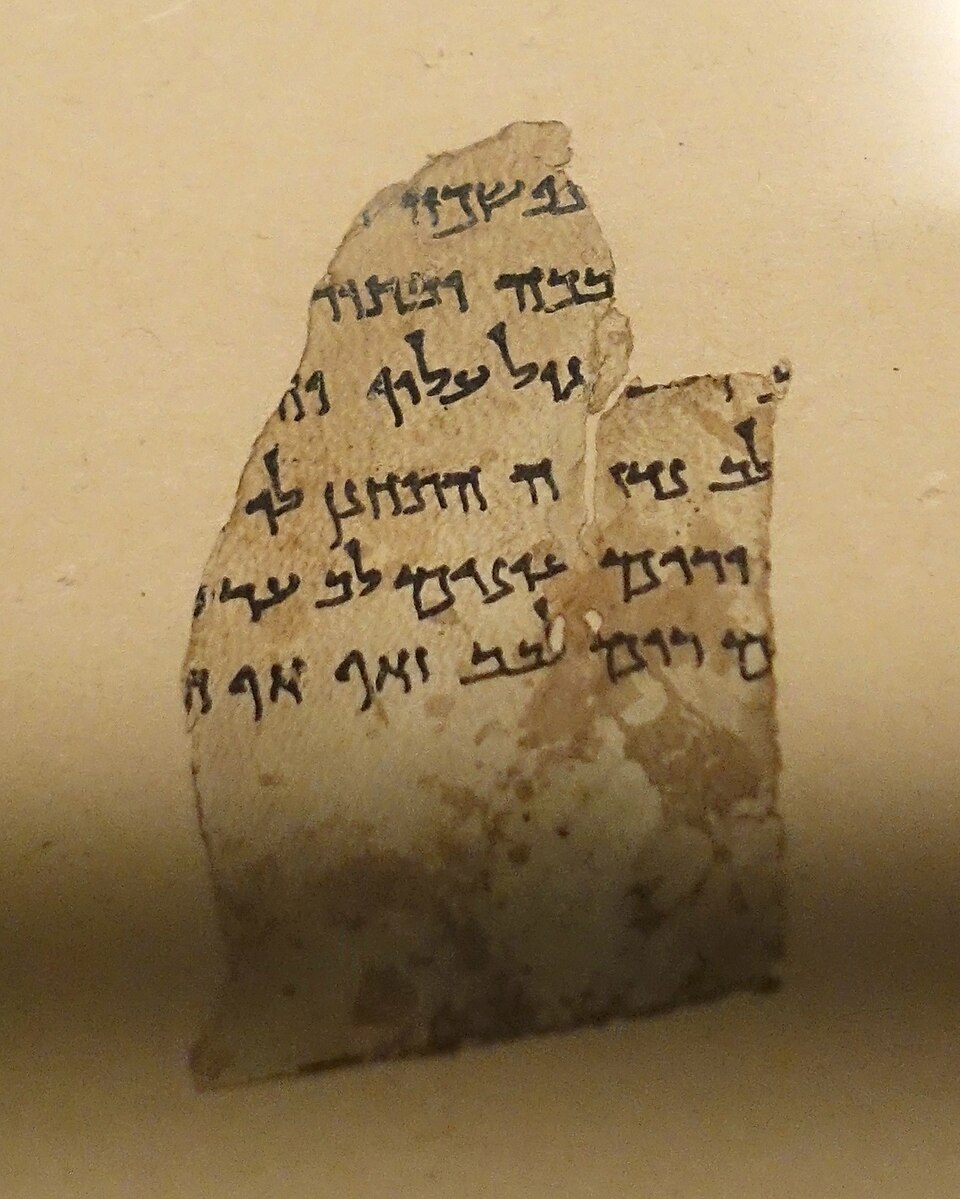
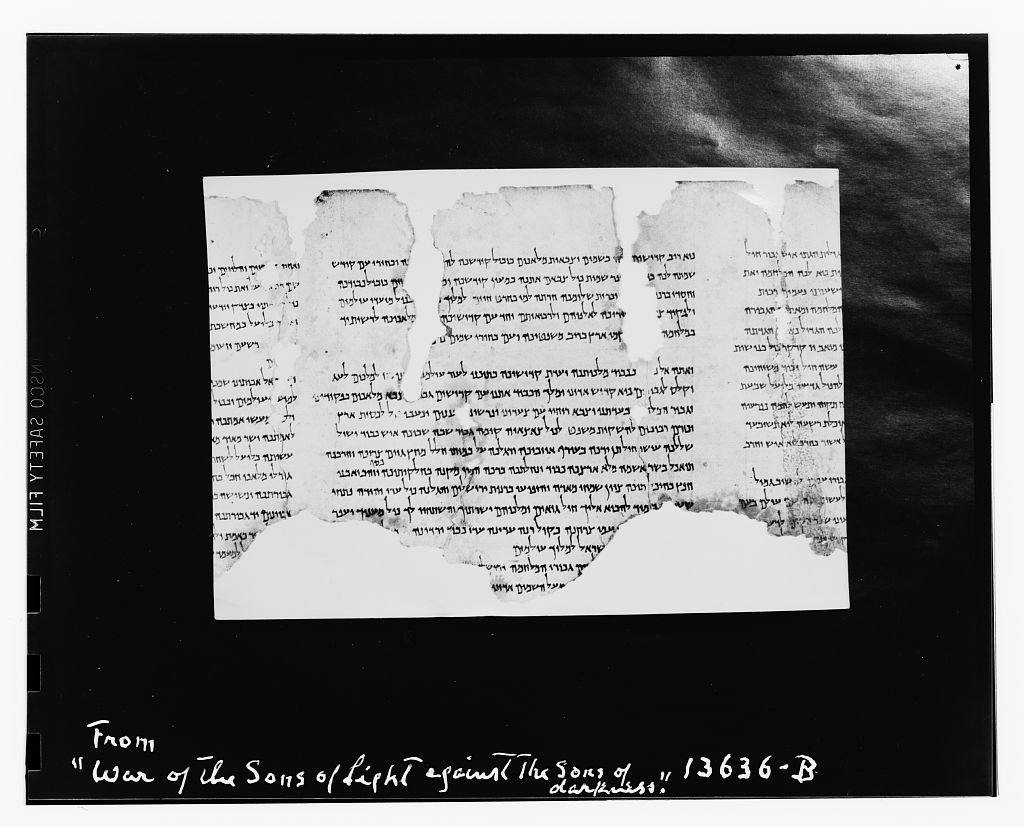
The caves near QumranQumranArchaeological site northwest of the Dead Sea near manuscript caves; its settlement and the groups who deposited the scrolls are studied together but not assumed identical. It is not synonymous with all Dead Sea Scrolls.Glossary · Click to read the explanation, by the Dead SeaDead SeaThe Dead Sea is a salt lake in the Jordan Rift Valley, near sites where ancient manuscripts were foundGlossary · Click to read the explanation, preserved diverse Jewish writings. One is the War ScrollWar ScrollDead Sea Scroll text portraying war between the sons of light and the hostile camp; its principal copy is designated 1QM.Glossary · Click to read the explanation, a vision of an ultimate struggle between the sons of light and darkness. Its principal manuscript, 1QM, is commonly assigned to around the turn of the era; dating a surviving copy is not the same as dating every stage of the composition. [10]
At 1QM 13:10–11 we read ואתה עשיתה בליעל לשחת מלאך משטמה, translated here: “And you made Belial to corrupt, an angel of hostility.” This is a continuous excerpt from the end of line 10 and beginning of line 11 in the scholarly transcription; no restored letters have been added to it. The continuation about darkness is damaged in the manuscript, so its supplemented wording is not presented as an entirely preserved quotation. [13]
לשחת can be read “for the pit” or “to corrupt.” Charlesworth favors the latter because the context explains Belial’s task and counsel leading to wrongdoing, rather than his ultimate fate; the digital lexicon likewise takes the verbal sense. This is a reasonable contextual preference, not elimination of the nominal reading. The stronger point is that God is credited with making him and he is called an angel: cosmic conflict here does not make its two sides equal creators. [1][11][13]
His function is not merely an abstract embodiment of evil. In 1QS 2:4–5 the Levites curse the people of “Belial’s lot,” while 1QM 1:5 envisages his following’s final destruction. Heavenly camps thus help define the human community and its opponents. Calling opponents Belial’s followers, however, expresses these texts’ viewpoint, not a neutral historical classification of everybody who disagreed with their authors. [11][13]
The Community RuleCommunity RuleHebrew text among the Dead Sea Scrolls; the copy designated 1QS includes teaching on the spirits of truth and perversity and conflict within the human heart.Glossary · Click to read the explanation, a text regulating communal life and teaching, contains a “Two Spirits” instruction in 1QS 3:13–4:26. It speaks of the Angel of Darkness and Prince of Lights. Comparing that passage with Belial’s role is legitimate; silently replacing one designation with another erases the textual difference. [1][5]
The abstract sense did not disappear at Qumran: 1QS 10:21 reads ובליעל לוא אשמור בלבבי, “and I will not keep wickedness in my heart,” whereas 1QS 2:19 speaks of כול יומי ממשלת בליעל, “all the days of Belial’s dominion.” Their coexistence within the same collection rules out a clean division into an age of the word followed by an age of the name. Qumran-Digital assigns these witnesses to different senses; some other occurrences remain ambiguous. [11]
Comparison without automatic identification
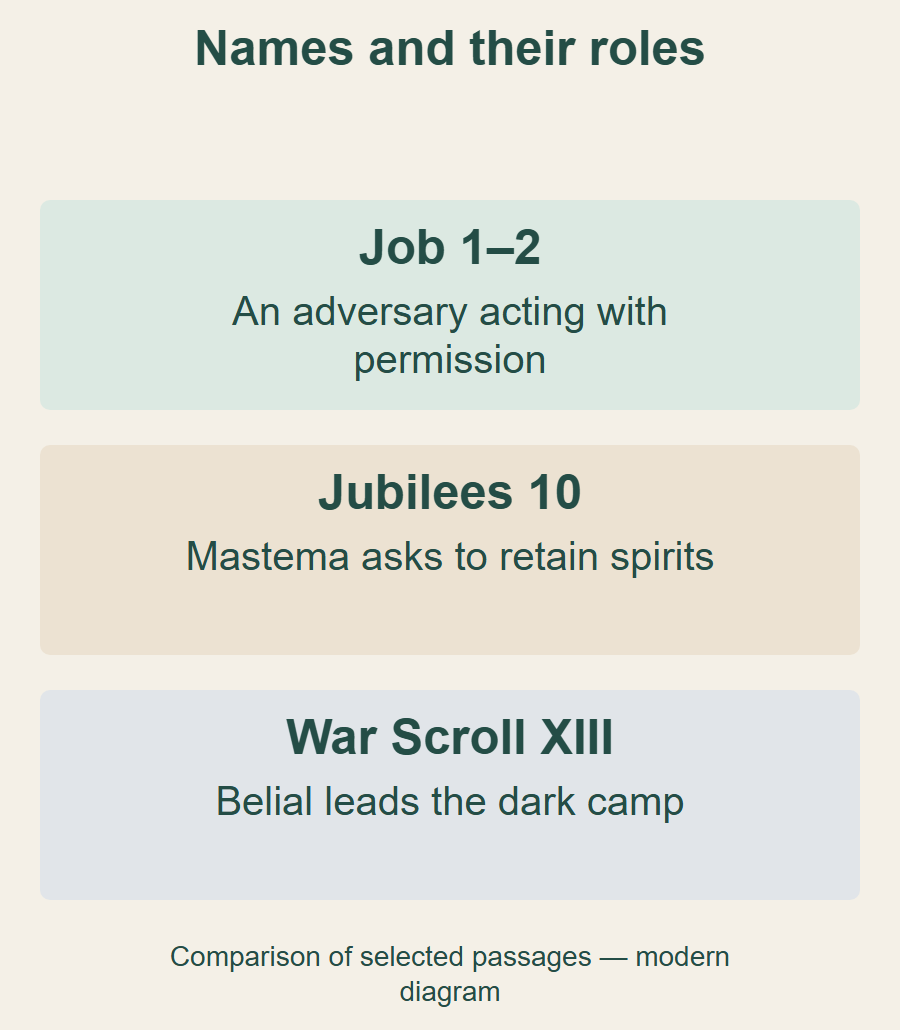
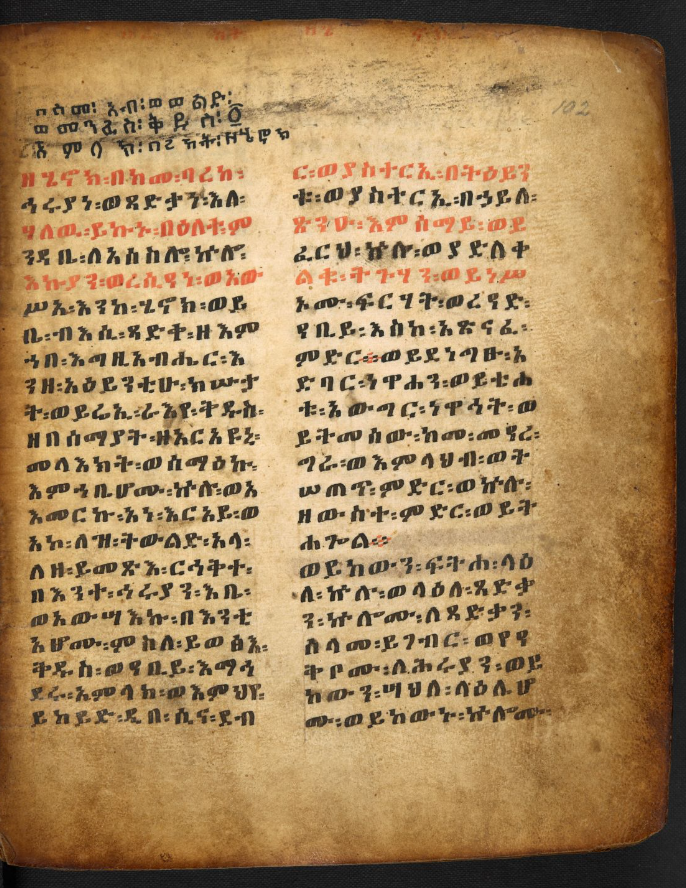
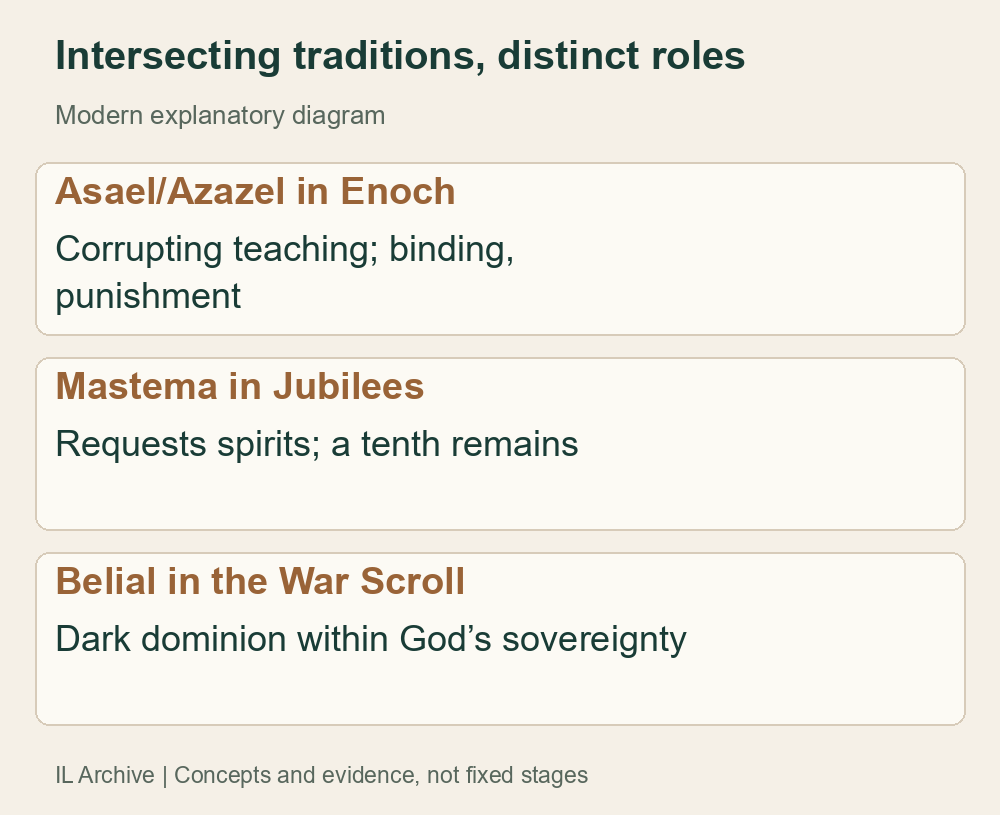
Other narratives explain evil differently. In First EnochFirst EnochA composite Second Temple Jewish apocalyptic collection on the Watchers, parables, celestial cycles, historical visions, and judgment, preserved complete in Geʽez.Glossary · Click to read the explanation, a collection of Jewish writings, Asael/Azazel teaches corrupting knowledge and is bound for punishment (chapters 8 and 10). In JubileesBook of JubileesJewish retelling of Genesis and Exodus framed as angelic teaching to Moses, adding chronology, narratives and interpretation.Glossary · Click to read the explanation, a retelling of early biblical history, MastemaMastemaFigure in Jubilees called Mastema or “prince of hostility”; leader of harmful spirits and proposer of trials under divine permission. Not automatically identical with every Satan or Belial tradition.Glossary · Click to read the explanation requests that harmful spirits remain under his authority; a tenth is permitted to remain (10:8–9). [2][8][9]
R. H. Charles’s English translation uses “Satan” in 10:11 in this same episode. VanderKam’s translation quoted by Hanneken instead reads “Mastema”; its note explains that a medieval Hebrew witness has this name where the Ethiopic tradition reads “the satan.” The difference concerns witnesses and translation choices, not proof of the wording of the lost Hebrew original at this point. [14] Thus local overlap is possible, but it does not make every hostile figure, including ha-satan in JobHa-satan in Job: Title, Role, and InterpretationHebrew “the adversary” in Job 1–2, who challenges Job’s motives with Yahweh’s permission. “Accuser” is a common functional interpretation, but “enforcer” has been argued; later Satan traditions cannot simply be read back into the passage.Glossary · Click to read the explanation, interchangeable. [2][8][9]
The New Testament and later demonology
In 2 Corinthians 6:14–16, Beliar stands opposite Christ within a sequence contrasting righteousness and lawlessness, light and darkness. This is naming within an exhortation to separation, not an account of the figure’s origin. [6]
In the SBLGNT edition, the Greek of 2 Corinthians 6:15 reads τίς δὲ συμφώνησις Χριστοῦ πρὸς Βελιάρ, “And what accord has Christ with Beliar?” Beliar is a form of the name Belial, not another figure established merely by the different final consonant. The NET annotation identifies the referent as Satan; the sentence itself establishes opposition rather than narrating how the adversaries’ names became identified. [15]
Suspicion that 6:14–7:1 was inserted rests on its shift in language and topic and on the interruption of the appeal for reconciliation, which resumes at 7:2. These literary observations deserve consideration, but they differ from finding an ancient copy without the passage. Accordingly, this entry uses the meaning of the text as read, leaving the history of its incorporation a separate question; shared light-and-darkness language alone does not establish a particular chain of transmission. [6][15]
Much later, the demon catalogue published by Johann Weyer in 1577 presents Belial as a king with eighty legions and the appearance of an angel in a fiery chariot. Such details belong to early modern demonological literature, not to the Hebrew idioms or to 1QM. The history of the name includes reinterpretation; the surviving examples do not establish an uninterrupted, uniform tradition. [7]
A chronology of the witnesses
- Hannah’s story is set before the Israelite monarchy within the narrative. That setting does not date Samuel’s composition or revision. The Hebrew quoted here comes from a modern edition of the Masoretic tradition, not a manuscript contemporary with Hannah. [3]
- The Qumran writings belong to Second Temple JudaismSecond Temple JudaismDiverse Jewish traditions between the rebuilding of Jerusalem’s temple around 515 BCE and its destruction in 70 CE: institutions, diaspora, groups and texts, with distinctions between events, composition, manuscripts and the limits of evidence.Glossary · Click to read the explanation and have multiple compositional layers. The copy 1QS is commonly dated to the early first century BCE and 1QM to approximately its end. The war anticipated by the latter is future within its outlook, not an event dated by the parchment’s age. [5][10]
- Jubilees retells the time of NoahNoahNoah is the flood-story figure in Genesis and a prophet in the Qur’anGlossary · Click to read the explanation, the ancestors and MosesMosesCentral figure in Exodus, Torah traditions and the Qur’an; childhood accounts differ in detail.Glossary · Click to read the explanation, but is a Jewish composition probably of the second century BCE. Its ancient Hebrew witnesses differ from the Geʽez tradition preserving the continuous text and from the modern translations by Charles and VanderKam. [14]
- Second Corinthians is a first-century CE letter. Papyrus 46, an early witness to a collection of Paul’s letters, is usually dated around 200 CE. A copy’s date does not settle when every passage of a letter was composed. [6][16]
- 1577 dates the publication of Weyer’s catalogue, and 1584 Scot’s English rendering used by the source. Neither is the birth date of an ancient figure. [7]
References and notes (16)
- James H. Charlesworth (1969). “A Critical Comparison of the Dualism in 1QS III, 13–IV, 26 and the ‘Dualism’ Contained in the Fourth Gospel.” New Testament Studies 15(4), pp. 389–418. DOI: 10.1017/S0028688500019251. Public publisher notes for pp. 390–394, especially p. 393 n. 2 and p. 394 n. 1: distinct designations and “for the pit” / “to corrupt.” Not the full article. Return to the text ↑
- Miryam Brand. “The Benei Elohim, the Watchers, and the Origins of Evil.” TheTorah.com. Watchers’ teachings, giant spirits, differing explanations of evil; note 6 on Asael/Azazel. Not all evil powers or Jewish traditions equated. Return to the text ↑
- 1 Samuel, Hebrew text and English translation at Mechon Mamre. 1:13–16; Hannah and bat-beliyyaʿal. Return to the text ↑
- Deuteronomy, Hebrew text and English translation at Mechon Mamre. 13:13–15 on this page; bene-beliyyaʿal at 13:14, corresponding to 13:13 in common Christian numbering. Return to the text ↑
- Thomas J. Farrar, “New Testament Satanology and Leading Suprahuman Opponents in Second Temple Jewish Literature,” Journal of Theological Studies 70/1 (2019), pp. 21–68. War Scroll and Community Rule sections; author version in CPUT repository, PDF pages 30–31, not journal pagination. Return to the text ↑
- 2 Corinthians 6, NABRE translation and annotations, United States Conference of Catholic Bishops. 6:14–16 and note on 6:14–7:1; Beliar in context and the proposed insertion. Return to the text ↑
- Johann Weyer, Pseudomonarchia daemonum (1577), §23; Joseph H. Peterson’s electronic edition, with English from Reginald Scot’s Discoverie of Witchcraft (1584). Belial entry: kingship, chariot and eighty legions. Early modern reception, not Qumran belief. Return to the text ↑
- R. H. Charles, The Book of Jubilees (1917), English translation, pp. 79–81; electronic transcription. 10:1–17, especially 8–11; “Satan” in this translation, not an independent collation of Ethiopic. Return to the text ↑
- R. H. Charles, The Book of Enoch (1917), English translation, chapter 10. 10:4–8; Azazel’s binding and punishment; compare chapter 8 quoted in reference 2. Return to the text ↑
- Museum of the Bible, “Dead Sea Scrolls Resources,” section on biblical, extrabiblical and sectarian scrolls. Manuscript list dates 1QM to the late first century BCE; date of copy, not of the envisioned war. Return to the text ↑
- Ingo Kottsieper and Annette Steudel, “בליעל,” Qumran-Digital lexicon, revised by Steudel, Mirjam Bokhorst and Bronson Brown-deVost, v1.3.0 (21 May 2026). Sprachgeschichte; A.I.1 (1QS 10:21); B.I.2.a (1QS 2:19); B.II; B.III.1 and 4. Hebrew excerpts from edited attestations, not independent photographic collation. Return to the text ↑
- Ulrich Dahmen, “Belial / Beliar,” WiBiLex (November 2016). Section 1.1 on disputed etymology; sections 3 and 4.1 also consulted for multiple usages and limits of reconstruction. Return to the text ↑
- Qumran-Digital, scholarly transcription of 1QM, version of 21 May 2026. Column XIII, lines 1–16, especially end of 10–beginning of 11; checked transcription markings, not the physical parchment. I:5 is also attested in the lexicon, note 11. Return to the text ↑
- Todd R. Hanneken, “The Book of Jubilees,” in Early Jewish Literature: An Introduction and Reader, ed. Archie T. Wright, Ron Herms and Brad Embry (Eerdmans, 2014), author-hosted version. PDF pp. 2–4 on composition/transmission; pp. 25–26, “Noah and the demons,” Jubilees 10 translation and n. 41 on the medieval Hebrew witness versus Ethiopic “the satan.” Not independent collation of those manuscripts. Return to the text ↑
- Michael W. Holmes, ed., SBL Greek New Testament, Second Corinthians; Greek text published in the LogosBible/SBLGNT repository. 6:11–7:2; quotation from 6:15 with the edition’s apparatus marker omitted. For Beliar: NET note on 6:15, https://classic.net.bible.org/passage.php?passage=2Co+6%3A15%2C16 (accessible indexed text; direct opening failed). Return to the text ↑
- David Trobisch, A User’s Guide to the Nestle-Aland 28 Greek New Testament, publisher excerpt, section “Papyrus 46.” Indexed excerpt of the section dating the papyrus to around 200 CE; direct PDF opening failed. Not inspection of a Second Corinthians leaf or a reading of the whole book. Return to the text ↑
Suggest a correction · Suggest a source for this record
Cite this record
IL Archive, «Belial», https://ilarchive.com/en/entities/belial
Continue reading