Entity
War Scroll
A reference page linking a name, group, or concept to the materials that discuss it.
A Hebrew Qumran war text known chiefly from 1QM and varied related witnesses, envisioning an eschatological struggle between light and darkness; its material history, rituals, Belial and dating debates.
Estimated reading time: 9 min Published Last reviewed:
Share article

Text
Introduction
The “War Scroll” is the conventional name for a HebrewHebrewA Northwest Semitic language of the Canaanite group, encompassing Iron Age epigraphy, Biblical, Rabbinic, medieval and Modern Hebrew; its scripts and pronunciations changed over time.Glossary · Click to read the explanation work among the Dead Sea ScrollsDead Sea ScrollsManuscript collections from the Judaean Desert, best known through Qumran: diverse works, languages and textual forms, with copying distinguished from composition.Glossary · Click to read the explanation describing an eschatological confrontation between the “Sons of Light” and the “Sons of Darkness.” Its best-known witness is the scroll designated 1QM, found in Cave 1 near QumranQumranArchaeological site northwest of the Dead Sea near manuscript caves; its settlement and the groups who deposited the scrolls are studied together but not assumed identical. It is not synonymous with all Dead Sea Scrolls.Glossary · Click to read the explanation on the northwestern shore of the Dead SeaDead SeaThe Dead Sea is a salt lake in the Jordan Rift Valley, near sites where ancient manuscripts were foundGlossary · Click to read the explanation. It includes regulations for standards, trumpets and formations; yet prayers, angels and divine intervention are more decisive for its imagined conflict than the details of weaponry. This is not a chronicle of a war fought as described, and the other war-related texts recovered from the caves cannot all be treated as identical copies of it.
This entry distinguishes the physical manuscript from the composition and related fragments, traces the work's sections, examines decisive Hebrew passages and assesses its literary development. It also sets limits on identifying the “Kittim” with Rome or ascribing the work to a particular community. The anticipated events within the story, possible stages of composition and redaction, and the approximate date of the surviving copy must be kept separate. [14] [15]
The scroll and related witnesses
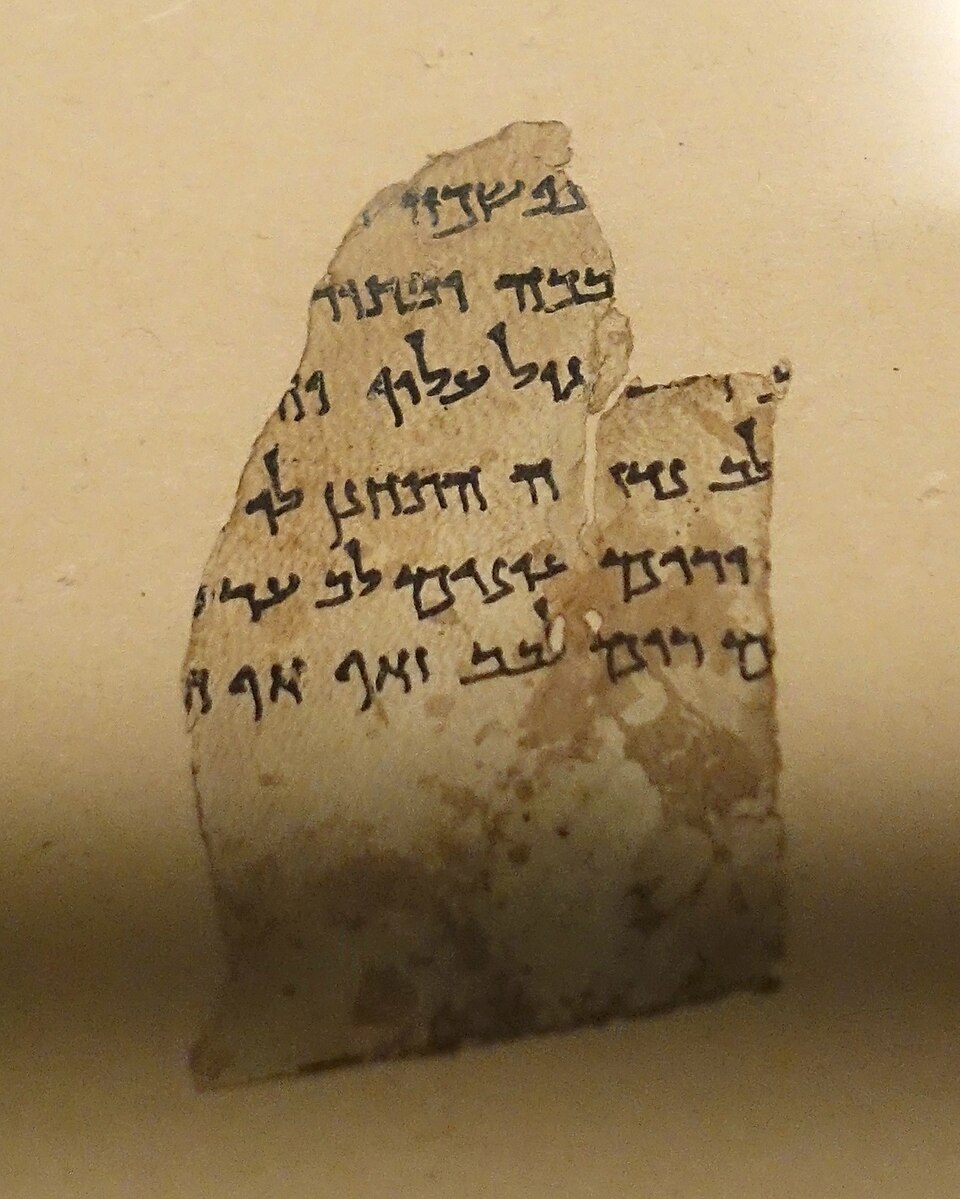
The designation 1QM identifies a Cave 1 manuscript; M abbreviates the Hebrew milḥamah, “war.” The designation 1Q33 is also used in scholarship. Written in Hebrew in a square Herodian book hand on parchment, it measures about 2.79 metres in length and 15–16 centimetres in height. Nineteen incomplete columns survive, their lower portions damaged; the original work probably extended to at least one further column. Discovered among the early Cave 1 finds in 1947, the scroll is held at the Israel Museum in JerusalemJerusalemJerusalem is a city of religious importance in Judaism, Christianity and IslamGlossary · Click to read the explanation, while the museum's cataloguing identifies the Hebrew University as owner. The handwriting is conventionally assigned to the late first century BCE or early first century CE. That is a proposed date for the copy, not for the composition of every passage it contains. [14] [15]
Cave 4 yielded related war texts numbered 4Q491–4Q497, but their fragmentary and varied character makes it unsafe to assemble them automatically into another complete copy of a single book. The papyrus witnesses 4Q496 and 4Q497 were written on both sides, unlike the parchment scroll 1QM; palaeography places some Cave 4 witnesses, notably 4Q493 and 4Q496, before the middle of the first century BCE. Related compositions include 4Q471 and texts often grouped under the title Sefer ha-Milḥamah, such as 4Q285 and 11Q14. Resemblance in subject matter does not turn them into lost sheets of 1QM. Recent manuscript-centred scholarship therefore asks not only how many “copies” existed, but how different literary units and war traditions circulated in several textual forms. [16] [18]
Three different times
- Narrative time: an eschatological future in which the camp of light expects the destruction of evil; it is not the date of an attested battle.
- Composition and redaction: proposals locate the formation of different materials within the second and first centuries BCE, but neither their exact dates nor a single sequence of layers has been established. [15] [18]
- The surviving manuscript: the late first century BCE or early first century CE, as suggested by the handwriting of 1QM; followed by its discovery in 1947 and publication during the 1950s. [14]
A resemblance between a military practice or enemy-name and a particular regime cannot by itself date the physical copy, still less every prayer or regulation within it. Some Cave 4 material may be earlier or may represent parallel textual developments; a definitive family tree of all the witnesses remains unavailable. [16] [18]
Military ordering and ritual
Column I outlines the confrontation. Among its enemies are Edom, Moab, Ammon, Philistia, the “Kittim of Asshur,” and covenant-breakers. Column II then provides a framework for a forty-year war, including sabbatical years during which troops are not mobilized, and an organization of active years and campaigns against different nations. This scheme supplies no historical starting date from which to calculate the calendar of a war actually fought. Columns III–IX treat the inscriptions on standards and trumpets, formations, ages, ritualRitualAn organised or distinguished practice meaningful to a community; it may leave traces, but its form alone does not reveal an associated doctrine.Glossary · Click to read the explanation eligibility and movements of fighters. Column VII bars children, women and people who do not meet the camp's purity requirements. These are rules internal to a literary portrayal of the army, not a general description of Jewish social practice at the time. [13] [15]
Columns X–XIV move into prayers, blessings, curses and thanksgiving, with priests and Levites occupying essential roles. Column XIX was written on a separate sheet; its immediate succession to XVIII is not demonstrable. Columns XV–XIX describe successive encounters with the Kittim, within a seven-phase battle whose decisive seventh phase belongs to God. The forty-year campaign and the seven phases need not represent the same chronological scale. Some scholars discern joined traditions here, whereas others warn that repetition and changes of narrative scale do not alone demonstrate a particular series of independent sources. [15] [18]
Priestly direction is not a merely decorative feature: the blowing of trumpets, spoken blessings and purification following combat belong to the structure of the scene. Column IX keeps priests away from the slain so that they will not be defiled by blood. The work may consequently have functioned as a ritual organization of communal identity and anticipated divine aid, rather than simply as a training manual for practical warfare. [13] [15]
Combatants on earth and in heaven
In its opening line, 1QM frames the antagonists in the language of a “lot,” allotted side or camp:
A contextual translation is “the Sons of Light setting out against the lot of the Sons of Darkness.” The Hebrew goral here marks affiliation or allocation within the work's conceptual framework, not two historically fixed ethnic groups. At column I, lines 10–11, the text also brings together an “assembly of divine beings” and a “gathering of humans,” placing the conflict on heavenly and earthly planes. The beginnings and lower sections of the columns are damaged: the reconstructions supplied in modern editions must not be mistaken for every word being securely preserved on parchment. [12] [13]
“Kittim” does not uniquely identify the date of a historical battle. Elsewhere at Qumran the designation may point to Romans, and a Roman identification of the enemy in the extant 1QM has substantial support, including from the military vocabulary. Yet “Kittim of Asshur,” references to Egypt and lists of scriptural nations may also preserve conventional imagery or older political horizons. The historical referent and the dates of particular textual layers are arguments to be evaluated, not facts supplied by the name alone. Familiar Hellenistic or Roman military detail does not convert an eschatological scene into a report of operations actually performed. [15] [18]
Belial and the sovereignty of God
The adversary BelialBelialA Hebrew term for wickedness and worthlessness, and the name of an opposing power in some Second Temple texts. This entry distinguishes ordinary usage, Qumran’s Belial, New Testament Beliar and later demonology.Glossary · Click to read the explanation leads the dark camp; the work speaks of “the spirits of his lot” and destructive angels. Strong cosmic opposition, however, does not necessarily imply two independent and equally primordial gods. The prayer in column XIII addresses God as follows; “and you” closes line 10 and the sentence continues in line 11:
In a close translation, “And you made Belial for destruction, an angel of hostility.” The subject addressed by “you made” is God, not a rival deity credited with creating Belial. The passage proceeds to describe Belial's dark domain and wicked counsel, although parts of the following words are damaged and reconstructions vary. It therefore depicts opposed moral and cosmic camps under the sovereignty of one God, rather than two gods of equal origin. That distinction does not erase the vivid personification of evil or establish a single theology shared by every strand of Second Temple JudaismSecond Temple JudaismDiverse Jewish traditions between the rebuilding of Jerusalem’s temple around 515 BCE and its destruction in 70 CE: institutions, diaspora, groups and texts, with distinctions between events, composition, manuscripts and the limits of evidence.Glossary · Click to read the explanation. [12] [19]
The prayer places a “Prince of Light” opposite Belial, and angelic names including MichaelMichael / MīkālA name meaning “Who is like God?”, borne by humans and an angel. The angel protects Daniel’s people, is called archangel in Jude and fights the dragon in Revelation. The Qurʾan names Mīkāl without assigning a task; later traditions develop different roles.Glossary · Click to read the explanation appear in later sections. Covenant, deliverance and holiness also run through the work. Comparisons with the Two Spirits instruction in the Community RuleCommunity RuleHebrew text among the Dead Sea Scrolls; the copy designated 1QS includes teaching on the spirits of truth and perversity and conflict within the human heart.Glossary · Click to read the explanation (1QS) are illuminating; nevertheless, shared light/darkness vocabulary alone does not establish identity between the works or a one-way transmission of a fully defined doctrine. [15] [19]
What the Cave 4 fragments establish
Parallel witnesses test some reconstructions and qualify others. Fragment 2 of 4Q495 probably parallels part of the prayer at 1QM XIII, lines 9–12. But the name Belial is supplied in editorial brackets at the corresponding place in 4Q495; it does not survive there as a complete, independently legible word. The phrase “you made Belial” is thus cited here from the 1QM witness, while 4Q495 supports the circulation of a similar passage without verifying all its letters. Similarly, 4Q496 overlaps parts of columns I and II, whereas some alleged connections between 4Q471 and the main work are less secure than their older labels might suggest. [12] [16] [17]
Two approaches to the work's development need to be distinguished. One reconstructs earlier military material subsequently combined with a more sharply dualistic eschatological framework; it points to the differing scales of the long campaign and final battle, and to repeated prayers and episodes. The other resists turning every repetition into a datable stratum, explaining the different witnesses partly through simultaneous uses, including study and liturgical performance. The evidence warrants recognition of multiple materials and forms of circulation, but does not compel a single linear history of redaction or a known individual author. [15] [16] [18]
Community, history and the limits of the image
Large parts of the Qumran collection have traditionally been connected with the EssenesEssenesA Second Temple Jewish movement known especially through Josephus and Philo; evidence supports a Qumran connection without identifying every Essene or manuscript with one uniform community.Glossary · Click to read the explanation or another organized Jewish group, but the self-description “Sons of Light” is not sufficient to identify the authors of 1QM or establish that its army actually existed. The composition unites scriptural enemies, imagined rulers and heavenly figures, and makes the outcome dependent on God's action. It is best read as a vision of eschatological warfare shaped by ritual, collective identity and contemporary historical expectations, while its precise relation to political events remains open to investigation. [15] [18]
The cover supplied with this entry is a newly generated modern symbolic illustration of the contrast between light and darkness. It is neither an image of the 1QM artifact nor a documented reconstruction of ancient script or a battle. Photographs of the actual scroll can be viewed through the Israel Museum's digital project; no Hebrew wording discussed in this entry is claimed to be visible in its cover. [14]
The War Scroll is consequently an important witness to how some Jews of the late Second Temple period imagined war, holiness and the powers of evil. It is neither a complete historical account of an actual war nor proof of two independent divine origins, and it is not synonymous with every war-related text discovered at Qumran. [15] [16] [19]
References and notes (8)
- Qumran-Digital, Hebrew transcription dated 11 March 2025 for 1QM, with cross-references to related fragments (CC BY-SA 4.0). Columns I and XIII were checked directly; brackets and restorations belong to the editors, not securely preserved letters. 1QM I:1–15, 10–11; XIII:9–13 Return to the text ↑
- Qumran.org, column-and-line presentation and English translation of the War Scroll. Selected passages were compared with Qumran-Digital’s Hebrew transcription; English additions in square brackets should not be treated as fully preserved text. 1QM I:1–15; II:6–14; VII:3–6; IX:7–8; XIII:10–12 Return to the text ↑
- Israel Museum, The Digital Dead Sea Scrolls, 'War Scroll' object overview: the publicly indexed catalogue description (19 columns, parchment, language, script, dimensions and proposed dating). The interactive image viewer itself was not examined. 1QM catalogue overview and dating; indexed excerpt, not photographic inspection Return to the text ↑
- Philip R. Davies, “War Rule (1QM),” in David Noel Freedman (ed.), Anchor Bible Dictionary (1992): sections on contents, literary history, genre and historical background read in full in the authorized COJS reproduction. Sections A–C, online reproduction of the 1992 entry Return to the text ↑
- Hanna Vanonen, War Traditions from the Qumran Caves: Re-Thinking Textual Stability and Fluidity in the War Text Manuscripts (Brill, 2022; STDJ 139). Publisher abstract, contents and indexed excerpts from the conclusions and chapters on 4Q471 and 4Q495 only; not the complete book. Publisher description; chapters 4–5 and 8 in contents; indexed conclusion excerpt Return to the text ↑
- Qumran-Digital, diplomatic transcription of 4Q495 (25 August 2025); fragments 1 and 2, especially fragment 2 lines 1–4, read and compared with 1QM XIII:9–12 and the editorial restorations. 4Q495 fragment 2:1–4; bracketed restoration at line 3 Return to the text ↑
- John J. Collins, “Dead Sea Scrolls,” Anchor Bible Dictionary 2 (1992), pp. 85–101. Section H.1 on the War Scroll, competing recensions, Kittim and genre and introductory discovery/provenance passages were read. Printed pages are those of the original volume, not PDF pages. Anchor Bible Dictionary II (1992), section H.1 (full article pp. 85–101; web reprint unpaginated) Return to the text ↑
- Stefan Beyerle, “Monotheism, Angelology, and Dualism in Ancient Jewish Apocalyptic Writings,” printed p. 240, on 1QM XIII:10–11, read from the page image and text; Hebrew checked against Qumran-Digital. This is page 22 when counting the PDF pages from one. Printed p. 240; PDF page 22 (one-based) Return to the text ↑
Suggest a correction · Suggest a source for this record
Cite this record
IL Archive, «War Scroll», https://ilarchive.com/en/entities/war-scroll
Continue reading