Study
Judaism between exile and Christianity
An extended study of a topic, with evidence and references.
Following Jewish diversity from exile to Roman times and changing angels, evil, resurrection and visions, distinguishing textual testimony, historical reconstruction and cultural-influence hypotheses.
Share article
Text
After the city fell
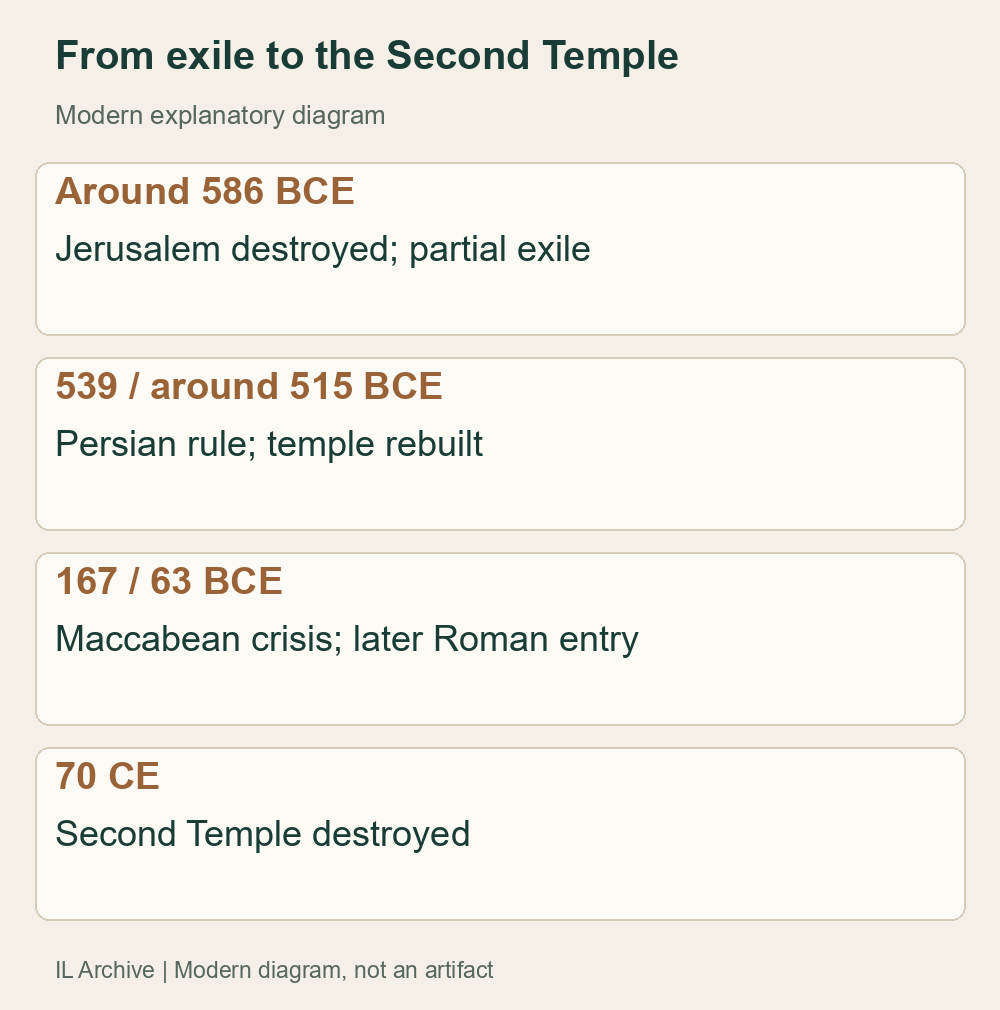
When the Babylonians destroyed JerusalemJerusalemJerusalem is a city of religious importance in Judaism, Christianity and IslamGlossary · Click to read the explanation around 586 BCE, monarchy and temple collapsed and part of the population was deported to Babylonia. The whole community was not exiled, and life in Judah continued. Yet destruction posed a religious question: how could the defeat of the city associated with its God be understood? [2]
By the first century CE, Jewish writings describe named angels, hostile spirits, resurrectionResurrection of the deadThe dead returning to life, distinguished from soul immortality, with differing scope and form among texts.Glossary · Click to read the explanation, judgment and hopes for a messiah or new age. These did not emerge together or command universal agreement. Their setting is Second Temple JudaismSecond Temple JudaismDiverse Jewish traditions under Persian, Hellenistic and Roman rule, not one creed.Glossary · Click to read the explanation, a history in its own right rather than an empty interval before Christianity. [1]
Six centuries, not a single phase
The period is usually framed by return and temple rebuilding in the late sixth century BCE, around 515 BCE, and Roman destruction in 70 CE. Some studies begin with authorization of return around 538 BCE or use wider boundaries suited to their subject. [1][2]
Persian rule gave way to Hellenistic kingdoms, Hasmonean power and Roman domination. Languages, institutions and interpretation differed between Judea and the diaspora. Fifth-century BCE Jews cannot simply be assigned the same religious profile as first-century CE Jews.
Judah within the Persian Empire
Cyrus conquered BabylonBabylonBabylon is an ancient city in central present-day Iraq, south of BaghdadGlossary · Click to read the explanation in 539 BCE. Judah, or Yehud, became a small province in a large empire; return did not restore the old kingdom. Temple, priesthood, texts and interpretation became important to communal organization without exhausting every aspect of identity. [3]
Jewish communities also lived outside Jerusalem. Reading Persian-period religion solely through Jerusalem’s books would make it more uniform than the evidence permits. Origin, locality, worship and law could all shape community membership, with different weight in different settings.
Elephantine: a Yahu temple outside Jerusalem
An AramaicAramaicA group of Northwest Semitic language varieties with a long history across the Near East.Glossary · Click to read the explanation petition from ElephantineElephantine / YebIsland near Aswan at the Nile’s first cataract; Persian-period Aramaic papyri document a Jewish community and Yaho’s temple.Glossary · Click to read the explanation in Egypt, dated 407 BCE, directly attests a temple of Yahu. Its writers describe destruction and request reconstruction, mentioning priests, offerings and contacts with authorities in Yehud and Samaria. This was institutional worship outside Jerusalem’s temple. [4]
The petition speaks for one community, not all Persian-period Jews. Nevertheless, it prevents treating Jerusalem’s model as a rule already followed everywhere. Texts demanding centralized worship are different evidence from universal compliance with that demand.
Defeat did not abolish God
Jewish writers could interpret catastrophe as divine judgment on their own community. Empire then became an instrument within YHWHYahwehThe divine proper name written YHWH in the Hebrew Bible.Glossary · Click to read the explanation’s sovereignty rather than conclusive proof of MardukMardukBabylon’s god, elevated with the city’s history. Enuma Elish celebrates his rise and cosmic ordering; sources associate him with Nibiru and Jupiter. Earliest origins and functions remain uncertain.Glossary · Click to read the explanation’s superiority. Political history itself became a theological problem.
Saying “exile invented monotheismMonotheismBelief in a single God as the only deity, rather than merely the highest among several gods.Glossary · Click to read the explanation” compresses a layered history into one cause. A single God, exclusive worshipMonolatryWorship of one deity without necessarily denying others; variable analytical term, not one uniform doctrine of all Israelites.Glossary · Click to read the explanation and explanations of disaster are related but distinct ideas, developing differently across communities. Texts and their stages must be studied alongside the varied practices witnessed at Elephantine. [3][4]
Greek did not mean the end of Judaism
After Alexander’s regional conquests around 332 BCE, Jewish communities entered the world of Hellenistic kingdoms. Some transmitted scripture and wrote works in Greek, including the SeptuagintSeptuagintTraditional designation for ancient Greek translations of Jewish scriptures, whose readings sometimes differ from the Hebrew Masoretic Text.Glossary · Click to read the explanation tradition. They engaged surrounding cultures while resisting particular practices. [1][2][5]
“Pure Judaism” opposed to “foreign ideas” is inadequate. An adopted language could defend the law, and interaction could rework older traditions. Hengel’s summary emphasizes fragmentary evidence for the pre-Maccabean centuries; gaps cannot be filled with a complete borrowing narrative.
The Maccabean crisis: faith under violence
Antiochus IV’s measures against Jewish observances around 167 BCE became a defining crisis in Jewish memory. The Maccabean revolt was followed by Hasmonean rule. Rebellion and later autonomy should not be collapsed into one date, and internal Jewish conflicts also mattered. [2]
Martyr narratives portray obedience to law as a reason to face death. If a righteous person dies for obeying God, is justice finished? Second Maccabees answers through restored life, but this is its author’s answer rather than a consensus of all Jews. [20]
Multiple forms of Judaism
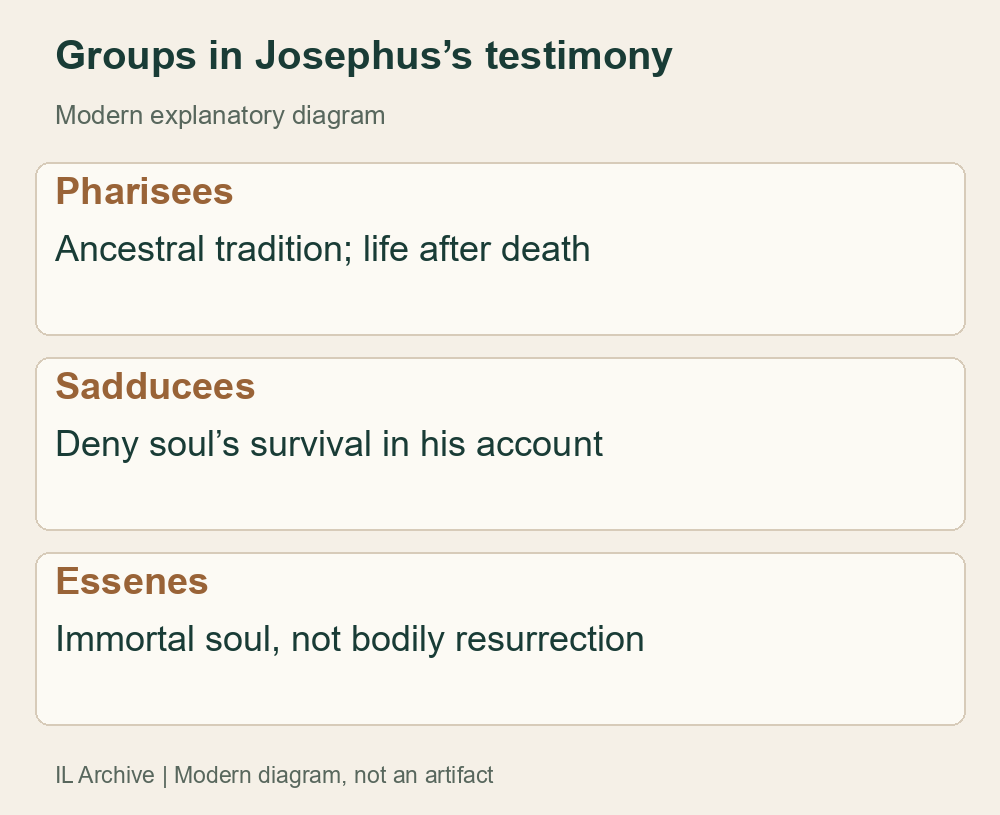
Temple, law and Israel’s heritage supplied broad shared reference points, without one doctrine of resurrection, spirits, fate or leadership. Josephus describes three “philosophies”: PhariseesPhariseesJewish group known through ancient testimony about law and human destiny.Glossary · Click to read the explanation, SadduceesSadduceesJewish group without a surviving doctrinal library of its own; known through others.Glossary · Click to read the explanation and EssenesEssenesGroup described by outside authors; a Qumran link is likely, not identity with all scrolls.Glossary · Click to read the explanation. This is a valuable window, not a complete social map. [6]
Other groups and poorly documented individuals also existed. Beliefs could change within a group over time. Josephus must be read as an author selecting and comparing for an audience, then compared with manuscript evidence, rather than treated as a neutral census of every belief.
Pharisees: interpreting law and destiny
Josephus attributes to the PhariseesPhariseesJewish group known through ancient testimony about law and human destiny.Glossary · Click to read the explanation inherited observances beyond the written Mosaic law and a destiny for souls after death. His language of fate and soul speaks to Greek readers; it cannot alone supply a detailed resurrection creed. [6][7]
Their relationship with later rabbinic Judaism matters, but simply equating Pharisees with rabbis erases subsequent changes. The ancient group and later schools are not automatically identical, and descriptions written by opponents are not neutral portraits.
Sadducees: limits of our knowledge
The SadduceesSadduceesJewish group without a surviving doctrinal library of its own; known through others.Glossary · Click to read the explanation are known mainly through others. No surviving Sadducean creed underlies their study; Stemberger stresses selective, sometimes hostile sources. Josephus’s portrait rejects enduring souls and postmortem recompense, and contrasts their position on inherited observances with the Pharisees. [6][7][8]
They are often associated with elites and priesthood, but every priest cannot be called a Sadducee. Their presence makes resurrection a disputed Jewish belief, not something every Jew accepted before Christianity.
Essenes: immortality is not simply resurrection
Ancient accounts describe EssenesEssenesGroup described by outside authors; a Qumran link is likely, not identity with all scrolls.Glossary · Click to read the explanation through discipline, purity and organized communal life. Betz’s summary places them roughly between the mid-second century BCE and the war with Rome, noting that PhiloPhilo of AlexandriaFirst-century CE Alexandrian Jewish author. In Life of Moses he presents Greek translation as inspired; the passage does not explicitly assign a separate room to each translator.Glossary · Click to read the explanation, Josephus and Pliny write as outsiders. [9]
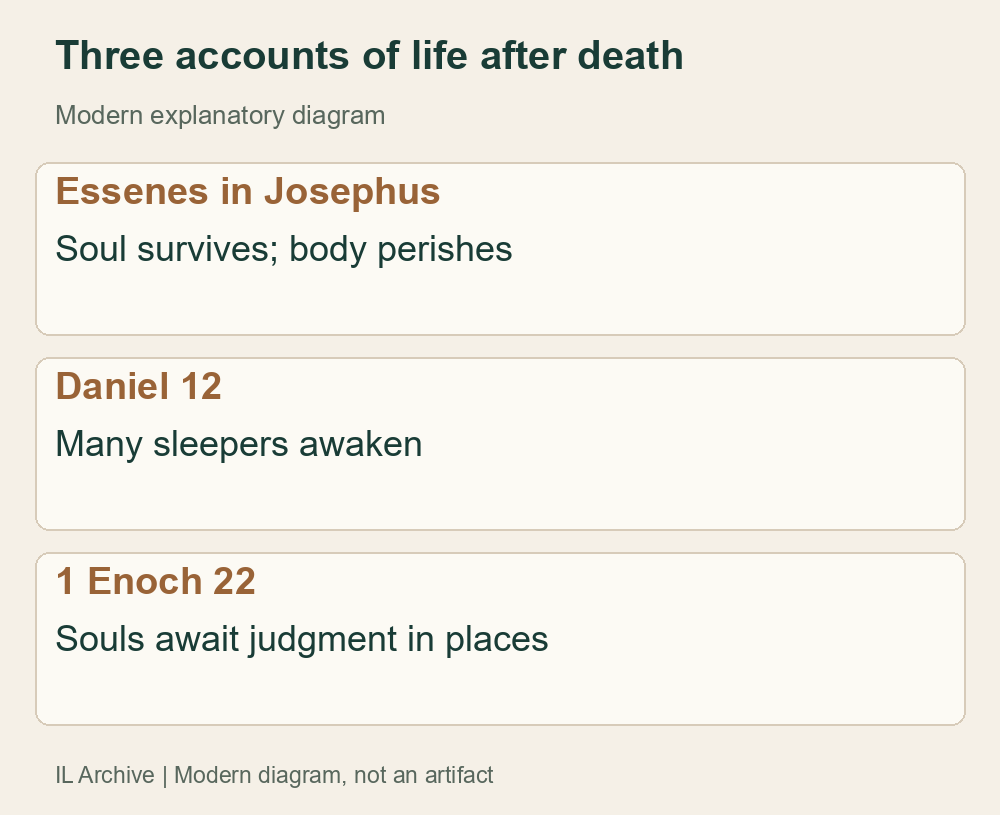
Josephus describes perishable bodies and enduring souls, explicitly comparing Greek beliefs. His “immortality of the soul” cannot simply be translated into “bodily resurrection” without argument. Different afterlife models belong to the period’s history. [6]
Qumran: a library wider than one community
The discovery of the Dead Sea ScrollsDead Sea ScrollsJudaean Desert manuscripts, especially Qumran cave finds. Biblical copies and other works reveal textual diversity; a copy’s age is not the work’s initial date.Glossary · Click to read the explanation from 1947 added voices no longer accessible only through opponents. Rules, calendars, law, interpretation and hymns stand beside more widely circulating books. The IAA’s classification explains why a single-sect description cannot encompass the whole library. [10]
An Essene connection is influential and supported by evidence, but it does not make every scroll an “Essene book.” The Essene name itself is absent from the manuscripts. The library’s attribution, a work’s origin, and the identities of copyists or readers are separate questions. [9][10]
Names and tasks in heaven
Heavenly messengers did not begin with exile or Enoch. Some Second Temple writings instead provide greater detail about names, ranks, knowledge, stars, revelation and war. Annette Reed locates more organized written knowledge in third-century BCE Aramaic material: a literary development, not the first belief in a heavenly realm. [11]
Figures such as MichaelMichael / MīkālTheophoric name asking who is like God; borne by humans and a heavenly figure in Daniel. It establishes no former Canaanite deity.Glossary · Click to read the explanation, GabrielGabriel / JibrīlName joining El with an element involving man or strength; interpreter in Daniel, messenger in Luke, named Jibrīl in the Qurʾan.Glossary · Click to read the explanation, RaphaelRaphael / RephaelTheophoric name from healing and El; human Rephael in Chronicles and angel Raphael in Tobit. Distinct from Israfil, whose etymology is a separate question.Glossary · Click to read the explanation and UrielUrielName joining El to an element interpreted as light or fire; human in Chronicles, heavenly figure in Enoch. No Ugaritic divine origin established.Glossary · Click to read the explanation appear in different texts. Lists vary, and names ending in El do not establish former Canaanite deities. Name, function and a figure’s origin constitute different evidence.
The older council and the adversary’s limits
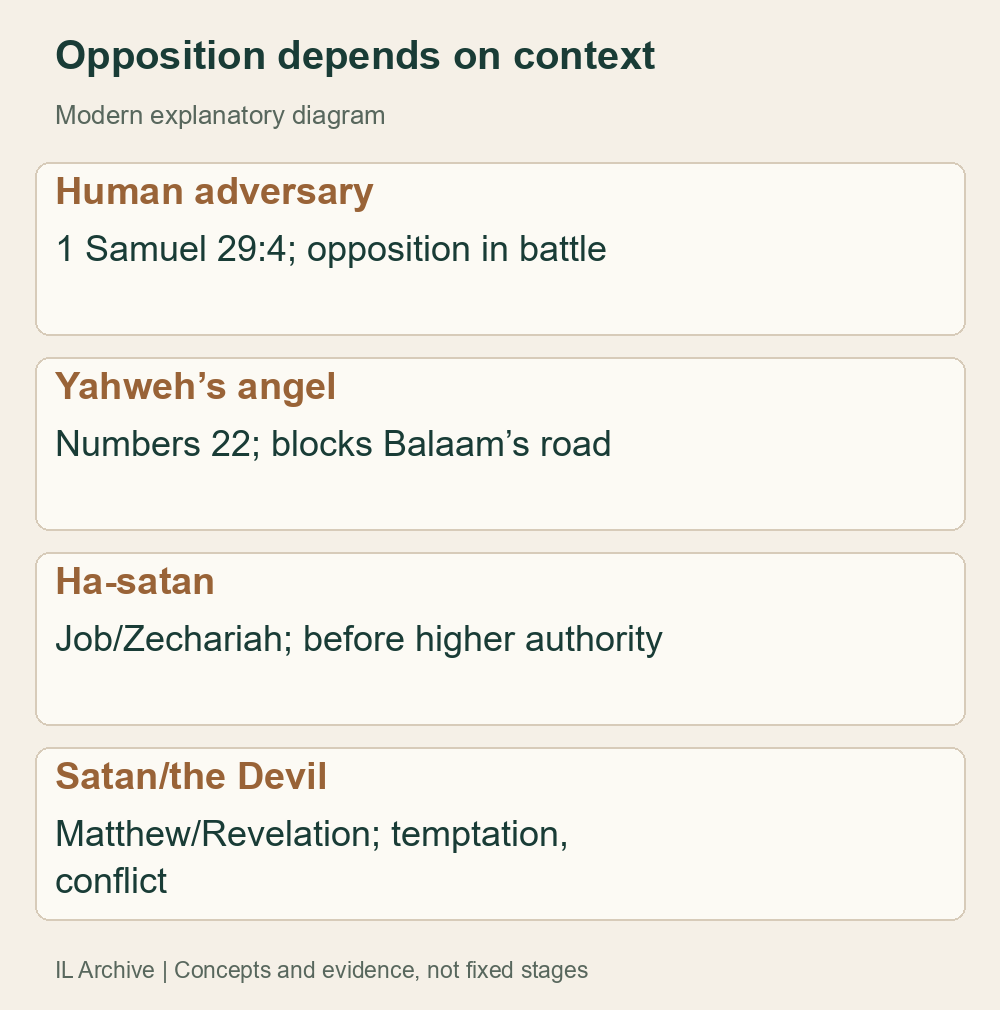
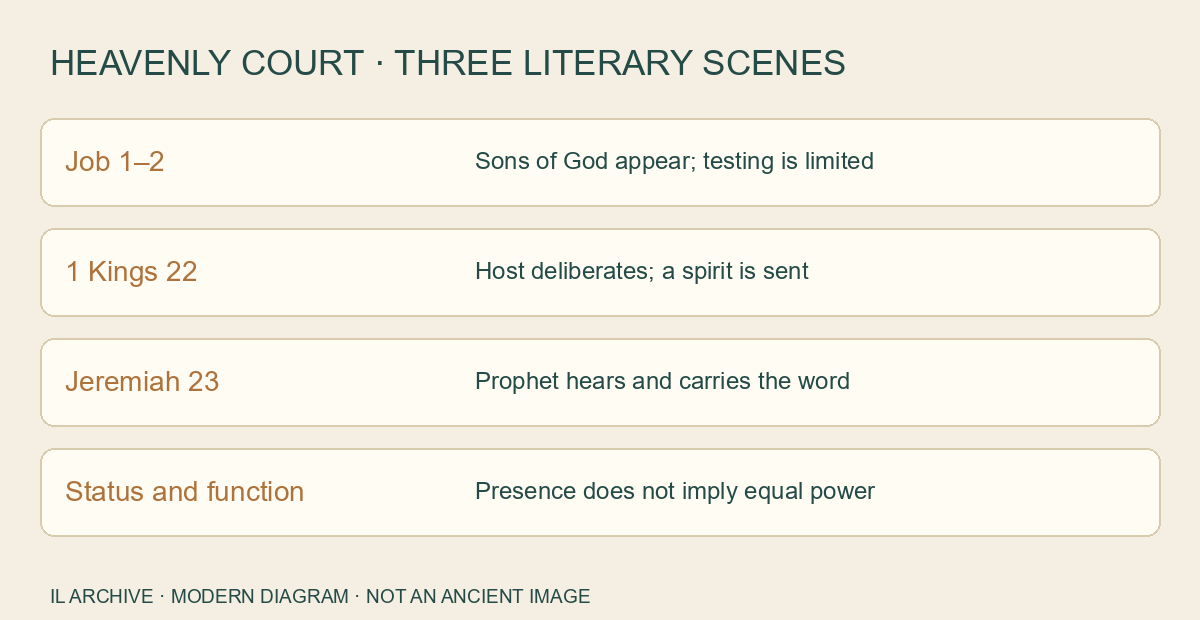
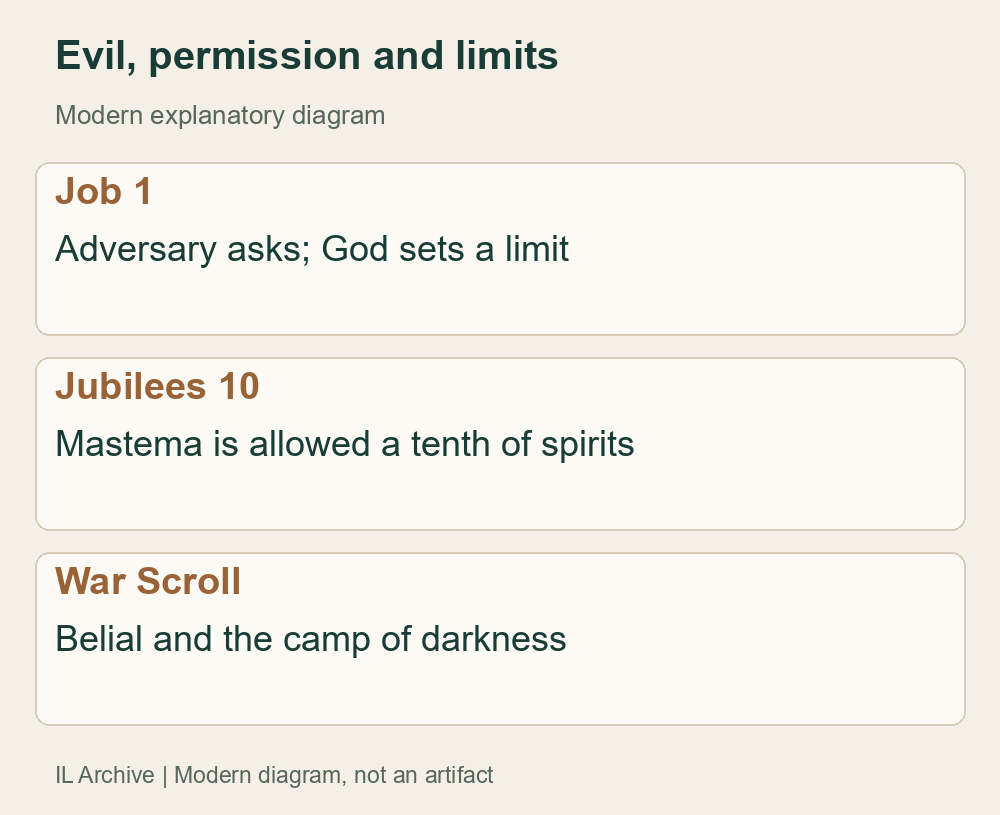
In Job 1, the sons of GodSons of GodA Hebrew expression for heavenly beings in texts such as Job; context determines its meaning, rather than biological descent or a fixed angelic roster.Glossary · Click to read the explanation present themselves before YHWH, with the adversaryHa-satan in JobThe adversary or accuser in Job, with the Hebrew definite article; among the sons of God, acting within permission and limits rather than carrying every later Satanic trait.Glossary · Click to read the explanation, ha-satan, among them. He questions Job’s devotion and acts within permission and limits. The text does not make him a deity equal to YHWH. [26]
Job’s dating is complex; a story’s setting cannot order every text chronologically. Yet the scene permits a functional comparison: council, higher authority and a figure testing humanity. A cosmic enemy in later writings requires its own history, without assuming every occurrence of satan means the same thing.
The Watchers rework Genesis
In 1 EnochFirst EnochLayered collection of Jewish writings about heaven, evil and judgment.Glossary · Click to read the explanation, especially the Book of the WatchersWatchersDesignation for heavenly beings in Daniel and Enochic literature, covering an obedient holy watcher or a rebellious group according to context.Glossary · Click to read the explanation, Genesis’s hints become an expanded narrative. Genesis 6:1–4 mentions divine sons, women and NephilimNephilimTerm in Genesis and Numbers; it alone identifies neither a biological population nor every fallen angel.Glossary · Click to read the explanation without all the later details of angelic descent, names and prohibited teachings. [27]
The book combines multiple units and traditions, joining Enoch’s walk with God to beings descending to women. Its formation belongs to the early Hellenistic horizon, not one author producing every unit in one year. Knowledge of evil and revelation develops by reworking inherited material. [11][13][14]
Giant spirits and the source of evil
1 Enoch 6 describes angelic descent, chapter 8 corrupting teachings, and chapter 15 harmful giant spirits separated from their bodies. Evil acquires a history beyond one person’s wrongdoing: the effects of crossing heavenly boundaries extend into human life. [14]
Reed calls the Watchers the earliest known extensive Jewish demonologyDemonologyStudy or organization of harmful powers, names, origins and roles within specific traditions; no single doctrine or claim about existence beyond the text is assumed.Glossary · Click to read the explanation. This concerns surviving evidence, not the first human idea of an evil spirit. The giant narrative is also not automatically identical to every later Christian account of Satan’s fall. [12]
Belial: the camp of darkness
In some Qumran writings, BelialBelialFigure associated with darkness and wickedness in some Qumran texts; not a fixed alias for every heavenly adversary.Glossary · Click to read the explanation belongs to darkness, opposed to a community of light facing human and heavenly enemies. Social and moral conflict receives a cosmic dimension: the group’s earthly position corresponds to a heavenly camp. [21]
This dualism does not automatically entail two equal gods. In final-war visions, God determines the outcome. Ethical camps and subordinate powers differ from two independent divine principles, and not every Jewish book uses the same system.
Iran: contact is clear, borrowing needs evidence
Persian rule and diaspora created sustained contact with Iranian cultures. Shaked argues for influence on Jewish eschatologyEschatologyStudy of destiny and endings, including individual judgment, resurrection and renewal; not one uniform creed.Glossary · Click to read the explanation while acknowledging disagreement and the late Pahlavi witnesses for developed Zoroastrian detail. Morton Smith warns against turning every angelic or demonic parallel into established transmission. [16][17]
Neither “Judaism borrowed everything” nor “it was untouched” is adequate. Each proposal requires testing the antecedent idea’s age, the Jewish text’s date, contact, distinctive resemblance, transmission mechanism and internal, Mesopotamian or Hellenistic alternatives. Without these, transfer remains possible rather than proven by similarity alone.
Death: more than one Jewish answer
The HebrewHebrewA Northwest Semitic language in the Canaanite group, with ancient and modern forms.Glossary · Click to read the explanation Bible does not provide one fixed system of death. In several texts, SheolSheol: a Hebrew term for the realm of the deadHebrew textual term involving death, descent and lost return; it does not automatically mean later punitive Gehenna.Glossary · Click to read the explanation is a realm of the dead, not simply the later punitive hell. Much language of recompense concerns longevity, family, crops and land, alongside other questions and images. [28]
Second Temple literature juxtaposes enduring souls, rising dead, waiting for judgment and rejection of some such expectations. Josephus, Daniel and Enoch do not offer identical versions of one doctrine. Preserving differences reveals change without projecting later Christian or Islamic maps backward. [6][15][19]
Daniel 12: “many” will rise
Daniel 12:2–3 supplies one of the Hebrew Bible’s clearest witnesses to resurrectionResurrection of the deadThe dead returning to life, distinguished from soul immortality, with differing scope and form among texts.Glossary · Click to read the explanation: many sleeping in the dust awaken to differing destinies, life or disgrace. “Many” matters; the passage does not simply state that everyone in history rises in the same way. [19]
Narrative setting is not composition date. Daniel’s stories inhabit Babylonian and Persian royal worlds, while historical criticism dates the visions’ principal form to the Maccabean crisis, around 168–164 BCE. Newsom explicitly distinguishes these stages. A sixth-century protagonist does not make the passage a sixth-century witness. [18]
Martyrs: justice beyond killing
Second Maccabees 7 narrates a mother and seven sons killed while defending the law. One son expects God to restore life; another hopes to recover his mutilated body. The ruler can end present life but cannot pronounce the final verdict on the righteous. [20]
Persecution and resurrection are strongly connected within this story, without proving violence alone invented the idea. The events narrated and the book’s composition also differ in date. Second Maccabees is outside the Hebrew canon, though recognized by Christian traditions; its later canonical location does not erase its value as Jewish testimony.
Enoch 22: awaiting judgment
1 Enoch 22 describes places holding dead souls until judgment, separating their destinies. Raphael explains the scene, and murdered Abel’s voice seeks justice. Death does not close the case; earthly events still require an otherworldly hearing. [15]
Charles’s displayed translation preserves variants within the description of the chambers. One detailed diagram cannot become “the Jewish doctrine of the afterlife.” This is a particular text in a varied library; waiting for judgment differs from bodily resurrection and Josephus’s account of immortal souls.
Apocalyptic writing: disclosing hidden history
In apocalyptic literatureApocalyptic literatureWriting disclosing hidden heavenly and historical knowledge, not every catastrophe.Glossary · Click to read the explanation, people receive knowledge beyond ordinary observation: an angel guides them or symbols disclose time and destiny. Empires may become beasts, and history unfolds in stages culminating in divine intervention. “Apocalypse” is not a synonym for any catastrophe. [13][18][22]
Nor does “the end” always mean annihilating the earth. It may end oppressive rule, close a corrupt age or inaugurate justice. Apocalyptic writing organizes knowledge, hope and authority rather than supplying predictions shared by the whole population.
Messiah: expectations without one agreed figure
The expected messiah is not the same king in every text. Hope can be royal or priestly, allow more than one figure, or center on God’s intervention without a specified human messiah.
Qumran traditions include language of the messiahs of Aaron and Israel, discussed by Collins alongside priestly and lay organization. This is not a model for all Jews, and manuscript formulations should not all be harmonized. It rules out a universally agreed expectation whose details were settled before Jesus. [21]
Empires enter heaven
In Daniel 10, the prince of Persia resists the heavenly messenger; Michael intervenes, and the prince of Greece is also mentioned. Earthly imperial rivalry has a counterpart among heavenly powers associated with peoples. [22]
This is a visionary account, not a historian’s witnessed battle. It does not identify Persia’s prince with a particular Iranian deity. The characters’ roles can be examined within the text; matching them to other gods requires independent evidence.
One God and an inhabited heaven
Increasing divine exclusivity does not require removing every heavenly being. A monotheistic conception can retain angels, messengers and a host subordinated to God, without granting them independent divinity entitled to worship. Counting heavenly characters alone cannot measure monotheism. [11][26]
AngelAngel / Divine MessengerHebrew malʾakh means messenger, human or celestial according to context; the word alone proves neither wings nor origin from a particular Canaanite god.Glossary · Click to read the explanation originally denotes a messenger. Functions inherited from the divine councilDivine councilA representation of divine beings acting as an assembly with authority and differentiated roles.Glossary · Click to read the explanation could persist in new conceptions. This continuity supplies no table converting each Canaanite god into a named Jewish angel.
The adversary, Belial and Mastema
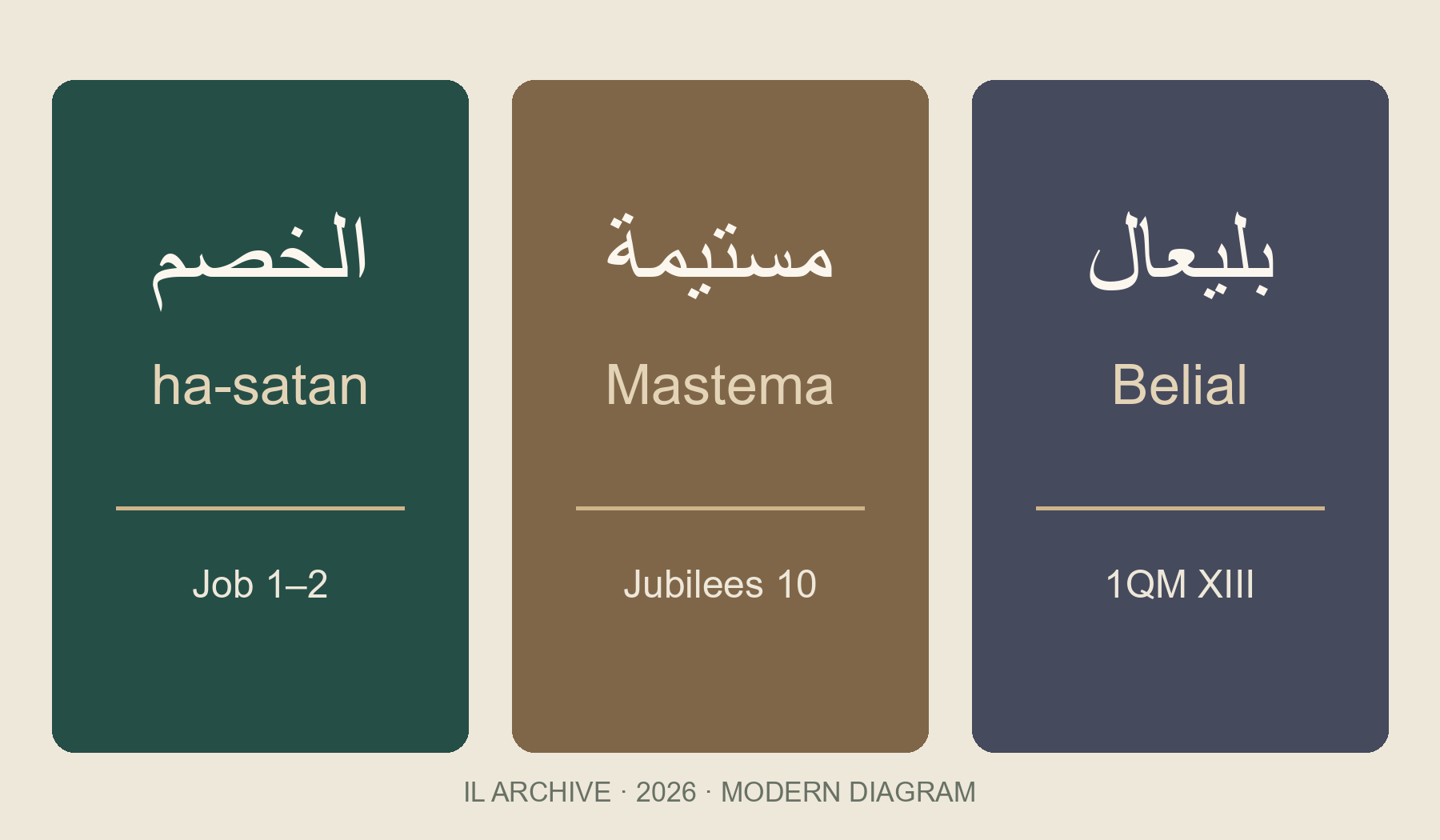
Jewish texts name hostile powers differently; these should not automatically be combined into one biography. Job’s adversary acts by permission, Belial heads darkness in some Qumran texts, and JubileesBook of JubileesJewish retelling of Genesis and Exodus framed as angelic teaching to Moses, adding chronology, narratives and interpretation.Glossary · Click to read the explanation has MastemaMastemaLeader of harmful spirits in Jubilees; requests some spirits and proposes Abraham’s test, subject to divine limits.Glossary · Click to read the explanation request control of some harmful spirits. [26][21][29]
Jubilees 10 permits him a tenth while the rest are bound. The translation used also calls the figure Satan in verse 11: particular traditions do connect these names. That does not make all portrayals across all books identical. Permission and limits prevent treating this figure as God’s equal. [29]
The War Scroll: an imagined future
The War ScrollWar ScrollDead Sea Scroll text portraying war between the sons of light and the hostile camp; its principal copy is designated 1QM.Glossary · Click to read the explanation places sons of light and darkness in a final conflict involving angels. Camp and combat instructions accompany priestly language, prayers and hopes for divine victory. Belial belongs to its hostile world. [21]
It is not a report of an actual battle or a statement of every Jew’s belief. Different copies and forms of war material also discourage treating it as one fixed plan. It reveals how some authors imagined deliverance through holy warfare and heavenly participation, not that every Jewish community expected to fight tomorrow.
Everyday life does not disappear
Reading visions alone can make the entire age look like an expectation of the world’s end. Yet the libraries preserve wisdom, law, prayers and calendars; food, purity, family, work and festivals mattered. Eschatological conceptions did not replace this life. [10]
Manuscripts give access to particular authors, scribes and groups, not a census of the population’s beliefs. A theme’s prominence in surviving literature must be distinguished from its social prevalence. These writings alone cannot establish how many Jews expected an imminent end.
Christianity emerged within these debates
Jesus, his earliest disciples and Paul belonged to this Jewish world. TorahTorah / PentateuchGenesis, Exodus, Leviticus, Numbers and Deuteronomy: Mosaic corpus with a compositional history. Torah can also mean teaching or law beyond these five books.Glossary · Click to read the explanation, temple, kingdom, resurrection, angels and judgment were already subjects of discussion. Early Christianity is better understood within Jewish disagreements than as the arrival of an entirely unfamiliar religious vocabulary. [1][23]
This does not make Christianity an identical repetition. Groups associated with Jesus reinterpreted these themes around his identity and fate. Nor does it imply that every later Christian author was Jewish or that communal boundaries were established on a single day.
Enoch between reception and marginalization
Jude 14–15 invokes Enoch’s prophecy of divine judgment. This directly witnesses the reception of an Enochic tradition in an early Christian text, but does not make First Enoch canonical in every church. [24]
Preservation and interpretation later differed between Christian and rabbinic Jewish settings. Reed examines the continuation of fallen-angel traditions in some Christianity and the diminished prominence of Enochic literature in rabbinic traditions. This variation should become neither a universal Jewish ban issued at one moment nor a uniform Christian reception. [23]
The temple remained central
Apocalyptic writing did not turn the temple into a building superseded by new ideas. Sacrifice, priesthood, pilgrimage and calendar remained important. Disputes about purity and worship could express demands to correct temple practice rather than indifference to it. [10]
Herod, whose reign lasted from 37 to 4 BCE, rebuilt the temple complex on a large scale. Those are reign dates, not a claim that every construction project ended with his death. Destruction in 70 CE again altered the circumstances of Jewish life and emerging Christianity. [2]
When life does not vindicate the righteous
Some resurrection and judgment narratives address justice: what becomes of a righteous person killed unfairly? In Second Maccabees, the family’s survival alone cannot repair martyrdom; in First Enoch 22, the murdered person’s voice persists while judgment is awaited. [20][15]
This helps explain the force of hope beyond death, but interprets only part of the evidence. It is not the sole cause of every eschatological belief. Scriptural interpretation, political experience, inherited traditions and cultural contacts intersected; one causal model cannot encompass them all.
The difference made by proclaiming Christ raised
In First Corinthians 15, Paul presents Christ’s resurrection as already accomplished and as the beginning of his followers’ resurrection, followed by the subjection of powers and abolition of death. Resurrection is not invented here from nothing; a Jewish hope is reorganized around an event the Christian community proclaims foundational. [25]
“Already accomplished” describes Paul’s proclamation and the community’s belief. Historians can study the text and the history of this conviction; the letter’s existence alone is not archaeological proof of a miracle. Distinguishing belief from the nature of its witness preserves the comparison’s precision.
What does the evidence establish?
Texts from this period certainly describe named angels, hostile spirits and hopes for resurrection and judgment; they do not agree in every detail. Josephus certainly distinguishes groups with different positions, but his account remains an outside author’s testimony. [6][14][19][20][21]
Scriptural interpretation, writing, political experience and cultural contacts probably contributed to these conceptions. Deriving all of them from ZoroastrianismZoroastrianismIranian religious tradition associated with Zoroaster, with changing texts and conceptions of goodness, evil and endings.Glossary · Click to read the explanation, or converting every old god into a particular angel, is unproven. Iranian influence on a specific theme remains a possibility requiring its own investigation. [16][17]
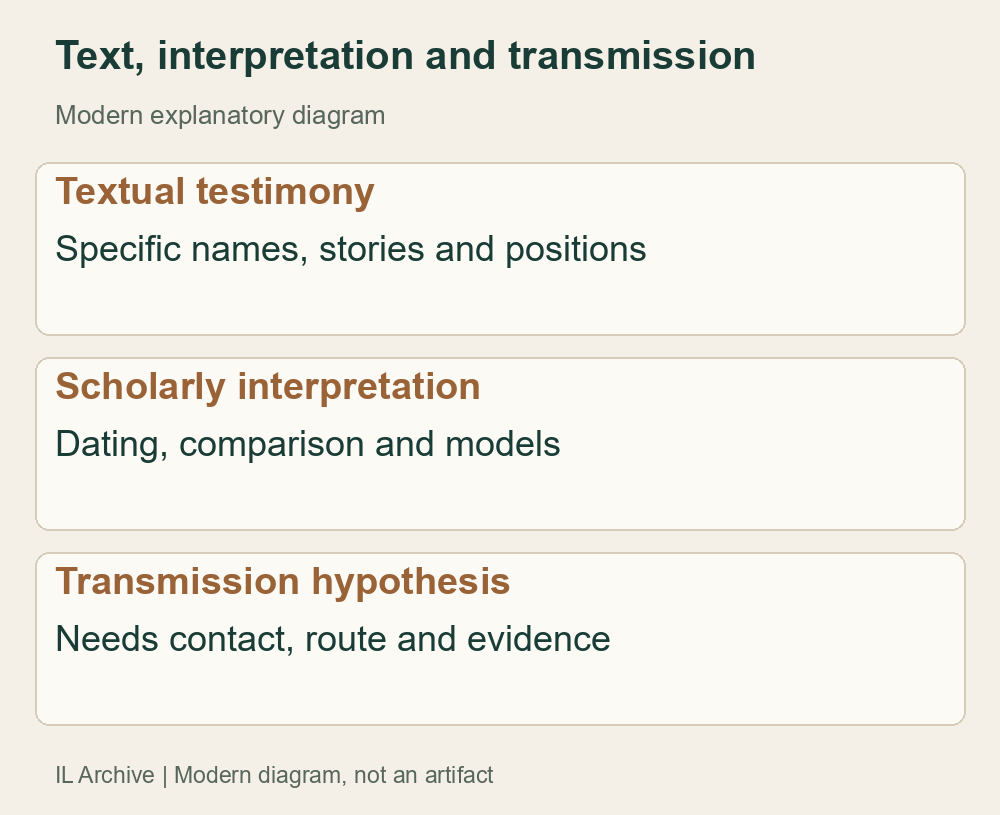
The world in which heaven changed
Between exile and Christianity, Israel’s traditions neither vanished nor became one universally agreed system. Successive empires, dispersed communities and multiple languages changed how they were read. Some scribes found in heaven a language for empire, injustice, illness, death and hope. [1]
Heavenly characters acquired sharper identities and narratives of evil and judgment expanded. Yet law, wisdom, temple and everyday life persisted, as did disagreement about death. Christianity arose within this world; its paths and those of other Judaisms developed in interwoven, divergent ways. [23][25]
These centuries are not an empty corridor between religions. They have a rich history of their own, showing how one God could preside over an inhabited heaven, and how different writers gave death, evil and the world’s future meanings that were never identical.
References and notes
- Annette Yoshiko Reed (2012). “Second Temple Judaism.” Oxford Bibliographies in Biblical Studies. Introduction: period boundaries and diversity; full entry not read. Return to the text ↑
- Dan Pioske (2019). “Jerusalem.” Oxford Bibliographies in Biblical Studies. Introduction: 586 BCE, temple c.515, Pompey 63, Herod and destruction in 70 CE. Return to the text ↑
- Morton Smith (1984). “Jewish religious life in the Persian period.” The Cambridge History of Judaism 1, pp. 219–278. Chapter summary: Persian rule, varied community definitions and Elephantine; not full reading. Return to the text ↑
- Petition for authorization to rebuild the Elephantine temple, 407 BCE; K. C. Hanson, English translation and Aramaic transliteration. Petitioners report Yahu’s temple, its destruction and request reconstruction; not all Jews. Return to the text ↑
- Martin Hengel (1989). “The interpenetration of Judaism and Hellenism in the pre-Maccabean period.” The Cambridge History of Judaism 2, pp. 167–228. Summary opening: cultural interaction and fragmentary sources; chapter not read in full. Return to the text ↑
- Flavius Josephus, Jewish War 2.8; William Whiston translation, Perseus Digital Library. 2.8: souls, bodies and group comparison. Josephus’s Greek framing is his authorial choice. Return to the text ↑
- Flavius Josephus, Jewish Antiquities 13.10.6 (13.297–298); William Whiston translation, Perseus. Inherited observances, Pharisees and Sadducees; external report, not a Sadducean creed. Return to the text ↑
- Günter Stemberger (1999). “The Sadducees – their history and doctrines.” The Cambridge History of Judaism 3, pp. 428–443. Summary: no surviving Sadducean writings and selective outsider/opponent reports. Return to the text ↑
- Otto Betz (1999). “The Essenes.” The Cambridge History of Judaism 3, pp. 444–470. Summary: ancient sources, approximate period and absence of the Essene name in the scrolls. Return to the text ↑
- Israel Antiquities Authority, Leon Levy Dead Sea Scrolls Digital Library. “Scrolls Content.” Digital classification: library wider than community writings; calendars, rules and wisdom. Return to the text ↑
- Annette Yoshiko Reed (2020). “Rethinking Scribalism and Change in Second Temple Judaism.” Demons, Angels, and Writing in Ancient Judaism, pp. 87–131. Model of organized angelic/demonic knowledge in third-century BCE Aramaic literature; not the first heavenly messenger. Return to the text ↑
- Annette Yoshiko Reed (2020). “Textualizing Demonology as Jewish Knowledge and Scribal Expertise.” Demons, Angels, and Writing in Ancient Judaism, pp. 189–246. Summary calls the Watchers the earliest known extensive Jewish demonology; scholarly assessment. Return to the text ↑
- Annette Yoshiko Reed (2005). “Angelic Descent and Apocalyptic Epistemology.” Fallen Angels and the History of Judaism and Christianity, pp. 24–57. Summary: composite text joins Genesis 5’s Enoch with Genesis 6’s divine sons; no single date for all units. Return to the text ↑
- 1 Enoch 6, 8 and 15; R. H. Charles (1917), translation, Internet Sacred Text Archive. 6: angelic descent; 8: teachings; 15: giant spirits. Older translation, not manuscript inspection. Return to the text ↑
- 1 Enoch 22; R. H. Charles (1917), translation, Internet Sacred Text Archive. Dead souls awaiting judgment; displayed textual variants preclude a single imposed Jewish map. Return to the text ↑
- Shaul Shaked (1998). “Eschatology i. In Zoroastrianism and Zoroastrian Influence.” Encyclopaedia Iranica. Iranian influence argument alongside acknowledged disagreement and late Pahlavi detail. Return to the text ↑
- Morton Smith (1989). “Bible ii. Persian Elements in the Bible.” Encyclopaedia Iranica. Parallels can be independent; insufficient alone to prove borrowing in angelology and evil. Return to the text ↑
- Carol Newsom (2010). “Daniel.” Oxford Bibliographies in Biblical Studies. Introduction separates tales from visions dated to the Maccabean crisis, c.168–164 BCE. Return to the text ↑
- Daniel 12; Hebrew text and English translation, Mechon-Mamre. 12:1–3: Michael and “many” rising to different outcomes; universality not explicit. Return to the text ↑
- 2 Maccabees 7, NRSVUE, Bible Gateway. 7:9–14, 22–29: restored life and body in martyr narrative; literary testimony, not its composition date. Return to the text ↑
- John J. Collins (1992). “Dead Sea Scrolls.” Anchor Bible Dictionary 2, pp. 85–101; author’s article reproduced by COJS. Aaron/Israel messiahs; 1QM, angels and Belial. Scholarly reading, not independent reading of every manuscript. Return to the text ↑
- Daniel 10, NRSVUE, Bible Gateway. 10:13, 20–21: Persian/Greek princes and Michael; not a military record. Return to the text ↑
- Annette Yoshiko Reed (2005). “The Interpenetration of Jewish and Christian Traditions.” Fallen Angels and the History of Judaism and Christianity, pp. 190–232. Summary: divergent Enochic reception; no universal Jewish ban or uniform Christian reception. Return to the text ↑
- Jude 14–15, NRSVUE, Bible Gateway. Invokes Enoch’s judgment prophecy; reception witness, not every church’s canon. Return to the text ↑
- 1 Corinthians 15:12–28, NRSVUE, Bible Gateway. Paul proclaims Christ raised first, then his followers; describing belief, not adjudicating the miracle. Return to the text ↑
- Job 1; Hebrew text and English translation, Mechon-Mamre. 1:6–12: divine sons, the adversary and YHWH’s permission/limits; no exact Job date claimed. Return to the text ↑
- Genesis 6; Hebrew text and English translation, Mechon-Mamre. 6:1–4: divine sons, women and Nephilim; later Watchers detail is not all present here. Return to the text ↑
- Ecclesiastes 9; Hebrew text and English translation, Mechon-Mamre. 9:5, 10: limited account of the dead and Sheol in this text, not every Jew’s creed. Return to the text ↑
- Jubilees 10:7–11, R. H. Charles translation, Internet Sacred Text Archive. Mastema requests permission and is allowed a tenth of the spirits. Verse 11 also calls the figure Satan; not an absolute separation in every text. Return to the text ↑
Suggest a correction · Suggest a source for this record
Cite this record
IL Archive, «Judaism between exile and Christianity», Edition 1, https://ilarchive.com/en/studies/second-temple-judaism
Continue reading