Entity
Nephilim
A reference page linking a name, group, or concept to the materials that discuss it.
The Nephilim are an enigmatic Hebrew name in Genesis 6:4 and Numbers 13:33. This entry separates the scouts’ claims, the heroes, sons of God, the Greek giants, Enochic elaborations, and Qumran witnesses.
Estimated reading time: 8 min Published Last reviewed:
Share article

Text
Introduction
The Nephilim are an enigmatic name in two passages of the HebrewHebrewA Northwest Semitic language of the Canaanite group, encompassing Iron Age epigraphy, Biblical, Rabbinic, medieval and Modern Hebrew; its scripts and pronunciations changed over time.Glossary · Click to read the explanation Bible: a brief episode before the flood in the Book of GenesisBook of GenesisHebrew book of the Torah containing Noah’s flood, survival offering and covenant with living creatures.Glossary · Click to read the explanation and the scouts’ report about Canaan in the Book of NumbersBook of NumbersTorah book addressing daughters’ inheritance and tribal retention of land.Glossary · Click to read the explanation. Does the name refer to giants, heroes of antiquity, or the offspring of heavenly beings? This entry distinguishes the wording and speakers of the two passages from the readings of the Greek translation and later Second Temple literature. These are connected but not interchangeable kinds of evidence. [1] [2]
Genesis: Nephilim and ancient heroes
Genesis 6:1–4 says that the “sons of God”Sons of God“Bene elohim” is a Hebrew expression in Job and Genesis whose interpretation depends on context; it also appears in Qumran 4Q37 at Deuteronomy 32:8. It does not itself establish biological descent or a fixed divine roster.Glossary · Click to read the explanation (bene ha-elohim) saw human women and took wives; it then mentions the Nephilim. ElohimElohimA Hebrew word with plural morphology, used for “gods” or for a singular deity according to context.Glossary · Click to read the explanation may refer to God or divine beings according to syntax and context, so its translation alone does not settle the identity of these “sons.” The episode is set in primeval narrative time immediately before the flood, not in an archaeological account. [1]
These opening words of Genesis 6:4 mean, in our translation, “The Nephilim were on the earth in those days, and also afterward.” The verse continues with the sons of God entering into relations with human women and children being born, before speaking of “the mighty ones of old, men of renown.” It uses three expressions: נְפִלִים (Nephilim), גִּבֹּרִים (gibborim, mighty men or heroes), and אַנְשֵׁי הַשֵּׁם (anshe ha-shem, men of name or renown). It gives no body measurements and names no individual Nephil. [1] [6]
Many interpreters take “those” to refer to the children born of these unions or to the previously mentioned Nephilim, bringing the two groups together. Yet the syntax does not lay out a detailed genealogy. Nor does “and also afterward” specify how Nephilim would have survived the flood; it may mark a broader time horizon or anticipate their later mention. Treating this phrase as proof of an unbroken biological lineage goes beyond its explicit words. [1] [6] [12]
The name is often associated with the Hebrew root נפל (n-p-l, “fall”), yielding proposals such as “fallen ones” or “those who fall upon others.” The precise derivation and original sense remain disputed. “Giants” reflects an interpretive translation and the report in Numbers; “fallen angels” is not an established dictionary equivalence for Nephilim. Nor does gibbor, a mighty person, invariably mean someone exceptionally tall. [6] [11]
Numbers: whose claim is it?
Numbers 13:22 and 28 mention the AnakitesAnakites in biblical narrativeThe Anakites are a group the scouts in Numbers describe as powerful and large.Glossary · Click to read the explanation around Hebron among the inhabitants of Canaan. Caleb urges the people to advance, but other scouts warn that the inhabitants are stronger and spread a discouraging report: the land “devours” its residents and the people they saw are very tall. The climactic assertion about the Nephilim is made by these frightened scouts, not independently by the narrator as a verified observation. [2] [12]
“And there we saw the Nephilim” (Numbers 13:33). The Hebrew then places the Anakites “from the Nephilim” and reports the scouts comparing themselves to grasshoppers both in their own eyes and, they assume, in those of the others. The comparison conveys vulnerability and fear, not measured dimensions. Even the claim to know how their opponents saw them belongs to the scouts’ rhetoric. The Anakites are a named group within biblical Canaan traditions; their proposed descent here is a claim within a speech, not an archaeological finding. [2] [12]
What did the Greek translation do?
The SeptuagintSeptuagintA name for the varied ancient Greek translations and writings associated with Jewish scripture; beginning with the Torah, the texts differ across books and manuscripts.Glossary · Click to read the explanation is a corpus of ancient Jewish translations into Greek. Its rendering of Genesis 6:4 begins: [3]
That is, “And the giants were on the earth.” The Greek γίγαντες (gigantes) also appears later in this verse in place of the Hebrew gibborim (“mighty ones”), narrowing a distinction present in Hebrew. In Numbers 13:33 the Greek has “there we saw the giants” (τοὺς γίγαντας), without the Hebrew clause linking the Anakites to the Nephilim. This is a genuine textual difference; it does not, on its own, tell us whether a translator abbreviated the passage or had a different Hebrew wording. [3] [4] [11]
Gigantes would have carried associations in Greek culture, but using the term was a translator’s interpretation, not scientific evidence of human stature or proof that the Hebrew account was identical to any particular Greek myth. [11]
Who were the “sons of God”?
Many historical interpreters favor beings of the divine realm in the ancient story. The contrast between sons of God and daughters of humanity, together with related wording for a heavenly assembly in Job 1:6 and 38:7, supports this reading. It suggests a crossing of the human–divine boundary; it does not yet narrate, in Genesis itself, the named rebel angels and detailed offenses found in later compositions. Nor should the fathers and their offspring be collapsed into a single class of beings. [1] [5] [6] [8]
Two prominent human readings identify the “sons” either with powerful rulers or judges who seize women, or with descendants of Seth marrying women of Cain’s line. The first draws attention to judicial uses of elohim and the verbs of choosing and taking, but must explain why the precise plural title refers to a group of human rulers. The second draws upon the neighboring genealogies in Genesis 4–5, but the passage never calls the sons “Sethites” or the women “Cainites.” On balance, comparative usage and the contrast in the verse favor the divine-being reading, while the human explanations remain important evidence of later interpretation and attention to abuses of power. [6] [13]
First Enoch and the Watchers
First EnochFirst EnochA composite Second Temple Jewish apocalyptic collection on the Watchers, parables, celestial cycles, historical visions, and judgment, preserved complete in Geʽez.Glossary · Click to read the explanation is a collection of ancient Jewish writings from several periods. Its early Book of the WatchersBook of the WatchersOpening unit of 1 Enoch (chapters 1–36), concerning the Watchers’ descent, offspring and judgment, Enoch’s mission and cosmic journeys; a composite work with multiple textual witnesses.Glossary · Click to read the explanation (chapters 1–36) elaborates the short biblical episode. In chapters 6–11 the WatchersWatchersDesignation of a heavenly being in ancient Jewish literature: a holy messenger in Daniel, but a rebellious group in First Enoch. It is not automatically equivalent to demons or giants’ spirits.Glossary · Click to read the explanation become named heavenly actors led by Shemihazah; their unions with women produce giants who exhaust human provisions and commit violence, alongside episodes of forbidden teaching and punishment. Chapter 7:2 in the Ethiopic textual tradition, as translated by R. H. Charles, famously gives a fabulous height of three thousand cubits. Charles also writes “they bare great giants” (7:2). This is his historical English translation, not an Aramaic transcription of 4Q201; the extraordinary measure belongs to an Enochic narrative, not Genesis, and cannot be attributed verbatim to every Qumran fragment. [7] [8]
The relationship between the Genesis passage and this Enochic story is strong: it witnesses ancient reinterpretation and enlargement. But Enoch’s additional names, offenses and explanations are not automatically present in four verses of Genesis. Nephilim, Watchers, offspring and fallen angels therefore require separate definitions; in further Enochic elaboration the giants’ spirits become harmful spirits after death, another claim not made explicitly by Genesis. [7] [8]
By contrast, Genesis RabbahGenesis RabbahJewish exegetical midrash on Genesis, mainly redacted around the fifth century CE in Roman Palestine. It assembles interpretations and narratives from different layers, including 38:13 on Abraham and the idols.Glossary · Click to read the explanation 26:5 (26:6 in another division) reads the sons of God as sons of judges or nobles, reporting an objection ascribed to Shimon bar Yochai to calling them divine sons. This late-antique rabbinic reading cannot simply be projected back as the passage’s sole original meaning; it is an important witness to changing reception. [13]
Narrative time, composition and surviving copies
- Time within the stories: Genesis 6 belongs to the world before the flood; Numbers 13 belongs to the wilderness reconnaissance narrative. Neither is a dated artifact report.
- Composition: Traditions and editions of Genesis and Numbers developed over stages in the first millennium BCE, with competing scholarly models. The events narrated do not fix the date of Genesis 6:4 or the final edition of either book. [6] [12]
- Greek transmission: Jewish Greek translation of the Torah began in Hellenistic Egypt around the third century BCE. The Greek wording now read is transmitted through later copies, not an autograph of an original translator. [3] [4] [11]
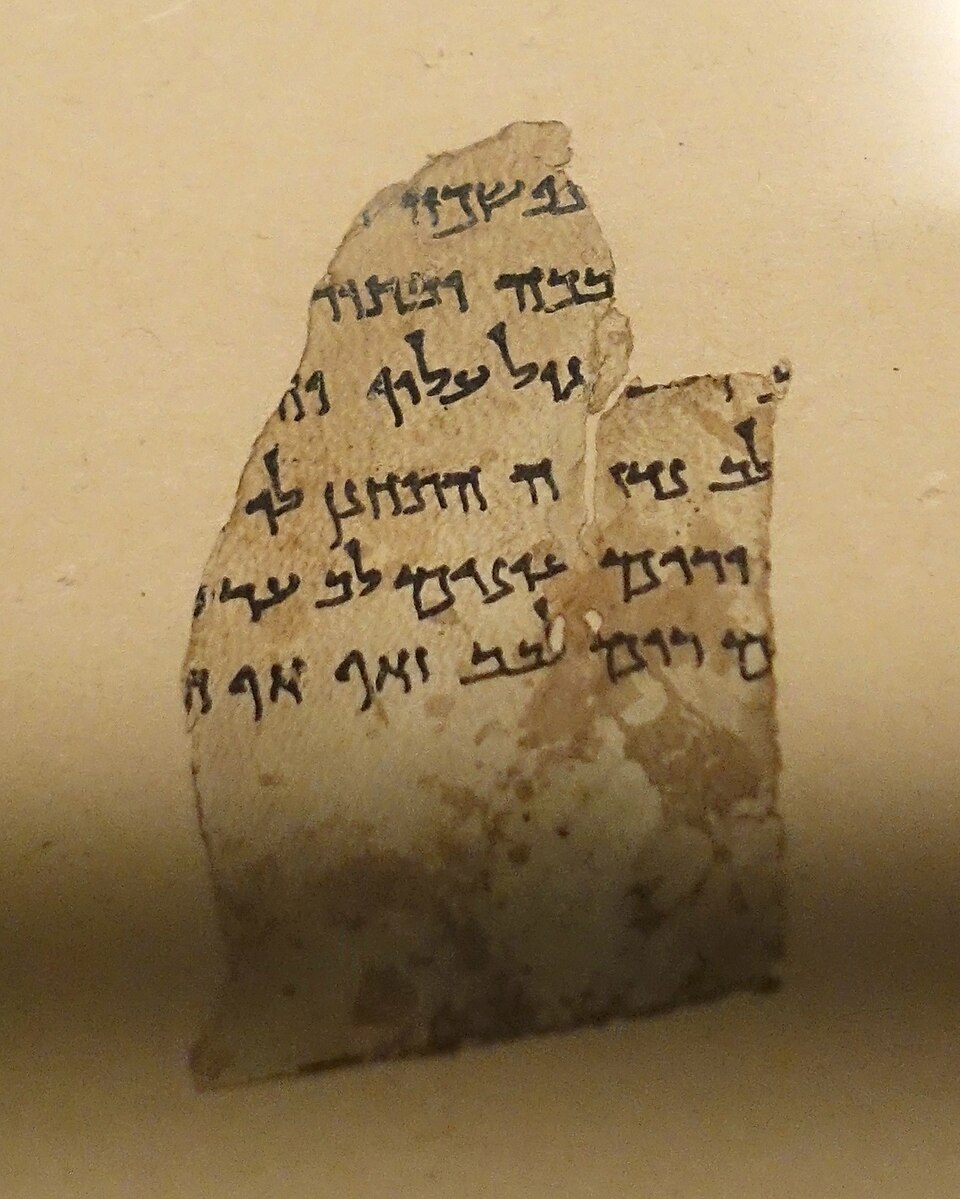
- Enochic composition and witness: The Book of the Watchers is often placed broadly in the third–second centuries BCE, before some extant manuscript copies. The Library of Congress dates the copying of the Aramaic parchment 4Q201 from the Dead Sea ScrollsDead Sea ScrollsManuscript collections from the Judaean Desert, best known through Qumran: diverse works, languages and textual forms, with copying distinguished from composition.Glossary · Click to read the explanation, found in Cave 4 at QumranQumranArchaeological site northwest of the Dead Sea near manuscript caves; its settlement and the groups who deposited the scrolls are studied together but not assumed identical. It is not synonymous with all Dead Sea Scrolls.Glossary · Click to read the explanation, to approximately 200–150 BCE. Its fragments preserve parts of the work, not a complete chapter 7. Henryk Drawnel’s critical edition studies these and related witnesses; only the publisher’s description of that edition was available to this review, not its edited pages. [9] [10]
- Later reception: Rabbinic midrash and Greek and Ethiopic Enoch manuscripts reflect additional stages of transmission. A late copy does not date the narrated event—or the first formulation of every portion—to the copyist’s century. [7] [13]
What the evidence supports
Nephilim is rare: once in Genesis and twice within a single verse of Numbers. Genesis places it with ancient heroes and the unions involving the sons of God; Numbers has anxious scouts identify the Anakites with the Nephilim and very tall people. Greek translators selected “giants,” and Enochic literature developed the world of the Watchers and their offspring. A divine-beings-and-heroes setting is a strong reading of the old Genesis story, though its syntax, etymology and literary development remain debated. None of these textual layers provides archaeological proof of a super-sized human species or extraterrestrial ancestry. The accompanying cover is a new AI-generated symbolic illustration, not an ancient witness. [1] [2] [6] [11] [12]
References and notes (13)
- Masoretic Hebrew text of Genesis, as displayed by Mechon Mamre; translations in the entry are original. Genesis 6:1–13, especially 6:1–4 Return to the text ↑
- Masoretic Hebrew Numbers, Mechon Mamre; scouts’ narrative and speech. Numbers 13:22, 26–33 Return to the text ↑
- Greek Septuagint Genesis text, as displayed by Blue Letter Bible; short extract from the Greek text. Greek Genesis 6:1–4 Return to the text ↑
- Greek Septuagint Numbers, Blue Letter Bible; Anakite clause absent in displayed Greek. Greek Numbers 13:28–33, especially 13:32–33 Return to the text ↑
- Hebrew Job on Mechon Mamre: sons of God in a heavenly court scene and a creation scene; linguistic parallel, not the Genesis plot. Job 1:6 and 38:7 Return to the text ↑
- Jaap Doedens, “Those Elusive Sons of God: Genesis 6:1–4 Revisited,” Bible and Interpretation, April 2019; arguments for the heavenly, judicial, and Sethite readings. Online essay, “Unsung Heroes,” “Mainstream Interpretations,” and “History of Exegesis” Return to the text ↑
- R. H. Charles (editor/translator), 1 Enoch, in The Apocrypha and Pseudepigrapha of the Old Testament (Clarendon); historical English version, not a direct collation of every Aramaic witness. Book of Watchers, 1 Enoch 6–11, especially 7:1–6 and 15:8–12 in posted translation Return to the text ↑
- Miryam Brand, “The Benei Elohim, the Watchers, and the Origins of Evil,” TheTorah.com, 2016 (updated 2026); reading of 1 Enoch 6–11 and evil-spirit traditions. Sections “Three Versions of the Watchers’ Sin” and “Benefits of a Belief in the Fall” Return to the text ↑
- Library of Congress, Qumran Library exhibit, Enoch parchment 4Q201 on loan from Israel Antiquities Authority; exhibition caption dates copying to 200–150 BCE. “The Enoch Scroll,” 4Q201 exhibit label; not all fragment transcriptions Return to the text ↑
- Henryk Drawnel, Qumran Cave 4: The Aramaic Books of Enoch (Oxford, 2019); publisher/catalogue description only, NOT the critical edition itself. Publisher description quoted in National Library of Israel catalogue; no book pages read Return to the text ↑
- Wojciech Kosior, “The Fallen (or) Giants?,” Przekładaniec 29 (2014), 41–64; English abstract and selected extracted Polish text on the author-provided ResearchGate page, not full verified reading of the printed journal. English abstract and selected extracted text; 41–64 is article pagination, not claimed read-through Return to the text ↑
- Ki-Eun Jang, “The Problems of Sons of Gods, Daughters of Humans, and the Nephilim in Genesis 6:1–4: A Reassessment,” Religions 16/8 (2025), article 972; abstract and indexed excerpts only, not full article. Abstract and indexed excerpt of discussion; remainder not accessed Return to the text ↑
- Bereshit Rabbah, interpretation of “sons of God”; Hebrew passage on Sefaria and comparison of different section numbering. Bereshit Rabbah 26:5; 26:6 in another division Return to the text ↑
Suggest a correction · Suggest a source for this record
Cite this record
IL Archive, «Nephilim», https://ilarchive.com/en/entities/nephilim
Continue reading