Entity
Watchers
A reference page linking a name, group, or concept to the materials that discuss it.
- Names
- Watchers · עִיר · עִירִין
“Watchers” designates a group of heavenly beings whose role changes by text: a holy messenger in Daniel 4, transgressing angels in First Enoch, and a group whose mission begins positively in Jubilees.
Estimated reading time: 6 min Published Last reviewed:
Share article

Text
Introduction
Why does Daniel call a heavenly messenger a “watcher,” whereas First EnochFirst EnochA composite Second Temple Jewish apocalyptic collection on the Watchers, parables, celestial cycles, historical visions, and judgment, preserved complete in Geʽez.Glossary · Click to read the explanation describes Watchers who rebel and transmit forbidden knowledge? The name brings together different texts, characters and moral judgments. This entry traces the wording, the narratives and their manuscript witnesses, distinguishing what each ancient text says from interpretations attached to it later.
The holy watcher in Daniel
In the Book of DanielBook of DanielA book combining court tales of wisdom and deliverance with visions of kingdoms and the future, formed in stages.Glossary · Click to read the explanation 4, the Aramaic word ʿîr, associated with wakefulness, occurs in Nebuchadnezzar’s dream of a great tree. A “watcher and holy one” descends from heaven to announce the tree’s felling; the decree of the “watchers” and “holy ones” ultimately communicates the rule of the Most High over human kingship. In the Aramaic numbering displayed by Mechon Mamre the expressions appear at 4:10 and 4:14, usually 4:13 and 4:17 in other numbering systems. Nothing in this scene presents the messenger as rebellious: he delivers a heavenly judgment. [1]
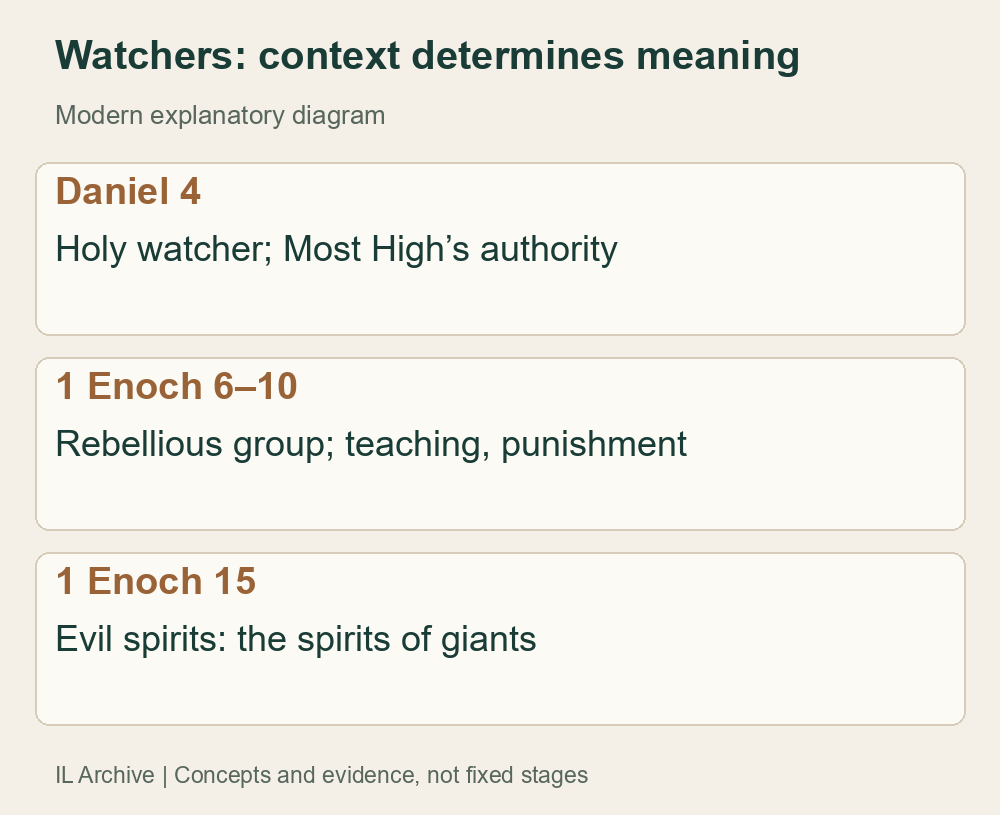
Consequently, the plural “Watchers” does not automatically mean fallen angels. The narrative role matters: is a watcher carrying a decision, or has a group crossed a boundary? The following inherited explanatory diagram preserves that difference and distinguishes a third category, the spirits of the giants. [2]
The brief passage in Genesis
GenesisBook of GenesisHebrew book of the Torah containing Noah’s flood, survival offering and covenant with living creatures.Glossary · Click to read the explanation 6:1–4 says that the “sons of God” took wives from the “daughters of humankind”; it also mentions the NephilimNephilimHebrew name in Genesis 6:4 and Numbers 13:33, linked to ancient heroes and the scouts’ report; its identification with giants or heavenly offspring depends on interpretation.Glossary · Click to read the explanation and ancient mighty figures. It does not call those sons “Watchers,” number them, name their leader, or say they taught secret arts. Reading this passage through the Watchers story is a consequential ancient interpretation, not a verbatim retelling of Genesis. Both the identity of the “sons of God” and the place of the Nephilim in this terse account have been disputed. [4]
The Book of Watchers as a layered work
Chapters 1–36 of First EnochFirst EnochA composite Second Temple Jewish apocalyptic collection on the Watchers, parables, celestial cycles, historical visions, and judgment, preserved complete in Geʽez.Glossary · Click to read the explanation are conventionally known as the Book of the WatchersBook of the WatchersOpening unit of 1 Enoch (chapters 1–36), concerning the Watchers’ descent, offspring and judgment, Enoch’s mission and cosmic journeys; a composite work with multiple textual witnesses.Glossary · Click to read the explanation. It is not a surviving text personally written by the antediluvian Enoch. Rather, it is a Second Temple Jewish composition attributed to the biblical figure whose life Genesis 5 describes so briefly. Many scholars place the formation of major portions around the third century BCE, while allowing for older materials and stages of redaction. That proposed literary date is distinct from the pre-Flood time in which the story is set. [3][11]
The compilation joins Enoch, whom God “took” in Genesis 5, to the episode of heavenly sons and human daughters in Genesis 6. Its concern is therefore not only a family tale but also the origin of violence, the risks of knowledge and the boundary between heaven and earth. Annette Yoshiko Reed examines the different literary units brought together in the extant composition. This is an interpretation of textual construction, not the identification of a single complete authorial scroll. [3]
An oath on Mount Hermon and the giants
In First Enoch 6, a group of two hundred angels pledges to descend and marry women, and the narrative connects their oath with Mount Hermon. ShemihazahShemihazah: leader of the WatchersShemihazah is a leader of the Watchers in 1 Enoch, associated with their collective oath and binding until judgment.Glossary · Click to read the explanation leads them, although the spellings of the leaders’ names vary between witnesses and translations. The number and the mountain are features of the story, not archaeological evidence for an actual heavenly descent. Later chapters describe giants whose violence overwhelms humankind and disrupts the world. [5]
Forbidden instruction and earthly corruption
Marriage is not the only transgression. First Enoch 8 associates Asael/AzazelAsael / AzazelAsael is a punished angelic teacher in First Enoch; Azazel is a name whose referent in the wilderness rite of Leviticus 16 is disputed. Later traditions connect them, without establishing one unchanging identity across all witnesses.Glossary · Click to read the explanation with instruction in weapons, metalworking and adornment, and names others connected with enchantments and celestial knowledge. The narrative treats the circulation of particular secrets beyond their rightful bounds as an additional source of corruption. Reed stresses that this theme of corrupting instruction is not simply the marriage episode in Genesis 6, and its prominence changes across retellings. [6][11]
Who is punished, and who carries out the sentence?
In First Enoch 10 faithful angels receive commands: RaphaelRaphael / RephaelRaphael means “God has healed,” a name borne by a human in Chronicles and an angel in Tobit and 1 Enoch. In Tobit he accompanies the travelling son, helps heal the father and presents prayer before God; in Enoch he executes judgment and explains the places of the dead. Similarity of names does not settle his relationship to Israfil.Glossary · Click to read the explanation is to bind Azazel, GabrielGabriel / JibrīlA Semitic theophoric name for an interpreter of visions in Daniel and a messenger in Luke; named Jibrīl in the Qurʾan. His functions depend on each textual context.Glossary · Click to read the explanation to confront the offspring of the Watchers, and MichaelMichael / MīkālA name meaning “Who is like God?”, borne by humans and an angel. The angel protects Daniel’s people, is called archangel in Jude and fights the dragon in Revelation. The Qurʾan names Mīkāl without assigning a task; later traditions develop different roles.Glossary · Click to read the explanation to bind Shemihazah and his company. The text separates the judged from the agents of judgment. Chapter 20, moreover, lists “the holy angels who watch,” including UrielUrielHebrew name containing “El,” borne by humans in Chronicles and an angel in 1 Enoch and 4 Ezra. Roles vary by text; no Ugaritic divine origin is established.Glossary · Click to read the explanation and others. That list must not be substituted for the roster of rebel leaders. [7][8]
The giants’ spirits are not their fathers
First Enoch 15:8–12 associates harmful evil spirits with the giants after their deaths. Their fathers are heavenly Watchers in the story, but the departed spirits of the children are not merely another name for the imprisoned fathers. The distinction provides a literary and religious explanation for continuing evil after the original offenders have been punished; it is not historical verification of the existence of such spirits. [9]
Enoch the intermediary, not the rebels’ leader
In chapter 13, the condemned Watchers ask Enoch to write and present a plea for forgiveness. The following scenes describe his vision and the condemnation he carries back to them. Enoch does not lead the rebellion. He is a scribe and intermediary who conveys a judgment, explaining in part how his traditions and the Watchers story are combined in one book. [10][3]
Manuscripts and the history of the text
The earliest important physical witnesses include fragmentary Aramaic Enoch manuscripts from QumranQumranArchaeological site northwest of the Dead Sea near manuscript caves; its settlement and the groups who deposited the scrolls are studied together but not assumed identical. It is not synonymous with all Dead Sea Scrolls.Glossary · Click to read the explanation. The Library of Congress dates the copying of parchment 4Q201 to approximately 200–150 BCE. It is a surviving fragment, not a complete manuscript of the Book of the Watchers and not an image of every descent episode. Henryk Drawnel’s 2019 edition covers seven Aramaic manuscripts, 4Q201, 4Q202, 4Q204, 4Q205, 4Q206, 4Q207 and 4Q212; the accessible publisher description, however, is not a substitute for reading the critical edition in full. [12][13]
Enochic texts also circulated in Greek translation, while the continuous Book of the Watchers survives in Geʽez (classical Ethiopic). Later complete copies do not date back to its original composition. We must distinguish the proposed date of composition, the date of a physical copy and the version on which a modern translation relies. The textual passages compared here were read in R. H. Charles’s historical English translation, not through a complete fresh collation of the Aramaic manuscripts. [11][2]
Jubilees and early Christian reception
The Book of JubileesBook of JubileesJewish retelling of Genesis and Exodus framed as angelic teaching to Moses, adding chronology, narratives and interpretation.Glossary · Click to read the explanation 4:15 and 5:1–11 reshapes the narrative: the Watchers initially come to earth on a mission to teach uprightness and only later turn aside. Jacques van Ruiten discusses this distinction in a 2007 study. The comparison reveals different distributions of responsibility across the texts, rather than one invariant story repeated unchanged. [14]
Jude 6 refers to angels held for judgment, while Jude 14–15 cites a prophecy attributed to Enoch corresponding to First Enoch 1:9. Second Peter 2:4–5 places punished angels beside the Flood and NoahNoahNoah is the flood-story figure in Genesis and a prophet in the Qur’anGlossary · Click to read the explanation’s deliverance. These are witnesses to the reception of Enochic traditions in Christian writings. They do not establish that every watcher is Satan, or that all parts of First Enoch were composed together at one date. [15][16]
Reading the term responsibly
A watcher’s identity follows from the passage and the role assigned to the being: a holy agent in Daniel, a rebellious group in parts of First Enoch, and angels whose initial purpose is positive in Jubilees. The giants’ spirits are connected to the Watchers through the story of descent, not by being identical with them. Texts and manuscripts let us examine the history of those ideas and their transmission; they do not establish the historical occurrence of the mythical events themselves.
References and notes (16)
- Daniel 4, Mechon Mamre Aramaic text with English translation. The term is עִיר; the holy watcher and the watchers’ decree appear at 4:10 and 4:14 in this numbering, commonly 4:13 and 4:17 elsewhere. Daniel 4:10, 4:14 (Aramaic numbering) Return to the text ↑
- First Enoch, R. H. Charles’s historical English translation on Wikisource, chapters 6, 8, 10, 15 and 20. These passages, not every version of the entire work, were compared. Chapter 20 lists holy angels. 1 Enoch 6, 8, 10, 15, 20; link to ch. 20 Return to the text ↑
- Annette Yoshiko Reed, “Angelic Descent and Apocalyptic Epistemology,” ch. 1 of Fallen Angels and the History of Judaism and Christianity (Cambridge, 2005), pp. 24–57. Consulted the publisher’s description and available chapter excerpt, not the full chapter. Chapter 1, pp. 24–57; description and excerpt only Return to the text ↑
- Genesis 6:1–4, Hebrew and English text at Mechon Mamre: “sons of God” and “Nephilim,” not “Watchers” or an account of forbidden instruction. Genesis 6:1–4; specified verses read in full Return to the text ↑
- 1 Enoch 6:1–8, R. H. Charles’s translation: oath, Mount Hermon, two hundred angels, Shemihazah and named leaders; spellings vary among witnesses. 1 Enoch 6:1–8; entire chapter Return to the text ↑
- 1 Enoch 8:1–4, R. H. Charles’s translation: weapons, adornment, metalworking, astral lore and incantations are ascribed to different figures in the narrative. 1 Enoch 8:1–4; entire chapter Return to the text ↑
- 1 Enoch 10:1–15, R. H. Charles’s translation: missions assigned to Raphael, Gabriel and Michael and punishment of Asael, Shemihazah and the Watchers’ offspring. 1 Enoch 10:1–15; specified passages Return to the text ↑
- 1 Enoch 20:1–8, Charles: a list of holy angels who watch, distinct from the rebel leaders in 6:7. 1 Enoch 20:1–8; entire chapter Return to the text ↑
- 1 Enoch 15:8–12, Charles: evil spirits arise from the dead giants’ bodies, while their heavenly fathers receive a distinct judgment. 1 Enoch 15:8–12; entire chapter Return to the text ↑
- 1 Enoch 13:1–10, Charles: the Watchers’ petition, Enoch’s address and vision; Enoch is not their leader in rebellion. 1 Enoch 13:1–10; entire chapter Return to the text ↑
- Annette Yoshiko Reed, Fallen Angels and the History of Judaism and Christianity (Cambridge, 2005), publisher’s “Introduction” excerpt: printed pp. 1–10 read in full within the ten-page sample; the rest of the book was not read in full. Introduction, printed pp. 1–10; publisher excerpt only Return to the text ↑
- Library of Congress, Dead Sea Scrolls exhibit, “The Enoch Scroll,” 4Q201: Aramaic parchment copied ca. 200–150 BCE, with fragment dimensions. The complete exhibit entry was read, not a full decipherment of the scroll. “The Enoch Scroll” exhibit label, 4Q201; complete entry Return to the text ↑
- Henryk Drawnel, Qumran Cave 4: The Aramaic Books of Enoch (Oxford, 2019), publisher/catalogue description of seven Aramaic manuscripts; the critical text and plates were not read. 2019 publisher description only; no critical-text pages Return to the text ↑
- Jacques van Ruiten, “Angels and Demons in the Book of Jubilees,” in Angels: The Concept of Celestial Beings (2007), pp. 585–609; the Watchers section around pp. 594–600 was read in the open publisher PDF, not the entire study page by page. Watchers section, approx. pp. 594–600; accessible text Return to the text ↑
- Jude 6, 14–15 and 2 Peter 2:4–5, Bible Gateway (NIV). The specified verses were compared; this is not a claim that the Greek wording matches every modern translation. Jude 6, 14–15; 2 Peter 2:4–5 Return to the text ↑
- 1 Enoch 1:9 in Charles’s translation: the divine arrival with holy ones for judgment; compared with Jude 14–15 without claiming identical wording in all witnesses. 1 Enoch 1:9; chapter 1 consulted Return to the text ↑
Suggest a correction · Suggest a source for this record
Cite this record
IL Archive, «Watchers», https://ilarchive.com/en/entities/watchers
Continue reading