Entity · Name and heavenly figure
Uriel
A reference page linking a name, group, or concept to the materials that discuss it.
- Names
- Uriel · אוּרִיאֵל
Uriel is a theophoric Hebrew name borne by humans in Chronicles and an interpreting angel in 1 Enoch and 4 Ezra. The entry separates dated witnesses and shifting angel lists from the unproven theory of a former deity.
Estimated reading time: 5 min Published Last reviewed:
Share article

Text
Introduction
Is Uriel a human figure in biblical narratives or an angel in heavenly visions? This entry follows the HebrewHebrewA Northwest Semitic language of the Canaanite group, encompassing Iron Age epigraphy, Biblical, Rabbinic, medieval and Modern Hebrew; its scripts and pronunciations changed over time.Glossary · Click to read the explanation name and its proposed meanings through Chronicles, 1 EnochFirst EnochA composite Second Temple Jewish apocalyptic collection on the Watchers, parables, celestial cycles, historical visions, and judgment, preserved complete in Geʽez.Glossary · Click to read the explanation, and the Jewish apocalypse known as 4 Ezra. It distinguishes what each text actually says, when its traditions were written or transmitted, and what cannot be concluded merely because different figures share a name containing “El.”
The Hebrew name and its possible meanings
The name is written אוּרִיאֵל (ʾÛrîʾēl) in HebrewHebrewA Northwest Semitic language of the Canaanite group, encompassing Iron Age epigraphy, Biblical, Rabbinic, medieval and Modern Hebrew; its scripts and pronunciations changed over time.Glossary · Click to read the explanation. Its second element, El, denotes God or a deity. Lexicons offer “flame of El” and “my light is El” as possible interpretations. These are alternative analyses of a theophoric personal nameTheophoric nameA personal name including a deity’s name or another divine element, often as part of a short sentence or invocation, interpreted in its original language and context.Glossary · Click to read the explanation, not fixed descriptions of an angel’s duties.[1]
Human bearers in Chronicles
Uriel appears in a Levitical genealogy as a descendant of Tahath in the Kohathite line. The verse is 1 Chronicles 6:9 in the Hebrew numbering displayed by Mechon-Mamre, corresponding to 6:24 in a common English numbering. Another genealogical sequence in the chapter differs in details, so these lines should not be harmonized without a textual argument.[2]
In 1 ChroniclesFirst Book of ChroniclesBiblical retelling of Israel’s monarchy; its census passage ascribes the incitement of David to “satan”.Glossary · Click to read the explanation 15:5 and 15:11, Uriel is a leader of the Kohathites summoned by David in preparation for the transfer of the ark. This is a human role in a ritualRitualAn organised or distinguished practice meaningful to a community; it may leave traces, but its form alone does not reveal an associated doctrine.Glossary · Click to read the explanation narrative, not an angelic appearance. In 2 Chronicles 13:2 another Uriel, “of Gibeah,” is named as the father of Micaiah, identified in that verse as King Abijah’s mother. The genealogical Uriel, the Kohathite leader, and Uriel of Gibeah must not automatically be combined into a single biography.[3][4]
The name in apocalyptic literature
1 EnochFirst EnochA composite Second Temple Jewish apocalyptic collection on the Watchers, parables, celestial cycles, historical visions, and judgment, preserved complete in Geʽez.Glossary · Click to read the explanation is a collection of revelatory compositions narrated in the name of EnochEnoch son of JaredEnoch son of Jared is a figure in the genealogy of Genesis 5, seventh when counted from Adam.Glossary · Click to read the explanation, a figure placed before the flood. It was not composed in one sitting. Aramaic fragments survive from QumranQumranArchaeological site northwest of the Dead Sea near manuscript caves; its settlement and the groups who deposited the scrolls are studied together but not assumed identical. It is not synonymous with all Dead Sea Scrolls.Glossary · Click to read the explanation, while the full collection is preserved in a later Ethiopic translation. The dates of literary sections, surviving manuscripts, and the primeval time of the story are different questions.[5]
Uriel among the holy angels
In 1 Enoch 20:1–8 a list names seven “holy angels who watch.” Uriel comes first; R. H. Charles’s English translation describes him as being over the world and “TartarusTartarusDeep abyss in Greek poetic imagination, named by Zeus as a place of punishment in the Iliad.Glossary · Click to read the explanation,” a term associated with a place of punishment in Greek expression. RaphaelRaphael / RephaelRaphael means “God has healed,” a name borne by a human in Chronicles and an angel in Tobit and 1 Enoch. In Tobit he accompanies the travelling son, helps heal the father and presents prayer before God; in Enoch he executes judgment and explains the places of the dead. Similarity of names does not settle his relationship to Israfil.Glossary · Click to read the explanation, MichaelMichael / MīkālA name meaning “Who is like God?”, borne by humans and an angel. The angel protects Daniel’s people, is called archangel in Jude and fights the dragon in Revelation. The Qurʾan names Mīkāl without assigning a task; later traditions develop different roles.Glossary · Click to read the explanation, GabrielGabriel / JibrīlA Semitic theophoric name for an interpreter of visions in Daniel and a messenger in Luke; named Jibrīl in the Qurʾan. His functions depend on each textual context.Glossary · Click to read the explanation, and others follow. The functions here belong to this particular list, not to an unchanging classification shared by every tradition.[6]
In 1 Enoch 19:1 Uriel explains the place associated with the fate of angels who crossed their appointed bounds. He functions as an interpreter within a vision; its symbolic geography is not independent evidence for a physical or archaeological site.[7]
Guide to the heavenly luminaries
The “Book of the Heavenly Luminaries” opens at 1 Enoch 72:1 with Enoch saying that Uriel has shown him the courses and appointed times of the heavenly lights. The ensuing passages describe horizon gates, the Sun and Moon, and variations in daylight. This is an ancient calendrical and cosmological model, not modern observational astronomy. Uriel is depicted as a teacher of its order; the passage does not assign him an unsupported planetary identity.[8]
Jonathan Ben-Dov’s academic chapter dates the Aramaic astronomical composition broadly to the third–second centuries BCE and notes Dead SeaDead SeaThe Dead Sea is a salt lake in the Jordan Rift Valley, near sites where ancient manuscripts were foundGlossary · Click to read the explanation Scroll fragments and Mesopotamian scientific models. Only the institutionally published abstract of this chapter was accessible for this review, not the chapter in full. The presence of Aramaic fragments must not be taken to mean that every wording of 1 Enoch 72 survives on a particular Qumran manuscript.[9]
Angelic lists are not uniform
Chapter 20 is not the only roster. In 1 Enoch 40:9 four presences are identified as Michael, Raphael, Gabriel, and Phanuel: Uriel is not the fourth name in that passage. Distinct numbers, names, and literary settings call for comparison, not a silently harmonized universal list.[10]
Uriel answers Ezra
In 4 Ezra, the Jewish apocalyptic core of 2 Esdras 3–14 in some Bible editions, the narrator identifies an angel sent to him as Uriel (4:1). The angel answers Ezra’s questions about justice, history, and the fate of his people while exposing the limits of human understanding with images such as weighing fire and measuring wind. The scene is principally a dialogue about the intelligibility of divine judgment, not an astronomical handbook.[11]
Uriel is named again at 10:28 as Ezra seeks the angel during a vision of a grieving woman, followed by further explanation connected with Zion’s distress. Peter Hayman dates the core apocalypse toward the close of the first century CE, in the wake of the Temple’s destruction in 70 CE; the era assigned to Ezra within the narrative is not its date of composition. The likely Hebrew original and the complete Greek translation have been lost, leaving ancient versions as the principal textual witnesses.[12][13]
Later reception and its limits
The Jewish midrash Numbers Rabbah 2:10 presents Michael, Gabriel, Uriel, and Raphael around the divine throne, connecting Uriel with illumination and the northern side. This documents a later interpretive use of the name, not a detail that can be projected automatically into 1 Enoch or all Jewish communities.[14]
Qurʾan 2:98 names Gabriel and Michael, but not Uriel in that verse; Enochic descriptions should not be assigned to the Qurʾanic text without evidence. An 1888 mosaic depicting Uriel in St John’s Church, Warminster, is an example of later Christian visual reception, not a portrait preserving an ancient angel’s appearance or an eyewitness historical event.[15][16]
What the evidence can establish
The element “El” does not prove that Uriel was El, the god of UgaritElEl is a senior deity in Late Bronze Age Ugaritic texts, portrayed as father of the divine family and a council authority, alongside his consort Athirat. This entry does not cover every linguistic use of El.Glossary · Click to read the explanation, or a renamed deity attested there. The linguistic element belongs to a wider tradition of personal names, while the sources examined here describe specific bearers and narrative functions. The modern chart separates three settings without asserting a direct historical line between them.
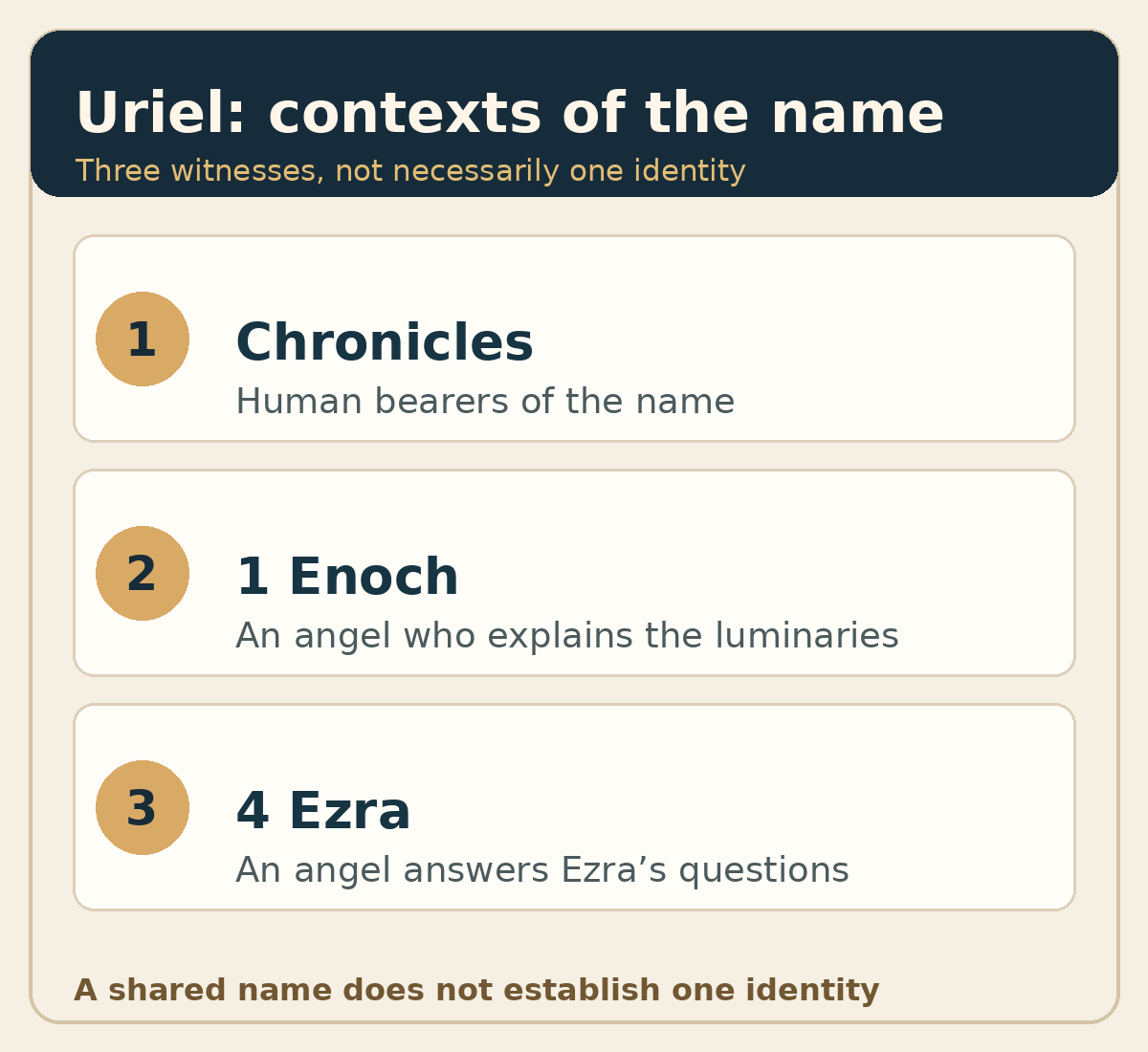
The secure claims concern the named passages: humans in Chronicles, an angel interpreting heavenly scenes and luminaries in Enoch, and an angelic interlocutor in Ezra’s later apocalypse. How particular roles passed among communities remains a separate question requiring additional evidence.
References and notes (16)
- Brown–Driver–Briggs Hebrew lexicon, Uriel (H222). Entry H222 only; online transcription of a historical lexicon, not the whole volume. Return to the text ↑
- Hebrew Bible, 1 Chronicles 6:9 (Hebrew numbering; commonly 6:24 in English), Mechon-Mamre. Hebrew vv. 7–23, especially vv. 9 and 18–23; no manuscript collation. Return to the text ↑
- Hebrew Bible, 1 Chronicles 15:1–14, Hebrew and historical JPS translation, Mechon-Mamre. Verses 1–14, particularly 5, 11–12, read in parallel. Return to the text ↑
- Hebrew Bible, 2 Chronicles 13:1–4, Mechon-Mamre. Verses 1–4, particularly Micaiah daughter of Uriel of Gibeah in v. 2. Return to the text ↑
- John C. Reeves, “Enoch, Books of,” Encyclopaedia Iranica, VIII/5 (1998). Opening paragraphs on composite 1 Enoch, Qumran fragments and Ethiopic preservation; bibliography not independently read. Return to the text ↑
- 1 Enoch 20:1–8, R. H. Charles’s English translation, Wikisource. Chapter 20 in full in Charles’s translation; not checked against Ethiopic, Greek or Aramaic witnesses. Return to the text ↑
- 1 Enoch 19:1–3, R. H. Charles’s English translation, CCEL. Chapter 19:1–3 in English translation only. Return to the text ↑
- 1 Enoch 72:1–8, R. H. Charles’s English translation, CCEL. Opening of chapter 72 only; not the whole 72–82 cycle or manuscript apparatus. Return to the text ↑
- Jonathan Ben-Dov, “Astronomy in the Book of Enoch,” institutional research record. Abstract only, not the chapter; dates, Qumran and models are abstract-level claims. Return to the text ↑
- 1 Enoch 40:1–10, R. H. Charles, Wikisource. Chapter 40:1–10, particularly the four names at vv. 9–10. Return to the text ↑
- 4 Ezra (= 2 Esdras 3–14), 4:1–25, World English Bible Classic, eBible.org. English version 4:1–25; not lost original or Latin manuscripts. Return to the text ↑
- 4 Ezra, 2 Esdras 10:21–35, World English Bible Classic, eBible.org. English passage 10:21–35, including named angel at v. 28. Return to the text ↑
- Peter Hayman, “2 Esdras,” in The Oxford Bible Commentary, ed. Barton and Muddiman (2001), transcription hosted at UECF. Sections A, C, E and F on composition, dating and versions; online transcription, not printed volume or entire chapter. Return to the text ↑
- Numbers Rabbah (Bamidbar Rabbah) 2:10, Hebrew with English translation, Sefaria. Paragraph naming the four angels and explaining Uriel; not the full midrash. Return to the text ↑
- Qurʾan 2:98, Arabic verse, Quran.com. Verse 2:98 only, checked for Gabriel and Michael; not an exhaustive Qurʾanic concordance. Return to the text ↑
- Wikimedia Commons, file page for “St Uriel, St John’s Church, Warminster,” mosaic by James Powell and Sons (1888). Specific file metadata and PD label read; image could not be obtained and is not reproduced here. Return to the text ↑
Suggest a correction · Suggest a source for this record
Cite this record
IL Archive, «Uriel», https://ilarchive.com/en/entities/uriel
Continue reading