Entity · Concept
Theophoric name
A reference page linking a name, group, or concept to the materials that discuss it.
A personal name incorporating a deity’s name, title or divine element; its form and setting must be studied without treating it as a full account of its bearer’s beliefs.
Estimated reading time: 8 min Published Last reviewed:
Share article
Video
The Name No One Owns | The Road of El
More than four thousand years ago a palace burned at Ebla, and one small word waited in its clay: ʾl, El. We follow it through names and inscriptions, from Ebla, Mari and Ugarit to the kings of Samʾal, Karatepe and Saba and the stones of the basalt desert, then set the Torah's names and the Arabic question side by side. Some scenes are AI-generated illustrations.
The YouTube player loads only when you press play. Watch on YouTube
Text
Introduction
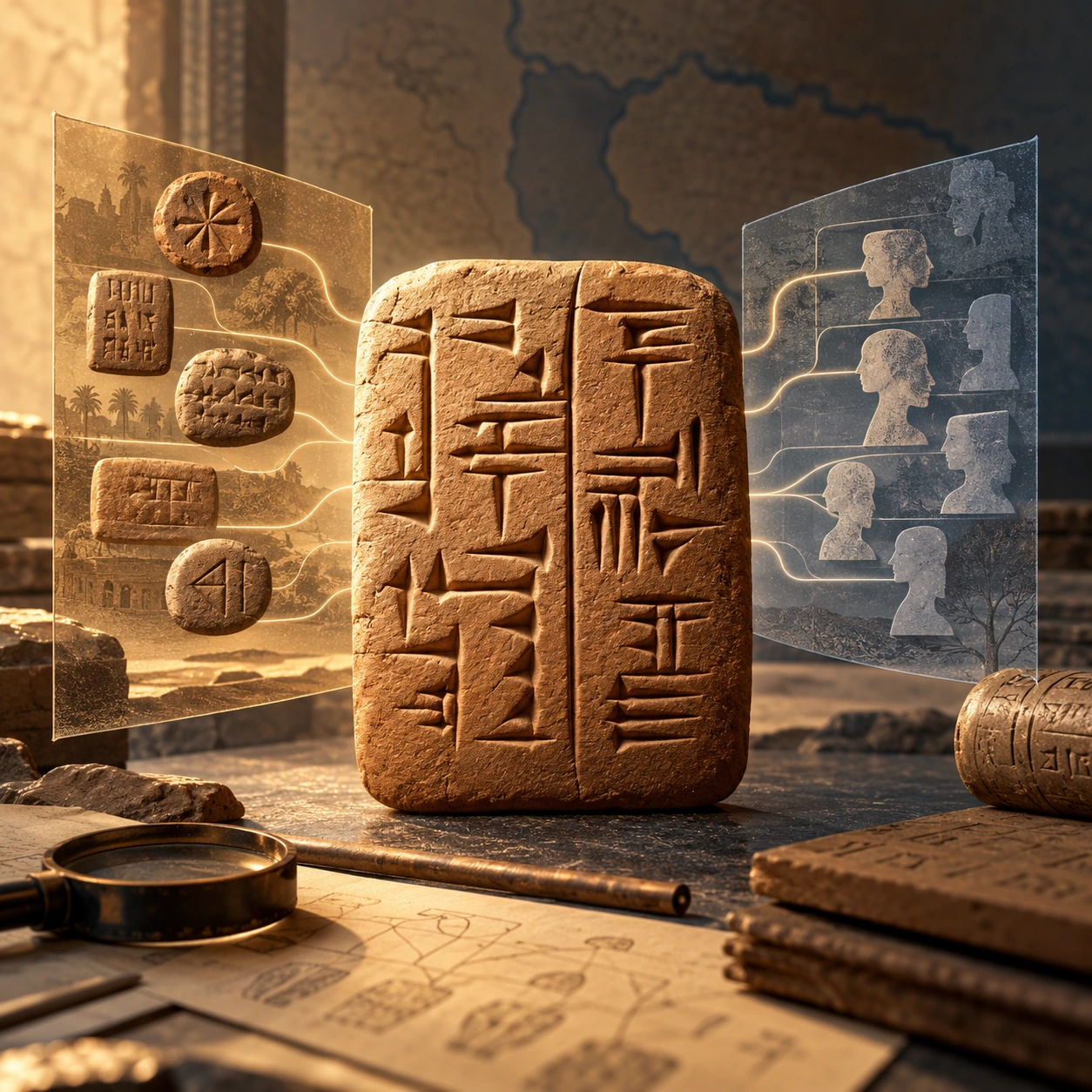
How can a personal name preserve a prayer or a divine name for thousands of years? A theophoric name, literally a “god-bearing” name, offers evidence for everyday religious language that does not survive only in myth. Such names occur on inscriptions and seals, in administrative documents and in literary works; each witness has its own date and history of transmission.
This entry examines how these names are formed and how their meanings are cautiously reconstructed, from MesopotamiaMesopotamiaHistorical region associated with the Tigris and Euphrates: Uruk, Ur, Eridu, cuneiform, Sumer, Akkad, Babylon and Assyria, their languages and cults, and the limits of archaeological evidence.Glossary · Click to read the explanation and HebrewHebrewA Northwest Semitic language of the Canaanite group, encompassing Iron Age epigraphy, Biblical, Rabbinic, medieval and Modern Hebrew; its scripts and pronunciations changed over time.Glossary · Click to read the explanation to Egypt. It distinguishes what a name actually says from what historians can reasonably infer about the people who used it. A personal name is linguistic and historical evidence, not a complete account of its bearer's beliefs.
What makes a name theophoric?
OnomasticsOnomasticsStudy of proper names, especially personal and place names, through their forms, languages, histories and social uses; a name alone does not establish its bearer’s identity or religion.Glossary · Click to read the explanation studies personal names within their languages, periods and social settings. A name is theophoric when it contains the name of a deity, a divine title or another element referring to a deity. The divine element may precede or follow a verb meaning “give” or “hear”, an attribute, a question or a short invocation. Not every name with a religious association contains a divine name; its structure must be established in its original language rather than inferred from a superficial resemblance.
CuneiformCuneiformWriting with wedge-shaped signs, developed from Mesopotamian recording traditions and used for several languages from the third millennium BCE.Glossary · Click to read the explanation name lists are particularly rich. Ignace J. GelbIgnace J. GelbUniversity of Chicago Assyriologist (1907–1985), studying ancient languages, writing and personal names, including Amorite names.Glossary · Click to read the explanation collected thousands of AmoriteAmorite languageA West Semitic language studied especially through personal names, much of whose evidence comes from the Old Babylonian period (ca. 2000–1600 BCE).Glossary · Click to read the explanation names found in Sumerian and AkkadianAkkadianAn ancient East Semitic language written in cuneiform from the third millennium BCE; its varieties include Babylonian and Assyrian, and it served in international diplomacy.Glossary · Click to read the explanation records, chiefly from the Old Babylonian period, but clearly defined the corpus and excluded evidence from EblaEblaAncient city at Tell Mardikh, southwest of Aleppo, Syria. Its Palace G archives illuminate third-millennium BCE administration, language, and cult; the site has later occupation phases.Glossary · Click to read the explanation. The publisher's description establishes the value of administrative archives for name studies; it does not, by itself, constitute an examination of every entry in Gelb's book. [1]
A divine element is not necessarily a full divine name
In Hebrew, ElSemitic ilAn ancient Semitic word meaning “god,” with cognates across several languages. It may function as a common noun or a proper name according to context; it is not always Ugaritic El.Glossary · Click to read the explanation (ʾēl) occurs at either end of a personal name. Depending on linguistic and historical context it may mean “god” or refer to the deity El. A clear example is MichaelMichael / MīkālA name meaning “Who is like God?”, borne by humans and an angel. The angel protects Daniel’s people, is called archangel in Jude and fights the dragon in Revelation. The Qurʾan names Mīkāl without assigning a task; later traditions develop different roles.Glossary · Click to read the explanation, from mî kā-ʾēl, conventionally understood as “Who is like El/God?” This is a rhetorical question, not a statement that its bearer was considered divine. The proposed etymology of a name should also be distinguished from a later religious account of the figure who bears it. [2]
An originally longer divine name can be reduced to a conventional element, and its pronunciation may shift through transcription and translation. Modern English or French spellings therefore cannot replace Hebrew letters or cuneiform signs when those forms are crucial to an argument.
The Mari statue: one divine element, another recipient
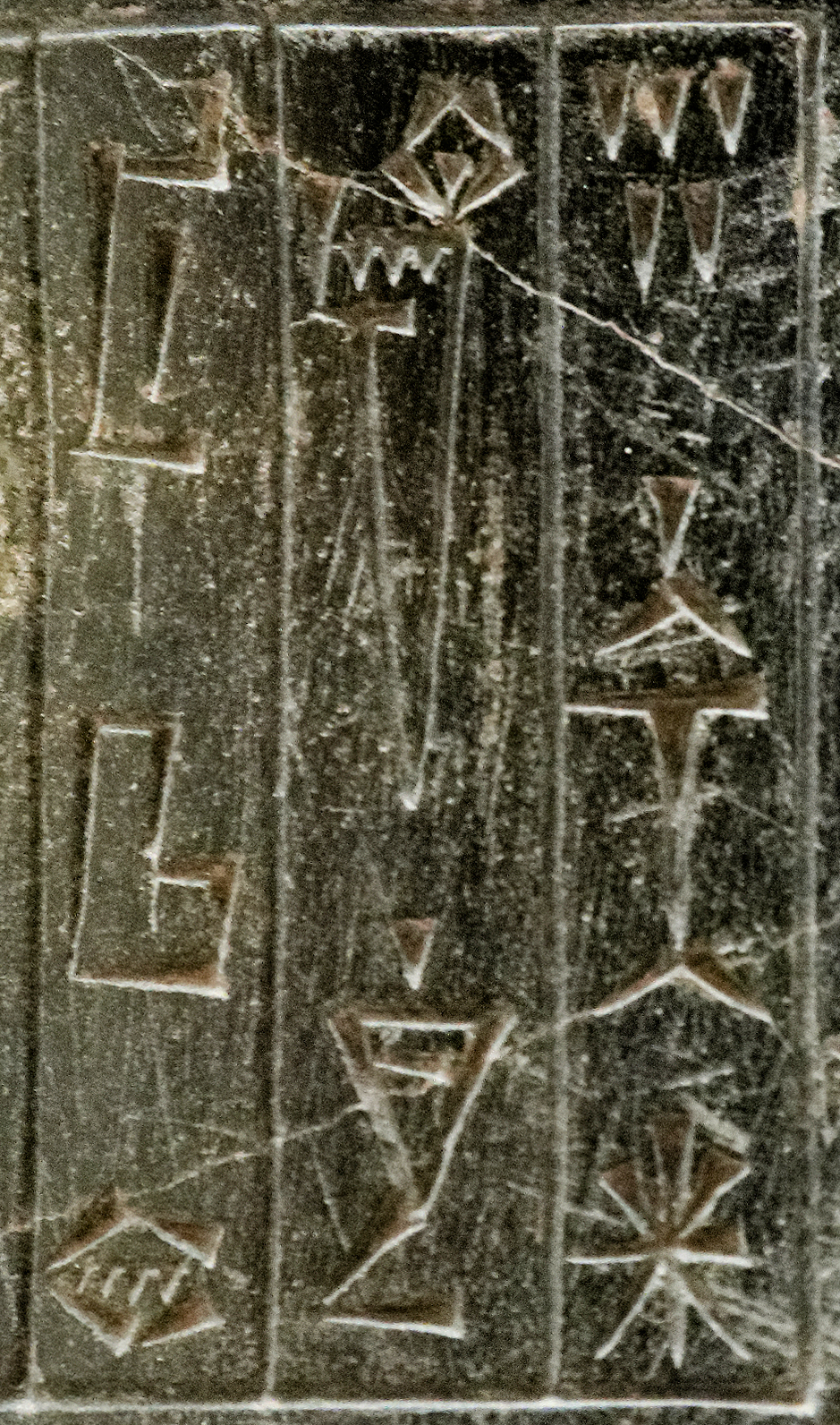
A statue of Iddin-Ilum (also Iddin-El), a governor of MariMariMari at Tell Hariri on the Syrian Euphrates was founded around 2900 BCE and rebuilt through three major urban phases. Its palace and cuneiform archives illuminate trade, royal government and religious practice, especially in the eighteenth century BCE.Glossary · Click to read the explanation, dated approximately 2100–2000 BCE, bears an AkkadianAkkadianAn ancient East Semitic language written in cuneiform from the third millennium BCE; its varieties include Babylonian and Assyrian, and it served in international diplomacy.Glossary · Click to read the explanation inscription identifying him and recording the dedication of the statue to InannaInanna / IshtarA prominent Mesopotamian goddess whose Sumerian name Inanna became associated with Akkadian Ishtar across diverse traditions. She was associated with desire, war, royal authority and Venus, while local forms and genealogies varied among texts.Glossary · Click to read the explanation/Ishtar. The object is held by the Louvre as AO 19486; the inscription runs across the statue's garment. The ilum/El element of the personal name can be understood in connection with “god”, in a formation often explained approximately as “the god has given”. Yet the conventional reading and translation of a name should not be mistaken for a fresh critical edition of its cuneiform spelling. [3]
This example illustrates why the setting matters. The deity evoked by a person's name need not be the figure represented by a statue or the recipient of the dedication. Iddin-Ilum is human, while the dedication invokes Inanna. A name ending in “El” does not turn an image of its human bearer into a depiction of El.
Dagan and the Mesopotamian evidence
Mesopotamian names incorporate individual divine names as well as the common nounCommon nounA noun referring to a member of a class, such as “city” or “god”, unlike a proper name designating a particular entity. Semitic il/El may fulfill either function in context.Glossary · Click to read the explanation iluAkkadian iluAn Akkadian common noun meaning “god”; older case forms include ilum, ilam and ilim. It occurs in personal names but does not by itself identify Ugaritic El.Glossary · Click to read the explanation, “god”. The Oracc account of DaganDaganA god worshipped in Syria and Mesopotamia, especially at Tuttul and Terqa on the Euphrates, and associated with royal authority. His name appears as Dagon in the Hebrew Bible; no ancient image of him is securely identified.Glossary · Click to read the explanation cites Pu-Dagan on the obelisk of Manishtushu from the Akkadian period and discusses the spread of Dagan elements through the Middle Euphrates and Ur III records. Such evidence shows the circulation of a divine name in particular social and administrative settings; it does not directly map the private convictions of each individual. [4]
Even the grammar of a name may be uncertain. In a note on a cuneiform personal name, Wolfgang Heimpel discusses alternative readings that yield either a request for a god to judge or a reference to the judgment of gods. Where the philology remains disputed, a single translation should not be passed off as final. [5]
The short religious statement in Hebrew names
A Hebrew theophoric name can combine a deity element with a verb or a petition. Nethanel evokes the idea that “El has given”; Eliezer refers to divine help. Depending on its construction, a name may recall a blessing, express a wish or pose a rhetorical question. A short English gloss does not always settle its precise verbal tense or grammatical alternatives. Heriberto Haber surveys Hebrew names containing El and shortened forms related to the tetragrammatonYahwehThe proper name of Israel’s deity, written יהוה (YHWH), the Tetragrammaton. Its exact ancient pronunciation is not directly preserved; texts and inscriptions witness its history.Glossary · Click to read the explanation, including Yeho- and -yahu. [6]
A narrative example is IshmaelIshmaelSon of Hagar and Abraham in Genesis; later Muslim interpretation identified him with the unnamed son in Qur'an 37's sacrifice scene.Glossary · Click to read the explanation (Yišmāʿ-ʾēl), approximately “El hears” or “May El hear”. Genesis 16:11 links his naming to a cry that was heard. That is the name's explanatory function within the narrative; it is not independent evidence for the historical birth date of its character or the first spoken form of the name. [7]
Daniel and the angelic names: form is not identity
Daniel 1:6–7 names DanielDaniel in the biblical bookDaniel is the Jewish sage and visionary in the biblical book bearing his name.Glossary · Click to read the explanation, Hananiah, Mishael and Azariah, and then recounts the assignment of new names to them at the Babylonian court. The naming episode within the story presents an encounter of authority and identity; it does not independently date the book's final composition. Daniel (“El is my judge”) and Mishael (“Who is like El?”) illustrate theophoric constructions. [8]
Names transmitted in Jewish, Christian and Islamic traditions include Gabriel/JibrilGabriel / JibrīlA Semitic theophoric name for an interpreter of visions in Daniel and a messenger in Luke; named Jibrīl in the Qurʾan. His functions depend on each textual context.Glossary · Click to read the explanation, RaphaelRaphael / RephaelRaphael means “God has healed,” a name borne by a human in Chronicles and an angel in Tobit and 1 Enoch. In Tobit he accompanies the travelling son, helps heal the father and presents prayer before God; in Enoch he executes judgment and explains the places of the dead. Similarity of names does not settle his relationship to Israfil.Glossary · Click to read the explanation, UrielUrielHebrew name containing “El,” borne by humans in Chronicles and an angel in 1 Enoch and 4 Ezra. Roles vary by text; no Ugaritic divine origin is established.Glossary · Click to read the explanation and Michael. Gabriel is often explained in connection with strength and El; Raphael as “El has healed”; and Uriel as “El is my light”. These are approximate linguistic explanations, shaped by Hebrew forms and the subsequent history of transmission. A name's root alone does not establish the status, powers or theological identity attributed to an angel by a particular tradition.
Yahwistic elements at the beginning and end
Many Hebrew names contain shortened elements associated with YahwehYahwehThe proper name of Israel’s deity, written יהוה (YHWH), the Tetragrammaton. Its exact ancient pronunciation is not directly preserved; texts and inscriptions witness its history.Glossary · Click to read the explanation: Yəhô-/Yô- initially and -yāhû/-yāh finally, as in varying forms of Yehonathan, Isaiah and Jeremiah. They do not reproduce the full pronunciation of the four-letter divine name. Their distribution varies with period, text type and scribal practice.
Aaron D. Hornkohl discusses the changing prominence of -yahu and -yah names in the biblical corpus and proposes a history of their distribution. For this review, the publisher's chapter description and summary were read, not the full twelve-page chapter. Its chronological proposal is accordingly presented as a scholarly interpretation, not as a mechanical rule for dating any given text. [9]
Seals and statistics: what does a sample represent?
Beyond literary characters, seals, clay impressions and ostraca preserve names from everyday administration. Mitka Golub assembled 625 names from 40 sites in Judah for an Iron Age II study, classifying the divine elements and their position within the name. Its abstract reports the prominence of Yahwistic elements and a rise in attestations as the written record becomes more abundant. These figures describe a defined archaeological sample, not a census of the population or its religious commitments. [10]
In a separate study of inscribed seals, Golub also investigates whether seals bearing Yahwistic and other names differ in their use of imagery. An observed statistical relationship cannot make every individual seal proof that its owner followed a ban on images: traditions of manufacture and administration matter too. Only this article's abstract, not its complete data tables, was accessed here. [11]
An Egyptian example of a changed royal name
The change from TutankhatenTutankhamunLate Eighteenth-Dynasty Egyptian king, originally Tutankhaten, later Tutankhamun as official patronage of Amun resumed. Famous for tomb KV62; aspects of his parentage and death are debated.Glossary · Click to read the explanation to TutankhamunTutankhamunLate Eighteenth-Dynasty Egyptian king, originally Tutankhaten, later Tutankhamun as official patronage of Amun resumed. Famous for tomb KV62; aspects of his parentage and death are debated.Glossary · Click to read the explanation, introducing the name of AmunAmunAmun is an Egyptian deity centered on Thebes and Karnak, the “hidden one,” also worshipped as Amun-Re. His names and images were targeted under Akhenaten before royal support resumed.Glossary · Click to read the explanation in place of Aten, is a well-known example from Egypt's Eighteenth Dynasty of a divine element changing with an officially proclaimed religious and political transition. The Egyptian Museum's account documents that change of name, without giving direct access to the child king's private beliefs or the details of who decided each measure at court. [12]
Names across families, languages and centuries
A theophoric name may survive long after a community changes its language or religious practice. A modern pronunciation cannot by itself reconstruct the use of a name in the second millennium BCE. An onomastic study of Akkadian names in AramaicAramaicNorthwest Semitic language varieties documented since the early first millennium BCE, including Old and Imperial Aramaic, Syriac, Jewish dialects, and living Neo-Aramaic forms.Glossary · Click to read the explanation documents from ancient Egypt distinguishes theophoric, shortened and non-religious names, and explores names transmitted across families of different linguistic backgrounds. Only the study's abstract was available for this review. [13]
How to read a name—and what it can tell us
A useful analysis asks: What is the earliest datable witness? In which language and script is the name written? Is the apparent divine element a particular deity's name or a generic word? What grammatical role does the rest of the expression play? The investigator then compares the inscription, the literary narrative and later lexicographical interpretation, using dated sets of evidence rather than isolated lists.
Theophoric names document vocabularies of hope, protection, kinship and authority, as well as the movement of words between societies. They may establish that a divine name circulated in a particular milieu even where little narrative literature survives. By themselves, however, they cannot tell us everything about a bearer's affiliations or show that the named deity was the only god that person worshipped. Iddin-Ilum's statue—with a divine element in its human owner's name and a dedication to Inanna—makes that distinction tangible.
References and notes (13)
- Ignace J. Gelb, Computer-Aided Analysis of Amorite, Assyriological Studies 21 (1980), publisher’s description. Publisher’s corpus description and contents: 6,662 names, chiefly Old Babylonian; Ebla excluded. The full volume was not read. Return to the text ↑
- Blue Letter Bible, Greek lexical entry G3413 “Michael”, with Hebrew cross-reference H4317. Entry meaning “Who is like God?” and Hebrew cross-reference; no claim to have read the whole lexicon. Return to the text ↑
- Musée du Louvre, catalogue entry for the Iddin-Ilum statue from Mari, AO 19486 (M. 1349). Object entry: date ca. 2100–2000 BCE, Akkadian inscription, ruler’s name and dedication to Inanna. Not an independent cuneiform edition. Return to the text ↑
- Oracc, Ancient Mesopotamian Gods and Goddesses, “Dagan (god)”. Attestation/history section discussing Pu-Dagan, Akkadian and Ur III records, and Middle Euphrates names; secondary works cited there not read in full. Return to the text ↑
- Wolfgang Heimpel, “The Akkadian Personal Name DI-NI-NI”, Cuneiform Digital Library Notes 2003:1. Short philological note on alternative analyses Dīn-Ilī/Dīnni-Ilī versus Dīn-ilē; no claim of a settled reading. Return to the text ↑
- Heriberto Haber, “Theophoric Names in the Bible”, Jewish Bible Quarterly 29/1 (2001). Online article sections on El, Yeho-/Yo-, -yahu/-yah and verbs of giving and favour; references cited by the author not independently checked. Return to the text ↑
- Blue Letter Bible, BDB/Strong H3458, entry “Yišmāʿēl”. Name formation from “hear” + El and the cited Genesis 16:11, 16:15 passages; not every concordance occurrence was examined. Return to the text ↑
- Daniel 1:6–7, Hebrew text and translation at Sefaria. Verses 6–7 with the local 1:6–9 context of renaming, not a study of the entire book. Return to the text ↑
- Aaron D. Hornkohl, “The Onomasticon with and without yahu Names”, in Diachronic Diversity in Classical Biblical Hebrew (2024), pp. 27–38. Publisher’s chapter abstract/description only, not the full text of pp. 27–38. Return to the text ↑
- Mitka R. Golub, “Personal Names in Judah in the Iron Age II”, Journal of Semitic Studies 62/1 (2017), pp. 19–58. Published abstract reporting 625 names from 40 Judean sites; full article and tables not consulted. Return to the text ↑
- Mitka Golub, “Aniconism and Theophoric Names in Inscribed Seals from Judah, Israel and Neighbouring Kingdoms”, Tel Aviv 45/2 (2018). Official abstract only on name elements and seal iconography; the complete quantitative analysis was not read. Return to the text ↑
- Egyptian Museum, “New Kingdom Rulers: Tutankhamun”. Museum summary paragraph on Tutankhaten becoming Tutankhamun; not an examination of court records. Return to the text ↑
- Bezalel Porten, Ran Zadok and Laurie Pearce, “Akkadian Names in Aramaic Documents from Ancient Egypt”, BASOR 375 (2016). Publisher abstract only, concerning theophoric, shortened and non-religious names in Aramaic records; full article not read. Return to the text ↑
Suggest a correction · Suggest a source for this record
Cite this record
IL Archive, «Theophoric name», https://ilarchive.com/en/entities/theophoric-name
Continue reading