Entity · Deity
Amun
A reference page linking a name, group, or concept to the materials that discuss it.
- Names
- Amun-Re · ỉmn
- Region
- Ancient Egypt (Thebes/Karnak); later Nubia and Mediterranean reception
Amun, “the hidden one,” an Egyptian deity linked to Thebes and Karnak, rose to king of the gods in the New Kingdom; the entry examines evidence of his erasure under Akhenaten and of renewed support under Tutankhamun.
Estimated reading time: 8 min Published Last reviewed:
Share article
Text
Introduction
How did Amun, a deity associated with the Egyptian city of Thebes, become one of the kingdom's leading gods, why were his name and images attacked under AkhenatenAkhenatenEgyptian eighteenth-dynasty king, formerly Amenhotep IV, who reorganized royal religion around Aten and founded Akhetaten.Glossary · Click to read the explanation, and how did his cult recover? This entry follows Amun's name, images, temple practice and political role, setting individual artifacts and inscriptions alongside modern historical interpretations. Each object belongs to a particular date and context: a later statuette cannot by itself illustrate what happened in the AmarnaAmarna / AkhetatenAmarna is the archaeological site of Akhetaten, Akhenaten’s fourteenth-century BCE capital in Middle Egypt, preserving royal boundary stelae, temples, houses and cemeteries.Glossary · Click to read the explanation period.
Name and historical importance
Amun (also Amon; the Egyptian name is conventionally transcribed ỉmn) is an Egyptian deity whose name evokes the “hidden” or “concealed” one. His worship grew in prominence at Thebes in EgyptThebes, EgyptThebes, Egyptian Waset, was an ancient Egyptian city in the area of modern Luxor, with monuments on both banks of the Nile.Glossary · Click to read the explanation, in the region of present-day Luxor, as Theban dynasties rose to power in the Middle Kingdom. From the New Kingdom, beginning around the middle of the second millennium BCE, Amun became one of the most important gods in royal and temple discourse, especially as a protector of kingship. This prominence did not mean that Egypt's many local deities disappeared. [4][15]
Amun also acquired a cosmic, creative role and was combined with the sun god ReRe, Egyptian sun godRe is the Egyptian sun god, associated with creation, life and renewal of cosmic orderGlossary · Click to read the explanation as “Amun-Re.” Egyptologists call such a combination syncretism: divine aspects are brought together in a composite form. It does not imply that all gods were identical or that Re ceased to have his own identity. This helps explain titles such as “king of the gods” within Egypt's many-deity religious traditions. [5]
How was Amun depicted?
Amun commonly appears as a human figure wearing a divine beard and a tall crown with two long feathers; a ram or ram-headed figure is another of his forms. Such attributes help identify images, although a crown alone is not always sufficient without an inscription or context. A small gold statuette at The Metropolitan Museum of Art (26.7.1412, Dynasty 22) has lost its original tall plumes. Its emblems include the sign of life and a curved weapon associated with the god's power and the king's victory. Its proposed origin at Karnak is recorded as possible, not certain. [4]
The Met also records later epithets describing Amun as a god who heard and helped people. These suggest a dimension of his worship during the first millennium BCE; they should not be projected unchanged onto every earlier period. [7]
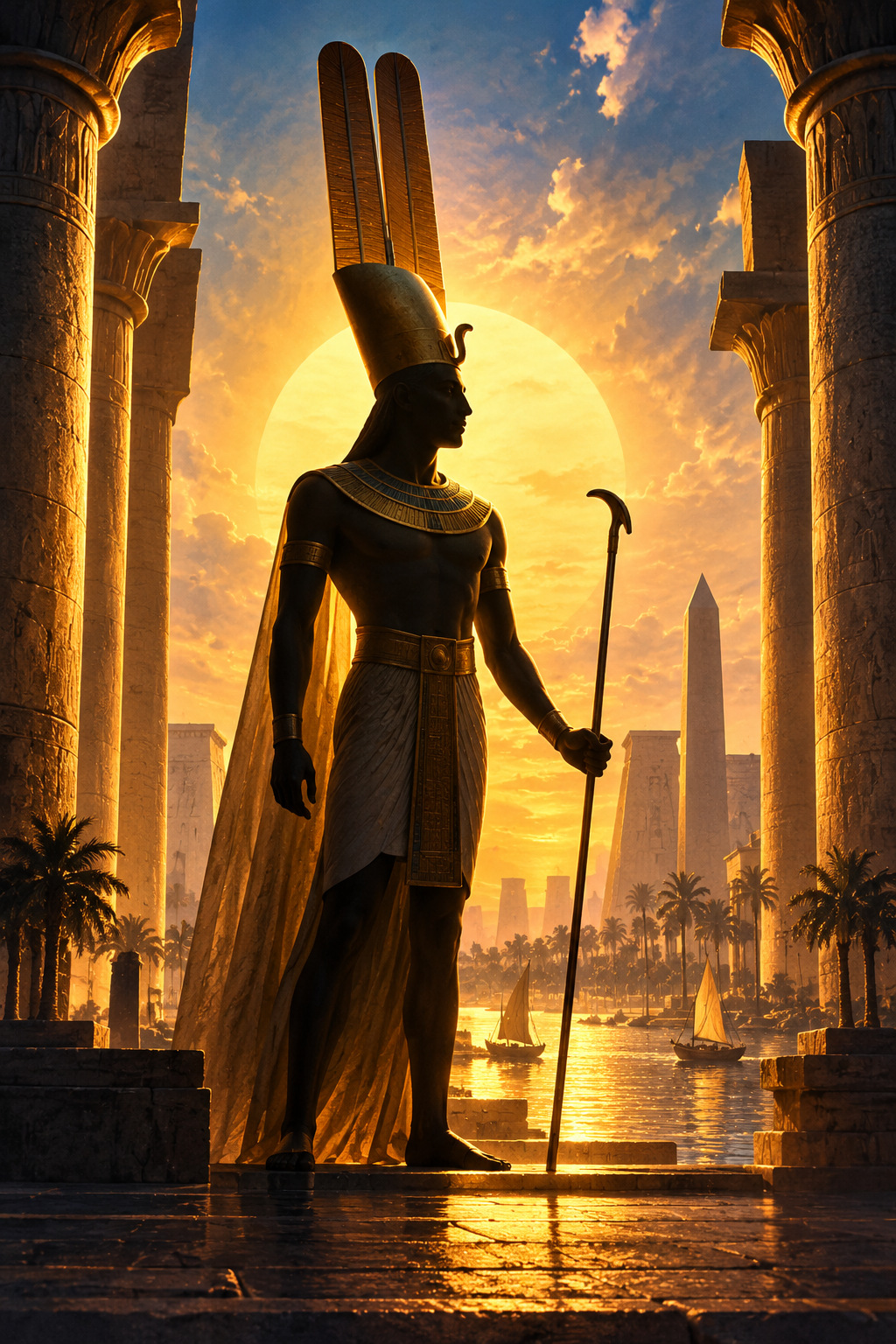
The cover of this entry, by contrast, is a newly AI-generated imaginative illustration, neither an ancient artifact nor a verified reconstruction. Museums preserve actual ancient depictions identified by accession numbers, materials and chronological assessments. One is The Met's granodiorite head of Amun (07.228.34), dated by the museum to TutankhamunTutankhamunLate Eighteenth-Dynasty Egyptian king, originally Tutankhaten, later Tutankhamun as official patronage of Amun resumed. Famous for tomb KV62; aspects of his parentage and death are debated.Glossary · Click to read the explanation's reign and associated with the restoration of the god's monuments at Karnak. This ancient head, the modern illustration and the royal head discussed below must not be confused. [11]
Thebes, Karnak and royal authority
The Karnak complex on the east side of ancient Thebes was Amun-Re's foremost sanctuary, within a larger sacred landscape that included places for other deities. In the local Theban divine family, Mut was Amun's consort and the moon god Khonsu their son. This was a religious grouping, not a historical human family. Courts, pylons, shrines and processional roads accumulated over numerous reigns: the complex cannot be attributed wholesale to one king. [6][8]
Temples controlled farmland, storage and workshops and drew resources from wider systems of estates and taxation. Amun's cult therefore belonged to economic and political institutions as well as religious ones, although the influence of its priests varied over time. Reliefs show kings bringing offerings and receiving divine approval, and Amun's presentation of a victory weapon could express royal legitimacy. These are ritualRitualAn organised or distinguished practice meaningful to a community; it may leave traces, but its form alone does not reveal an associated doctrine.Glossary · Click to read the explanation and ideological representations, not direct proof that each narrated campaign happened precisely as shown. [6][4]
Daily service and the Opet festival
The cult was more than the production of statues. Priests attended the divine image in its shrine, offering incense, food, clothing and other gifts. University College London summarizes Berlin Papyrus 3055, dated to the early Twenty-second Dynasty, which preserves formulas for unsealing the shrine, offering incense, singing hymns, clothing the statue and purifying the setting. These details come from a modern description of a hieratic ritual manuscript, not from our own reading or translation of its Egyptian text. Nor do they establish that every temple performed identical rituals in every century. [9]
During the annual Opet festival, sacred barks bearing the images of Amun-Re, Mut and Khonsu traveled between Karnak and Luxor Temple. Their journey made the city itself part of ceremonial life. In the abstract of his specialist study, John Darnell relates the festival to the renewal of royal power, while the Digital Karnak project's account documents the route and participating deities. The symbolic interpretation should not be mistaken for an eyewitness record of every performance. [8][16]
Akhenaten: what was erased, and what survived?
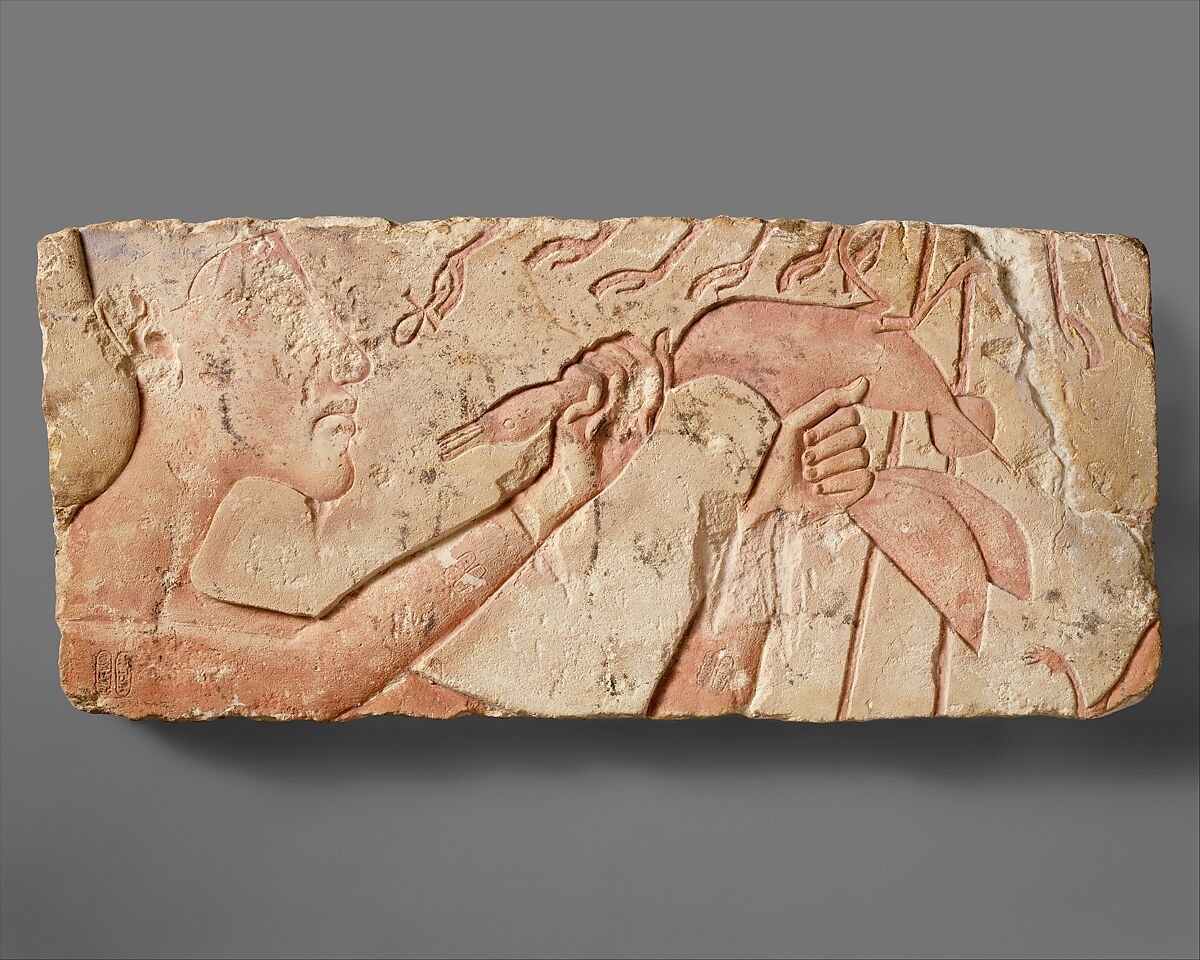
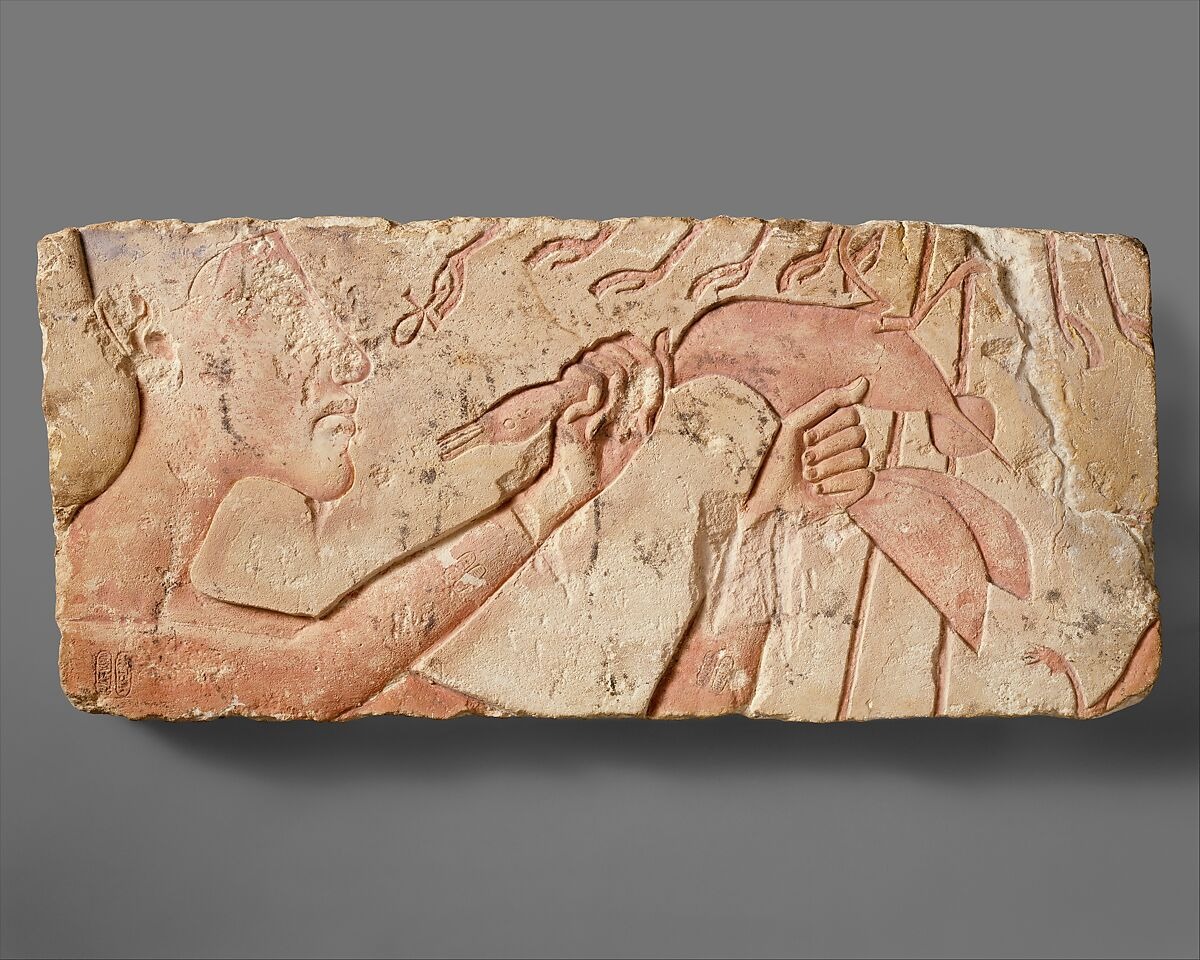
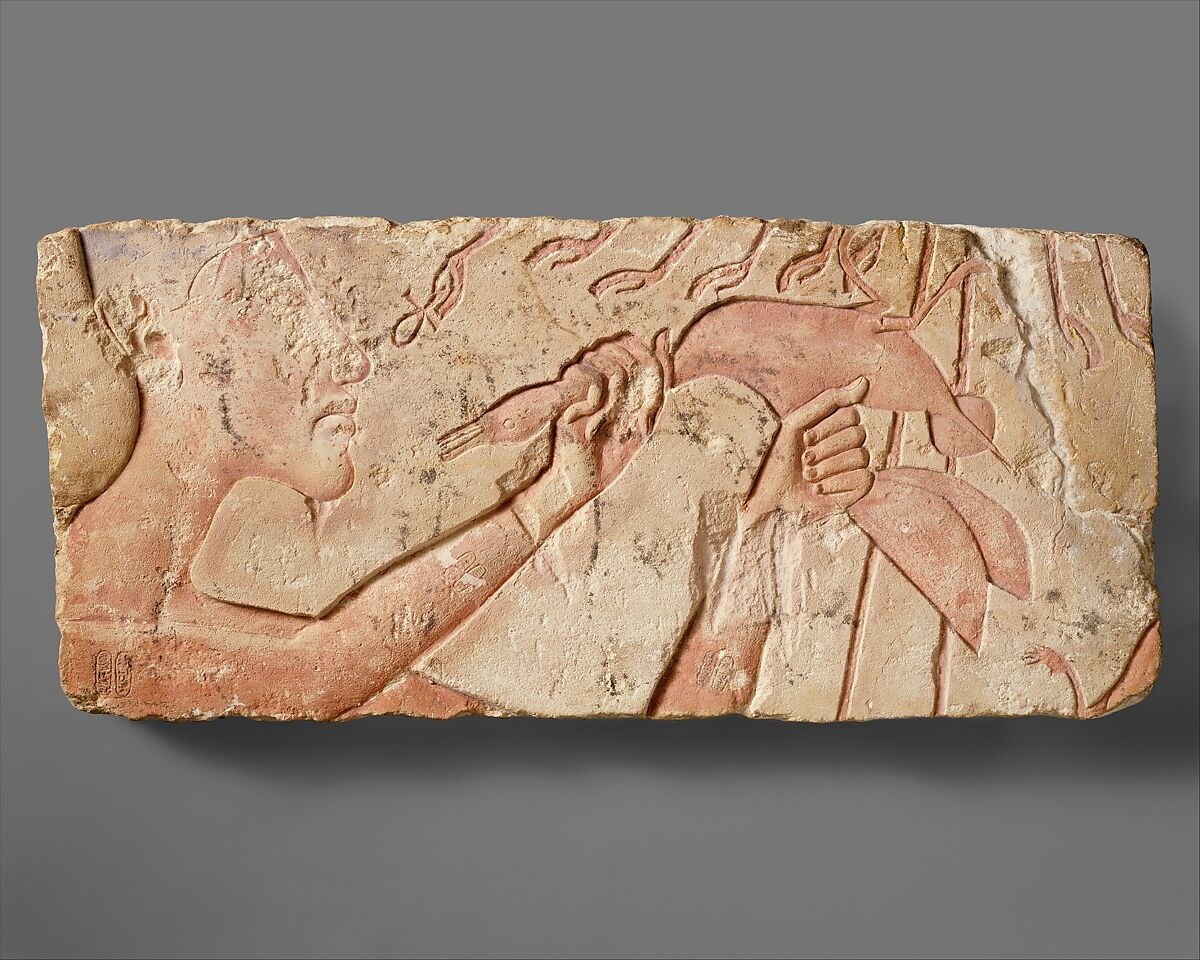
In Dynasty 18, AkhenatenAkhenatenEgyptian eighteenth-dynasty king, formerly Amenhotep IV, who reorganized royal religion around Aten and founded Akhetaten.Glossary · Click to read the explanation, earlier called Amenhotep IV, redirected the court's official religious emphasis toward AtenAten: The Solar Disk and Akhenaten’s CultAten is the solar disk and the divine power associated with its light in ancient Egypt. Akhenaten made Aten the exclusive focus of his official cult; Amarna reliefs show rays ending in hands, while household finds reveal other religious practices.Glossary · Click to read the explanation, the sun disk, and founded Akhetaten, now AmarnaAmarna / AkhetatenAmarna is the archaeological site of Akhetaten, Akhenaten’s fourteenth-century BCE capital in Middle Egypt, preserving royal boundary stelae, temples, houses and cemeteries.Glossary · Click to read the explanation. Inscriptions and images document this exceptional royal focus, but they do not tell us that every person throughout Egypt changed belief. The date of an object, the date of Akhenaten's reign and the moment at which an object was defaced must also be distinguished. [14]
In a lecture abstract describing her dissertation research, Egyptologist Laura TaronasLaura TaronasEgyptologist studying the erasure of divine names and images in the Amarna period.Glossary · Click to read the explanation reports a catalogue of movable objects from 37 sites across Egypt, Nubia and SinaiSinai: peninsula and biblical mountainSinai is a peninsula in eastern Egypt; in the Torah the name also denotes the mountain of revelation to MosesGlossary · Click to read the explanation, with additional objects of uncertain provenance. She identified 22 types of potentially erased terms, and found Amun and his syncretized forms overwhelmingly prominent among the targets in that sample; references to multiple deities were affected less often. On the evidence of name changes she proposes that the campaign probably began between regnal years 5 and 9. This is a sample-bound research inference, not a definitive date for all acts of erasure or proof that the worship of every other god ceased. [1]
There is also a concrete object-based example. University College London's record of block statue UC 14351, made for a man named Djehuty in the early Eighteenth Dynasty, notes that Amun's name was erased while those of Hathor and OsirisOsirisOsiris was an ancient Egyptian deity associated with the dead, life after death, renewal, and kingship. His roles appear in changing funerary texts, rituals, and judgment scenes, notably the weighing of the heart.Glossary · Click to read the explanation remained in the relevant lines. It is evidence for selective damage on this particular object. Extending its pattern to every inscription, or to every inhabitant's beliefs, requires additional evidence. We consulted the institution's object description, not the original hieroglyphic text on the sculpture. [10]
The restoration under Tutankhamun
Following the Amarna era, TutankhamunTutankhamunLate Eighteenth-Dynasty Egyptian king, originally Tutankhaten, later Tutankhamun as official patronage of Amun resumed. Famous for tomb KV62; aspects of his parentage and death are debated.Glossary · Click to read the explanation again supported traditional temples and cults. His shift from the earlier name Tutankhaten to Tutankhamun made the god's renewed importance publicly visible. The Restoration Stela, a royal inscription from Karnak now in the Egyptian Museum in Cairo, represents the king making offerings to Amun-Re and Mut, and claims that temples had fallen into ruin before he repaired them. This is a deliberately constructed royal statement of legitimacy, not a numerical measure of actual destruction. Horemheb subsequently appropriated the stela, altering some but not all royal cartouches. This account rests on Digital Karnak's catalogue description; we did not collate the full ancient inscription. [3]
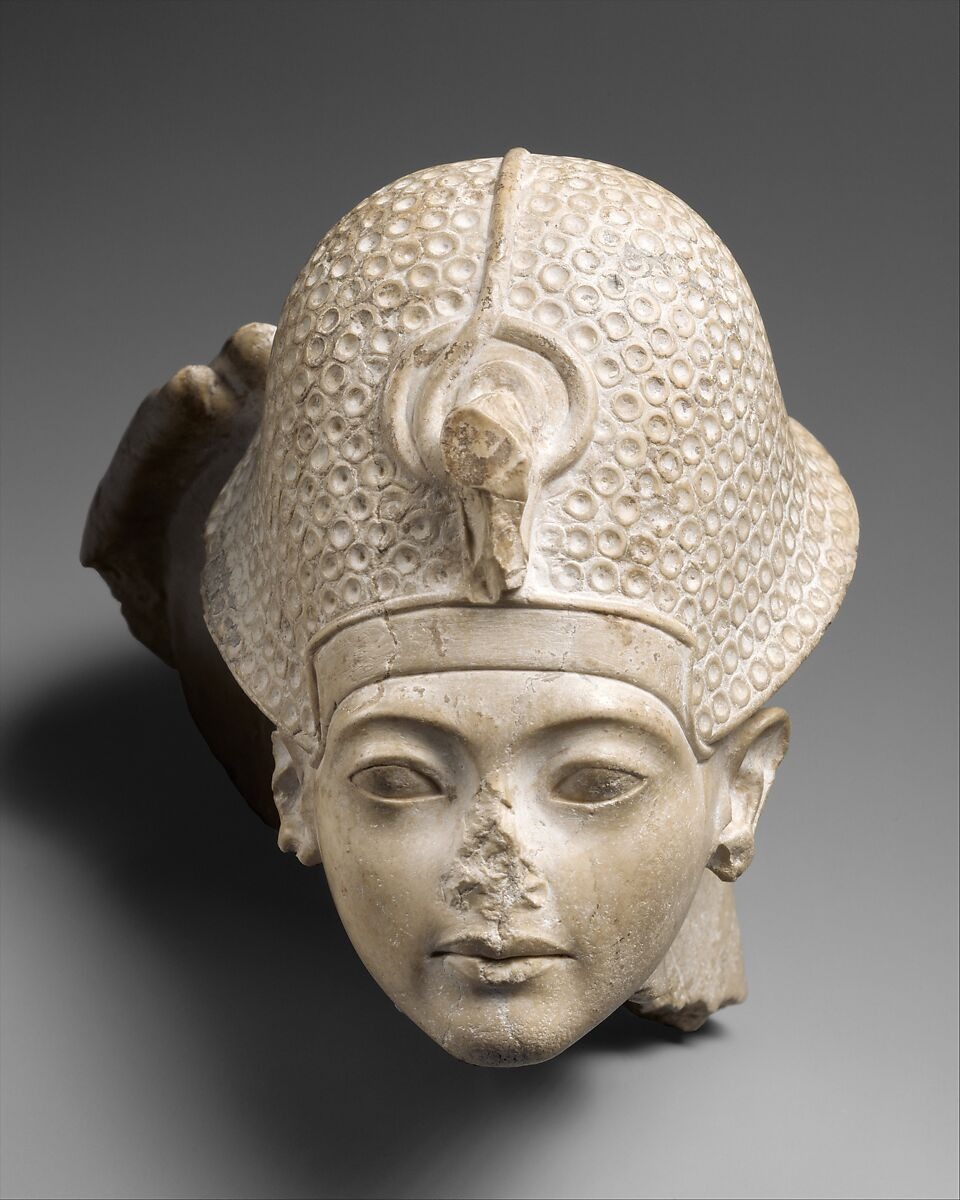
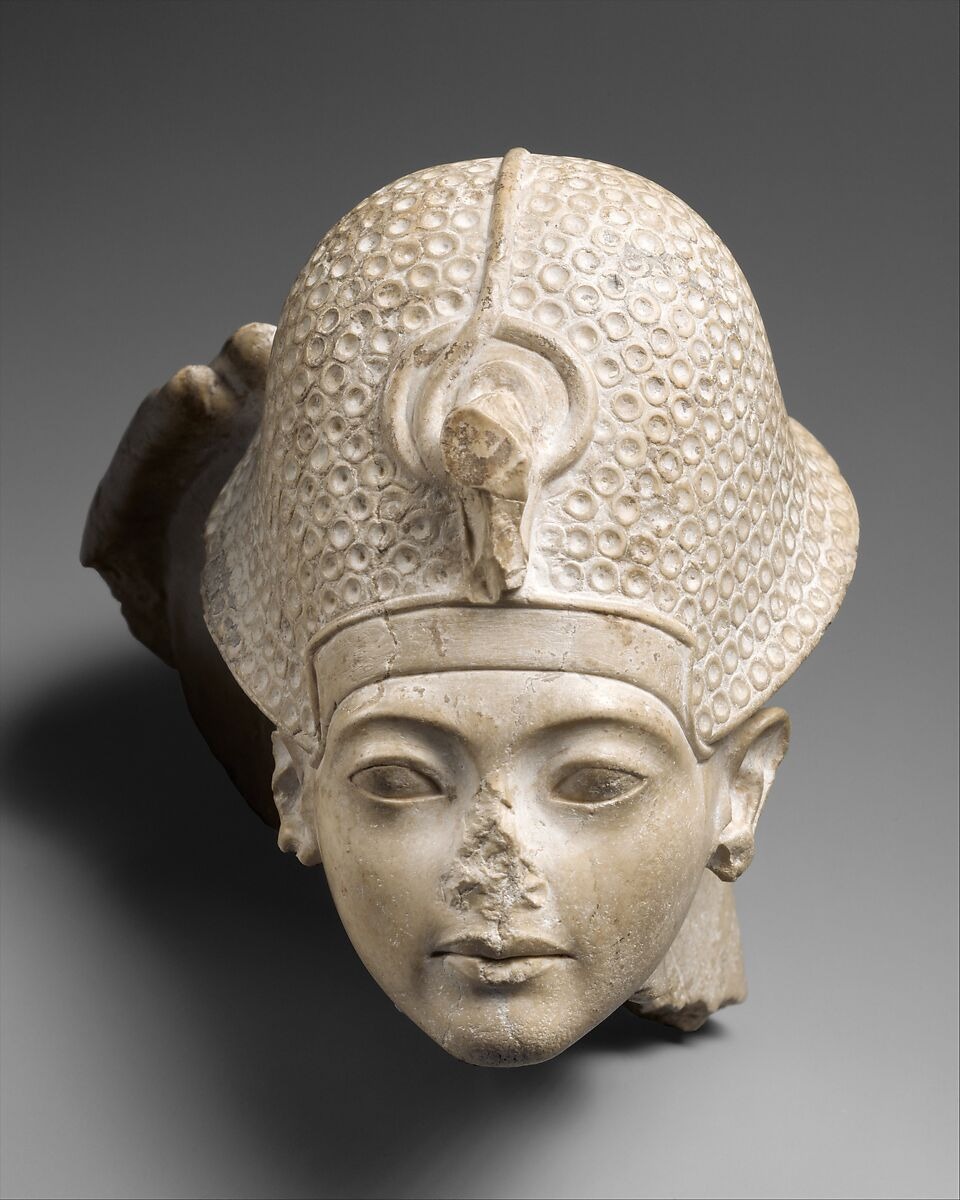
The surviving archaeological photograph in this entry shows Tutankhamun's head, not Amun's face. Part of Amun's right hand touches the king's crown. The fragment, made of indurated limestone, is The Met 50.6 and belonged to a larger statuary group. The museum reports a match with remains of a seated god at Karnak, where an epithet identifies him as Amun. This considerably strengthens the identification and context of the original group, without supplying its missing portions. Nor is this object the same as The Met's separate granodiorite head of Amun, 07.228.34. [2][11]
Beyond Egypt: Kush and the Mediterranean
Amun's history did not end with the Amarna conflict. In the kingdom of Kush, in what is now northern Sudan, a form of Amun with a ram's head held exceptional religious importance. A major sanctuary stood by Jebel Barkal near Napata, while Napatan royal ornaments attest to the presence of Amun's imagery. These objects document a regional tradition shaped by exchange with Egypt, not a simple or unchanged duplication of an Egyptian cult. [12]
In later Greek-Egyptian settings “Zeus-Ammon” brought the Greek ZeusZeusZeus is the sky god and leading deity in many Greek traditions. In the Iliad he presides over divine gatherings while others can still speak and object.Glossary · Click to read the explanation into association with Egyptian Amun. The oracle at Siwa Oasis became famous, and Greek accounts relate a visit by Alexander and a proclamation of divine sonship. Those accounts are literary reports with uncertain details, not a preserved transcript of the oracle's words. Likewise a later bust tentatively identified with Alexander cannot be treated as a portrait taken during his lifetime. [13]
What can the evidence establish?
Three levels should be kept apart. Physical objects and inscriptions demonstrate specific depictions, damaged divine names and royal claims. Museum and university records help identify and contextualize them. Modern scholarship weighs the motives, chronology and reach of religious change. Damage to Amun's name does not establish that all other gods were erased; a royal restoration narrative does not prove that all Egyptians had abandoned their rituals. The best-supported conclusion is that Amun was a central focus of the official Amarna conflict, regained royal support afterward, and continued to be worshipped in varying ways within and beyond Egypt. [1][3][10]
References and notes (16)
- Laura Taronas (2020). “The Amarna Period and the Politics of Iconoclasm in Ancient Egypt.” Harvard Museum of the Ancient Near East, lecture abstract. Lecture abstract reports a catalogue from 37 sites: Amun and his forms dominate, plurality is less targeted; proposes years 5–9. Not a full dissertation reading or census of every Egyptian monument. Return to the text ↑
- The Metropolitan Museum of Art. “Head of Tutankhamun,” 50.6. King’s head with Amun’s hand on the crown from a statue group; Rogers Fund 1950, Public Domain. Image does not show a complete Amun statue. Detailed dates differ across language pages; caption uses Dynasty 18. Return to the text ↑
- C. Zarnoch and E. Sullivan. “Restoration Stela of Tutankhamen.” Digital Karnak, UCSC. Restoration of traditional cults, temple ruin/restoration claims and Horemheb’s usurpation. Catalogue description read, not a complete translation of the ancient inscription. Return to the text ↑
- The Metropolitan Museum of Art, “Statuette of Amun,” acc. 26.7.1412 (collection catalogue). Read museum description and object fields: “hidden one,” role, crown, victory weapon, Third Intermediate Period and uncertain Karnak provenance; listed scholarly references not read. Return to the text ↑
- University College London, Digital Egypt, “Gods and goddesses in ancient Egyptian belief,” “Fissioning and fusing names.” Read the university explanatory page, especially Amun–Re syncretism; not a collation of Egyptian original texts or a reading of the cited Assmann book. Return to the text ↑
- Elaine Sullivan et al., Digital Karnak (University of California), “Temple Complex Overview.” Read the complex overview, including estates, resource networks and processional routes; the site’s hypothetical 3D reconstructions were not separately inspected. Return to the text ↑
- The Metropolitan Museum of Art, “Amun,” acc. 04.2.451 (collection catalogue). Read the museum description and object fields, including its cautious interpretation of later epithets about hearing and helping worshippers. Return to the text ↑
- Digital Karnak (University of California Santa Cruz), “Processional Routes and Festivals,” Opet Festival paragraph. Read festival description, Karnak–Luxor route and participant deities; videos and linked PDF guide not viewed. Return to the text ↑
- University College London, Digital Egypt, “Daily Offering Ritual in ancient Egyptian temples,” summary of Berlin Papyrus 3055. Read introductory discussion, nine-stage outline and headings of formulas through no. 49, plus indexed extracts; not the hieratic manuscript or a full critical translation. Return to the text ↑
- University College London, Digital Egypt, object record “UC 14351,” block statue of Djehuty. Read short object description identifying erased Amun and surviving Hathor and Osiris; no firsthand hieroglyphic reading or reading of Page (1976). Return to the text ↑
- The Metropolitan Museum of Art, “Head of the god Amun,” acc. 07.228.34 (collection catalogue). Read granodiorite head description, date/reign and probable Theban provenance, distinguishing it from royal head 50.6; museum image not obtained as a distributable file. Return to the text ↑
- J. Paul Getty Museum, “Nubia: Jewels of Ancient Sudan,” “The Napatan Period (750–332 BC).” Read Napatan-period exhibition discussion of Jebel Barkal, royal adornment and ram-headed Amun; individual exhibit objects and full catalogue not studied. Return to the text ↑
- The Metropolitan Museum of Art, “Bust of Alexander,” acc. 08.202.52 (collection catalogue). Read description of Zeus-Ammon, Siwa tradition and tentative attribution of the bust; ancient Greek accounts not read firsthand. Return to the text ↑
- University College London, Digital Egypt, “Amarna Belief,” introduction and framing of the Great Hymn to the Aten. Read contextual introduction, name-change discussion and presentation of the Great Hymn, with selected displayed transliteration/translation lines; no complete text collation or original-language competence claimed. Return to the text ↑
- University College London, Digital Egypt, “Thebes,” historical index. Read short overview of Thebes in Middle and New Kingdom contexts; linked subpages not all read. Return to the text ↑
- John Darnell, “Opet Festival,” UCLA Encyclopedia of Egyptology (2010), abstract via eScholarship. Abstract only (route and renewal of royal power); full article access blocked by verification, no article pages claimed read. Return to the text ↑
Suggest a correction · Suggest a source for this record
Cite this record
IL Archive, «Amun», https://ilarchive.com/en/entities/amun
Continue reading
Related readings