Person · Ruler
Tutankhamun
- Names
- Nebkheperure · Tutankhamen · Tutankhaten
- Region
- Ancient Egypt, Eighteenth Dynasty
Late Eighteenth-Dynasty Egyptian king, first named Tutankhaten; the Restoration Stela shows an official shift in temple patronage, details of his ancestry and death are under study, and finding his tomb KV62 made him famous.
Estimated reading time: 10 min Published Last reviewed:
Share article
Text
Introduction
Why is Tutankhamun better known for his tomb than for his reign? This entry examines the life of a king of Egypt's Eighteenth Dynasty and the evidence connecting his name with the transition from AkhenatenAkhenatenEgyptian eighteenth-dynasty king, formerly Amenhotep IV, who reorganized royal religion around Aten and founded Akhetaten.Glossary · Click to read the explanation's religious policy to renewed royal patronage of traditional temples. Names, inscriptions, sculptures, and excavation records are read as different kinds of testimony. The aim is to distinguish what these records actually say about the king from interpretations proposed by modern historians.
His fame calls for caution about two simplified portraits: a ruler who single-handedly reversed an entire religious system, and a child remembered only for a golden mask. Royal government depended on institutions and powerful individuals. Likewise, the discovery of his tomb more than three millennia later belongs to a different history from the events of his reign.
Reading guide
- Name, dates, and family: the king's identity and the evidence for his immediate circle.
- Restoration Stela and sculpture: official claims and surviving material objects.
- The limits of change: distinctions between state policy and people's religious lives.
- Mummy and tomb: medical investigations, archaeological discovery, and modern conservation.
Name and chronology: from Tutankhaten to Tutankhamun
Tutankhamun ruled Egypt near the end of the Eighteenth Dynasty, in the fourteenth century BCE. He came to the throne as a child and ruled for approximately nine or ten years. Modern chronological lists differ slightly in their absolute dates: University College London gives approximately 1333–1323 BCE, while the Getty Conservation Institute's project uses about 1328–1319 BCE. These are alternative placements within an uncertain ancient chronology, not disagreements over which king is being discussed; a single year should therefore not be presented as certain. Another royal name, Nebkheperure, is his throne name, not the name of another monarch. [4][18]
Early in his life or reign, he was called Tutankhaten, 'living image of the Aten'; the later and better-known form is Tutankhamun, 'living image of Amun'. The AtenAten: The Solar Disk and Akhenaten’s CultAten is the solar disk and the divine power associated with its light in ancient Egypt. Akhenaten made Aten the exclusive focus of his official cult; Amarna reliefs show rays ending in hands, while household finds reveal other religious practices.Glossary · Click to read the explanation was the solar divine power around which AkhenatenAkhenatenEgyptian eighteenth-dynasty king, formerly Amenhotep IV, who reorganized royal religion around Aten and founded Akhetaten.Glossary · Click to read the explanation, formerly Amenhotep IV, organized his royal religious project. AmunAmunAmun is an Egyptian deity centered on Thebes and Karnak, the “hidden one,” also worshipped as Amun-Re. His names and images were targeted under Akhenaten before royal support resumed.Glossary · Click to read the explanation was a god especially associated with Thebes and the Karnak temple complex. The change of name is direct evidence of a revised official religious identity. On its own, it does not establish exactly when practices changed at every temple or in every household. [3][2]
This should not be imagined as an automatic transition between two uniform religions embraced by every Egyptian. As Marsha Hill explains, solar worship already had a longer Egyptian history before Akhenaten. His program reshaped court art, ritualRitualAn organised or distinguished practice meaningful to a community; it may leave traces, but its form alone does not reveal an associated doctrine.Glossary · Click to read the explanation, and the new royal city of Amarna, or AkhetatenAmarna / AkhetatenAmarna is the archaeological site of Akhetaten, Akhenaten’s fourteenth-century BCE capital in Middle Egypt, preserving royal boundary stelae, temples, houses and cemeteries.Glossary · Click to read the explanation in particular. Elements of the artistic language developed there continued in works produced after court policy had changed. [3]
Family and the royal entourage
The king's wife was Ankhesenamun, earlier known as Ankhesenpaaten. Evidence from the Amarna royal family identifies her as a daughter of Akhenaten and Nefertiti. One object bearing the names of both spouses is a calcite vessel found at Gurob, held by UCL's Petrie Museum as UC 16021. An inscribed object from a royal context establishes the presence of the names more securely than any account of the couple's private relationship inferred from a single ceremonial scene. [5][6]
His father is a more complicated question. Akhenaten is a candidate, but royal paternity does not become indisputable simply because a numbered mummy was assessed as a close relative in a genetic study. The succession between the end of Akhenaten's reign and Tutankhamun's accession also remains under investigation: rulers sparsely attested in the surviving record, among them Smenkhkare, complicate the sequence. Ay and Horemheb were leading figures in the state during this era, and each subsequently became king after Tutankhamun's death. Powerful advisers and commanders make it unsafe to attribute every government measure to the independent decision of a child ruler. [5][18][13][14]
The Restoration Stela: how power described itself
A central document for the reign's religious program is the Restoration Stela, a round-topped monument of red granite found at Karnak. The Digital Karnak catalogue maintained at the University of California, Santa Cruz, identifies its present location as the Egyptian Museum in Cairo. Its upper scene depicts the king making offerings to Amun-Re and Mut, while the inscription describes temples and cults fallen into disrepair and their subsequent restoration and provision. This is commemorative royal discourse: it frames both a problem and its remedy from the state's viewpoint, not a neutral inspection of every sanctuary or direct evidence of what every Egyptian believed. [1]
The monument also shows that the memory of that policy was itself altered. Horemheb subsequently appropriated the inscription by changing royal cartouches, though not all were changed, and later damage bears witness to an attempt to split the stone. Its present surface must not be treated as an untouched text dating wholly from Tutankhamun's reign. This entry relies on the published archaeological description of the stela, not an independent reading of all its hieroglyphic lines or a complete translation of the ancient inscription; no supposed verbatim quotation has been invented. [1]
Face, crown, and hand: reading one specific sculpture
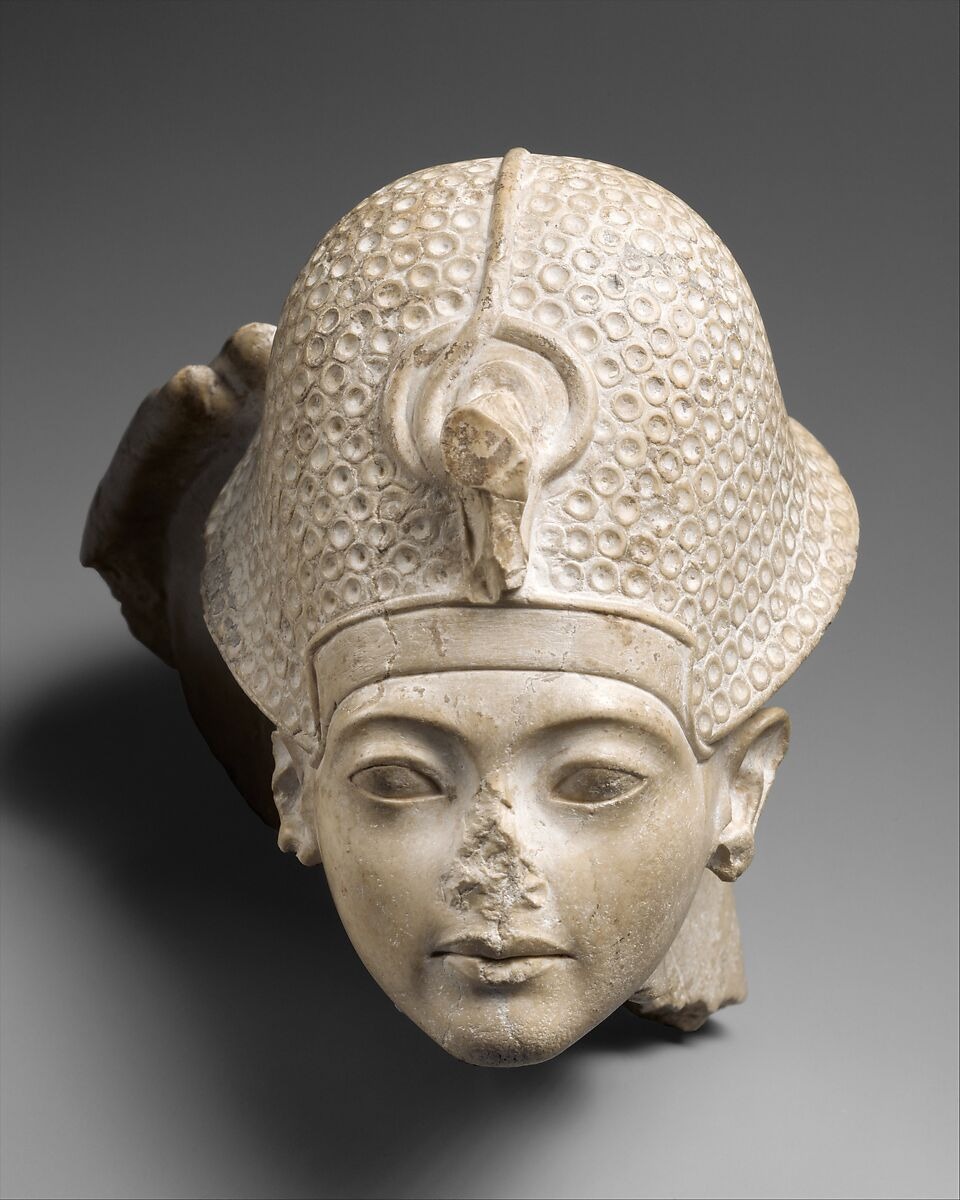
The cover reproduces the Head of Tutankhamun in the Metropolitan Museum of Art, accession 50.6. Carved from indurated limestone, the head wears the so-called blue crown, or khepresh. At the rear of the crown the surviving right hand of Amun touches it. This is the visible remnant of the deity from a larger sculptural group, not a photograph of a complete statue of Amun. The museum reports that a cast of the head was fitted to remains of a seated god's statue at Karnak, whose inscriptions identify Amun. The composition visualizes royal legitimation in the god's presence; it is not photographic documentation of a coronation held on a known date. [2][17]
In the composition the king appears smaller than the god seated behind him. The museum's interpretation also notes features inherited from Amarna-period art in the softened face and the handling of the stone, despite Amun's renewed prominence in royal imagery. Stylistic continuity does not cancel religious change: artists, workshops, and techniques do not all change on the day a policy is announced. [2][17]
For comparison, the Metropolitan Museum also holds a distinct granodiorite Head of the God Amun, accession 07.228.34. It attributes that work to royal building or restoration projects for Amun under Tutankhamun at Karnak. This is a separate object from the king's head numbered 50.6; the two must not be combined into an invented single statue. The museum suggests that features of the Amun head may reflect sculptors trained within the Amarna artistic milieu and continuing to work at Thebes. [7]
What changed at the temples—and what remains unknown?
The revised royal names, the stela, and surviving sculpture together indicate that the court renewed funding and public representation of traditional gods, especially Amun, at major sanctuaries. The change was simultaneously religious, administrative, and political: the king sought divine legitimation, while temples and their personnel depended on royal patronage and resources. Yet those sources cannot quantify what was restored in every region, identify a single date for dismantling every Atenist building, or show which person at court drafted each policy decision. [1][7]
Nor does a royal assertion that temples had fallen into ruin mean that all religious life beyond the court ceased during the Amarna era. Akhenaten's project transformed royal institutions, a capital city, and the arts, while the diversity of people's practices has to be investigated through local evidence of several kinds. Horemheb's appropriation of earlier monuments is another reminder that official versions of events were revised after Tutankhamun's death. [3][1]
Death and mummy: examination versus hypothesis
Tutankhamun died young, probably in his later teenage years; exact age estimates differ according to the methods and sources used. A 2010 study by Zahi Hawass and colleagues in JAMA combined computed tomography with the analysis of biological samples from royal mummies. The authors proposed that the mummy designated KV55 was Tutankhamun's father and was probably Akhenaten; they also reported evidence of skeletal disorders and genetic material associated with the malaria parasite. They interpreted a combination of these findings as a possible contribution to death, not a historical diagnosis conclusively settling what killed the king. [13]
Eline Lorenzen and Eske Willerslev challenged aspects of the ancient-DNA evidence, raising concerns about degradation and contamination; members of the research team replied with details of their controls and repeated tests. Brenda Baker separately questioned the estimated age of the KV55 mummy, an issue that affects the proposed identification. It is therefore necessary to distinguish a scientific result as reported by its investigators from the identification of a named historical individual inferred from it. The evidence reviewed here does not prove assassination or establish a single universally accepted cause of death. [14][15][16]
Tomb KV62: the discovery that transformed his fame
The king's tomb, designated KV62, lies in the Valley of the Kings west of Luxor, the royal burial ground of ancient Thebes. On 4 November 1922 the first step of its staircase was exposed during excavations led by Howard Carter and carried out by a team of Egyptian workers and other excavators. Project diaries record the opening of the first sealed doorway on 25 November and a view through an opening in the second doorway on 26 November; the burial chamber was opened on 16 February 1923. These dates belong to modern archaeological discovery, not to the king's lifetime. [8][9][10]
The tomb contained an extraordinary array of funerary objects in a more complete state than in many other royal burials, transforming Tutankhamun's position in modern cultural memory. Yet it is misleading to say that the tomb 'had never been touched': excavation accounts, seals, and evidence of packing show that parts had been entered and resealed in antiquity. Carter's archive matters not only for the celebrated moment of discovery but for the documentation of object locations, removal procedures, and the later history of handling them. [8][9]
The tomb as funerary evidence and a conservation site
KV62 differs in size and decoration from other major royal tombs. Only its burial chamber carries wall paintings, depicting aspects of religious ritual and the king's fate in the afterlife. They document a funerary program, not every event of his reign. The Getty Conservation Institute reports that brown spots were already visible on its walls at the time of excavation and that modern visitation introduced further risks, including dust, humidity, and physical contact. [11]
From 2009 to 2019 the Getty Conservation Institute collaborated with Egyptian authorities on investigating and stabilizing the paintings and improving visitor conditions. Comparison with historic photographs and scientific analyses found that the brown marks were the result of old microbial growth that was no longer active. Forceful removal could damage the paint layer, so the spots were left in place. This research shows how historical documentation and laboratory evidence can test interpretations, and how the study of the past entails responsibility for preserving its surviving material. [12]
Conclusion: historical king and modern icon
The king's identity can be established with high confidence through his royal names, tomb, and attributable monuments, as can the renewed official support for Amun and other traditional cults during his reign. The Metropolitan Museum's sculpture and the Restoration Stela illustrate two ways of asserting the legitimacy of this policy: a king receiving divine sanction and an official inscription recounting acts of restoration. [2][1]
The exact sequence of succession, the young ruler's personal agency relative to his advisers, details of his ancestry and health, and the cause of his death remain questions answered with varying degrees of confidence. The tomb that made him famous today preserves remarkable evidence about burial, craftsmanship, and royal representation; it does not turn every hypothesis about his life into established fact. [18][13][14]
References and notes (18)
- C. Zarnoch and E. Sullivan. “Restoration Stela of Tutankhamen.” Digital Karnak, UCSC. Restoration of traditional cults, temple ruin/restoration claims and Horemheb’s usurpation. Catalogue description read, not a complete translation of the ancient inscription. Return to the text ↑
- The Metropolitan Museum of Art. “Head of Tutankhamun,” 50.6. King’s head with Amun’s hand on the crown from a statue group; Rogers Fund 1950, Public Domain. Image does not show a complete Amun statue. Detailed dates differ across language pages; caption uses Dynasty 18. Return to the text ↑
- Marsha Hill (2014). “Art, Architecture, and the City in the Reign of Amenhotep IV / Akhenaten.” The Metropolitan Museum of Art. Early cult, Aten names, royal mediation and succession sections read. Older solar background and a later didactic name of disputed date. No claim to have read the essay’s entire bibliography. Return to the text ↑
- University College London, Digital Egypt, 'Tutankhamun', Chronology. Entire short chronology entry read: approximate regnal dates, accession and death age, throne name and KV62; not a reading of original ancient sources. Return to the text ↑
- University College London, Digital Egypt, 'The Royal Family of Akhenaten'. Entire short university page: children of Akhenaten and Nefertiti, queen's name and late-Amarna royal milieu. Return to the text ↑
- UCL Petrie Museum / Digital Egypt, Gurob object catalogue, 'UC 16021'. Complete short object entry: calcite vessel, provenance Gurob, names of Tutankhamun and Ankhesenamun; no independent epigraphic reading. Return to the text ↑
- The Metropolitan Museum of Art, 'Head of the God Amun', accession 07.228.34. Complete separate object catalogue: identification of Amun, granodiorite, Karnak, Tutankhamun's patronage and sculpture style. Return to the text ↑
- University of Oxford, Griffith Institute, Tutankhamun Archive, 'First Season, 1922–1923'. First-season published timeline: 4, 25 and 26 November 1922 and 16 February 1923, excavation context and ancient re-entry. Return to the text ↑
- Howard Carter, 'Excavation Journal, First Season', Griffith Institute, Oxford, published transcript of page 33. Visible transcription of the 25 November 1922 journal entry; original handwritten scan and whole journal were not read. Return to the text ↑
- Howard Carter, 'Diary, 1922', Griffith Institute, Oxford, page 189 transcription. Transcription covering 26–27 November and the second doorway; not the whole diary or an independent reading of the handwritten page. Return to the text ↑
- Getty Conservation Institute, 'Conservation and Management of the Tomb of Tutankhamen'. Project overview, background, burial-chamber decoration, 2009–2019 conservation, visitor risks and brown spots. Return to the text ↑
- Getty Conservation Institute, 'Getty Conservation Institute Completes Work at Tomb of King Tutankhamen in Egypt' (2019). Article passages on inactive historic microbial spots, comparison with 1920s photographs, analyses and avoiding damaging removal. Return to the text ↑
- Zahi Hawass et al. (2010), 'Ancestry and Pathology in King Tutankhamun’s Family', JAMA 303(7):638–647. Abstract, methods, genetic results, pathology/malaria/cause-of-death sections and conclusion examined; not every table, supplement or cited work read in full. Return to the text ↑
- Eline D. Lorenzen and Eske Willerslev, correspondence on Tutankhamun's family and demise, JAMA (2010). Visible opening/abstract only, raising ancient DNA contamination and authentication issues; full correspondence was not accessible. Return to the text ↑
- Yehia Z. Gad et al., reply to the 'King Tutankhamun's Family and Demise' correspondence, JAMA (2010). Visible opening paragraph of author reply referring to testing controls and replication; full text not accessible. Return to the text ↑
- Brenda J. Baker, correspondence on Tutankhamun's family and demise, JAMA (2010). Visible opening only, about the disputed skeletal age for KV55; complete letter and any supplementary material not read. Return to the text ↑
- Jennette Mullaney, interview with Dorothea Arnold, 'Curator Interview: Head of Tutankhamun', The Met (21 April 2010). Full online curator interview: head 50.6, cast fitting to the Karnak statue, artistic continuity after Amarna. Return to the text ↑
- University College London, Digital Egypt, 'Kings of the New Kingdom', chronology list. Whole short chronology list reviewed for Akhenaten, Smenkhkare, Tutankhamun, Ay and Horemheb and approximate regnal years. Return to the text ↑
Suggest a correction · Suggest a source for this record
Cite this record
IL Archive, «Tutankhamun», https://ilarchive.com/en/people/tutankhamun
Continue reading