Person · Ruler
Akhenaten
- Names
- Amenhotep IV
- Region
- Ancient Egypt — Thebes (Karnak) and Akhetaten/Tell el-Amarna
Akhenaten (Amenhotep IV), an Egyptian Eighteenth-Dynasty king of the fourteenth century BCE, reshaped royal worship around Aten and founded Akhetaten; chronology, exclusive worship and succession remain debated.
Estimated reading time: 8 min Published Last reviewed:
Share article
Text
Introduction
What can we establish about Akhenaten, and what remains disputed? This Egyptian king of the Eighteenth Dynasty, initially named Amenhotep IV, presided over extraordinary changes in royal worship, temple architecture and representations of the ruling family in the fourteenth century BCE. This account traces his religious programme and the foundation of his capital, distinguishing contemporary inscriptions from scholarly interpretations and court ideology from the lives of residents.
No single complete source tells his story. Karnak monuments, boundary stelae, AmarnaAmarna / AkhetatenAmarna is the archaeological site of Akhetaten, Akhenaten’s fourteenth-century BCE capital in Middle Egypt, preserving royal boundary stelae, temples, houses and cemeteries.Glossary · Click to read the explanation tombs, cuneiformCuneiformWriting with wedge-shaped signs, developed from Mesopotamian recording traditions and used for several languages from the third millennium BCE.Glossary · Click to read the explanation letters and household finds illuminate different aspects, while his successors altered much of the physical record. Dates are therefore qualified, and neither stylised royal images nor the label “first monotheist” is accepted as a diagnosis or an established verdict.
Names, dynasty and chronology
Akhenaten was the son of Amenhotep III and Queen Tiye, from the royal world centred on ThebesThebes, EgyptThebes, Egyptian Waset, was an ancient Egyptian city in the area of modern Luxor, with monuments on both banks of the Nile.Glossary · Click to read the explanation. He ascended the throne as Amenhotep IV before adopting “Akhenaten”, a name referring to AtenAten: The Solar Disk and Akhenaten’s CultAten is the solar disk and the divine power associated with its light in ancient Egypt. Akhenaten made Aten the exclusive focus of his official cult; Amarna reliefs show rays ending in hands, while household finds reveal other religious practices.Glossary · Click to read the explanation, the solar disk of his new royal cult. Queen Nefertiti, his principal wife, held an exceptional position in its ceremonies and official imagery. His throne name, Neferkheperure-Waenre, appears alongside his personal name in inscriptions; it does not denote a second king. [1][3]
His reign belongs to the fourteenth century BCE, and year 17 is the highest attested regnal year. Modern absolute dates vary: UCL gives approximately 1351–1334 BCE, the Metropolitan Museum often uses circa 1353–1336 BCE, while Williamson employs another reconstruction. These are alternative chronological frameworks, not three separate reigns. Regnal dates cannot safely be turned into a certain birth date or age. [1][3][4]
Early reforms at Karnak
Amenhotep IV did not begin with a clean break. He initially pursued conventional royal projects, then expanded buildings for a solar manifestation at Karnak, the Theban centre of AmunAmunAmun is an Egyptian deity centered on Thebes and Karnak, the “hidden one,” also worshipped as Amun-Re. His names and images were targeted under Akhenaten before royal support resumed.Glossary · Click to read the explanation’s cult. The deity’s early long name involved Re-Harakhty, Shu and Aten; its representation gradually became a disk whose rays ended in hands presenting the sign of life. These are successive developments within his programme, not simultaneous depictions of a doctrine fixed from accession. [3][4]
Small stone blocks called talatat enabled rapid construction and later reuse. Some ritualRitualAn organised or distinguished practice meaningful to a community; it may leave traces, but its form alone does not reveal an associated doctrine.Glossary · Click to read the explanation settings were adapted for offerings in open sunlight rather than enclosed sanctuaries. The Karnak evidence securely attests an early royal commitment; precise political motives and the sequence of individual buildings remain interpretative where securely dated inscriptions are scarce. [3][4]
Founding Akhetaten and its boundary stelae
In his fifth regnal year the king proclaimed the establishment of AkhetatenAmarna / AkhetatenAmarna is the archaeological site of Akhetaten, Akhenaten’s fourteenth-century BCE capital in Middle Egypt, preserving royal boundary stelae, temples, houses and cemeteries.Glossary · Click to read the explanation, “Horizon of the Aten”, in Middle Egypt at present-day Tell el-Amarna. Rock-cut boundary stelae preserve two foundation proclamations, the first dated to year 5 and the second to year 6, with a reaffirmation in year 8. Proclamation, royal name change, court relocation and subsequent building were connected processes rather than one securely dated event. References differ over whether the name change belongs to year 5 or 6, partly because they privilege different evidence. [5][1]
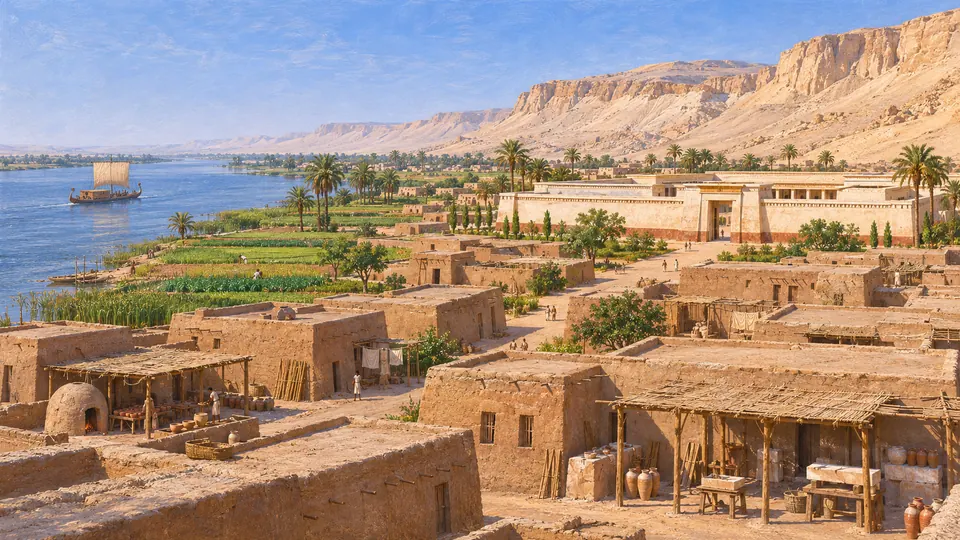
The new city was more than a temple: it contained palaces, administrative quarters, housing, elite tombs and two principal Aten temples. Investigation of the Great Aten Temple indicates two major construction phases and large-scale removal of masonry after the Amarna period. A modern reconstructed plan must therefore not be mistaken for the complete standing fabric of a single original year. [4][9]
The Great Hymn and the king’s mediation
The Great Hymn to AtenGreat Hymn to AtenEgyptian hymn from Akhenaten’s fourteenth-century BCE reign, preserved in thirteen columns in Ay’s Amarna tomb. It praises Aten as life-giver and privileges royal knowledge; neither personal royal authorship nor Psalm 104’s dependence follows automatically.Glossary · Click to read the explanation is a central witness to court theology. Its text survives on a wall of the official Ay’s tomb at Amarna, not as an autograph papyrus by the king. It depicts sunrise, the activity of humans, animals and plants, light reaching different lands, and the unique source that sustains life. For this review, portions of the Egyptian transliteration and published English translation on UCL Digital Egypt were compared by theme; the original hieroglyphs were not independently collated sign by sign. [6]
The hymn places the king in a privileged relationship with Aten as the one who understands the deity, while images show king and queen presenting offerings and receiving life. A hymn preserved in an official’s tomb, however, does not prove that every verse was personally penned by Akhenaten or adopted in the same way throughout the population. [3][6]
Suppression of Amun: what is meant by “monotheism”?
Royal texts and damaged divine names and images show coercive measures against other gods, especially Amun, Mut and Khonsu, as well as the redirection of temple resources. Williamson reports a forceful Karnak declaration that other deities had “ceased”, drawing on editions of that inscription; this review did not independently examine the stone. Erasures were unevenly distributed, and a damaged name on one object cannot establish the belief of its owner or universal abandonment of other cults. [3]
Some scholars call the project an early form of exclusive monotheismMonotheismBelief that only one God possesses divinity in its fullest sense. Historically distinct from exclusively worshipping one deity without denying others; its theological forms vary.Glossary · Click to read the explanation; others prefer royal concentration of worship on one god or a reform whose social reach was limited. Domestic archaeology at Amarna justifies caution: pottery and images relating to Bes, Hathor and other divinities occur alongside shrines to the royal family and Aten. A court policy is not a survey of everyone’s beliefs, while an object found in a home does not automatically reveal how it was used. [3][7]
Nefertiti, the family and royal authority
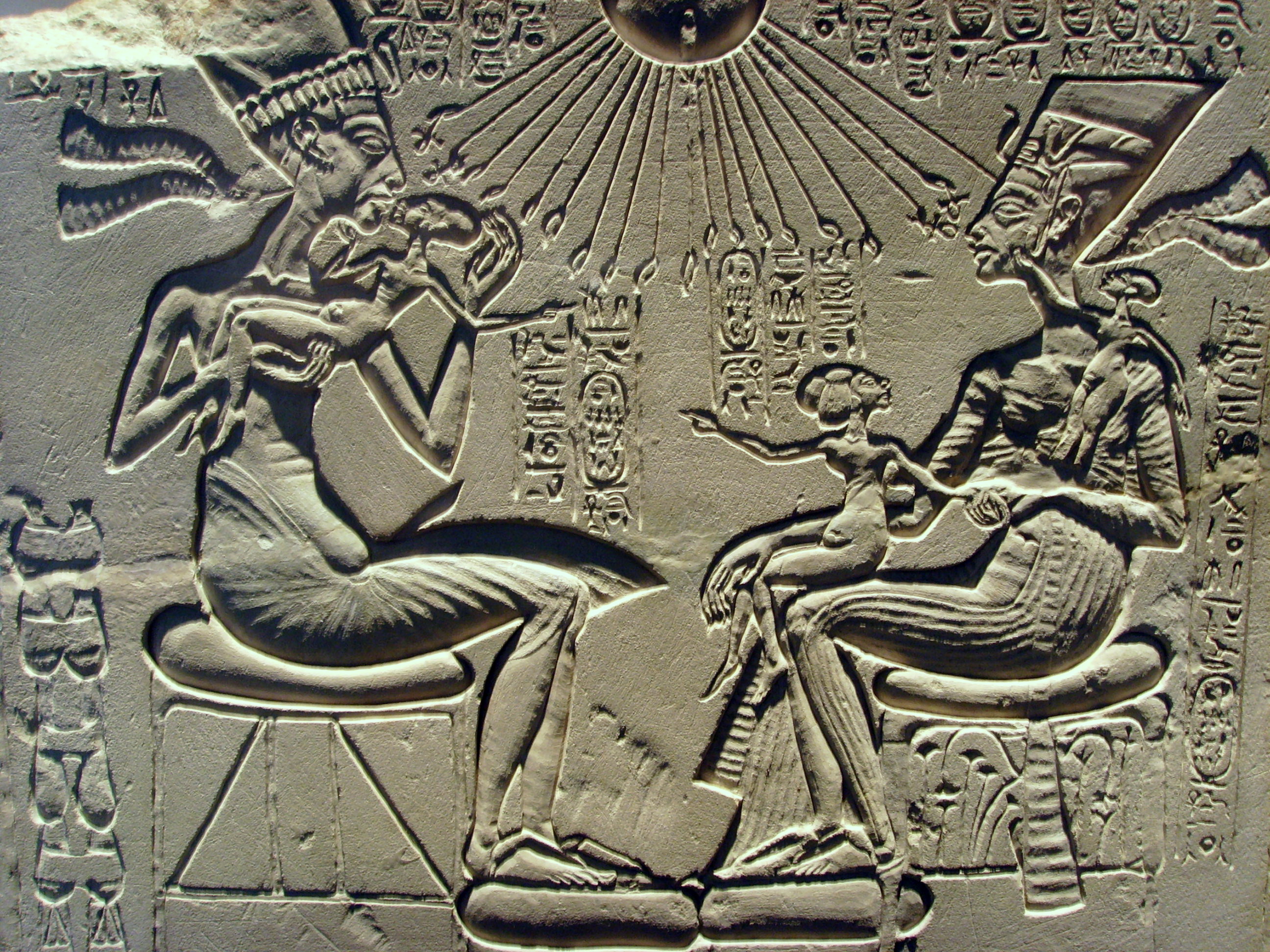
Nefertiti was not a decorative bystander: inscriptions show her performing rituals, sometimes without the king, and with the royal daughters, ultimately six in official representations. Images of family intimacy are also a court-produced statement about the dynasty’s legitimacy and its connection to Aten, not transparent records of private feelings or daily conduct. [4][3]
An inscription dated to regnal year 16, published from the Dayr Abu Hinnis quarries, still calls Nefertiti queen late in Akhenaten’s reign. Later royal names, notably Neferneferuaten and Smenkhkare, remain disputed in terms of individual identity and succession. Similar names alone do not prove that Nefertiti became king or was an early coregent. Only the article’s abstract and metadata were accessible directly here; more detailed discussion is based on Williamson. [11][3]
Amarna art and the limits of medical diagnosis
Amarna images are known for elongated or transformed bodily proportions, hand-ended solar rays and scenes of movement and touch within the royal family. They nevertheless reflect deliberate artistic choices within Egyptian conventions: new bodily forms can coexist with older rules such as displaying every finger even in a strained pose. Exaggerated proportions are not photographs or automatic evidence of a hereditary disorder. [4][2]
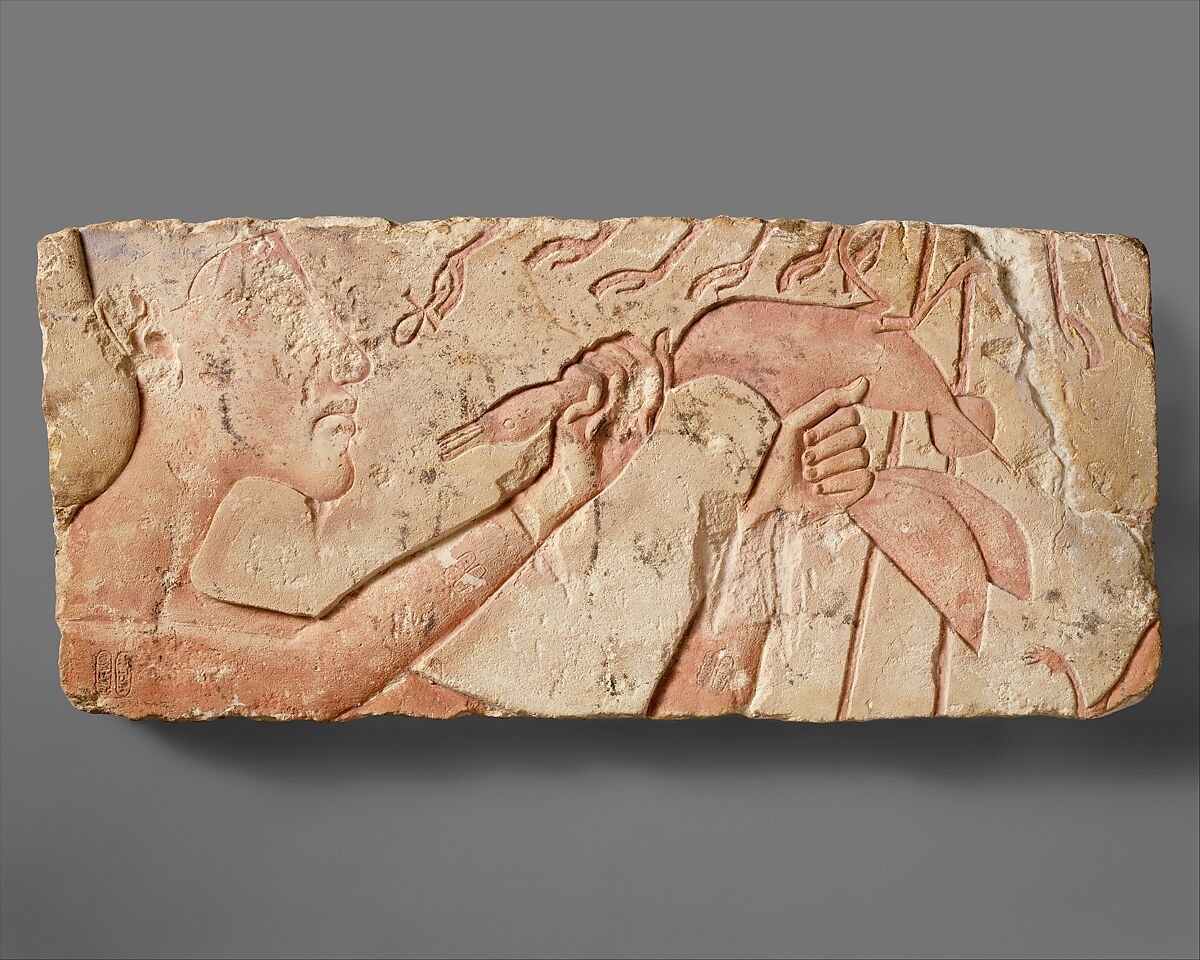
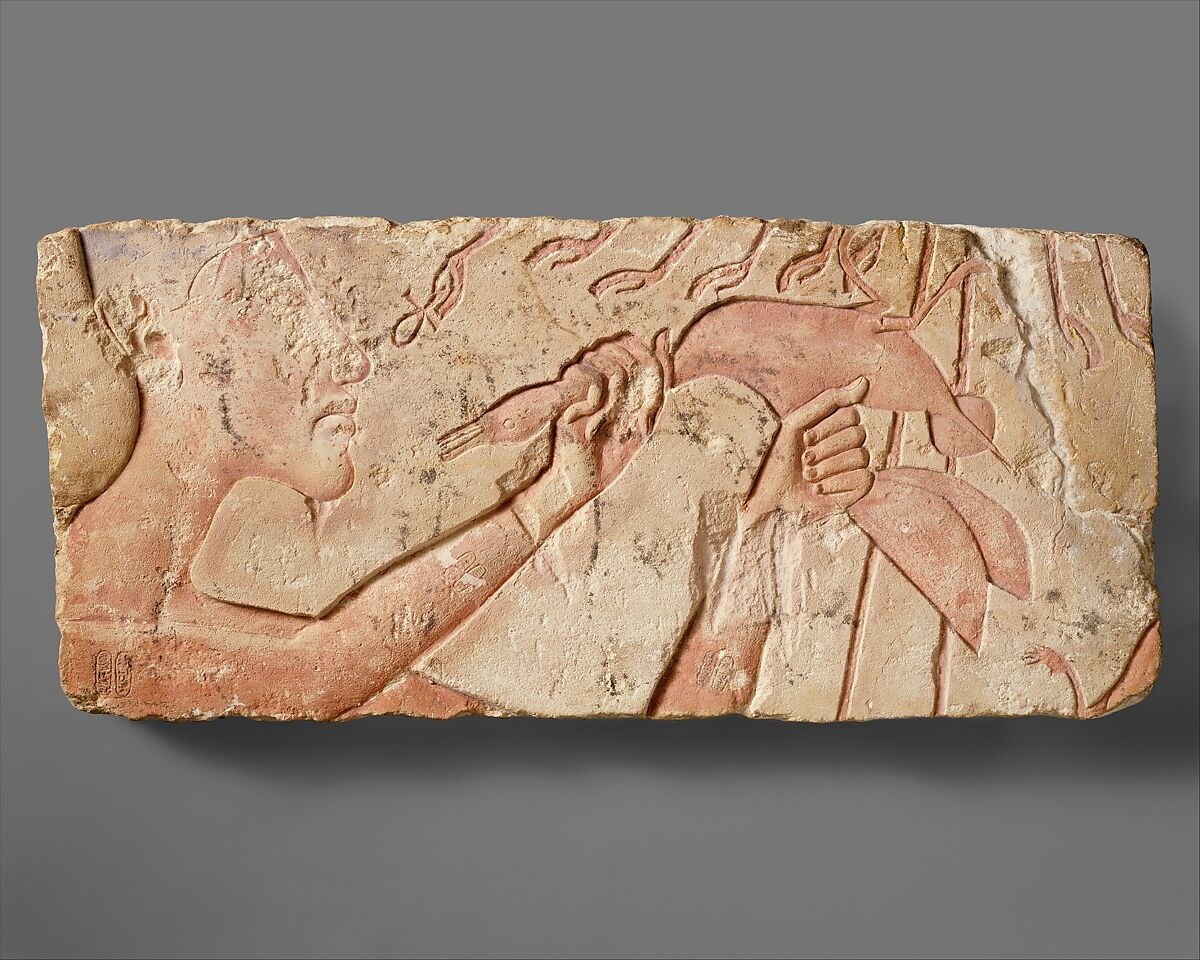
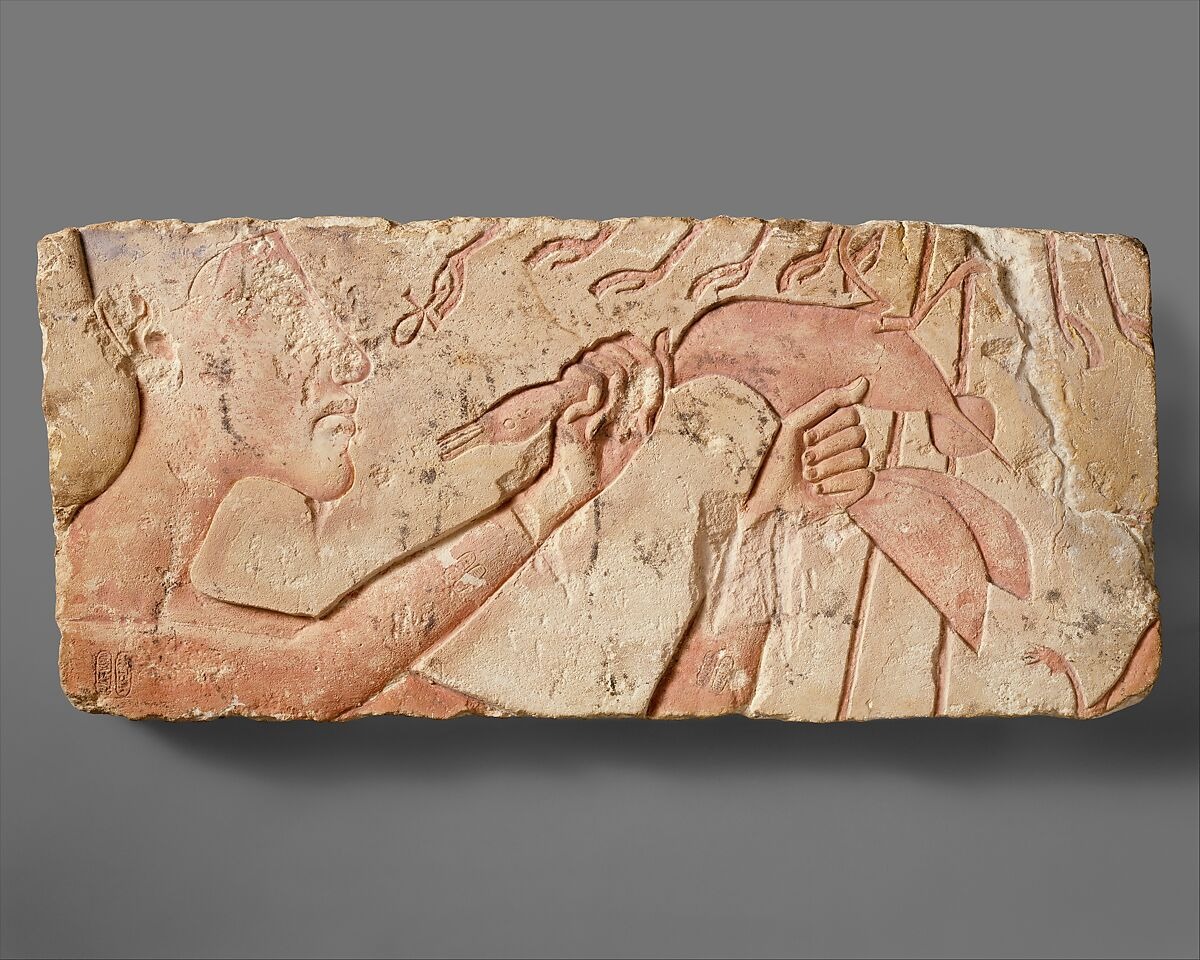
The Metropolitan Museum relief 1985.328.2 shows the king raising a duck for offering beneath Aten’s surviving rays and hands. The museum records limestone with paint, a probable findspot at HermopolisHermopolis, KhemenuHermopolis is an ancient Egyptian city at Ashmunein, called Khemenu in EgyptianGlossary · Click to read the explanation and a probable earlier origin at Amarna. The stone captures movement but does not preserve the entire solar disk. Medical hypotheses about the king’s appearance have been assessed in a clinical study, yet reliefs and the contested identity of the KV55 mummy do not provide a conclusive diagnosis. [2][10]
Diplomatic letters and life in the capital
Amarna yielded a cuneiform diplomatic archive documenting contacts between Egypt, other Near Eastern powers and dependent city rulers. One identifiable original in the British Museum, EAEnkiMesopotamian deity also known as Ea, linked with Eridu and the Abzu (deep fresh waters), wisdom, incantations, and narratives of creation and cosmic order. Later written attestations do not identify the deity of Eridu’s earliest layers.Glossary · Click to read the explanation 10 / E29786, is a letter from the Babylonian king Burra-Buriyash to the ruler addressed as Naphurareya (Akhenaten). It concerns relations and gifts, including a complaint about the quality of gold. A specific surviving letter does not by itself establish that Egypt’s entire foreign policy prospered or collapsed. Some other archive letters address Amenhotep III or IV, so the addressee must be checked tablet by tablet. [8][3]
Workers, craftspeople, officials and families also lived beyond the ceremonial scenes of the court. Houses preserve hearths, utensils, workshops and varied expressions of religion; excavations have reconstructed the Great Aten Temple from foundations left after its masonry was removed. Combining elite correspondence with household archaeology gives a more complex picture than either an entirely isolated king or a uniformly converted population. [7][9]
Death, succession and the reversal of policy
The securely dated evidence for Akhenaten reaches regnal year 17; his cause of death remains unknown. Mourning scenes survive in the Amarna royal tomb, but details such as the identity of an infant depicted at the death of Princess Meketaten are disputed. Possible reburials and the identity of remains associated with tomb KV55 likewise require caution. The evidence does not permit a simple, universally agreed succession list before TutankhamunTutankhamunLate Eighteenth-Dynasty Egyptian king, originally Tutankhaten, later Tutankhamun as official patronage of Amun resumed. Famous for tomb KV62; aspects of his parentage and death are debated.Glossary · Click to read the explanation, initially called Tutankhaten. [3][11]
Under Tutankhamun and later rulers, traditional temples and cults regained official recognition, and Akhetaten lost its role as royal centre. Kings including Horemheb and Ramesses II removed names and monuments or reused blocks in later buildings. Erasure makes reconstruction difficult, yet reused masonry also preserved some inscriptions by accident. The end of the royal programme does not prove that every artistic or religious trace disappeared immediately. [3][4]
Historical legacy and the limits of comparison
Akhenaten matters because a relatively concentrated royal experiment can be studied through texts, architecture, images and houses whose implications do not always coincide. Calling him the “first monotheist” requires a question: does the phrase mean one official recipient of worship, denial that any other god exists, or general acceptance by society? The surviving record does not answer all three in the same way. Claims about later religious influence require a demonstrable transmission route, not resemblance alone. [3][7]
Images of creation and light in the Great Hymn are often compared with Psalm 104. The published abstract of a chapter by James Hoffmeier argues that this comparison does not establish a direct connection; other scholars emphasise the parallels. The inaccessible full chapter was not read in this review, so its conclusion is not imposed as a settlement of the debate. Court inscription, modern theological interpretation and hypotheses of later influence remain distinct evidential layers. [12][6]
References and notes (12)
- UCL Digital Egypt, “Akhnaton (Amenhotep IV),” royal chronology (online academic entry). Entry on parents, name change placed in year 6, chronology ca. 1351–1334 BCE and latest regnal year 17; compared with boundary proclamations without forcing dates to coincide. Return to the text ↑
- The Metropolitan Museum of Art, “Akhenaten Sacrificing a Duck,” accession 1985.328.2 (object catalogue and primary image). Object record, limestone and paint, 25 × 55 × 3.3 cm, probable Hermopolis findspot and probable Amarna origin, main-image Public Domain designation; supplementary restricted views not used. Return to the text ↑
- Jacquelyn Williamson (2015), “Amarna Period,” UCLA Encyclopedia of Egyptology, 1(1), peer-reviewed academic synthesis. Selected passages in print pp. 1 and 4–11 of the PDF: family and Karnak (4–6), erasures and relocation (7), religion and letters (8), royal deaths (9), succession (10) and restoration (11); not a continuous cover-to-cover reading. Return to the text ↑
- Marsha Hill (2014), “Art, Architecture, and the City in the Reign of Amenhotep IV / Akhenaten,” The Metropolitan Museum of Art, Heilbrunn Timeline of Art History. Read the article’s sections on Karnak, Aten’s didactic name, year 5, talatat, Nefertiti, art, city plan and chronology; institutional scholarly essay, not an excavation monograph. Return to the text ↑
- Amarna Project, “Boundary Stelae,” excavation project documentation, original stelae and published proclamations. Read descriptions and dating of first (year 5) and second (year 6) proclamations and reaffirmation in year 8; individual hieroglyphic signs on all stelae not independently collated. Return to the text ↑
- UCL Digital Egypt, “Amarna Belief,” “The Great Hymn to the Aten” (Egyptian transliteration and English translation). Read site and textual introduction (Ay’s tomb, 13 columns) and passages of Egyptian transliteration and English translation on light, living things, other peoples and the king; no full sign-by-sign comparison with Davies (1908). Return to the text ↑
- Anna Stevens (2009), “Domestic Religious Practices,” UCLA Encyclopedia of Egyptology, 1(1), archaeological synthesis. Read printed p. 1 introduction and the Tell el-Amarna finds catalogue on print pp. 17–18; not the whole 33-page PDF or works cited in it. Return to the text ↑
- The British Museum, cuneiform letter from Burra-Buriyash to Naphurareya (Akhenaten), EA 10, E29786 (collection record). Read museum catalogue identifying EA 10/E29786, Babylonian sender and Egyptian addressee, the gifts and gold complaint; neither Moran’s edition of all 35 lines nor cuneiform was read directly. Return to the text ↑
- Barry Kemp / Amarna Project, “Great Aten Temple,” excavation history and conservation description. Read introductory account of the temple plan, removal of masonry, two phases and renewed investigation since 2012; linked excavation reports were not read. Return to the text ↑
- Zahi Hawass et al. (2010), “Ancestry and Pathology in King Tutankhamun’s Family,” JAMA 303(7), 638–647. Read journal section on gynecomastia, cranial form, claimed syndromes and the KV55 identification; radiological images and genetic raw data not independently inspected, nor is the identity treated as settled. Return to the text ↑
- Athena Van der Perre (2014), “The Year 16 Graffito of Akhenaten in Dayr Abū Ḥinnis,” Journal of Egyptian History 7(1), 67–108. Abstract and publication metadata only: year-16 graffito and Nefertiti’s title; full pp. 67–108 and quarry inscription not directly read. Return to the text ↑
- James K. Hoffmeier (2015), “The Influence of Atenism in Egypt and the Bible?”, in Akhenaten and the Origins of Monotheism, ch. 9, Oxford University Press, pp. 238–266. Publisher abstract only: author’s position on Psalm 104 and transmission; full chapter inaccessible and its entire evidence not independently checked. Return to the text ↑
Suggest a correction · Suggest a source for this record
Cite this record
IL Archive, «Akhenaten», https://ilarchive.com/en/people/akhenaten
Continue reading
Related readings