Ancient text · Inscription
Great Hymn to Aten
A text for line-by-line reading, with transliteration, translation, and resources.
The Great Hymn in Ay’s tomb: universal life and the king’s privileged knowledge, Egyptian primary passages, and a weighed comparison with Psalm 104 separating resemblance from dependence.
Estimated reading time: 9 min Published Last reviewed:
Share article
Text
Introduction
The Great Hymn to AtenAten: The Solar Disk and Akhenaten’s CultAten is the solar disk and the divine power associated with its light in ancient Egypt. Akhenaten made Aten the exclusive focus of his official cult; Amarna reliefs show rays ending in hands, while household finds reveal other religious practices.Glossary · Click to read the explanation is a major witness to the religious language of AkhenatenAkhenatenEgyptian eighteenth-dynasty king, formerly Amenhotep IV, who reorganized royal religion around Aten and founded Akhetaten.Glossary · Click to read the explanation’s reign in fourteenth-century BCE Egypt. It celebrates the solar deity as the source of life for people, animals and foreign lands, while assigning the king a privileged relationship with that deity. Its significance lies in this combination of universal life and royal mediation, not merely in calling it an early “monotheistic” text. Its resemblance to Psalm 104 is important, but resemblance, literary dependenceLiterary dependenceA historical relation in which a text was composed using another text or version; similarity alone cannot establish its direction.Glossary · Click to read the explanation and identical theology are three different claims.
A hymn inscribed in a courtier’s tomb
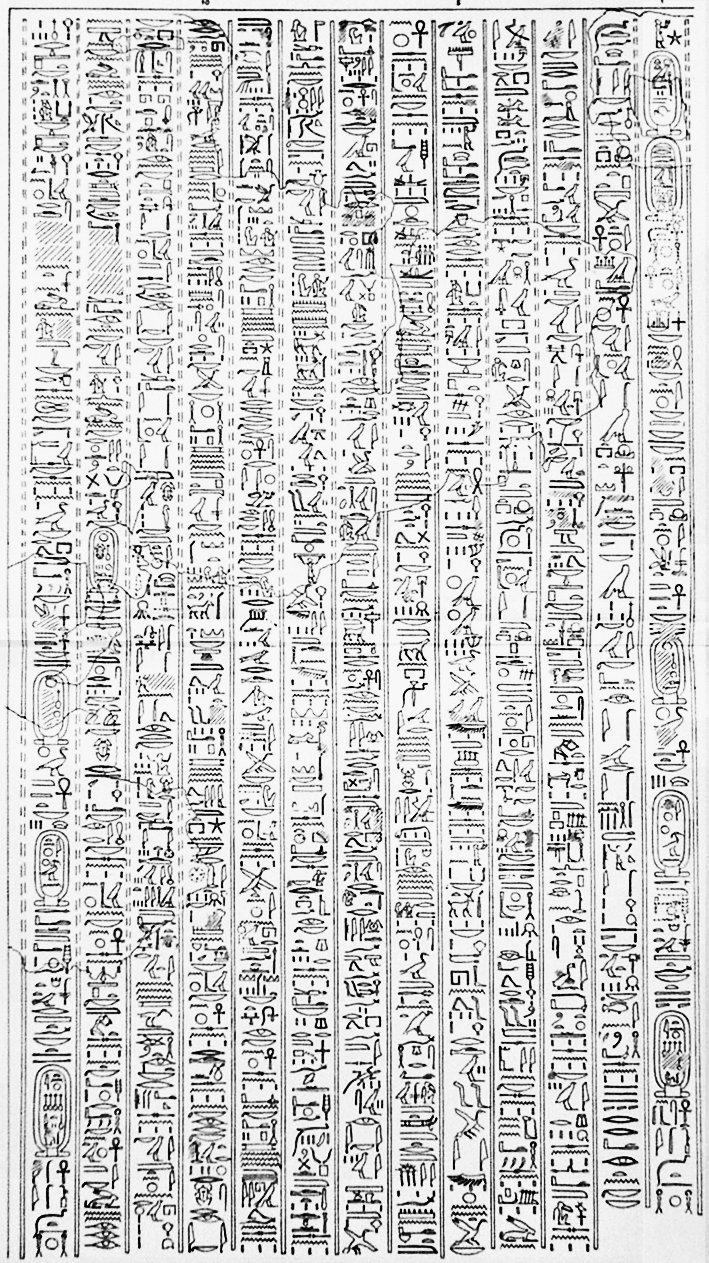
The text survives in thirteen vertical columns on the west wall of the entrance to Ay’s tomb, number 25, at AmarnaAmarna / AkhetatenAmarna is the archaeological site of Akhetaten, Akhenaten’s fourteenth-century BCE capital in Middle Egypt, preserving royal boundary stelae, temples, houses and cemeteries.Glossary · Click to read the explanation, ancient Akhetaten. Ay was a high-ranking courtier who later became king. This is a tomb inscription containing a hymn, not an autograph signed by Akhenaten. The king’s central position in its language is strong evidence for royal theology; it does not independently prove who composed every line. Other Aten hymns belong to the same religious setting, but the Great Hymn should not be confused with the shorter compositions. [1][4]
The wall has suffered damage, including destruction after its nineteenth-century recording. Modern readers therefore encounter a text established through copies and editions as well as the surviving stone. UCL’s Digital Egypt presents transliteration and translation and identifies Davies’s 1908 publication, plates 27 and 41, and Sandman’s 1938 edition, pages 93–96. The nineteenth- and twentieth-century records are witnesses to an ancient inscription, not its composition dates. [1]
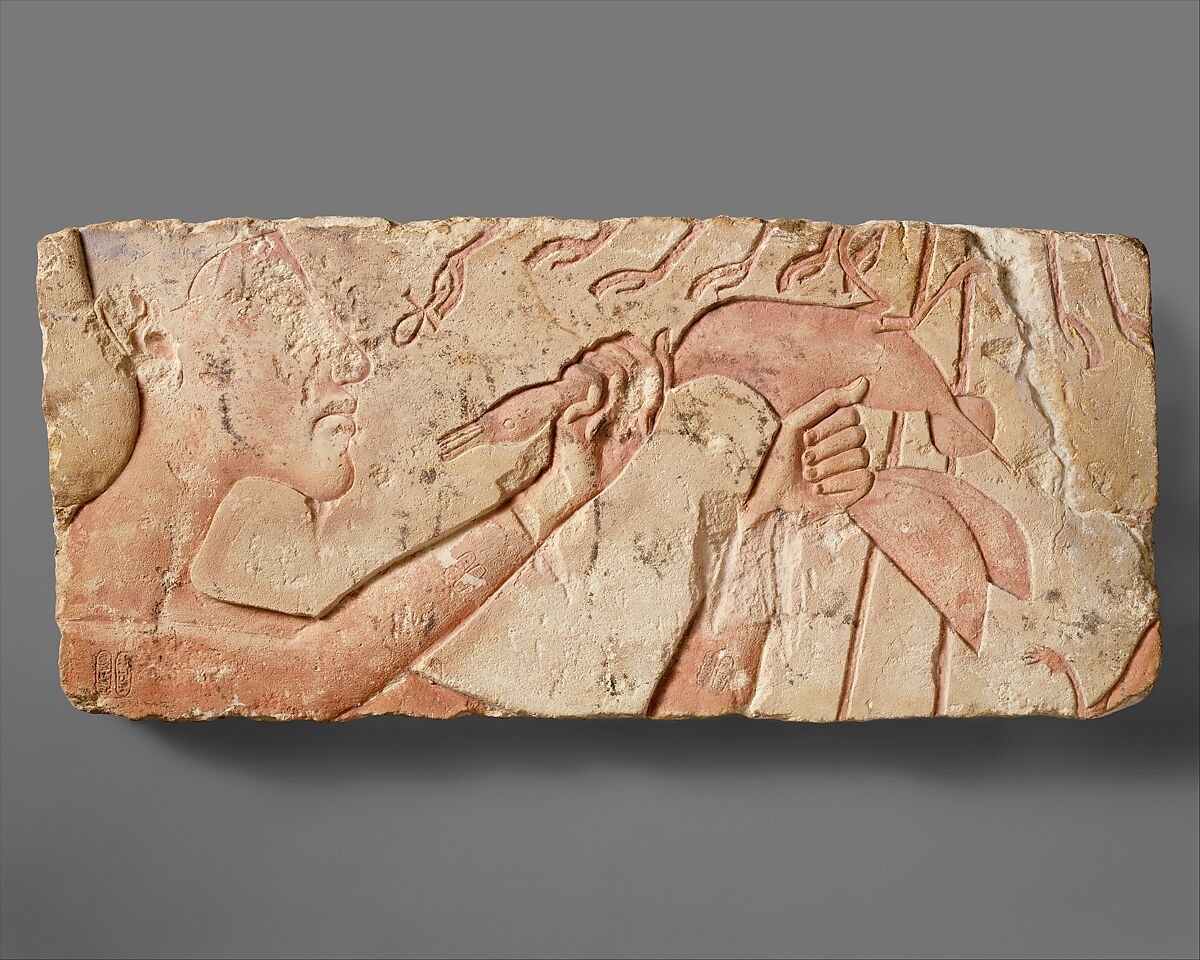
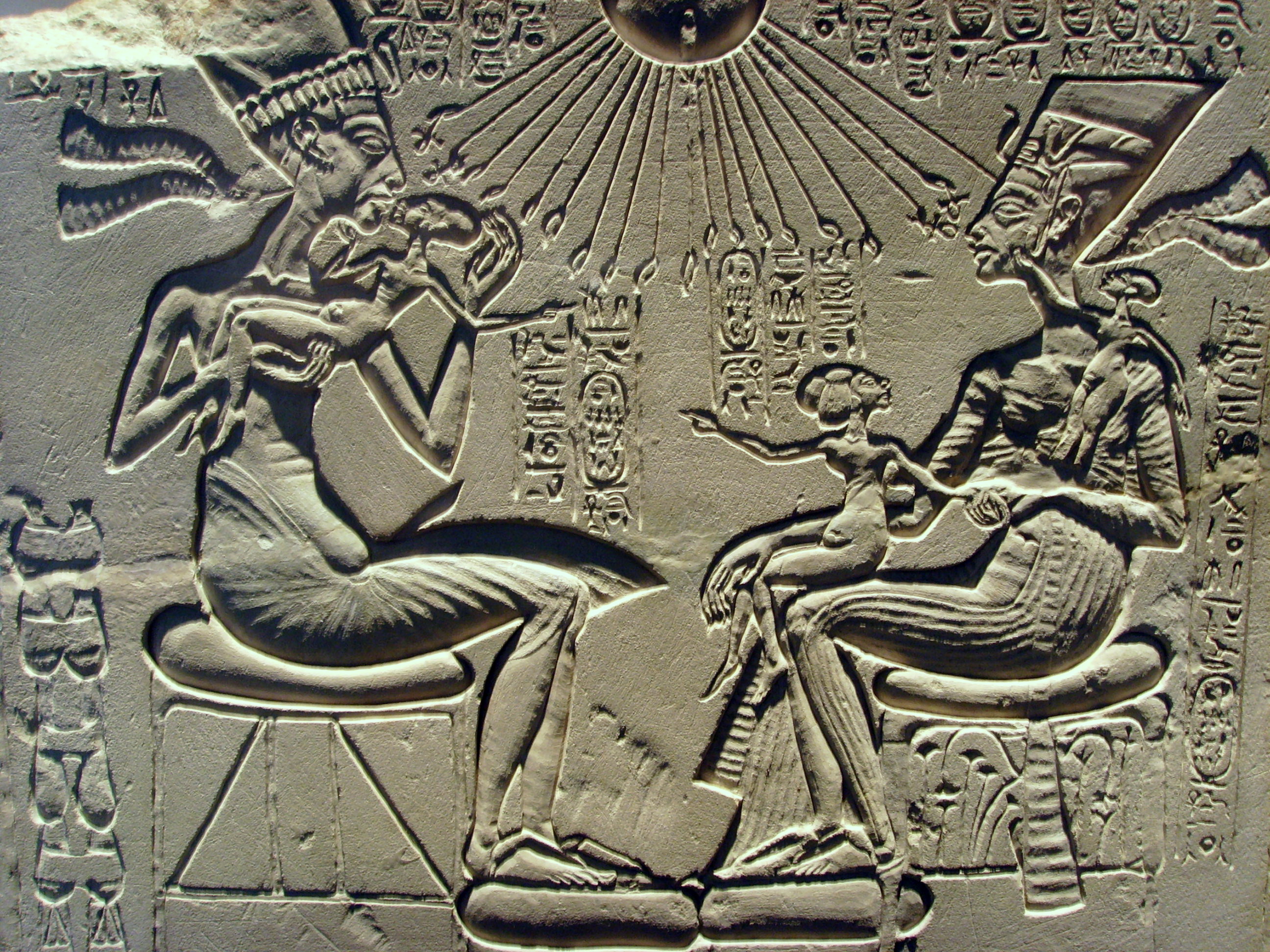
The internal illustration reproduces a published drawing of the hieroglyphic columns. It is not a recent photograph of the wall or a newly discovered manuscript. The cover shows a different object: a limestone household altar with Akhenaten, Nefertiti and three daughters beneath Aten’s rays, Berlin ÄM 14145. This supplies visual context for royal mediation, not the physical support of the hymn itself. [8]
How the poem builds its argument
The movement of the hymn follows life becoming visible and active. Sunset brings sleep, concealment and danger; sunrise awakens people to work and animals to movement. Boats travel, fish move, plants grow, and life develops within the womb and the egg. These examples connect the grand scale of the inhabited world with processes that are small or hidden from ordinary sight. This is praise of a life-sustaining creator, not a scientific account of solar energy. [1]
The geographical horizon is also wider than Egypt. Khor and Kush appear alongside Egypt; differences of speech, appearance and livelihood are placed within one creative ordering. The poem contrasts the Nile sustaining Egypt with a heavenly Nile that waters foreign lands, an image for rainfall. Its universal scope does not erase the Egyptian viewpoint: foreign conditions are explained through the Nile as a familiar model. [1][7]
Sunset and morning therefore do more than furnish attractive scenery. They provide the pattern through which dependence on the deity becomes intelligible: activity and nourishment recur with the light. The hymn’s cumulative examples make that dependence pervasive before its conclusion concentrates privileged knowledge in the king.
Two decisive Egyptian passages
The passage describes night through an analogy with death; it does not establish that all organisms literally die every evening. The following column describes lions emerging and danger in the darkness. No damaged words have been supplied in this short extract. Capitals such as H and A belong to the transliteration system, not to ordinary English spelling. Column positions were visually checked in the teaching hieroglyphic text: column III, page 1, teaching line 12; the heart passage is in column XII, page 6, lines 85–86. These line numbers belong to the modern layout, not additional wall lines. Transliterated wording follows UCL. [1][9]
The royal name identifies Akhenaten. This is not merely an intimate statement by an anonymous worshipper: it sets the universal giver of life beside an exclusive channel of knowledge. The courtier’s inscription and the king-centred voice must be distinguished without pretending that the tension identifies the composer. Damaged wording elsewhere in the hymn remains a separate textual problem; it is not repaired here by filling gaps from a preferred theological interpretation. [1][9]
Is “monotheism” an adequate description?
The hymn calls Aten the sole deity without another beside him and presents creation as his work. Such language, combined with the political and cultic setting, supports a strong claim of divine exclusivity. Yet the text also uses inherited Egyptian solar vocabulary and royal names containing Ra. Calling it simply the invention of a completely unprecedented religion conceals that linguistic inheritance. Conversely, inherited vocabulary does not make every aspect of the new cult unchanged. [1][2]
James Hoffmeier’s published chapter abstract highlights precisely this combination: traditional solar language with new monotheistic emphases. Only that abstract, not the full chapter’s detailed demonstrations, was available for this review. It supports identifying the author’s stated approach, not claiming to have independently checked all the older parallels he discusses. [2]
The analytical conclusion is narrower and stronger than a competition over “the first monotheist”: this hymn gives one solar creator an encompassing function and the king exceptional access. It cannot, by itself, tell us what every inhabitant of Egypt believed or demonstrate that its conception of deity is identical to biblical or later philosophical monotheismMonotheismBelief that only one God possesses divinity in its fullest sense. Historically distinct from exclusively worshipping one deity without denying others; its theological forms vary.Glossary · Click to read the explanation.
Psalm 104: similarity and a consequential difference
Psalm 104:20–23 also moves from night and wild animals to sunrise and human work. Verses 24–30 continue with the variety of creatures, the sea, sustenance, life and death. The concentration and partial sequence of these motifs make the comparison more substantial than a single generic mention of sunshine. Aaron Koller argues for a significant Egyptian literary connection on this basis. [5]
Here lies an important difference. In the hymn’s night scene the creator’s setting accompanies danger and a death-like world. In the psalm, nocturnal hunting itself belongs to a divinely sustained order: the lions seek food from God. The sun also has a place in the ordering of time in verse 19, rather than being the deity addressed. Hennie Viviers’s reading emphasizes the differentiated rhythms of animal and human life. These differences do not disprove every possibility of adaptation, but they rule out treating the poems as interchangeable confessions. [1][5][6]
How far can dependence be argued?
A clustered sequence is stronger evidence than isolated shared imagery; this is the main strength of a connection argument. Its limitation is that recurring motifs can circulate through a broader repertoire of hymns and regional traditions. Martin Leuenberger’s review of Anette Krüger’s detailed study reports her rejection of a simple direct literary dependence while allowing multilayered cultural transmission. The review also criticizes insufficient separation of possible stages in the psalm’s composition. The book itself was not read for this article, so its detailed demonstrations are not presented as firsthand findings. [10]
Hoffmeier’s chapter abstract likewise rejects a direct connection. That stated conclusion is recorded, not used as a substitute for the inaccessible argument. Taken together with the passages actually examined, the sound result is that the parallels warrant serious comparison but do not establish a direct translation of this particular hymn. Nor has a complete chain of intermediary texts been demonstrated here. A proposed connection remains stronger where distinctive combinations can be traced and weaker where it rests only on universal experiences such as day and night. [3][5][10]
Dates that must not be collapsed
- The world described: recurring sunset, sunrise, growth and subsistence. These are the poem’s represented processes, not a unique event with a calendar date.
- Egyptian composition and ancient witness: the hymn belongs to Akhenaten’s fourteenth-century BCE religious setting; the Ay inscription is its ancient material witness. Attribution to the king is a question distinct from that setting. [1][4]
- Psalmic composition and editing: proposed pre-exilic and post-exilic settings lie within the first millennium BCE and remain debated; the final form and any earlier components need not share one date. The temporal gap cannot be eliminated merely by placing the poems next to each other. The quoted electronic HebrewHebrewA Northwest Semitic language of the Canaanite group, encompassing Iron Age epigraphy, Biblical, Rabbinic, medieval and Modern Hebrew; its scripts and pronunciations changed over time.Glossary · Click to read the explanation transcription is not itself a dated ancient manuscript. [6][10]
- Modern records: Davies’s 1908 drawing and Sandman’s 1938 edition record and edit the Egyptian evidence. They neither date the hymn’s original composition nor prove the path by which a biblical poet might have encountered related motifs. [1]
The hymn is thus best read first as a complete argument in its own Egyptian setting, and then comparatively. Its breadth of living forms and its concentration of religious knowledge in the royal son belong to the same text; keeping both in view is more informative than reducing it either to a pleasant nature poem or to a ready-made ancestor of another religion.
Quick answers
Where is the Great Hymn to Aten found, and who is it linked to?
It is written in thirteen vertical columns on the west wall of the entrance to Ay's tomb at Amarna. Ay was a high-ranking courtier who later became king. [1][4]
Did Akhenaten write the hymn himself?
That is not proven. It is a tomb inscription containing a hymn, not a signed work by Akhenaten. The king's central place in its language is strong evidence for royal theology, but it does not show who composed every line. [1][4]
What does the hymn say about the setting of the sun?
It says that when Aten sets in the western horizon, the earth is in darkness, in a condition like death. This compares night to death; it does not mean all living things literally die each evening. [1][9]
How does the hymn describe the world beyond Egypt?
Khor and Kush appear alongside Egypt, and differences of speech, appearance and livelihood sit within one creative ordering. Still, the viewpoint stays Egyptian: foreign lands are explained through the Nile as a familiar model. [1][7]
References and notes (10)
- University College London, Digital Egypt, “Belief at Amarna”: Great Hymn to Aten. Entire page read, including transliteration, translation and bibliography. Source of the two Egyptian quotations; localized translations prepared for IL Archive. Its references to Davies 1908, plates 27 and 41, and Sandman 1938, pp. 93–96, do not imply full reading of those volumes. Return to the text ↑
- James K. Hoffmeier, Akhenaten and the Origins of Monotheism, chapter 8, “The Hymns to Aten: A Monotheistic Manifesto” (2015), pp. 211–237. Publisher’s abstract only read: inherited solar vocabulary and new monotheistic emphases. Full chapter not read; unavailable detailed demonstrations are not claimed. Return to the text ↑
- James K. Hoffmeier, same volume, chapter 9, “The Influence of Atenism in Egypt and the Bible?” (2015), pp. 238–266. Publisher’s abstract only; it states rejection of a direct Psalm 104 connection. Used to identify the author’s position, not as a substitute for examination of the detailed evidence. Return to the text ↑
- Amarna Project, South Tombs guide, section on Ay, tomb 25. Indexed text of the Ay-tomb section, entrance and hymn read; not every guide page visually inspected. Establishes archaeological context and witness location, not authorship. Return to the text ↑
- Aaron Koller, “Psalm 104 and Its Parallels in Pharaoh Akhenaten’s Hymn,” TheTorah.com (2022). Comparative argument and displayed witnesses read directly, including Hebrew Psalm 104:21. The motif-cluster and sequence argument is weighed; not every authorship or first-monotheism claim is automatically adopted. Return to the text ↑
- Hennie Viviers, “Is Psalm 104 an expression (also) of dark green religion?”, HTS 73/3 (2017), a3829, DOI: 10.4102/hts.v73i3.3829. Psalm-exegesis section, associated notes and introduction read; not the complete theoretical framework. Used for night/day rhythms, lions’ food and contested dating. Return to the text ↑
- Miriam Lichtheim, Ancient Egyptian Literature, II: The New Kingdom (1976), Great Hymn excerpt, pp. 96–100. Digital transcription of the excerpt, translation and notes read, not the whole book or images of all its pages. Used particularly for Nile/rain and universal life; quoted Egyptian follows source 1. Return to the text ↑
- Staatliche Museen zu Berlin, household-altar object record, ÄM 14145. Object identity and context: Akhenaten, Nefertiti and their daughters beneath Aten’s rays, not the hymn inscription. Photograph rights are separate: Gerbil, CC BY-SA 3.0, documented in media metadata. Return to the text ↑
- Great Hymn to the Aten: Text, six-page hieroglyphic teaching sheet, referencing Davies VI, pp. 29–31, plates XXVII and XLI, and Sandman, pp. 93–96. Downloaded PDF; pages 1, 2, 5 and 6 actually viewed. Night: column III, p. 1, modern line 12; heart and royal name: XII, p. 6, lines 85–86. Not an independent collation of every inscription sign. Budge’s 1923 numbered presentation was also read, but UCL supplies the adopted transliteration. Return to the text ↑
- Martin Leuenberger, review of Anette Krüger, Das Lob des Schöpfers, Journal of Hebrew Scriptures 10 (2010). Entire review read, not Krüger’s book. Source for reported rejection of simple direct dependence and multilayered cultural transmission, and the reviewer’s criticism of insufficient separation of textual stages. The book’s demonstrations are not claimed as firsthand reading. Return to the text ↑
Archive records may be reviewed and refined as better evidence or sources become available. Suggest a correction
Suggest a correction · Suggest a source for this record
Cite this record
IL Archive, «Great Hymn to Aten», https://ilarchive.com/en/texts/great-hymn-to-aten
Continue reading